Yoga for Busy People w/ One Love Movement | Natalie Jill
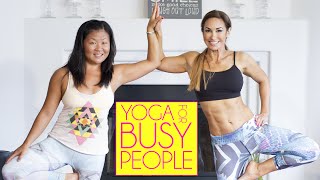
Natalie Jill and yoga instructor Kim Bauman demonstrate five yoga poses designed for people with no time. They cover stretches for flexibility and injury prevention, plus breathing techniques to add to your routine.
Hi, guys. Natalie, Jill here. Back on happy, healthy and fit. And this time we're doing yoga. Yoga for crazy busy people, for people that don't want to do yoga. All those people. So I have my friend Kim, Kim Bauman here. She's my yogi. She's amazing. And she's actually taught me to slow down and like yoga. Right, right. So what are the reasons that people should incorporate yoga? Because I know a lot of people do yoga and love it and have benefits, but then there's a lot of people like me who like to work out and they think it's just too slow. They don't have time, they're not into it. Let's talk about what are the benefits? Why should somebody incorporate yoga?
I mean, I would say there's probably three top benefits in my opinion. The first, most obvious one would be flexibility in terms of allowing you to be able to move a little freer when you're walking, when you're grabbing something that drops, and as well as if you're an athlete of any type, if you run or do a lot of hardcore workout, then yoga is just a really great pairing with that to give you more endurance, more flexibility when you're doing a harder exercise, as well as prevention of injury.
No, it's interesting because you taught me that it doesn't have to be the slow, boring type of yoga because I used to go to classes and I would actually get bored. I'd start looking at the time and I would get. And what Kim is so good at is showing how you can have that personality but still benefit from yoga. And she's got a few moves that you say if you are busy or if you do have that personality, if you just do these five moves. It's a great starting point for yoga.
Yes, exactly. But not only is it great in terms of a starting point as far as connecting to your body, but it also gives you a sense of peace of mind without even trying or knowing it. Over time, your head becomes a little bit quieter. Maybe your ability to run so quickly with your thoughts, it slows down a little bit and gives you space to breathe.
Yeah, and I definitely agree with that because that's what I found through my Force yoga, which I now do like I do, and I'm getting more flexible coming. So let's talk about those five moves because we went through these earlier. There's a lot of great yoga moves, but the five that I know have really changed me and have helped me a lot. The ones that I wanted to show today and that was child's pose. We're going to go through how to do that. Thread the needle and downward dog. Downward dog. A great one. Rag doll and runner's lunge.
Exactly. And these are some of Natalie's favorite poses that we do. So we're going to show you these today. Yeah.
All right, so let's get started. So first, one child's pose.
Child's pose. Yeah. Okay, so just starting towards the end of your mat, grab your two big toes together behind you and just divide your knees, only as wide as comfortable. So if this is too much of a stretch on your hips, you can always walk your knees closer together. And then just begin by softening at your shoulders and feel the weight of your body as you press down into the mat. Your shin bones, your elbows, and the tops of your palms just begin to connect to your breath. In yoga, we call the breath ujjayi, which means the breath of yoga.
And you told me an interesting fact about breathing in yoga. What was that about the. Actually, yoga started from breathing, right?
Yeah. So actually, you know, back in the day, when yoga was just yoga, and it's different than how we have it conceptualized today, but yoga was just the breath, so there were not a lot of postures. There weren't actually any postures. And then over time, postures have been added to yoga. And so today in our Western culture, we know yoga as more of a physical activity rather than meditation or just sitting still. And so here's where you arrive. The reason that I love this posture so much, and I'm sure that's probably why you chose this one as well, Natalie, is because it's such a grounding pose. And so connecting to your third eye center, which is that space between your two brow bones, closing your eyes and really sinking down towards the ground is such a great way to build a foundation and to quiet your mind, allowing yourself to be fully present and come into the moment. And so in yoga, we say stuff in the sense of connecting to the four corners of your mat, allowing yourself to stay in just this one single space. It's a big opportunity to slow your thoughts and to step away from your schedule and from your to do list. Another option in child's pose is to place your palms on these blocks if you have props. And what this is going to do is it's going to stretch open your shoulders even more. So you can see the elevation of her elbows and her shoulders, which allows for a deeper stretch along her side body and also her arms.
And I love this pose. Because I feel like it really stretches.
Out my back, too, with my lats, for sure. Yeah. All right. And now let's press up to tabletop pose. Place your palms underneath your shoulders. And this is prep for our next pose. Thread the needle, extend your right arm up and out to the side, and exhale. Weave your arm underneath your body. Land softly on the side of your face and your right shoulder, and continue to press your hip bones up and back. I'm just gonna adjust your arm out a little further, and then option to use your left palm to twist your body even deeper. Or you can extend your arm all the way up and overhead. Yeah, this is a big opening across the scapula that side. Shoulder the right side of her back here. And just make sure you relax your neck and your shoulders to gain the most benefit from stretching on the right side. And when you're ready to come out of this posture, push into your left palm, inhale, extend your right arm up and out, and exhale. Tabletop pose. Perfect. And now we'll do the other side. To balance the body out, take your left arm up and out and. And exhale. Guide your arm underneath you. Thread the needle. Good. And again on this side, you can use the right palm to adjust yourself. Just keeping in mind that our bodies are asymmetrical. So that means that how you feel on one side could be different from how you feel on the second side. So be willing to make those adjustments. Perfect. And now press into your right palm to guide your body up. Now tuck your toes and press back to downward facing dog Adho Mukha Svanasana. So Natalie's palms here are shoulder width apart. Spread your fingertips even wider and root down through all of your nail tips. So the heels of your hands, your knuckles, your fingertip pads are all pressing down firmly. Now strengthen your arms, your biceps and triceps a little bit more. But then soften your shoulders and feel your shoulders fall away from your neck. Perfect. Now grab your belly muscles in tighter, and it's your core strength that's going to elevate your hip bones up and back. Now, with Downward Facing Dog, you can play around with softly bending the knees to help flatten your back. So notice as you bend your knees, you're able to drop your chest closer to flatten your back or squeeze your legs straight. Both variations are correct. It just depends on the one that feels best for you today. And then heels actually never will. Really, it's not important that your heels touch the mat. It's just more important that you're energizing your heels down. Look ahead and step forward into ragdoll pose. Uttanasana. Distance your feet at least the width of your hips. Parallel your feet. And now tip the weight of your body forward into the ball mounds. Your heels will remain on the mat, but the pressure of your body is in the front of your feet. And what does this one do? Mostly, it's for your hamstrings. Yeah. So this is an amazing posture to stretch open your hamstrings. We often refer to this as the good morning hamstring stretch. So oftentimes, too, just understanding it, what you gain from yoga is that the more you realize that your body is entirely connected. And so oftentimes, if someone has lower back pain, it could be because their hamstrings are too tight. So rest your pinkies in opposite elbow crooks and just allow your head, neck, and shoulders to dangle. And what I'm doing here is I'm just pressing on your sacrum in order to help you continue to tip the weight forward. Good. And now release your hands down to the mat. And why don't you step towards the top of the mat, Natalie, and join your feet together to touch in a forward fold. Good. Place your palm to these blocks. I love using blocks. No matter how advanced you get in yoga, it's such a great tool to allow you to go deeper into each pose. Send your left leg high as you breathe in and drop to a low lunge. Left toes land at the end of the mat. Perfect. And now from here, we'll move into runner's lunge. Set your back knee down and tiptoe your right foot towards the upper right corner of your mat. Just make sure your ankle is out in front of your knee like it is. And then let's lower these blocks down and either forearms or hands to the block. And so this posture is really good for opening up your inner legs and your hip. You just want to stay on the top of your left knee and point your foot straight back for an added opening. You can even come onto the knife edge of your front foot. And now press up to your hands, and let's move into downward facing dog again. And we'll get into the second side.
Now, why is it that everyone always goes back in their downward dog in between every move?
That's a great question. Downward facing dog is simply a reset posture. We kind of refer to it as home base in our yoga practice. It's the one posture where you can always kind of rest there if you're not Feeling like moving forward with whatever the rest of the class is doing, but it really allows you to continue to build your foundation into ground, into your space. So that's why we move back to down dog. Yeah. And now just walk to the top of your mat again and lift your right leg high and step back to a low lunge. So this is just one way to get into the posture. Come down to your back knee and tiptoe your front foot up and away. And I'll set these blocks here again for you. And you can either stay in your hands or come down to your forearms. This is another example of where your body is asymmetrical. So keeping in mind that we're typically tighter on one side than the other. And if you just make sure to make those adjustments. There you go. Make sure to make those adjustments with each side. All right, let's place your hands to the mat, Step your left foot back, and move into downward facing dog. All right, you can drop down to your knees. And so that's just only about five postures.
No, it takes no time.
No time at all.
So hopefully you guys did them with me and didn't just watch it, but if they're personality like me, they probably just watch. Watched it initially.
Yeah.
But they're awesome. And I will tell you that doing them repetitively now, I'm not a very flexible person, but it has definitely improved that. So it's awesome. And it does help you clear your mind. I used to think, I don't want to do yoga. I don't want to shut my mind off. And now I actually enjoy doing it. So thank you for that.
Thank you.
So where can they find you? Where can they learn more about you and what you teach? What's your website? Your direct website?
So. So my website is called jointheonelovemovement.org and on Instagram, it's. Hey, I'll put that information down below for you.
Yeah, thanks, guys.
Thank you.










