The Importance of ARV
After Repair Value, or ARV, is what a property will be worth after renovations. Real estate investors use it to decide if a deal makes money, calculating it by comparing similar homes in the area and adjusting for the improvements they plan to make.
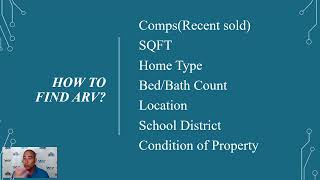
Foreign. Okay, finding your arv A very, very highly sought after question. And it's a subjective question, right? In in all honesty, your ARV can be determined in so many ways and seen in so many different variables are light. So let's go back to the fundamentals. What is an arv? Back when I first started, I mean, I laugh now because it's something that we talk about consistently in meetup groups and in multiple platforms. In ARV is what seems to be common language. But when I first started, I didn't know what it was. I just thought it was some cool like variation of an rv. But when I looked into it further, I realized, man, this is something I need to understand. And it stands for after repair value. So for those of you who don't know what ARV is, that's what it is. After repair value. And to emphasize the after is the important part. When I first started investing, since I didn't know what ARV was, and even after I slightly understood what ARV meant, I got confused on how to figure it out, which we'll get further into. Throughout the presentation, however, the ARV is again post rehab or repair. In the beginning I thought ARV was what's the property worth? And it really changed my perspective on analyzing the deal. So if I were to use an example, when I first started looking with not knowing too much about ARV, say I was looking at a $50,000 acquisition of a property in its current state and I ran 25k in rehab, if I ran it as is value instead of ARV or after what it could be worth when I'm done rehabbing it and I was running at 50, it made the deal not worth it. But as I grew more experienced and understood what ARV was, how to find it, how to calculate it. Well, if this 50k property that I'm looking to buy with 25k in for rehab is worth 100k, all of a sudden, this works perfectly for our burst strategy. It's pretty crucial to know that crucial next point. Why is it important? It changes and alters in your numbers and calculations. So those of you in the group, some of you are very new. Maybe you haven't gotten some of the tools that we utilize to analyze deals, but when you do, this will all make sense. Knowing your ARV is important because one of the tools requires you to input it to then give you a suggested offer price based off of the calculations you found for the rehab, the rehab calculator, and if your subjective ARV or your perspective of an ARV is different from say mine. Even though we might be running the same rehab number, we could be drastically off. Back to my original example, right? So if we're looking at a $50,000 acquisition with a 25k rehab, if I'm running an ARV after repair value on this subject property at a hundred and you're running it at maybe 90, we potentially could be 10 grand off on our offer price between the two of us and that changes the results, right? Vice versa, if you're aggressive and on your ARV side because of your subjective view on it and you believe it's 110 and I believe it's 150k purchase, 25 all in on rehab, you potentially can offer 10 grand more than me and take the deal away. So understand the importance of being okay with it. We got to work within ranges, right? Everything we do is within ranges. So knowing your range is crucial with the arbitrary how to find it million dollar question. And this is what leads to your subjective analysis of ARV. So back to my case study of 50k purchase price with the assumption of 25k rehab potentially worth a hundred. Well, how did I get the hundred? Well, I utilize some of these tips, right? The simplest is to pull comps, right? You're dealing with an agent most of the time, they should be able to produce that, no problem of recent sold. However, one thing I found over the many years of doing this is that even agents have a subjective view of subject property that could vary from you and your comfort and confidence level and using that as a valid comp. An example of this was one property that I was looking to acquire. It was sub meaning less than 1,000 square foot. It was like 912 square foot for 3, 2. The agent that I was working with on the said property sent me comps because I was, I was a little baffled as tiny three two house wasn't confident that anything was going to appraise near what I needed to for it to work. Excuse me. And they sent me back comps with four twos at 1500 square feet. If you're not paying attention to the detail or the like kind of subject property, that could also vary and alter your assumption of arv, which could lead to inaccurate ARV numbers, right? So in that case, property was extra bedroom, roughly 6, 700 square feet larger than my current subject property. That all matters, right? Home type. Is this a split level? Is this a single story? Does it have a basement? Is it a crawl space or is it a slab? Certain areas like school districts and locations. You got split levels where the home enters at the mid and goes up or down and it's considered a split level. Garages? Do we have garages? Are you on a main street? Young just did a presentation the other day of lesson learned on one of his case studies. On his first burp he bought a property right off of a main thorough road and it affected his ARV just a little. It actually affected more of the rental performance side than that. But that's a whole nother presentation. A bed, bath count. My example is a 3:2 property sub 1000. However, the agent produced four twos which doesn't quite add up. It's a little bit larger in both square footage and bath count. So being very aware of this and in the ship we look to train you to find these things in multiple ways. Here are some of the ways you can do it right. First and easiest is agent. Most of you will be working with an agent at some point, if not throughout the entire mentorship. They're a tool, they're a great resource, someone to leverage. Not only do they have the ability to access mls, they have area knowledge, experience and they probably sold property or at least put in offers on property around the area. They can give you feedback. Your second option is all these online platforms. Zillow, Trudio, Redfin. I'd say take as much information from each of these points and filter through. It's like how I was sharing in the beginning ARV subjective. The more information you have, the easier it is for you to dwindle and or knock off things that don't meet your criteria. So I'm looking at 32900 square feet but you're sending me four twos at 15, 16, 1700 square feet but those are easily dismissed. Now I'm looking for something along the square footage. So similar with I have a basement. These properties don't. Right. We can then funnel it down to an average. Personally I like to run with about 5. 5 is my minimum of comps or ARV was that can give me a distinct range or number that I can use as a potential and then filter from that. I make an average from that. You can also pay to have a membership to platforms. I know. I think Jen, if if not, if I'm not mistaken he has access to something similar to MLS that can produce what it sold for recorded at. Right. Investors are a very good tool, especially flippers. Right. What are you running your numbers at as a brrrr investor we might not necessarily be looking to get that flip arv. But if we know their target market or their target list price it could be a solid comp when we come around on the refi side. So it's very important to to grab and gather as much information in a short period of time to get to your arv. One thing I want to encourage you guys is not to spend too much time on looking for the perfect arv. Back to what I say all the time margins and ranges. All we're looking for is to be okay with it showing up around here and here. Anything in between. Sweet deal. Anything over icing on the cake. Anything less. Great opportunity to learn how to better run my numbers next time. You cannot fail. You can only learn and grow. Right? That's one of those things you got to accept. We do not control what happens on the ARB side. Our job is to calculate and best formulate what we forecast it to be.