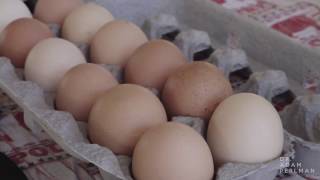
A short conversational YouTube segment filmed at a farmer's market where a shopper, confused by many supermarket egg labels (cage-free, free-range, organic, omega-3, vegetarian-fed), speaks with a farmer. The farmer explains that omega-3 enrichment is typically achieved by feed (canola or flaxseed), free-range only guarantees access to outdoors, and pastured eggs (hens rotated on fresh grass) are more humane and—per a 2010 study—may contain more vitamin E and omega-3s. The farmer describes moving hens to new 3,000 ft² pasture plots four times and keeping them outside year-round; the clip ends with the shopper choosing to buy pastured eggs from the market.
Questions this video answers
2010
3,000 square feet
24/7/365 (year-round)
So we're here at the farmer's market. We came in search of pastured eggs because the other day I was in the supermarket and I realized there's like 10 different choices. It's cage free, it's free range, it's organic, it's regular eggs, it's omega 3, vegetarian fed, vegetarian fed. And so I did a little bit of research because I was totally confused. And it turns out Omega 3 supplemented is probably better than reg. Cage free. Yeah, that's good. But it could mean they're just living in a large hen house. Free range is probably a little bit better, but it just means they need access, and it doesn't mean they were necessarily out in the pasture or in the range most of the time. And pastured eggs are really the most humane for the chickens. And also there was a study in 2010 that showed they actually had a little more nutrients, more vitamin E, and perhaps even more importantly, more Omega 3s. They're also a little more expensive. But you know what? We're gonna make that sacrifice today and get some good eggs for our family. So let's see what we can find. I was at the supermarket the other day, and I'm like, looking, and there's like six, seven different choices of kinds of eggs. I mean, and I was like, what do I want to get? What do I want to buy for the family? Can you tell us about that and how you sort of raise the chickens and get the eggs?
Yeah, absolutely. We rotate them outside on pasture. At my farm, we move them four times a brand new 3,000 square feet of fresh green grass. They are outside 24, 7, 365. Absorbing that sunshine and increasing your vitamin D content, especially in your egg. And I think the thing that's confusing about the grocery store is that these labels make all kinds of clams. Like you mentioned, the omega 3. The biggest way that they boost omega 3 levels in eggs is by feeding canola.
Oh, no kidding. Yeah, I heard flaxseed.
And I think the best way to get to a good quality food for you is to talk to the person that grew it.
Right.
Otherwise, you're just trusting words or a picture on a package that doesn't tell the whole story.
For a couple more dollars, I'm getting a much better egg. And that's gonna. I mean, that's four or five breakfasts for the kids and us. And so.
And if you break it down like, we're always concentrated on price per dozen, but if you break it down by the ounce, it's the cheapest, healthy protein for your family. You know, you look at other proteins like beef or chicken, and exponentially, as the quality goes up. With eggs, it's just a couple dollars.
So I still think it's great to come to the farmer's market, support the local farmers and get some healthier eggs. Right. I mean, I think that's. That's a great thing.