Dr. Adam Perlman and his wife Larisse present a short, conversational guide to improving sleep ("sleep well strategy"). They frame poor sleep as a common public-health problem (citing an estimated 50–70 million people with sleep disorders) that increases risk for heart disease, diabetes, obesity, anxiety, depression and substance use, and then offer practical, household-level strategies: consistent 7–8 hour schedules, dark/cool/decluttered bedroom (authors prefer ~67–68°F), calming pre-bed routines (mindfulness; avoid stimulating media), dim night lights for restroom use, and short naps (≤20–30 minutes). Emphasis is on experimenting to find what works and coordinating routines within a shared bedroom.
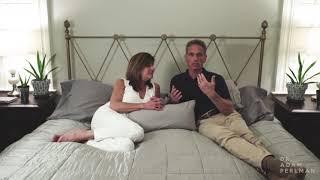
Hi, I'm Dr. Adam Perlman here with my wife Larisse. We are in our bedroom and perhaps not surprisingly, we're here because we want to talk about sleep. I think we could talk about a lot of epidemics in this country. Heart disease, obesity, a number of things. Sleep has really become one of our newer epidemics. I mean, it's estimated that 50 to 70 million people have some type of a sleep disorder. They may have trouble falling asleep, they may have trouble staying asleep, they may have excessive somnolence or sleepiness during the day, or they may find that they're doing strange things in bed at night, like kicking their legs a lot or developing restless leg syndrome. When you look at the science of sleep and you look at what poor sleep does to our risk of chronic diseases, you really want to try to do what you can to get a good night's rest. Because not getting enough sleep increase your risk of heart disease, of diabetes, of obesity, even things like anxiety, depression and excessive alcohol use. This has become a 30, 40 billion dollar a year industry in this country. All kinds of gadgets are coming onto the market. Different sprays you can spray on your pillow, sound machines you can put by your bed, different apps you can use, you can experiment and see what works best for you. We started our journey to getting better sleep with looking at all the different recommendations out there and trying to figure out what worked best for us. We call this sort of our sleep well strategy. And Larisa and I had to team up on this since we both share this space. Yes, we're trying to get seven to eight hours of sleep. We're trying to go to bed and wake up around the same time. But also within that, assessing how we're feeling constantly as we sort of adjusted our routines and adjusted our environment. And the environment's another big part of it, you know, making sure that our room is dark. The other thing is the temperature. That can be really important. Making sure that a room is cool enough, I think for us around 67, 68 degrees.
One of the things that both of us feel strongly about is we don't like a lot of clutter. If the room feels chaotic when we walk in because there's stuff all over the place, then that's not a settling feeling for either one of us.
You know, we have a pre bed sort of routine. You know, I know if I watch some action packed movie right before bed, you know, that kind of gets my adrenaline going and I'm going to have more difficulty falling asleep sometimes that's a time where I'll practice some mindfulness. I find that to be helpful. The other thing is, I still wake up occasionally in the middle of the night. And we actually have some night lights set up so that I don't have to turn a bright light on if I want to go use the restroom. That bright light can sort of tell the brain, oh, maybe the sun is up and it's time to wake up. And we'll keep the lights relatively dim. I don't want to walk into a wall. So we use night lights. Simple things that we can do to keep the environment more conducive to sleep. So one of the things I get asked about is, what about taking a nap? If people are able to have a nap. And that can be very effective and a nice way to rejuvenate. No longer than 20 or 30 minutes at the very most, because you then get into deeper levels of sleep so you could wake up and feel much more groggy. It's all about finding the way to live your best life, right? You want to be energized, you want to be able to do the things throughout the day, be focused. If you're at work, you want to be productive. And sleep is such a key component to this. Get your sleep down and have your right sleep environment, sleep hygiene, sleep routine, sleep strategy, sleep well strategy, and find really what works best for you.