From Impossible To Inevitable with Aaron Ross
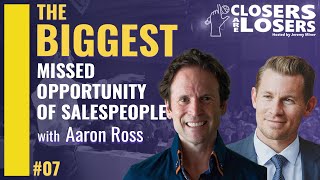
Aaron Ross built Salesforce's outbound prospecting system that nearly doubled the company's growth. He explains why most salespeople shouldn't prospect themselves, outlines a four-role specialization model, and stresses the importance of nailing a niche and personalizing cold outreach to build a predictable revenue engine.
Chapters
was the most common reason companies struggle to grow was that they weren't ready to grow. Created the outbound system and team that did all the prospecting for Salesforce, and that almost doubled their growth.
Buyers today don't want to be talked at and sold. They want to be asked, and they want to be listened to and understood. Well, yeah, the best salespeople are the salespeople who actually listen to what the prospect means, not just what they say.
Most salespeople shouldn't prospect.
I think the biggest missed opportunity in, in making sales, one of them is on[No speech] All right, so I wanna ask all of you this question, and I want you to think about it. Whether you're driving down the road to your next sales appointment, whether you're about to pick up the phone in your office to call a lead, or you're about to go into an important meeting with maybe other people in your company, have you ever wondered what it takes to be the best business owner, the best CEO, or the top salesperson in your company, in your industry, the ones who get all the respect, the ones who make all the money, the ones who get promoted anything they want to get promoted about? My next guest, Aaron Ross, is going to answer that question for you. And let me give you a small taste of his background. You see, Aaron is the co-author of a great book called From Impossible to Inevitable with Jason Lemkin, and a book called Predictable Revenue. And it's called the sales Bible of Silicon Valley. I'm going to want to know more about what that means, about sales systems that help companies like salesforce.com, which we're going to get that into the interview. I probably can't pronounce this word, Twilio. I think I've heard of that. And is it Zora? Like I said, I'm from, my mom says we're from Arkansas. We don't know how to pronounce names. And other companies, a lot of other companies that's on your website that have created billions a year in revenue. That's B with a billion there. He's also married with 9 children, half through adoption. I'm not sure he did the 4.5 thing. We're going to find out. And he lives, he just moved to Edinburgh in the UK, Scotland, and he's the co-CEO of predictablerevenue.com and a global keynote speaker. Aaron, excited to have you on here today. I was on your website this past week learning more about you. And I love, here's what I love doing. I love talking with experts in the art of using human behavior in sales, sales systems, sales processes and how that applies to being at the very top of your game as an organization, as a company, as a management group, whatever you are. So I'm excited to have you on here. And I want to do this. I want to dive right in your story and give our listeners a feel for your background and how you arrived at this point where you're one of these elite authorities on sales and sales process and system. And heck, you're the guy who created a sales team structure that exploded Salesforce's revenues. You're like the OG.
Whoever grows up thinking they're going to be a salesperson or sales author or sales thought leader. So I stumbled into sales. You know, the shortest version, I did like programming in school and civil engineering in college and investment banking after that, and then some product stuff and ultimately started a company. And I think the sales story really started when my company failed. And this was raising, we raised like $5 million back, you know, in '99, 2000. And one of the reasons the company failed, the company was called Lease Exchange, which actually survives a bit now as elease.com. My old partner runs it out of Florida. But raised $5 million and went down the tubes because I, and I was CEO, I think every entrepreneur can sell, has a talent for selling, enthusiasm, and passion, but that's different from having like a system and knowing how to build and manage a sales team and creating predictable revenue. So that failure was the first time I was really like, wow, you know, if I want to start a company, be CEO, or whatever my career aspirations are, I need to really know how to sell, how to build a sales process sales team. And so that led me to go to salesforce.com. Now sales at the time, well, and the only job they had was the most junior job answering basically like the 800 line.
Really? So how old were you? You got hired by salesforce.com. So this is how it started. You actually got hired by them.
Yeah, it was probably about 30 and it was 2002. So maybe 30, 31.
Okay.
Went from being CEO, and then there was a break between the company failure. I took a break and did some other random stuff, but ultimately the first work was looking to do sales. The best way to learn something is to do it. You could read the sales books, which is great, but you gotta sell to learn how to sell. Sales job. I went from being the internet CEO, whatever that was worth, by the way, to this, they call it sales rep. Basically it was, at the time, $45,000, basically compensation. Lowest rung on the ladder, but you know, I just wanted to learn. So to me, I was like, I'm gonna get paid to learn how to be in the trenches in sales and how to respond to these website leads and 800 number. And I think, so one of the keys was being willing to get my hands dirty and get into the trenches to learn from the ground up how something worked. Yeah, and not having— not being too good for it. Um, now I didn't have a family to take care of back then, so I couldn't— it was easy to make that choice.
You know, it's, it's striking because you had your own company, you're the CEO, that doesn't go so well, and then you start this junior position at a company. Hey, that's, that's pretty humbling sometimes for somebody who is running their own thing, whether it worked or not, and then you're going in to like basically start over and almost humble yourself. How did you go from that junior position to helping them make hundreds of millions of dollars a year? Like, what did you create at Salesforce? Can you tell us more about that work with them?
Yeah, well, part of the mindset was, um, going into it knowing, okay, I'm going to start another company. Yeah, at some point. So Salesforce to me was a, like, uh, an MBA, right, in sailing, right? I'm gonna go there and get paid to learn because jobs, amazing way to get paid to learn if you look at it that way. Yeah. So I'll get there, whatever the job is, I'll start, I'll learn, and then I'll find some opportunities once I'm there to make a difference. Now, I would say that I didn't— I wasn't born with that mindset. And I remember there's definitely a flip when I was mid-20s, 27, I don't remember exactly, when I was applying to business school.
Sure.
And the question was, what do you want to do with your life? I'd never really thought about it. And I thought, wow, you know, I should want to be an entrepreneur. But part of that was then thinking about, it's not, will I start a company? It's when I start one. It's not, will it work? It's like, it's when, not if. So that really kind of opened my eyes to opportunities and going into Salesforce, like, okay, I'll find something here. I don't know exactly where, when, but I will. And within 3 months or so, I'd, you know, one of the, again, great thing I did, I would give advice to anyone. I went and when I started, I went and talked to and met people all across the company.
Sure.
I went and sat in with customer support, engineers. I went and reached out to like the president. I, with field salespeople, right, and marketing. I just kind of a variety of people there. And I wanted just to get a better sense of how the company worked, but it also gave me The starting point of, hmm, are there different problems there to be solved? How does the company work? What's working, not working? That was what led to, okay, I saw that Salesforce was making this classic mistake of hiring a lot of senior, like, you know, quarter million dollar a year field salespeople and expecting them to bring into their Rolodexes a whole bunch of big name clients, which wasn't working. They were getting nothing. So that identifying that problem, pipeline problem.
So you found the problem and then what did you do? Like, how did you build that sales system out to really get them to the level they are now?
Yeah. Well, the next step. So first I was in the trenches. I kind of proved myself for a few months and then found a problem, right? Cause, and then got support from executive, this VP I was working for who got Mark Benioff. So there was only 150 people at the time, about like a $20, $25 million company.
Sure.
Now Salesforce is $15 billion and 50,000 people, some crazy ridiculous, I don't even know. Sure. So I got executive support to say, hey, this problem is real and this person can take a stab at it. And luckily they actually agreed to something like 3 months of time. Okay. Like, it's really rare. Yeah. Because it took me 3 or 4 months to really kind of crack the system of experimenting with sitting down at a desk. My whole thing was I saw people, doing prospecting. And they weren't doing it very effectively. It was kind of scattered, it was very scattershot. And I'm like, I don't know how to do it, but I can do better than what's going on.
Yeah, when you say it was scattershot, tell us what you meant. Like, how was it scattershot? What were they doing?
Well, again, the salespeople, even the expensive ones, were prospecting kind of here and there, and they weren't very good at it. Even I could see that. And there's no heart in it. And then there's some junior people who've been put on it. They did really well with kind of like junior lead response. They're like, hey, the promotion was, hey, call a bunch of leads. And they were just kind of calling a bunch of random old leads. There wasn't, even I could tell there wasn't like a focused approach.
There was no system, no process.
There wasn't a system. People just flailing around. There was just a feeling. I could just, I didn't know if I could put into words. I remember the feeling of people just flailing around. Yeah, you know, if I really like— I think I can figure something out here. I know I could figure something out that's better than what they're doing.
Sure.
And I didn't know what that would look like. I didn't know. So that was another step, was knowing there's a problem here. I know there's something better. I don't know what it is. I'm willing to take a shot. Right. Then I read a bunch of sales books. Vito.
Okay.
I don't even remember, right? And I tried a bunch of those from the books, right? Veto letters and this and that, and mailing books, and nothing worked. And so at some point after, I don't know if it's like a couple months or 3 months, I just kind of threw all those away. I'm like, all right, I just sat down and I just tried to come up with ideas, I guess. I don't remember exactly how that worked. I do remember distinctly this one point where this impression that, wow, you know, mass emailing Fortune 500 executives, like that wouldn't work. Sure. Not personal. Yeah. Yeah, like not— and then I actually mass emailed a bunch of Fortune 500 executives and I remember sending 2 emails. One was more like a classic pain email that people would write, which is, do you suffer from pipeline issues and forecasting? And I wrote a separate email, which was kind of related to this problem I've been having. Yeah. And looking back, I was like, it's calling these big companies and it's just such a pain in the ass to go find the right person. Like that was the hardest problem with these bigger companies.
Navigating that, right?
Navigating them, just finding the right person is such a— and I just wrote a simple email. It was basically, hey John, I'm not sure who to talk to there. Could you point me towards the person who manages sales?
Sure.
It was a little longer than that. Yeah. And that, you know, the pain email with all these like the bullet points of problems got zero responses out of 100. I sent a mass email. Of 100 and then another mass of the other one. And I got a whole bunch of 10 out of 100 responses from the simple referral. And that kind of like started me on like systematizing it because that was a good breakthrough. So there wasn't like, that was one breakthrough. And I think, I would think more important is kind of willing to first learn from a bunch of other people, but then if it's not working to kind of put all that aside and just sit down and just come up with my own own ideas. Yeah.
So you don't notice, you don't just follow the crowd. You're actually coming up because a lot of times you follow the crowd. That's where you get killed because it doesn't necessarily work just because everybody's doing it.
Yeah. It's just copycat success, which sometimes works. But then when you, if it works too well, everyone, you sound the same, then you don't stand out. So it stops working. Yeah.
You become commoditized in their mind, right? You, you look like you're just a salesperson, just another salesperson of the hundreds of emails they get from other salespeople. Trying to stuff their solution down their throat. So you become commoditized in their mind. That leads me to my next question. What do you feel is one of the biggest reasons— like, what is one of the biggest things that business owners and entrepreneurs get wrong about sales?
Well, at least give you one thing they get wrong about marketing, because I think— let me just build on this, this email idea. And like, whoever you are, yeah, one of the things that doesn't happen enough is putting your own style and personality into the messages you write. Could be LinkedIn, email, I don't know about texting, but especially like email, LinkedIn. Now whether this is with a prospect, cold, you know, proposal, so much, so many of these emails and documents or whatever you want to create is just so, it's not boring, it's just flat. Just the analysis shows that the data, da da da da da, is just so uninteresting. And people are so afraid to put themselves into their personal, whether it's like, it could be, and there's a million ways to do it, a picture of yourself or a funny emoji or a style or the greeting you do it or a video. There's a lot of ways to do it. And so going back to anyone, the way you write emails or you're on LinkedIn, just people don't put themselves into it. And for business owners, I think the biggest missed opportunity in making sales, one of them is on the front end in lead generation and marketing where it's just, why aren't business owners putting themselves personally out there? Because most don't.
Why is that? Why do you think they don't put themselves out there?
I think primarily they don't realize the impact, like the hugely positive impact that it can make. They think like, why not have Sally do it? Or maybe we'll just, they don't realize the incredible benefits of putting a person and the founder or the C-level out there on the website, in the video, in the newsletter. That's one. The other one is everything like, I'm busy, what would I say? I don't know, like public, you know, think about public speaking. How many people are comfortable public speaking? Right. So I get that. I mean, my, when I was, you know, in my early 20s, the feedback I got from, you know, I remember this investment banking job was, you know, oral skills, like speaking was my main challenge. Like I didn't speak much and I was an introvert. And so with practice, I think if you realize how important this can be, sure, in putting yourself and your people, so leading the example, like putting yourself and helping people put themselves or personality into everything you do.
Yeah, you hit it right on the head. You're authentic, right? So you're a real person. And I, you know, even in marketing, you know, we've noticed our own company the last couple years, there's been a major shift from like production filmed ads that sound canned, their conversion compared to me just picking up a phone with like a couple of questions and redirecting them converts 10 times higher because it's more real. It doesn't feel canned. And I think email's the same way. You know, one thing that we do with our clients and my sales organization is we teach them how to really lower the amount of words they use in emails because typically when people email out, it's like, Oh, we're a solution-based cloud services that does X, Y, Z, and it's like 7 paragraphs long. And how many CEOs or C-level executives are even going to read a paragraph of that? They're going to look at it, read the first sentence, another salesman trying to sell me something, delete. So we teach them how to lower that to like a couple, 1 or 2 sentences that focus on how what you do helps other companies solve problems. That get them curious where they want to respond. That type of email is like a 20-fold response rate compared to the 6-paragraph, we've got the best this, we've got the best that email. Completely different results.
I mean, I think anyone who's not following your advice is missing a huge opportunity.
Sure.
So like, for example, most cold emails are under, you know, like 300 to 500 characters. Yeah. So it's like one, like I said, a couple sentences. Yeah. Fits on a phone.
Yeah, 100%.
I think so. That's— and one of the— so going back to adding personality, so one of the simple techniques you can do is to pretend that you're talking to someone at a cafe. Yeah. And then write that down, or, you know, talk out loud and write that down.
Sure.
I know my wife does that. She's a playwright, and when she's really stuck, we'll talk about it, and then she usually sounds much— when she's talking, she sounds much better than when she's trying to write.
You're conversational.
Yeah, write that down. So that's one way to do it, but again, video, pictures, style. I know when I, my emails, I write all lowercase. It's just like a quirk. Everyone's got their quirks. So that's the, that's the one of the biggest missed opportunities for owners to know about in terms of sales, including that's on the lead gen front primarily, and but still in the sales process as well.
Yeah, and it's important, and I want to talk about this for our listeners. I want to give you a key tip. So Let's say that you've had a conversation, it went well. Let's say that you booked another appointment for a demo or whatever with that prospect, whatever you sell, it doesn't matter what industry or product you sell. And you call them, they, they miss the appointment. And let's say another day later you call them, they don't respond. You email them, they don't respond. That last email should be very basic. Okay. Hey, John, tried to reach you a few times, but did not hear back. ... How did you want to proceed from here? That little email will get so many people respond like, oh, oh, I'm so, I'm so sorry. I'm so, I'm still very interested. I just, you know, we had some medical emergencies. Can I book tomorrow? Just that little email. Hey, John, tried to reach out to you a few times, didn't hear back... How did you want to proceed from here? That type of email, completely different response rate than like, oh, well, when we talked, we talked about this and this and this and 7 pages later, that's just going to get you
nowhere. 100%. Yeah. There's, well, actually, so there's, that's the whole conversation around like amounts of attention, but I realized the, actually the number one, it's still the number one challenge and things, the missed opportunity in sales. And this is primarily for B2B sales. I know I'm sure there's a variety of people listening, but for companies that have B2B salespeople and not so much like super— as the deal sizes get a little bigger, like a few thousand dollars a year, I end up— sure, sales specialization is the— if you don't do that, and I can explain what it is, that is the number one thing that makes everything easier. Yeah. So sales— but like, think about it, like most salespeople shouldn't
prospect. Yeah, I wanted— I was going to ask you that question. You say in your book that salespeople shouldn't prospect. What do you mean by
that? Well, think about any sports team. Yeah. Not even a winning sports team, but okay. Any winning sports team. There's no coach in the world who would tell, go out and take the team, whether you like basketball, hockey, say, okay, everybody, I want everyone to go attack and then everybody defend. Right. And everyone like be goalie too. Like that would be insane. Sure. But why do we do that in sales? I want everybody to prospect and then everybody close, and then, well, first, a lot of people, they also have them manage customers, and for some of them, oh, also respond to your website leads. Yeah, no, it's crazy. So what happens is salespeople can't, they can't, no one can do it all well, or maybe 1 out of 20 people, 15, 10, you can't, you can't do it all well. No, it's, and by the way, it's just, it's humanly impossible to juggle it all well. Again, like any— there's no sports team that would do that because it doesn't work. It's just, it's out of habit we do
that. Yeah, right. It's kind of ingrained. What would you suggest
instead? So the way is to again, follow the sports team. You've got attackers, midfield, defenders, whatever, pick your sport. But in this case, in focus on B2B, so the principle is focus. Now you might apply this a bit differently based on your business, but in a lot of business-to-business The 4 core roles. One is dedicated outbound prospectors. Used to be called telesales. I mean, there's so many names, whatever. Their job is to find and book meetings, quality meetings with people who don't know you. That's it. By the way, they're not responding to inbound leads, they're not closing deals. That's one. The second job is if you have marketing-generated leads, become lead development rep or lead response, but they're just responding to all those marketing leads and their job is, it's kind of inbound, often called the inbound SDR. The prospectors are often called outbound SDRs, sales development reps. Then the third role, uh, salespeople, closers, account executives, their job is to sign new customers, right? And the fourth is customer success or account management, which is once a customer signs up, Yeah, it's basically anything after the sale. There could be a lot of different roles there, renewals
and— So it's basically built like a football team, right? You've got the— you've got the offense, you've got the defense, you've got the special teams, you've got the kicking unit,
right? Okay, so it's like a well-oiled machine. A team of specialists who all work together in coordination, and it's a lot easier than ever with all the technology, although technology itself, you know, there's, there's so much. So again, those are the 4 core roles. You may not have inbound leads, so you don't need So maybe you have 3. If you have, if you sell small businesses, maybe you have, it's the salespeople who are doing the prospect, whatever, the lead gen side plus selling, but then you pass it off to customer maintenance. So the way, the principle is focus. It's having more types of jobs so people can be better at doing fewer things. And it
works. It works on their
skillset. Huge
difference. They're focused on their skillset. So it's like the whole team effort. I agree with you 100%. What do you think leaders get right and wrong? About outbound prospecting? I know you're big on that. What did they get right and wrong about
outbound? Yeah, well, outbound prospecting, you know, that's— so I go back to Salesforce. I created the outbound system and team that did all the prospecting for Salesforce, and that almost doubled their growth, right? So then there are a lot of things people get wrong with it. It's, uh, I think one of them is then you expect people can prospect part-time and do it well. It's just, no. It happens, but so people win the lottery too. If you really want results. The other thing is that predictable, basically the lever of most companies' growth is not the number of salespeople you have, it's having a predictable lead generation system. So that can come from market, there's a lot of ways you can do that. Prospecting and outbound can be very predictable, but people underestimate how long it takes to build a quality system and team. It could be, you know, say you say, hey, this is great. Let's read Predictable Revenue, the book. I got this. I got someone. Okay, man. 30 days, 60 days. Think more like 6 to 12 months. And I think so executives underestimate the amount of like focus and time and patience it needs. But when it works, I mean, it's just something that can power. So you mentioned things like Zora. Zora is a $200 million revenue SaaS company, a billion or two in valuation. 60% of their new business comes from outbound prospecting. So, I mean, there's a company called BrightEdge that now, I don't know, but when we started with them, They went from $1 million in revenue to $20 million in 3 years, 90% based on outbound prospecting. And then they said, okay, we got that. Let's now focus on our inbound system. Because they wanted to be balanced. They wanted to have like half of their revenue sourced by inbound marketing, half by outbound. But you can't do both. It's really hard to do significant investments at the same time. So they kind of picked their battles, they did one then the other. Sure. So just the huge benefits, but it also takes like focus. It takes a lot of time, patience, iteration, and the right person to lead
that. Right person leading. It takes a lot of testing too. What do you— that leads me to the next question. What do you feel are a few of the biggest mistakes that companies make when training their salespeople how to actually
sell? Not having a training program. Okay, that's not having, not having an onboarding program or much of one. I think assuming that training has happened, like we did the training, so that's that it happened, that people were trained. It just, it takes so much repetition. And by this hard, I mean, even in my own company, we have 55 people and training, you know, it's a, it's something you just have to do
endlessly. Yeah. It's a motto in our company. Is training something you did or is training something that you do? Right. One of my mentors taught me that,
right. Said that better than
me. Yeah, exactly. Like, is training something you did or is it something you do? Like, if you're a top athlete that goes into the NBA, do they just train their rookie season and, oh, I'm good, I don't need to shoot more, I can make every shot? No, they have to continually train. Tiger Woods, when he was the greatest golfer on planet Earth, you know, 10 years ago before the injuries, he still has a hitting coach. He has a hitting instructor and he's like the best golfer there is. He knows that for him to keep his edge on everybody else, he has to continually train. And I, I see so many salespeople out there, you know, the average— I read this in Forbes the other day— the average salesperson in North America spends south of less than $100 a year on actual sales training. And is it even the right sales training? You know, one of, one of our largest clients is Google AdWords. We train 4 of their, uh, 4 of their divisions. They've got a lot of divisions, but trained for their divisions. And when I came into their offices, they said, we've got a great training program. But when you pulled back the curtain, it was all about product. What does the product do? How does it work? The features, the benefits. And their salespeople, when they get on the phone, would just use the brand recognition because everybody knows that company. But they thought that they could say, hey, I'm with, you know, Google, and then everybody was just going to buy money. You know, send me money. But they found out that that wasn't— and they were doing a lot of cold calling for this new, uh, this new, um, service they had, which was basically setting up ads for like business contractors, plumbers, electricians, like getting them leads to actually call on. It was a great service and it solved a problem that most people running those businesses have. They don't have enough leads. But because they thought they were Google and they just cold called, that people would just want to do it. So they didn't realize that people have problems, right? So people have problems, you have a solution that can solve those. And we talk a lot about in our company about there's 3 errors of sales training. And a lot of companies are still in like error 1 and error 2. Error 1 is more boiler room selling. And I hate to say this, I can't believe companies are still teaching this, especially in more of a complex sale where it's more of the Wolf on Wall Street, Manipulate them, posture them, push them into doing something that you want them to do. The ABCs of closing, right? You know, it's, hey, we've got a great opportunity for you. Companies, major companies are still training salespeople how to sell that way in some aspects. Then you have era 2 that came out probably in the late '80s, early '90s, where it's more of a consultative selling, right? They taught us how to ask questions that would find out the needs about the client. You know, logical-based questions like, John, can you tell us what keeps you awake at night? You know, the standard consultative question, you know, but here's the problem. When you only ask logical-based questions to a prospect, what type of answers are they going to give you? Logical-based answers. And do people buy on logic or emotion? Of course, emotion, right? They
only— they buy on logic, but it's all
emotion. It's all emotion. Yeah, brain studies even prove that. Then there's error 3 where you're more persuasive when you allow others to persuade themselves. We call that dialogue when you ask what are called neuro-emotional persuasion questions. Now, the question is, how do you get somebody to do that? Can you just show up and say, hey, you know, go ahead and persuade yourself and here's our bank wire information to wire to get the
deal?
No. You have to learn specific structured step-by-step questions that get that person to become open to want to engage with you because they feel like you can help them. And then they persuade themselves that it's their idea and you're just that facilitator, right? There's no really closing at the very end. They're basically closing themselves to move forward. There's a couple of questions you're going to ask to get them to that period for sure. Here's the problem. There's these error 1, error 2, error 3. Most salespeople are still using error 1 and error 2 techniques that are Ancient. However, the consumer in 2020 is in Era 3. That's the way they're thinking. Buyers today don't want to be talked at and sold. They want to be asked and they want to be listened to and understood, right? So if you're still using Era 1 and Era 2 techniques, Stone Ages of selling, with a modern-day Information Age consumer that's more cautious and skeptical ever, and salespeople wonder why they're not selling that much. It's, it's crazy when you really roll back the dice. Even major companies, I'm sure you're You've seen that
too? Oh yeah, oh yeah. I mean, it's a huge world of sales, and so there's going to be some chunk that's evolving as a leading edge, and there's going to be the waves of, you know, if 5% is era 3 or whatever the percentage is, and 5 times that'll be era 2, and 10 times that'll be era
1. So here's the question I want to ask you, Aaron. Why is what you call nailing a niche so important? What does that
mean? Uh, so the Predictable Revenue book came out in 2011. Yeah. Um, and over a few years I saw this trend where a bunch of companies would especially implement the ideas of sales specialization and outbound prospecting. Yeah. They go together because you can't have a successful outbound prospecting system without specialized prospectors. And a lot of companies did great and a lot of companies didn't do very well. Yeah. And there's different reasons why, like, and who leads the project, execution, market. So, but the thing I noticed, and my co-author Jason Lemkin noticed, was the most common reason companies struggle to grow was that they weren't ready to grow. They hadn't nailed a niche. Here, I guess, in the UK, they call it niche. So we just moved from Los Angeles to Edinburgh a few months ago. And what that means is, ultimately, it's an incredibly confusing world. And there's so much overload in terms of content, messages, channels, apps. There's thousands of thousands of sales apps alone. And people's attention is getting squished or compressed. They're not willing to spend, so the amount of energy they're willing to kinda figure out a message is getting smaller. Which means that you have, let's say that with cold email, cold calls, and you've got fractions of a second to a few seconds to kind of, for them to judge, is this relevant or not? How do you sharpen, you have to really sharpen your message to fit with that little bit of attention they're willing to give you. And most companies are used to word of mouth and relationship-based lead generation sales, which is, you know, a customer, one of your customers, refer someone, the person says, "Oh, you know, Bob said you're great. Sure, I'll sit down with you for coffee for an hour to find out what you do. We can go over everything and just kind of explore." But you can't do that when you're growing and you're working to tap into new audiences who haven't heard you yet. The idea of nailing a niche really means, or niche, it depends on the continent I'm talking to, knowing what kind of customer needs you not when you're a nice to have, who needs you the most, what, how they think, like in terms of their language, how would you communicate to them in their words, things that sound meaningful and about the problem that you're solving and knowing that with such clarity that you can basically as a radio station, right, send out that clear signal and whatever the venue is, or I don't know, to medium, so like on a website or cold email or video so that it's a clear signal so the right customers tune in and understand that you're relevant to
them. Yeah, I think you hit it right on the head. You're, you know, salespeople and business owners have to stop thinking like sellers and they have to start thinking like buyers, right? They have to, you know, what problems do these companies or these people have and how does my solution actually solve those? And you really have to understand people's problems even before you have that conversation because What, what the best salespeople in the world do is they are the best at helping their prospects find problems that they didn't even think they have, right? They're challenging on that. They're more skeptical, right? So they don't just come in and ask a couple surface-level questions and get a few problems and then give a pitch. That, that's what average salespeople do. That's what average companies do. They're the best at asking the right questions at the right time in that conversation with the right tone because you're tone can make a world of a difference when you're selling. And they help that prospect uncover questions about their process or their problems that they didn't even think they had. Or maybe they knew about a problem, they didn't know how bad it really was, or they didn't know the root cause of it. Or maybe they didn't realize that if they don't do anything about the problem, the consequences of what's going to happen. And I call those, those salespeople problem finders and problem solvers. You have to be the best at problem finding in 2020 if you want to be very successful in sales. Go ahead, I cut cut you
off. Yeah, no, I think it's really also, like you said, going back to the AdWords example, salespeople ideally who understand the businesses they're selling to, like what's it like to be in the buyer's shoes, as much as possible. So part of like one of the recommendations of kind of how do I nail my niche, which is a common one, is just like go talk to It's basically how do you get in your buyer's shoes, and one of the ways is to go talk to buyers, customers. That's one of the ways. If you're— so I got this question from VP of marketing: with COVID how do I adapt marketing with all this going on? Like, go get on the phone with customers. Like, go talk to them. Executives often don't do that enough because they're waiting on reports from other people who kind of summarize things, people who talk to the customers and summarize it. Go sit on sales calls, go listen to them, see what are the words they're saying. Sit on a sales call or go interview them to really look for what are the words they're saying, the specific phrases they're saying. You get these little golden nuggets if you have a good conversation or a good interview. It's not always possible to do that. It's hit or miss. But just kind of listening and practicing, how do we get into their shoes? Can I put myself in the job of that? Person. That's one of the secrets of, I guess, Salesforce.com. You have salespeople selling to salespeople, right? Because they know what it's like. So if you sell to marketing people, how can you actually put yourself in kind of like a marketing position to really get a feeling for that and then be able to, I don't know, read the minds of your
customers? Well, yeah, the best salespeople are the salespeople who actually listen to what the prospect means not just what they say. That's a whole different shift when we're listening to what they're meaning, not just what they're saying, right? So I have to ask you this. You have 9 children. Why? Why 9 kids? I have 5. I can't handle the basketball team. How are you handling the soccer team,
man? You know, and I never expected to want to have a big family. It just kind of worked out that way. Yeah. Um, adds up to— from my wife's first marriage Yeah. And then we have had 3 bio kids together and adopted 4, a couple from China, one from Florida, one from Los Angeles. So also different races and ages. Right now they're ages 3 to 21. So why? I, you know, it just felt right every time. And every time it's like, oh my God, I'm so tired. But, um, you know, any parent who's listening, by the way, 9 kids. Yeah. It's, But in some ways it's easier too, like seeing the family play together. Like there's more fighting and arguing and whining, but there's also more, you know, of all the like helping each other and loving each other. There's more everything. Sometimes there's more help. We have to force the bigger ones. So that's a whole, like, it's questionable as to the payoff of actually forcing them to come out of a
place. That's a whole nother parenting skill right
there. Yeah, exactly. So forced
labor. Why did you move to Edinburgh though? Like Edinburgh, Scotland, I mean, going from LA to Scotland, where does that match
up? Well, we had known we wanted to move out of Los Angeles for a while. I mean, LA's great. Yeah. But we just, we just wanted to, we tried to move to Europe a long time ago. Yeah. And we couldn't because two of the kids, their bio father, some from my wife's first marriage, was still had legal, he would have fought it legally because they were too young. And then they got to be older. They went to boarding school last year. And we had been vacationed in Scotland because we just kind of discovered it and loved it, like the Isle of Skye and Inverness. And, and we just decided to bite the bullet to move here, really, because we wanted to grow up, have a family grow up
here. That is
amazing. I mean, you know, it was a pain in the butt to do it, but it was worth
it. I bet you did. So here, I can't thank you enough for being on the show with us today. Do you have any final thoughts or advice for our listeners real quick before we, before we dive into how they can learn about
you? Yeah. Well, you know, I come back to this and I mentioned the From Impossible to Inevitable book is the newer one. And one of the sections I'm most, I don't know if proud is the right word, proud of is really about the journey and how the lesson is it always takes years longer than you want. Yeah. So I think that again, whether you're a person and you're trying to whether it's dealing with your family, whether it's you have a business where you're trying to make more money, it often takes years longer than you want. Just because everyone else feels like they're succeeding and crushing it, everyone has the same problems, but they're not going to post all their problems on social media. So what they're going to post on is how they crushed the big deal. They sold the company, they got married, they lost weight, they hit their push-up goal, whatever, you know? So just remember, like, they have all the same problems. You're not doing anything wrong. You're not falling behind. You just gotta keep focused, like I said, on how do you learn, whether it's training, how can you get better? What's the next step? Like, focus on yourself and realize it's, it's, it can take a lot longer than people want or realize. And you know, that's all right.
Yeah. It's creating the right team. It's learning the right skills, right? The faster you learn the right skills, the faster you're going to take off from my experience. Where can our listeners learn more about you and your, and your training and your vision, like where can they go to learn more about what you
do? Well, I would recommend you start with a book. And then people say the best one, I think the From Impossible to Inevitable book is the best one to start with. It's, find out more at from, there's a little mini site fromimpossible.com. You can get a free chapter, that niche chapter, and a lot of people said it is gold. And then for kind of business services, I mean, I'm on LinkedIn, you can find me, but predictablerevenue.com. Is kind of our business for— we do outbound sales services, help build outbound teams. Um, but that's
good. That's it. So, Aaron, we're gonna, we're gonna post those websites on here, uh, so for our listeners to be able to go learn more about you, get your book. Everybody get your book. Like, if you want to learn better skills, if you want to up your income with whatever you sell, or if you're a business owner especially, you have to learn from people who've already paved the path and who have already proved themselves that they actually know what they're doing. Don't learn from amateurs. Learn from people who actually have a track record of success. And Aaron Ross, you're one of the very best people at that. So congratulations. Thanks for being
honest. Yeah, Jeremy. Hey, there's always next level for everybody, including me. I love
it. Now, if you're serious about joining the top 1%, I mean the top 1%, and you want to experience more training content just like this, click the links right over there, right over there. They're exactly what you need to see next. You see, I release new episodes featuring top salespeople and sales authorities, multiple 6-figure, high 6-figure, even 7-figure earners every Monday, Tuesday, and Wednesday every single week at 10:00 AM Eastern, 7:00 AM Pacific Standard Time. And if you're new here, do yourself a favor and smash that subscribe button right below, right below, and join our new Facebook group, Sales Revolution. You see, it's free, and there's a link in the description below just for you. We put it there for you. Finally, I make posts on Facebook and Instagram each and every day with more tips and training, so be sure and follow me, turn on your notifications. So make a comment in the first 7 minutes to any of my latest posts, share this episode, and there's a very real chance that you're going to win some killer prizes. And here's the thing: don't sit on the sidelines. Don't be like everyone else. Get into the game. Join the sales revolution. Stay active. Get involved. Learn the right skills, and we will show you how to take your life and income to a level level that most only dream about. Stay safe. Talk to you