SaaS Founders Q&A with Sales Legend - Aaron Ross (HD)
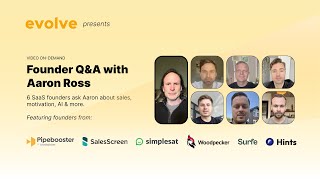
Aaron Ross, author of Predictable Revenue, answers SaaS founder questions on quitting ventures, founder burnout, scaling sales teams, and AI adoption. He says moving from founder-led sales to a scalable motion takes 6-12 months or longer and requires hiring an experienced sales leader. On sustaining energy, he emphasizes sleep and regular breaks as non-negotiable.
Chapters
Hey everyone, and thanks for joining this Founders Q&A with Aaron Ross. My name is Bruce Pignall. I own and run Evolve, a technology consultancy based in the UK, working globally, on a mission to empower small and scaling businesses to thrive in the digital age. We do this by providing easy-to-use sales tech solutions, enabling business owners and their teams to digitise their workflows and processes with tools that they not only need, but actually want to use. You might know us from the Evolve Podtrack podcast, where I speak all things sales, apps, and Pipedrive CRM Marketplace. However, today I'm very excited to say we're doing something a little bit different. In this webinar, we're going to be talking about failure, struggles, challenges, because sometimes it can seem like everyone is smashing it except you, especially on social media, especially on LinkedIn, and especially on YouTube. But that's just not the case. It's just that more people are talking about these success stories than their failures, and that can give you a misleading impression of the reality of things, which is where the idea for this webinar was inspired by an Aaron Ross LinkedIn post on exactly that. And as a business owner myself that runs a business to help SMEs scale, we thought it'd be a great idea to speak with the world-leading sales advisor keynote speaker and bestselling author of the books like Predictable Revenue, From Impossible to Inevitable, and CEO Flow. And to get him to answer the questions on the minds of some friends of Evolve and leading B2B SaaS founders with a video Q&A to explore their questions and challenges of growing their businesses. I'll be keen to hear what you think about the format as we asked each founder to send a video question to ask Aaron to answer back with a video. So without further ado, to kick things off, here's George Levin, founder of Hints. Thank you.
Hi Aaron, my name is George Levin, founder of Hints from Mountain View. As a founder, I'm wondering how to understand when is a good time to give up, cut losses, and start over again. I see a lot of founders who spend 5, 6 years building something that doesn't work, and they are afraid, I guess they're afraid to admit their failure, so they just push harder and harder, which sometimes may seem like madness. On the contrary, there are great narratives about people who, you know, invested a lot of time and finally succeeded. So it's very hard to understand when you need to stop and when you need to push harder another year or two. I understand there is no one great answer to this question, but maybe you could share some framework, something that could help us founders to understand some approach here.
Thanks.
Hey George, thanks for the question. Okay, so when to cut your losses and move on versus when do you kind of like double down and stick it out? As I said, there's no simple answer. I'll just share some times when I've given up. Those are kind of more obvious. I had to think about some other times I doubled down no matter how hard it got. But one time, my first marriage, when This is back, I was like 30 years old, and I was putting in work and I could tell at some point that she just wasn't. And that's when I knew, like putting energy into a black hole, it could be with a partner or something, you know, that was just not going to work. That was very hard though. Another was the lease exchange business I wrote about in Predictable Revenue. We just ran out of money. That really wasn't my choice there. And another one's predictable revenue. I had my sales consulting business and I was doing that for probably more than 10 years. And I was doing, had been doing it with at least for 6 years with a partner named Colin. Yeah, okay, well after 6 years I got to the point, because we had always had different struggles and things, and at some point I just got to the point where like, I just, we're not getting anywhere, I can't work with this person anymore, I don't want to work with this person anymore. So it wasn't the business per se, it was really the person. And we had to get a coach. I was like, we need to get a coach to help us separate like a divorce. So again, it was, the point was, I think too, if I'd had a teammate where we were really like in sync, we definitely, I would've kept going with that, but I didn't. And so that has been more of a pattern is it's not so much the business to give up on, but it's like, is the team with me or not? I would say there are a lot of reasons, nuances as to whether you can kind of double on, put more work in, right? Maybe your product hasn't fit, maybe you haven't hit on the right thing. You know, there's some things that are changeable. Sometimes that's team, sometimes you just, you know, burn out with your energy and you take a break. Like ultimately there's something in you which has to say, what, am I just like truly done? Or am I just tired? And for me, that's— those are 3 times I was just like, truly done. And it felt different than grinding it out, which I do with, again, such a big family and other, other ways to make money. I grind so much. And if you've had that time in your life where you've got to the point where you're just done, then I think you can more easily recognize when you hit that point again.
Hi, Aaron. My name is Corey Brown, and I am the founder and CEO at SimpleSat. SimpleSat is a customer feedback management platform which makes it super easy for businesses to survey their customers and understand feedback in order to improve their business. So my question for you is, as you may know, maintaining a high level of intensity and motivation can be challenging. So are there any strategies or routines that you can recommend to help keep the level of intensity and motivation going through the ups and downs of a startup? I'd love to know.
Thanks again, Aaron. All right, Corey, the question: how to keep that high intensity and motivation up for, you know, an ongoing or long periods of time during ups and downs of a startup? I mean, you can't. Just fucking take breaks. Short breaks, long breaks. You need to find some way, and it might vary for different people or the team, like ways to restore your energy. Because it's like, how do I sprint for a long time? You can't. I don't know, there's this, maybe there's in the news, there's that impression of people who work 100 hours a week and like, there's so much bullshit in the world and social media and what works. Yeah, the only time, sometimes you just can't take breaks. Again, or actually I don't know if you can't, like, with lots of kids and I've had lots of little kids, It's been like a physical grind for years. And I just had to like to grind it out. And there are a lot of days I was just like a zombie. But that's not optimum. So in short, find ways to take breaks. It might be vacation breaks. It might be lunch breaks.
Sleep.
Yeah, sleep is like— is there anything better than sleep? Like real sleep, not again if you drink or do weed or things that can interrupt your sleep. Maybe that's the other thing, it's like take breaks and just get as much sleep as you can.
Hey Aaron, this is David from surf.com. We are a sales productivity tool that connects your CRM with LinkedIn, and we're building up our sales team now. So my question would be, how do you transition actually from founder-led sales to scalable enterprise sales motion?
Hey David, thanks for the question.
We had a better transition from founder-led sales Well, if you look online, I'm sure there's lots of tactics that you can, can get around sales process and structuring and blah, blah, blah. But I think really the main thing is to realize normally it's going to take a lot longer than you want.
You might want it to happen in 6 weeks or 2 months or 3 months, and it could happen that long.
It could take 6 months.
It could take 9 months. I know you're not a services company, but in I mean, it could take 2 years for, depending on how challenging, how dependent the sale is on the founder magic.
Anyway, it's probably gonna be taking longer than you want it to take. And there's not like a magic answer to how long it does take.
It takes as long as it takes. Next best thing is to realize the person that you have on board to take it over, sometimes that's a salesperson.
Sometimes it's a sales leader, again, who they are and to what extent they've either done sales just like you wanna do in some respect will speed it up.
So sometimes that's a sales leader who's coming, who's done, let's just say like exactly what you've done.
They've sold the same, you know, paint bucket to the same paint shops.
All right. So that should be relatively quickly, right? It could be. You should see results within a sales cycle. If you have someone who's again, senior and they've sold something similar, it's gonna take longer. If you're hiring something junior, who's just kind of absorbing the founder, your magic over time, it's gonna take longer. You know, there's not really a wrong way to do it because even when it takes longer, if you have someone who's junior, who's got tons of potential and they're kind of at your side as an apprentice, sometimes those people can end up being superstars. So again, it's not so much about how long it takes. It's like, how can you find the right people and how can you kind of keep over time transferring little bits and little bits of your knowledge, insight, enthusiasm, and kind of learnings over to them, kind of like sprinkle the fairy dust bit by bit.
And again, it just kind of takes as long as it takes.
Hi, Aaron. This is Matt from Woodpecker, a sales automation tool. I have a question for you. What are your 3 tips or techniques that help you write your business books while running your own business and having a family life?
Hey, Matt. Okay, great question. So how do I, you know, basically write my business books while I'm running a business and family life? And yeah, having a big family has been incredibly challenging on physical schedules and emotional energy. You know, there is when I wrote the From Impossible book, which is really the one I wrote in the middle of all that. The Predictable Revenue book I had written, drafted before the family. But I think we had maybe 5 kids-ish when I did the Impossible book. And so there were some things I had to do for that one. I blocked out Wednesdays. So I need, like, for me, I need big blocks of time. I'm not good at writing little bits. As I go. That's just not my thing. So I blocked out Wednesdays and like every other Wednesday I was able to get in like 4 to 6 hours of just like work on it. I got a partner, right? So Jason Lemkin. It's always easy for me to get a buddy. They may or may not do anything, but they create kind of like a good energy and accountability and someone to talk to. And so, so blocking out time on the calendar, a partner, and the third thing is that it took steps. Oftentimes I'll start with kind of blog post type formats to get my ideas out, and then they're all kind of in Lego block style, and later I go back and recollect them into chunks. And with the Impossible book, I did an ebook first, and that then led to, again, a bunch of chunks and kind of led to the bigger book. Because for me, doing one big book is just, it's intimidating. Now for the next book I'm doing, which is gonna be more about like family and money stories, kind of like more of a life book, very tactical stories from the trenches of having a big family, dealing with all the money, the people, the emotional intelligence and the things, my own energy, my own life, finding out what I wanna do with my life. That's a whole nother story 'cause that's kind of, I've been thinking about it for years. I only started writing it You know, I got a table of contents done like a year, not quite a year ago. In that case, a bit different. Someone asked me to do an online course and I talked to them, hey, can we do a segment on this new stuff? And so talking to them forced me to think about doing a table of contents. That was one step. So basically committing to do something, table of contents, and that kind of made me get a flow for it too. It helps say, okay, this feels like a real thing. I also was telling people I'm going to do a book. So when I tell people I'm going to do a book, this is probably the other, maybe the other key thing, even more important than baby steps, is like when I say, hey, I'm going to do a book versus I'm thinking about doing a book. I'm going to do a book creates like that concreteness that yes, it's going to happen. It makes it more real to me and to others. So actually, I would, those 3 main things, they're 3.
One was the block.
Well, first I'd be start with that I'm going to do a book. I may not know when. That's probably number 1, the mental decision. 2 was finding a partner or blocking out time, whatever order, but those 3 are probably the key ones. The last thing with this new one is, you know, every book's been a different style, so I'm kind of sorting through how this one's going to work, but I do feel like when I'm kind of ready, sit down and just like pound it out. It's all stories in my head. I'll be able to do that. I'm not really sure when, so I'm just kind of like feeling the flow, feeling for when the right time is to kind of take the next step on it. And, you know, just know that it's gonna come out at the right time, and it will. Probably end of this year, early next.
Hi, Aaron, this is Vlastimir from PyBooster.io, and I got question for you. In your book Predictable Revenue, you emphasize the importance of specialization in sales roles. And given the rise of AI in the sales process, how do you see the role of specialization evolving? Thanks a lot.
Hey, Vlastimil. Okay, thanks for the question. How do I see AI changing specialization? Well, like everything else, I mean, I hate to say there's no easy answer because there's not, because there's so many ways AI can be used. It's almost like saying, how would I see the internet changing sales? You know, how would I see electricity changing, you know, how houses work? There's a lot of ways. So I think like a lot of things that are new, we're all trying to get our hands around it. Finding out within your teams where can people even use AI in a way that's practical. We're not through, as much as there's things that are advancing, You know, there's no magic bullets. And I feel like AI, you know, in writing, I've struggled to use it very well. Some people can use it really well in sales. Some people, I'm sure, if I was going to imagine, use it for like maybe drafting or editing or like maybe automating some things. There's so many ways that people have their workflows, their days, and what they struggle with. And AI is something that can have that glue that can fill in a lot of cracks, potentially. I mean, that's too early. So again, there's no easy answer. It will enable more types of specialization and it will enable more types of generalization, right? So I guess in other words, it kind of enables more complexity because more people can do more things, right? That's just the future. Technology just creates more options, more overwhelm too. And so your job is to sort through, okay, here's what we're doing. Here's all the things that this fancy new toy, this AI stuff can do. Like, let's pick a very specific tangible problem we're dealing with or opportunity and how do we put to use so to cut through the hype and actually like how can we make it practical?
Hey Aaron, this is Sindra, the CEO and founder of SalesScreen, the world's leading sales gamification platform. We help motivate sales and BDR teams worldwide to hit their goals. I have a very good question for you today. One of the insights that you surfaced is the need to have specialized roles in order to have a well-functioning sales machine. At least from what I can see in the market right now, due to the recent SaaS downturn, more and more companies are cutting in their sales and BDR teams. And as a consequence, they're moving towards more full-cycle sales reps again, or generalists. So the question is, what kind of consequences and benefits do you see happening due to this trend? Thanks.
Hey, Cintra. Okay, so with a lot of the teams being cut, headcount being cut on the BDR side or salesperson side, this need to ask people to wear more hats, to go back to be more full cycle, what is some of the consequences of that? Well, I think that a lot of people will find some benefits to that and a lot will find that it doesn't work. I think one rule of thumb that I have not seen broken is that if you have a salesperson and they need to prospect as a significant part of their goals, Let's call it more than 20%. And part of that is things that aren't just purely relationship-based, right? So colder prospecting, if they need to do that, and that— I'm using the word colder because that could include a range of things that aren't, you know, just their relationships. If they need to do more than 20% of that, then it probably means they need some sort of BDR support. It's pretty rare to find a salesperson who's really capable at not only prospecting to colder accounts, but also juggling that plus their day job. So just because you cut people, expecting people, salespeople to be like, oh, well, you have less support, so now you just need to do it, most won't be able to from, if I look at history. Some people will. So one of the benefits will be that some people, salespeople or teams who didn't realize that they actually could be better prospecting than they realized, will realize, wow, actually I can do this and I've learned something. There may be a skill, maybe there's some push to break through a new technique, skill, a way that they've made this happen. Again, I think that will be less common and more often it just will be a struggle and they'll have to, it's not gonna work very well. But anytime you kind of like change things up and people are pushed to push to a new challenge. It may not— the results may not be any better, but they will have learned things that are useful that maybe the results are, maybe they aren't. But whether the results get better or not, they'll learn something useful. Again, actually, whether it works or not, in a big— in a large way or small way, there's things to be able to learn from that to apply towards like that next— how are we going to make this work next? We were pushed to make it full cycle. Something worked, we learned X. Something didn't work, we learned Y.
Okay, now what?
Like, that's really the chance to learn a lot more as a team. Again, I think what goes wrong is when people punish the lack of results and it's like, oh, it's a failure versus look at, hmm, we've learned something here no matter what. A chance to learn. And I know I hope people take advantage of this chance to learn. A lot of people don't because they're so focused on results. They don't— they just see like, didn't get results, wasted time, stop. Rather than, hmm, no matter what you do, you can learn something from it.