Webinar: 5 New (& A Little Crazy) Ways To Align Sales & Marketing
Aaron Ross, who built a $100M revenue operation at Salesforce, shares five unconventional tactics for aligning sales and marketing. He covers specialized sales roles, unified metrics and compensation, cross-functional job swaps, defining your company's unique genius, and empowering employees as mini-CEOs. Active listening between teams is the single most critical habit.
Chapters
and sponsored by ZoomInfo. We're going to go ahead and get started. Today's webinar will be in listen-only mode. So if you have any questions during the call, please submit them via the question feature on the GoToMeeting control panel. Erin will answer any questions at the end of the presentation. I'm going to go ahead and hand things over to Erin. Erin is a sales guru, an entrepreneur, and author of CEO Flow. Turn Your Employees into Mini CEOs. Welcome Aaron.
All right, thanks. Thanks ZoomInfo team. I'm actually excited. I added here on the front page 5 new and a little crazy ways to align sales and marketing, because some of the ideas, some of the 5 ways will be, some might be things you've heard before, or may be common sense, and some you'll be like, what? We can't do that. Let me start by sharing a little bit about myself. So if you haven't heard of me, who is this Aaron Ross guy? I've always been in engineering and started off life coding at NASA and went to Stanford. Dropped out of Stanford Business School to start an Internet company which failed spectacularly. We raised and spent $5 million. And I learned a lot about what does and does not work as a CEO and as someone managing sales and marketing. So I know what does not work. And then I'm a very adventurous person. I like to do, it's like that little crazy part of me. So I've done Ironman triathlon and a 30-day survival course in the desert. But what all these things prepared me to do was then I went to this little place called Salesforce.com. And I started there in 2000, gosh, 2002? I don't know, ancient history. 2002, yeah, it was like 2002. Salesforce at the time was probably about 150 people. And they just started their inside sales team. And at the time they were just trying to go after bigger companies, enterprises. They had been doing very well with the small business base already. And what I ended up creating there was an inside sales lead generation team. I call it cold calling 2.0 or a prospecting team. That went after, proactively went after companies and ended up helping add $100 million to Salesforce.com's revenue and recurring revenues in the first few years. And left Salesforce. I was there for 4 years. Left to be for venture capital. Was at a venture firm as an entrepreneur in residence for a while before leaving there to start my own company called PebbleStorm. And I actually wrote a book called CEO Flow: Turn Your Employees into Mini-CEOs. So now what I do, I would say for the context of this audience, I consult with companies on creating predictable revenue and autonomous happy teams. And this is what we are going to talk about here on the webinar. So just mentioning that a lot of what I have learned, it really comes from having been a CEO of a company that failed, as well as then creating a huge success. My team at Salesforce which helped add $100 million to their recurring revenue and almost doubled their enterprise bookings. But a lot of it came from how to really align teams and people and goals in sales and marketing. So after Salesforce I actually did a bunch of consulting with other companies. So this is all based on not just Salesforce but working with all kinds of companies to see what works and what doesn't. And I mentioned CEO Flow is a book I've written, and there is another one coming out soon called Predictable Revenue. So if you want to grab a free copy, a preview of the first, there is an excerpt. It's at BuildASalesMachine.com/book, BuildASalesMachine.com/book which is my sales blog. All right, with that there is one slide here before we get into the 5 ways And I'm going to go through the content here relatively quickly, but again, there will be a recording if you want to go through. And you can always get the slides from me. But just at a really high level, I think that these big changes over the last 10 years really in sales and marketing have created a lot of reasons why if you— there has been a lot of turmoil and change. So how do sales and marketing people adapt? So from a salesperson's perspective, to some extent marketing. Like my favorite one is the second one down. There used to be this idea, this culture of always be closing. That was the old way of selling. And now it's really, hey, is there a mutual fit? Can we find a fit? And again, past would be like okay, making cold calls in sales. And today it's really making calls that are more based around doing research and referral calls. So a lot of stuff has changed in marketing as well. Marketing used to be very fuzzy. Advertising-based but with no metrics, and now it's very metrics-oriented. So we just need to adapt on today, like how sales and marketing stays aligned needs to evolve as well. In the very bottom right it says authentic selling. And even though I don't really get into it specifically in this webinar, authenticity among people and in the company to me, this is my personal, this is the unique genius work I do, but the more that your people and your company can really be authentic, the easier everything gets to keep people aligned and to get the results you want. And with that, I'm going to jump into the 5 ways. So 5 new and little crazy ways to align sales and marketing. So I'll go through them here and then we'll go through them one by one. But the first is to specialize sales to ensure every lead gets the attention it deserves. The second is to use common terms, metrics, and compensation. The third is pull a switcheroo, and we'll get to that, what that means. The fourth is discover your unique genius. And the fifth, turn your employees into mini-CEOs. Now I have a bonus one as well. If it comes up, there we go, which we'll get to at the end. Now, number one method, specialized sales roles to ensure every lead gets the attention it deserves. This will be the most traditional method. So just before we get into what it means, to me what is important about specialization is understanding both sales and marketing, that there are different types of leads. So I break it down into seeds. I call it seeds, nets, and spears. Now on the upper right are the seeds, word of mouth or PR, things that take time. It's like you're planting seeds and they grow later, but you're not really sure how long it might take. So these are the highest value leads. But they are the hardest to increase. Word of mouth, by far the most valuable, hard to create. Sort of like organic SEO, really valuable, hard to create, hard to control as well. Nets are just marketing programs, email marketing, webinars, low value per lead, but it's the easiest to increase. You can go out and just generate a bunch of leads, although a much lower percentage of them will close. And the last one is spears which is really targeted selling. So a human is involved and they've got a target list of some sort targeting partners or prospects. So it's really high value per lead generated. It does take some work to do it. And this is the most controllable. So this is what worked at Salesforce and with my other clients is we can get to the point of saying, all right, we know our sales funnel. If we hire a salesperson in this lead gen role, 3 months, and if they do X, Y, and Z, 3 months later we will have a certain amount of revenue pop out. It's very controllable. But you have the whole point here is you have these different types of leads. And so you need different, you need to specialize your processes and salespeople to handle, to manage these leads that marketing is generating. So just to go back, you might have different funnels. So here is a classic NetS funnel. So there is the website visitors come and convert to leads, and then those leads are qualified and handed to sales, and sales closes them. So this is a traditional NetS funnel. But it's different than the Spears funnel which is more cold calling 2.0 where you have salespeople, inside salespeople, more junior ones typically, building a list and then they are sending emails or calling into that list. To create conversations and appointments resulting in sales cycle opportunities. This funnel is just different than the next funnel. And I'm not going to share a seed funnel because that's just so different. That could be anything around community, PR, organic search, Facebook, word of mouth. But the whole point is you've got different leads. You need different ways to manage those leads. Which then results here, and this is the most important slide of this section. Marketing is creating leads, and they are— so to me this goes back to the point that you have to specialize sales to really create marketing and sales alignment. So in this sense, the leads that marketing is creating are handled by a role called an inbound sales rep or just a market response rep. Their role is they are 100% dedicated to responding to leads that marketing generates, which is separate than the role that is doing outbound sales development, the cold calling 2.0, the prospecting in the companies. One of the main fatal sales mistakes that companies make is they've got some inside salespeople, and those inside salespeople are both qualifying their own leads they get from marketing, and they're doing their own cold calling, and they're closing deals. That is a recipe for failure. So this model is, there's one role which is just responding to marketing leads, inbound sales development. A separate role which is doing outbound prospecting. A separate role, account executives who are closing. And then another separate role, the farmers, the customer success account managers who are just taking care of clients who are customers, and these are separate. A common question is, all right, if we are a small company, we don't have enough people to start to specialize. Well, you can start to specialize as soon as you have 2 salespeople or 3 salespeople. Typically, it's either common to have 1 salesperson and 1 outbound sales development person to begin, or 2 salespeople and 1 one either outbound sales development person or inbound sales development person. But as soon as you get 2, or 3, or 4 people, that is when you start to specialize. And the roles that you start with all depend on how many inbound leads you are getting or are not getting, and how much is converting, how much pipeline you have. But start to specialize sooner than you think. If this is the only slide that you take away from today, like this is it. And this makes it really easy for marketing and sales to align and to cut down on the problems and miscommunications and to get control over your process and actually get the results you want. And just a couple words on cold calling, because cold calling itself is really, it's dead. The spears kind of leads, and an outbound role doing prospecting. And this is where with marketing, it is mostly effective where that sales team is really doing their prospecting. They are the ones generating their— that role is generating the leads. And marketing is supporting them. In the past, This is the big difference in how to effectively generate outbound sales-driven leads and what worked at Salesforce.com and other clients. In the past, people would do cold calling 1.0. People would actually make cold calls and then they would send an email to follow up if they had an email address which is really inefficient. It can work, but it's really inefficient. And in cold calling 2.0, it's so much more efficient to send a cold email first to a prospect. And there are ways you can get 8% to 10% response rates. And then when you are making calls, so you are sending cold emails, you are getting responses. By the time you are calling, you are making referral calls. You are making warm calls. They are not cold calls. It's so much more productive that way. And just a couple notes here, I'm not going to spend much time on how this works. It is possible for doing prospecting to get sponsors. And one of the tricks is just to imagine you are a salesperson. And going back to why this is important to sales and marketing alignment is when you've got a team of salespeople who are prospecting, you do not want to use marketing emails. It is just easier to stay aligned if the salespeople create their own very simple text-based, no HTML, text-based prospecting emails. And if you are reaching out to somebody emailing them, just be really honest about why you are reaching out. And then keep it really short and sweet. So it should be easy to read and respond to on a BlackBerry. So if you are at a company and marketing is creating emails for salespeople to send out to cold prospects, just stop that. The marketing emails are really useful once you've got some prospects once you've got sales cycles and you want to nurture people. But historically, marketing is not— they are not the experts in creating prospecting emails. Just have the salespeople do that and marketing creates nurturing emails separately. And then of course, you can actually go through a process. I'm not going to go through these, but again, if you want to get the recording slides you can look at this. But there is a real process to creating that outbound sales machine inside salespeople who are sending emails and just very predictably generating pipeline for the sales team. So hey Lauren, do you have any questions before we move on to method 2? Sorry, I got on a roll there. So method 1, this one of specializing sales teams is something I'm so passionate about because so many companies get it wrong. And they have all their salespeople wear all the hats. Where a salesperson again, qualifying inbound leads, also doing prospecting, and closing, and taking care of customers. It just doesn't work.
I think we are good Aaron. Thank you.
Well then, heading on to method 2, aligning terms, metrics, and compensation. And obviously it should be common sense, but sometimes common sense isn't very common. But if you don't have common terms, metrics, and even how you talk about things, it's just going to create confusion, errors, and frustration between sales and marketing. And here is the simplest one where just having terms that people, like the word "lead," there are a million ways people use the word "lead." Here is how I define things. And by the way, before I get into these, the most important thing is that your company, your team has just a common definition. So if you use the word "lead," make sure the VP of Sales and the VP of Marketing agree on what the hell that means. Because sometimes, often they don't. They use the word lead and people think it means different things. Here is where I go. A prospect is an untouched cold list or name, so a list of prospects. There has been no activity. Leads are prospects that have shown some kind of positive interest by say registering. So if you buy a list and you have never talked to them, those are not leads. Those are names of those prospects. Leads are people who have registered on your website or responded to an email in some way. And then an opportunity is a lead that has been qualified usually by a human because we are in B2B here. Sometimes it could be something different. Usually it is like someone has talked, 90% of the time someone has talked to that lead and qualified them. You could also call this opportunity or qualified lead. And then a client is someone who pays you money. And then a champion is someone who actually refers you to leads. This could actually be a client who is a customer, or it could be someone else who just refers you leads like a partner or someone. I also define it as someone who offers testimonials. So these are my 5 main terms. The point is you've got to come up with your list in your company and make sure everyone agrees to them so you are consistent. Now on metrics, So these are the 5 that I think are the most important. Just tracking number of new leads per month, and of course you break these down usually in more complex ways, types of leads, new leads per month, and where do they come from and so on. But just number of new leads per month, number of new qualified opportunities, so this is leads that have been qualified. How many of those actually then become qualified? I like to track this in 2 ways, one of which is just the number of qualified opportunities. And the second way is the dollar value of those opportunities. The third is the conversion rate, right? So you had leads to opportunities. So if you had 100 leads come in and 20 turned into opportunities, conversion rate is 20%. Of course, the amount of closed bookings, and then win rate. What percentage of your pipeline is closed won into bookings? And marketing needs to understand these and pay attention as well, because marketing in the past, all right, their goal is number of leads. But the more that you can actually tie marketing to metrics later in the funnel, the better. And that's what the compensation point is. So we know measuring marketing on new leads is like measuring sales on dials per day. Anyone can generate leads. It doesn't mean that they are quality. And it's a useful metric. You've got to track it, but you don't want to compensate on it. So what matters is qualified opportunities. And frankly, your amount of qualified pipeline per month is your best predictor of your revenue. So this is where to create predictable revenue, if you can create predictable pipeline, qualified pipeline, then that will lead to predictable revenue. So what matters is again, qualified opportunities and how many are created each month from marketing leads. This is for marketing. So number of opportunities, again, I like to track number of opportunities and the dollar value of opportunities. It's important if you know that you can generate $1 million in qualified pipeline per month, qualified opportunities, and your close rate is 20%, becomes a lot easier to predict revenue. And so however you can tie marketing to this number of qualified opportunities, you should. Whether it's part of— everyone does comp in so many different ways, or if it's part of your review, if they actually get paid for it in some way, if they are sort of like sales with a quota, if it's part of their blended MBOs. But marketing needs to be tied in some way to the number of qualified opportunities generated per month. That come from their leads. So remember, 2 of the metrics, number of leads generated, but then how many of those get turned into qualified opportunities. Like that is where marketing needs to be connected to. The whole point is you want to have aligned incentives, sales and marketing alignment. There is always this problem around sales complaining about marketing leads, and marketing complaining about sales not following up. Well, if you connect both of them to qualified opportunities, then a lot of the back and forth goes away. Marketing is incented to figure out, okay, well, how do we either help sales convert more opportunities, or how do we generate leads that are more likely to be converted in the first place? Aligned incentives. So number 3, and before I move on, Lauren, anything come up for you guys, any questions?
I do have a couple of questions now for you. The first one is, how have you been successful in changing the paradigm of aligning sales specialties with executive teams who still think in traditional terms?
Well, everything starts with the CEO. So I mean, the question is a little bit general, but the point is if the CEO is committed to something, it is going to happen. If the CEO isn't committed to something, it is not going to happen. Assuming that person, if they ask the question, if they are not the CEO, they have to find out about what is the CEO or whoever manages that division. What's important to them? How can they get that high enough buy-in to get the change? Because it has to come from the top.
Okay. The second question I have for you is with sales reps wearing so many hats, It's a reflection of the economy and companies' fears about hiring more employees. What's an alternative if a company can't afford to hire more people in terms of breaking out the roles?
If you have more than 2 or 3 people, you have to restructure your teams and some people get shifted in roles. There's always going to be exceptions. So you can't turn off your common sense or judgment here, There are always exceptions, but in B2B especially if you are doing software, 90% of the time you've got to specialize. You have to. And if you want to ask a question in a more specific way, we can get to that and talk about it a bit at the end here. Sort of like how many people you've got or so on, some more specifics.
Thank you. One other question I have is, what is the best way to get a purchasing contact at a company to present follow-up offers? To actual users of the product who sales reps often don't have contact info for? And the second part of that question is, what is their incentive to get the value message to the users?
You know, that's a little bit of a broad question. What I would say is why don't you go grab my— at the end you can email me and I will send you a draft copy of the Predictable Revenue Book. I think that will be helpful. My email will be at the end. It is Aaron@pebblestorm.com. It will be at the end again, but if you email me I will send you a draft copy of the sales book that is coming out.
Okay, and the last question I have for you at this point is, how do you qualify an opportunity?
That's a little tactical. Let me give you a high-level answer. So the important thing is you have to come up with a set of criteria. When does it count as being qualified? So that is what you need to do. And then just make sure your people are trained on— consistency is the most important thing. It's that all the sales reps are qualifying not in the same way, but when they pass an opportunity— I'm sorry. Let's say you specialize and you've got sales development reps who are qualifying leads and then they are passing those to sales reps quote-acquiring closers. What's most important is not the criteria of what gets qualified. The most important thing is that all those sales development reps are basically qualifying things to the same point so that when deals, when opportunities are getting passed to sales reps, there's a consistent level of quality so sales rep knows what they're going to get.
Okay, thank you.
I hope that answers your question. Consistency is more important than exactly and exactly how you qualify it.
Okay, thank you.
And again, if you have more questions around that, submit them at the end and we can spend some more time on it. But I'm going to now keep going through the different methods. So the pool of switcheroos is probably the first crazy one. So this is the whole have them walk a mile in each other's shoes idea. So bid people lose touch with others' realities. Especially true with executives. So how can you have salespeople and executives work or intern in each other's— so sales intern in marketing, and marketing in sales, so they get to walk, spend some time in each other's shoes. I mean, that's just the only way to really get it. So you could switch sales and marketing, even the VPs for some amount of time. If that's too much of a leap, the directors or managers, Somebody, take some salespeople and involve them in marketing projects. Take some marketing people and involve them in sales calls and opportunities. The biggest problem, you can't just do this once. It needs to happen regularly, every week, month, quarter, whatever, where the two different groups are getting to see what it is like in the other's world. And if you don't do this, they just forget and it is impossible. It makes it really hard If I'm in sales and I'm so busy with sales, I can't understand or I can't respect what is going on in marketing which makes it really hard to communicate and stay in alignment with them. I hope this doesn't take any more explanation because to me it is very simple. It can be challenging. I mean, I would say, how badly do you want the results of sales and marketing alignment and thus more efficient revenue and predictable revenue Because this idea I'm sure comes up with lots of like, "Oh, we can't do that" excuses. I'm sure you can come up with a million reasons why this will not work, and why it's the wrong time, and we are too busy, and da, da, da, da, da, da, da. But you know, you've got to ask yourself, how committed are you really to aligning sales and marketing to getting the revenue results you want, or reducing costs, or reducing drama? So I'll leave you with that. Let's move on here to method 4. I call it discover your unique genius, which is your purpose translated into fulfilling profitable work. Now, I do a whole bunch of work around what I call unique genius. And to me, individuals and companies can have a unique genius. So it's not just one or the other. In this case we are going to talk about companies, companies and teams. Groups can have unique genius too. So there is a company, so in the purple, a company you would have your genius. You are an expert at something that whatever you do you can be an expert at. The yellow is other companies or competitors, and they've got geniuses as well. So you can see where there is overlap you might have something that sounds the same. I don't know, ZoomInfo competes with jigsaw. And then the orange is what people need. So the unique genius is really where you are creating what you do best. You are doing what you do best, and it is always in a place that is different, very unique from what other people do, and you are serving a market need. That's where it's a little happy face. The point is, So the way to describe it as a neat genius, it's really a vision. This is where I'll get some examples. But having a vision and core values, it's like what are you meant to do? What is your company's purpose? And not some lame-ass mission statement. We are here to increase shareholder value. But like no, really, why do you matter? Why do you matter? If you disappeared, why would people care? And understanding that and communicating it so that not only do so that your employees care. It's a bigger mission than you are. And the market ends up caring. It's this idea like what do you stand for? And making money doesn't count. I mean you need to make money, but that is not a cause unless you are in investment banking. That is not a cause that people care about. Being number one people can care about. Making a difference people can care about. Money is important, but it is not a cause. So one of the questions I like to ask about it, I'll give you some sample homework questions here. If your company is on the COVID of Business Week for changing something about the world, or business, or culture, what did you do? What would be that important that you make the COVID of Business Week for changing the world in some way? And the point is having a clear and actionable mission and set of core values really helps align sales and marketing and every employee, in fact your partners and clients, because it's like they have something to rally around. And again, it's not a tagline. It's everything you do. It's not just saying that hey, we are changing the world of da-da-da-da. It's actually doing it and living it. Think about how many companies say they have a value of integrity, but their actions don't match their words. So it's not just saying something but actually doing it. So here are some of the examples I mentioned. Salesforce.com had no software. Their unique genius as I call it, their unique genius, again, it's not just the words. It's to actually create what they have created without software, getting rid of software. And they don't just say it, they live it. Or Zappos.com, deliver happiness to the world. And they don't just talk about being a customer service center company and making people happy. Like they live it. And the last one here, Google, organize the world's information and make it universally accessible and useful. So companies that have found their unique genius, like a cause that they care about, and the executives care about, the employees care about, the market cares about, and they tell people about it and they live it. That's unique genius. And this is the point, creating something that is bigger than yourselves, It creates a way to get out of the drama. Sales and marketing, it's like what is the bigger purpose of why they should cooperate, listen to each other, and help each other? So I mentioned some homework, some ways to think about hey, what is your unique genius? So forget about what you do. Customers care less about what you do than the results you create. So if you're one of these companies that says, we're the leading application platform for widget integration on a social graph, and we're buzzword compliant, and the integration API is better No one cares about that except for the pundits. My example, I'll just use myself because it's simple. I could say if people ask me what I do, I could say I'm a sales and management consultant, or I do sales coaching, or I'm a coach, business coach. Instead what I tell them is I help companies create predictable revenue. Or if it's a CEO, I help companies turn employees into mini CEOs. So it's more of a result to create for people, not so much how I do it. So again, think about that in your terms for your company. Are you talking about you are a platform? No one knows what a platform is except for tech people. What does that mean to a customer? And here's the homework. So when someone asks you what do you do, pretend they asked how do you help customers? And by the way, this, I mentioned you need genius that applies to companies as well as individuals. So you can try this for yourself as an individual. It may be a little more frustrating, but it does work well. So again, instead of what do you do, pretend they ask, how do you help customers? And then the clearer you can get on your ideal customer profile, the better. Who are you really serving and how are you serving them? What are the problems you are solving for them? And then here are some questions you can help to get clearer on this. You can ask customers. But ask customers, what difference have you made to them? Why did they do business with you? Why do they continue to do business with you? And why would they or do they refer others to you? Like getting to the core of why do you really matter to them. Lauren, any questions either from yourself you want to chat about or anything that is relevant that came up through the chat?
I did have a question and it goes back to your number 3, pull a switcheroo. And someone asked if you could provide an example, or how you get commitments from the execs to do the switcheroo.
That's a great example. So how to get commitment from the execs to do something like a switcheroo is think about what is your cause. I'm going to go back to unique genius. I mean, this is really my life's work is unique genius work. But if your cause is bigger than that individual, Whether it is a company goal, so let's say your mission, let's use Salesforce.com. Their mission was "no software." And if the employees really believe that, and you can say okay, well in order to accomplish this vision, and it is broken down into goals for the year and so on. It is to take the personalities out of it. What do we need to do to accomplish this goal which is related to the vision of no software? If one of the goals is aligning marketing sales in some way. It's really presenting the problem and then getting those executives to help buy into what the solutions could be. You can't tell people what to do. You can't tell them the solution. You have to help them co-create it with you. So I would say with yours, do you even have a cause? What's your mission? And then what are the challenges or problems to get there? And then have those execs you mentioned help you come up with the answers to get there. And you can throw in, hey, here's an idea, this poll switcheroo. But as much as you can, it's to try to create an environment where people, they don't get defensive and they are really trying to help solve problems. I guess that's the best advice I could give you in that situation.
Thanks, Aaron.
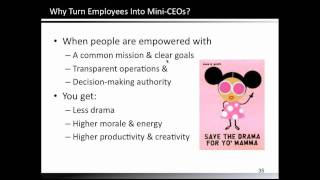
Yeah, you have to help them help come up with the solution. Or one last idea, you could rephrase the question which is, if we did a switcheroo, how could we do it in a way which didn't disrupt things, which really added value? Put the challenge on them to not do it or not, is how to do it in a way which would be the most helpful. All right, we're getting here to the last method. Turn your employees into mini-CEOs. And I'll explain what this means. Obviously, did a whole book on it, but in this case around sales and marketing alignment, the way I describe it, this is the visual for CEO. It's the idea that traditional command and control is that left triangle where there's top-down. Ideally, you want the right side CEO flow where there is a CEO, or it could be a team leader in the middle, and they are not telling people what to do. They are just catalyzing. They are facilitating the environment for things to get done. So things aren't dependent on that one person. And here are the core values towards creating that. People need to trust each other. There has to be trust. There has to be transparency which also helps trust. And alignment. And all these, as you continue to practice these, help create an authentic workplace. And why does that matter? Well, people are empowered with— so going back to unique genius a little bit, but if there's a combination and clear goals, and then I mentioned transparency. If you have transparent operations and people are empowered to make their own decisions as much as possible,, then you get a lot less drama. You have a lot higher morale and energy, and higher productivity and creativity. I have that little— this is a refrigerator magnet. Save the drama for yo mama. But the point is, the more excited, empowered, the higher morale, the happier your employees are, sales and marketing, the less conflict you are going to have, the more alignment you are going to have between them. So this is like a fundamental level. Like a management approach. And I would look toward, if you are choosing a company with the culture, I would look to the CEO because the CEO is called the pebble in the pond where the CEO sets the tone for the whole company. And in fact, if it's the founder, if it's a company that was created by a founder, typically the culture and company is really a reflection of that founder's personality. So the CEO goes, they impact executives, and the executives impact the employees, and so on. An example is if the CEO is really, really stressed about closing the quarter out, he or she will hammer on the VP of Sales. And then the VP of Sales will hammer on the sales reps. They are passing that stress down the line. The sales reps will hammer on the customers. And the customers have a bad experience, so they are going to tell other people they know, prospects and so on. So this is where the CEO has to be the role model If they don't buy into this sort of thing, it's just not going to stick. If the CEO doesn't buy into any of these sales and marketing alignment ideas, and by CEO I mean whatever the division, it could be division manager, general manager, whoever the P&L owner is. If they don't buy in, the stuff isn't really going to stick. So the CEO or that leader has to set the tone for how are you going to create more transparency, trust, and alignment within the teams of the company. Here are 3 ways to begin. Transparency is always, to my mind, the simplest. Maybe not the easiest, because for some companies transparency is really challenging. A lot of fear comes up. What if our competitors find out? What if people find out our financials? I'm sorry, I've never come across a situation where— I mean, do your financials really matter that much? Excluding sometimes like if you actually create products and some sorts of production costs and margins and pricing. But actual financials, who cares? Really, the value of sharing more financial information with your employees far, far outweighs any potential pie-in-the-sky threat of some competitor. I don't know. I never had a good answer on why people are so concerned about keeping financial information secret. 90% of it. There is always 10% that you do want to keep secret. So again, transparency is the simplest, so operational and financial transparency. Just like what are the company's metrics? And you can do this through weekly or monthly updates, maybe online dashboards. And I call this term brutal honesty forums. The best way to create trust in a company, one of the best ways is for the CEO or leader, it could be even VP of Sales at this point, is to do regular updates on everything that's going on and let employees have an anonymous way to post questions, ask them the brutal questions that they want to hear answers to. And having a forum where the leader can answer those questions, brutal honesty forums. Some of you are probably like, oh my God, I can't do that. But again, if you really want to create an environment where your employees are excited to work at your company, on your team, then leading towards of course more alignment with sales and marketing and more of the results you want, really take it seriously. The second way is again, with employees, create a joint vision for your ideal company and culture. Instead of taking that top-down approach of you think there is a problem and you have this idea, hey, we are going to do this thing, It takes a little bit longer, but you get a lot more buy-in and better ideas if you create ways for your team, your people to help you solve problems. And the important thing here is when they come up with ideas, you don't shoot them down. You have to let people stumble or fail safely. You have to be patient with the process. It's like kids. You can't just run over them. They are just not going to grow up if you do everything for them. So again, co-create with your employees what a vision for your ideal company culture looks like. And the third way is called meeting the line. It's a little bit more of a tactical thing, but it might actually be the simplest way to begin with the number 2 idea. Just create a regular forum for any employee to share concerns without a way to be punished for it, but also to suggest solutions and take ownership of improvements. So it could be a meeting where you have your team get together on Monday, meeting the minds. Whiteboard, what are all the problems? What are frustrations that people have? List them out. All right, as a team, what are the main frustrations we want to focus on? What are the ideas? How can we solve them? All right, sounds good. If there is one thing we are going to pick or 3 things to pick, who wants to own those? Very simple. So that leaves us with— actually, before we move on to the last bonus method, did any questions come up on this topic, Lauren, or even that you had? This is very unconventional for most companies, the way business is done in terms of having employees help be equal partners in running, and growing, and creating a company instead of being a very top-down CEO and executive-driven, do as I say, not as I do approach. I'm curious if anyone piped up about this.
No, we are good.
All right, excellent. Oh, I'm sorry, I forgot by the way you can get a sample of the book, CEO Flow. This is on Amazon, but you can get a sample at CEOFlow.com. All right, here is the last method, and then before we get to questions and answers. So the bonus method is just frickin' listen. Communication is so important. And like in marriage, lack of authentic communication creates 90% of the problems in sales and marketing, and sales in companies. So it's simple. When people don't share or listen, and not just talk, but actually share real concerns, solutions, and actually let other people listen, then those minor things stew into much bigger dramas that fester and then blow up later. So the whole point is keep it simple and listen to what they are saying. If you are in sales, listen to marketing. Marketing to sales, because oftentimes it is too easy to say, I'm in sales and marketing is complaining about X, Y, and Z, and they don't know what they are talking about. Or vice versa. That's what happens. No one listens. And just by having, I would say weekly meetings or calls between the executives, the heads of sales and marketing, and maybe even include, I would include the CEO if you can. But at least that the VP of sales and marketing are talking regularly. Or happy hours with the 2 teams, marketing and sales to get together. If you are a sales executive, walk in the halls, not just with your team, but over to marketing. If you are in marketing, over to sales. You just keep the flow going, but not just going through the motions, actually like really listening. And it's so simple, but it's like a marriage. Usually it's just communication that's the problem. All right, so just to review, these are the 5 new and little crazy ways to align sales and marketing. The specialized sales to ensure every lead gets the attention it deserves. Use common terms, metrics, and compensation. Pull a switcheroo. Discover your unique genius. And turn your employees into mini-CEOs. And then there is the bonus of just freaking talk. So to wrap up on, I mentioned I do sales and predictable revenue coaching and the CEO Flow Coaching. So really this value with clients creating clear step-by-step plan to create predictable revenue. And part of this is that Cold Call 2.0 process to be able to repeatedly source sales-ready leads from ideal clients, these companies who aren't calling you, and attract awesome top-notch sales talent. And to really develop autonomous happy employees like workforces so that executives and CEOs aren't— your teams can depend on you, but they are not dependent on you. Testimonial, but let me move on here to the address if you want to get in touch for the slides. And I mentioned if you want a draft of the Predictable Revenue book, or for speaker consulting if you want to get in touch, info@pebblestorm.com is actually the best address. But because I am— here I am— aaron@pebblestorm.com works equally as well. But my assistant goes to the info@pebblestorm.com, so you will probably get a better, faster answer if you go through there. I just want to thank everybody. It will be fun here to get into some of the questions and have some more discussion on this. So thank you.
Aaron, I do have a question. If your CEO isn't fully open to this idea, or mostly says that they are but their actions don't support that, is there any way that you can enact any of these strategies or changes at a company?
Yeah, I mean you can always start with baby steps. And it does help if you can, especially if they ask the question again, if there is one in particular they want to talk about. But you can take anything and do it in a small way to get some sort of proof so that when you go to your CEO or executive that you are like, hey, we tried this. Here is what worked and here is what didn't, and we want to do it in a bigger way. So for example, even if you have salespeople that aren't specialized, in terms of just get it done as soon as you can execution, That is the most important thing to do is to specialize your salespeople so that again, the leads that marketing are creating really get the attention they deserve. And the way to do that in a small way could be to take one person on the team and have them specialize. Or it could be to have your salespeople, this would be trickier. It depends on how anal you are and how small your team is, break up their days into parts of their day. The first half of the day it's outbound, and the second half it's inbound. But let's say if you— that would be a little trickier. The easiest could be to take one person and have them just focus on one role like outbound prospecting or just qualifying inbound leads. And show hey, you got some results there. Can we switch the whole team over? Or I'm sorry, to specialize. Can we take the specialization idea go bigger with it.
Another question that came in is, do you have any ideas for how to use social media to facilitate improving the relationship between sales and marketing?
You know, I know some companies, this really is a culture thing. Some companies use, well salesforce.com has chatter in it. I haven't used it myself. That could be something interesting. It looks pretty cool. I just haven't used it. And there is a tool called Yammer which is like chat. I don't know, social media to me I feel like I would rather use, at a company I would rather have social media being a happy hour on a Friday as a way to bond rather than online social media. Do like offline social media by meeting people in person and having lunch. Having a team lunch. If you are really scattered all over, one place where social media could be handy, the online stuff, is if you are a really scattered company. Sometimes you have companies where sales reps are all over the place. In that case, I don't have a great idea unless you did a fan— maybe it's like a Facebook, not fan page. I guess you could use a Facebook fan page, but more as like an internal company page where employees can just post up what they are doing, what's interesting, what's going on. That would be my suggestion.
Thank you. If anyone else has any questions for Aaron, please send them to us via the chat feature. We are going to hang on for a couple more minutes. Thank you so much Aaron. This was tremendous and really, really great.
Yeah.
And if everybody wants to hang on the line, I'm going to do a quick demo of ZoomInfo Pro, a couple of minutes just to show you the tool. But please keep sending the questions for Aaron. I know that he wants to take them, and we will make time for all of them.
Right, Aaron? Yep. I'll stay on here. So if questions come in, and after you do the demo there are some that come up, we can talk about them some more.
Okay, great. So I'm just going to switch over.
You're going to take control here, right? Yep.
Aaron, do you see the ZoomInfo Pro home screen? Yeah. Okay, terrific. So ZoomInfo Pro is our patented proprietary technology. That crawls the business web like a search engine. It actually reads the English language on the web. The ZoomInfo database consists of over 5 million businesses and almost 50 million people. I want to show you just a couple of features of the ZoomInfo Pro. The first thing that you'll notice about the search options over here is that there is no search button. So as I create my search, you'll see right away whether or not I'm getting what I'm looking for. And you can enter multiple titles or industry keywords or locations and separate with the word "or." I like to actually use these person dropdown menus. So if we scroll down, if I were to put VP Sales in the job title, I would only get people with those titles. But these job function categories are much more broad. So I like to select using those. And any time there's a blue arrow, there's a sub. You can select management levels. You can select a person's name. If you scroll down and open up the company tab, you could do industry. There are many industry selections to choose from. And again, subcategories below. You can sort by public companies, Fortune companies. You can use these revenue or employee sliders to sort your company based on revenue or number of employees. You also have options under the location tab. You can select US states, US metro regions, Canadian provinces, Canadian metro regions, Australia, and the United Kingdom. You select the little arrow next to any of these, and you can select. So you can also select more than one simply by holding down the Control key. You have the option to save your location. So that it remembers where your territories are and you don't have to enter your location every time you come in here. Once you have a list of people that you are interested in or companies over here under the companies tab, you could build lists, you can export, you can set alerts on people or on searches, and you can save the search to come in and rerun the search in the future. So if I pull up any of these searches that I've already saved, I'll get the results from the last time I ran the search, as well as any new results. The little date stamp over here is an important feature. It actually date stamps the last time we update someone, or verify that their information is correct. So you can see that for Pierre here, we did it just a couple of days ago. You can change how your information is sorted. By company. You can eliminate results without email addresses if you are going to be doing an email campaign. And you can even change the range of your results. We are going to send you an email. It will have a link to this webinar. It will also have our contact information. So if you are interested in finding out more about the ZoomInfo Pro Tool, you can contact ZoomInfo. And one other thing I want to show you on the Pro Tool are the profiles. So you see not only Pierre's company information and his contact information, but you see employment information for him, previous employment information, education information, and any boards that he sits on. And then over here on the right is an excellent feature that we have called Web References. So anytime Pierre appears on the web, whether it is on his company's website, or whether he is quoted in a newspaper article, or appears in a trade show website, or an industry website, we capture that information and store it here. You can click on the link to go right to the page where you can read the article. And we even save the websites, so if the information is dated or no longer live on the web, you can click on this cache link and it will take you board version of the website. So it's really a great tool for learning not only contact and business information for someone, but to get a really good idea about their professional experiences and maybe even some personal information as well. We have buttons to LinkedIn and Facebook, and those take you to— if I click this, it will take me to LinkedIn, and it will run a search for all the Pierre Vander Van Benedens in LinkedIn. So that's what I wanted to show you on the ZoomInfo Pro tool. Once again, you will get an email that will have a link to this webinar. So if you want to share this webinar, share Aaron's professional expertise and advice with any of your colleagues, you can feel free to do that. And it will also have our contact information in case you are interested in learning more about ZoomInfo Pro. Well, I don't see any more questions that have come in. So I want to thank you all again for your time. I mostly want to thank Aaron, especially want to thank Aaron for his time. This was a terrific presentation, really valuable, really great. And we hope to do it again with you soon.
Yeah, awesome. Hey, thanks Lauren. That was fun. See you. All right, take it easy. Thanks, everybody. Bye.