Todo sobre SUNO y los derechos de autor
This is a YouTube video titled "Todo sobre SUNO y los derechos de autor" created in June 2025. The content is a detailed monologue explaining the copyright and ownership issues related to music created with the AI tool Suno. The speaker discusses the differences between free and paid plans, what rights users have over the music they generate, the limitations on copyright registration for AI-generated works, and practical advice for creators using Suno. The video aims to clarify common misconceptions and legal aspects surrounding AI-generated music rights.
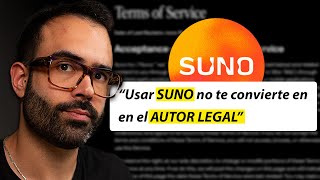
How far can we go with a song created with Suno? Are we really the owners of this song? Do we have any kind of authorship that is copyright? Copyright? We can monetize any type of music created with Suno. We can distribute it on any platform we want. Or is it that Sunoh is the one who owns all these creations and is profiting from all the royalties generated by this music? Well, today we're leaving all the conspiracies aside, leaving all the comments we read online, and we're going to clear up all these doubts because we're basically going to see what Suno has to say about it. To prepare this video, what I've basically done is read all the terms of service that Suno has on its website. In fact, it has a knowledge base with a specific section on rights and ownerships which explains in a very clear way all these doubts that we usually have. And spoiler alert, I have to say that some things are different from what I've been thinking lately. On the other hand, I just realized that many of the things that are repeated the most in comments that I see on the Internet are completely false. It works completely differently. So today we are going to clarify a little bit about what you can and cannot do with Suno. Today, let's get started. Let's start with the simplest. What can I do with a song created with Suno? Well, something that you are probably wondering is if you can put a song created with Suno on Spotify, if you can release it to streaming platforms, digital platforms. Well, one of these is quite clear and says that if you use the basic plan, that is the free one, Suno is the legal owner of the output. The output is what Suno calls the final creation that you make using its application, the song in question. And you can only use it for personal and non commercial purposes. What are personal and non commercial purposes? Well, for example, basically making music to have a laugh with your friends or family at home. For example, you could add music to a video you made with photos and videos from your trip last summer, or music for a college or school project, whatever, things like that, okay? They won't generate money, so you can't register any type of copyright or monetize it. And be careful with this copyright thing because it's quite a bit of work. I'll explain it to you in a moment. On the other hand, if you're on the Pro or Premiere plan, in this case, you are the owner of the output. You are the owner of the master of the song that you created with the Suno application. Therefore, in this case, you will be able to upload this song to platforms. You will be able to upload it to YouTube, Spotify, Bitport, any platform you want, and you will be able to monetize the sales or streams that the song has had. This means that you can use it commercially, you can distribute it, and you can monetize it. But be careful. This is very important. In order for you to monetize a song made with Suno, you must have a premium subscription active at the time the song is created, either the premium or premiere subscription. If you are on a basic plan at the time of creating the song, but later become a pro and you say, wow, I want to release this song that I liked, that is not valid because it is not retroactive. So it is important that at the time of creating the song in question, you have to be subscribed to a plan. Now, what can't you do with a song created with Sun? Oh, well, we are going to start with the most obvious, the simplest, and then we are going to make it a bit more complicated. At the outset, you cannot prevent others from receiving the same or similar output, and this is quite important since it is a matching learning model, you cannot prevent another person from receiving a similar output. And this makes sense because when a tool of this type is feeding off more or less fairly similar music, which is usually the most popular, most commercial music, it is easy for it to generate things that are very similar to what it has generated before. Which is why Suno does not give you exclusivity. It does not guarantee exclusivity. Perhaps this is leaving you with many questions, but I simply wanted to put it on the table because at the end of this video we are going to dedicate a little more time to this point since I want to show you a real example that has occurred in recent months. On a similar topic, you cannot use Suno to create products that compete with them. Logically, you cannot use the output to train an AI that you are creating to generate music. This is a bit vague really, because I find it difficult to demonstrate. But anyway, they put it there. What you do have to keep in mind is that any content that you upload or generate can be used by Suno. That is, you are granting them a perpetual irrevocable sublicensable license so that they can use it, display it, modify it, and monetize it, and you will not receive any type of financial compensation for it. This means that if you are using the basic plan, all the music you make will basically be able to do all the things that are mentioned here. If you have the premium or Premiere option, they will be able to do all these things here. They will not be able to monetize it because you will be able to monetize this. I have to say here that I do not know to what extent they can monetize this music because as of today I have no proof that Suno releases music generated by its users and is generating royalties on Spotify, for example. But it is true that this music that we train, that we make at Suno is used to train its own artificial intelligence. Logically, which is one of the most important assets that one has and what interests them the most, they can really have the power to display it. That is when you enter the home screen you can find music created by other users. You can actually hide this, make it private or make it public. Okay, but from the outset you are giving them the okay. What else can't you do with a song that is 100% self generated? And here a rather important issue, registering the copyright. And here we are going to dedicate a specific section to this. Copyright refers to authors rights. Authors rights are attributed to you when you are the total or partial composer of a work. That is if you have created the composition, the chords, the harmony, or if you have created the lyrics logically, if you have created the melody, if you have composed the melody too and it is different from ownership, from property ownership, that is what we can monetize when we have the pro plan refers to the rights of the master which refer to all the royalties collected mainly from music sales and streams. This whole rights thing is a bit deep and dense and I don't want to go into too much detail in this video, but if you have questions about what master rights are copyright or and want to see specific examples of what can be done with them. Well, a while ago I recorded a video where I talked a little bit about this. I'll leave it down below in the description of this video. It's a video that's a bit old, but hey, these things haven't really changed. They've been the same for many years. Well, let's get back to copyright. In order to claim the copyright of a work, first of all you have to register it with an entity that is dedicated to managing the copyright of its members works. In Spain for example, it's esgae and in the United States we have entities like bmi. What happens that if you are going to present a work for which you have no support. You do not have to prove that you are the author, that you created it, that you composed the lyrics or the melody, the harmony, it will be more difficult for them to register it. Perhaps at some point it may work, but what the law says today is that you cannot. In other words, at the time I recorded this video, both European and American law do not recognize as copyright works created exclusively by AI. They only recognize those in which human intervention has been involved. Therefore, if you have the SUNO payment plan, if you create a song with this application and do not touch anything at all, you can release it as is. You will be able to keep the master rights, you will be able to benefit from those rights, but you will not be able to register the copyright. So you will be able to generate money with the copyright that is generated. As I mentioned before, when someone plays your song on platforms such as Spotify, Net, YouTube, Tidal, etc. Apple Music, or when there are digital sales on Bitboard, for example, even when it is played in advertisements or in a movie where you have previously licensed that song, each time it is played, royalties are generated, so you collect those royalties. And in certain countries, master rights are also generated when they are played on the radio. What is it that you will not be able to collect? Well, the copyright. Because as I mentioned before, there is no real legal way to be able to register something created 100% with AI. Some situations where this income from copyright is generated are when your song is played on the radio, on tv, in movies, in advertisements. This is because you have previously licensed it so that it can be played on those programs in that movie theater or on that tv. When someone plays it on streaming platforms such as Spotify, Apple Music, etc. Although what is generated is a much smaller fragment than what the streaming master rights generate. When other artists cover it, for example, when they do a cover of yours and someone else recreates one of your songs, that person owns the master because they have created an MP3, a new WAP. But you still earn royalties because after all, they have used your lyrics or one of your melodies. As I said, I explain all this better in the dedicated video that I will leave in the description of this video. When your song is performed live by another artist, for example, it also generates royalties. You've probably heard that festivals or clubs issue a variety sheet called esg, for example, at least here in Spain, which is a list of all the songs they usually play, so that royalties can be distributed to the authors. Well, all of this that we're Seeing here, if you don't have a way to register that song as your copyright, as if you own the copyright to that song, then you won't be able to collect all of these rights. You'll mainly be able to collect streaming fees on Spotify platforms and digital sales. Well, you might ask me, well, how important is this really? Well, in practice, copyright is something that mainly benefits big artists. Because when we're talking about really making money because you've been played live many times or because your song has previously been licensed in synchronicities, that is, on television, in commercials, in series, in movies, or because you have other people doing covers of your music, well, it's usually something that usually happens. It usually happens to artists with a certain track record. And in any case, if you're an artist with a certain track record, or if you're not an artist with a certain track record, I don't think you're interested in starting to Release music created 100% with artificial intelligence. It doesn't make much sense, or at least that's the way I see it, because today I think it's very difficult to maintain aesthetic coherence, artistic coherence. And if you're not putting your hands on that music to make it yours in some way, and for all this to lead you to have a brand that's solid and consistent enough to start generating something interesting from the opportunities that arise from copyright that we've seen before. That is to say, if you start making music with artificial intelligence and for whatever reason you make it big on Spotify, you will probably start making money with the rights to the master, with the rights to the recording. But if you make it big on Spotify with a name X without any kind of artistic background, it does not mean that it will lead you to have gigs, that it will lead you to have a fan base, that all this, well, at the end of the day, will lead to all the actions that we have seen that can happen to you and that you can benefit from through copyright. For that, you need to do something solid to do an artistic project. And for that, it is absolutely necessary that you make music that represents you and that you are truly an artist and do something and you can perform it live. And all these are things that you will not be able to do if you dedicate yourself to creating music with Suno with an application and uploading it to social networks as it has been created. No matter how much it improves on these types of platforms, how can you then benefit from both the rights of the Master and also claim the copyright of that creation. Well, as we saw in the previous video that I uploaded here on the channel, and if you haven't seen it, I'll leave it in the video description. Right now, the only way I think is smart to use Suno is to use it as a creative tool. As a tool for creating samples or ideas that are adapted to the project that you have already done to the music that you are working on right now. Even the samples that it gives you or the ideas that it gives you, you can then process them and turn them around and not be left with the result that this type of application is really giving you. And I am realizing that this is increasingly important, that is that you do not stay with what one gives you directly, even if it is a single track. Below, I have prepared a table for you with CHG GPT where you can get an idea of how far you can register a song depending on the intervention that Suno has had on your creation. Let me explain. Here's how it works. Here we have different situations, okay? For example, the first situation tells you that the lyrics were created by Suno, right? You created them. This applies to both SUNO and chgpt or to another artificial intelligence. Okay? If the lyrics were created by Suno or an artificial intelligence, the voice as well, and the instrumental as well. In this case, you can't apply for composition rights because you didn't compose the song, an artificial intelligence did. The rights to the master can be yours as long as you pay for one of the premium plans, as we've seen before. In the second case, imagine that the lyrics are from SUNO or an artificial intelligence, the voice two but the bass or composition is yours. Did you make the chords or the melody? In this case, the bass is yours. You can also monetize it perfectly because you use a paid plan. Even if the voice and lyrics are from suno. But you won't be able to register the voice and lyrics. Yes, you can register the bass part. This is something you can do. We can register different parts of a song, just as we will see later that we can register only the lyrics, but not the bass. For example, in the third case, the lyrics were created by CHGPT, the vocals were created by 21 and the instrumental bass was created by a. In this case, you cannot apply for copyright because the lyrics and music were created by an AI and that is not registrable. However, if you pay for the paid plan, then you could sell it. You could make money from the royalties for the master. Ok, from when you release the song on Spotify, let's go to case five, for example, which tells you the lyrics are yours, the vocals are by Suno and the instrumental bass is by su. This is quite interesting because for example, there are applications like Ace Studio where the lyrics can be yours, but the vocals are from an artificial intelligence model. Well, in this case it could be registered as a copyright. That is, the copyright for the composition of those lyrics would be yours. Logically, because as it says here, you could register the lyrics but not the music, since the music is created with AI. Although you can also benefit from the rights of the master, because if you pay for the payment plan, you can always benefit from the rights of the master. Note that it is complicated, it is convoluted. Well, I'll leave the table here in case you want to take a screenshot and save it on your computer to consult it in the future. Now, let's go back to what we saw at the beginning of this video. Do you remember that we had read that Suno could generate outputs similar to outputs it had made previously? Well, in this case, Suno is quite clear and says due to the nature of matching learning, the outputs may not be unique and may be similar to other outputs generated by third parties. This means that another user could get the same melody, hook or vocal line as you, even if they have made a different prompt quote. And this is starting to sound a bit familiar to me because this is very similar to when people download sample packs and use the same vocal and you find that there are two songs with the same vocal or the same hook. This is something that has happened and continues to happen today. What happens is that I think that with artificial intelligence it is a bit more difficult for you to have exactly similar cases, since it is true that it can do very similar things, but it is more difficult for it to do exactly identical things. Even so, let's not complain if we ever find that another person has obtained a vocal or hook very similar to what we have had with our contributions. And in the end, it is the most normal thing in the world because these machines are constantly being fed the same type of music. Furthermore, in this case, artificial intelligences are processing thousands and thousands of songs every day and it is very likely that due to pure statistics or pure chance, they will end up creating very similar things at some point. In fact, it is something that happens to people. You, without intending to copy anyone, because of your own experience, your musical background, everything you have listened to in your life, you might end up creating A piano, a melody, a hook that is very similar to a song that was created a long time ago and that. Well, perhaps you will be accused of plagiarism, but you had no intention of plagiarizing. You have simply acted based on all the experience and all the background you have in your head, and unconsciously you have done something similar. Well, after all, we are in a fairly similar situation to the one we were in before, but with much more potential for it to happen in the long term. Because as I say, these machines are going to produce 100,000 times more than we do. In fact, as an anecdote, I want to remind you that Calvin Harris was recently sued. Well, he was accused of plagiarism. And it's because through Calvin Harris latest release, Blessings Sheikh came and told him that it was very similar to a song he had released in 1996 on offshore, which was the typical little guitar style song. Is it possible that there aren't similar guitars in the style of trends? Well, Calvin Harris had to upload a reel on Instagram analyzing and comparing the two hooks, playing them at the same time in the same key, and still showing how they really weren't the same. They are similar because they are in the same style. Perhaps they are set or inspired by the same era, but they are not the same. Even Venus Theory uploaded a video a few months ago explaining how he was being sued for copyright for songs created by the same artificial intelligence, but which were actually his own songs, but they had things that looked like those songs with artificial intelligence that had been registered. Anyway, this whole copyright thing is really messy and sometimes, especially on platforms like YouTube it becomes absurd because as it is something that works completely automatically through content id, sometimes they claim things that are really yours and that deep down are you claiming them. And you have to contest it by sending evidence and saying that you are the author of this. Anyway, it's messy. Christ. Finally, let's talk about extensions. Extensions are when you upload a fragment of a song by Osuno and tell it to generate more music for you to extend it based on what you have given it. Well, something very similar to what we were seeing earlier happens here. If you have the pro plan, everything you generate from that extension can be monetized as master rights. But this is important for you to be clear about and that is that everything you upload really has to be your property. It has to be yours. And this is already stated there that when you upload something, make sure that you check the box saying that what you are uploading is really yours, even if you do not want to monetize it, even if it is for your own use. Something that, for example, I did not comply with in the previous video that I uploaded here to YouTube where I showed you some tips on how I have been using Suno lately. Personally, I thought there was no problem if I did it for non commercial purposes because it was just an educational way to make the video, but it turns out that it is not. Even if you don't want to commercialize it, everything you upload has to be yours. That makes perfect sense because. Because who gave me permission to upload something to a platform that isn't mine or that isn't my property? Well, that makes perfect sense. Well, up to this point I think we've reviewed the most important points that your one refers to regarding the subject of copyright. Or at least what I see is usually the most confusion on social media here on YouTube too, and what directly applies to us as creators and music producers. I hope that has provided some clarity. Let me know below if I've left out anything important that I should have mentioned in this video. And that's it. See you in the next one.