In this TEDx talk, Dr. Alik Widge, a clinical psychiatrist and biomedical engineer, argues that many mental illnesses stem from disrupted communication between brain networks, particularly a loss of rhythmic synchrony. He opens with vivid patient stories— a new mother terrified of harming her baby and a survivor of childhood sexual assault terrified of intimacy—illustrating how parts of the brain can act against a person’s wishes. Widge frames the brain as a computational engine composed of interacting sub‑systems that rely on synchronized electrical rhythms (like radios tuned to the same frequency) to transmit self‑regulation signals. He describes his lab’s three‑year effort to build a closed‑loop system that detects a region’s activity and delivers precisely timed electrical nudges to restore synchrony, noting that such nudges can produce lasting network changes. Collaborating with epilepsy surgeons, they mapped the neural circuitry of cognitive flexibility and identified the theta‑band rhythm as a key hub; stimulating a specific theta‑rich spot improved flexible thinking and reduced anxiety in patients undergoing brain surgery. Widge then outlines the translational pipeline: shrinking the control algorithms onto a power‑efficient implantable chip (analogous to a pacemaker for the brain) and developing a non‑invasive version for broader use. He envisions a paradigm shift where, instead of pills, patients receive tools that give them direct control over their brain rhythms, potentially reducing the massive burden of depression, anxiety, PTSD, addiction, and suicide attempts.
Chapters
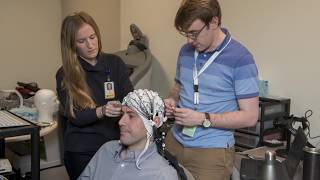
So today, I wanna tell you a story about mental illness and about changing how we treat it by building technologies that could give people back control over their own brains. And I wanna start that story by telling you about some patients. One's a new mom, and she's become terrified that she's gonna grab a knife and stab her baby. Not that she wants to or hears voices, she never would, but she's just afraid that she's gonna somehow snap, blank out, lose control. And so she won't go in the kitchen or anywhere else that there might be knives. And most recently, she won't pick up and hold the one person who matters more to her than anything else in the world. Or another patient who as a child was sexually assaulted repeatedly by a male relative. And to this day, 30 years later, is terrified by intimacy. Just the thought of it takes her back to this incredibly hurt vulnerable place. So what these two and so many others like them have in common is that part of their minds, part of their brains, has gotten out from under their control. You or I, we can have one of those thoughts and say, "That's not me. I'm not gonna do that." These patients can't. Millions of people living with depression, anxiety, PTSD, even addiction, They can't. It's like one part of their brain knows what they want, but another more emotional part is saying, "No, we're going this way." And many of you know the pain these patients go through that brings 1.5 million of them every year to try to kill themselves, and the pain of their families who just would do anything to help their loved ones stop hurting. Mm-hmm. So what I wanna ask is, can we change that? Could we build a world where these patients have back that control over their brains? And the answer is yeah, we can, but we have to think about the problem in the right way. So as you may have gathered, I'm a clinical psychiatrist. I practice at the University of Minnesota. And I'm also a biomedical engineer. And the story I want to tell you today is about how, by using engineering principles, by thinking about the brain as a computational engine, we might be able to find new ways to fix it. So the first part of that story is about networks. Your brain is not a single monolithic organ. It's composed of many subparts interacting, passing messages back and forth, a lot like the parts of a computer. For our minds to function, that communication has to happen. And mental illnesses are when that communication breaks down, when information like those self-regulation signals I mentioned just can't get from point A to point B. And we think we know something, about how that communication works. We think it involves rhythms. Every brain region has electrical activity going up and down, on and off like a wave. And we think that for that network communication to happen, it takes synchrony. Those rhythms need to rise and fall together across brain regions. Think about two radios that need to tune to the same frequency in order to communicate. Mental illnesses would be when that synchrony breaks down, when information like an obsession can get through, but others like that, "Hey, don't pay attention to that," can't. And so in my lab, we've been working on tools to restore the healthy patterns of network synchrony. We can watch the activity of one region rise and fall, and then right at the right point in the cycle, give another one a nudge, a little boost of electricity to bring it back into sync. Think about a conductor pointing at one musician in the orchestra just to bring him back into tune with the rest of the ensemble. Now, that takes about 10 seconds to say. It took us 3 years to build it. But when we did, we saw something interesting. When we nudged 2 regions back into sync, They stay nudged. They stay in communication for hours after we stop stimulating, which means that if we did that repeatedly, if we let it build up, we might be able to cause lasting, semi-permanent change. We might be able to repair brain networks in a way that drugs and other current technologies just can't. Now, that's the first part of the story. The other part is what networks, what rhythms, in what diseases? And so that also we may be able to answer by thinking with engineering principles, and specifically by asking, "What are the parts that make up mental disorders?" Because things that look really different on the surface can actually have common causes and functions. For example, Think about the two patients I told you about at the beginning, or think about someone living with an addiction who just feels controlled by their cravings. All of those folks are stuck. They don't have flexibility to shift their train of thought from one path to another. So we've been thinking about the idea that if you could just make people more flexible, that could be a treatment for a whole variety of mental illnesses. And we had a chance to work on that with some colleagues at Massachusetts General Hospital in Boston who were working with patients undergoing brain surgery for epilepsy, who had electrodes placed all throughout their brain to map out where their seizures were. So what we could do is have those patients do a laboratory task that measures flexible thinking, and we could build a network map of flexibility. Flexibility. What brain regions need to talk and when to make it happen. When we built that map, we found that a specific frequency called the theta band was overrepresented. It was particularly important in the map. And we knew from an earlier study that there's one specific spot in the brain that if you give it a little burst of electrical stimulation, it augments the theta rhythm. It makes it stronger. Stronger. And some of our epilepsy patients had electrodes right near that spot so that we could build a controller. We could have them do our laboratory task, and when they started doing a little bit worse, we could give them a boost of stimulation, raise up that theta rhythm, try to bring them back into a more flexible mode. And not only did that work, but some of these patients had not just epilepsy, but also severe anxiety. And they experienced something really interesting.
Like, I'm notorious for being my own worst critic and, like, overthinking to the point that it actually is counterproductive for me.
Okay.
If I'm nervous about anything, like, it kind of gets a hold of me instead of me controlling it. So it's just weird.
And for a few minutes, it sounds like that was just a little bit different. Yeah. That was there, but not as much.
Yeah, it was like, it just like couldn't get to me.
So think about that just for a moment. They had back that control over their own brains. Imagine if we could give it to them, not just for a moment, but all the time. Imagine if we could give that to the millions of people living with mood and anxiety disorders. And think about what a different way that would be to treat mental illness, not just, "Hey, take this pill and the bad feelings will go away," but, "Let me give you a tool. Let me help you take back control of your own illness." Think how much more power that gives back to the patient. Now, there is a long way between the demos I just showed you and a working treatment. So we're taking the steps to close that gap. We're working with a team of engineers in Switzerland to take all the algorithms I just told you about and shrink them onto a microscopic, power-efficient chip that could be the heart of a new medical device. So that just as some people use pacemakers to keep their hearts in rhythm, we can give our patients an implant to keep their brains in rhythm. And because not everybody with a mental illness can have brain surgery, We're working with a Minnesota company to build a non-invasive version that might be ready for human tests by 2022. So in other words, we are about to have a new set of tools that could transform the treatment of the largest epidemic in America, that could give my patients and millions of others like them back that control over their own brains, that could give their family members, their loved ones back, that could give their employees at full productivity, that could maybe stop some of those 1.5 million suicide attempts before they start. That cannot be anything except powerful.