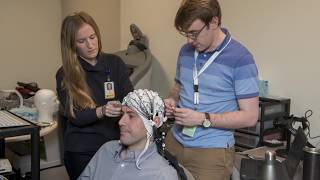
UWECE Research Colloquium: May 2, 2023 - Alik Widge, University of Minnesota
Dr. Alik Widge describes deep brain stimulation tuned to specific cognitive problems like rumination and compulsive thinking, rather than broad psychiatric diagnoses. A closed-loop system that delivers stimulation only when decision-making slows doubled the effect size in early trials. The goal is restoring patients' ability to control their thoughts, not just adjusting brain chemistry.
Chapters
Hello, everyone. It is my great pleasure to introduce our speaker today, Dr. Alik Widge. Alik is an MD-PhD. He did his MD at the University of Pittsburgh and PhD at Carnegie Mellon University. And then he came here to University of Washington to do his residency in psychiatry, and he simultaneously did a postdoc with our own Dr. Chet Moretz. And then he went to do a fellowship at Massachusetts General Hospital and MIT. He has had his own lab for the past, like—
3 years.
7, 8 years?
Yeah, something like that.
And he is a world-renowned psychiatrist because he is bringing his unique expertise in neural engineering and clinics, you know, clinical psychology or psychiatry to engineer brain circuits and using brain stimulation to rewire the brain towards developing therapies for mental health applications, and that is what we're gonna hear about today. So without further ado, I'm gonna hand it out to Alik.
Thanks, Azadeh. And so the title of the talk today is Engineering Brain Circuits. I'm actually gonna, I'm actually going to go through a sort of very narrow definition or narrow version of that, which is talking specifically about how we engineer circuits involved in cognition and decision-making and how that is one of the ways that we can apply general principles of system identification and system decomposition to get a handle on the really complex and thorny problem of mental illness. Now, up front, I'm going to— I am going to— I need to say that I get to come back to a city I have loved being in for many years and give talks like this and have dinner with friends. This— everything I'm going to show you is the result of— Azadeh's not kidding— about 7 or 8 years of work by an outstanding team of postdocs, graduate students, collaborators, people along the way who have contributed seed funding to get this going. So understand this very much as a huge team effort. Now, the reason that I've been able to get so many people to work on this is because they know they're working on a huge problem. Maybe everybody thinks their problem is the most important, but I will really argue to you that mental health disorders are the public health crisis of this century, of our time, because they are the disorders where we spend the most and get the least. So let me contextualize this number, right? First off, mental disorders are the single largest cause of healthcare spending in our country. $200 billion is sort of— right, that's federal budget numbers. Like, we can't visualize $200 billion. Entire cost of the space shuttle program, from bunch of people in short-sleeved dress shirts drawing blueprints to it's all done, there's one at Boeing Field, you can go see it and walk around in it if you want. All of that was $200 billion every year, that level of spending. And yet these disorders are the single largest cause of years of life lost to disability because they hit you in many cases in your teens. But if they kill you, it takes till your 50s— it can take till your 50s, and some people just end up spending a life just knowing they're not the person that they could be, but not knowing how to get out of that trap. And so this is— this is something I realized back in med school about 2007, 2008, is that, wow, this is a gigantic, thorny, complicated problem, and as such, this is a place where developing technology could really make an impact. Mm-hmm. Now, one of the things that's become increasingly clear over, again, sort of late 2000s into the 20-teens, is that we knew these were brain disorders. The dominant metaphor then was these are chemical brain disorders. More and more, the idea becomes that whether you're talking about depression, whether you're talking about addiction, whether you're talking about anxiety, that these are informational disorders. They're network disorders. They're circuit disorders. That they are problems of flow of information from one brain area to another. And as something that many of the neuroengineers on this campus know, and this is how I ended up coming to work with Chet in the first place, that's not unlike problems of stroke or spinal cord— or spinal cord injury or limb loss or nerve damage. There's information that's not getting from point A to point B, and that in many cases, what we therefore should want to do is put in a little bit of electricity to restore the connectivity, restore the communication to the patterns we know are supposed to be there. And in fact, as I'm gonna talk to you about, People have been trying to do that in the mental health space since the night— since the late 1990s. But it turns out that as you go from motor systems into cognitive systems, the problem gets harder, and that it turns out to be really hard to do what we call target engagement, to get the brain and to get the network to do what we want. And that's what today's story about— is about. Is how do you get there? How do you control something whose basic physiologic functions are not fully understood? And because there's many electrical engineers, maybe there's some neuroscientists, maybe there's some bioengineers in the room, every engineer knows that when you're handed a problem and you just don't know what to do to it, especially in controls, the answer is you should just rotate the coordinate basis.
Yeah.
Go find— orthogonalize it, linearize it, just pull whatever tricks you can so then you can go pull out your usual linear dynamical systems theory and everything's gonna be all right again. I mean, every one of my controls class was boiled down to how can you zero this part, how can you zero out this part of the kinematics, how can you linearize that part? And in fact, so today's talk you should think about entirely as how do you do coordinate transforms in mental health? Mm-hmm. In order to find specific dysfunctions that you can then build control policies for. And I am going to talk you through an example of that in the domain of cognition, executive function, and self— and self-regulation, talking you through how we got there, how we found an initial control point to the system, and then what we are now doing to bring that all the way into a clinical closed-loop therapy. Thank you. I'm gonna start with a little bit of clinical background before we jump into the science. And the clinical background is that everything I tell you about today, you should be thinking about this specific embodiment. You should be thinking about deep brain stimulators, which some of you in the room I know you know about, but just as quick background, technology that's been around, basically a repurposed pacemaker with a wire in the brain rather than the heart, in use around the globe, hundreds of thousands of them implanted specifically to treat Parkinson's disease and tremor. And what's done is surgical placement of a tiny wire, about a millimeter in diameter, through a tiny hole in the scalp into a nucleus usually in the center of the brain, hence the name deep brain stimulation. And then that wire's just going behind the ear to a little battery pack, and in everything I'm gonna show you today, We can talk about more complex patterns if we want during the Q&A or over lunch or individual meetings. In everything I'm going to show you today, what that's doing is just firing constantly, 130 times or more per second, buzz, buzz, buzz, buzz, buzz, the idea being that this creates a pacing and in many cases a disruption of the circuit that's being targeted in a tiny, about like lima bean size, maybe fava bean size, area of brain tissue. So super precise in terms of what you affect, also super adjustable, and that's both a blessing and a curse, as we're gonna get to in about 10 slides. If you follow the news and if you follow neuro— and if you, if you follow, if you follow, if you generally follow sort of what's going on in neurotechnology, you will have heard that there are actually multiple places that people have tried stimulating the brain to treat psychiatric disorders almost exclusively, but not quite, in the area of depression, major depression, major depressive disorder. And the reason for that is pretty simple, 'cause that's where the money is. Because if you look at all that healthcare spending, the majority of it, the majority of visits, the majority of patients are people whose labeled diagnosis is major depression. And if you're a medical device company trying to develop and commercialize a therapy in a space like this, the first question you ask is, where can I make the most money? Which is how— where are the— what disease do the most patients have? And so that's why all the work has been done in depression, not because we understand the neurobiology of it, but because that's where the money was. And I will mention that in particular, If anybody saw the very nice interview, I want to say it came out in Nature News or maybe it was PBS recently, talking about deep brain stimulation with Helen Mayberg, that's the middle of these targets.
That's the sub—
that's the subgenual— that's the subgenual cingulate gyrus. We're actually not going to talk about that one today. We're going to talk about the one on the left side of your screen, the ventral internal capsule or ventral striatum, which—
Is And a muscle.
this is gonna become important, so hold on to this, has been tested not just for depression, but also for obsessive compulsive disorder with really similar clinical results in each. In fact, it was first tested in OCD, and then they noticed those patients felt less depressed, so they said, "Hey, maybe this is going to be a good antidepressant." And what you should know as your little bit of neuroscience lesson for the day is that Where that specific stimulation electrode is going is into a piece of white matter, so axon cabling, that is sandwiched in between the nucleus accumbens, one of the major structures in your reward and motivation and learning pathways, and the globus pallidus and caudate, two structures that are heavily involved in habit learning and in switching of behaviors in responses to changes in what's going on in the environment. So for those of you who study things like decision policies, if there is such a thing as a Markov decision policy engine in the brain, it probably lives somewhere down here in this caudate-GPE axis, and in their interactions with the prefrontal cortex, the evolutionarily new stuff at the front of your brain that does models of the world. Why that matters is I said there's a stripe of white matter here Those axons that are coming in and out of the plane of the board, those are the fibers that go from the prefrontal cortex into these striatal nuclei and onward to the thalamus. So you are sitting right here— this electrode is sitting at the hub of decision and motivation within the brain. Keep that, keep that one in mind. Now, why did we stick this here? Because we had some sense from old lesion studies that this was also a circuit that was very involved in mood aspects of motivation. And the first attempts to say, "All right, we've got a technology. Let's try seeing if it can treat severe resistant cases of depression," were right in the mid to late 2000s, right as I was an impressionable med student. This is not a coincidence. Those results probably changed my life.
Mm-hmm.
And this happened about that time because deep brain stimulation had just been approved for Parkinson's disease in the early 2000s, so now there was a known safe technology, and when you hand people with a really bad clinical problem a new tool, we just go and we try and solve every problem we can with it. So these were the early results stimulating this brain target in depression. Y-axis, severity in depression. Going down is change from baseline, i.e., improvement. X-axis, months. By 3 months, patients who had been resistant to every drug under the sun, to talk therapy, in many cases to electroconvulsive therapy, 50% on average of their symptom burden gone. And lasted at least out to— lasted at least out to a year. The word miracle got thrown around an awful lot in the popular press right about then. Now, that's open-label results. That's 15 people, all of who know they're the first to try a fancy new technology with lots of very high-touch attention to them. Next step before you'll get the FDA to approve anything is randomized controlled trial, a.k.a. Everybody gets a stimulator, but only half of them get it turned on because having the surgery and having the attention is effectively the ultimate placebo. We want to know if the electricity does something. Same target, same device. Right there's where they get implanted. This is the period where half are on, half are off. There's no statistical separation between those curves. And interestingly, you'll notice they didn't get better either as fast or as deep as the people in the previous studies. So, uh-oh. So this was all hype. This was all placebo, right? Dustbin of history. No, I'm still here. There's a reason I'm still here, which is that in parallel, a European group decided to do this not industry-sponsored with a different design. Everybody gets a stimulator. Everybody gets it turned on, and over the course of a year, the clinician does their best to optimize and adjust exactly the pattern of electricity that's coming out of that stimulator in order to optimize the patient's symptom recovery. And over that time, the patients that— those blue— those dark blue are the average curves. They separate themselves into the folks in orange, non-responders. We just— Yeah. They didn't get better no matter what somebody did, an alleged expert for a year. And in blue, the responders, the people who got better. And again, it took some time. It took out to 20 weeks. So we're talking 4 to 5 months before they got better. But then at the end of that year, you take everybody whose stimulator is on, and in half of the time, you secretly turn it off.
Oh.
You do that, the ones who got better get worse. You turn it back on, they get better again. What this tells us is that if you can dial it in, this kind of deep brain stimulation, this particular circuit can work, but that brains are even harder than computers to program. That— and the reason is simple. The space of what we can do is so close to infinity as to make no difference. So what I haven't told you yet, I said we stick an implant in the brain. That's not just one electrode, that's at least four. In more modern ones, it's eight, and people are trying to scale that up rapidly. And I, and all the different ways of which I can do anything from 4 choose 1 up to 4 choose 4, work out that factorial. Mm-hmm. There's at least 20 reasonable things, there might be 100 reasonable things I can do with those electrodes. And then into, into them I can apply multiple different patterns of how fast is the stimulator pulsing, what's its intensity, what's its pulse width shape, and that determines exactly which neurons get activated. There's a gigantic space for me to explore, and then what kills me is the loop latency of feedback.
Mm-hmm.
So if you're doing one of these for tremor, the hand does this. And when you get the stimulator tuned in, the hand does that. The tremor stops. You can see it with your eyes. You can do what our own Jeff Herrin has done and stick an accelerometer on there and do an automatic programming algorithm instead, but you get feedback in seconds. In psychiatry, you set it and the patient may not have a subjective emotional response for 2 weeks. And then you try something else. And you wait 2 weeks. And you tell me anything in the world that has ever successfully achieved control with a loop latency of 2 weeks per measurement. That's just— that's just not possible. And it's even worse because your objective function is asking the patient, "How do you feel?" And if something happened like they had— they had something bad happen in the news or their dog died or their grandma got sick, you could have done perfectly effective deep brain stimulation 2 weeks ago and they're still going to come into the office and say, "I feel like crap." Yeah. So number, so number one, programming is hard because the loop latency is too long and the output is noisy. Those are two problems we have to solve. Thing two, and this is where we're gonna get to why we need coordinate transforms. These diseases are noisy because we have, one of the things I didn't say, so I said, oh, there's blue responders, orange non-responders. Look at those distributions. There's some people who got better enough that they're in the blue group, but they're actually more ill, they've got higher symptoms than people who are in the orange group. And even if programming is hard, okay, what's going on with that orange group? If this stimulation works, how come a third of people don't get better even after a clinician has like a whole year to try and do their best job to tune it? This leads to another fundamental problem that I'm going to unpack in about 2 slides. We are probably defining the problem wrong. We are assuming that they— that when I say this person has depression, that that is a single neurobiological entity that can map to a single perfect little 1-centimeter spot in the brain, and that that's just the master switch that I can just go—
Whoa!
Boop, 2. That's not how brains work. That's not how diseases work. And so almost certainly, we were defining the problem wrong. We were likely measuring the thing wrong. And I'm going to get to, in about 5 slides, we may even have told the patient the wrong thing, which was that I'm going to take your symptoms away. And that may not be how this works. So now let's dig into that. And let's start with how do we redefine what it means to have a mental illness in the first place? So the thing on the left, that peacock diagram, is from the field trials of the DSM-5, the Diagnostic and Statistical Manual, the quote-unquote Bible of psychiatry, where it's written down what is the definition of someone to have depression, anxiety, PTSD, and et cetera. So that blue oval right there, That's the people who were diagnosed with major depression by a psychiatrist just sitting in a room looking at the checklist criteria and saying, "Do you fit them or do you not?" Over half of that oval overlaps with other diagnoses. That is, in over half of those cases, it was— you could not get two independent raters to agree on whether this person had depression, whether they had PTSD, whether they had anxiety prominent, whether a substance use disorder was actually their pri— was their primary What's the primary problem? The kappa, the inter-rater reliability, for those of you who know that statistic, on the DSM-5 is 0.3 at best. That is crappy. If you had a thermometer that had a kappa of 0.3, you wouldn't know whether you were sick or not. So, problem one, we can't tell our disorders apart from each other. But problem two, they're internally heterogeneous. So, what's in the checklist for major depression? There's 9 symptoms. There are things like feeling sad all the time, but you can also just feel irritable, especially in adolescence. Increased need for sleep, in bed all the time, or insomnia, can't fall asleep. Increased appetite, craving carbs all the time. You know, we're in that period of— this may empathize with people in this period of the Seattle spring transition. But decreased appetite, food tastes like nothing, no pleasure in anything. Count those out. There's 500 different ways to build symptom combos that you all stick one label of MDD— of major depression on. You can assemble groups of patients who have no symptoms in common with a— and put a single label on them, assuming that there's one spot in the brain that treats all that. Again, that does not make sense with how we know about how brains work as computational engines. And so, in fact, everybody up to the National Institute of Mental Health realizes this. And they proposed— and conveniently, this was about the time I was finishing psychiatry residency here and really feeling frustrated by this diagnostic system— they said, why don't we rotate the axes? Why don't we instead stop trying to find categories and describe patients as embedded in a continuous space of measurable psychological dysfunction? So that we don't ask the question, for example, about Does this person have depression? We might ask the question, is their depression characterized by very rigid, stuck, negative thinking? The person who just, no matter what they do, their thoughts go into what we call a ruminative, self-defeating loop where they're constantly thinking about their past failures and that's constantly informing how they try about future things. Or are they more the kind of depression that their thoughts aren't the problem but they just can't stop breaking into tears for no reason at all and say it's a sunny day, the birds The birds are singing and I'm crying and I don't know why. Could we start to describe people by specific definable dysfunctions? And why this matters for our story today comes back to what I said about 10 slides ago, that there's a brain system— that this one brain target has almost identical clinical results in depression and obsessive compulsive disorder. Mm-hmm. Now, those are different chapters of the DSM. People who treat them go to different conferences. They are not traditionally thought of as living together. But if there's one spot in the brain that's almost exactly clinically effective in both of them, then there has to be some common cognitive or psychological dysfunction that unifies those two disorders and that ha— and that that brain spot, the ventral capsule, ventral striatum, is a handle into controlling that function. And that's what got me thinking— this was about 2013, 2014— about this construct that we call cognitive control. Essentially, you can also think of it as metacognition, or thinking about thinking. It's the ability to say, wait, I had this policy, I had this way of thinking, I had this way of acting, and it was adaptive for the situation I was in. But now it won't work. And we all understand this. We're different people when we're with our friends on a weekend than when we're with our colleagues or our advisors in the workplace, right? Mixing those two and not adapting our behavior to context is what will then get us into trouble. Well, a friend of mine always says, well, I cannot— my kid knows he has an inside voice and an outside voice and which one is to be used when. But this is a function that goes disrupted in depression, in OCD, in many other psychiatric disorders. I just gave you an example in depression. The person who can't stop ruminating and getting stuck on their past failures or on their fears of future failure and they get stuck in a loop of never really wanting to try but then feeling bad because they didn't try. Aaron Beck described this. It's the basis of cognitive behavioral therapy. People with OCD get stuck in their rituals. They have this thing that they have to do exactly right, and if it's not just right, they have to start it over and keep redoing it until it feels just right. These are possibly the same thing. So is the craving of a person with addiction who will say, "I don't want to take these drugs anymore. They're wrecking my life, but I can't stop." I can't stop. And so we start thinking about this. And the first experiment was to round up everybody who had been in those failed trials. I happened to be at Mass General Hospital in Boston. It had a lot of them. And have them do a laboratory task that tests this cognitive control function. They're being shown numbers on the screen and they've got to just pick the one that's different from the other two. You put a non-intuitive motor mapping on this It's hard. You've got to turn on those circuits of executive function, self-inhibition, and switching in order to do this task, especially because in this version we throw some emotional pictures at you in the background to try and distract you. And all I did was I had these patients come in— they already had neurostimulators— do this task with your stimulator on, turn it off, wait an hour, do it again.
Uh-huh.
And with their stimulators on, they're better. And better in a very specific way. They're about 5% faster at doing this without making mistakes. We all knew we can do something difficult faster as long as we don't mind making more errors. That's the classic psychological speed-accuracy trade-off. Having your stimulator on breaks it. For those of you who know things about hyperdirect pathways and basal ganglia, I always include this. Uh-huh. It is not the hyperdirect pathway. It is not a motor effect. We tested for that. They are not faster on just simple motor speed tasks. It is specific to decisional speed. And we were able to take a second cohort of patients who had never had an electrode in their brain in this target before the day I walked in— actually, before the week I walked in and did the experiment with them— and we were able to replicate that effect. Another group has independently replicated in humans. Mm-hmm. So don't believe anything in neuroscience till somebody tells you about the replication. That's a general rule. But this has, this has now reproduced across multiple cohorts. This effect is real. And I think it might be both a mechanism and a different way of thinking about what it even means to treat a mental illness. Because one of the phenomenological interesting things that and as I've gotten to work with more and more patients who have these stimulators, I've noticed, is a lot of them don't say, "I'm not depressed anymore." They don't say, "I don't have OCD anymore." What they say is, "Oh, I've still got the thoughts, but I can push them out of my head. I can just ignore them. They're not in charge of me anymore." And that's very much cognitive control. That's, well, there's this thing And normally I would feel compelled, pulled to pay attention to it, but now I don't have to. And I wanna bring this up because this is very, very, very much— a lot of the work on this campus is about rehabilitation engineering, right? We tell people, "All right, I'm gonna put a stimulator on you, but now you're still gonna have to do your physical therapy exercises. You're gonna have to do your reaches, but we're gonna stimulate your spinal cord. We're gonna stimulate your perilesional stroke cortex." Mm-hmm. And by doing that, we're going to cause remapping and cause plasticity, and we're going to make you more able to treat the symptoms of your own disease. I believe that what we've got here is a way to do that for mental health. And then, you know, again, analogy that will fit with people on this campus, I talk to them about, "I'm going to give you an electric bicycle instead of a regular bicycle. It'll help you up those hills." Mm-hmm. But you're still going to have to pedal. And as a result, you are going to know that when you feel better, it's not just, "Oh, I put a stimulator in and it changed your personality, changed who you are, changed your brain." It made you able to do what you've always wanted to do. That it made you more you. That is a radically different perspective. All right, ask the question.
My question is, for the people that the stimulation has worked for, it seems like most people that get the stimulator is because they have been non-responsive to medicine, right? Yeah. Pharmacological intervention. But for people that pharmacological intervention does work for, my experience is they describe very similar things. Like, I still have the thing, I'm just able to control it. So how do you view, like, the intersection here of—
I think that's the same mechanism. I mean, I think— so I will often analogize that when we treat someone and they get better because we put them on a selective serotonin reuptake inhibitor, I analogize that to sometimes— and this was the case of my— of several of my old laptops— the screen would go wonky and I could fix it by just giving it a light tap right about there. Now, my laptop did not have a deficit in the amount of percussive force being applied to it, right? It did not have— right? So we used to talk about depression as this serotonin imbalance. I would argue that what we're doing with the serotonin is we're giving a big perturbation to the brain, and if you're lucky, the energy landscape of that brain is just right so that when you whack it, right, if we think of the brain as one of those little classic balls rolling around a state landscape, it pops up, and then you're lucky, it rolls into a nice little local minimum or metastable point that the patient experiences as non-depressed. That's what I think we're doing with SSRIs, and deep brain stimulation may just be a more precise target may just be a more precise and possibly stronger kick, right? If that person's not serotonergically vulnerable enough, the SSRIs just may not work, or if they've got side effects, they've got metabolic reasons why they just can't get enough drug into the brain. There's 3,000 reasons why. But yes, I mean, I think this is the mechanism of cognitive behavioral therapy. I often say that basically what I'm doing is I just make the CBT work better. It's like I'm pouring fertilizer on the— On the— On the— fertilizer on the soil. All right, let me get— but it's the right question. We can come back to that whole sort of idea of unity of treatments a little bit more if we have time. Now, there's a challenge. We found these results, and there was a nasty question that kept coming up at conferences, which is, prove to me that this is an improvement and that you're not making people more impulsive. Because one of the things that happens with stimulation at this particular brain target is about half the people do get impulsive. They pick up gambling problems. They pick up drinking problems. They become hypersexual. And we can tune this out if we adjust the electricity just the right way, but people kept asking, "But you're saying they got faster. What if it's just your assay of cognition, this multi-source interference task, is too easy?" So they can just be a little impulsive and they won't get it— they won't get it wrong. What if actually DBS is actually just impulsivity conveniently provided and all you're doing is just giving them like a little bit of, "Eh, what the hell, it probably won't be that bad." And this is both an interesting neuroscience question and a real challenge to the hypothesis I'm promoting. Now, that's really hard to model in humans. Yeah. Because there are limits to how often you can bring a human in and fiddle with their neurostimulator before they say, you know, I have a life I'm trying to live now that I'm better. I don't really feel like sitting in the lab all week. But I also run an animal lab. And rats, you can in fact make them sit there for weeks on end and do what you need. And so we asked the question, could we take this and could we back-translate this human cognitive effect to rodents. And what we thought about was— when I showed you the replication, something I didn't quite delve into, but let's talk about it now. In the replication, we stimulated patients in different subparts of this same deep brain stimulation structure. Remember I said I can steer the electricity a little bit. We use the electri— we use the electrodes to do that. And we found a topography. There's some spots, tending to be more towards the top or middle of the target, that produce a bigger improvement. People get even faster when you stimulate there versus other spots that are more ventral, more towards the base of the brain. So we asked the question, "All right, can we replicate that pattern in rats?" So we take a rat task where they have to inhibit a response. Specifically, you train them to poke their nose in a hole that's lit up, and every time they do it, they get a little sugar pellet. And then you change the rule on them without warning. You say— you still have the light, but the light means nothing. What they have to do is know that they always have to poke their nose in a hole that's on the left side of the little box they're in, and that's how they'll get the sugar pellet. And they have to switch back and forth with— between those rules without warning. And we tried stimulating them in multiple sub-sites of a structure that we happen to know was anatomically and functionally homologous to the structure we stimulate in humans. Got the same effect. That just like in humans there's a spot that works better, in rats there's a spot that wor— there's a spot that works better and it's in approximately the same place it would be in the humans and you get the exact same thing. They get faster at doing this task without making, without making more errors. And why this is cool is that now You can have them do this for days and days and days and weeks and weeks and weeks, and you can start to ask questions about mechanisms. One thing we could do, we could prove that it's not impulsivity because there's a well-established rat assay of impulsivity. You make them wait for that little cue light to come on before they can poke their nose in the hole and get the sugar pellet, and if they don't wait and they go mip too soon, they get nothing. Mip. In that version of the task, no effect on any behavioral measure. Same stimulation that does this, no effect when you do a direct measure of impulsivity. And more importantly, you can do decision modeling. So if you can get thousands of behavioral trials from an individual subject, you can actually fit a model to that. You can actually try to say, "All right, here's how I think abstractly cognition should work." Mm-hmm. Here's what algorithm I think is running inside their brain that solves the problem. What parameters of it change? And in this case, because I said they're switching back and forth between rules— so one of the things you have to do to switch to a new rule is you have to forget the old rule. You have to— as Yoda would say, you must unlearn what you have learned. And so one of my graduate students, Evan— Evan. Who has experience in reinforcement learning models, tried fitting a reinforcement learning model. And what he found was you cannot model the rat's behavior— for those of you who know about posterior likelihoods, the posterior likelihood does not look good— unless you include a forgetfulness term, that you specifically model that memories are leaking out of the rat's brain unless reinforced. And when you do that, A, A, the model fits the data. B, specifically and only at the site that was behaviorally effective to reduce response times, the forgetfulness parameter goes up. We can actually now show that what's happening inside the head is we are making rats— and almost certain, I will say, that this looks like this might be true in people, more to come on that—
we are at—
we can directly mathematically show that We are increasing the ability to let go of something that's no longer effective. Now I will say the data are a little conflicted. There's another story that's about we're making it possible for them to pre-commit to a course of action that they know is going to be difficult and kind of psych themselves up and get ready for trying something difficult. More to come, more to come on that. Ask me again in 6 months. Now to finish up. That's some cool mechanistic stuff, but I haven't told you how we use this yet, because now I can tell you, hey, I've got a spot in the brain, I can stimulate it, people's cognition gets better, I can model what's happening, but is that actually gonna make people feel better? Can we even use this effect on a laboratory task in the clinic? And of course, I'm asking these rhetorical questions because the answer to them is yes, we think we can. And here's how. In that same study I said we replicated the cognitive effect in humans, we went one step further and we asked, could we build a closed-loop controller? Specifically, since we know the thing we want to measure is the speed of response trial to trial on this cognitive task, can we track that response time in real time? And that's harder than it sounds because number one, the way this task works is it's got easier and harder trials and you're flipping back and forth between them. So if response time suddenly shoots up, you need to be able to know, is that because the person just got slower because their cognitive functions are fatiguing? Or is it because you just threw an extra hard trial at them and it was of course more difficult? Right. And then there's just general stochastic noise in the system. And then there's the fact that human response times aren't Gaussian. They have a— they follow what's called a gamma distribution. There's a really long right tail. And our standard methods for tracking variables, a.k.a. Kalman filters, don't work great on very, very, very non-Gaussian variables. So we basically had to reinvent the Kalman filter for gamma-distributed data and gamma-distributed data where there was something that was actively messing with reaction times under the hood and find a way to regress all of that out to get what was essentially a state vector of the system that just described the underlying cognit— the underlying baseline cognitive performance. And then when we did that, we were able to simply do a sim— a simple thermostat-style controller. Mm-hmm. When the patient slows down and slows down below a threshold, which we treat as saying their cognitive control function is lapsing, then you turn on the stimulation. When we do that, we can actually double the effect size compared to what we can do if we do it in open loop and just stimulate whether or not we think we need it. So as with many systems, and this is something that's been seen throughout deep brain stimulation, stimulate when the system needs it, you're gonna get bigger effects because the system's in a more receptive, more vulnerable state. So that's thing one, is we can track this in real time and we can make the effect better. But thing two—
What's the sensor for detecting the patient slowdown?
Give me one second and I'll tell you while I'm getting the video lined up. I mean, the sensor is literally their response time as measured through a keyboard, like ordinary USB or Bluetooth keyboard. You're just looking at how fast— what's the time between the known time of stimulus presentation to their eyeballs and the moment that that switch on the keyboard completed its circuit? Which is one of the things, by the way, we can— we can talk about this more during the Q&A. But one of the— as I'm going to describe, one of the cool things about this is, much as I love closed-loop neurophysiology, everything I just told you, you can do with a laptop. Which is a— which when you want to talk about scalable technology is probably a useful thing. So, and I apologize, the video has an uncomfortably long intro slide because—
it's a little better. Earlier, I was like counting the numbers of how loud it might get. And then like, figure— with figures, or like, literally, I look at my section for an hour here, and it just comes out. And the thing is, I'm sort of automatically not having to know what to do, and that obviously does come with practice.
Interesting. Yes.
Literally, I can I almost physically felt like, lighter. But also, it's like a sensitivity to light too. But also, just, like, lighter. I don't understand. It was like, you know, weight down, like it just like couldn't get to me. Whatever I was trying to do, it made it easy.
So I was like overthinking.
No, actually, not too much at all.
Okay. So healing just kind of a little bit?
A little bit behind, a little bit—
Yes. Stick around.
Okay.
Massachusetts 2014, we were a bit behind the curve. You can notice that that really came on or was it just a gradual—
Back.
Okay. So not everybody said it, but a couple of folks, when we achieved that enhancement in their cognition, You could hear it. "I'm lighter. I'm not as weighed down. Stuff just can't get to me." There was this sort of subjective— there was that last one, a subjective relief of anxiety. So this is something we still need to actually do a formal clinical trial and prove. But those are real people saying, "Hey, you improved my thinking, and I just now feel like I can manage my brain and my emotions better." And by the way, anybody who's ever had a friend with ADHD— and I can say this from experience with with my own kid. You'll see this when you improve attention with a stimulant too. I'm not sure that that mechanism is different. You would not think that anxiety gets better when you put more norepinephrine into the system, but it can if that's what the brain needs in order to organize. So closing up, what I've shown you so far is this general idea— Oh, hang on. Let me try and see if I can get it back to the— More visible laser pointer. Is this general idea that if we do that coordinate rotation, if we start to think about mental disorders as composed of these different dysfunctions, and this worked example I've shown you in this domain of cognitive control, if we do that, we now have a way that we can measure specific psychological functions at the same second-to-second precision that my Parkinson's colleagues are measuring tremor. Now I can do that with cognition. And still to be proven, but that might, that might move clinical needles. That might make a difference in people's lives. What we now need to do, and the last little bit of future speculation I'm going to show you, is how we finally are going to turn that into a treatment. And so the clinical trial part, is we can now automate programming. So I said, one of the things Jeff showed is if you have an accelerometer, you can then have an algorithm that says, "Okay, try stimulating this way, try stimulating that way, try stimulating that way. Hey, wow, the tremor band power just went way down. That one right there." We can now do that for cognition. I can have the patient, laptop in front of them, playing the same cognitive task I've just shown you, and a recommendation algorithm sitting on a screen next to me saying, "Alik, try this contact." "Okay, turn up the intensity by 2 milliamps." "Okay, do this." And watching for that moment when their response time drops, when that filter picks up that, "Hey, no, this isn't just noise. Something just happened." And it can estimate for me that response surface. Now, we haven't done this in a person yet. We just published doing it in simulation with a realistic surface and showing that yes, you can't do it in one run. You've got to do an ensemble of 3 to 4 runs in order for it to reliably converge. So I'm still going to have to bring the patient in 3 or 4 times over the course of a week and do this optimization. But that's still one week. Remember what I showed you about 20 weeks? That's a pretty— That's a pretty good order of magnitude improvement and I'll be able to send the patient home saying, "I saw your brain change today. I can prove to you, I can show you the graph that you are walking out of here with a brain that functions differently than when you went in." Just that little bit of hope, just that little bit of knowledge that truly there was something your clinician could see and show to you, that in all in itself can have profound—
Impact.
Improvement effects across a wide range of diseases. So this is what we are right now trying to convince the FDA that this is safe, that they should let us do this. We had our feedback call with them not yesterday, but one Monday ago. There, we got a lot of skepticism, and we're going to have a lot of paperwork and risk analysis and formal software engineering to do. But I think a year from now, we might actually be kicking off this trial. Wow. Thing 2, way more advanced, but relates to some of the— some of the collaborations that brought me back to campus. Eventually, I'd love to do this without the cognitive task. The dream, of course, is that this all is completely unobtrusive to the patient, that you put in the stimulator and it just knows when is there— when is your— when is their network not working? When is it working well? When are they trying? Let's use the e-bike analogy, right? You don't tell the e-bike, "I need help." Some of them you do. You pedal, it's got a force sensor. It notices, "Oh, you're slowing down. I'm going to throw a little more power assist onto the wheels." It would be great if we could build that in a neurostimulator. There is a challenge, which is that one of the things we showed in the course of some of the research I haven't shown you is— All right, I know. One of the things we showed is that if you want to decode when someone's trying to apply cognitive control that's not working, you cannot read that out from any single area of the brain. You have to look at the connectivity within a broad network that encodes this function. You need the ability to estimate network connectivity and graph structure in real time. That is not yet possible on modern brain implants. It is close. It is a near-horizon technology. It requires some fancy signal processing and some fancy application-specific integrated circuits. We think we can get there, and we think we've got some different ways to stimulate in order to go after that more efficiently. That is a whole nother hour-long talk, so convince them to invite the same seminar speaker 2 years in a row, and I'll give you that talk instead. But, This is why we think either with this paradigm or eventually with a physiology-based paradigm, we are on the cusp of being able to take this idea that I've told you, this, hey, start with a domain, measure it, control it, find the hook, build the algorithms, and actually turn that into a clinical and much more reliable reality. And with that, I think I'm pretty much perfectly at time. So thank you for the attention. Thank you for letting me be here again. I'm happy to take questions. Thank you.
Thank you so much. Can you hear me?
Hello? Raj has one, Chad has one.
Yeah.
I don't know which of them are we going to get in more trouble if we don't call on first. All right, go with Chad. He's closer to you. Mine's a little— it's taken a little deeper. I was hoping Raj would go first, but that's okay. So you said in the rodent study is you think you're effectively either erasing memories or making it easier to forget past behavior. And so I just wanna dig a little deeper into that and make sure we're not getting on this slippery slope of memory deletion and things like that. So tell me more about the mechanisms. So I'm pretty sure it's not memory erasure for the simple fact that they don't instantly forget the old rule, right? So they, Still— so hang on here... There we go, right? So the task is they're doing something; the rule changes. They have to get a couple trials wrong, right? And anybody who's doing this test you have to make a mistake in order notice hey I just did something that should've worked and what the heck just happened? Why did the world not react the way I expected And in fact, usually you've gotta try that one or two more times just to be like, hey, is this sensor broken? Is this— hey, human, is this thing on? And then they're like, all right, you changed the rule again, didn't you? Fine, let me go try— go into trial and error mode. You can see very clearly that they dial in on the new rule over the next about 10 trials, and you can see that exponential time constant of that learning just nudged down a little bit faster. So it's very clear Right, there's no little eternal sunshine button you can push in the rat. And in fact, it's very interesting because the reason we started— the spot we found aligns with another group that's been trying to do helping animals unlearn threat or fear-based memories. So you teach the rat that a little beep predicts that it's gonna get shocked, and you then try to help it learn that no, no, no, now that beep doesn't mean that anymore. They'll learn that memory a little bit faster if you stimulate them at the same spot. So it's definitely— it's a learning augmentation. Could it help someone learn better from other things like motor rehabilitation? I don't know.
My question is also about mechanisms. So it's great that you have, you know, the rat model as well to study the mechanisms. And so in terms of, you know, you mentioned there's relationship to changing functional connectivity. And we also know that, you know, from the prefrontal cortex, you know, there's striatum and then from there GPE and then you go to the thalamus.
Yeah.
The thalamus is known to control functional connectivity, you know, there's a paper with Michael Halassa, right?
Sure.
So I'm wondering if that's the kind of mechanism. So one hypothesis there would be when you're stimulating the striatum, you know, similar to what Shannon's group have been doing, which is you're activating circuit, but then you also have inputs from the prefrontal cortex, which —control is into presumably, right? And so are you looking at plasticity in the cortical striatum, you know, circuit, right? Have you seen evidence of that, you know, for example, in rat models?
So why— we have not yet been able to show persistent neuroplasticity. Now what— so one interesting thing from this effect is it goes away when you turn stimulation off. That is, at least in this paradigm, they get faster, but if you turn stimulation off, they'll go right back to being slower. And these data I showed you are in fact from multiple days of on-off experimentation in the individual animal. That's why things like that— that's why things like— I guess it was further on in this version of the talk— that's why things like this closed-loop controller work. And it's actually a fascinating— something I don't yet understand is How is it that I can do something that enhances learning but yet does not produce persistent change or reorganization of the network? Why don't they just become uber good at the task and stay that way? I don't know. There is something about— however— so I don't think whatever— however we're enhancing this network, it's not exactly neuroplastic, even if it supports some forms of learning and neuroplasticity. It may be a working memory effect because one of the things we think we see is that in the humans, they become a little bit better at estimating whether a hard trial is coming up. They become a little bit better at future prediction and world modeling. The rats will actually start to do kind of a rehearsal for what they want to do on the next trial and my theory is that they're actually using their bodies as a kind of working memory. The same way that, right, you see golfers and batters taking those practice swings to try and get that kinesthetic memory working. I think rats, which are very sort of embodied cognition kind of animals, I think anthropomorphically that's what they're doing. I haven't figured out how to do the experiment to prove that yet. What I can also say, the other thing is, We don't see like a synaptic plasticity change. We do see an oscillatory change. So it's not in this— it's not in this talk because I didn't have enough time and slides, but where's the paper? This one, the 2019 Nature Communications paper, and it's actually in this secondary Nature BME paper also. When we stimulate down in the deep brain, you actually see prefrontal oscillations, specifically in the theta band, that are very associated with this this cognitive control function, you see them ramp up. And in a very state-dependent way. They'll only do it if the person's doing the task. They won't do it at rest. So there's something there about— I don't know if we're somehow entraining more ensembles so they can oscillate together, or we're affecting E to I balance somehow. There's a—
Right.
There's a lot of deep cellular mechanism I can't tell you yet, but that's what the rats are for investigating. But there's something Something in that space is where I think we're getting. Sorry, long-winded answer. All right, I see a Sarah question. We should probably let at least one of the students have at me first. I don't know, you're closest. Yeah, so was there only one activity that was designed, like picking the number, which was— or you can have similar different activities and you would see increases in those? So we used this asset. Because it was already in use within the group and because it has a— it is particularly well-known to be good at producing large, easily detectable effects within individual people. So, in one of the stories here is a story of luck. The first assay I tried worked. This is actually something that comes up a lot, is the question of, all right, if you used a different measurement, would you get the same effect? I have not been able to personally test that. I'll tell you that another group down in Texas has, using a different task, and they've gotten the same result. So no, I don't think it's assay-specific, but I'm sticking with this one because I've sort of got a whole code pipeline and a whole paradigm that already works around it, and once you get one part working, you kind of don't swap that part out for a while. But it's a critical question. It's a good question also because, frankly, At some point I'm going to want multiple cognitive assays because the patient's going to get bored if they have to do this for thousands of trials at a time. Let's go to you and then Sarah, maybe. Yeah, this is like a long-term, more speculative question, but I was wondering like what you thought about how cell types may play a role like within a brain region. Like we know from basic neuroscience that like there's a lot of heterogeneity within, you know, an ensemble of cells and that can sometimes correlate with genetic Yeah. So the question for those on Zoom or YouTube or whatever was, hey, what about specific cell types, genetically defined, connectivity defined, etc., that may be playing this effect? Yeah, it's directly related to Roger's question. If you made me guess, I'd say it's projection neurons that are going cortical, that are corticothalamic, just because— my God, that's annoying— just be— just because because that's what, when we think about the anatomy of this brain— of this brain site, it's mostly corticothalamic projection neurons that are going through. Now, I don't know because it is equally possible— there are some results saying you stimulate the caudate nucleus, you enhance learning. And so it's possible that there's one thing that one of my graduate students is busy optogenetically dissecting different pathways and seeing which one can replicate this effect. Or if none of them can and you actually need the weird mishmush of activation that electricity causes in order to do it. So it's a great question. Stay tuned. Dr. Gehring.
Thanks. One quick question. Just do people have habituation or do the rats have habituation so that they need more over time? You know, it's kind of the opposite of plasticity. It's just that they, they keep— Adjusting and to keep up the speed that you have to deliver more stimulation.
So the question is, the question for everybody was, do I have to keep ramping up the intensity to get the same effect? Not in the laboratory preps, and certainly the clinical phenomenology is most patients will eventually reach a stable level of stimulation that just works for them for years. Now, there are some patients, and you and I have talked about this in some of our discussions, there are some patients who find stimulation kind of fun and pleasurable and will ask for more stimulation because it feels good. I'm not sure that's because they need it to treat their disease. I think that's because we're getting an interesting euphoriant side effect. But in general, no. It looks like if you can find a dose that works for a circuit, at least over the time scales we measure, it's a stable dose.
Can I ask you a quick, just a separate question? 'Cause it's so striking how they are faster, but To me it doesn't— the connection between what the patients say, like they feel lighter or something, I don't— why would that be in any way related to their speed at this task?
So here's my just-so story on that. It relates, and it relates back to this notion of working memory, attentional control, and maybe the link between some of these cases and ADHD. And this sort of link between that and emotional dysregulation. And that is that we can all get to the point where we simply got too much buzzing around in our heads and we can't think and we can't focus enough to even tackle the problem in front of us because there's too many competing drives or thoughts going on. Now, and patients will certainly describe this to us that, well, I just, I can't, I can't focus, I can't think that way, I can't make my brain do it. Mm-hmm. Right. And so one story you could tell, and it's a story you could tell, it's not a— this is not proven, would be that if you give them that little bit of extra attentional control or working memory capacity, that you're doing something to improve that lateral prefrontal function, that they become more able to get rid of whatever drive is particularly distracting so they can focus on what they want. But it's equally possible that it's— they become more able to exercise a top-down control more generally. If their amygdala is overactive, maybe they're able to shut it down and get it to stop sending so much feed-forward drive. I actually— it's very unclear. These are stories of why it could work that generally enhancing the PFC could make someone feel more regulated, more able to cope. Okay. But that's, that's guesses. And I'm still trying to figure— I mean, I'm still trying to figure out how we unpack that, frankly. A lot of what we're thinking about is in the clinical trial, do we just do very dense measurement of symptoms multiple times per day? I've got a colleague in Europe who thinks she can then actually estimate causal graphs between different kinds of symptoms and which one is causing or driving the other. And in that framework, maybe we could show, okay, we'll see your processing speed and brain fog was what cleared up. And then you said you felt less sad like 3 days later. So we were able to maybe show something about a temporal causal arrow. That's, that's our current hope.
I wanted to say that the class time is over, so if people want to leave, that's fine. But we have the room for a little longer, so if people want to stay stay and continue the conversations with Chad. [FOREIGN LANGUAGE] Maybe we'll give another round.
More from Alik




Healing mental illness through brain network stimulation | Alik Widge | TEDxMinneapolis



First-of-its-kind brain chip to treat mental disorders being developed at the U of M