42° Parallel - On the Edge of Chaos
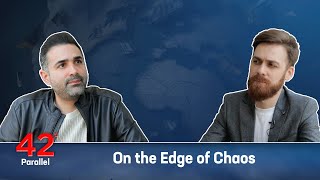
In this interview, Dr. Arta Moeini, Director‑Researcher at the Institute of Peace of Diplomacy, analyses the current “great transition” in international relations, describing the shift from a US‑centric unipolar order to a more multiplex, regionally focused multipolar system. He argues that the United States, especially under the influence of the MAGA‑realist camp, is moving toward a grand strategy that prioritises national interest and regional power projection, notably in the Indo‑Pacific, while retrenching from Europe, Africa, the Middle East, and the Caucasus. Moeini contrasts the MAGA‑realist perspective (embodied by scholars like John Mearsheimer) with the neoconservative establishment, noting a generational shift away from interventionist policies. He assesses the Ukraine war, predicting a major Russian offensive by year‑end and asserting that US support for Ukraine is unsustainable, framing the conflict as a strategic gamble that could risk nuclear escalation. Turning to the Middle East, he critiques Israel’s Netanyahu for opposing a US‑Iran détente, argues that Iran is seeking pragmatic engagement with the US and regional powers, and doubts Saudi Arabia will normalize relations with Israel while the Gaza conflict persists. He discusses the West’s paradox of integrating former jihadist groups into the Syrian army, warning of long‑term repercussions of short‑term realist calculations. Moeini highlights China’s growing economic role in the Middle East, advocating a non‑interference, trade‑focused model for US policy. Finally, he examines the South Caucasus as a fault‑line region where multiple civilisations and great powers intersect, proposing a neutral, multi‑aligned stance for Georgia and similar states to avoid being drawn into great‑power rivalries. Throughout, he stresses geopolitics over ideology, urging realistic, interest‑based diplomacy.
Chapters
We are hosting now Dr. Arta Moeini PhD PhD, Director Researcher from Institute of Peace of Diplomacy. Thank you, Mr. Moeini, for accepting us.
Thank you.
We are glad to host you in our TV program. Let me start with general question. We live in a transitional era. Everything sounds and seems gloomy. There are no rules anymore in the international system. There is like a chaotic situation. No one knows what will happen in 5-10 years from here. There is already like prospects of the peace and global security are also gloomy. The US doesn't intend to, I would say, give up its absolute hegemony over the world, but its adversaries like China and Russia also do not step back, let's say. Can we say that we just passed the point when there is no way back, I mean, to reach global peace global security?
There's no way back?
Yeah.
Well, first of all, thank you for having me. I'm glad to be here in Georgia and in Tbilisi, in a beautiful country. We are in what I call the great transition. It's a great transition from a unipolar order that was dominated by US power and US force projection and international institutions and and alliance networks that worked with the US government and were carrying US policy to a more, again, we can call it post-unipolar, post-liberal international order, which it's more multiplex, more multipolar, more regionally focused, and away from that one center of gravity. Some people call this multipolarity in terms of sort of a great power politics, great powers, and that means China, America, and perhaps Russia. But I think it's more complicated than that. It's a world in which it doesn't have blocs that can contain each other anymore, but actually regions that are based in cultures and civilizations and realms, and we have the return of geopolitics because of that. So the United States now, with the election of Donald Trump, has in a way, semi-recognized this fact that America cannot be everywhere all at once, that we cannot be the police of the world, that we don't want to be involved in everyone's wars. But yet there are certain areas of priority for the US government that will continue to try to project presence and power, such as in the Pacific. So I think the specter of American power projection is going to be more strategic, more contained, more regional. But effectively, we need to, as Americans, we are moving towards a grand strategy of national interest, putting America first, right? The national interest first. And that means to protect the region around America, the American doctrine, if you will, which is, you know, the North Hemisphere, the Northwest Hemisphere, the areas that surround America from the Atlantic Ocean to the Pacific, all the way down to Panama Canal and the Arctic. And that region is going to be the core of US power. And yet we are going to try to see, we are gonna see America be involved in the Indo-Pacific region through its alliances and through its force projection. But that means that America is just gonna be much less involved in Europe, much less involved in Africa, and much less involved in the Middle East and the Caucasus. And so what we are seeing is a process of gradual retrenchment of America from certain regions and theaters.
How do you describe the battle in USA between MAGA platform and the neoconservative part of political establishment? Does MAGA have a future in this, I mean, in the foreign policy directions? Because it does not have any institutional basis in the US, in Washington, and no, how would you say, famous personalities who will support this MAGA foreign policy?
Well, I mean, there are— first of all, I think that MAGA, the better term for it is there's a group of people that are not neocons, they're not universalists, they're realists. And people from the realist school have always existed. They have been marginalized for a long time. You know, people like John Mearsheimer, people like myself, people like a lot of people who are here in this conference, like Nick Petro. These are people that, and academics, that believe in putting America and American interests and national interests front and center. So you don't start wars just because you want to do regime change or do democracy promotion. Now, it is true that the establishment in America for a long time since the Cold War believed in containment and believed in the idea of expanding American values around the world. That era is ending partly because of Donald Trump. So if you say who is the person for MAGA, it's obviously Donald Trump, Make America Great Again champion. But also there is, and it's true that there is as of yet not that many institutions, but the US government is, is moving and shifting away from neoconservatism to a degree. There are still some neocons or reconstituted neocons, neocons of the past like Marco Rubio, that are still involved in US policymaking by understanding or at least professing some of the tenets of the MAGA movement, such as putting America first. And again, it shouldn't be controversial to say put America first, but it comes with more than just that. It's sort of like you have to understand what your values and interests are and what the values and interests and ways of life of others are. And that strategic empathy should be increasingly part of this conversation for realists and for people who want to challenge the dominance of imperialists or neoconservatives. So I think that's the change that we're going to see institutionally as well in the near future. And also generationally. So generationally, almost everybody under 45 does not want America to be involved in all these wars, does not understand why we have to be involved in a war with Russia, why we have to poke Russia through NATO, why we have to do NATO expansion, why do we have to have this antagonistic relationship with Iran? The nuclear issue in Iran doesn't really threaten America. And why do we have to have this, like, weirdly special relationship with Israel? And this is not necessarily because the new generation is against Israel or pro-Palestine. It's just, what is America's role in the Middle East?
It's about morality, generally, humanity.
Not even that. I think it's even more so black and white than that. It's your fight, your business, Russia and Ukraine, Israel-Palestine. It's not our fight. Why should we be in the middle of all these wars? Because that means resources, that means That means bad economy, that means inflation, that means a worse quality of living for Americans. And so that is the kind of mindset. So my point is more and more Americans on the right-wing side of the equation, if they're younger, want America to dispose of these conflicts. Now, there is an element about sort of the humanitarian aspects of war and everything else that exists in the younger, left-leaning Americans. But since your question was about MAGA, there is a lot of generational shift within the Republican Party away from this globalist position and towards a much more America-first regional position.
Several days ago, global nuclear security also was shaken when Ukraine attacked the nuclear-capable airplanes in Russia. In this context, in this situation, how do you see the future of these negotiations holding in Istanbul? Will it be like, will it give us some essential decisions or it's like cosmetics about this conflict?
I think the war will come to an end ultimately when Vladimir Putin and Russia decide that they have enough leverage and Ukraine basically decides that it can accept the concessions that it has to give to Russia for the war that has been happening. Ultimately, America cannot be party to this war. And I see part of this new aggression by Ukraine to be part of signaling to Washington that, no, we do have the cards. You know, it's not by coincidence that it happened right after Lindsey Graham, the most hawkish American senator, the friends of John McCain, the guy who is responsible, in my book, him and Victoria Nuland are responsible in part for the Russia-Ukraine war. He has more of the blame for the war than Vladimir Putin or frankly Zelensky does, by selling the message that you can actually have this kind of, you know, you can have your cake and eat it too. You can have American support that's unconditional, that will not end, and all you need to do is bloody Russia and we will back you, which is a lie. America does not have the interest, the willpower, the capability even to back Ukraine over the long term. So I think part of this Blumenthal-Lindsey Graham visit to Ukraine was to give him the green light and say this US Senate, the establishment wing of the US foreign policy, back any action, any aggression that Ukraine needs to make. So we can signal to Putin and to the MAGA world and to Donald Trump that Ukraine is not a pawn. But the matter of fact is that I think by the end of this year, we will see a huge Russian offensive and much more land taken by Russia and will make the prospect— the reason people who are advocates for peace and diplomacy like myself advocate for peace talks and an understanding that's based on reality on the ground is because we don't want more Ukrainians and more Russians, frankly, to die. And so I think that all this will be for naught. It raises the risk of a confrontation, of even a nuclear confrontation and escalation, which nobody wants, but it actually doesn't achieve anything. So Ukraine will never be able to get rid of this Russian presence in its east. And Ukraine brought this on because it bought into the lies of the establishment globalist neoconservative wings of US foreign policy.
Let's turn to another critical point in the world. It's called Middle East. The, let's call it, unrecognized war between Israel and Iran. Okay, when we have personality like Benjamin Netanyahu, how it's possible to reach some consensus or compromise between the US and Iran talks right now in Oman? So you're right that Benjamin Netanyahu, I mean, he consistently presses to attack Iran and it's, he's like main goal, like Israel's ultimate goal, to like influence the whole Middle Eastern region.
So ultimately, I think you're absolutely right, ultimately, that what Israel wants, I think less than a war, what Israel under Netanyahu wants is to ensure that a U.S.-Iranian deal, a kind of a détente, can never happen. So long as Iran can be used as an enemy, as a threat, as an existential threat for Israel in the Western media circles, it could be used to support Israel. So Israel says that it is a righteous party fighting against this existential threat. I think a lot of this is mythology. Iran's original problem with Israel was because Israel, and this happened actually under the Shah, not under the Islamic Republic, even though Israel and Iran were friends, Iran was always objecting to the fact that Israel was gonna become a sort of a U.S. or Western base in the region. That was always against Iranian national interest at the time. And after the Islamic Republic, it became moralistic, about, you know, the rights of the Palestinians, all these kinds of more ideological things. But Iran has changed a lot since 1979. Its leadership today, after 45, 46 years, is far more pragmatic about what it wants and what it can achieve. And I think it has decided that it wants to make a deal, not really with the Europeans, with the West as such, but with America, with Donald Trump. And that deal would allow for Iran and the U.S. to have more normalized relations. Relations and potentially commercial relations. And that could really alter the dynamics in the Middle East. Iran has also shifted its relationship by starting peaceful negotiations and ententes, closer collaborations with Saudi Arabia. It's one of its greatest—
During the former government, it started.
Yes, but there's continuity in foreign policy under the Supreme Leader Khamenei. So the idea is that we need to, we cannot antagonize the region. So Iran has realized that it is part of a region and it cannot go against all of these actors in the region and take on America and take on Israel. So its new strategy is to do constructive engagement, diplomatic engagement, and potentially ententes, closer relations and commercial ties with region, with regional powers such as Saudi Arabia, even Egypt. The Iranian president, Pesechian, I believe was just—
He visited, yeah, Cairo.
He just visited Cairo. And was it Arakchi? I forget at this moment.
No, no, it was Pesechian.
It was Pesechian, yeah, that's what I thought. So my point is that high-level foreign minister and presidential delegations have been to Saudi Arabia, have been to Egypt. You know, Iran had a very fraught relationship with Egypt because it saw Egypt as, again, another capitulating power to the West. Iran has been trying to mend relations with Azerbaijan. It is leading the peace deal between Azerbaijan and Armenia. So, and Iran has had historic relations with Qatar and Turkey to try to keep everything imbalance. So I think it is possible with backing from the region, and I think it's vitally important that Mohammed bin Salman called Donald Trump and said no war with Iran and has backed the talks and backed the deal, and the region accepts the nuclear enrichment in Iranian territory principle of the Iranians, and Iran accepts so that they can also be part of a consortium to enrich their own uranium. So the whole thing that I'm trying to make here is that Iran and the region at large are moving towards a peaceful coexistence model, turning a page on what was a very sort of post-Islamic Revolution antagonistic contained model of containment. The only government that's stopping this is Israel and its supporters, specifically Netanyahu and his supporters, the neocons of Israel, if you will. Yes.
Ultra-Zionists.
Well, I mean, the neocon playbook, a lot of it is very similar with what Benjamin Netanyahu wanted for Greater Israel. So my point is that what Netanyahu has been arguing for is against the long-term interests of Israel. I think Israel has a future in the region as part of the region. And I think that not understanding this for ideological and political reasons, because survival is what's the most important thing for Netanyahu, and Netanyahu always needs this kind of chaos, this kind of violence, this kind of enmity, whether it's Hamas, which he paid for for a long time, or whether it's Iran. That's why I say ultimately, Netanyahu doesn't want even the change of government in Iran. He wants to keep the status quo where Iran is frozen out and Israel is the special friend. But there are changes, as I mentioned earlier, in terms of moving from neoconservatism and globalism towards MAGA and restraint and realism, which means that more and more people don't want that relationship. So Donald Trump has to decide and is increasingly choosing choosing to, you know, how long is he going to do the bidding for Israel and how much is he going to do America first. And I think the likes of Steve Witkoff, who is, you know, himself Jewish and a billionaire, friend of Donald Trump, very close with Israeli figures, but here he says American interests diverges from Israeli interests. And so does Adam Bowler. Who was the, there was a huge controversy about how he had negotiated with Hamas under Trump's own guidance. So I think that there is a fissure even between American Jews and Benjamin Netanyahu, even between people who like Israel and love Israel and Benjamin Netanyahu. So I think ultimately this will end with Netanyahu having to leave office because it's unsustainable for a leader of Israel to have such a bad relationship with not just the region, not just the world, but also United States of America. And the next leadership in Israel has to understand that, you know, these are systemic and structural trends and it will not— no one can stop it. Iran and America will have better relations because ideology has not served them well and because there has been reasons, structural reasons, mostly the rise of Turkey that allows for Iran to be a more important player for the Arab world and for the United States. And having that relationship, last point, having that sort of general understanding of relationship and peaceful relationship stabilizes the framework to allow America to then pull back, which is the ultimate goal.
To continue this topic, how do you see the normalization process between Saudi Arabia and Israel unless the Gaza Palestinian case will not be solved?
I do not believe that Saudi Arabia will normalize relations with Israel in the foreseeable future, partly because of Gaza and the war, but partly because of— I think Saudi Arabia position has been very consistent on this issue. Saudi Arabia wants a two-state solution with Palestine as it existed.
There was a conference in Amman two days ago. Arab leaders met and Saudi Arabia was like organizer of this me think.
Yes. And Saudi Arabia has consistently reiterated its position of what it needs. Saudi Arabia doesn't want enmity with Israel, but Saudi Arabia cannot abandon some of these principles that for also domestic reasons, for regional reasons, because, you know, Arabs see this as a huge problem. So I think the prospect of Abraham Accords extending to Saudi Arabia has stopped. And instead Saudi Arabia has become friendly with Iran. These are two different issues, but it's happening in the general context of a change in the Middle East. And so I think we are going to see a much more peaceful relations, but I don't know if there will be formal recognition of Israel by Saudi Arabia.
For foreseeable future. Someday, maybe.
Yeah, I mean, like, again, if there is ever a solution to the question of Palestine and the question of Israel as to how they are going to negotiate that—
All disputes will be solved immediately, maybe, yeah?
I don't think so. I mean, interestingly, I think, again, I believe that we need to look at the world through the lens of geopolitics, not through the lens of ideology or even morality. So what does that mean? It means that we have to see what are these countries and what— so I believe that in the long term, Israeli interests, Iranian interests, and Saudi Arabian interests are colliding, coming together, converging. They are converging against the dominant position that Turkey sees for itself as a new Ottoman Empire. And because of that, we're going to have this axis. So the axis of resistance, once America pulls back, will become an axis just to keep Turkey in its own domain and not reaching out further. So the Saudis are wary about Turkish power, the Iranians are understanding of that, and Israel is directly involved. So there could be a possibility of direct confrontation between Israel and Turkey in a way that it will never be between Iran and Turkey. Israel because they don't have borders, right? Iran is actually from a separate region, which is closer to the Caucasus and Central Asia, which is called the true Middle East or Central Asia, than Near East, which is the East Mediterranean region. So the East Mediterranean, Near East has its own dynamics, and Iran is an outsider to this dynamic as a Middle Asian power. So I think those realities of geography, realities of regions, and the changing geopolitical structures are coming again. And because the structure of unipolarity and the false ideological setting and premises of it, the rules-based order, is going away. So it allows for more natural understanding of statecraft and diplomacy.
To touch on Syria also, what does it say about the West when there is a normalization of terrorism? Several days ago, West accepted to integrate the jihadi groups in the Syrian army. It's like an unimaginable thing.
So it shows that ultimately we say a lot of these things about terrorism and Islamism and ideology, but these are the context and the pretext that we use to justify our policies. America has only Again, realism. America wanted a government in Syria that is more friendly to its interests. Turkey has now convinced Donald Trump— Erdogan has a close relationship with Trump— has convinced Trump that, you know, we will control Syria for you. And they have accepted this. So there will be long-term repercussions over what happens in Syria, the same way that there will be There's a lot of question mark over Palestine. There is a question mark over Syria. A lot of people see this as a, you know, a backtracking or as a problem, as a, let's say, defeat for Iran in Syria. But I actually think Syria was for Iran how Ukraine is for the West, spending a lot of money for a cause that was not really worth it because ultimately the Syrians weren't even fighting for themselves. At least the Ukrainians fight for themselves. So this has allowed Iran to recalibrate its resources. Now, again, the United States has also supported Islamic jihadis in Syria in the past, in spite of the fact that Ahmad al-Sharq was, he had a $10 million bounty on his head, you know, under Operation Sycamore, Timber Sycamore. The United States Defense Department, the United States CIA, you know, different entities of the United States government were funding different terrorist groups because they didn't want Assad. So the point is that, you know, America unfortunately does these myopic, narrow-minded things where we just say we don't like this one person, And we don't care how, we just want to get rid of it now. And there's a long-term repercussion of what you're doing. So we go in Afghanistan in the '80s, and we are saying we just want the Soviets out. And that leads to Osama bin Laden, who then does 9/11 attacks. So implications and repercussions of ill-advised policies, and not having a clear sense of what your interests long-term are. Because ultimately, this one or two dictator or antagonistic figure a small part of the world doesn't really do anything for America. What is America's deep interest in Syria? None. What is America's interest in Israel? None. No, but also America doesn't have an interest in Israel. America ultimately had an original interest in the Middle East because of oil and because of shipments of oil, but because America has become energy independent, America doesn't really even have that interest in pacifying the Middle East. America's relationship with the Middle East today can be in a relationship of commerce and trade, where, you know, money from the region gets invested in American companies, and American companies try out and invest in the region for its people. So there could be a lot of that, and that's what China is doing. So it's interesting that America has lost its commercial power, and, you know, we will see if Trump can get that back.
And China is feeling this vacuum in the Middle East.
Not in a security sense, but economically. Yes, this was ultimately the American promise. The American promise was that we originally, after World War II, the American promise was, so the Soviets are ideological, they come for you, they want to convert you to their religion, in a way, to their ideology of communism, They want you to live like they do. But we want to just trade with you. We will protect you. We don't care about how you live. So that's why Portugal, which was a dictatorship at the time, was part of the original NATO. America was agnostic about your type of government. But that changed. And instead, we said, no, we care about what kind of government you have. How close are you to us? And if you're not, we're not going to support you. So that kind of litmus test that moralism, that has made America less attractive to even countries like Saudi Arabia because, you know, for multiple Democratic governments, US governments under Democrats, like under Obama, had very bad relationships increasingly with Saudi Arabia. It was fraught with human rights and everything else, And the question is, why do we think about these questions when we are trying to— remember, we should actually think about interests. And the interest is in trade and commerce, and if that works out, we should not worry about what kind of government and what kind of domestic politics a foreign state has. That's their prerogative. As long as they are not attacking us and they're doing trade with us, that's good for us. And that's the Chinese model. It's called the non-interference model.
Win-win cooperation.
And in fact, China brought Iran and Saudi Arabia to the table saying, I want to invest in you both, you guys figure it out, right? So this is how America used to do diplomacy. And as an American, what I want my country to do, and I urge the Trump administration to do, is to do this kind of realist, interest-based thinking.
Let's bring positive agenda.
Which would bring everyone together through trade and diplomacy.
Okay, that's final question. The South Caucasus region is one of the touching points of geopolitical interests. This is a small region, maybe it's not in the priorities of the big powers, but it's important somehow. How do you see the future of this region? Region in this transitional era? How do you evaluate the prospect of this region? We often talk about this middle corridor of China to EU. How do you see this route?
Just to answer it shortly, I think it is a touching point of civilizations. 3 different civilizations come together, uh, the, you know, the Iranian, Turkic, and the, and the Russian. And then there's also the geopolitics aspect of it. So China, Iran, Russia, and, and the United States, and the EU now. So you have a fault line region, and in this fault line region you have the different countries, but ultimately they all have very similar interests. And this is what is an interesting aspect, even though Azerbaijan and Armenia fight wars for years, and Georgia has had its war with Russia. But ultimately what the goal should be is to create a multi-aligned neutral space where it is not siding with any one middle power, regional power, civilizational power, or great power. So it is not part of China's sphere, it is not part of Russia's sphere, it is not part of Turkey's sphere, Iran's sphere, or the United States and the EU. And by— and that means what? It means that you need to have good relations, trade relations, in-depth relations, commercial ties and diplomatic ties, engagement with Iran, Turkey, Russia, China, and the West. And by using and showing this to be a neutral ground, a fault line state can be an active player in the diplomatic world in the multipolar era. If not, the alternative is the Ukrainian alternative. You side with one outside power, outside influence, outside camp to go to war with your neighbors, whether that could be Iran, It could be Russia. Basically not in this case because Iran and Russia and Turkey are in the region, you go with the West and you use the West to fight Western interests. It is only in West's interest to have a weaker Iran, weaker Russia, and ultimately weaker Turkey. But that's in the European and especially American interest. It is not the traditionally understood interest. But it is not, you know, in the region's interest. And I would argue it is not in America's interest. And that's the whole change. Because what America should welcome is this kind of neutrality. And it is, I think, important that American right-wing movements, such as close to Donald Trump, have been celebrating the role of Hungary in the Russia-Ukraine war. More. Because Hungary is a neutral state, it is again, is where the Russian influence, the Germanic influence, the Western influence comes together. And Hungary as a fault line has acted in a neutral way. Oman, the same way. It has acted as a central way between the Arab world, the Persian world, and the West. And so it's been able to bring them together. So that's the role that I I imagine and I foresee for the future of Georgia. And I think the path of, you know, the toxic path of becoming the battering ram of the West against the enemies, the perceived enemies of the West, because I don't think these are real enemies, the perceived enemies of the West. Russia, Iran, or whatnot, is the worst thing that can be done to the future of Georgia, to the future of almost all small states. And by the way, Israel is in the small state category here as well. So Israel should also be careful about what it's thinking about because it is alienating all of its neighbors because it only has used one-way relationship. So everything that happened with Saakashvili really can happen with Netanyahu, which is why I'm very hopeful about the future of Israel as well. These are strategic and structural trends to think about. But ultimately, I think we need to appreciate the role of regions and fault line regions and how you cannot go to war with your neighbors that are much larger than you and drink from the poisonous chalice of Saakashvili again, or Zelensky, or Saakashvili, or There are examples like this everywhere. Netanyahu is another one. These are toxic leaders, rulers that do things out of their own self-interest, for their own political survival, not for the long-term interest of their country. And this is why I think they can be rejected. They're not statesmen, they are opportunists.
Okay, thank you, Mr. Moeini PhD PhD PhD.
It was nice to talk to you.
More from Arta
Dr Arta Moeini: US does Israel's bidding; failure in Iran will finally kill unipolarity. #iranwar

WAR IN IRAN: Consequences for Armenia: Arthur Khachikian with with James Carden and Arta Moeini
The World on the Brink and the US Foreign Policy of the New Era: Arta Moeini & Arthur Khachikian
First US President HATED Alliances For This Reason | Dr. Arta Moeini & Dr. Chris Mott