"Neo-Containment" Is A CATASTROPHE For The USA. | A. Moeini & N. Petro
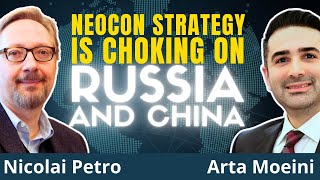
Arta Moeini and Nikolai Petrov argue that reviving Cold War containment toward Russia and China would be self-destructive for the US. They trace how George Kennan's political strategy became militarized under Paul Nitze, fueling the military-industrial complex, and propose instead a concert-of-Europe model based on regional interests and diplomacy.
Chapters
What if the timing has passed and we are actually further along the way to multipolarity or long enough on the way that a return to a bipolar system or some form of predominant hegemony of the United States is no longer possible? Then in that case, the inability of the American elite to see this is catastrophic for the United States, and its catastrophic consequences will become more and more evident in our constrained role in the world. At the same time, I would say that those countries that predict or are essentially committed to that view, China by choice, Russia by necessity, are in a better position in the long run. But that's where the idea of a concert as an alternative comes into play.
Hello everybody, this is Pascal from Neutrality Studies, and today I've got with me two wonderful guests who both have been on this channel before, but not together yet. I'm talking to Arta Moeini PhD and Nikolai Petrov PhD. Dr. Moeini PhD is the Director of Research and Head of US Operations at the Institute for Peace and Diplomacy, which is a North American think tank, while Dr. Petro is a professor of political science at the University of Rhode Island and the author of The Tragedy of Ukraine: What Classical Greek Tragedy Can Teach Us About Conflict. A few months ago, the two published a wonderful article entitled The Folly of a New Containment, in which they argue that the neocon dream of containment revival to deal with US adversaries, that is Russia and China, is downright self-destructive. This is what we want to talk about today, so welcome to both of you.
Nice to be here.
Thank you for having us.
Nikolai and Arta, when I read your article, I thought this is an argument that needs to be play more and also repeat it again and again. Because this idea that containment needs to be used in order to deal with China and Russia is an old Cold War concept. And it seems destructive, but you laid out why that is. Can I maybe ask both of you to just quickly give us an overview of why containment is such a bad way of trying to deal with this new world situation? Maybe I ask you, Nikolai, to start, and Arta, maybe you can pick up on that later.
Sure. So it was based on— the article, I think, was based on a discussion that was sponsored in part by the Institute for Peace and Diplomacy that included Oh, oh geez, what's his name?
Sorry, I forgot.
Is the professor at—
Michael Kimmage.
Michael Kimmage, right, of course. Michael Kimmage, who teaches at Catholic University and had written an article in Foreign Affairs. And Michael made an active case for the renewal of containment. And that just seemed to both of us the wrong way to go and to be thinking about a post-Cold War world. At least that's, at least in my mind, there's still this hope that we don't have to return to the Cold War. But I guess the advocates of a new containment accept the view or take the view that a Cold War revival is necessary and maybe even for some desirable. Well, there are many reasons to disagree with the revival of containment. And I guess there are philosophical ones and practical ones. Both of which I think are weak arguments that we addressed. So on a practical level, the argument for containment is that it can be made today successful, more successful than it was in the Cold War because of sanctions. So the assumption here it is blithely that sanctions work. Although there's no evidence to point to for success, nevertheless, sanctions must be assumed as a matter of faith, I guess, that they will triumph in the end, that they will change policy. And by the way, as far as I can tell, The literature on sanctions is very clear. Not only do sanctions not work in the case of Russia over the past decade, I would say, since 2014, but they haven't worked historically with any country to actually change policy. Very much the measure of the failure of sanctions very much depends on how devoted the country is to the objectives that it sees as essential to its policy. And the closer those objectives are to national survival, the less effective sanctions will be. And certainly in this case, Russia has committed a great deal and sees the conflict in Ukraine I think as a conflict in which Russia's own survival is deeply, deeply involved. And therefore, given the stakes, given the geostrategic proximity of Ukraine, I just can't imagine a scenario in which a Russian government would back down. And submit, or let's say alter its policies due to sanctions. So that seemed to me a very weak read to base the success of any new containment on. The second is the assumption of political isolation of Russia, given the Western will to make it so. Well, again, the evidence seems to point to the contrary, that Russia is forging a number of new alliances and making those alliances much stronger. And the growth of the BRICS and the number of countries that are striving to become involved in this sort of BRICS— I don't know what to call it exactly yet. It's not clear how it will evolve, but some sort of BRICS matrix that will establish the framework for an alternative world order, one that is not so much dominated by the United States and its allies, suggests that there is ample room for expanding Russian contacts. And I'm only talking about Russia now, and this is important to remember, but it really is a much larger framework that includes Russia, China, Iran, Brazil, and India and a number of other countries. And I think the third, so that premise of Russian isolation seems to, again, to me, to be contradicted by reality and therefore a weakness of the neo-containment argument. The third one is the assumption really not addressed but implicit in the new containment policy is that the West has endless money. Endless money to throw at this problem and endless, uh, resources to apply. And that simply seems to not be the case, although it's not something that is widely acknowledged. I read quite recently that Germany has decided— we'll see whether it comes to pass this way— but there are now open discussions about the current German government, and I don't think there's one in Europe that is more committed to Ukraine's victory, at least on paper, saying it cannot provide any more weapons because the gap in its funding, its budget deficit is too large. So they have suspended, they will continue through the end of the year to provide what has been allocated, but that Ukraine should not expect any more military funding after that. Of course, the United States is in a unique position to print all the money it wants. But again, I suppose there's an economic debate. Does it matter? Can, in fact, the United States print endless amounts of money without consequence, or will the, the bill someday become due, and what will the actual costs be to the American consumer? And that's a very big question mark that I suppose at some point politicians in this country may want to or may be forced to address. So those are 3 big caveats that I would say just on, on a practical level make a neo-containment unfeasible.
Arta, do you have to add to that, to this mindset under which neo-containment is being proposed in the US? And seriously, I remember having read this article in Foreign Affairs, and it's just one of these articles where I can just shake my head and I can't take that very serious because of these constraining factors. Do you have something to add here?
Yeah, I mean, I think Nick rightly spoke about the material constraints and the money and the sanctions. And I think one of the things that I want to focus on to just also give the audience the sort of the other aspect of this, the psychological impulse. So there is a lot of move. I mean, everyone talks about the end of unipolarity. Many people talk about the coming of a new order. But if you actually sort of sift through the ideas that the sort of neo-containment or the new language of post-unipolarity pushes forward, you see it's the old ideas repackaged and put on a new form. They are not sort of a— they are stuck in the Cold War mentality. They are fundamentally Manichean. It is very hard for many of these arguments to move past the militarized approach that things took during the Cold War. So when we think about sort of what is the alternate sort of world order that we are heading towards after unipolarity, even the ones who talk about multipolarity, and especially the ones that talk about great power competition, the great power competition sort of argument, which casts itself as realist, is I think needs to be addressed because it looks at the question through the question of universal power of the great power. So the world is again reduced to 2 or 3 great powers, and it is then incumbent upon the United States to protect its own power at the global level. So that ends up reducing itself to another quest for primacy and global hegemony. And through this kind of containment mechanism, not only applied to Russia, but will now be applied to China or any other country that challenges us quote unquote globally. So this globalist cognitive bias, maybe we can call it, coupled with a Manichean mentality, a zero-sum idea that there's a world for the taking and the logic of realism means that the entire world will be taken either by us or by China. This is the fundamental, I think, fundamentally failed logic of the great power competition arguments, which then makes it inevitable for us that we need to do everything that we can to weaken our quote-unquote adversary or enemy. And I think a more holistic concept of realism, as we're introducing, that focuses on the psychology and psychological and cultural aspects of realism as well, that is very helpful here to help us move from the sort of the Cold War mentality of black and white thinking and this idea also of teleology, right? We know how the world moves, which way we are moving towards. The idea of progress is tied with this idea of historical teleology, the role that we have for ourselves as a kind of, as a power. But if you think about it, we are also seeing the world in highly ideological terms. So I think what changed during the Cold War is that And this is another thing that it's important. A lot of people who, even when we were having this discussion with Nick originally, when we discussed Kennan, I think one of the things that we need to focus on is how even George Kennan, the advocates of containment, were not seeing this as a military strategy initially. It was a political understanding of an aggressive ideology and how to protect and preserve the sort of the interests of various other countries from this aggressive ideology. But during the years, during the decades, that changed. So the idea of containment became militarized and became something that we can only see in the battlefield and through coercive and forced posture. And so that shift, I think, is a very important one to address because Again, the idea of defending against an aggressive ideology would be something that then we seem to have internalized from the Soviet Union. And now we have that globalist ideological impulse to try to dominate the world. And that's the problem.
This is something I didn't understand because this containment idea now of Russia and China is not new. I mean, this has been floating around latently even before '22 and now even more. But the original containment, as conceptualized by Kennan and so on, was containment of communism. It was the containment of the idea. And the whole point was, let's not have the domino effect where today, after China, it's then Vietnam and then Laos and then Cambodia and then the Philippines and then Japan. And then in the end, the communists pop up in San Francisco. That was the idea of containing communism over there. And now this, at some point, this was transformed, right? And taken, like, literally into, like, containing a country with military force. When did that happen?
With military bases, with the construction of a network of bases around the physical territory.
But why? And when did that happen?
Because that's how you can make money. The budgets can be written around military budgetary expenses and the construction of bases. And this is the heart of the military-industrial complex. And I think in their heart of hearts, The people who espouse containment want to get back to those simpler days, to that simpler accounting where you knew who the enemy was and how to stop them by spending money on more missiles, tanks, defensive and offensive weapons, and the entire plethora of networks that can be constructed around base agreements, sales, military sales agreements. My God, the literature on these military contracts fills entire libraries. And all the legal wording that goes around these constructs and all the legislation that goes with it. Those were good times. You know, those were good times for the American economy, for industry. And you know what? They can actually point to the impact that this has by looking at Russia today and say, well, look, look how well Putin's doing economically. Because why is that? Because he can spend domestically. Turn on the spigot and spend money on arms and arms sales, which, by the way, are going through the roof, Russia's foreign exports of arms, among other things? Why can't we? We're better at this than they are. We can do this even better.
But it's military Keynesianism. I mean, you don't need containment to do military Keynesianism. You just need to want to spend what's around.
But containment is the positive outcome of this. I sometimes wonder which comes first, the military economic component or the military ideological component. I think it's a toss-up.
Arta?
Yeah, and also, I mean, I'm just going to add very quickly to this. The idea of containment that, for example, Kennan was advocating from the very beginning had a spending dimension, but it was not military-oriented. It was based on the idea that you cannot, as we talked about earlier, contain an idea the same way that many ideological problems don't have military solutions. The best thing you can do is to strengthen your domestic core. That meant to spend on your infrastructure, create programs, social programs and economic programs for your own people. And by sort of having a strong economy across the West, you know, conceived at the time, Western Europe and the United States especially, you could, you know, just stop the advance of communism as ideology. That's a very different understanding, which talks about sort of the economic strengths and manufacturing and industry and your own people and their interests instead of military conglomerates, but also a military dimension of question, which really early on caught on. And I think by, you know, by late '70s and '80s, you're talking about rollback. I mean, the containment also became so aggressive as to turn into rollback. So I think the militarization of outlook around questions that don't have military solutions, we see this across the world. I mean, for example, I mean, if we think about Israel and Hamas, again, Hamas does not have a military solution either because it is also Driven in part by an ideology and in part by some national psychological sense. So when we look around the world, we see that we think of various problems in military and security terms that don't have military and security dimensions. But we need to actually focus on our domestic priorities. And in that way, we strengthen the country against a lot of these threats.
Nikolai, you want to add?
When you militarize the concept of containment, which happened under Nitze, I think, when Nitze took over as head of the policy planning staff at the State Department, you also, at the same time, to justify the military expenditure, need to constantly remind and refurbish your enemies. You have to create a perpetual mindset of these are our enemies and we need to stop this development of our enemies, lest there be more enemies in the future. It's all about creating and to some extent maintaining these enemies to justify the expenditures that you want to over, which are the solution to the problem. But actually, in a bizarre way, you can never let go of that problem. Because if the enemies, you know, were vanquished, my God, then you'd have the end of the Cold War. And we certainly didn't know what to do then. We couldn't just let peace break out. And to make sure of it, we kept NATO. The argument at that point was just in case. Well, lo and behold, just in case became a self-fulfilling prophecy.
Yeah, let's not forget that during the 25 or so years when there was no serious adversary nowhere to be seen, We conjured up terrorism as a phantom threat to fight against everywhere and anytime.
The global war on terror.
Global war on terror. And if all you have is a hammer, then everything starts looking like a nail. The sad thing, and this is something that should worry us political scientists, is that it seems to be working because we now are going to have 50 new US bases in Finland. 17 new bases in Sweden. There's at least 3 or 4 more bases in the Philippines and expanded base agreements. There was a coup in Bangladesh, which probably is going to result in a US base somewhere in the Gulf of Bengal. So this is a success story here for the containment wing of US national security thought, right? I mean, it is expanding now.
I'll just— I completely agree with you, but I think short term, I think you're right. But I think long term, both the lack of sustainability of this kind of expansion and also the failed logic behind globalism, because you don't actually have one world, you have multiple systems in various regions. And I think that's the return of normalcy. We need to refocus and recalibrate the world according to its various regions, various peoples, various cultures. And it means that, yes, one of these countries, no country perhaps could fight the United States at the, you know, early post-war years as a superpower. But as the US power has declined relative to itself because of this expansion, right, because of this sort of hegemonic impulse, various regional actors, what we call middle powers in India, Brazil, and some of them that have grown to become great powers like China, are each sort of pushing back in their own regions. And collectively, that'll be very impossible to handle for the West. So I think this kind of push that you're seeing is actually a kind of last-ditch attempt, sort of the, you know, the star before it sort of explodes, it becomes very bright. And I think this is what we are witnessing at a time of radical shifts and change around the world. And I think this kind of containment mentality doesn't work. But of course, having an enemy, having, you know, a Manichean mentality— Manicheism begets Manicheism. When you have a universalist understanding of the world, you need to have another sort of universalism to fight. So Islamism is the perfect sort of foil for this kind of global hegemonic model because it's also universalist, it's also totalitarian, it's also hegemonic. And so it was as communism. And what happened is that a lot of these reactions to these universalist ideologies are cast in other universalist terms. So in a way, today's liberalism is a mere image of the communist ideology. Not because it is communist, just because it is universalist and it has internalized many of those sort of friend-enemy distinctions. And it likes permanence. So we talk about permanent enemies. We also talk about permanent alliances, NATO always expanding because it is sort of, we think the world should stay as it is in terms of our permanent ontologies, permanent friends, permanent enemies, permanent reality. Quote unquote, which is our constructed way of seeing the world. And we are— we refuse to think outside the box of the categories that we have inherited, the path dependencies that we have put ourselves on. But I think at some point, as good realists, we should know that realism bites back. Times change and nothing is permanent. So that is a tragic reality or tragic sensibility that someone like Kennan had. So I just before this talk or before this session, I just came across a letter a friend sent me from 1997. And it's, you know, Nietzsche and many others, basically all the luminaries of the post-Cold War era during the Clinton administration sending a letter opposing NATO expansion. This was like everyone, I mean, from, you know, Susan Eisenman, Raymond Garthoff. I mean, we had Michael Mendelbaum. I mean, you had almost everybody including Nietzsche. So even the people who were containment-oriented in the '90s wanted, I mean, again, so my point is not to vilify these people. They wanted a shift, but sometimes the categories that you have in the back of your head and the system itself works in such ways as not allowing even when the statesmen in charge all of them collectively wanted to. So if we can use the term the blob, the blob wanted to shift, and yet the system didn't shift. So the question becomes, why and how can we change when even when the blob is willing to shift and wants to see a new understanding, the forces that be sort of move towards more containment, more militarization, more hegemonic stance, and that begets more universalism, militarization, and other sort of aggressive posture from the other side. So obviously Russia, China in time, and we saw that in the Islamic world as well. So I think it's a tragic cycle that we cannot easily escape from. But then the tragic sensibility is that ultimately nothing lasts. So we cannot sustain this for much longer without severe cost for our national or security and also our national interests as the United States.
Nikolay?
No, all— I agree with everything that's been said, but I'm not very hopeful about breaking this cycle because the easy— I think politicians around the world, and certainly in the West, tend to take the path of least resistance. And the path of least resistance is the one that rewards them for short-term thinking, not long-term planning. And the— in the short term, it's about, uh, you know, where am I going to get a base? Am I going to get those resources that the state can provide for our military security. And I'm going to define military security as the solution, the solution to all our problems. And we'll let, uh, eggheads like us talk about the long-term difficulties and the projected troubles that this could lead to, that'll all be well and good after we're gone. You know, not our problem, I think, is the actual practical policies that are pursued by our political leaders. And unless there is an imminent catastrophe, they're not likely to change their actual policies. And my question is even, I think, I hope this isn't the case, but I sometimes fear that even an imminent catastrophe doesn't change deep-seated patterns of thinking. It says it will lead specific statesmen to change their tactics, but not their specific strategic thinking. And that's one reason why I think Russia as a European power has been marginalized, not just over the course of the past decade, 20 years, 50 years, but probably going back centuries, actually. And I think it's interesting to see Russian political analysts now, well, not for the first time, but more aggressively and actively trying to redefine Russia's role in the world away from being a European power, which has always been the assumption, I think, among the Russian elite. Russia is a European power with an Asian caboose. Now they're saying, we were actually, if you look at our relations honestly, never going to be a European power, and we are something in between. Clearly, you know, we're not, we are European in our cultural sensibilities, but also vastly located in Asia. So we have to somehow come to that recognition that we are neither entirely European nor entirely Asian, but as they like to put it, a world unto ourselves that establish, is here to create some sort of bridge.
And what if that in and of itself, the way that the world is now moving, is already the catastrophe, is already the calamity that has to induce change? Because the The point about a multipolar world is that if it emerges and if we have it and if we agree that it is multipolar, then it is not something that one or the other power can stop. That's the whole point, right? You have power distributions that then start counterbalancing each other. And that is definitely something the containment strategy wants to prevent. But what if that point has already passed? And this is where you also went back to history and said, look, we've had that moment before. And the Europeans then decided, let's do a concert. So a concert would be a more fruitful way of trying to conceptualize a stable relationship of global politics.
I'll let Arta get into the concert part in a second, but I just wanted to say, picking up on your point about what if the timing has passed and we are actually further along the way to multipolarity or long enough on the way that a return to a bipolar system or some form of predominant hegemony of the United States is no longer possible, then in that case, the inability of the American elite to see this is catastrophic. For the United States and its catastrophic consequences will become more and more evident in our constrained role in the world. At the same time, I would say that those countries that predict or are essentially committed to that view, China by choice, Russia by necessity, are in a better position in the long run. But that's where the idea of a concert as an alternative comes into play.
Arta? I mean, I think one of the— we need to look at all of these things that are happening in different pockets, whether it's in the Middle East with Israel, whether it's Ukraine. The dynamics that we are witnessing are accelerating the shift away from the unipolar order. And with it, and with the insistence of Western leaders on the sort of old assumption, the deep-seated patterns of behavior and belief, it is actually kind of not only diluting the West's geopolitical advantage, but also its cultural and soft power influence around the world. And I think that is already a shift. And it's hard to sustain once you realize that the United States debt is skyrocketing, trillions in national debt. You have a misconception of priorities. And again, none of the argument, at least the Institute for Peace and Diplomacy, for example, in general, we don't have official positions, but it's a realist understanding of world affairs does not mean pacifism. It does not mean that we don't want to spend anything on the military or not to spend anything at all. It just means to first look at what are the reasons for you acting the way that you're acting? What are the sort of the deep-seated beliefs? What is the ontology? But also what is the resources that you have at your disposal? And in that sense, the United States and the West is having problem dealing with all these various regions that it calls sort of basically crisis zones. So that is already accelerating and that's producing a polycentric order. I'm not going to even call it a multipolar order because that assumes only 2 or 3 or perhaps 4 great powers, which again reduces the world to the universalist ambitions of those 2 or 3 powers. But a polycentric order that's more normal. And what do I mean by normal? I think previously to the sort of the modern sort of end of the 19th century, 20th century era, before the concept of Europe collapsed, we had a different understanding of foreign policy and international affairs that was based on multiplicity rather than sort of one-sidedness. And this meant diplomacy was very important, also put a huge value on neutrality of fault line states. I mean, think about the Neutrality Act of 1839 for Belgium. I mean, again, big anchor states, core countries in Europe, understood that in order to peacefully coexist, Belgium has to be a neutral state and demilitarized. Now compare that attitude to the way that we are thinking about Ukraine. The idea of demilitarization has been anathema for a lot of people, but that is that idea of peaceful coexistence, that idea of multiplicity, that idea of modus vivendi. That sort of counteracts the globalist cognitive bias, the sort of the general sort of one-sided hegemonic way of seeing the world and wants to not necessarily share the world, but allow for various powers and the power is more diffused to come to certain informal arrangements and understandings within themselves through diplomatic and multilateral arrangements. So I think that idea of sort of what we tried to think through in this paper was to say, well, the Concert of Europe was very stable for almost 100 years. There was a reason because of wars and instability of the late 18th century, early 19th century in Europe because of Napoleonic Wars that created the concert. So perhaps, we are seeing this in a way repeated, but at the global level now, because the European models have been in a way also exported. So how do you create that understanding in a world that's more diverse, that's more diffuse in power and more regional? And if we can do so, we should be able to allow for a much more, much better understanding where we're sort of Yes, national interests are protected, but spheres of interest, spheres of influence for countries have been a reality. And that's not something that any state can just wish away. That would be wishful thinking. So how do you come away thinking through these actual existing reality that is, again, the system, my point is that it's normalizing, going back to that multiplicity of power centers. And what we cannot perhaps defend against or resist, as neo-containment likes to do, is that the systemic shifts in the power differentials and the return of civilization and culture. And again, to an extent, I do respect Sam Huntington, not because I agree with everything he says, but because he understood at a core level that civilizations cultures, the way that people make sense of themselves, that sort of being in the world matters. And I think we are seeing various cultural powers, civilizational states, but cultural powers in specific domains come back and try to affirm their own existence away from a universalist doctrine. But the more we push them through our sort of universalist lens, the more they also see the world universally. So for example, Russia is the perfect example of a country that had this sense of cultural realism. It understood after a while that, you know, maybe it is not a European country, maybe it's always been an outsider, the same way that Turkey has understood that as well. And, you know, even Iran flirted with the idea of being European at the time. But all these, you know, cultures understood once the allure of Westernization and European exceptionality passed, that they are exceptional are at least distinctive in their own rights, and they want to affirm their own sort of presence and existence. So it's very hard to fight against systemic pressures through policy, and the more you do that, the more you actually weaken yourself in the world that is about to come. So the next world order, the post-uniform polar order, which I argue would be more normal and more diffuse and more regional and more multiple and multiplex, will still have regional powers. It will still have great powers. And these great powers will have more of a say than smaller powers. So the question is, do you actually survive this transition as a strong country? And that is something that I think our wastefulness and our insistence on ideology and maximalist thinking again actually does disservice to our own national interests.
Can I just jump in to suggest an answer which derives from the analysis that Arta made, which is that we get to this alternative by recognizing global cultural pluralism and making it, making a connection between it and a global security system. We connect the dots between the existence of cultural pluralism on a global level and say, well, what are the security implications that flow from that? And oddly enough, at least in my thinking, and I haven't— I'm not sure I have all the details down with this yet, but it goes back to something that began in the context of the origins of the current international system, when indeed the idea that one could prescribe the religious views of people based on the, on the view, on the religious preferences of their leaders was not enough of a good reason to kill everybody, to go to war in Europe. And the Westphalian system that emerged from that said that could be left aside. We didn't have to have that kind of religious, but now today we would say ideological or cultural more than religious uniformity in the world. We can have that. We can let that be a local matter. So why not actually reconceptualize that in modern terms and say what we need is a better intellectual cultural foundation for a global security system? Because a unipolar world And a liberal world model ain't going to work. It just doesn't suffice to guarantee that security today. And the United States can't make it happen on its own.
And I just want to add one quick thing. One of the pitfalls of realism as a realist is that it lost touch as well with political realism that had a big, large tradition in Western political thought, European political thought especially, and even the American model that we talked about before about George Washington, that sense of realism and sensibility and common sense, we lost that to a more doctrinaire theoretical realism of IR that was much more steeped in utilitarianism, cost-benefit analysis, material conditions and the material understanding of power. And again, this is not, that doesn't give you the whole picture and also sort of reduces all this complexity to the question of, you know, how many tanks you have. And it's not that simple. It is far more, again, the question is far more cultural and regional and local and geographical. When you talk about sort of the influence that a country like China can have in Southeast Asia. It's not just because of the number of military that it has, or because of even its economic power. It's because of its deep-rooted historical connections with a region that's proximate to it. And the question— and obviously, America has, for example, much more linkages in North America, and even in the Americas than it does in the rest of the world. So the idea of proximity, the idea of neighborhood, the idea of regions need to be again understood front and center because they, the history and the geography and the culture interlink. And sometimes we have this tendency of taking our experience and calling it exceptional. And then as that exceptionality, whether it's a Russian exceptionalism or American exceptionalism, system and then projected upon the world and that the world, this abstract thing, the rarefied thing we call the world, is better off if we were to govern it, if we were to, if our values and our rules were there. And I think the problem with this rules-based order or liberal international order that Nick rightly brought up is that it is very parochial. It came out of a specifically, you know, first European and then American experience. And it kept in, it was a corollary to American power and its universalist dimensions. So it is very hard to hold on to the kind of simulacrum that it has created once the power and the impact, the efficacy of US power is diminished. And again, all this language that we are so familiar with, the formal language of, you know, of this and this global organization, of international law, of all these different things that people take comfort in as the idea of the order, that in itself was always subject and created by power. And I think to allow for, again, the more, you don't have to think these legalistic and this legally or legalistically and formalistically about the reality of diffuse power and multiple existence. And that allows us to move beyond the homogeneity and homogeneous pressures of the current system.
The question to my mind, I agree with everything you are saying. The question to me is in this game of reciprocity and action and reaction, what's the current the current system that we are in, what that leads to. Because what we have seen in the Cold War is that the formation of NATO and the ganging up of certain powers led to the ganging up of the others 5 years later. The Warsaw Pact was formed, and you could see how this inspired each other and how that created then this block system from which a third block tried to distance itself, but it was framed as still within the bloc mentality. And what we are seeing right now is— the question to me is, will that happen? Will it happen that suddenly China and Russia too will try to form their blocs and their alliances and their military bases and their people and their chess pieces here and there? It doesn't seem to me like this. It seems to me that the system currently tries not to go that way. And neither the Russians nor the Chinese are building their alliances. The West frames it often as as such. They frame it as an alliance, but if Russia and China are in alliance, we need a new word for what NATO is. And so how do you see the action-reaction pattern now playing out? In what direction? Maybe if you want to frame it in realist terms, and realism has a huge problem now because Europe doesn't work on the realist framework anymore because most of these states are shooting their own foots right now.
Well, I mean, again, that's part of the ideological dimensions that we were talking about. There was a huge push and pressure towards Americanization in Europe that occurred in the post-war years. And we're still seeing, you know, even when Europe talks about its strategic autonomy, like Macron is a perfect example of this, it is really only pushing American agenda. And that is the kind of problem that before Europe can be independent, it's not just a matter of spending 2% on your military or contributing it to a military alliance. It's a question of how do you define what is your interest and what is your geopolitical reality that's different from the Russian or American one. So, but that's one question. I think, I mean, the other aspect of the question that you're raising, I think is very important. How do you get away from it? And I think you're right that the rest of the countries, China, Russia, for now, are not moving towards that direction because I think they have, in a way, realized or internalized, having gone through it in case of Russia, the sort of the Kennan logic. They now believe that the West, so again, this West, whatever, the liberal democratic Western order is has fundamental problems and it will implode. The same way that Kennan thought that communism and socialism in Russia has fundamental problems and it will implode. And Emmanuel Todd thought the same thing. So again, most people think that it was Reagan and NATO and our military posture that led to the fall of the Soviet Union. It wasn't. It was predicted by the overly universalist ambitions of the Leninist doctrine from the get-go. And it was that, that was the greatest grain of wisdom that we inherit from Kennan. And if we think about it in a backward way, Kennan's logic now applies more to the United States and its allies than it does to China and Russia. And yet, obviously, there are elements, there are ideological and totalitarian elements in those places and countries as well. Because again, we all live in this kind of world and many of the people who are in Russia and China are still, for lack of a better term, boomers that live through the bloc thinking. So it is hard for them to necessarily get out of it. But I think there is that sensibility. And also when you have, when your resources are more limited, when you have other things to consider, you become more realistic. And I think that is the one thing. I mean, if you think, The Islamic Republic of Iran is a fundamentally ideological political system. And yet when it comes to foreign policy, it acts with severe restraint and realism and diplomacy actually. How? Because it knows that there is limits to its power. And that its power is fundamentally regional in orientation. When you do not have those limitations, your ideology really goes on, you know, takes a life of its own. So I'll just stop there and let Nick respond to that.
Ideology on steroids. Well, Emmanuel Todd has recently made the case explicitly that the West, the United States, is following the model of the Soviet Union in its, and its demise, that same structural pattern. So the question is, have modern Russian and Chinese leaders learned the lesson of the Cold War better than the United States? Assuming that the lesson here is not that we can outspend other countries until they collapse, but rather, as Kennan famously put it, that containment was meant to be a political solution to a political problem. And political solutions and problems are always negotiated problems. They are not problems that you try to exterminate because they are not, you can't, they cannot be totally eliminated. They survive in a different form because the people, because they take into account those broader historical long-term cultural interests of people that survive. Beyond this administration and that political leadership. They are eternal problems. And so they are problems that are never resolved. They simply become reformulated, reconceptualized, and addressed in different ways under different circumstances. So that's, I think, the core idea of realism, of properly conceived, that problems never are never fully— they don't go away, that we will not somehow reach nirvana after a specific set of conflicts, but rather that these conflicts are always with us because human beings have conflicts. And that's the nature of our existence. And I think evidence of that, if If that were indeed the case, we will see major countries in opposition to the United States articulating the need for alternative instruments that are non-military and not responding to the creation of military blocs with those same in a tit-for-tat fashion. They will instead work to strengthen their mutual ties in alternative arrangements. So that will eventually— so the thinking goes among those that look toward and see the possibility of a polycentric world, that over time, these alternative arrangements, which will include political, economic, as well as military arrangements, will become more attractive overall to a number of independent actors or that are currently leaning toward the West. They will, over time, lean less and less toward the West and say, well, this is clearly a better model for us today and for the world in the future. And that is the kind of thinking that I think is long-term thinking in the rest of the world that is really lacking in the American and current European political elite. Which is holding on to some perhaps outdated concept of how the world works and that they can manipulate that concept to their own advantage.
If that analysis is correct, then that gives me a lot of hope for neutrality because it is one of the alternative ways of trying to manage conflict, not the only one, but one of those. 30 seconds, last words. Arta first, Nikolai later.
Yeah, I'm just going to sort of piggyback on what Nik said and say, think through the way that we approach engagement and diplomacy with our adversaries. I mean, the negative force or the negative press, the negative aura that talking to your adversaries has. Whereas that's the core understanding of multiplicity, the core understanding of a normal international system. You need to speak with everyone. And I think this is what ends up happening is that we end up with informal arrangements for diplomatic engagement among statesmen of these various countries. Again, it's not that Russia, Iran, China are in an alliance. But there is one alliance and the other ones are just talking to one another to find a way through. But then imagine if this model somehow ends up in the West, in Europe, in America, and spreads to the rest of the world. Well, different major countries are talking to one another, not through the UN, not through formal arrangements, but through informal person-to-person and statesman-to-statesman communication, which was the 19th century model. Again, this is part of the sort of neo-Maternecchian approach, which was also in a way favored by Kissinger and Nixon. So that's one thing. And the last thing I want to end it is just in terms of realism and what it means. One aspect of it was the expediency and sort of the understanding of the changeable nature of the politics and the art of the possible. The other one though is that to understand that the, so the cultural sphere, the global cultural pluralism that we Nick and I talk about is not a normative position. Our argument is that cultures exist. You cannot wish them away and they are different. And so that's why they have security and geopolitical dimensions. This is not a world of diversity and inclusion. Let's make it so that everybody has a say. The first thing is that they exist. There are various regions with various actors and various ontologies and being in the world. And that by itself has geopolitical and security consequences. And a good policy has to take that into account. A realist policy has to take that into account 100% and try to find a way to arrange those differences so that there is constant engagement and communication for a peaceful coexistence. And sometimes there will be war, but conflict will be much more reduced.
Nikolai?
Right. So if other nations and cultures exist, then our security at home here depends on respect for their existence and their continued existence. Because without that, we have only the option of a war for mutual extermination based on values, I guess, values which are falsely linked to our security. And we need to really go back and to some extent carefully distinguish which values are essential to our security and which are not, because right now Everything's in one bowl and our entire thinking about security is muddled and confused and it leads to extremism in practice.
Diversifying the security basket. Gentlemen, thank you very much for this discussion. We will talk again. Everybody, you can find Nikolai's work online and on his homepage. You can find Arta's work on Twitter and on the think tank. I will link all of that below. Thank you very much, Nikolai Petro and Arta Moeini PhD.
Thank you so much.
More from Arta
Dr Arta Moeini: US does Israel's bidding; failure in Iran will finally kill unipolarity. #iranwar
WAR IN IRAN: Consequences for Armenia: Arthur Khachikian with with James Carden and Arta Moeini
The World on the Brink and the US Foreign Policy of the New Era: Arta Moeini & Arthur Khachikian
First US President HATED Alliances For This Reason | Dr. Arta Moeini & Dr. Chris Mott