United in diversity? Can multiculturalism hold a society together?
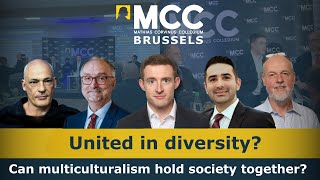
The panel convened at MCC Brussels examined whether multiculturalism can sustain social cohesion in European societies facing demographic change. Moderator SPEAKER B introduced four panelists – Dr. Goran Adamson (sociology), Prof. Bill Durodie (risk & security), Prof. Paul Cliteur (jurisprudence), and Dr. Arta Moeini (political theory) – and later incorporated contributions from audience members and commentators such as Frank Furedi. The discussion unfolded around several inter‑linked strands: 1. Conceptual tension – Adamson argued that “unity” and “diversity” are mutually exclusive; multiculturalism, he claimed, deliberately undermines a shared civic core while fostering intra‑group solidarity, especially among ethnic minorities, often to the detriment of women’s rights. 2. Elite‑driven policy – Durodie traced the origins of UK multiculturalism to 1970s‑80s race riots, describing state‑sponsored funding for separate religious/ethnic institutions as a divide‑and‑celebrate strategy that replaces genuine integration with managed segregation. 3. Left‑wing paradox – Adamson and Durodie highlighted that many left‑leaning parties defend multiculturalism despite its conservative‑leaning emphasis on group homogeneity; the left’s historical commitment to equality, democracy and universal law clashes with multiculturalism’s privileging of group‑specific autonomy. 4. Multiculturalism vs. cultural pluralism – Moeini contrasted “multiculturalism” (a top‑down, anti‑cultural, homogenising agenda) with “global cultural pluralism” (multiple autonomous monocultures co‑existing without state‑imposed hierarchy). 5. EU legal framework – Cliteur pointed to Article 2 of the EU Treaty, noting the tension between universal values (human dignity, democracy) and the EU’s push for pluralism, tolerance and non‑discrimination, and warned that the latter can be weaponised to erode nation‑state cohesion. 6. Empirical observations – Participants cited examples from France, the United States, Switzerland, Singapore and the UK, arguing that successful economies are largely mono‑ethnic or highly decentralized, while multicultural societies show signs of segregation, ghettoisation and declining social trust. 7. Identity, resentment and “woke” culture – Moeini and Furedi described a broader “ethic of resentment” that frames all groups as victims, turning diversity into a political currency that masks a loss of collective meaning and agency. 8. Tolerance re‑examined – Adamson and Durodie distinguished genuine tolerance (robust engagement) from mere indifference, arguing that a society built on superficial tolerance is cold and fragile. 9. Future trajectories – The audience asked what follows the decline of multiculturalism; panelists suggested a shift toward a post‑woke, meaning‑focused politics that re‑asserts a shared civic core while allowing limited, voluntary cultural expression. Overall, the panel concluded that multiculturalism, as currently practiced, tends to fragment societies rather than unite them, and that any viable path forward must reconcile universal civic values with genuine cultural pluralism without resorting to state‑engineered segregation.
Chapters
I want to swim, but I want to sail.
Okay. Hi, welcome back, everyone. Glad you can stay with us and join us for this, the second session, which we've wanted to kind of put after the discussion we've just had, where we're already beginning to dip in a little bit to these questions of what actually is required in terms of social cohesion and looking at how a society can hold itself together given kind of demographic changes and the response of multicultural policies and whether that helps or or hinders that quest for social cohesion. I was thinking about this a lot over the last few weeks, and especially in that last session, when you think about the responses often of policymakers and elites when they're pressed with the question, well, hang on, how do people form a kind of cohesive society? Their responses are often quite bureaucratic, and so lots of countries, you come, want to naturalize into a country, or even come on a long-stay visa, they'll often make you take a language test of some sorts. And not only are those language tests very, very basic at best, but also they're a very kind of bureaucratic exercise in that you go in, you take some— you tick some boxes in an online questionnaire, and that kind of entitles you to consider yourself as part of a— be part of a country or part of a nation. And so hopefully in this session, what we'd like to do is move a little bit beyond kind of bureaucratic responses to the question of how you cohere a society together in the face of differences and diversity, and take a stab at drawing out something more meaningful in terms of what the responses should be in European countries to these problems of social cohesion that we all can recognize from examples. If you live in Brussels or in Belgium, they'll be familiar to you, right through to recent challenges. And we heard about some of the social conflicts in some countries in the last session. People could have also added to that list the kind of recent difficulties and the riots in France. So there's a lot for us to dig into in this session. I'm really delighted that we've got a wonderful panel to help us navigate our way through this. I'll introduce them all briefly. On my far right over there is Dr. Goran Adamson, who's an associate professor in sociology and the author of a book, The Trojan Horse: A Leftist Critique in Leftist Critique of Multiculturalism in the West. You can read online in his biography, but we were discussing a little bit recently that book, which sounds a really useful intervention into this discussion, situating from a kind of left-wing perspective or history some of the challenges that multiculturalism as a series of policies kind of poses. So I urge you to go and look that book up. Sitting closest to me here on my To my right is Professor Bill DeRode. Bill is a visiting professor to us at MCC Brussels. We're very lucky to take advantage of his expertise there, but he's also a chair of risk and security and international relations at the University of Bath. He's held posts and taught and done research all over the world and is author, kind of very importantly, of a new report for us at MCC Brussels looking at the way that the EU uses and abuses the Eurobarometer polls to confer legitimacy on EU policy. So you can find that report on our website. Then sitting on my immediate left here is Professor Paul Clutter, who's a professor of jurisprudence at Leiden University. Paul is a really rare interdisciplinary figure. Usually when people say the word interdisciplinary, it makes me reach for my shotgun, but Paul is a kind of a really good model of that, moving across history, philosophy and the law, both in its kind of theoretical and practical applications, and also outside of academia, has a political involvement with the Dutch political party Forum for Democracy. So really delighted that Paul's with us. And then last, but by no means least, is Dr. Artemoini, who's a visiting research fellow to us at MCC Brussels. He kind of by trade is a political theorist and a scholar of geopolitics, international relations. He's looked at a variety of questions in the— at the Institute for Peace and Diplomacy related to international issues, but also situating those kind of geopolitical challenges within the realm of culture and within the realm of kind of the diverse national cultures that make up obviously the international space. So Can we welcome all of our speakers? So a little like the last session, I'll invite our speakers from my right to left to make some introductions, no more than 5 minutes, and then we'll dig into the conversation a little bit more. And we'll soon be out to the floor for questions and comments. But first, Goran.
Thank you very much, and thanks a lot for inviting me. It's a pleasure to be here. I will try to be rather brief because I prefer to have a discussion than just talking away for 10 minutes. What I'm going to do, I'm going to try to unpack, as they say, the very title of this panel. The title is called United in Diversity: Can Multiculturalism Hold a Diversity Together? My first question here is quite simple. United in diversity. I actually question that, because in my view, you can't have it both ways. You simply cannot have it both ways. Either you strive for unity, you strive for cohesion, you strive for similarities, you go for the common ground, for proximity, and all of these related ideas. Or you may favor, if you so wish, difference, distance, confusion of tongues, lack of understanding, etc. So, you can favor, if you so wish, unity, or you can also favor, if you so wish, diversity. But you cannot favor both at once. That is not possible, in my view. I think that's a bit of a delusion because they are polar opposites. You just cannot do that. You can say you do, you can claim you do, you can have conferences, you can have seminars, you can govern countries, you know, under these banners as much as you wish, but it still doesn't work from, I would say, a logical, philosophical point of view. These are two very different ideas. So, what has happened is something, I would say, intriguing and interesting. We used to favor equality, but now we are supposed to favor lack of equality. We used to favor similarities, and now we are told we should cherish the virtue of difference. Everything under the icy banner of multiculturalism. So things have changed. And this is also— I referred to it in my question before when I cited an old, very nice former Swedish prime minister, social democratic prime minister in Sweden, who was talking about Sweden being virtuous because— or lucky and happy, a happy country because we had a homogenous society. So you have these shifts. And this is not a conflict between left and right. This is a conflict. At the heart of left-wing ideology, or moderate left-wing ideology. I think that's worth mentioning. The next point here, which relates to the title, "United in Diversity: Can Multiculturalism Hold a Society Together?" is something that you hear very often, a kind of optimistic idea, an optimistic, perhaps a little bit naive idea, and it goes something along those lines: "We must focus what brings us together." And it sounds fabulous, it sounds lovely, and it is also a very nice thing to say. I'm not saying people— I mean, they also referred to this in the previous panel. We are not claiming that people are necessarily evil-minded. They are good-natured and they want to do good things. So they say, "We must focus what brings us together." Right, so what I'm saying, my comment here is this: this rests on the optimistic, or should I say again, the sometimes naive assumption that we always have something in common. That we always have something in common. The one who seeks, he shall find. We just need to look for it. We need to look for it, we need to search for it, and then we will find it. That's, you know, the logic behind this idea. So, but sadly, this might not be true. This entire idea does not work if we have nothing in common. It does not work if we have nothing in common. If there is nothing underneath that unites us, then you can go look for it, until the day you die, and you still will not find it. And I'm not saying that one is better than the other. I'm just talking about mere differences, the problem of difference. There might be absolutely nothing in common, and what do you do? Anyway, so in order for this whole optimistic idea to work, we need to have something in common beforehand. For instance, I have I have some Tunisian friends, and we all play chess. So this is a lovely thing we share. And if we hadn't played chess, we wouldn't have had this common, you know, thing that can bring us together. So there has to be some— there has to be some— something in common. If it doesn't exist, you can't do anything about it. That's the point. So without any preexisting common ground, these ideas have no meaning. And I do believe that this optimistic, or naive, I would say, assumption that our differences are merely superficial, that the differences are superficial, and that the commonalities are always at the core of our existence, is very central to the whole multicultural delusion in which we are living. And there are so many delusions in the multicultural ideology, among the multicultural entourage, as I used to refer to these people. But so it's like a cobweb, it's an intellectual— it's so complicated. But this is just one of these contradictions or delusions, actually. Okay, so then the last thing I'd like to bring up is the question The subtitle of the title here, "Can multiculturalism hold a society together?" That's a good question. Can it hold a society together? And my answer to this is that it depends. That depends. If we talk about the overarching society, the host community, Germany, Sweden, into which these people migrate, into which migrants wish to live, The answer, in my view, is no. Is no. Because the basic idea of multiculturalism is not to foster shared views within the wider community, but to undermine them. And this is supposed to be a good thing. This is supposed to be a good, virtuous thing, that we have this diversity. Instead, The net result is that societies will become increasingly fractured. But, and this is why I said it depends whether societies will be— we will create unity or not. But there is another society within the multicultural society, when the idea of multiculturalism and diversity has been finally implemented with the assistance of universities and the media and so forth. Another society within the multicultural society, namely the ethnic minority. The autonomy of the ethnic minority is the pillar, I would say, of multiculturalism, or at least one of the core ideas of multiculturalism: the virtuous identity and the right of the ethnic minority to live according to its principles, its ideas, etc. And this particular Smaller society inside of the larger, wider host society is often run, not always, but often run by conservatives, often religious conservatives, who cherish and will implement a very homogenous ethnic minority, often to the detriment of women and secular-minded people. Yeah, yeah, yeah, sure. So to sum it up, multiculturalism does two things. It contributes in undermining the wider community, but at the same time, it fosters unity within its own cherished society by the name of the ethnic community. And the combination of the two is not beneficial for either democracy, solidarity, or equal rights, in particular for women. Sorry for being a bit lengthy. That's it.
Thanks, Goran.
Thank you so much.
Yeah, Bill, some opening thoughts.
Okay, I'm going to give you a list of British politicians' apologies if you're not familiar with the British political scene. I want you to think of the British Prime Minister, the Foreign Secretary, the Home Secretary, the Mayor of London, the 4 chancellors before the current one, the leader of the Scottish National Party, and the leader of Scottish Labour. Can anyone tell me what they have in common?
[Speaker:AUDIENCE MEMBER] [INAUDIBLE] They all have an ethnic minority.
So that's the standard answer, and indeed it's true. But I want to suggest to you that that's the most tedious answer, that they're all descendants of migrants, that they're all people of color. What they have in common is that they are all people who chose to go into politics with a view to transforming the world. They don't all agree, they sit in different parties, But that's what makes them interesting. Multiculturalism asks you to focus on what is the least interesting part about them: their color or their place of familial origin. Whereas actually, the thing that defines them, the thing that makes them a human being that is transformative, that goes beyond their origins, is the piece that we forget. They chose to go into politics. And I, I would say to you, that's not an accidental part of multicultural thinking. It's an essential part of multicultural thinking. You think of multiculturalism, and it tells you that there are certain protected characteristics that we must respect to do with color, race, religion, religion, gender— those are attributed characteristics, whereas those that people choose for themselves in order to shape their lives and their destinies are the ones that we neglect as a consequence. So that's the first important point. The other thing about multiculturalism is that we're told that it's about social groups nowadays are defined by their history and sense of identity, and that we should recognize that that forms an essential part of them, and indeed that we should assert the differences between different groups. This kind of multiculturalism really emerged in the United Kingdom primarily in the 1980s, as a mechanism for effectively controlling the relations between different ethnic minority groups, and particularly between those minority groups and a predominantly white population. In fact, I want to skip to an example that, you know, in the 1960s and '70s, what you'll find is that there are many urban centers in the United Kingdom that yes, they experienced racism, and yes, racism was an act of division, but it also brought people together. The experience of racism meant that different communities came together politically to try and challenge the experience that they were confronting. And that experience wasn't primarily a few thugs beating people up. People's experience of racism is primarily experienced through immigration controls, allocation to housing. In other words, racism is propagated primarily by the elites of a country, and then people imagine that it's the acts of violence that are perpetrated by some of the least powerful people. In that country. So those are just a few kind of opening remarks. I think radicals like to celebrate the notion that the Enlightenment project of a kind of rational universalism has failed, and they like to view the idea that society has fragmented because they view it as undermining the grip and control of the dominant elites. The problem with celebrating that fragmentation, celebrating difference— there are several problems, but the first, I think the most important problem, is that a focus on essential differences has always been central, not to radical anti-racism, but is part of racial thinking in the first place, that people are fundamentally different. Different. It's actually an idea taken from the racist lexicon and readapted into the contemporary world. To give you a kind of simple conceptual model, you could imagine that in the past there was a notion of racial hierarchies where maybe white men were at the top of a ladder that then went down through different groups, and there was a sense maybe that if you were joining the ladder at the bottom as an immigrant, a member of an immigrant community, maybe you could struggle and kind of work your way up the ladder a bit, but of course you would never change your color. All that the radicals have done is tip the ladder onto its side and say, no, there's no hierarchy. But we are still trapped within the rungs of the ladder. There are different groups, and we must celebrate these different groups side by side. It prevents any notion of the possibility that human beings can transform themselves and transform their circumstances. It is the most profoundly anti-human way of looking at humanity. It means you are trapped now and for all time within the identity that is projected upon you, until occasional moments when people break out of their identity silos and upset the dominant elites. To give you just a couple of examples of that, what do we do when Muslim women— and of course Muslims today are to be celebrated as one of those diverse groups that we must, you know, absolutely not offend— what happens when Muslim women oppose the wearing of the veil? When they oppose, for instance, the installation of a statue in the United Kingdom in 2 weeks' time celebrating the hijab, a god-awful-looking statue, I have to say. It looks like Picasso was drunk. But called "Strength of the Hijab." Just at the moment when women in Iran are fighting with their lives to get rid of that, a white artist in the United Kingdom is installing a 1-ton, 5-meter-high celebration of wearing the hijab. Suddenly, Women, Muslim women, are no longer high on the hierarchy. Their voices have to be shut up because they are a problem. What happens when black men prove that, you know, vote for Donald Trump? They're not conforming to the presumption of what these identities are. I know that you want me to shut up, so I'm just going to leave you with a very quick thing. I have loads of— Multiculturalism. My definition of multiculturalism is that it is state-orchestrated actions based on a presumption of people as prejudiced to promote a caricature, a narrow form of cultural difference. It purposefully and willfully divides society, the better to control it. That is what multiculturalism is.
Thanks, Mel.
Thanks a lot, Bill. Paul, some thoughts?
Yeah, some thoughts. That's not very easy when you start at 10 o'clock, then you're the first speaker, then you can roll your own story, you can send out to the public. But I've heard so many very interesting things also in the previous session that I'm really confused. Well, let me start by thanking you for the invitation. Frank Furedi's book on Hungary and European values was for me absolutely an eye-opener on this topic. So I'm very happy here to be here on this symposium, on this conference, to join him in ventilating some thoughts on this subject. Well, let's start by yesterday evening. That was a very interesting multicultural conversation and a multicultural assembly that we had there, people from different nationalities with different ideas, and we were talking about books from all kinds of cultures. So on the individual level, being a multicultural individual is really an enrichment. I'm a great fan of the German philosopher Arthur Schopenhauer, who was a cosmopolitan, 1780, 1860, He was very well versed into German culture, German philosophy, Indian philosophy, Buddhist philosophy. He knew the whole world literature. He read all the books in the original languages. So he was a kind of model for a multiculturalist individual. So somewhere the basis of the concept is not bad perhaps, but things have gone terribly wrong somewhere. Multiculturalism developed into the whole diversity thinking business, and from diversity we went to woke, which is a very aggressive ideology, basically very inimical to free speech, to freedom of thought, to tolerance, and basically an undermining of all the values that we pretend to stand for. That's my first remark. Now, can Europe survive multiculturalism? Then we have to go back. What Europe are we talking about? Do we talk about the countries in Europe, about people living in Europe, some European institutions? What, what are the ideas of the Council of Europe, for instance, of multiculturalism? So So there's a variety there, but let's focus then on the European Union. And the European Union has a certain vision on what they see as multiculturalism, and that's articulated in Article 2 of the Treaty on the European Union. And what do we find there? That's interesting, perhaps. Quote unquote: The Union is founded on the values of respect for human dignity, Freedom, democracy, equality, the rule of law, and respect for human rights, including the rights of persons belonging to minorities. These values are common to the member states in a society in which pluralism— there we have our multiculturalism— pluralism, non-discrimination, tolerance, justice, solidarity, and equality between women and men prevail. So if you analyze that text a little bit further, you see first you have a basis, you have an ultimate foundation of all values. That's human dignity. That's what we are supposed to share in the European Union, the idea of human dignity, the ideal of human dignity. Second, this implies also a positive attitude towards freedom and equality. For humans. So no animal rights activists here, but for humans. Third, freedom and equality can best be safeguarded by the adoption of democracy, the rule of law, and human rights. And then fourth, it's a bit messy then what happens there, the text formulates also some ideals: pluralism, non-discrimination, tolerance, justice, solidarity, and equality between men and women. What I want to emphasize with regard to the question, can Europe survive multiculturalism, that is something that one of the previous speakers, Ehsan, here also emphasized, that you always need to regulate plurality and pluralism. You need a firm basis, the rules of the road, some generally accepted the rules of the game. You cannot— well, all the games that we do are, are all rule-dependent, and there you have— you need a monoculture. And, and, and, and, and we need a monoculture regarding to this Article 2 of, um, human dignity, freedom, equality, and also democracy, the rule of human rights. And if you realize that and you focus on that, then you can have the pluralism and the non-discrimination and the rest of the fourth element. I think that's a good— so there is— you can develop a sound idea of multiculturalism, but the train has got off the road. That's basically what I would like to contribute.
Great, thanks a lot. Finally, from some opening remarks, Arta Moeini PhD.
Thank you. I'm gonna probably echo some of the things that you already heard in these So far, two wonderful panels, and I'm going to try not to go too much over my time. But I think one of the major questions that we have to really focus on is the question that Ashley already brought up in the first panel, which is why does multiculturalism, why does this diversity agenda continue to persist? And I think there are two ways to think about that. There are certainly historical and normative continuities that lead themselves to a diversity agenda. A lot of people will, probably among my friends and colleagues, will say that immigration, multiculturalism, diversity, these are new things. I would say that these are a manifestation of something that's actually much older. It's the latest manifestation of that. We are actually in very much continuous ground not a disruption. And the secondary element for the sort of sociological condition of our zeitgeist. So what is it that allows for the appeal of diversity, of the appeal of multiculturalism to both the elites and the masses, for the population, the public at large? So on the normative elements, I would say a few things. The question is, are we actually driven by diversity as the sort of a nonplusultra value, as the highest ideal and value of Western societies? And my answer to that is definitely not. Diversity is an instrumental good, is a means to an end. And by extension, multiculturalism, the same thing. And as I just mentioned, these are manifestations of some different normative position. And so what is that normative position? I think there is, you can see in early, from early modernity all the way to late modernity and even approaching post-modernity, or some would argue we are in post-modernity, I just call it late modernity, an ethic of resentment. An ethic of resentment that's accompanied by a savior complex. That ethic of resentment, that idea that Basically, we should be fixated on leveling things. We should be moved towards reversing perceived or self-identified and increasingly constructed and contrived forms of oppression. And so long, and that this is structural. So the entire premise of society, and these are things that you find in many, in different ways, you find it in different thinkers, you know, even from like, early modern or middle modern, high modern period, you see that, for example, we want to— there are thinkers who want to leave the chains of society. There is something structurally wrong with society because it is not equal enough, because it is not egalitarian enough, and we need to figure out how to actually counter this structural oppression that exists. So this ethic then turns on the discovery and recognition of a virtuous victim. It doesn't matter what it is. It can be a different group at different times. We started with feminism. It has nothing to do with race or immigrants that are coming in, because, you know, most societies, at least 100 years ago in the West, were homogeneous anyway. But you need to find a group that you can project a version of oppressed naturehood to them. And then they have to— then it allows for The ruling class, it allows for the people in charge to justify why they are doing the kinds of things that they're doing. So it's ultimately tied with projects of equity and with a sense of redressing oppression, exploitation, injustice, which is then projected on a group. And then it's sort of used by the state, by the establishment, as the enlightened group that's going to fix things. For us. But does this mean then that this is an elite-dominated project? I think a lot of my colleagues would tell you that this is almost like a top-down dominant issue. I do not agree with that at all. I think one of the major things that we are also seeing is the sociological condition of our time, which both leads the public, the masses, the ordinary people, and the elites to invest in the currency of diversity. And I think there are two major reasons for that. And we can maybe call this— I was talking with Maren earlier— an identitarian dialectic, in which both the masses are participating and the elites are sort of justifying and indoctrinating it even further. And in this, for example, the migrant himself or herself And the migrant groups are themselves a tool in this, and they are an other of either side. They are an other for the nationalists, and they are the other for the internationalists or the cosmopolitan. So it's not so simple as, you know, one thing is coming and we should all unite and fix this problem. It's a systemic problem in Western civilization which comes from this sort of ethos of resentment, or ressentiment, as Nietzsche would say. What are the two major crises? I will try to wrap up soon. Two of the crises that we are facing on the sort of the bottom-up side, the masses are increasingly feeling uprooted. They're delinked. There is a crisis of meaning. And in the absence of meaning that's tied to a collective feeling or myth of what we are and who we are, we have to figure that out. Everyone is told, be an author of your own story. That's impossible. You be our We are cultural and communal beings, and culture is not just a throw-around word that we have to use to just make things, you know, sell things or make things happening for us. So it's very important to understand that that crisis, the crisis of meaning in society, lends itself to something which we can call identity consciousness and explosion of identity groups. So the identity group becomes basically a substitute for meaning that you can take very easily just by the color of your skin or your sexual orientation or something else. But that is not real, uh, meaning and is not sustainable over the long term of any personal life, which is why we have to constantly change the borders of this, move towards a new direction, and create new identities so that the trans identity will be against the feminist identity. It will, it will always move towards that direction because we have to— we also tell people that they have to be able to define these themselves. And even so, the boundaries in the identity groups are also themselves not fixed. And finally, a crisis of authority. And this is where the elites come in. If you have a crisis of legitimacy, and liberal democracies everywhere are facing a crisis of legitimacy, you have these kinds of salvation projects of trying to level the playing field, create a certain diversity effectively and difference, becomes something that's weaponized by the state, by the ruling class, that's able to then say that this is why I need to be in charge so that I can advance this social engineering project. Bill is absolutely right that a lot of these people are here for transforming the world. He thinks that's a good thing. I think that's a horrible thing. I don't think people should always be here to try to transform the world because they try to then micromanage, centralize, and create a more powerful state. So in that sense, I'll just say this and end on that. I think so long as the arc of diversity bends towards equity, diversity will not create an actual pluralistic world of distinctive cultures, but one of conformity and global homogeneity. It's actually completely paradoxical to what it wants to create. And both the nationalists and the internationalists, the universalists, are complicit in the language games and the cycles of recognition and denunciation or demonization that diversity agenda works around or functions on. So thank you. Great.
Thanks so much, Arta. Yeah, I want to come out to the audience in a second, but I just want to tease out a couple of things from our speakers. And Goran, if I can start with you. I mean, the title of your book is A Left-Wing Case Against Multiculturalism. And we have talked a little bit before about how multiculturalism goes hand in hand with some of the trends that maybe people of the traditional left might have identified about European society. Could you just expand on that a little bit?
Yes, I can. So maybe I should start by saying I'm not a radical left-winger. I never was. I'm more like a left liberal, I would say. But I actually think that multiculturalism— the reason I claim it's a criticism from the left is because I think that the main underpinnings, the core values of multiculturalism are conservative or even reactionary. For instance, the role of women, and for instance, the idea that, as I mentioned here, that the group you're in should be homogeneous. It should not be diverse. Forget it. It should be homogeneous, should be ruled by, you know, some spokespersons or spokesmen, I would say. And so forth. So I think there is some major delusion going on, because multiculturalism is being defended by left-wingers who do not understand what they are defending. And it's being criticized by right-wing populists, even though many of the ideas of multiculturalism are actually very, very conservative, or even reactionary. So I think there's some funny things going on here. And I think that if you have a look at traditional or classic left-wing— I mean, not like Marxist ideas, but social democratic ideas such as modernity, the idea that you should have equality between men and women, and you should have democracy, and you should have the rule of law, you should have one law for everybody, and all of these things— and then you compare it to the virtues, of multiculturalism, cherished mainly by Green Party members and people on the left, you realize there is a terrible confusion going on. Because they do not seem to see that what they are defending is not what they believe they are defending. And this also relates to another idea, I think, is quite— or idea, but problem— when you talk to multiculturalists. Because if you talk to a Marxist, or if you talk to a conservative, or if you talk to whatever, anybody with a— or a liberal, you know that these people know what kinds of ideas they are in fact defending. So the conversation can be pretty straightforward and interesting and clear, you know. But when you talk to multiculturalists, that happens all the time, you realize that you're confronted with someone who has no idea what kinds of ideas they actually are defending. So it's an absolute confusion. You are standing there, trying to talk, to have a conversation, and it simply doesn't work. Yeah, sorry.
No, no, that's great. And Bill, to come to you, you gave that list of politicians from the UK who all had an ethnic minority background but are all involved in politics. And I'm sure this is similar in other countries too, is that the thing that seems to unite them as much as their being politicians is that, I mean, that most of them are all kind of, they all subscribe to not just the ideology of multiculturalism, but a particular kind of slightly paternalistic, elite-driven way of managing society. And they think— and what I'm getting at is I'd like you to expand a little bit on why multiculturalism has such a kind of affinity with elite, top-down attempts to kind of manage or control society. This point that you really brought up at the end, why is it that there's such an affinity between those ideas?
Okay, look, I gave that list not because I agree with any of them, but just to provide a sense of the range of different politicians. And, you know, I take Arta's point, but presumably we all want to see a better world. And, you know, to me, getting involved, putting your head above the parapet and becoming a politician is quite a step that ought to be respected. Even if you don't respect their ideas. I think the fundamental confusion in this discussion, which is partly, you know, I should have made the point a bit clearer, is that there's two different ways of understanding multiculturalism. There's multiculturalism as a lived experience. That's the one that people naively think they're supporting when they say, "Surely we should live in a multicultural society." They say, "Surely I should be able to live with someone from the Afro—" you know, an Afro-Caribbean, and enjoy the diversity that that brings to my urban street life. And that's absolutely true, of course. But that ship sailed a very long time ago, as it happened. You know, my mother's friend, her sister married a black guy from the Caribbean in the '50s, when it wasn't really done at all. You know, my brother married a German, which is even more horrific. I'm married to a Chinese Singaporean. My children are really messed up. You know, that's part of life, right? Nobody's opposing that. But when people in the elites talk about multiculturalism, that's not what they're talking about, right? What they're talking about is mechanisms to superficially celebrate the diversity of communities, but implicitly control how those communities go about doing things. In the United Kingdom, it primarily emerged after a period of race riots in the '70s and '80s, when, as I pointed out in my talk, communities— didn't matter if they were Hindu or Muslim— they came together to challenge the British government about shitty housing, no jobs and racial discrimination. And the one thing the government couldn't handle was a united community of many colors, all calling themselves black, interestingly enough. And so they went about saying, "Well, maybe what we should do to make your life a bit easier is give your community money to build a mosque, your community money to build a Sikh temple, your community money to build an Afro-Caribbean community center." And that was the start of a process that divided society. Now, you can look at any British northern town where a lot of these communities used to live next to one another. They have become more segregated as a consequence of multiculturalism than they were in the past. And I'll just finish on this point. When the government says, "Oh, well, what we should do now is kind of— we don't like these segregated schools that have emerged where this "this school appears to be predominantly Muslim, and this one appears to be predominantly white. What we want to do is mix everybody up so that everybody can see and celebrate the difference within their community." Can you see what they're doing? They're not saying, "We should put them together so that they can have a shared educational experience." Education isn't their agenda. It's divide and celebrate differences. You know, you would think you'd put people from all different communities together so that they could see the commonality that they have and have a shared educational curriculum. No, it's about observing that they're all different. But difference is just a fact of life. We're all different in this room. We're all different in this room. Equality, on the other hand, the fact that we all get one vote in an election and we treat each other as moral equals when we go outside, That's not obvious. It's not obvious that we're all equal, and indeed, just 2 generations ago, we weren't all equal. There was a very strict social hierarchy. Fighting for political equality has been one of the greatest achievements of our times over the last century and a half, and it is being destroyed through the multicultural agenda.
Thanks, Bill. Paul, in your opening, you talked a little bit— you kind of contrasted maybe what you call kind of true diversity or a true sense of of a difference, and you cited kind of the world of Schopenhauer and someone having different kind of elements to their personality, which is a very different idea to the one that's posed today. What other ideas do you think are kind of associated with that kind of richer sense of true difference or the true distinctions that we have between persons?
Well, I tend to think, I do agree with Bill, what he said, that is we were confronted nowadays with a kind of character caricature of perhaps of multiculturalism. But there is a real difference, I think, between multiculturalism as an ideology and as an ideology as it is propagated by, for instance, the European Union, and a more realistic approach of looking at social processes. I think that what what a lot of people have done this morning, and we continue with that, that is looking at a more realistic way at possible differences in society than multiculturalist people tend to do. Multiculturalist people will say, well, there is no problem with cultural differences. All cultures are equal, all cultures are alike, and people share a lot of things together, and there is no— need to be so gloomy about people living together. And so you don't have to be opposed to immigration, that's enrichment. And that, that's the kind of multiculturalism that, that became prevalent, and that also the European Union tries to enforce on the nation-states. It's, it's, it's an enforcement strategy of this way of looking at the world, and they try to enforce that on nation-states. But you also can have a kind of multiculturalism within the European Union or within the Council of Europe that could respect national differences, and then it's a very positive thing. For instance, when the European Court of Human Rights in Strasbourg said, well, you have crucifixes on the wall, in Italy, and you don't have that in France. Let's respect that. That's also a kind of multiculturalism, but that practiced in their own ideology. And then, and, and, and, well, in, in that sense, multiculturalism can be fruitful in the sense that it respects national differences and that you, you leave the Queen intact in, in Great Britain and you respect that he died under the guillotine in France. And well, that's diversity, isn't it? But that's never the diversity that gets the main emphasis.
And then, Arta, that leads me on nicely to what I wanted to ask you, because I know in your work you talk a lot about cultural pluralism, and I just wanted you to expand on that as a kind of counterpoint to multiculturalism. What does the world of differences of opinion, of ideas, of religion, and all the rest of it look like but it's not multicultural? Right.
Well, I mean, I think one of the— and thank you for the question— I think one of the major parts of this and this whole debate is we are talking about multiculturalism and we need to think about what does the word actually mean and does it actually do what it wants to do. The word is multi and cultural. I think it is not cultural, it is anti-cultural or deculturing. It is also not interested genuinely in a world of multiple differences. So when I talk about global cultural pluralism, as the opposite to this idea of multiculturalism. And I think in the last panel, Lars made a similar kind of point, if I remember correctly, which is, you know, these cultures, these traditional cultures are celebrated when they are basically a guest or an immigrant in a different culture or a different nation state. But they're never— if the same culture tries to celebrate its own thing, its own values, its own rootedness in their own society, it will be sort of, you know, that you're nationalistic and you're moving towards illiberal movements and all that stuff. So which one is it, right? And I think what the problem is is that we have to understand that multiculturalism is not interested in culture, and that's sort of my major critique of multiculturalism, because if you were, genuine authentic cultures are formed within more cohesive groups in the first place. They are effectively a culture for it to be a genuine culture and not be emptied out of its own meaning or a shell of itself has to be a monoculture. But the world of diversity is a world where you have multiple monocultures actually having multiple worldviews, different experiences, different particularities. And this push towards universalism is effectively nothing but a kind of hegemony of— or it's, you know, the multiculturalism in some ways stands for a kind of hegemony of the Western and Anglo-American, in this case, culture, which has— I mean, for what stands for Anglo-American culture today. So obviously, there is so much we know that there is so much more to the— and part of the reason some of us are here is because we think that there is so much more to the West and to Anglo-American tradition as a tradition. But what we are today, in a position where for most of the world, Anglo-Americanism is equivalent to this kind of woke multiculturalist idea. And so that stands for the culture, but it also is a hegemony of these sort of ruling class, this kind of general class of people who think themselves or think of themselves as, you know, enlightened enough to tell every different group in actual authentic rooted cultures how to live, whether it's the Chinese, whether it's, you know, whether it's the Russians, whether it's the Persians, whether it's Arabs, it doesn't matter. The point is, this is our values. And I would end on this: culture, for it to be actually rooted, is never a propositional thing. A propositional culture, like, you know, we stand for these things, so we are a culture. Is almost always, you know, first of all, it's very abstract, but almost always lends itself to a kind of ideology. So a culture needs to be rooted in practices and customs and norms that are historical, which, you know, probably Frank has something to say about that historical nature of it.
Okay, great, thanks. I want to come out for some questions and comments. Feel free to kind of take a position on this as well as just asking a question. So we'll We'll take Frank and then we'll come to the front and then there's that gentleman over there. There's a mic on your left, Frank.
Right. I think all of you are a little bit soft on multiculturalism because actually there is no inherent virtue in multiculturalism at all. It's actually a concept that is self-consciously designed to call into question uniculturalism. It's self-consciously designed to particularly pathologize national cultures, and the reason why multiculturalism emerged is not accidental. It's because a large section of the intelligentsia and of the political elites really hate the nation-state, and they really want to distance themselves as much. And even if they don't hate it, they're ashamed of it. And if they're not ashamed of it, they feel that it's somehow not right, it's not them. And I think to that extent, Goran, you're wrong to say that people are confused when they like multiculturalism. They may not understand what draws them towards multiculturalism because it's often a very semi-conscious or even an unconscious process. But what is very interesting is that when you scratch the surface and you talk to them, they, to a person, whether they're left-wing or conservative or liberal, multiculturalist, they all make excuses as to why the nation-state is morally inferior to a multicultural standpoint. The only— the concept that I would use that has got any mileage or virtue is multiethnic, because multiethnic is at least an honest reflection of reality. That is a fact. It's not an ideology, it just recognizes the fact that we live in a world where not all of us are the same, but to move from multi-ethnicity towards multiculturalism is both, as Arta was saying, to devalue the meaning of culture because it's anti-cultural by definition, but more importantly, it's to ultimately turn national consciousness into toxic phenomena, something that you're kind of contaminating. So I would advise that we need to be a bit more ruthless and clear and actually not make the slightest concession to multiculturalism because it's got no redeeming features whatsoever. There's no such thing as a good multiculturalism and expose the fact that this is a medium of technocratic control that can only have a negative destructive outcome. So I just like your reaction to some of this stuff.
And then can you take— Richard, can you take that microphone to behind Frank, 2 rows or so? Yeah, please. Thank you.
I think I have to agree with the point you make, Frank, about it being a very conscious attempt to toxify or delegitimize anything national. And the experience of Britain in education really bears out very briefly. People think it was the Marxists that took over and brought this in. Actually, it was the Conservative government in 1985 in the form of the Swan Report. The genesis of that report itself is very interesting, but I won't go into that there because it shows how political ideas can be transformed in new circumstances to have very different meanings. But the Swan Report basically said it was now the duty of schools to create a sense of belonging amongst all the pupils from different ethnic groups. Now, what— first of all, two important things there. One, that's a slightly— that's quite a different role for schools than an educational one. Secondly, creating a sense of belonging is different to inculcating into a national culture. And the, and the intellectual and aesthetic goods of that national culture. And then this was kind of stressed even more because the way schools were meant to do this was precisely by abandoning what I've just said, the inculcation into a national culture, and embracing a multicultural curriculum, by which they meant abandoning all the methodological and intellectual standards which would cohere. So you end up with maths using rangoli Hindu patterns to teach mathematics, etc.
All right, thanks. Uh, there's someone with the microphone already. Can— is there anyone else who wants to speak? Uh, yeah, can we— can you bring that microphone around here? Yeah, yeah, the person with the microphone should speak. Yes, thank you.
Um, my name is Gunnar Becker. I'm an EU lawyer and academic and currently in Amity, uh, MEP. Let me try to be even more pessimistic, although I largely agree with Frank here. It seems to me not clear at all what good multiculturalism could do and what the solution may be. Let's look at the successful economies. It's my impression that there isn't really a single successful multicultural economy in the world. Now, there may be apparent exceptions. Take the United States, but I think the United States assumed a position of dominance when it was still largely monoethnic and monocultural. Switzerland is an apparent counterexample, but it's not all that multicultural, it's not all that multiethnic, it's multilingual, although it's probably got one fairly dominant linguistic group, and to make all that bearable, it's highly decentralized. And then a third possible counterexample may be Singapore, an apparently multicultural society, but again, it's monolingual increasingly. I mean, Chinese is spoken, but official language is English, and about 90% of the population, I believe, are of Chinese origin. So I'm struggling to find that one successful multicultural society. It seems all multicultural societies are in decline. Now it seems, secondly— because we'll have to get a few more people in.
Thank you. You've got the microphone, yeah. Can we bring the other microphone around to the front as well, and then we'll go down to the back?
Yes, thank you for the lovely panel. Very interesting, more interesting than most of the congresses here. They are a little bit single malted. The question is the following: what I miss here is the Maslow Pyramid and the SDGs. The Maslow Pyramid as the individual needs on the literacy and what I need as an individual, and the SDGs as a society, what we need in that perspective where you come to the multicultural aspect. So you can never make a round getting a square, because as an individual I'm in different moments of my life, I'm getting to different cultural belongings, to say it like that, and as a society I take the majority of my total society like the old statistics. So my question is, on the panel, how do you connect that? Because we are right now in Europe trying to solve that problem.
Yeah, thank you. Okay, Rakib, a quick thought and then we'll get We'll take some quick responses and come back out.
No, no, thank you, Jacob. I just want to make a quick point. I wanted to defend Dr. Goran, actually. I think that many people don't truly understand what they're defending when they say, "I'm a proponent of multiculturalism." I'll just give you a very quick example. You know that after Ms. Swela Braverman's speech, many people saying, "Oh, but her parents migrated from Kenya and Mauritius. They're of Indian origin. We have a Hindu prime minister. She has a Jewish husband." That's all well and good, but what we're talking about there is the racial and ethnic background of politicians that have made it quite far in British politics. What we're talking about are integration outcomes in places such as Leicester, in Bradford, in Manchester, in Birmingham. How do we cultivate stronger forms of social cohesion? So I think that many people, when they're talking, they say that, "I support multiculturalism," what they really support is just diversity in high level of British politics, which is two very different things. But what I would like to really hear from the panel is we're very critical of multiculturalism as a philosophy, as a political idea, but how would they say the sort of secular, colorblind, universal model in the French Republic, how that's working out in terms of maintaining social cohesion there? Thanks. Okay, some quick responses.
Paul, can we start with you? Just a thought.
I'm confused. Try someone else.
Okay, sure. I'm going to reflect on the French one, but the— I mean, yeah, of course, my reply to the critique of Suella Braverman for, you know, being multi-ethnic herself on social media, my reply to everybody's been, is that all you see? You know, it's just phenomenal, isn't it, that multiculturalism makes that makes it the dominant interpretation of actually a really interesting speech that everybody should watch. I just want to actually throw back a question at the audience, because I'm curious what people think about this, and actually potentially at Frank as well, because of his talk of monoculture. I mean, there's a question mark over how homogenous cultures have ever been. José made the point, suggested this morning, that Spain is a homogenous society. I found that slightly hard to believe. I know that France, at the time of the French Revolution, had, depending on who you read, between 35 and 62 different languages spoken. Less than half the population spoke French, only 14% of them spoke French at a reasonable level. Actually, France went through a process of being turned into a nation by destroying languages, really only 50 years before the French did it in Canada. Together with the English. But also, Kenan Malik, in his book, "Multiculturalism and Its Discontents," makes the point that, isn't it odd that we're talking so much about multiculturalism at a moment in time when we share culture more than ever before? If you go to New York 100 years ago, there were 67 different Polish-language newspapers. And that's just one group, you know. And there were all, as I'm sure you know, all these communities living cheek by jowl, Swedes and others. And it was much more diverse. Anyone going to New York today, even from Afghanistan, you know, apart from wearing a Chicago Bulls t-shirt on the plane on the way there, will fit into the culture much more readily than they would have done 100 years ago. So in many ways, ironically, Culture itself is more homogenous. And last point, this is an achievement of people, not of the state. The problem with multiculturalism is the notion that the state offers any solutions. The state created the conditions for racism in the first place and is now offering to divide you all up into your little tribes. Thanks.
Out of my control. Okay, good. Yes. What helps perhaps What helps perhaps is that we also try to focus on certain cultural practices that are widespread in other parts of the world, and from which you say, this is something that we absolutely don't want. Famous example is of course female circumcision, or female mutilation. If you see the figures in in Africa, in Northern Africa, Egypt, 91% of the girls between 17 and 50 years old circumcised, yeah, genetically mutilated. That's a problem, and according to my values, unacceptable. So there tolerance stops. Another example, you find it also in Article 2 of the Treaty on the European Union. Democracy. What if a jihadist says, "Well, democracy is simply not a value for me. I mean, we need a theocracy. We need the governments by God. You have a wrong system here, and I come here to Europe, to one of the European countries, to change that, to open your eyes, because theocracy is absolutely superior." Well, then you get a list of a certain type of values in that sort. And that helps you to also to see the, the, yeah, the boundaries of multiculturalism and multiculturalist tolerance as a concept.
Great. A quick response, Arta? Um, where to start?
I mean, one thing I want to say, two things. One is, uh, it's sort of like to follow up with what Paul was, just brought up. Um, I think there's a tension there, right? I mean, in one sense you say that that if there are certain practices that we find unacceptable, so because we find unacceptable, and by the way, this is all the question of interpretation, then we can get ourselves into interjecting into affairs of other cultures, but we're also talking about affairs of other nations and their sovereignty and all those kinds of things, which it kind of gets you the woke imperium. This is why I say a lot of these things that actually come, they are a pathology, but they come from liberal values as well. Because when you get to go there, and you're absolutely right, the other side can also say, "Oh, the way that these Westerners are running their life is completely crazy and we have to go and change them," because they also believe in the value of salvation in a different way. So the question is, on this you are thinking about a way, not tolerance, you don't have to like or respect the way that somebody else does things, but unless we get to an appreciation of particularity or at least an understanding of particularity, that lets us have a modus vivendi globally, we are not going to live, we are going to basically be going from one military campaign to the next, which has been the experience of the American military. So that's, I mean, maybe that's enough here, okay.
Yeah, that's enough. Goran.
I would like to just make a short deviation here because I think we're all interested in where multiculturalism in Europe, where it comes from and how it is spreading. And in my own country, I was very intrigued by the fact that when I was working, this was like about 20 years ago, I was working in the university, and everybody started talking about diversity, "mongfal," we say in Swedish. And I was wondering, why do they do that, and what does it mean? And I didn't get an answer. And to cut a long story very short, I realized that behind everything there was these diversity projects and diversity manuals, that we all had to fabricate. And behind them was a big, big book written by the Social Democratic— produced by the Social Democratic Party, 260 pages, and it was called Diversity in Higher Education. And that's where the whole ideology of multiculturalism came from. And I found out that two guys had been asked, assigned, to write this report, and they couldn't say no. And I talked to one of them, he was a nice guy, and he wasn't that enthusiastic about it, but still he had written it. And this big, big report, 260 pages, was absolutely crammed with phrases like "diversity is enriching," "diversity is good," "diversity is wonderful"— "mongfaller fantastisk" in Swedish, sorry. And I asked him, So how do you prove, what are your arguments in proving that diversity is so good? How do you give evidence for that? And then he looked me straight in the eye and he said, we don't.
They had no arguments.
It was just— sorry, I just want to finish. It was based purely on emotions and on a kind of sentimental idea. No rational arguments. No reason behind it.
Okay, that's good. Okay, well, no, no, no, we'll let everyone sum up in a sec. We have to take a few more people from the floor. So there's two people at the back, I think, that we want to take. Anyone else who wants to speak should put their hands up. Okay, two people at the back, and then you'll have to sum up very briefly, I'm afraid, panel. Of course.
Yes, thank you. I'm Gerrit Spruyt. I'm here in private capacity. I'm not representing anyone, and I've been following this interesting debate, but I'm still a bit confused. I guess it's part of the multicultural thing to be confused. What are we— what is the panel in fact debating? Because I've been hearing people say, okay, multiculturalism is the fact of diversity in society, right? Then you can say multiculturalism is a way of dealing with this diversity by people, right? Kind of personal philosophy. Is that what we're discussing? Is it what the government wants to do with it, you know, because then you have the debate: do we have a lead culture, do we not have a lead culture, what is the lead culture, do we have a pluralist government policy, so is it living together, is it how to deal as a person with living together, is it how the government wants to deal with people from diverse backgrounds living together, are we talking about the onslaught of what you say, the result, the cultural result of globalization, right, that people just end up living together and then you have to find a way to— so it's not clear to me what the panel is in fact— are we discussing Benedict Anderson stuff, how, you know, nationalities are social constructions and have power plays going on? So it's not really clear to me what the panel is in fact discussing. That's good.
So if you're summing up, you can more precisely take aim at the target that you want to hit. There was a Maren, did you want to speak at the back?
Thank you. So I think we've already mentioned that the idea of multiculturalism is not very fashionable at the moment. You know, Angela Merkel said it, it's over. Suela Braverman said it's run its course. So we're just talking about diversity now, and I just wanted to ask the panel, what do you think comes next? You know, what's after? If this multiculturalism is seen as unfashionable and doesn't work, we see ghettoizations, in most countries. So, but how does this ideology then sustain itself? What do you think?
So, some very quick final reflections.
Arta, do you want to kick off? Sure, I'll try to answer, I mean, at least my thoughts on what, uh, to Maren's question. Um, I mean, I, I think that multiculturalism, as I mentioned earlier in my, in my remarks, uh, was just latest manifestation of something else, right? And so multiculturalism, which is deeply tied to the question of immigration, not that the problem of immigration is over, it is not, but I think elites are learning that, you know, there are different sources that they can use to have that sort of the sort of virtuous victim from. So they can go back to thinking about like, that's why the The awareness, the idea of being woke to social injustice is now so big. You know, the woke culture has become the new kind of multiculturalism, I would say. And the reason for that, again, is because it allows for you to use the resources, the peoples, the communities that already exist as the victim group, the vulnerable and the marginalized. And then you can make policies to make things more equal and equitable for them. So I do not think until we have a complete reevaluation of our value in terms of whether or not this mindset, this mentality of Ressentiment is a good mentality to have where we want to actually make this utopian society that's based on complete leveling of all boundaries, of all histories, of all peoples into this, you know, one thing, one mass, and then superficially create these, you know, maybe ghettos or balkanizing society to these different groups and then asking them to, you know, basically politicizing personhood, right? Giving these people a sense of identity, which also these people and people in society, given the meaninglessness of our life today, kind of crave. So you have this sort of dynamic, this interaction, and it will make sure that until we, I mean, we deal with the general problems of our time, which is the meaninglessness, the powerlessness, the loss of agency, and all these collective agency and collective action, we are not going to be able to, you know, solve this, which is just a symptom of a general malaise. Great, thanks, Arta.
Paul, final thought? Yeah, well, also for the gentleman at the back seat there, the meaning of words is its use. So I think that multiculturalism, diversity, woke, you can give definitions of all those of all those concepts in a sense that it makes sense, that they make sense. But I think that multiculturalism and also diversity thinking has been used as an instrument to undermine the nation-state. So Frank made that point before, and I think that's a very dangerous situation. And you should also be skeptical that people invoke those concepts. People who invoke diversity usually are not in favor of diversity. They have a whole list they are against, all the diversity and inclusion offices at the universities. They have a whole list what they want to exclude: right-wing people, people who do not have the right ideas on the general ideology, and those kind of things. So we didn't address it yet, but we should also engage into the whole propaganda around motto. Culture.
Yeah, very important point.
Bill, final thought? Paul's really right. I mean, you know, Muslims are, as I pointed out, you know, held on a pedestal until they oppose the, you know, LGBTQI, you know, lessons in school, at which point it becomes quite a sensitive subject, and then we can't talk about them because they're challenging another of the diversity agendas. I think, you know, we all like to think that we're living in a very tolerant age, but the reality is that, you know, and again, Paul pointed out, words change their meaning. Tolerance doesn't mean what it used to mean in the past. You know, what people mean when they say tolerant is they mean they turn a blind eye to people who do weird things like dress up in, you know, sexual bondage gear and walk along the street. They just turn a— yeah, I tolerate that. Whereas, you know, that's indifference. That's not tolerance. Tolerance used to mean robustly engaging and saying, "Well, I disagree with everything you say, everything you do, sexual genital mutilation, but we won't come to blows and kill each other over it." But it's to have a robust discussion. Hopefully we're having a robust discussion, even if the direction's not completely clear. Great.
And finally, Goran. I think tolerance is an interesting concept. Someone said once that Tolerance is when you can't get rid of people you don't like. You need to tolerate them. It's not love, it's not appreciation, it's not even concern. It's like something very, very mild, something very, very cold. And a society geared by tolerance, in my view, is not a very happy society. It's a pretty formalistic society. And speaking about— just mentioning this— you also mentioned it when you talked about about multiculturalism. I think there is something— there is the elephant in the room when we talk about multiculturalism, because we don't talk about Swedish culture as opposed to Dutch culture or as opposed to Vietnamese culture. It is mainly about Islam. When people talk about multiculturalism, they are talking about problems or, you know, challenges related to Muslims and to Islam. So when people are in favor of multiculturalism, they are somehow, I would say, in favor of the idea They are favoring the idea of Europeans or Swedish people living with Muslims. And I don't think you need always to take sides here to have a normative opinion about it and say things that— what's good, what's bad. You can just be very cool, like a sociologist like I am, and say that it might not work that well. I've been living in Jordan for 6 years, and it was a great experience. But I realized that people in Jordan, even people I played tennis with, nice guys, nice women. They are very different, and you don't— again, you don't need to say that someone's bad, someone's good, but people are simply different, and that is a huge challenge. So yeah, so that's my comment.
Okay, okay, great. Can we thank the panel for a lovely discussion? There's now a short coffee break until quarter to, until 2:45. 2:45, so we'll see you back all in here at 2:45.
More from Arta
Dr Arta Moeini: US does Israel's bidding; failure in Iran will finally kill unipolarity. #iranwar


WAR IN IRAN: Consequences for Armenia: Arthur Khachikian with with James Carden and Arta Moeini
The World on the Brink and the US Foreign Policy of the New Era: Arta Moeini & Arthur Khachikian
First US President HATED Alliances For This Reason | Dr. Arta Moeini & Dr. Chris Mott