How to Become a Better Product Designer (Q&A + Design Review)
Charles Postiaux reviews design work, discusses onboarding flows, and answers community questions on portfolio building, design systems, and AI's impact on design careers. He recommends spacing in multiples of 4, prefers Framer over other tools, and stresses that volume of work and iteration matter more than perfection.
Chapters
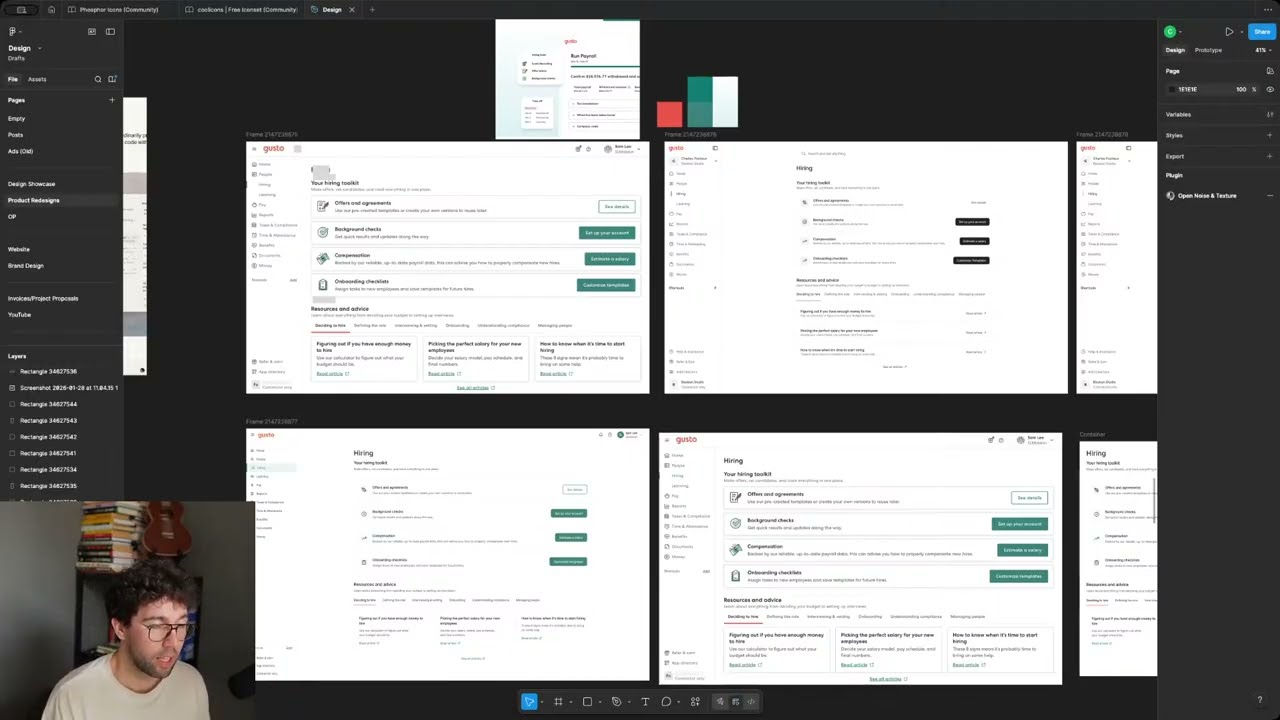
All right, guys. Hello, hello. Are we live? Is it working? Everything should work, I think. Yeah. Okay, cool. I've been trying to like install like another, I don't know, another plugin or something on OBS to like stream stuff and a lot of things happening. So yeah, I will see how it goes. It's difficult to get everything. Hey, Danny. Welcome, welcome. Hello, how are you? I am doing good, thank you. How are you guys doing? Having a good Wednesday? Okay, nice, cool. Yeah, I was like freaking out. I'm like, okay, I have to start streaming at like 3 PM. I— it's not working exactly how I want it to work, but I think it should be fine. So good. I'm doing good, I'm doing good. Went on a little walk, it was sunny, partially sunny, a little bit for like an hour, 30 minutes. So I took the opportunity to like go for a nice walk after lunch, so it was really cool. Okay, nice. Happy you're doing good. So, uh, watching F1, where is it now? I don't know why before I always thought F1 was like happening once a quarter or something, and now I realized that it's happening every weekend almost. Like, I don't know how these, these athletes do because it's so— it must be so tiring on the body to just drive non-stop at this, at this high level. It's pretty impressive. Uh, but yeah, otherwise the, the goal for this livestream is going to be— I have 2 ideas. It's like we can review a little bit some like cool little designs on Mobbin, for example. I'm still like, I'm not sure exactly for the— like this week's video is going to be about on Friday. The time right now on Friday is going to be about— I tried to do something different than just redesign stuff. So it's going to be like an onboarding flow review like I did in the past. And so I think it should be cool. It should be pretty cool. And then next Friday we go back to redesign video as well. And yeah, the goal will also be for this— the schedule for this live will also be to like we can talk about or review the redesign I did last Friday. Um, I hope you guys liked the video. The, the editing was a bit different. I tried to like cut a lot more, add a bit more dynamism, if it's— if what you call it— to like keep retention high. Um, so yeah. Please make a video from SaaS research to design, include grid, also design system. SaaS research to design, so like, uh, literally like a full 0 to 1 project kind of, right? In Bahrain, why it must be so hot over there? But yeah, I hope it your team and your favorite drivers succeed, Danny. Greetings from Valencia. Oh, Spain, really cool. I've never been to Valencia. I've been to only Barcelona, but it was really nice. I liked my stay there. Um, but yeah, I hope you guys like the video, the redesign. I don't know. I have so many. Tabs open. Um, but yeah, what do we have? I think we have new designs dropping on here. Nice. We have Pinterest. I don't know what this social experiences— Posh. I like the logo, it's pretty cool. That's nice. Okay, I don't know about that. It feels a little too much to blur, over-blurring stuff. Oh yeah, and then for the schedule, obviously, like as usual, if you have questions, we can also, I can also, we can also take the time to, to discuss those. I think that's always a nice little thing compared to just making Compared to just usual content and replying to comments, which I always appreciate, by the way. It's always nice to get nice comments. But yeah, it's nice to just chat together. And also it just gives me better ideas on the content that I think you guys like and want to see more of. It's always good. Cheap flights. Travel is a super interesting industry to design. I feel like the patterns and the stuff are like come from like the '70s, so it hasn't been really updated so far. But with AI and more personalization, I feel like there's a potential on making something really cool and obviously upsetting people a lot. Um, could you give us access to the Figma files links for like the redesign? So I have like the— so for this, right, you can see the whole process breakthrough. Hey Samir, welcome, welcome. I always see your tutorial. I just request you take one SaaS problem from ChatGPT and design it from research to design full product. Hope it's help for us. I mean, I think that's a cool thing. For me, it's just extremely long for me to make. And so what I'm trying to do right now is stay consistent with content, even when I get super busy with projects. I want to be able to still deliver every week a good video. And so the problem is that doing a full SaaS design project is like doing literally a paid project, and it takes a long time. And so I'm trying to like give you kind of like snippets or bite-sized of the process that I go through so that you can still learn some stuff. And for me, it's not taking like a huge chunk out of the energy that I have. Yes, I mean, I will see what I can do. What I tried to do before Was to like on my like design shop was was like having the the design the the file sources. So I'm wondering if I can do that or maybe if I can do it for maybe members. I'm not sure like you know ethically if I can just give away like the redesigned files from like other products for free. I don't know if distribution-wise that makes sense. But yeah, maybe make a playlist or ideas of process. Yeah, I mean, it's, uh, it's always a fine line to, to figure this out. Like, do I do like a straight up me talking to the camera and talking about the process? I actually, you know, that's what I do sometimes with like the members videos, simply because members videos— and that's something to take into account— is it has— the video has to be somewhat entertaining, otherwise it's like impossible for the— to YouTube to pick it up, to— for the algorithm to show my video to other people, and the video just makes 200 views, and it's like, just spent 10 hours on a video just to get 200 views. That's a pretty heartbreaking thing. So I'm trying to figure out the right balance between making a video where I actually enjoy what I do, and it's also entertaining and fun for you guys to watch, and at the same time, having a way to Still be like you said, like being able to give as much as possible of the process and helping you guys succeed more. So yeah, making a place could be interesting. Maybe ideas of like maybe like a yeah, like breaking down the process and then making videos for each of them. That's what I'm trying to do as well. Like I talked about it before in other lives. It's like making more strategic videos. And so what does it mean really to make a strategic video? And that could be in some ways that, like taking a chunk of the process that I use for a project and then really diving deep into that. That could honestly be a good idea. Yeah, I'm trying to also like, that's why this week's video, Friday video is going to be different is I'm trying to not just have the YouTube channel be like redesign nonstop all the time. And that's just like you go to my YouTube channel and you see all the videos, it's just like redesign thumbnail. nonstop. I'm trying to like maybe add a bit more variation to it so it's not just that. And so that could be like a nice idea to try. So yeah, I will definitely consider it. The funds could be a good starting point to work on personal projects. Yeah, definitely. I think that's why it's— I think it's an interesting thing. I just don't really know, like I need to think about it a bit more. I think it's something I've been thinking about as well. Yeah, it's I need to think about it more. But definitely, I keep that in mind. Case study tips. Hey, Toxic. Yeah, actually, I have a video. Is it for members or for everybody? I think it's for members. But I do have a case study video. I don't remember for who it is. But also, actually, that's why the lives are for. I tried to do something. I don't know if it works. Let me actually try that. I've tried to add like comments, but does it work or not? I don't know. Let me try to do like review. Does it work? No, it doesn't work. Okay, so the, the comment doesn't work, but I will try to set that up for next time if it works. But basically, I would like to have like a way for you guys to just like put your portfolio URL or something like link in like the form like I did before. And then I can just review during the live stream. I think I could add a bit more, I don't know, a bit more value to the stream. Because technically, like a case study, all you need is 20% text 80% designs. Ideally, you make it into like a storytelling thing. It's not just a design. You try to package it into like strategy and story. So like, what's the goal? What's the benefit of that? And you just basically explain what the design is about or what the big picture like related to the design that you're showing. And ideally, you also have animation so that it's not just like an image. It's Actual, like an interaction, a real experience. And that's pretty much it. Like when I look at portfolios, what I want to see is the potential that you have and is it really connected to like your rate? That's my biggest thing is like the gap maybe between how much you're asking for. Like for example, like on the link that I have for like hiring designers, I look at your portfolio versus your rate. And actually, the, uh, that could be another video idea, is like how to price yourself. That could be cool. Um, but yeah, I'm just looking at potential. If you're like a junior designer, like, do you have enough design skills to work with me or to learn from me, for example? And you know, I have— usually people spend a minute reviewing portfolios, so it's really, really fast. That's why I'm like, don't put a ton of text into that because nobody's going to read it except you. All you care about is like having good visuals, good strategy. And the thing is, you don't really need to show your design process because if you have a good design, the process, it's like it's understood that you went through a good process. But also that, like, I've worked with a lot of designers, different designers from different countries and companies, and they all have a different way of working and designing. Some people, for example, they love to Like stack all the designs. I'm someone like that. I like to like just keep a visual track of everything I've done, and some people just delete everything and keep only the like the the one they've landed on and agreed on. And so everybody has their own way of designing. What really matters is just what you land on. Obviously, you need to be professional. You need to communicate well, keep track of stuff, all of this. But in terms of just pure design skills, I really care about you know. All the little details that you see in a design. And please, like, if you have like case studies, if you have a portfolio, make sure to have like a good website, not something super ugly or broken. Or like, we are literally designers, so like we have to have some standards on that. Would you say you're strictly a UI/UX designer or more of a product designer? So to me, the definition is slightly different. To me, UI/UX designer is mostly about like the visuals and experience. And then product designer is the same thing, but you add a layer of strategic thinking and product kind of strategy on top of it. So there is a bit more, at least for me, what I'm expecting from product designers is a bit more strategy and product strategy on top of the actual UI/UX design skills. Okay, on the Charles, you rock. Thanks a lot, Andres. Right, it's Andres? What does qué onda mean? How are you doing? Do we also need to show data that our design achieved, like conversion rates? Ideally, yes. But it's really difficult to get data usually from companies. It depends. Like, for example, for case studies and portfolio, I don't think it's necessary. If you run like a design business, like if you're not just freelancing, but like you have like a studio or like a design business, It's usually better to have, but some companies don't have them and they are doing really, really fine. So I don't think it's super relevant. Or you could have them like sometimes you can, it depends on some like, what's the name? Like you cannot talk about it publicly. DNA, NDA, not DNA, NDA. And so in this case, and that happens also for portfolio, like sometimes you don't, you cannot show publicly portfolios and designs. You can only show them when someone is interested in it and you show them on a call or something like that, but you don't publicly show those case studies. That's kind of the same where you can also talk about the outcomes later on, but it's not really necessary. Okay, that's correct for both name and meaning. Perfect. I'm not too bad at— I think it's Spanish, right? I don't want to I was like, is it Portuguese? But I think it's Spanish. In my country, like, companies are expecting case study, not just design nowadays. Oh, I mean, a case study doesn't have to be tied to, uh, like real stats, real statistics. You could also say, for example, like an average improvement. You could just say it's increased by 12% or whatever. Like, I'm not even sure people are really going to ask or check Is it true that this company— you can also anonymize. I know there's a studio that offers different kind of design strategic packages. And then for each package, they have a set of outcomes or statistics, but they don't say the company that's from. You can have a guess depending on the case studies that they have related to the package. But it's not really tied to it entirely. And so that could be a way to maybe fix that a little bit. But I just don't want— hopefully, and it depends where you live, right? Like, I usually work with US-based companies and startups most of the time, or like, you know, Australian companies or stuff like that, Canadian as well. And I've never— like, nobody has ever asked me about, like, so what they had— what was the outcome on this? They, they never asked me that. Actually, even my first, like, website design gig, they literally didn't ask me for— like, I didn't have any proof, any case study, any portfolio piece on, like, web design. And they're like, we want to work with you on the web design. I'm like, okay, cool. Cool. Yeah, we can do that. So I don't know. I hope you find like a good in-between of where you don't have to really say who it is from, or you can make like an average, for example. That could be nice to counter that. But yeah, hope it's helpful on this. Oh, I'm so sad about the actions. I worked on it to be like, I hope it works, and it does not work. I don't know if it's something on Twitch. Or not. But yeah, I don't even know actually if it works on YouTube, but I need to figure something out on like maybe just a post on like the community on like the— what's it called? The post? I think it's something like that where I can just maybe have like just one post that you can go through, that you can go to and click on the link to fill out the form. And just like get the URL and then I can review your portfolio. That could be a nice little addition to it. I'd like to ask you, when you are working on a project-specific situation where everything has to be made from scratch, how do you know when to make the call to start a design system? That's a good question. So right off the bat, like all of the projects I work on, everything is from scratch. Like I don't start from like a design library or have like a design system. The only things that I don't do from scratch is like the iconography. Like you can see even here, I have those like those 2 here, like what I talk about on the videos, what I use for projects and for the tutorials. It's like Phosphor Icons, which I think is really nice for like those like specialized like health and wellness, media, travel. It's really— it has everything pretty much. And then for more general ones Like for the chevrons, menu icons, all of that stuff, I use Cool Icons, like here. That's the only thing pretty much that I don't create from scratch. And actually even that, sometimes we might even do it for a specific project. So if it's like a branded icon that we don't have. But everything is from scratch. For the gen system specifically, I'm usually— it depends on designers. Some designers would like to have them, especially managers sometimes, but designers, they like as early as possible, they want to have a design system in place. I'm more of the more, let's slow down a little bit. Let's make sure that the design we have is good and consistent. But actually design system doesn't have— doesn't mean you go from 0 to 100 right away. It can also be literally, okay, We've agreed on this search bar design. Let's make it into a component and use it in the design system. That's pretty much— as simple as that. And it's more progressive. That's what I'm trying also to explain, is that it's not just a day-night thing where it just happens suddenly. It's more of a progressive evolution of the design system. And you add more things over time. You add more even states in the design system. So you— Don't really go from, like, start from scratch and suddenly switch to design system. As soon as you agree on like a specific design, like for example, you can even look at this. Like for example, if I like this kind of card design and I kind of reuse the same thing here, but just a different variation of it. Like for example, this one has an icon at the top at the start. This one does not. Then I'm like, okay, We all agree with that. It's a cool design, cool visual. Let's make that into a component, create a variation for it, and that's it. And the rest doesn't have to be. Like, if I'm not sure about yet this sidebar, I'm not going to turn it into a component yet. Hope it helps. Thanks for giving your views and tips. Yeah, no problem at all. I'm happy to help as much as I can on this. I know it's always difficult sometimes depending on like your situation, your country, your type of clients. My experience and understanding of things can be different from literally everybody else. We all have like a different set of experiences and, and situations. So I'm just trying to like help give some different perspective on this. Hey Nothing, one request. Can you make green buttons background white, whatever the background color is, and Button border green for like this design? Can you make the green buttons white? Like, I didn't fully understand the, the question, the request. But yeah, I like— you guys have enjoyed, uh, this redesign video? You like the editing style on this, or it was Nothing, nothing different. Nothing changed. I realized, and some comments pointed out, pointed, pointed out that it was a bit too much green, and I agree. Like probably I would have changed a little bit more stuff. I think it looks cool for like the YouTube video and and the thumbnail, but like if I were to work on a project like this and deliver that, I would have said no, no, no, no, no. We We slow down a bit more on the green. I do like this like little, I don't know what to call it, like gradient at the bottom. It's not really a gradient, but it's not really a gradient. Um, so maybe a bit less green on the, especially on this, on this like tab section. The card button, like those. You want it to do like, like a white and then, ah, you want it to do like, oops, I need to remove this. Actually, let me copy that. That would be easier. So like those ones, right? You remove those things and then you add this, the green here. Or I've yeah this one like this. Hey Lord of Fish. Hi Charles. I posted something on the community page and maybe it will be good for the stream. I need to find— I need to find that. I have super tiny tabs right now, so I mean tiny screens. I don't know why the, the recording, like the stream recording screen is so big. It just takes so much space that I have to push everything aside. Where is the community thing post? Where did you post that? I don't see anything. The total design looks good. I admire your work. Okay, thanks a lot. I appreciate that. But yeah, I mean, I guess it's usually pretty tough to also in the moment, like you can imagine, I just have like 2 hours. I try to not do more than 2 hours just because otherwise it's too much. But having to copy the whole design and then trying to figure out, okay, how to make it, how to improve the space, how to improve the copy, the typography, the iconography. It's a lot, but actually it's a nice challenge. I talked about it before, but if you like redesigning, actually even if you don't like redesigning, but ideally you like redesigning, if you want to train your skills and speed, Being able to like set a timer and be like, I'm going to redesign this screen in like 1 hour, 2 hours max, and you try to do it no matter what until it's the end of the timer and you see where you land. That's like a really good skill to work under pressure and tight timelines. Because as you know, like in the agency, design agency world, you usually have tight timelines or it's like last minute you have to do something different or you have to work until I don't know what hour. And so being able to like be able to jam quickly with another designer on the team, with the manager looking what you're doing, or doing some light updates. That's a really, really good skill to, to train in, and that's like a nice way to do it. But yeah, I think that's a pretty nice one. Actually, this could have been for the secondary button, even if we lower a bit the opacity. Nah, maybe not. We could have this as like secondary, and then the primary would be this like Fill state simply because it captures the eye a bit more. So you want to focus, you want the primary to, you know, just grab the attention slightly more. But I do agree that it looks really clean with this outline. Not sure how the hover state would be on this, if it should be a slightly opacity reduction or if it should be like A field state after that. Actually really nice. Just now, I'm trying to find it. Did you post it? Post. I cannot find anything right now, but I mean, I can always find it for next time as well. Yeah, it's okay. It's no big deal. I cannot really find anything. But for next time, yeah, that would be nice. Yeah, it looks cool. Okay, nice. Yeah, I agree on this. And yeah, I'm trying to figure out like the next one as well. Like the next— I need to like search and look at the— I mean, that's usually what I do is obviously because I look at the redesign so much, I mean, the like Mobbin page so much, I know that I can, I kind of know a bit more in advance, like, oh, this design would be interesting to redesign or something like this. And so when I record a video, it's like I'm going to look for screens and then I actually look at actual screens and decide which one do we go with. But it's always nice to get inspiration on this. But yeah, I need to find for the next one what I want. That's actually a cool design. I like this. I like this. What's trip details? That's a cool little. I like this timeline design. Reaching out to the airline to confirm your booking usually takes up to five minutes. Oh, that's really nice. Nice paddings. Nice corner radius. It works well with the rest of the card. This is a little weird because you can see that some of them have this dotted outline and the other one next to it doesn't. They have just a normal outline, so it looks a bit weird. But besides that, it looks really nice. They should have a way to upsell here. All right, that's really cool. If you turn on the newest, you should see it. Yeah, I'm trying to like— is it like a— oh, is it here? No. Like literally the viewers post, I only see people from like October. Newest. Yeah, I don't know where it is, but maybe I'm just not good with— I spend so much time looking at the stats on this on like how to optimize the videos and stuff. I don't— am I like, am I crazy? Anyway, it will be for another time when I can find it. But yeah, this is so cool. Little upsell on the seats. Oh yeah, actually I might have a new project coming up soon, maybe like a consumer project. So I'm looking at trying to look at like consumer products and apps to see like the kind of standards and norms. But I didn't really design a lot of consumer stuff. So I think that could be a nice little challenge for me to work on. Ah, it gets deleted for some reason. Well, what is it about so I can like try to find a way to, to fix it or something. Because I know that there, there is like a— you can post as a member, but I don't know if— I don't know why, like maybe they changed the settings or something in the community to post some stuff. I don't know, maybe it's a link. If it's a link, maybe it doesn't work. It's only text. Like, I, I'm not sure what YouTube has for like the, the rules on that. ID Reason: ElevenLabs text-to-speech module, I found it hard. Eleven Labs. I think I I made a video about this. I mean, it's not a video. I mean, it is a video. Oh yeah, yeah, yeah. Eleven Labs. Is it Eleven Labs? Or I think it's Twelve Labs that I oh yeah, it's Twelve Labs that I've that I've reviewed, but not Eleven Labs. Eleven Labs was Something I saw, there are probably recordings on the channel for redesign stuff. I never really designed, made a redesign video on it because it looks pretty clean. But what you said is the text-to-speech module. Is it this? That's the one, right? I have 2 questions. Visit your portfolio. Yeah. Go ahead. It's a feedback board for mobile apps, I think, because it has— oh yeah, I think that's why. So what I can do for next time, what I'm going to do for next live next Wednesday is going to be I'm going to post in the community, like, posts on the channel, the post tabs. I'm going to put the link to review portfolio. And even if it's not like a portfolio, if it's a project you're working on, you can link it and then I will be able to have a look for like the next The next live and we can chat about it. But I think that's probably why. So one, what is your typography selection? I mean the size of the text. How do you animate UI in your portfolio? The text, I think it's 14 pixel, and there's probably some 12 pixels and 16, and maybe 24 for like the headline, or 28, something like that. I actually have it right here. Let me check. So I have 26 for the headline. Then for like the text at the top, it's 12. For the copy, it's 14. And then for like the description of under the animations, it's 14 as well. And for like the section headline, it's 26. I try to keep it very standard. I mean, not I always say use multiples of 4, and when I do it, it's not multiples of 4. But I try to keep it consistent across everything. So like the headline, like the sidebar, you know, like the side section, it's, uh, I think it's 2614 as well. So everything is like 2614 in terms of size, and sometimes it's 12. Yeah. Um, how often do you create wireframes? I've noticed that I don't wireframe very often because I usually already have an idea of how I want to design a screen. So that can be good and bad at the same time, Samir, simply because when you have an idea, you then end up becoming like tunnel vision and only think about this idea and don't— and discard kind of like other potential ideas that could have been interesting to explore and that you could have taken a bit of like some elements here and there from them. And put it into the design you go with. And so I was like that too, where I was like, I have this idea for this redesign, I know it's right, I know it's the best idea, I just designed it. And then the manager or designers are like, actually, that's not right. And so through experience and processes, I've been able to understand, okay, first it's not even designing or wireframing. First it's like understanding The product itself, the features, the flow that you go with for onboarding, for example, or a specific flow in the product. It's like, what input does the user have to submit or do in order to get the output? And how do we shorten that or improve that, refine that, et cetera? So you add this strategic and high-level vision on the product and the project. Then you decide to do the wireframing. So it's like— Yeah. The layout first and how you're going to do the navigation, some like little elements here and there. You're just starting to brainstorm. The goal here is not to design anything really, is to just go fast and iterate a ton of like the different variations on layouts. And again, like the content, where does it live, what it is. And then you do more like wireframing. And again, wireframing can be the very high fidelity, but you just don't care about the UI, you don't care about the colors, you don't care about like drop shadows and stuff. You just focus on Again, how do we figure out the best experience possible? So I think it's really good in terms of like skipping wireframing can be good if it's like a fast project, if you have to do— if you know the project really well and it's not something like you do from scratch. But if it's an actual project that can take several weeks and that you do from scratch, I would advise to still go through the whole process. That's something that I didn't do again in the beginning and that I've been able to learn over time and improve. I realized that it was super valuable to have that. Have a look at the original one. Yeah, so that's this one. I guess it's the one from Mobbin, but I don't know from when it was. April 2025, so almost a year ago. What don't you get here? Is it just being able— like the layout itself is not good? Or is it the library on the side? Or the out— like it's not clear? Just help me understand like what's, what's like the, the friction for you. I'll need to leave, but thank you for your answer about design systems. Buongiorno. Thank you, Andres. Have a good one. Um, do you follow like 4-point or 8-point grid system? Do you use something like odd sizes, 11, 13, like iOS design? I usually follow the like 4-pixel or like multiples of 4 in my designs, especially projects. I don't like odd numbers like 11, 13. I usually go with like what I just said was like 12, 14, 16. I would recommend not to go below like 12 or 11. 11 can be like really edge case where it's like legal text that you put at the bottom of the screen. That could be 11, but I try to stick with— but again, it's whatever works for you and whatever works for the client. As long as you stay consistent and you don't just switch up every now and then, I think it's fine. But yeah, usually I do multiples of 4. I think we can see it on the redesign. Like, what do I have? Oops, I have 20. Here it's 16. I think I didn't go lower. Oh yeah, 14 here. So you can see like multiples of 4 and then 14. As well for like the little text, the navigation. But the goal again is just to stay as consistent as possible because the problem, or usually what's going to happen is the more you're going to dive into the product and the flows, like at a later stage in the project, usually the more complexity will be added. And so that's why the simpler you start regarding the product, the easier it's going to be Over time, that's why I talked about also in the redesign video. Like I think on this, like you can see my colors. Actually, my colors are even right. But yeah, like something like this. If you just look at the grays, for example, like F, F two, E six and two. Sometimes there is a bit more like C. There's sometimes nine to like have some some changes on that and a bit more depth to the design. But it's super simple. And so then when you get that super simple palette. Color palette, it's a lot easier than to add the colors to differentiate everything. And then you can again like add more complexity, but start like super basic, super simple, as little as like as, as few font variables as possible, typography variables. Um, that should be better. Usually just use multiples of 4. Yeah, I actually did that. It's funny, I did a TikTok a while back about like multiples of 4 just change your life as a designer. And I got like 40,000 views on this, and it's just literally just me like recording myself. And it's— I don't know why this, this went viral versus the other ones. I guess people also had their like, uh, 2 cents to comment on this, on the, on this. Like, actually multiples of 4 is not the best. Um, yeah, minimalistic design still works. I mean, I don't know if you would think, think that's the minimalist. I'm not sure what actually I always said I'm a minimalist designer, but I think I'm just a normal— like, it's just a design, right? Like, like minimalist design, I'm not even sure if it means anything now. I think before it meant something because the designs were a lot older and had like more— not personality, but you know, like they were that— they were more diverse in the, in the design and colors. And so minimalist was Like, let's keep everything clean, like space things, have like those black and white kind of colors. Now it's, it's like pretty much the norm, so I'm not even sure if minimalist design is really like a thing. I feel like it still— it's just— is— it's just design now. Um, but if by minimalist design you, you, you say like have good spacings, have consistent paddings and space, and, and like Uh, typography styles, then yeah, I guess it's still there and it's probably going to stay there, which is good. I think I, I personally prefer those like clean designs. And what I like to do in my process is I like to make it super boring. I talked about it in a previous reason actually. Uh, I think it was this one. Yeah, the other one where before adding the colors it was really, really boring. It was pretty much dead. And then once you add the colors, it gets so much more alive. And I think that's really the magic with keeping the design clean and simple is then you have so much more freedom and so many more opportunities to create like a super exciting and cool product experience. And you make it feel really alive with just a few colors. I think that's really cool. I also wanted to see how you work with spacing. For me, spacing— like, text can depend, but spacing for me is like a religion in terms of multiples of 4. Text can change. Sometimes it's 16, sometimes it's 14. Here it's pretty much 16 everywhere. Maybe not here. Yeah, sometimes it's 14, 12, 16, 18. It depends. But spacing, I'm not messing around with it. Spacing is always multiples of 4. It's like you can see like 84, 64, here is 20 probably. Usually it's also 16. Here is probably 24. Here's 20 as well, right? Like I'm not messing around with that. So like that's for me, that's like super simple in this way. Like even here it's, I think it's, oh yeah, 20 here. This one is 20 as well. Here's a bit more complex because I just didn't like the spacing between this, the headline. But in hindsight, I could have just like this, like remove the vertical trim on this and would have fixed the problem. I don't know why I was like, okay, let's try to optimize this 34 and 44 when I could have just done that. But anyway, what multiple of 4 Is not best. What number four is not best? My whole life was a lie. What do you mean? Nice. Can you share your dribble? I do have the dribble. I mean, actually, you can find my dribble. Just type my name, like my full name, like YouTube channel, and then just add dribble on it. And and you can find it. No, but yeah, I used to be pro on Dribbble, and then since the like the change where I feel like Dribbble just became like a like a like a Fiverr almost like a marketplace, and I'm like no, it's not. It's like yeah, it was good actually before like a few years ago. It was really nice to like find opportunities or like get opportunities to come to you. That's how I've started pretty much. And now it's just, I don't know. Oh nice, you found the Dribbble, cool. Oh, do we have some Nepali in the chat? Yeah, just that's what I kind of, I was able to understand. That's really cool. We connect people here. It's a big family and we connect people. Actually, yeah, looking at the stats, I'm like blown away. It's every— like, I have viewers from everywhere in the world. That's really, really cool. Yeah, yeah, I agree with you. Like, Dribbble used to be really cool, and I like the fact when it was like pre— I mean, not premium, but it was like you had to be invited to join the platform, and it felt like— it felt like something. And then they opened it up, it was okay, um, but I don't know, it was, uh, I I feel like they make probably more money now because everything goes through them, so it's like they can get a percentage out of it. But it's— I feel like it's cheap labor. Are you working on your new redesign? Not yet. I try to like try to not redesign for like— for videos, I try to not redesign before recording so that it's literally— I'm not lying when I say I'm going to find a random stream online and redesign it in like 2 hours, something like that. Like I'm literally just looking at the screen. I obviously like I go through Mobbin through the videos or during projects, and and then I see the screens and I'm like, oh, maybe for next time it could be good. But like besides that, I'm not like redesigning anything before the recording, so I don't have anything yet. But maybe I still have to edit the video for Friday. I have not done it yet, so I have bit I'm a bit. In a bit of a rush, but yeah, like next week it's going to be a redesign. I don't know which one yet, but yeah, be ready for it next Friday. This actually this Friday there's also a video, so I would really love if you same time to the Friday if you can like take a little look, have a little like. I really appreciate it. I was so stuck about getting an invite back in. Yeah, I also have it. I was like, I literally like found the person who invited me or like accepted invited me. Yeah, invited me. And I was like, thank you so much for letting me go on Dribbble. I really appreciate it. It was really fun. Charles, you know you're really underrated. We want we want to gatekeep you to be honest, but really want. I appreciate it. No, don't gatekeep me. No, I want everybody to know about the— about product design and, and becoming better. Like, the ultimate goal is just for you guys to just make enough money for you to have the best life ever and, you know, design cool projects. We have to enjoy design, right? To some extent, it's not just about— like, obviously the more you grow, the less you have— you're able to like really just design whatever you want. Like, I would love to just do redesign all the time and not have to work on projects, or actually be paid to work on redesign projects. But usually it's more professional and strategic and all of that stuff. But I appreciate it. I still appreciate the, the kind message. Just like web design and coding, a lot of junior designers are worried AI makes the career not worth pursuing. What's your current thought on that? Yeah, I mean, even even for, I think, everybody, right? Like, every job, every specialty can be, uh, can feel attacked by even engineers now. Like, I see so many products for like every, like literally everything, for like contract reading, contract creation, for editing, for like literally everything you can get an AI to do it. And I think it's mostly going to be about It's mostly going to be about what we— I mean, it's never going to be so bad or so good. I think it's always going to be an in-between. And you're always going to find people who value, overvalue maybe AI. But it's just like, you know, before AI, like people would pay, you know, cheap designers, cheap graphic designers to do their work. Now they don't pay them. They just use AI. And probably the cheap designers working for those clients, they also use AI to do it for them. So you have to adapt. I think that's a great skill we have as designers is because of the design industry evolves so much and so often, we have to also adapt and learn new skills and always improve. And just what I do and try to teach on those videos is you always keep that mindset of I need to learn, I need to get better because it's always going to evolve. And so I think the people who are like that, who have this mindset, are going to be able to adapt. and use AI for them. That's why I use AI as well on my projects. But I do believe that there are still a lot of clients, a lot of companies that rely and that believe in actual quality work. But it's like the industrial revolution where suddenly you didn't have to buy your furniture from the local woodworker. You can buy it online or, I mean, not online, but you could buy it at a factory or something. Yeah. That's pretty much the same thing here where there are some people who are still going to value premium, high-quality design work or just human-made designs and people who are going to pay and only care about AI designs. That's just business and capitalism. There is a world for everybody. There is something for everybody. But that's why you need a good portfolio. That's why you need a good case study and a good website. And let people know that you exist by posting your design, sharing stuff, all of that. Do you recommend learning Webflow or is Framer enough? I tried both. I've had a lot— I've had a much easier time learning and using Framer than I've had using Webflow. Maybe, I don't know, maybe that's just me. I would suggest you to try both. I feel like Framer is pretty in demand right now. There are still a lot of companies— actually, there are companies still using WordPress. So it just goes to show you that, you know, again, there's a market, there's a niche for everything. It depends if it's for you, if it's a service that you want to provide, if it's like an upsell you want to do. I feel like startups might prefer Framer. And then maybe bigger companies or corporations might prefer Webflow, or even like, how to say that, like you just code it yourself. And then there are still like the old school who use WordPress. I think that's how I would maybe frame it. Something really good with Framer, I think, is for me, it feels very similar to Figma in some ways. And so that's why for me it was probably easier to use than Webflow. Webflow feels a bit more to the technical side. And I'm someone who's really simple with complex stuff. So I cannot— I take a long time to understand some stuff, some complexity levers. Levers? Layers. Like coding, for example. Kendrick talked about coding above Framer, Webflow. Coding gives you all of the upsides pretty much. But for me, it's like impossible. I've tried so many times to code. I've tried. I can do like QA. I can like review. Like you could see me do that on some websites where I like try to understand, or maybe I cut it out, but I pretty much like analyze some websites like I did for like here on this project for Manus. I was like, okay, how did they actually code this? Is it like 2 cards? Is it 1 card? Like do they have paddings? Right? So I can analyze the code and understand the design. And I think that's a really helpful thing. And even to some extent, Framer helped me also understand that a lot more. But coding for me is dead. I mean, it's not dead, but I cannot get my head around it. WordPress is not my domain. It was so hard for me. Yeah, I think I tried once, but it goes to show you just go into what you're interested in, what you're naturally good at, what you naturally understand. There are again so many different products. Try to take the time to understand things and take the time to try them all. But like, for me, I've tried them all and I prefer Framer. That's, that's, it's just my personal preference. Any advice on starting up an agency or getting clients? I am trying to start my own. Well, the advice is that really think about it before trying because it is really difficult. And sometimes if you are really good, if you're a really good designer, and you're ready to relocate maybe, and you have a strong portfolio and strong case studies, you might make more money from a job than from starting your own agency. So that's my advice on this. It's really difficult. It's also really exciting in a way because you learn so many more things. Like, I have to design pretty much, and I have to also make content, and I have to do marketing, do sales, contracts, negotiations, right? There's a lot of stuff happening. Outside of design. And you— like, I end up actually doing less design than other things sometimes. So it's not something that you should jump in just— you could try it for, for, for fun on the side, like in the— on the weekend, your downtime, to see how it goes, how it feels. If you are able to gain momentum— like, I've only started my— I don't know if I talked about it before— like, I only started my design agency because Legally in France, it was better for taxes to create a company than to be a freelancer. And so that's how I did it, to get to work with clients and to pay less taxes. I never really was like, oh, I'm going to build a business. And so if you are in a situation where you already have clients, you already have some success, you already have some— like, you make some money, then starting a business or like an agency could really be interesting because the benefit of the agency is that you can charge. I mean, you can do it as a freelancer too, but it's usually easier as an agency. You can do like fixed price. And with fixed price, you basically earn a lot more per hour than a freelancer does. And so that's when you're able to make margins and then delegate. And that's how you kind of have the business figured out. But you still need marketing, and all of that stuff, which all of them are different skill sets and almost like different jobs. So yeah, coding has gotten really accessible with things like Cloud Code or Cursor. Obviously it still takes time, but definitely more accessible if it's something a designer wants to get into. Absolutely, I completely agree with that. Like, I'm amazed with like all of, all of that. I actually, I had Cursor for a while on my, on my desktop. I just, I think I used it once. Cloud Code, I barely used it. I don't know, I keep trying, but it's not something I'm super passionate about or care so much about. So you're right that it's never been easier or more accessible to code and to learn to code. And so for designers, I think it's such a good— like, you can see new job titles now. It's a design engineer. It's literally if you're really good at design and you can also code, It's like, you know, it's a really good thing because basically you're getting paid and you replace 2 people instead of having 2 people to pay. So for companies, it's a really good upside. So if you are into that, I think it's really good. It's better for, you know, delivering the work to engineers, helping with handoff, but also understanding how design works. I think technically, I mean, the way I like to design is the same I mean, the same as coding or developing where you kind of— it's basically a container inside of a container inside of a container. And that's how you like do auto layouts. That's why I'm always like, do an auto layout every time, group things together so it stays consistent. And ultimately that's how it's being implemented to some extent. Again, like that's as far as I know with like engineering. Did you have a course on your website? I was wondering what was included in it. As it is not available. And yes, I had, I had a lot of things. I've tried a lot of things. I'm like, how do I monetize my YouTube audience? Obviously there is like the $5 per month membership, which I would advise anybody interested if you have the money. It's a really good, it's a really good resource because for $5 you get like a ton of strategic videos that I don't want to edit a ton of and, or like think about how do I keep it entertaining and stuff. So it's just raw talking to you guys and sharing extra stuff. And then I had the course. I was thinking about the course. I was thinking about a decent subscription too. I had a community as well. It didn't perform. It didn't work well. I don't know if it's the positioning. I don't know if it's just literally the content itself that was not good. But I try, I learn, I fail, I improve. That's pretty much the story of life. So I'm still thinking about it. I'm brainstorming how am I going to do it. I think it's Danny before we talked about like sharing the design file, like the redesign files. That's something I could consider. I also have the— what's it called? The private coaching one-on-one, a bit more expensive, but that's something as well. So it's still like always in my mind. It's not primary right now. What I care about is getting leads, getting clients, not so much monetizing you guys. But yeah, I'm fully transparent. I don't care. I'm just telling you everything. Thanks for the advice. Yeah, no problem, Nisha. No problem. Happy to help. Yeah, I get that. If you don't care much for it, it's better to just stick to design, I guess. Personally, I'm really enjoying design development, so it makes a lot of sense for me. Absolutely. Yeah. And I think a lot of people, from what I've been able to see online, like YouTube and stuff, designers really— or actually, I'm wondering if designers prefer to code or if it's engineers preferring to design, because I also see a lot of engineers getting into design and really appreciating making good design. And so I think that's a really, really good thing. It's all about knowing you and your unique skills. Again, I'm really into making good, beautiful visual designs. I'm really into web app design, making sure that I become the best product designer ever. But also, how do I run my business? How do I make content? That's more like different skill sets. And that's why we're all unique and different as well. And that's your edge, Kendrix. That's how you can stand out as a designer and have that unique offering, that unique skill set that people would want. Or pay more for. Private coaching could be profitable and better in my opinion. I mean, profitable or better, it all depends, right? Because when you think about it, if I make a course, if I make like a community, it's pretty much one for as many as possible depending on volume and reach. So like I could spend an hour and then deliver it to 50 people paying each of them a subscription, for example, and my my hour would make me a lot more money than, for example, like a coaching, for example, because the coaching is just 1 hour and I cannot scale that. I cannot just do 1 coaching for 10 different people. That could be a different offering, actually. It could be like a workshop, something like that. But yeah, they all have their pros and cons. Coaching can really go high. Like, I have like a business coach sometimes that I use, and it's— I think it costs $5,000 for an hour, something like that. I was like, whoa. But like, it can be pretty, pretty expensive. Again, it depends on your like your audience, who you're targeting. I don't want to like make you guys pay for like a private coaching for like $5,000 an hour when it's like I don't even know how to make, I don't know, $4,000 a month as a designer, right? Like, you're learning all of that stuff, right? It doesn't make a lot of sense. John, if you were starting all over again, you know the path but you don't have the skills, how would you improve as a designer? You know, Patrick, don't know the skills as like a product designer, or like, I don't even know that because literally how I came across design, like, I never knew like design existed until I was like 19, something like that. But like, I was like, whoa, what is that? That's super cool. I thought about marketing, for example. I started with marketing for like a startup, and I just— that's how I discovered design pretty much. And I was like, that's really nice. But it took still 3-ish years, 3, 4 years before I was able to make money from it. So it was never really obvious for me to like Be a product designer, be UI/UX designer, get paid to design. What? So yeah, I was really lucky with that, but it was always something I enjoyed. Like, I did a lot of like Photoshop like design and stuff, creative work in the past. I was interested into like 3D special effects, something like that. So creativity and visuals was always in my like my guts, but I never really came across design until recently. I mean, not recently, but Uh, until then. And that's where I was like, that could be a really cool thing to do, but I didn't know anything about it. I literally, like, the first design I did were on Photoshop, just to show you. Like, I was like, let's do mobile design on Photoshop where it's absolutely terrible to, to do it. Uh, but yeah, and then it was, uh, Adobe XD. I don't know if they're still a thing. In other words, if you had a brother and you wanted to become a top-level designer, what would you tell him to do on a daily basis? So probably for me, it would be my advice, it's just volume. Like, I think it's volume and like knowing what to put volume into. So work for free. But the problem with working for free is that if you don't have skills, working for free doesn't make a lot of sense because I don't want you with no skills to take up my time and energy, even if it's free, because I'm losing pretty much. Like you're costing me money and resources and efforts into training you. And so it's a really tough thing. Luckily now with AI, I mean, in this day and age, you could have the AI, you could have a lot of tutorials like what I'm doing, courses, stuff like that. So that's what I would do. I would like figure out like the foundations and the rules, the principles of design. What do I need to invest time in? Is it like UX, UI, visuals? Design systems, all of that stuff, and then just a ton of volume. Like it takes so much volume. Like it's not even like it's not even funny. Like it ten times whatever you think it is. Like if you think I need to design one redesign to get better, I need to spend an hour to get better. It's probably like you need to spend ten hours, a hundred hours, a thousand hours to like get better at whatever whatever element in. In the design skill set that you need to have. So that's just it. Just figure out the principles, figure out what's required in each of them, and then just ton of volume until you get better. Like ton of volume in redesigning like I do here. Design your own ideas or just surrounding yourself with really good design quality and like beautiful designs, whether it's graphic design, architecture, whatever you You enjoy looking at. It could be cars for all I know. And then after that, work for free or cheap. So like ten, twenty dollars an hour, something like that. Or free. I think free would be fine for like the first for first year, first two years. And so you sacrifice short-term money for long-term gains. Small money, big money. And so I can. Because it's like if you read a book about working out and you've never worked out, you understand the logic, or like you understand the theory, but you can only relate to it and improve your skills of working out with the context. So it's because I've worked out and then read the book that I can understand, oh, that's how you're supposed to do it, and then apply this to my workout. And so if I learn from a top-tier designer but I've never designed, yes, I can understand the, like, the gist of it, but I won't be able to apply anything. That's why it's like important to understand your principles and do a ton of volume first, to then get to work for free and have like senior-level designers above you to then teach you like, actually, this is how you're supposed to do it, or that's not the right way to do things. I mean, obviously you have multiple ways to design, but a designer will always have its preferences, and then you can apply this learning into your own skills and knowledge. And then it's just again ton of volume. So like if you can like if you can work for free, then one, two, three different projects at the same time absolutely until you're like really good enough. And usually if you're really good enough, you will either have people reach out to you or when you apply for like a job or a gig, people will get back to you. That's how you you know. Like I've applied to thousands, literally thousands of like gigs and jobs as a designer when I started out. And nobody said yes. So I knew that I was just not good enough. That's just the truth. Even if, like, if it's 10 or 100, maybe, maybe just unlucky. But 1,000, that's really hard. So yeah, then, then you just know it. How to find, uh, wait, how to find that first job project even if it means working for free? LinkedIn, even actually Dribbble, even if it's pretty trash right now. But they have like these full-time jobs. So you could do that. You could Google literally like product design job or like whatever specialty you want to have. If it's a project, project is a bit more complex because a project, you flip it where you become like the pitcher. And so it's like they probably, they don't maybe don't need a project. And so you have to have that case study again. You have to have like a kind of offer to give, even if it's for free. And then you can maybe work. It made a lot of sense. Thank you for your advice. No problem. Happy to help. Love your recent video redesigning this. Okay, I'm glad you liked it. Was the pacing good? Like, was it— I tried to not make it too slow because I think the other redesign video was like 25 minutes and this one was 15 minutes. So I've cut a lot because it's like literally 2 hours of redesign content and then I just chunk it down to 15 minutes. So I hope it was like good pacing and like not too much information but still like valuable. Sorry, but what's the live about? Well, it's a bit of everything. It's mostly design talk. It can be me going on Mobbin reviewing some designs. It can be me literally going on Figma, for example, like reviewing the redesign video that I've done last week and answering people's questions about design, product designs, whatever. That might want. So that's pretty much what the live is about, and it's nice to connect with, with you guys. Um, again, I don't have the opportunity to do that usually with the videos, so it's nice to be able to do that here, get your thoughts, feedback, questions live. It's pretty fun. Once a week, it's pretty nice, middle of the week. Nice to like get to like keep Kick the rest of the week. Kick the rest of the week. Kick off the rest of the week. Yeah. But yeah, we're almost. I think we are on an hour, right? An hour and ten minutes. Whoa! That went by super fast. I didn't even realize it. But yeah, do you guys have any more questions? Otherwise, I will leave you to it. As usual, you can always watch the replays of those streams. See if you like missed a part or if there is something else that if you want to rewatch something, that's always nice. I think it takes a few hours. Like last time, I thought it would just be live right away, but it actually takes multiple hours. So be on the lookout. But otherwise, that's about it. I hope it was helpful. I hope I've been able to answer a few questions and you've enjoyed your time here. Make sure to stay tuned for the video dropping on Friday. Same time, uh, with like a— it's a different video, it's not a redesign, it's a flow review this time, onboarding flow review. But I will try to make it as informative and, you know, like nice crunchy valuable content. And yeah, I hope you have a great rest of your day or evening, and I see you for next one. Bye!