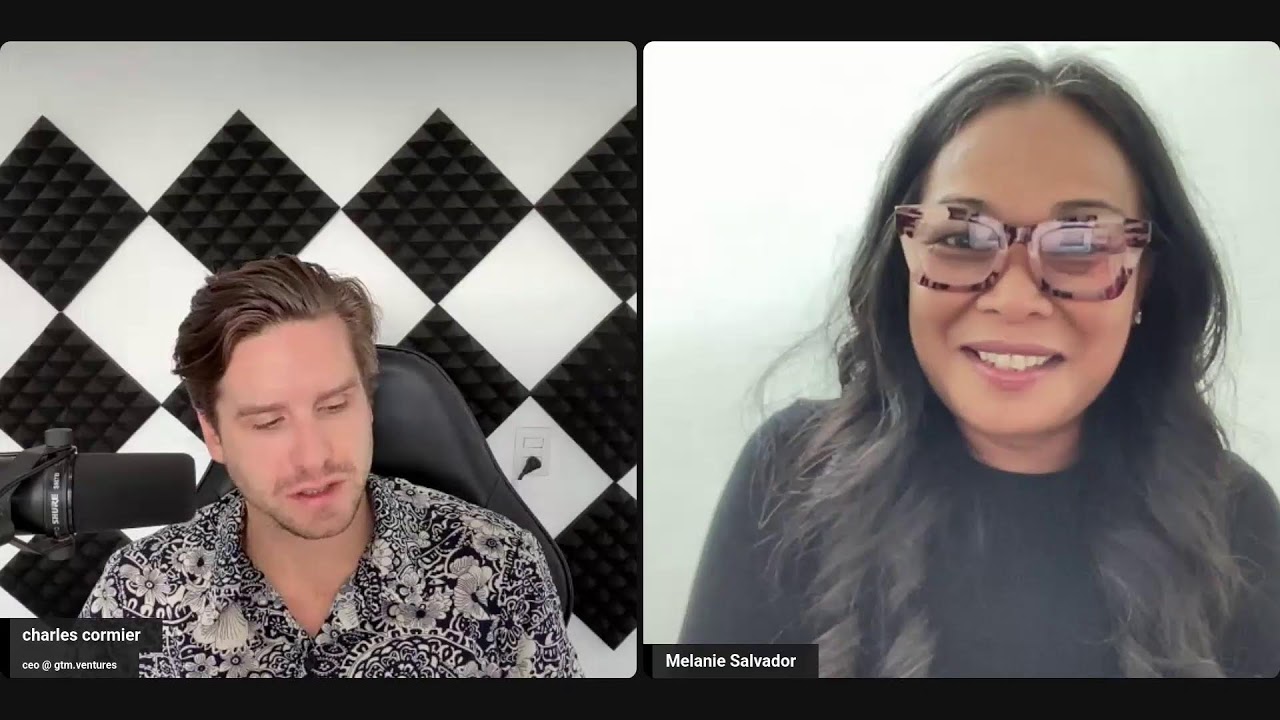
In this VC Wisdom Pod episode, host Charles Cormier interviews Melanie Salvador, General Partner at Maker Venture Fund (Maker VF) and executive at Pure Technology and Terralight. Melanie outlines her 30‑year career that began in traditional banking (TD, Raymond James) and progressed through telecom entrepreneurship to AI‑focused venture investing. She describes Maker VF’s inaugural $1.5 billion fund, its focus on AI infrastructure and smart‑city technologies, and its global deployment ambition across the US, Latin America, the Middle East, and Asia. The fund’s investment approach includes a minimum $5 million check, typical $20‑$30 million checks, and occasional $50‑$70 million allocations, supported by an internal “Maker X” ecosystem that helps portfolio companies commercialize. Melanie explains the GP team composition (Melanie, Katie, Michael, Rima), their banker‑led fundraising process, and the importance of personal rapport and founder adaptability. She shares her vision of smart cities where seamless, privacy‑aware monitoring enhances daily life, and illustrates her own AI‑driven workflow with a personal assistant named “Tether.” Challenges discussed include remote collaboration across time zones and the need for physical proximity among GPs. The interview concludes with resources for learning more (LinkedIn, melanniesalvador.com, makervf.com, purebrain.ai).
Chapters
Welcome to another VC Wisdom Pod. We have Melanie Salvador with us today. She's a GP at Maker Venture Fund. She's also a founder. She's a vice chairman at Pure Technology. She's into smart cities, AI, and telecom. Been New York City, I saw some Toronto in there. So Mel, welcome to the podcast. Tell us a bit more about yourself, what you're up to nowadays.
Thanks. Thanks for having me, Charles, and good morning, everyone. Melanie Salvador, General Partner at Maker Venture Fund, as well as Vice Chairman and Deputy CEO of Pure Technology, as well as CEO and Chairman of Terralight Technologies. So what do I do? And, you know, what I've been doing, literally working in artificial intelligence. Started with the base layer of telecommunications back about a dozen years ago. Moved into the upper layers of AI infrastructure in the last several years. Started a fund which is close to closing, and we are highly focused on making investments into AI infrastructure, anything in smart cities. We do do a lot of work in smart city and smart developments globally. Um, and our fund is also global, uh, based in New York where I am, London, Dubai, and Geneva.
Interesting. And how did you get started in life? I see Raymond James for 7 years here in Vancouver. What was the start of you?
Um, I think the start of me was actually TD, um, which was many moons ago. Uh, you know, I've been in corporate finance for, uh, over 30 years. Started in traditional banking, being a teller, moved into doing various functions within banking, retail operations, everything with institute— on the institutional side as well, spending time at Raymond James for quite some time, as well as with IFTS, which is a collaboration that was done between State Street and DST Global. So, you know, I've done quite a bit of things, and then I went into really investing into companies with my own money maybe about 10 years ago, 12 years ago, and really focusing on telecommunications, then technology, then hyper-focusing on artificial intelligence.
Which was your first entrepreneurial experience?
Oh, back— that was back in my 20s, you know, uh, doing sound and lighting. Um, I had a partner at the time, um, and we, we did that. Uh, we were very highly focused in the entertainment scene, obviously, doing sound and lighting in Vancouver. Um, held a lot of parties. That was in my early 20s, very early 20s. Um, and that was my kind of my first foray While I was already still working at TD Bank. And then into my first foray into being actually an entrepreneur is after I left IFDS. And I went into owning a telecommunications company, a global telecommunications company that business focused in the MENASA region. So Middle East, North Africa, South Asia.
And when was the pivot from this, or being a banker, to starting your own fund?
So I've never stopped being a banker. I'm still a banker at heart. I still wheel and deal. That's really the kind of the crux of who I am. Um, and that, that kind of started, um, probably around 2014, uh, towards the end of my life cycle at IFDS, where I really thought that Technology is really— telecommunications was where I wanted to be and start moving into getting into the startup world and that. And I jumped right into owning a company that was already a going concern.
And which one was your first investment and how did it pan out?
My first investment would have been TerraLight. So TerraLight was a— is a telecommunications company. And it's not that it converted into taking my team and converting that into a company that was more focused on mobile networks and also moving into AI the last several years. So we moved Terabyte into pure technology about maybe about 5 years ago, where I took the team across with me and we started focusing last several years on AI, AI for mobile network.
What do you invest in nowadays? Why smart cities specifically? AI, sure, I understand. Also, AI is pretty broad, right? What category of AI, but also why smart cities?
So, you know, the intention for me was always really understanding the entire layer of smart cities down from understanding all the fiber optic all the way up to satellite, including infrastructure, energy, and everything in between. When we started working in— when I started understanding PureTech and what we were doing and building our own smartphone, understanding our own comms mesh networks, and using that, we started building an operating system for it. And whilst doing that, realized that what we built was actually an AI for the people. We really realized that that operating system, before it even gets implemented into the phone, can be used by pretty much anybody that's building anything and using it in a natural way. No prompting. Um, no, nothing that you have to learn. You speak to your AI just like you would speak to your COO, your chief of staff, your EA, whichever it is. And that's literally how we built our AI and how people are using it today.
Cool. And what's the fund number? What's the fund call and how much you raise generally per year per fund?
So our fund is brand new and this is my first fund. We have— it is a fund that's really based on investing in AI infrastructure and smart cities. We are— sorry, we do expect the fund to close at about $1.5 billion. And yeah, we're really focused on AI and infrastructure.
Yeah, 1.5 billion. That's a lot. Tell us a bit more, like what's your strategy right there? Like who do you raise from? Why so much money? Is that like what's needed to build like a smart city? Also, where the money would be deployed. We see, we hear more about smart city, like yeah, Dubai is certainly one, or Neom, for example. Like then I heard like GC earlier on. So. Are your startups going to deploy in these cities? Tell me a bit more.
So we are really looking for technologies where they can be deployed globally. The intention is that we would invest in companies that are, that are able to move into different geographies and different projects. So companies where their GTM is the US government or is heavily on the US government, that would not be of interest to us unless of course we could change the commercialization and turn it into a global product. But we really are focusing on companies like PureTech that are really focused on the global arena. And also we are looking at deploying in different projects as well. So projects in Latin America— Latin America is very, is very much growing right now in terms of smart developments, not necessarily just smart cities, smart developments. Colombia is growing a lot. Panama is growing a lot. Even, you know, we've heard a lot of discussions with Venezuela really moving and things happening in Salvador. These types of places are really growing in terms of smart developments. There's also a lot of growth happening in Asia, specifically in the Philippines, where President Marcos has put down a lot of different mandates for energy, telecom, telecommunications, things that would really make AI move and really at the crux of what AI is.
And you're 4 GP in the fund. There's Katie, Michael, Rima. What's your fundraising strategy here? Like, how do you raise from LPs? Because again, $1.5 billion is not common, right? Start smaller, so maybe at like $300 million, right? Like, why so much? And what's your fundraising strategies from LPs here?
So we actually have a banker that we have. So, you know, I am actually quite limited as to what I can actively say, but we are represented by a big London firm.
Okay, then they're in charge of raising from LPs, like none of the GPs actually raise, or—
Everything goes through our banker.
Okay, interesting. Um, then I saw your check size in the meeting. Um, can you tell us a bit more about like, uh, How much you invest in these companies and how do you filter the deals?
So we are looking at, you know, our— based on our mandate, we are— we have a minimum check size of— or we will be having a minimum check size of about $5 million. A lot of our companies that we have been looking at would really look at a check size from anywhere between $20 to $30 million. But, you know, as you know, at about $1.5, we are going to have some check sizes in the range of north of, just north of $50, $70 million. So it just all depends on kind of where we see, how we see the fit of those companies and how it fits the actual mandate. The mandate of the fund is not just smart cities. It really is companies that fit inside an ecosystem. Right? These come— we have a commercial business inside of our fund called Maker X that allows us to fund and deploy the companies that we invest in. So, um, this is really a big mandate for us, and everybody needs to be able to work together within the ecosystem in order to generate that larger ROI.
Got it. And what are your founder criteria? What— when do you
Um, you know, I'm not traditional in terms of what I look at. For me, I have to be able to have some sort of rapport with the founder or founders. Well, I have to know that in the long term, in the next 5 to 7 years, that we'll be able to work together. And that suggestions that either I or any of my partners or any— or the market temperance or anything like that, that we'll be able to work together. that those founders will be able to pivot into what's required in order to change the motion if necessary. So that really is important to me, is that they have that ability for change management. A lot of founders don't have it. They're very stuck on their product and that's it. They don't understand how to move to the market and it's super important to be able to.
And wasn't Rima one of these? Rima that became your partner later on in Terralight?
He did, actually. So Rima was originally— originally worked for me at Terralight. Um, I brought him in as a, uh, a partner at Maker Venture Fund. He's also my co-executive at Pure Technologies, so we work very, very closely together.
What about your other 2 co-GPs, Michael and Katie? How did you meet them? Why are you guys a good synergy?
Well, Michael and I met through mutual— other mutual connections. Um, and then Katie, Katie, we met through our banker. Um, that was, um, and we just clicked. I mean, the 4 of us really just click. Um, and, you know, it's like we We treat each other like siblings. We argue, we get along, we hug it out. And, you know, when we, at the end of the day, we all have the same common goal, which is to really put money into companies that are being fit into smart developments globally. And that really is our mandate. And we all kind of feel to have that same vision.
Right. What are your goals for this year? You're launching the fund, uh, is it like closing the capital? And how does your role differ from, uh, your co-GPs?
So I'm really focused on, um, commercialization, um, you know, monetization. That, that for me is, you know, sales has been in my kind of blood for a very, very long time, um, and I do plan on spending most of my time with portfolio or prospective portfolio companies in helping them with, like, what you do is their GTM and commercialization. So, and then also finding contracts for them. I do have a very large Rolodex of companies that I work with that are looking for these types of technologies. So we very much looking forward to working with them on that.
Interesting. What's been hard about the fund so far? What's been challenging?
One of the things that I find challenging is having Katie, Michael, and Rema at such a distance. You know, we work obviously very well on Zoom and Teams, However, I feel like having had a long career in corporate, I feel like sometimes things could have been moved a lot faster if we were in at least, at least the same city, you know, maybe not in the same office, but at least in the same city, things would have been moving, at least the same time zone would have been nice. But yeah, that's kind of the most challenging.
What's been the most fun? What's the most exciting about launching that?
Most fun is being able to actually change things, you know, and I'm not saying, you know, I want to change the world or anything completely lofty like that, but just kind of using technology and artificial intelligence in order to make us more efficient in what we're doing.
What would be the coolest walk in a smart city in the future? Like, if you picture yourself, right, I don't know, pick your favorite city and add like smart tech on it. What does a day in your life in that city would like— would look like?
Um, I'd really like to be able to monitor everything about myself while I'm walking around anywhere. You know, I used to say I'd like to be able to walk into my house and it tell me if I'm not well or something's wrong. But nowadays I say, what if that could happen When I'm not even at home, you know, and I think that would be able to— so where it's, I'm going for a walk and my body can tell me, hey, you could take it, you know, go a little bit faster, or maybe you need to go a little bit slower, or maybe you need to hydrate. That would be the optimum, to be able to— for somebody to be able to tell me, because I'm a go, go, go kind of person. I'll kind of keep going till I drop. It'd be really nice to be able to have that technology that allows me to have that more longevity in the things that I do.
Do most people want to be monitored in cities? Isn't that like an actual challenge to deploying smart technologies? Like, most citizens don't want to be watched, right? So, yeah.
They, you know, if I think given a choice, people don't want to be monitored. But we already are fundamentally monitored. I mean, if we use the internet, we have email, we have a smartphone, we're being monitored. I mean, I think people forget that even all your searches, right, on whatever— pick your choice— whether you're using an LLM or whether you're using Google or Yahoo, everything's being monitored. There's cameras everywhere. I mean, the only place is if you own a farm, right? Um, but if you're walking in any city, there's cameras everywhere. You might not see them, but they're there. There's drones flying everywhere. You don't see them.
And yeah, maybe like more, uh, seamless type of technology and more privacy-based. Maybe if you can tell the citizen that they are monitored but that their infos is, uh, is safe, right? So that, that would be one thing. And I think like the keyword is like seamless UX, right? You just walk and you don't know that stuff is happening and the environment is sort of adapting to you, right? Like, that would be a fun city. And also maybe start with the, the basics, like no useless lights, you know? Like, we're still stuck at red lights with no one passing on the other side in, in big cities. Traffic's still a problem, pollution's still a problem. So we could imagine like, uh, trees pretty much everywhere, right? And you're in a city, but it looks like you're in the forest, right? Like, I think that that'd be the ideal smart city.
Yeah, for sure. I mean, you know, for some people it'd be, you know, being out in the forest or being out in the farm country, countryside, things like that. Some people want to be surrounded by glass buildings, right? So, you know, it kind of all depends. I'm kind of both, you know. I like, I like both. I like having access to, to everything, uh, which is why I like New York. It's like ocean, city, mountains— it's all here. Which is, you know, same for you, right, where you are, right?
What does a day in your life look like, and how do you leverage, uh, AI?
Day's pretty boring on average, you know. I wake up at 3 in the morning, you know. I try to do every— I try to give myself Start with my me time before anything else. Otherwise, there will be no me time. And then after a couple of hours, I get in, start talking to my AI partner, Tether. And then I start running through, okay, all the things that we need to get off the table today, whatever meetings I have. She'll start organizing. Okay, these things need to be reviewed. I've done all this in the overnight. The team's done A, B, C, D, E over the weekend. These are the things that you need to approve. So we'll start going through all of that in the first hour, and then we'll start— and then unless, of course, I have to jump straight into meetings. But, you know, and then she'll start organizing my meetings, and then she'll start, you know, looking at different things that I'm prepping for, then post-meeting adjusting where we're at with those clients or whomever, those partners, based on the transcripts of the newest meeting. So We really focus on that in the first couple of hours of the day. Then I can, you know, focus on getting more things pushed forward with my AI. I gotta tell you, Charles, everything I do on a daily basis, absolutely everything I do is with my AI partner. I cannot live without her anymore.
Yeah, yeah, for sure. How's it been for you to be part of that revolution? How's it felt to To see like the development and the growth of all these tools, and every day there's something new?
Um, well, I really, you know, every day there's something new, but, you know, I don't really use any other tools. We at PureTech, we really built PureBrain to be the only tool that you use. So it really is only the, the only tool that I use. I don't try to keep up with whatever else is going on in the world in terms of AI tools. Because my tool works because we built it. We built it to work with an entrepreneur or or a fund manager or whatever. Everything that you want it to be is built for that. So it it really keeps you away from trying to or or watching or listening to anything else that's going on.
Where can people find out more about you, Melanie?
Well, you can come to my LinkedIn, um, or I have my website, melanniesalvador.com. It's actually good being updated right now by my team of AIs, uh, but it will be, uh, it'll have, um, my newly updated website, melanniesalvador.com, as well as, uh, my fund website, which is makervf.com, and purebrain.ai. Pure P-U-R-E-B-R-A-I-N dot A-I.
Nice. That was Melanie and Charles for another VC with.