How We Can Build Products that are Designed for the Next Billion Users - Talk at NFT.NYC 2022
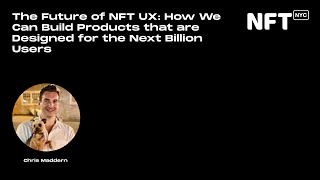
Chris Maddern argues NFT products need to solve real user problems, not just enable speculation. He defines UX as what a product actually does for people, and surveys existing categories like wallets and marketplaces to show where the next billion users might come from.
Chapters
Wow, this is. So do I sit.
Thanks so much for being here, everybody. So I'm here to talk about the future of NFT ux, how we can build products for the next billion users. Otherwise known as Chris. Complaining about the current state of UX for I think it's only 10 minutes they gave me, so it's going to be blissfully short. A little bit of context. My name is Chris, I run a company called Flor NFTs and we're trying to make NFTs more understandable and accessible and have really spent the last 10ish years in some way trying to think about the intersection of money, culture, transactions, personalization. And NFTS is just an incredible toy playground to do some of that in.
So I wanted to start by framing what is ux. I think it's like a really overloaded term that can be used to mean a lot of different things. And I wanted to describe the way that I'm using it for the context of, of this. And so user experience is really the kind of the sum total aggregate of solving a problem for a user in a way that they can actually realize the benefit that you're trying to give them and that they're trying to get out of using the thing. And so kind of as a sound bite, most importantly, UX is not how it looks. UX is what it does and how it does it, and how successfully users can actually achieve those things that they're trying to do.
By way of example, I think Craigslist is a UI that we all laugh about quite a lot. But actually I would posit that as a ux, it was pretty good at the time because it took a new emerging technology in the form of the Internet and the ability for information to move around, and it allowed people to actually solve the problem of finding a place to live or finding someone to buy a secondhand chest of drawers or whatever people did on Craigslist, as well as some of the other things that people did on Craigslist we don't really want to talk about. And then I think this is what I would categorize as a product. It's designed to solve a user problem. Little bit of a controversial example, one of my favorite tools and my personal wallet of choice, but I'd posit that actually Rainbow has a great UI, but actually hasn't thought about solving very many of the UX problems that come along with buying NFTs or selling NFTs or browsing NFTs, minting NFTs, those real things that users are actually doing with them, let alone thinking about accessing the underlying utility of NFTs, managing memberships that their NFTs have, managing royalty rights, and whatever else kind of those NFTs can allow you to do. Those are kind of real user problems and user opportunities that today aren't encoded into many of our products. Because today we don't really have any products, we have tools.
And so I think the. If you really only take one thing away from my opinion today, it's that we need to start building opinionated products. And great UX means coming in with a really strong thesis about what it is that we think users should be doing, hopefully being right about that, but then building guardrails up to make sure that they can actually successfully do those things. And those things don't mean interacting with a blockchain network, they don't mean signing a transaction, they don't mean understanding the balance of an ERC20 token. And today this is kind of where most of our building sits down at what I'd call kind of the protocol level. And the things that interact with those are really important stepping stones. Oh wait, someone gave me a laser pointer. This is amazing. And the stepping stone things that we have today are, I would call tools, not products. And then we're starting to get this little thin layer at the top of things that maybe actually start to talk about things that users might want to do in a way that isn't just very directly exposing kind of these concepts that sit down here in our protocols to end users in order to essentially let the user use the protocol as opposed to the protocol solving a problem for the user. And so a few of these we're probably familiar with, I kind of tried to over index on NFTs, but it's a little bit crypto broad. We have marketplaces, user problem, buy, sell, discover NFTs, that's a real thing. And OpenSea and a few others do that decently well.
Gaps, but decently well.
Another thing that we've seen emerge in the last year is NFTs can do more than just be owned. They can get you access to other stuff. And so there's a whole kind of swath of products that are being built around the problem of how do we get people access to other stuff and unlock the power of membership and utility for NFTs. And then similarly, on kind of the more traditional crypto side, exchanges roughly kind of fill the places of marketplaces. And then there's a whole defi ecosystem which not really NFT focus that we'll move on from. But importantly, I consider everything above this line. I love laser pointers. Don't know who gave me a laser pointer. Everything above the line is products and everything below the line is kind of these protocols and tools.
So I think the question that we need to be asking ourselves is what are the products? Sorry, what are the problems that we can solve better than any other industry or any other kind of technology use cases? And today, 100% of those that we really see built out line up behind one thing, which is speculation. Coinbase, probably the first company in crypto to find what I'd call true product market fit. Found product market fit around. Users want to buy highly volatile crypto assets and speculate on their future value. They made that a hundred times easier than anyone else through a mixture of technology, onboarding, education, like true kind of user experience, design.
As well as, frankly, custody, as well as taking some of the hard pieces of it out and allowing users a much simpler mental journey between where they were and owning assets. Uniswap, on the other end is a product, but it's designed for power users. It's designed to give users the broadest possible set of assets that they can, you know, spot exchange, and they do a pretty good job of that. Although it's not a product that's going to get a billion users, or at least I hope it doesn't. And then, you know, I think things like Goldfinch are just general defi products. They have found fit in a space that already exists, which is savings accounts. And today, you know, we've seen things like Luna happen. And so probably the whole world isn't going to put their savings in defi anytime soon. But there is a real problem there, which is you're making more money from your money in a way that's hopefully relatively low risk. These are all products that are in crypto that are about crypto, though. And I think that the biggest challenge and the biggest shift that we should all be looking for in the next, you know, one year, three years, certainly in five years, is it'd be great to see some crypto products that aren't about crypto that are leveraging crypto in order to solve user problems that don't exist purely inside of the domain of cryptocurrencies.
And I think fundamentally this is what's going to solve for the next billion users. It's going to be not coming at it crypto first, but rather thinking about what are the user problems that we can solve in the foreground where crypto gives us superpowers to solve those things. In the background, I think kind of to make some more questions, concrete predictions to consider. Right now, that taxonomy of tools that exists because of the structure of the protocols that exist under them, I think that's going to be disrupted. I don't think we're going to have as strict a line between the wallet and everything else we do because the wallet's really just a password manager at some level. It stores your private key and then it performs a function for you of signing transactions so that your NFT sale goes through, I think. And we'll talk in a second about a recent example. I think that as a pattern is going to reduce in time, I think you'll see more integrated wallets and frankly products that already do password management pretty well, handling some of the password management components of it. I think we'll see more portability of identity, whether that be in the form of wallet or other forms of identity. And I think you'll be able to bring your own or have them create one for you and operate anonymously. We're going to focus on learning by doing. It's really, really hard to teach people about the abstract concepts of crypto. It's really, really easy to teach people how to buy on Coinbase. And that's because Coinbase is solved for a problem that a user has. And then you teach them about the problem and the solution, not the underlying technology. And all products that I think are going to be successful at anywhere close to this scale are going to have to do that. And controversial opinion, I don't believe a billion users are going to self custody, at least not with anything that we've seen today. I suspect that at least for the beginning, we're going to see a lot of custody solutions and then the option to kind of portably move things off that power is important. It's a big mental burden for a user, an average user, to think about self custodying. Custodying. And so I want to leave you with one example. Probably many of you are familiar with them. History will tell us whether these folks survive. I think either way we're going to remember them as a really early, interesting example of someone who actually built something that people thought was fun on the blockchain and did not purely because it was crypto, but rather because they enjoyed doing it and it helped them feel like a more aspirational version of themselves. That's essentially what we do when we build products. We build things that either solve a very real problem people know they have, or we allow people to feel closer to the aspirational version of themselves that they want to be. And I think in this case Stepn definitely lent into the second one. So for anyone who's not familiar, Stepn is a move to earn concept. So abstracting it in crypto terms, it's an NFT that you buy that allows you to yield. That's my walk off that allows you to yield. But you have to actually take physical action in the real world in order to do that. And in this case, that abstraction allowed people to be successful with it at a much greater scale than we've seen in other products onboarding hundreds of thousands of users. So fortunately that was my last slide. So let's make products with crypto that are about your users and not about crypto. Thank you very much for giving me your time and I hope you have a great day at NFT nyc. Thank you so much, Chris. Really appreciate it.
More from Chris

Ship or Die Accelerate 2025: Why Everyone Should Refocus on Mobile (Chris Maddern, Johann Kerbrat)
Breakpoint 2024: Product Keynote: Rally: Your Social Wallet (Chris Maddern, Christine Hall)

Digitized | Spotlight Ep. 1: Floor - The NFT Everything App w/ Chris Maddern and Christine Hall