Welcoming the Next 10 Million Users to NFTs - Panel at NFT.London 2022
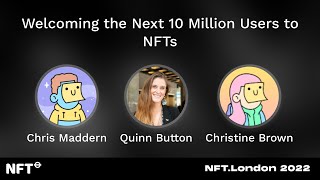
Quinn Button moderates Chris Maddern and Christine Brown, co-founders of Floor, on bringing 10 million new users to NFTs. They discuss custody models, community reputation, and Floor's mobile-first app that lets people manage NFTs with token-gated access.
Chapters
Our next panel is going to be talking about welcoming the next 10 million users to NFTs. And we're going to welcome Chris and Christine from Floor NFT and NFT NYC's very own Quinn Button. Thank you. Hey guys, how you doing?
Hey everyone Good?
We're almost done. Who's excited for New York in April? We gotta keep this rolling, right? Keep the fun going. All right, we'll put this over here.
Welcome guys.
Thanks for having us.
Thanks for coming over here across the pond. You're actually local here. Well, originally local ish. Local ish.
I was local once.
Yes. Well, thank you guys. And I think I see Pet out there who is actually the guy who connected us just a couple, just even like a month ago. And here we are on stage in London. Thank you guys so much for being here. My name's Quinn Button. I'm the VP of Growth for NFT NYC in London now as well as NFT Cred, which is a tech platform, works with brands to create white label marketplaces. But today I'm excited to be moderating, talking with these amazing people, Chris and Christine. I'll let you guys introduce yourselves. Why don't you guys go ahead and introduce yourselves to the crowd?
Yeah. So we are the co founders of Floor. Hopefully a lot of you in the audience know it. It is the app for the you to understand and stay connected with your NFTs. Chris might tell us a little bit about how it came about. I serve as coo and prior to this gig I ran the Robinhood crypto business from 2020 to about 2021.
Awesome. Hi, I'm the other co founder of Floor. As Christine said, kind of the home for your NFTs in your pocket. We've been building in public with the community since September of last year and I've just been really excited and overwhelmed to have so much positive reception and to be able to build with so many awesome people in the space. I also want to say amazing job this past two days. It is incredible to see how much work you've done and how amazingly it's come together.
Thank you, Chris. That means a lot coming from you guys. And we're going to do it all again in five months already. But I'm so happy that you guys are here. You guys came over here and I want to talk about Floor and how it was all developed and really, really, you guys have been so thoughtful in how you want to approach developing Floor IO and thinking about what the problems that it can solve currently in web3. So why don't you guys talk to me? I know we've talked a lot about trust and safety, so why don't you guys tell me a little bit about how trust and safety play into the design and what you guys are doing with floor.
Yeah. So a big part of how floor came to be was it's just really, really hard to figure out what the heck to do. And I say this as a computer scientist, someone who's been in crypto for four or five years. It was really, really hard for me. But when you start to understand the power of it, you understand how important it is that we make it a lot easier for a lot of people. I realize I'm not facing a lot of you. I apologize. And there's all sorts of layers to those challenges, and I think we'll talk about a few of them today. But one of them is, even if you. You do get folks over that hurdle and they do get the Fox app, and they do figure out how to get some eth, and they do figure out how to get their first nft, there's a good chance now that they're probably going to get rugged within a couple months and they're going to run away anyway. And so trying to create a place where you can do less, but more of it is safe. Like, we have this challenge where today we've created this set of tools that exist on top of a protocol, and a protocol that's very much designed to be just an abstract compute platform where you can do anything, but so many things are good and so many things are bad, and trying to give a little bit more of a bumpers up experience as people start to come into NFTs. Because in truth, while you can do anything on the Ethereum network or whatever other network you want to make NFTs on, really you only want to do a couple of things. You want to mint something or you want to transfer something. You want to, like, put something on a marketplace. And so putting bumpers up and being a little bit more opinionated. And I think this is the difference between products and tools. An opinionated solution to a problem that a customer has versus just giving them tools that can do anything, up to and including rugging themselves by signing the wrong thing.
I think you want that opinion. But where there's the potential for us to go is to, like, centralize everything again, right? To have one platform or one kind of person in the space that has the opinion and is saying, this is the good, this is the bad, and that's kind of the antithesis of what kind of brought a lot of us here in the first place. So I think what has been interesting in building with the community is saying, hey, can we build that opinion and surface it and share it from a bottoms up perspective, Take information about what other people are doing, what they trust, what they don't trust, make it a little decentralized versus having it top down. Right. In the very traditional like securities markets. You have analysts at Morgan Stanley and Goldman Sachs who say this is a good buy, this is a bad buy, here's my dollar target. But it's coming from a central authority. What happens if we actually gave that power to the communities and let them kind of with the way that they purchase and behave, kind of share that opinion and make it a safer space.
I love that you guys. You know, I think right now we're in such a different market than we were in 2021. Right. Like this reminds me very much like where we're here in London, like 2021 in New York, except for we're in a builder's market. Right. So we're really building. The people who are here to build for the long term are here and you guys certainly are. And I think the way that you guys have been thinking about this space, I mean this, the title of this talk is welcoming the next 10 million users to NFTs. That's where we're up to right now. Right. How do we solve problems and bring more people on board? Could you guys give the audience a little bit of a background of like how your background has helped kind of inform building these products? Yes. In Web three, but we're seeing a lot of brands come into this space. A lot of people who are Web2 don't really get Web3 and are trying to reduce friction to bring them on. How are we going to onboard 10 million users and how has your background kind of helped shape your vision for that?
Yeah, I think we're lucky in that both of us at different places were able to see millions of users come into a new financial system. So for me at Robinhood, I got to see, you know, we had dogecoin at a time when dogecoin became incredibly popular and there was only really one place to get it if you wanted to go to an exchange. And we saw 6 million users come onto the platform in a span of 60 days. And understanding, okay, it's accessible, it is a very easy, approachable thing. There is not a lot of overhead in terms of getting started right there. You don't have to self custody and it's fun, it's playful. Right. Where bitcoin was always like by engineers for engineers, there's literally a white paper that sometimes gate keeps people out from feeling like they understand it. Dogecoin was a dog on a coin called dogecoin. And so bringing people into the space is about not only the tech behind it and making it easy and reducing the barriers, but making it approachable and something that feels like is for. And I know you had kind of a similar experience at PayPal bringing millions of people into the P2P world.
Don't talk about PayPal. We call it Vermo. It's so funny seeing yourself as a PFP in real life. Yeah. So I think making 10 million people or getting 10 million people do anything is the same, no matter what you want them to do, which is it has to be useful and appealing to do that thing. And the juice needs to be worth the squeeze. It has to be more more appealing than it is hard to do. And if you think about that in terms of product, that means product market fit. And crypto fungible tokens reached that product market fit when centralized exchanges allowed you to easily buy it. And there was a pretty good chance of it going up, or at least people believed there was a very good chance at any moment of it going up. And so it was easy to do. The incentive to the person was pretty obvious financial gain. And it wasn't that hard. The gains were large, the juice was worth the squeeze. And so crypto exchanges popped up. Crypto spot trading was a massive thing and everyone bought, whether it was Bitcoin, Ethereum, Dogecoin, whatever, it was worth it. Scaling Web3 is going to be the exact same thing. We need to find some stuff that's actually useful for 10 million people to do. We need to make it easy enough for 10 million people to figure out how to do it. And then as that trade off balance changes, as it becomes easier and more useful, more people will do it. I think a few things that are inherent in that and maybe they're controversial to some people, maybe not to others. I don't think pictures of animals on the blockchain are useful enough for 10 million people to want to do that for any reason other than financial speculation. And frankly, non fungible assets being relatively illiquid are just a less good way of doing that than fungible tokens. So I'm a big believer long term in utility tokens, in tokens that gate provide access community. Like that's the power that we've seen with floor. And I think it's one of the things that's going to be really pivotal in creating creator economies, in aligning creators with their consumers. I think there's magic there and where fungible tokens for the most part found their superpower in being really, really easy to create liquidity events and really, really easy to like do spot trading and create gains. I think it will be in this area of kind of utility and community that NFTs will really find their fitness then all the way on the other side. And this one might be more controversial. I don't believe 10 million people are going to self custody assets and if they do, it's going to be a disaster because most of them are going to lose a lot of those assets. And so I think we need better shared on chain, semi custodial solutions. I do believe, and this is a very US Western kind of centric view of the world, there are parts of the world where self custody and self sovereignty are important because you can't trust the government. I think saying that in the UK or the US is like kidding ourselves. There is no problem to be solved with self sovereignty and it is so, so, so hard to overcome the challenge of. Here are 16 words that you have to keep safe. If you lose them, the money's gone. But also if anyone else finds them, the money's gone. Which is actually like a pretty hard security problem to figure out how to escrow that. So I think we need better custody solutions mixed with a more useful thing to do on the other side. And if you're looking for hints of things that those might be, I always use Stepn as an example. It was a genuinely fun game to play that close to a million people did really, really quickly because it allowed users to become closer to a more aspirational version of themselves, which is one of the key things that you can do as a product to actually gain traction. I think we will see lots more of these emerge. I think Reddit's doing really interesting stuff on the avatar side. I think it's more than art when it's a representation of yourself. I think that's what PFPs have been trying to play with for a little while. So there are things that are starting to show greater utility. I also think NFTs, where they meet defi can be a really interesting kind of financial yield instrument that could make it worth buying NFTs. That was a longer answer than I expected.
No, that was fantastic. And you know what's so interesting is, you know, in this builder's time. Right now we're all trying to find the solutions to problems. I mean, one of them is reducing friction. Because we are not going to grow as an industry, as a space if we're all just the same degens buying and trading things together. And so what's interesting to me is you guys came from two companies we all know, Robinhood and Venmo, right? Not PayPal, Venmo. And you guys helped them grow and scale at a certain time. So you understand the difficulties that come with scale and growth, right? And that's really what we need. We need those types of brains, right? But then you guys also fully understand where the space is right now and what it takes to actually get to where we need to be to get to that next level. Because I've met with a lot of different brands who are in here, kind of stealth mode, trying to understand this space. How is it going to grow, how are we actually going to solve these problems? And there are all different types of solutions, right? A custodial solution or semi custodial solution is something I think we have to keep on talking about. What does that look like if someone loses their keys? There were talks on the legal and accounting stage of what happens when you die to your assets. Do you have a plan? If you got hit by a bus tomorrow, would your assets be all good? Right? And so you guys are thinking about that and I'm so glad you guys are here on stage to talk with the builders because that's what it's all about, right? We are wanting to collaborate and make good products. And that's one thing that you guys have told me over and over again is like products that really.
Make, you said something like fun, make it fun, but also useful to people. So how do you guys see that kind of shaping out as people come into this space new? What, what are those things obviously you were alluding to? Okay, you don't have a seed phrase that you're only solely responsible for, but what are some of the other features that you guys are thinking about in floor that make it safe and actually useful to people when they get into this space?
I can start if you want. So I think some of this will fall in floors kind of area of responsibility. Others like as Christine alluded to, both across not becoming a centralized source of custody or authority or decision making or king making or whatever. We also don't want to be a verticalized solution that builds everything. This is a place that we very actively want to partner with other folks in the space because there are A lot of really hard problems to solve between here and being able to safely and easily welcome 10 million people. I think as you think about so Web2 actually did a lot of things very well. We got really, really good at getting people to buy stuff on the Internet and we got really good at getting people to create content on the Internet. And then we created Web3 and it has all this new magic stuff, but we forgot everything we learned in Web two. I think many of the things that we did in Web2 really, it's just a case of porting forward at some point. We made HTTPs, which made it safe to send things across the Internet. We made password reset flows, we made instant checkout solutions. All of these things kind of just need to find their analogues. I think it's really interesting to think about less from the safety side, more from the kind of long term project viability side. What's the replacement for subscriptions inside of Web3? That's a really interesting space that needs to be explored. I think if you just started by porting all the no brainer stuff from Web two, you start to get a lot closer to what a good consumer Web3 thing should look like while keeping the magic of Web3.
Yeah, I think right now we have all the building blocks of how things should work. The protocols, the technology. Okay. This is the kind of lower layer set of stuff. I think what I'm excited about during this builder's market, which I love that that's what we're calling it now, not a bear market, is what goes on top of that. Right. How do you have someone like custody, even if it's for themselves without ever having to know this is a wallet and like I have to take all these specific precautions around it. I think the idea of identity and KYC as well is going to be something that needs to be solved because like being able to carry your identity with you through the world and have that tied to something that is like web3 native is going to be really important to be able to say this person has a track record of like this kind of behavior. So if you're buying their project, you know what you're getting into, which I don't think exists as much today. That like, that is another big problem that I'd love to tackle.
That's a great one and I think that's a great way to actually end this one. And you guys check out Floor IO, it's really interesting. And please come and talk to these guys. They really are here to build something that's useful for us all long term. And that's what we all are wanting to do as well. You guys, thank you so much for being here. And we'll be sharing out some stuff on social media so people can learn more about what you guys are doing. And let's build together. That's what this event is all about, is for us all to meet and to collaborate together. And so thank you both so much for being here and sharing the stage with me.
Thank you for having us, Quinn. And if anyone here actually wants to try out Floor app, come find us afterwards and we'll give you a little QR code and you can try the token gated beta.
You want it? Trust me.
More from Chris

Ship or Die Accelerate 2025: Why Everyone Should Refocus on Mobile (Chris Maddern, Johann Kerbrat)
Breakpoint 2024: Product Keynote: Rally: Your Social Wallet (Chris Maddern, Christine Hall)

Digitized | Spotlight Ep. 1: Floor - The NFT Everything App w/ Chris Maddern and Christine Hall
How We Can Build Products that are Designed for the Next Billion Users - Talk at NFT.NYC 2022