Automated Marketing Machine
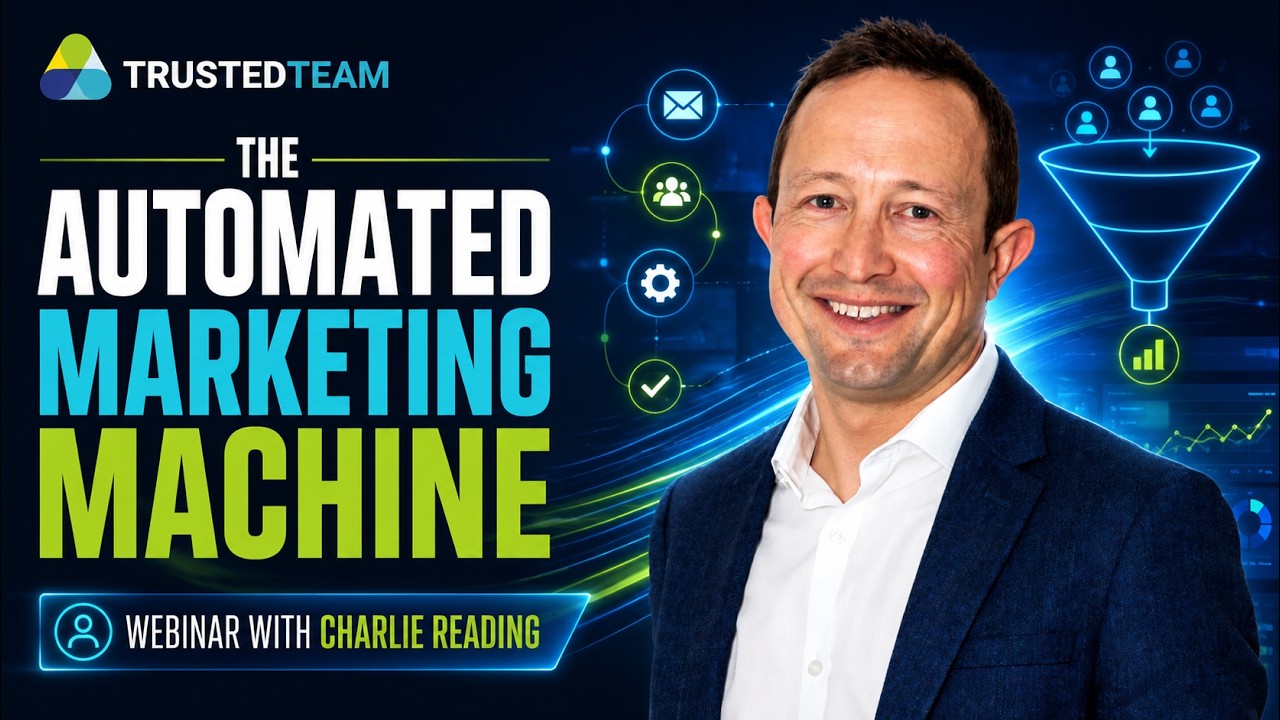
Charlie Reading presents the Professional Marketing Magnet, a 16-session course for professional-services firms. He's generated over 300 high-quality leads per year with his system. Enroll now for 20% off plus a free AI Masterclass worth £2,000.
Chapters
Okay, welcome. Thank you for dialing in early. Welcome to the Automated Marketing Machine: Attract Your Ideal Clients While You Sleep. We'll just give it a few more minutes to let everyone dial in. I know there's a couple of questions as you dial in, so we'll just give people time to do that. But thank you for those of you that have dialed in already and are on time. Looking forward to sharing this session with you. Not sure where you guys are in the world at the moment. I am in the beautiful Cornish, uh, or on the beautiful Cornish coastline. Um, I am looking at a view— well, no, that's not true. I am right looking over the Cornish coastline, but it doesn't currently look like this, if I'm honest. This is, uh, if you haven't worked it out by the fact that the waves aren't moving, this is not the actual, um, Cornish coastline today. But last night, uh, and if anyone, um, wants to see this, uh, just look at my Instagram account. But we were literally staring out at sea looking at the most incredible display of Northern Lights, um, from our garden and from, um, from our balcony here. So, uh, it really was quite stunning in Cornwall last night. You've probably seen photos online. It was absolutely beautiful. And then this morning, by complete contrast, honestly, it was like somebody had turned a swimming pool upside down. I don't think I've ever seen water fall out the sky as quickly as it did. When I was trying to get into St Agnes Village, which is where we, where we have had a house for ages. But at the start of this year, we actually moved down here. So we are down here for a trial year just to sort of see how it all goes. But yeah, you are thinking, if you've just dialed in, you're thinking, what on earth is he talking about the weather in Cornwall for? Well, don't worry, you are here for the Automated Marketing Machine, how to attract your ideal clients while you sleep. Um, but we're just going to give it a few more minutes to let people dial in, um, because I know there's always people that dial in a few minutes late. And of course, there's a couple of— I think there's a couple of questions that we set up for you to answer, which will slow a couple of people down as well. Um, so I'll keep rambling at you until such time as, um, we'll probably kick off at 5 past, I would think, because that'll give people time to dial in and get organized. Um, which means if you haven't got yourself a cup of tea or coffee and you feel like missed out by doing that, feel free to quickly rush to your kitchen, or maybe not the cafe. The cafe is not going to turn it around in 4 minutes, is it? But you've got time to grab a quick drink, um, if you want, and we'll kick off at 5 past the hour. But for those of you that have already dialed in, and by the way, I can see some familiar names already, so that's fantastic to see you here. Um, thanks for dialing in in plenty of time. Belinda, Andy, Paul, Stephanie, Tim, Ian, thank you, and plenty more of you. So thank you for all being here on time. But I can see there is, there's some good names there that I recognize, and also plenty of names there that I, I don't know who you are yet, although I'm sure hopefully from the technology we, we know who you are. I've got Charlotte and Amy sitting on on hand to answer any questions you put in the chat. So if you've got any specific questions you want answering immediately, put them in the chat. But I will do a Q&A at the end of my session. So if you've got any questions that you want me to answer, then fire them into the Q&A and we will, um, uh, and I will go through them, um, or as many of them as we have time. So a few of you are dialing in now. Brilliant. Welcome, welcome. Some— yep. Some more familiar names dialing in at this time. That's brilliant, excellent. I'm just saying to those guys, um, that are already here, uh, we'll just— we'll kick off at 5 past the hour. It just gives people a bit of time to get dialed in, settled, answer those enrollment questions and all that sort of stuff. But welcome to the Automated Marketing Machine: How to Attract Your Ideal Clients While You Sleep. And we're going to be talking today about attracting your ideal clients but without having to do any work, setting up the systems so that it happens automatically. Um, so thank you for dialing in on time. Um, I was just saying to— for those of you that are just dialing in now, just saying last night I was treated to the most incredible display of Northern Lights. Uh, I mean, down in Cornwall at the moment, uh, I am looking out across the Cornish coastline, but it doesn't currently look like it does here. Um, But yeah, the Northern Lights last night, uh, down here were amazing. Um, the best I've ever seen them, uh, anywhere. And so, uh, yeah, check out my Instagram feed if you want to see the photos that we were— and the show we were treated to last night. Um, but yeah, so while we go through this, any questions you want me to answer at the end, stick them in the Q&A. Anything you want Charlotte or Amy to answer, that's kind of a more practical thing, just fire them at them in the chat and they will come back to you on that throughout the course of this session. But I won't come to the Q&A until the end because being a typical bloke, I'm not very good at looking at, like, doing two things at the same time. So therefore I've got to focus on presenting and then I'll focus on the questions. So without further ado, you guys have been good enough to dial in on time. So let's get started. Thank you very much for joining us today at the Automated Marketing Machine. How to Attract Your Ideal Clients While You Sleep. And this really is the secret to so much success in business. It's actually— I've done a talk previously, which is on our website if you want to go back and watch it, called How to Build a Saleable and Scalable Business. And that, that talks about 4 principles that determine a saleable or scalable business. And one of those principles, one of those 4 key principles to building a saleable or scalable business, is to have an engine for growth. And that is what relates to what we're going to be talking about this afternoon, which is the Automated Marketing Machine. Because if your business will grow whether you're working or not, you have a vastly more valuable business, uh, and you have therefore a business that means that you can work less if you choose to, but it also means you can have a business that you can sell if you choose to. So over the course of the next sort of 90 minutes or so, with a little bit of buffer, I'm going to tell you how you can build out an automated marketing machine. But I'm also going to share with you what I think is working in the world of marketing at this moment in time, as opposed to what, um, what was working a year ago and kind of how we build a marketing machine that is resilient to the fickle changes we have in the world of technology. So that's what we're going to be spending our time doing this afternoon. Because, you know, maybe at the moment you're, you're not finding enough of those ideal clients. And, and of course they have to be, you know, just finding clients is not good enough. They've got to be the ideal clients. Otherwise you find that they don't pay you very well and they create you a huge headache. So perhaps at the moment you're not finding enough clients, and if that's the case, then probably that also means you're not generating enough revenue in your business. You may be generating a good revenue, but perhaps you're not generating enough revenue to employ the people that you want to employ, to employ the strategies and technologies that you want to employ, and also to live the lifestyle that you deserve to live as the entrepreneur and founder. Because ultimately, if you can't find these ideal clients, Uh, then that's what's going to hamper the revenue, and that's going to drive how you live your life, how you run the business, and who you bring into your business. And maybe at the moment also you're kind of struggling with this work-life balance piece and working every hour God sends. I know I've had spells during my life where I've had to do that, um, and often it's the founder that is the greatest bottleneck in the business. And typically when it comes to marketing, that's because the marketing is all being driven through the founder. So if you are doing all the marketing and being like super busy there, then it's difficult to spend your time doing the thing that— whatever it is that you got into, whether you're a financial advisor, accountant, coach. I can see other people, all sorts of different people that like the names— of the names I know that, um, that are in here today. Um, and you really got into that business to do that thing, didn't you? You know, you got into that business to be the coach or the financial advisor or the accountant or the solicitor. You didn't get into that business to be a marketeer. And so that's, you know, when that's dry, taking up all of your time, you can't actually do the thing that you set out to do. And perhaps also as a result of that, you find that, you know, you got into this business because you had a passion for a thing, the thing that you do. And yet because you find yourself doing less and less of that thing and more and more of the other stuff, whether that's the regulatory stuff, whether that's the administration stuff, or whether that's the marketing stuff, you end up actually falling out of love with your business because you're not doing the thing that you're passionate about. So if that's where you are at the moment, where would you like to be? Well, you know, imagine a time where you have got this constant stream of your ideal clients knocking down your door so that you can come into work and you go, brilliant, I don't need to go out and try and find those new clients. They've already found me and they definitely want to seek out our help, nobody else's. Imagine that was just filling up your inbox, you know, a constant queue of people wanting to come and use your services. Well, that's what we're trying to get to, isn't it? Um, but also imagine a time that that means that actually you get your, your work-life balance back. You decide how many hours a week or a month you work, and you only do the work— you only work the number of hours that you want to work. And that means that, of course, In the rest of the time, you could be doing the hobbies that you love most, spending the time with the people that you love most, and also becoming the fittest and healthiest you can possibly be. Because of course, if you don't do all, if you don't do those things and you just work every hour God sends, then okay, you might eventually create a successful business, but if your family don't speak to you and you don't have your health and happiness, kind of what I'd ask yourself, I'll ask you, what's the point? And then finally, imagine a time where when you're at work, you're only doing the thing that you got into business to do, the thing that you love, and doing the things that you would describe as fun. In fact, making work more fun than fun and enjoying the thing, loving the time that you spend at work. You know, my daughters take the mickey out of the fact that, you know, oh, you're going to work, Dad, but on the golf course, or you're going to work whilst going to the US to see some cool things, or whatever it is. So work can actually be more fun than fun. And so I want you to imagine this time where you're only working, you know, you've got this great business, you've got this flow of ideal clients, you're only working the hours that you want to work, and when you're at work, you love doing what you're doing. Now, I've spent— I've, over the last 25 years, I've built and sold 3 different businesses, and I'll come back to this in due course. And I am and I've created 3 more. And what I've seen is this trend, because why, why do we need to build this marketing machine? Well, well, really the problem is, like I said, that the founder restricts the amount of growth that they have within their business. Typically, most of the marketing is being done by that one person, and therefore it's all dependent on how much, how much success and how much time that founder has. And really, it's breaking through that barrier and finding an automated solution that can deliver you a flow of your ideal clients that is the, is the key to unlocking exponential growth. As it happens, there's two more barriers. Um, so then what you tend to end up with is a time-poor founder, and you can fix that by a different approach, which we're not going to cover today. And then finally, actually, there's another barrier, which is still where the growth of the business and the management of the business is, is restricted, um, by the founder. And it's only really when you crack through that that you create this self-driving business. And by the way, that's the most saleable and scalable business you can build when you do. Um, so why is this topic such a, such an important topic? Well, firstly, we want to get to that exponential growth business because it then allows us to drive that business forward. But the other thing is it's really important that we don't become the busy fool because it's very easy to sort of pay lead generation companies or marketing agencies to generate you this huge flow of leads, but if they're not your ideal client, you'll spend forever fighting them away or being really busy but not actually making much money. What you really want is a marketing system that delivers you a key— the number of opportunities that you can deal with, but those are genuinely your ideal clients. So you have this really focused, engaged conversations with people that are your your ideal clients. And, and you know, what you really want is these messages to be flying in, and whether it's from your email, whether it's from, um, you know, introductions, whether it's from social media. And what you want is this constant stream of people seeking you out without you having to actually go out and do the work. And by coincidence, and genuinely, this message came into me last week. Now, Just to be clear, I sold the business that this person is talking about 3 years ago. So I am not actively marketing for this business at all. But this person, and I saw this person 20 years ago, and you can see he jokes that the prior message that we'd had, and this was on LinkedIn, the prior message we'd had was 17 years ago. So 17 years ago, for whatever reason, and I know why it was with him, um, he did not become a client of ours. But 17 years he's been sat aware of us through our automated marketing machine. And 17 years later, since the last time we actually had any sort of conversation, he has said, actually, now I need your service and there's only one place I'm going because you're the person that has positioned yourself as the expert in my eyes. And so, like, I think it's a great example. I'm not even trying to find these leads, but the marketing machine is still doing so. And you see, the problem, the problem with, um, most professional service businesses is that what happens is they go out and they look for more clients, and they spend time looking for clients, whether that's networking meetings, whether that's referrals, whether that's paying for, paying for leads or whatever it is, and they get more clients. And then what happens is they get busy, so those clients get less attention. And then those clients get a worse— the existing clients get a worse experience. So some of them leave. So you have less clients, which means it frees up more time, which means that you can then go out and find more clients. Well, that doesn't look like a very scalable or saleable business, does it? Unfortunately, it's the case with most— a lot of professional service firms. What we need to adopt is the Amazon flywheel. And the Amazon flywheel is essentially a, a way of, um, of, of growing a business so that the bigger it grows, the, the better it actually gets. And so what we want is, you know, if you think about with Amazon, when they got more customers, what happened was more sellers listed. And when more sellers listed, there became more choice, which meant that the, the buyers got a better experience, which means it drove more traffic. More customers, more sellers. That's what we're trying to create. We can only do that through an automated process. So that is why this is such an important principle, because otherwise you, you'll just break the system. And there's never been a more important time to do this. Of course, we live in an age where AI is making everything faster, more efficient, more focused. So we need to be able to do, firstly, this is a great opportunity for you to upscale your marketing with these tools and do things that you've never been able to do before. And we're going to touch on this today. But also, this is also available to your competitors. So if you're not embracing AI, there's a saying that is, you're not going to lose your job to AI anytime soon, but you will lose your job to somebody who knows how to use AI. And that's really the key, is if you're not using it and your competitors are, they have a massive competitive advantage. So there has never been a more important time to get this right, otherwise you are going to be massively up against it. Um, and of course there's never been a more important time to do this because, uh, or a better time to do this because if you think about it, you know, years ago if you wanted to put a, an advert on the TV, it would have cost you literally thousands and thousands of pounds, probably tens of thousands of pounds to have an advert on TV. But it cost you thousands to have a, an advert on the radio, and it would have cost you thousands to have an advert in the mainstream newspapers. And of course, the problem with all of that is you're spending an absolute fortune to reach those audiences, and yet a tiny fraction of them are actually your ideal clients. And most of that money is wasted on people that aren't Whereas in today's age, you can have your own TV channel and you can put the content out there through that TV channel for free, and you can specifically target your ideal clients. Instead of the radio, you can have a podcast. You can have a podcast, you can have your own radio station essentially, uh, and you can do that for free. And again, with that, you can target your ideal clients. And then instead of a newspaper, you can obviously use the different social media platforms that are out there and you can have people reading your content and following you and you can target exactly your ideal clients. Um, and it doesn't cost you a penny. So we have this incredible opportunity, but with that incredible opportunity becomes complexity. And actually what's happening is, uh, whilst this was an amazing opportunity 5 years ago, I think in it, what I'm witnessing is the reversal of this as well, because it's now so freely available to use and so cheap to do this that there is now so much noise in that space. And with AI, obviously this is only being exaggerated further and faster. Then, um, what's happening is that the, the people, the people I know that spend a lot of money on particularly their social media ads are getting the lowest return they've ever had, um, because it's become much, much, much more difficult. There's so much noise in this space. And so where does this take us? Well, this takes us to today, and today really what I would describe it as is digitalizing the repetitive and, and humanizing the exceptional. So I think more, more today than in, in the last 20 years, we have this opportunity to humanize what we do, but to use technology to free us up to be able to humanize more. And I think if we do that, then we can build this incredible automated marketing machine that actually has impact and delivers those ideal clients to us. And in— when I ran a financial planning business, um, I always said that when it comes to investments, we do what's always worked not what's currently working. So we didn't put cryptocurrency and NFTs and all this sort of stuff in clients' portfolios because all the research said that what has always worked is a properly diversified portfolio with cash, bonds, stocks, and some commodities in there. And so that's what we did. We ignored all of the current fads because fads come in and out very quickly. And when in investment world, when they come out, it's it gets very messy. And I think this is where we're also seeing that marketing needs to go, because you can spend your money with ad agencies, you know, spend a fortune on Meta and find that you're getting zero returns, or getting— paying money for lead agencies that are lead generation companies that are going to fill your diary with lots and lots of calls, um, but that aren't your ideal client. Or you can go back to what's always worked in marketing, which is the human connections. And that's where I think we are today. That's what we need to do with our marketing. But you might be asking, well, you know, who's Charlie Reading? Why on earth would I listen to him? Um, so, uh, I'm just going to give you, for those of you that don't know me, uh, a very, very quick rundown of where I've come from. Uh, so historically I ran, uh, one of the top financial planning practices in the UK, a company called Efficient Portfolio. And if you'd seen me a kind of a few years into that journey, then you'd have seen me like all of what I've just described, the one man band drowning in a sea of admin compliance, trying to get out there to do the marketing meeting, to network, to do all of those different things. And I was drowning. I was working every hour God sends. I'd got two young girls that I wasn't seeing grow up. I was three stone heavier because I was in the, when I was in the worst um, situation, you know, health situation I'd ever been in. And I realized that something had to change. So I went out and sought out the best coaches in the world for all sorts of different things and different areas, um, spent a fortune on coaching, uh, but, but knew that that would allow me to learn from their experience, from their lessons, from, from their journeys. And ultimately, I went from that one-man band struggling business to becoming an award-winning financial planning practice. We were known as the best financial planning practice in the Midlands. And in 2015, I had a book published called The Dream Retirement: How to Secure Your Money and Retire Happy. And that book led on to a bit of a rollercoaster of success for us as a business. I started getting featured on the radio, in the newspapers, cover of my industry magazines, speaking on the stage all around the world, actually, from Miami to Nashville to Singapore to obviously in the UK as well. And we were recognized within the financial services space specifically as a firm that, that did things differently when it came to our marketing. So yes, we were an award-winning practice, but actually I went on to write 4 books while I was running that, uh, that business. Um, and we had a very innovative approach to marketing, and, and that marketing process continues to deliver clients to us today, even though we've turned it off pretty much, um, other than book sales, um, for the last 3 years. It's an automated marketing machine. It carries on working even when you don't actually need it to, um, which is amazing. Uh, and so, uh, and I mentioned at the start, I've actually had 3 companies that I've done, built and sold so far. Um, so a company called Efficient Power Planning, which helped financial advisors, a company called the Rural Business Community, which is a, um,, or was, uh, a rural business hub. And then obviously Efficient Portfolio that I mentioned. Um, I have just also had my fifth book published, a book called The Business of Endurance, uh, which is based on over 150 interviews of the very top endurance athletes on the planet. Um, everyone from Jonathan Brownlee— or sorry, Alistair Brownlee— to Sharon Davies, to Louise Minchin, to the best triathletes and ultra runners and and it's the lessons that we can learn in life and business from those stories of endurance sport. And really, like, I tell you all of this because ultimately what we want to do is build this saleable and scalable business, but we want to do it on our terms. And on that journey for over 12 years, I've been able to write those 5 books and do all sorts of different, you know, build those businesses. But I've had 3 months of every year off for the last 12 years. Um, in doing that because that was really important to me. It's what allowed me to spend time with my family and my girls growing up. Um, and, but, you know, while we were doing that, we were still delivering 50% year-on-year growth in, in the financial planning business because the automated machine was working. And 3 years ago, I sold Efficient Portfolio, the, the financial planning business. And what I do now is I've actually created 3 companies since then, but the main one The one that I work in and the one that I'm here to sort of talk to you about today is called The Trusted Team, and it's how we help businesses, particularly service-based businesses, grow whilst working less and enjoying more, and essentially help them build a saleable and scalable business. And we do this through, primarily through, um, systems, frameworks, through coaching, through connections, and through community. And, and the journey that we take people on is typically based around what we call the Better Future Framework, which I'm not going to go into any detail today, other than to say, you know, if you really want to build a saleable and scalable business, you need to master each of these different areas within your business. Um, but today's session is all about marketing. It's about generating more of your ideal clients. And so it's really all about generating leads within your business, a constant flow of leads so that you don't have to focus on going out and doing that. You can focus on doing the thing that you do inside the business, how you help those clients once you've found them. And so over the course of this webinar, and of course, like, you'll have already seen that I've talked about this framework. I always think in frameworks. I think in frameworks. It helps me clarify my thinking. It helps me clarify my message as a speaker. It helps me speak. Like, I always teach people how to speak with no notes. Having a framework is a brilliant tool for doing that, um, but it also makes it more memorable in your mind as well. And so when I thought about this, I thought, well, okay, what is— what builds the ideal client magnet? What, what does— what does building an automated marketing machine look like? And I built out the, the ideal client magnet as a system to deliver this automated marketing machine. And the starting point, the starting point of of having really brilliant marketing is to make sure that the message is right. So what is the message and how does that impact your marketing? Well, I want to start off by sharing the story of Samuel Pierpont Langley. Now, Sir Samuel Pierpont Langley, um, was the man that was tasked by the War Department of the US, um, to build a a flying machine, an airplane. He was given $50,000, which in those days was a huge amount of money. He had, uh, he was given that by the War Department to, to build a plane. He had a seat at Harvard, so he, um, he had access to a huge number of bright people, you know, the brightest minds of their day. Um, he worked at the Smithsonian, so again he had access to the brightest minds of the day. He hired the best minds that money could buy, um, uh, and, um, and the New York Times followed him around everywhere. And so like basically he had everything going for him. So I'm sure you know the story of Samuel Pierpont Langley inventing the first plane. Well, of course you don't, because he didn't. Now who did invent the first plane? Well, that was the Wright brothers. Now the Wright brothers didn't have any of what Samuel Pierpont Langley had. They were only a few hundred miles away in Dayton, Ohio, but Orville and Wilbur Wright were paying for their dream of building an airplane from the proceeds of their bicycle shop. Not one person in their team had a college education, not even Orville or Wilbur. But of course, as we know, you know, we know the story, how it ends. They did build the airplane.. And it was because it was right at the heart of their why. You know, Simon Sinek would describe that as their why. I'm gonna refer to that as their guide. They were guided from within to build this plane, and it was absolutely everything that, that they were determined to do. And when I think back to the stories that had the greatest impact on me when I was interviewing, um, people on the, on the, um, business of endurance, one of them that really stands out to me is when I interviewed Sharon Davies, the amazing swimmer And she now, now is a very active campaigner for, um, uh, for, uh, fairness in sport and particularly around the, the transgender in sport topic. But she was deprived of medals in the Olympics because of the East German state-sponsored doping, and she feels that she— that when she was competing the sport, it wasn't a fair sport. And so she's now adamant that it's got to be a fair sport. And that is her guiding why. That is what gets her out of bed. And she's willing to actually lose jobs over speaking out because it's so important to her. That is her guide. And if you know the story of Bremont Watches, it's a very similar thing. They are the only British companies to break into the really high-end watch market in kind of the last God knows how many years. And the reason they do this is they tell the stories behind the watch. So originally, Nick and Giles English got into this because their father, who they used to fly with a lot, was killed in an air crash whilst I think it was Nick was actually in the air with him. Nick survived. Dad didn't. And so the kind of magic of flying sort of fell, fell away for them. But the other thing they used to do with their dad was renovate clocks and watches. So that's what took them into it. And it's by telling that story that really cements their marketing. And it's all about why they do the thing. It's the thing that guides them from within. At the extreme of this is, is Bremont have a watch called the MB1, and they— this watch was solely to be sold to pilots that have ejected out of a Martin Baker ejector seat. Talk about that, a niche market. But those sell— those watches sell secondhand on eBay for $120,000. But that's the power of really knowing your guide within. And so when I'm like a financial advisor, making good inroads. I've kind of spent quite a lot of time doing retirement advice because I was one of the few people that had taken the most— the highest level of pension qualification, I think, called G60, for any financial advisors that are watching this. And, um, and I then heard this, uh, interview, uh, around some research that Professor Joseph Zeimuller had done, and It was basically concluding— it was on blue-collar workers in Zurich, and it was concluding that the earlier these people retired, the younger they died. Now, you would think that retirement was— early retirement was good for your health, but actually the research was showing the complete opposite. Now, for any financial advisors watching this, you'll probably understand why. You know, every day is a Saturday in retirement. But ultimately, listening to this connected up so many dots for me because I suddenly started realizing all those clients I'd been advising on their retirement, yes, they'd wanted to help with the money, but actually they wanted help far, far wider than that in terms of what they did with their time and how they looked after themselves. And actually, it was hearing that story that made me Want to Write the Dream Retirement and help clients at a much deeper level. And like I said, that book was a real sort of trigger as a roller coaster of success for us. And so the reason I tell you this is because this is what was guiding me to help our clients at a much deeper level. And this is what we need to do with our marketing. You know, they say don't sell the drill, sell the hole. But actually, nobody wants a hole in their wall either, do they? They might want a shelf in their Zoom backdrop to make them, you know, so they can put books on it and make them look smart. They might want a shelf because they told the wife they would do it and it's going to get them brownie points or whatever it is. But it's really about getting to the guide within them that, um, is, is where we can get the marketing really powerful. If we understand what's guiding us and we can get that into a message, we can do that. We can, we can make marketing so much better. And we do that, we help people do that through a process called the Guide are great. Now be warned, not a very pretty slide. I want to tell you a quick story. Now, um, a friend of a friend, um, was in, um, the US, uh, touring around on business, and, uh, he gets chatting to this lady at the, uh, at the bar, and, uh, they have a drink together, and the next thing that happens is he wakes up in a bath full of ice. Now he's absolutely freezing cold, and on the side he can see a note that says, call 991— call 911 immediately. Um, there's a phone sitting next to it, uh, and so he calls 911, describes the scene, and they say, ah, reach behind your neck, is there a pipe coming out of the water? And he does, and he's, he's obviously terrified by this. And the woman on the end of the phone says, 'An ambulance is on its way. Um, in this town there has been a series of kidney, um, harvesting, um, going on. You, you've had one of your kidneys stolen. Don't move, we'll be there shortly.' Pretty dramatic story. Now, that is an urban myth, just to warn you. It didn't happen. The clue was the friend of the friend for an urban myth. But pause that for a minute. Now let me tell you something else. So when I was a financial advisor, we used to work, we used to help people using trusts. And the reason that we'd set trusts up for people is because what it would do is it would save people, it would save them, save their children inheritance tax. It'd also mean that if one of the children got divorced, the money wouldn't get lost to the daughter or son-in-law from hell. And it's also a great way of making sure that if you— if, you know, your children are young and irresponsible when you die, that you've got trustees making sure that they're much more sensible with the money. Okay, pause again. I've given you two messages here. One was the kidney heist story, and one was the importance of trusts in your financial planning. Which one's more important? Well, I'd say the trust conversation is definitely more important. Which one will you remember tomorrow? It's the story. The story of the kidney heist. And because stories, uh, so they say that facts tell, stories sell. It's absolutely true. So then with our message, we've got to build in stories. In fact, there's an amazing example of, um, a group of people that did an experiment on the power of stories. And what they did was They went onto eBay and they bought a whole load of random crap. They spent $102, um, uh, sorry, they spent, uh, $250 and they bought everything from a toy horse to a globe paperweight and all sorts. And what they did was they just bought these, this crap on eBay and then they relisted each of the items, but this time they added a story. So for example, the toy horse, it's like, you know, I've just cleared out the bedroom of my daughter who's gone off to university, and she loved this horse when she was young, but it just needs to go. There's no space for it. That toy horse they bought for a dollar, they sold for $102. The Globe Paperweight again created some sort of similar story. Bought it for $1.59, sold it for $197. They turned $250 into $8,000. And the reason that they did that was only because of stories. Stories are incredibly powerful in our marketing, marketing. And in fact, in professional services, typically we are blessed with the curse of knowledge. So whether you're an accountant or whether you work in, um, you know, finance like lending and that sort of stuff— I can see we've got at least one person on here that does that— um, whether you're working in coaching, you have spent years understanding the knowledge that it takes to be amazing at what you do. The difficulty is that the curse of knowledge means that it's really, really difficult to then explain it to somebody that doesn't understand your sector, that doesn't have your qualifications or your years' experience. You know, it's the classic mistake that financial advisors make when they first join the industry. I've got all of these amazing financial services exams, therefore I need to talk about how technical I am and how knowledgeable I am. And the clients are going, I don't have a clue what I don't know what you're talking about. So unfortunately, the curse of knowledge is a real challenge for professional service firms like I can see many people dialed in here are. And yet, what's the best way to cut through the curse of knowledge? It's stories. People telling stories. And of course, there's lots of different stories you can bring into your marketing. One of the most powerful is your client stories, the stories of your clients telling you or your clients telling other people what, what it is that you did. There is almost nothing more powerful in a marketing system than having clients telling the story of how you help them. There's a specific formula to create that story, but at the moment you can see there's a little play button here. Now actually, this is just an image I just took this, but my instinct is there's a bit of you that's like, just hit play, just hit play. And because I want to hear his story, I want to know what, what this guy, um, says, and, and I want to know the story he's going to tell. And that's it. Anyone seeing your marketing is going through that exact same experience. They want to hear the story. So actually, in your marketing, uh, one of the things you can do is build out this story playbook of all the most powerful stories. There's lots of different types of stories that should be in the story playbook, um, and that is the way to make your marketing really resonate. And there's no more powerful story than the story about why you are the expert to help them. Um, and in fact, there's a very key structure that you build a story around. It's the same structure that Disney used for all of their stories, uh, and it's the same structure that you can build whether it's a video testimonial from a client, whether it's your story. Um, there's actually a 5-step process to building out your expert story. Um, I don't have time to go through all of that today, obviously. Um, but one, one story that is one way of, of capturing it is a bit like the accidental hero story. That's a nice type of expert positioning story. So, for example, like I said, I fell into the world of financial services from being a farmer's son. Actually, maybe I didn't even mention that. A farmer's son fell into financial services early on in my journey, but I didn't really like the fact that that it was commission hungry and everything else. So I went off and created the best financial services business I could, um, I could create. And then I worked out how to build a saleable and scalable financial planning business, which allowed me to sell it. Um, and that's now why I'm the expert at coaching other people on how to do that same thing. So that's it. That's an example of the accidental hero story. And you can create like, um, more stories around the sort of, um, the cartoon version of that accidental hero story, which you can see here. Once upon a time, there was a commission-hungry monster that wanted to line the pockets of its advisors. One day, Charlie, a farmer's son, mistakenly fell into this world. After moving from selling products to providing independent advice, Charlie soon realised that what he did could genuinely help people. You get the idea. So that's another way of bringing stories into your marketing. So that's the message. But of course, who are you going to send this to? Who's the audience? Who should you be targeting within your business? Well, there's an amazing dentist in Australia called Paddy Lund. Now, Paddy Lund ran a dentistry practice in Sydney, and he found himself on the, um, on Sydney Harbour Bridge, ready to jump off and to take his own life. Because actually, at the time— I don't know if it's still the case— the highest suicide rate for any, um, career in Australia was dentistry. But anyway, on that day, Paddy Lund decided he wasn't going to take his own life. He went straight back to his practice and he wrote a letter. And that letter said, um, I was just standing on Sydney Harbour Bridge, ready to jump off, take my own life. I'd had enough. 'And I decided to rethink.' And to 95% of his clients, that letter finished by saying, 'Here are all the other dentistry practices in Sydney. Please take your business to one of them. We will no longer be acting as your dentist.' He sent that to 95% of his clients. To 5% of his clients, that letter ended saying, You are exactly the type of client I want to serve. I would— you will be welcome in this practice, and I'd love to meet more people like you. He ended up speaking on stages all around the world, publishing books, and building this amazing dentistry practice where they baked dental buns for their patients. They had the best coffee. They had client relationship managers. It's an amazing practice known across the world. But what he did was a brilliant exercise in identifying his ideal clients and ditching the rest. Now, I'm not suggesting you necessarily need to ditch 95% of your clients today, but he built a world-class dentistry practice by getting rid of the people that weren't his ideal clients. So when I was running Efficient Portfolio, we concluded we had 4 types of ideal clients. Actually, no, sorry, we had 3 types of ideal clients and a future ideal client. So that's the reason why I wrote 4 books. I started with The Dream Retirement because the people in the sort of 10 years leading up to their retirement were typically our ideal clients. And we built a whole automated marketing machine around that. Then we realized that actually entrepreneurs and business owners were also our ideal clients, and they didn't have to be so focused on retirement. They needed to be focused on something else. So I wrote Entrepreneurial Happiness, and then also— and we built the whole marketing machine around that. Then we decided that actually the people post-retirement that were wealthy, that had, you know, worries around inheritance tax, were, um, uh, were also ideal clients. So we built, we built a whole marketing machine around a book called The Life Legacy Gift. And also along that journey, which it wasn't the fourth of the books, but it was, um, it was published along that journey. We knew that successful people in the future weren't maybe not our ideal client now, but in the future that they would be. And that could be the children of our existing ideal clients. It could be, you know, young professionals that were gonna become successful later on. And so we wrote Smart Money. So we identified we had three ideal clients and a future ideal client, and we built an automated marketing machine around each. Now, one thing I would say is we didn't try and build all 3 ideal marketing, you know, automated marketing machines in one go. We built one, we built it properly, we got it working, and then we moved on to the next one. And that is the better way to scale a business. So what I'm not suggesting is you pick 3 and try and work to all 3. You pick one, the most obvious one, you build your automated marketing machine, and then only once that's fully operational do you think about anything else. But what I would say is there's a powerful concept in Silicon Valley called the minimum viable product. So it's essentially, you know, how can you get— if you're trying to develop an app, how do you get the app to be vaguely working so you can send it out to test? Because what you otherwise— what you find is you spend— if you spend an extra year kind of getting the app perfect, you end up spending that time developing stuff that the people didn't want, and you don't develop the stuff that people did want. So better get the minimum viable product out there and then get the feedback and build the bits that they actually want. And the same approach applies to marketing and your, your niche. And the way that Seth Godin, who writes many, many brilliant books, uh, one of which is called This Is Marketing, and the way he coins this is This is the minimum viable audience. So what's the smallest audience you can target? Because let me say, like, for example, you know, I'm a coach now. I do a number of things, but I'm a coach. If I get a really piece of, a real, a piece of really generic marketing, um, in social media or wherever, I just scroll past it. It kind of applies to everyone, therefore it applies to no one. If somebody on my social media feed says, are you a professional business coach that's based in Cornwall that's trying to grow their practice by this, this, and this? Like, wow, now, okay, he's got my attention because he's gone for that minimum viable audience. And that's really what you need to do. You need to work out what your ideal client is. And there's lots of different ways that we measure this. In fact, we have a whole system around it called the Ideal Client Niche. And you build out what this ideal client looks like, and then you go after them. That doesn't mean you don't accept other non-ideal clients, and maybe you do or don't, but it means that you're not actually paying to market to them. You're only paying to market or spending money building the Automating Marketing Machine on the people that are absolutely your ideal client. And there's a whole way, a whole process that we go through to, to work out what that is. Um, and then one of the ways that we make that really resonate is, is kind of refining that message and making it relevant to the consumer, to that ideal client. So I don't know if there's any football fans watching this, um, but, uh, when you read, um, Leading by Sir Alex Ferguson, he tells the story of where he wanted to sign Paul Gascoigne, and Paul Gascoigne at the time was playing for Newcastle United. He was an amazing young prodigy. He was, you know, playing for England. But, um, and Sir Alex Ferguson running the most successful, wealthiest team in the UK at the time, he's adamant he wants to sign Gazza. And so he goes along and he takes, um, Sir Bobby Charlton along, who's famous Geordie, massively successful England player, as part of the recruitment drive to get Gazza. Uh, so you all remember this amazing time of Gazza playing for Manchester United, I'm sure. Well, of course you don't, because Manchester United never got to sign Gazza. Gazza didn't sign for Man U, didn't sign for Sir Alex Ferguson. He signed for Tottenham Hotspur. And the reason he signed for Tottenham Hotspur is because they offered to buy his mum a house in Sunderland. Now, the richest club in the country, Manchester United, had they known that that was what was going to get Gazza to sign Would they have offered to do that? I have almost zero doubt that yes, they would have done. They would have probably been offering more money than it cost. I mean, what would a house in Sunderland cost in the, in the kind of '80s? I don't know, £20,000 maybe? They would have done that. But the reason that they couldn't do that is they didn't know that that was important. They went in and sold what they thought was important to Gaza. They didn't ask. Really what was important to Gaza. So therefore, if we want our message to land and we, and we want it to hit with that audience that we've refined and targeted, it's got to be super relevant to them. And the way that we do this is two things. The first thing is we do, we, we, well, we, we walk people through a process called the ideal client SWOT. If you do a SWOT analysis on those ideal clients, you'll start to see the common trends and then you target your, that audience with the specific message that works for them, that talks about how they can maximize their opportunities, how can they, they can eliminate their weaknesses and threats and maximize their strengths. And also you can take this to an even deeper level if you start to think about, well, what are the human needs? We each have 6 human needs. What are the specific human needs of our ideal clients? Because if you do that, the, the, the, the message actually lands brilliantly with the audience that you're targeting. And that's what we're trying to do. We're trying to make sure that when, when that audience sees anything that you put out, they're like, wow, it's almost like this was written for me. That's what we're trying to do. The next piece in the, in the, um, uh, ideal magnet process is to allow it to embrace technologies and solutions and strategies that allow you to accelerate the growth. The growth of your marketing needs to expand, but not necessarily in a way that it takes up your time. So, and there's, there's loads of reasons why this is important, but I want to tell you another story. As you've probably gathered, I like telling stories, but you now know why, at least. I want to tell you another story as to why it's so important that we do this. So when Tesla introduced the self-driving feature, the Autopilot as they call it, in the Tesla Model S, one of the guys that owned a Model S living in near Silicon Valley, early adopter, early, one of the early people to get access to Autopilot, was trying to use his Model S to drive him home every day from Silicon Valley to his home. And on that journey, there was quite a sharp bend. And for about the first 7 or 8 times, Autopilot failed to take this corner. And on about the 8th attempt, it, it took the corner. It made the corner. Now, why is this important? Well, if you when on that day, it wasn't just his Tesla that learned how to take that corner. It was every Tesla on the planet. And not only on the planet that day, but every Tesla made thereafter forevermore now knows how to take that corner. So if we build our automated marketing machine in a way that embraces the technology that's available to speed this up, to allow for exponential growth, we can do something once and have it help us many, many, many, many times. So if we can start to embrace AI, particularly on the, on this journey, we're going to get huge growth in our marketing capital and therefore huge growth in our marketing effectiveness. I'll come back to the humanizing, the exceptional piece, um, because I'm aware I've already talked about that. So how might we do that? Well, obviously, one really simple way, but you may or may not have done it, is have you got AI to analyze your website? Take it to your website, give it your, give it all of your website's details and ask it for full critique of what's good and what's not. But give it your ideal client at the same time, because that way it can identify how you can get that message more in tune with your audience. Really powerful tool. Not that many people have done it. The next thing that you want to do is, by the way, I hope you're all using an AI note-taker as part of your business. Why would you not have like brilliant some AI, um, summaries and transcripts of every conversation? Um, like it's such a powerful tool in so many ways. Um, but The most powerful way I think it can be used as well. Now, obviously, it's brilliant for going back and catching up with, oh, you know, I didn't speak, I haven't spoken to that person for 3 months, what was said. That's really powerful. But what's brilliant is then how you use that content to truly bespoke the follow-up and to analyze it, like really getting to the heart of What was this person's key worries? What was this person's key opportunities? How can I now write a follow-up email to this conversation that we've had that really factors all of that in? You know, this is getting really creative with the content so that absolutely lands. It's personalized. It's, it's right on the money. Because AI can do that so easily. But only if it's got the, the data, which of course it gets from a note-taker. So it's a really brilliant system. There's another way that we can use AI to really drive forward and grow our marketing, and that is to teach it our voice. So to teach AI how to sound like you, because if you can do that, it will write blog articles and emails and content super quickly, but that actually really sounds like you. We've all had communication, whether it's social media, whether it's emails, and we're like, blatantly written by AI. But actually, if you do this bit first, you can genuinely create amazing content that sounds just like you. And in fact, we're actually gonna, we, we're gonna teach people how to do this, in the coming months. But I'll come back to that later on. You can obviously use it to brainstorm different ideas. So my latest book, The Business of Endurance, we created a whole load of imagery around trying to inspire what we wanted the COVID to look like. And actually, the COVID was genuinely created using AI as well. Um, so just like brilliant in that sort of, um, imagery creation. And of course you could use it to create ads if you wanted to. This is, um, a funny ad we created with the, with the night owl. Um, you know, don't let endless paperwork keep you up at night. Um, that was a, an AI created image and then another AI tool that, um, turned into, um, a moving image. Um, really simple to do. And of course the great thing about creating simple ads like that is that you could create 100 of them in an hour. And then you can split test massively to see which one works. Now, I, this is not the way I want to go with my marketing, but if you want your marketing to be social media based, this is a brilliant mechanism for doing that. Obviously, here's some different examples of ads that have been created through AI. A podcast is an amazing platform with which to, to, to boost your marketing. Uh, it's, it's an amazing content generator. So for example, my fifth book was written based on the episodes that we interviewed in the Business of Insurance podcast. Um, and there's so many different AI tools that can create the transcripts, that can write the optimized titles, can create the show notes, can do the editing, um, clean up the sound, all of that stuff. It just speeds up the process massively. And then of course there's video that can, we can use it for here. And this is a, this was just a really simple tool called invideo.io. And you can just upload content that you've already got and it'll— Why are 70% of entrepreneurs overworked and underpaid? They're working every hour God sends, but not seeing the results they deserve. Imagine this, increasing your profits and your time off by 50% in just 12 months. Balance is not something you find, it's something you create. So that was just literally dropping a, uh, I can't remember, that was an article that we dropped into that and it, it churned out the, uh, the video. It's not perfect, but it took literally minutes to create and it's a professional looking ad. There's another, another tool that, that we've used that will create 10 little ads from other content that you've got. Here's an example. Isn't that the perfect sweet spot? And that's actually what I ended up calling entrepreneurial happiness when I had my book published, because it was that sweet spot of having a business that's thriving and growing and generating great income for you, great success, but also at the same time only working the number of hours that you work, that you want to work. And when you're at work, loving doing what you're doing. And then here's another piece of AI that we used to create a clone of me. Now we tried to play on this with this particular ad. So you'll see this has got real Charlie as well as AI Charlie. Hi there, the real Charlie Reading here, and I've got a question for you. Are you ready for the AI revolution? It's likely that it's your greatest threat and your greatest opportunity. But what does AI Charlie have to say on the matter? We're not just talking about AI changing the world of business, we're talking about it revolutionizing the game. As business owners and entrepreneurs, we're in the midst of an unprecedented technological revolution. As— so there's so many different ways that we can use AI. I actually built a whole framework around this called the AI CEO, which we're obviously not going to go into today, um, and I built a whole masterclass on this Um, so which is 12, like 12 90-minute sessions on really how to embrace AI. Um, because it's— there's so much opportunity here, and obviously our marketing is one of the key areas of that. But what I would say, it is still that my emphasis would still be, uh, automate the digital and humanize the exception. Just kind of massively, you get AI to help you facilitate spending more time with people and being more human. Do what you do best and allow AI to do the rest. And what's of course even more powerful is when you train your team to do this. It's great if you can learn AI, but if you can upskill your team to, to, um, uh, to use AI, you don't just triple your productivity, you triple the whole business's productivity. It's one of the reasons why I built the AI Masterclass so that the people that I'm coaching through the Trust of team could not only learn AI themselves, but they could learn, they could give it to their teams to massively upscale theirs. And of course, there's so much opportunity to use this in the marketing play. And one of the things that we teach people how to do is to unleash the power of AI marketing. So that's definitely a huge area for potential growth. The next thing is to nurture those relationships. And like I keep repeating, We want to humanize the exceptional. We want to really massively, you know, use AI to take over some of the boring repetitive stuff to create a whole load of automations, but then give us the opportunity and time and freedom to be able to humanize the exception and build those strong relationships. Um, and so, so one of the things that, that we, um, we want to be able to do with that is we want to be able to, within our marketing, we want to be able to nurture audiences and contacts acts that we create. Um, so when I, um, was— I've spoken on stage literally across the world. This particular one I think was in front of 11,000 financial advisors, um, from around the globe in Miami. And I have no idea who within that 11,000 people wants to take action with— from what I'm saying. And likewise, when I am, you know, when I was speaking on LBC radio, which I would do regularly on a Sunday evening, it was always a phone-in about retirement planning. I have no idea at any point as to who is listening, do I? So if I want to be able to successfully market through that mechanism, I need to find a way of having listeners reach out and give us their contact details. And so that's— so what I would typically do with when I was on LBC and somebody would phone in, but I might do this from the stage when I'm speaking as well, is I'd say, oh, like, you know, that's a topic I talk about in my— you know, I'd answer the question, but say that's a topic I talk about in more detail in my book, The Dream Retirement. Um, but for anyone that's listening this evening that would like a free copy of The Dream Retirement, if you go to my website, you can download a free copy. So that's not me making lots of money on book sales. In fact, it's me making zero money on book sales. But what that book did do is make me only over a million pound in fee income because of how we used it. And so that's an example of what we would call an attraction marketing device. Attraction marketing devices are things that you can give away in exchange for their contact details. And then obviously what you do with that is then up to you, but that is building your audience that you can use, um, in so many different ways. And that's why, like the example I gave you right at the start, where after 17 years of not— of me not actually speaking to this person, he's still been picking up our Automated Marketing Machine content. And therefore has reached out to us when it was the, when it was the right time. There is literally loads of different attraction marketing devices that you can create. Some you can create in minutes, some that will take you much longer, like a book, although actually that doesn't need to take you anything like as long as it used to. But you build out this suite of different attraction marketing devices, and that then gives you the opportunity to bring those client, those people in when you, um, when you're out there. Um, and so it's, it's an incredibly powerful system. And in fact, there's really 6 A's of attraction, and we teach people how to, to build out these 6 A's of attraction so that when you get these opportunities, people actually do reach out, give you their contact details, book conversations with you, calls, etc., whatever it is that is your kind of the start of your client journey. And so that's a really important part of nurturing those people, um, that you bump into one way or another. And then the next thing is all about risk— not the risk of climbing mountains, as this picture might sum up— the risk of doing business with you. So the reason I'm showing you this picture is because I own Osprey, an Osprey backpack. In fact, I own a few Osprey backpacks of different sizes and different purposes. And Osprey has what they call an Almighty Guarantee. So this Almighty Guarantee is— so basically with, with Osprey, which was founded in 1974, it's built its reputation for amazingly durable, high-quality backpacks and travel gear. And they give you a, um, a complete lifetime guarantee which covers repairs, of any damage or defect for any reason, free of charge. So there's actually a famous story that they use in their marketing where somebody that bought a bag, like, in, like, 1975, 25 years later says, you know, this backpack's a bit worn out now. And they actually— I can't remember whether they repaired that one or they sent him a brand new one free of charge. But, and what a great marketing story that is. But What they're doing is they're saying you can buy an Osprey bag because any defect, any problem, don't worry, we'll fix it for you. It's an incredible reversal of risk, isn't it? You're like, well, why wouldn't I buy an Osprey bag? Because I know if it doesn't live up to my expectations that they'll fix it. And you can do this in business. Providing risk reversal is such a powerful way to do business nowadays. So I'll give you an example of this in a professional service firm, and it's the Trusted Teams one. So we have what we call our satisfaction guarantee. So basically, if you join up to something that the Trusted Team is doing, whether it's a workshop, whether it's an online coaching thing, um, if at the end of the first session you decide for whatever reason it's not right for you, no questions asked, we'll give you 100% refund. So you get to experience what we do for free, um, before you, you know, obviously you've decided that you're going to join it, but there's so many snake oil salesmen in the world of coaching that we want to be able for you to be able to say, look, you come along, if it's not exactly what you were expecting, no questions asked, you can, you can never come again and we'll give you your money back and it's, it's cost you nothing other than the time it took to do that one session. Um, so that's the risk where you can reverse risk and you can build this into your business. This. In fact, there's 8 ways of reversing the risk. Again, I'm not going to go into them all today, but if you start to reverse the risk on your clients, what you're doing is you're basically making them an offer that they say, well, I'd be stupid not to take this. You know, really, there is zero risk in me trying to work with you as a business. Um, and so yeah, so the Risk Reversal Revolution is this, a brilliant way of reversing the risk so that your clients are like, well, yeah, why wouldn't I do this. Um, the next way, and this is really an amazing opportunity to properly humanize your marketing process, is to go back to the power of endorsements and having people endorse you as a business. There's two distinct types of, um, this endorsement. Um, and the first is the, the way that I built out the Business of Insurance podcast, because the single question I got asked most about the Business of Insurance podcast was 'How did you get such amazing guests on the podcast?' We had Louise Minchin from the BBC Breakfast sofa. We had Mark Beaumont, who set two world around the world cycling records. We had Tim Dom, the guy who, um, uh, the man with a halo. But Mark Bryant, who— amazing story of terminal to triathlon. But we had people like way more famous than probably anyone there as well. So we had Alistair Brownlee, Chrissie Wellington, Mark Allen, the very most famous people in the world of endurance sport. Um, and the reason that we had all of these people wasn't because we had some brilliant, um, like online marketing system that pulled them in. The reason is because we asked for referrals at the end of every episode or in every interview. I would say, who do you know that would make for a great 'interview on this podcast?' And without fail, almost everybody would introduce me to another person. And so that means that it's self-pollinating. It eliminates my need to go out and continually find new guests, because actually that's really hard work. When we, when we wanted to get a guest on that we didn't get an introduction to, it was really difficult. When we got an introduction from some, from a previous guest, it was really easy. Charlie Reading. So one guest leads to another guest, which leads to another guest. And you can do the same with your business because what you find is if you do this in the right way, people actually really want to connect other people to you. It's almost a way of them showing off that they've got this brilliant black book. They're connected. They know people that are also brilliant. So if you give them the right opportunity and you frame it in the right way, they actually want to give you introductions to people that are your ideal clients. And in fact, we— I'm going to launch a new podcast this year, um, and we're using this brilliant— this concept brilliantly within that, not for the Business of Endurance, but a different podcast, um, which you'll have to wait and find out more about. Um, but we're using this, this concept like perfectly for, um, for marketing. Um, So, uh, how do we build a great referral system? Because actually, we— what we do need is a proper referral process. Uh, referrals happen, and if you do a good job, you'll get them occasionally, but it's all feast or famine, isn't it? You don't know whether they're coming or not and when they're coming, and, and you're like sitting there lying awake at night going, oh God, I haven't had any referrals for a little while. I wonder where the next client's coming from. Whereas if you build out a set process, you can create predictability and you can massively upscale the number of referrals you get each year. And so you won't be surprised to hear that I built a framework around this. It stands out for referral. We won't be able to go through all of these concepts today, but I'll just share with you two from within it. So for, you may have heard of Tom's Shoes. Tom's Shoes is a brilliant social business in the sense that when you buy a pair of TOMS shoes, TOMS also donates a pair of shoes to a needy child. So basically every pair they sell, 2 pairs get delivered, one to you and one to somebody in need. Now what's brilliant about this concept is it— do you think if I, if somebody said to me, oh, I like your shoes, I would just say, yeah, thanks, they're Toms. No, I'd say, do you know what's amazing about these shoes is when I bought these shoes, another pair of shoes like it got sent to a child in need that couldn't afford them. Now that's freaking awesome. What it means is people are talking about the business. So we need to up the engagement between people and making the business talkable is an incredibly powerful process. We also, within that engagement, needs to make sure that our business stands out. So, um, uh, this is an, uh, an ad actually that I created within AI. So I created all of the video here in AI, created the voiceover within AI. So this is kind of a, a drop back to, but it also sends the message of how to stand out as well. Are you wanting to use AI to stand out from the crowd? Did you spot the woman in the red dress? Learn how to step into the matrix with AI now. So you need to stand out is the message. And if you stand out, make yourself different, make yourself talkable, then that is one step towards generating a consistent flow of referrals. The other one is to build in massive reciprocity. So reciprocity is an incredibly powerful principle. Uh, we've all experienced it. You know, somebody gives you a gift and you can't help but try and find an excuse to give them a gift gift back. Uh, this was put to the extreme by, um, some researchers in the US, and what they did was they sent Christmas cards to a whole— to, I think it was like 100 complete strangers, complete strangers, random addresses. They sent Christmas cards to them, put their address on the, on the back, and something like 65% of those complete strangers sent a Christmas card back to the complete stranger that they just received a call from, because the power of reciprocity meant that they just felt compelled to do so. And we can, if we understand this principle, we can build this into our referral process. Um, and so for example, I mentioned about, you know, giving, giving away my books. I would give my books at strategic times within an automated sequence and a process in the client's journey. To make sure that when I asked for referrals, they had felt massive reciprocity already and they wanted to actually find opportunities to pay me back. That's just one example. You can use all sorts of other gifts to be able to do that. Um, you can use experiences. In fact, like I said, there's a whole load of different steps that you can do within the Referral Revolution. Um, I also, also mentioned that, um, with reciprocity, run of reciprocity Authenticity is one of 6 principles of influence that you can use. If you build all 6 into your marketing, you have— it will just resonate with people so much better, and it will, it will have people endorsing you, referring to you, but it'll also have people taking action with the marketing that you do. Um, so referrals is one of the 2 ways that people can endorse you. The other is partnerships. Now, I don't know if you've got— you're a Coldplay fan, if you listen to the Coldplay album recently, um, but on the album that Coldplay released Most recently, there was one of their singles was called We Pray. Really great song. And the original We Pray, which is on the album, has got, um, a guy whose name I escape that's got like a very much an African voice. I can't remember his name. And, um, and it also has Little Sims doing a rap on it. So they released this as a single, and the great thing about this is now Coldplay get exposed to Little Simz's audience and, um, and the African guy whose name I, I now forget, uh, and that expands their audience further. Of course, the same happens on a much grander scale for Little Simz and, and the other guy, um, but also by having brought this together with those different artists, it's a better song for that collaboration. And so therefore, um, it's produced a better outcome. But here's the thing, what they then did was they went out and did another version of that song. I dare say they didn't even go back into the recording studio. Coldplay's bit is exactly the same, but the rap gets replaced by Tinny doing it in Spanish, and then again by Ilana doing it in Arabic, and then Twice doing it in Korean. So what we see is actually multiple versions, exposing it to multiple different audiences in multiple different languages, making it better on a multitude of different levels, all because these guys are working in partnership together. And this is an incredibly powerful way of getting people to endorse you and send you clients and, and have people, other people looking for your ideal clients for you while you sleep. And the way I explain this is is, you know, when I first joined the world of financial services, what I found was that the client often ended up being stuck in the middle because they'd probably have an accountant, they'd have me as their financial planner, they might have a solicitor, and they're often getting conflicting advice from all those three different people. And the client's stuck in the middle, which means that they've got to go off and kind of do some thought. You know, the accountant might be saying, do this, the financial advisor saying, well, don't do that, put money into your pension instead because it's saving tax. And you're like, well, which way do I go? The client is getting pulled in different directions. And we worked out that actually, in fact, it's where the name The Trusted Team was originally born out of. We developed what we called the Trusted Team approach, which was how do we bring, how do we all together as those kind of the 3 trusted advisors of this client, how do we work together and come up with a joined-up plan with all of our expertise involved so that the client then gets this one cohesive plan that And he knows that he's got all of the different people he trusts helping him construct that. And it's incredibly powerful for the client. But what is also incredibly powerful, you've got 3 different business people here, the solicitor, the financial planner, and the accountant, all looking after the same type of person, the same ideal client, but without, but that aren't in competition with each other. So when you, when we started doing this, we would start working with solicitors and accountants and they would introduce us to their client because they knew we could add more value to their clients, which made them look good. We could also potentially pay them a slice of the fees if they wanted it, which sometimes they did. So they're now making more money off that, off the same client. But so the client's happier and we're delivering a better service, but also the same is going back in the opposite direction. We're introducing our clients to them. So they're getting new clients and they're getting higher fees. We're getting more clients and we're getting more fees. So it's a win-win for everything, everyone, especially the client. And that's really how we can build out the next way that we can endorse— have— find people to endorse us. It's about building out partnerships. You know, really what we want is to have a whole line of strategic partnerships where those people are trying to introduce our ideal clients for us. They're on the lookout for, for us. And when they find them and introduce them, the client's much more likely to take action because they've— a trusted advisor of theirs is telling them that, that you're going to be helped by you. So building out that partnership playbook is really, really powerful. And then the final piece of the ideal client magnet is about transformation. Transformation of, um, your client's situation and transformation of your positioning in their mind. Um, I'll never forget when we were looking for a new marketing agency when I was running Efficient Portfolio. We had 3 different agencies come We spent 90 minutes with each of them. At the end of each, I thought, I have absolutely no idea what process you're going to take me on. I don't know what it's going to look like. I don't know how long it's going to take. I don't know what success looks like. We spent a lot of time talking about marketing, but I did not know the journey that I was going from and how I was going to get from the struggles I'd currently got at that time to, um, to, you know, those struggles being overcome and those opportunities being maximized. And so really the transformation that you need to be able to communicate to your clients is the transformation that those clients get by working with you. It's how you take them on a journey that eliminates their concerns and maximises their opportunities. And being able to communicate that incredibly clearly is absolutely vital. Firstly, because it's the thing that's going to get them to take action so that when they see what you're talking about they'll go, yes, this is the firm that I want to use because I can only get that unique process through this particular firm. But also, um, it's going to allow partners to explain what you do more clearly, which also means they can endorse you much better. And the clients can then explain it to their other friends and family for them to endorse you and provide you with referrals. So it's a really, really powerful process., ultimately I've sort of demonstrated our, journey that we take, business owners on already right at the start. I talked about how, you know, really we help people build saleable and scalable businesses through the Better Future Framework. I didn't go into it in any detail, but you can see if you want to build a saleable and scalable business, you know, you build a platform of, of really knowing what's important to you in the future through clear goal setting. You generate this automated marketing machine to drive leads. You know the numbers, you keep, you know, you measure the correct numbers. And then it's about processes and magnifying everything that you do. And then finally, it's about purpose, leadership or team, and constant innovation. So that's the Real Results Roadmap that we take our clients on. It's how we help them build a saleable, scalable business. And you can do the same. And there's actually 4 key steps to building a Real Results Roadmap. So that's the first transformation you need to be able to communicate. Um, because it fits into every other part of your marketing. The second piece is the transformation of your positioning in the client's mind. Now I'm going to tell you a story. It's about a very rich couple. It's not about this rich couple, um, but they're a good example of a rich couple. So I chose this picture, um, getting a bit of bad press today, actually, it would seem. Um, so we've been introduced to this very wealthy couple that were definitely our ideal clients. Like perfect clients for us as a business. And at the time, I did have one other advisor, but he was a very junior advisor, and I was the, I was the person that would see anyone that was kind of like this client's wealth and significantly lower than this, to be honest. At this stage, it was probably a year or so after I'd had The Dream Retirement published. But one of the ways that they'd found us was through the book The Dream Retirement, and they'd been introduced to us by somebody else. And this guy was really busy. I was really busy at the time and we just could not find a date that would solve that we could both meet. So in the end, like the only option was to give him to be, you know, get him to be looked after by the junior advisor. And I felt really guilty about this. I was like, this is a great client. He should benefit from my expertise, but we just can't find the time to be at the same room at the same time. So I said, look, what I'll do is see Tom, who was my number 2 advisor at the time. But in the, what I'll do is if I can, I'll just pop into the meeting for 10, 15 minutes. Now, a really interesting thing happened here. He became a client, very good client. I popped into that meeting for sort of 10 minutes of the 90 minutes with the first meeting. Literally just said hello, said, really sorry, I've got to duck out to this other meeting, can't be here. I was feeling really guilty about only giving him 10 minutes. He was unbelievably grateful that he was getting just 10 minutes, just 10 minutes of my time. He was really happy to deal with, with Tom. And I thought afterwards, what's gone on there? Why, why is he grateful of the only 10 minutes when I feel guilty about it? And I realized it's because in the background what had happened is my book, The Dream Retirement, has positioned me as the absolute expert in the topic that he had come in to talk about. And so he didn't actually expect to have any of my time. He didn't expect to get my time. He expected to be helped by my business with— through my processes, but he didn't need me doing it. And he was grateful for 10 minutes, and I was incredibly grateful that he became a client with only 10 minutes work for me. So that was what was happening. Excuse me, sorry, I'm just losing my voice. That was what was happening behind the scenes. I had been positioning myself as the expert in his eyes, and, and, um, and so that's why we could take him, take him on as a client when even I couldn't, I couldn't see him. And there's a magic thing about doing all of this because you see, that book positioned me as an expert, but that book also got me on LBC radio, cover of industry magazines, on TV. Um, but then of course the book is also a really powerful process, as I've already mentioned, when you're on the radio or on TV to use as an attraction marketing device. So it's a self-fulfilling prophecy. You know, you, you write— when you write a book, you're more likely to get asked to speak on stages, and then that is another way of positioning yourself as an expert in front of your ideal clients. Because when they see that you've been on the radio or been on TV or been on the COVID of an industry magazine, it's even further confirmation that you are the expert in this particular field. So it's a brilliant way of transforming your positioning in front of your clients. And in fact, a book is an amazing way of doing this. Uh, there's lots of ways you can do it, but there's probably no better tool in my eyes than writing a book. And writing a book is no small feat. You know, when it, when I wrote The Dream Retirement, it took me 3 years to do that. I've now helped other people produce, publish, and promote a book in just 3 months. You can do this really quickly now, based with the tools that you've got, and it will sound like you, and it'll be brilliant. I used it a lot. I used this process to write The Business of Endurance. It took me a fraction of the time, and the whole thing has been produced on AI. And of course, we can show you how to do that as well. As well as a tool called the Expert Lead Accelerator, which is how we accelerate those leads by positioning you as the expert and, um, and continuing to drive those forward. So that brings me to the end of the client magnet and of the ideal client magnet, and it allows me to sort of share that if you get the message right and you target the right audience and you use tools that will allow you to grow your marketing but in a fraction of the time. You then continue to nurture those ideal clients. You get existing clients and partners to endorse you, to, to, um, to really humanize this process. And you ex— and you communicate how you transform both their pain, um, away and opportunities maximized, but also transform your positioning as the expert. Then you too can build an automated marketing machine, and you can have a constant flow of your ideal clients without even trying. And like I said, this particular example that happened to pop up literally last week is the perfect testament to that. I am— it's been working in the background for nearly 20 years and, um, 17 since I even spoke to this person. Um, so if you do this, you can build a business that will grow 50% year on year whilst having 3 months of every year off to be able to enjoy the things that are more important. And to embrace, you know, things like your health, which are of course more important. And one of the people that I've, uh, followed and, and been helped on my journey by is, um, a guy called Tony Robbins. And he says that if you do the same today as you did yesterday, you'll get the same results tomorrow as you got today. And of course, I've already used The Matrix as an example, but that kind of ties into exactly that. You know, if you think about what Morpheus says to Neo, you know, you've got the blue pill or the red pill. If you, um, uh, if you take the blue pill, you wake up in the morning and you've forgotten all this happened. And if you take the red pill, you get to see how deep the rabbit hole goes. And because really, if you want to, um, to grow your business, then, then you've got to embrace this stuff. It's the action that you take. And what we can do is we can show you how to build that referral process so it delivers a constant flow of your ideal clients. We can show you how to position yourself as the expert and how to do it really quickly in a fraction of the time it took me. We can show you how the marketing, um, has the impact so it turns your ideal client's head. We can help you, we can show you how to build a self-driving automated marketing machine so it basically just does the work behind the scenes without you getting involved. We'll show you how to build trust before you even meet them and to build partnerships that will actually deliver you clients. So if you'd like to know how we can do that, I'd love to share a quick opportunity with you. Um, because I explained right at the start that, you know, building an automated marketing machine is a really important step in the journey. And because it's only when you kind of get over this founder-restricted growth stage and you build out this exponential growth business that, um, that typically that's where people then come to— they become time poor, and that's where they come to us with our wider, um, coaching. So what we wanted to do is we wanted to launch something that helped those businesses that are at that earlier stage to kind of break the system, to build the automated marketing machine so that they fix that bit. And then we're— so essentially what we're doing is coaching them to get up to the stage where they then get the benefit of our core coaching, which is where we help them— that particularly the time-poor founder and the founder-managed business— and really move forward through that balanced business life and build a self-driving and sale— saleable and scalable business. So I wanted to launch something that we've never done before that's going to help you build that exponential growth business, build out the automated marketing machine, and all built around the principles of the ideal client magnet by getting that message right, targeting the right audience, using the tools for growth, nurturing them, um, finding, finding, you know, a system that will allow people to endorse you in a predictable way rather than having this feast or famine marketing, and communicating that transformation brilliantly. And so I wanted to share with you now something that is going to help take you on this journey to help you build an automated marketing machine and help you build what I would call a professional marketing magnet, something that's constantly acting as a magnet of your ideal clients. And as you can see from this session that we've done today, there's so many different aspects to it and you can't do them all at once and you want to work through them in what's important, in an order that's important to you. There might be some things you immediately want to fix, whether it's getting even more referrals into your business or whether it's whether it's building partnerships with firms that service your ideal clients but aren't in competition with you, or whether it's actually starting right at the beginning and thinking, what's the messaging that I need to focus on? What are the stories I need to be telling? What are the ideal clients that I am focusing on? And so that's why I built the Professional Marketing Magnet, so that it can take you on a journey so that you build this automated marketing machine that will have you generating, literally, I mean, we were generating as a firm over 300 ideal client leads per annum through these different mechanisms. And I was doing that whilst taking that 3 months off of every year. So, let me talk you through what's in the Professional Marketing Magnet, because it's obviously some of the things that we've talked about already in this session and some of the things that we haven't. So, we start off with this message of, like, what's the message that we need to be communicating to clients? Why why do we do what we do? What's the guide that makes us great? What are the stories that we need to tell? How do we niche down to the smallest viable audience? Because that means our marketing will have so much more resonance with them. How do we use things like podcasting to attract those ideal clients? How do we really kind of get to the heart of what is the burning needs, strengths, weaknesses, opportunities, and threats of that ideal client so they really resonate with the marketing?? How do you become an expert by producing, publishing, and promoting yourself through a book? How do we unleash AI marketing? There's so much opportunity to grow your marketing through the power of AI. So how do you do that? How do you reverse the risk? How do you create an offer so that when your ideal client sees that offer, they think, wow, I'd be really stupid not to take these guys up on, on engaging in that first step. So, we're going to talk about how you reverse the risk. We're going to talk about what attracts those ideal clients to you, how you build those partnerships with those other firms, build up a properly designed referral system, which we call the Referral Revolution, how you kind of communicate the journey that you take clients on, like I'm communicating the journey that we take clients clients like you guys on in terms of Professional Marketing Magnet. How do we build that out for you? How do we position you as the expert in front of your client? How do we use the power of influence to make sure that they listen to what you're saying? And how do we create IP in your business that makes clients want to work with you even more, makes you exclusive, makes them pay a premium, and will actually increase the value of your business dramatically? So, that's the Professional Marketing Magnet. And we're going to take you through this journey, as you can see. And, you know, this stuff hasn't just worked for me. It's worked for firms like Accelerate. You know, Matt at Accelerate now has a waiting list of his ideal clients because he's integrated so much of the Professional Marketing Magnet. And Annie has really helped— Trusted Team has helped her not just improve her business, but improve her life dramatically. And she's got a way better business than she had before she joined us at the Trusted Team, but also she's got a much better business work-life balance. So, this is about the Professional Marketing Magnet, and basically it's, it's 16 sessions, it's online, it's not just you listening to me talk, it's very much giving you exercises at the end of each session to work through, and then What each session has is a Q&A within it, so commonly asked questions around that specific subject. Because quite often there's, for example, when we're talking about referrals, it might be that, well, okay, but how does AI influence a referral system? So we've kind of covered all of that stuff as well. So basically, you get 16 sessions. It'll guide you on what good looks like and try and in my style of coaching, is to try and generate ideas. Then I'm gonna get you to work through an exercise, really, which is gonna focus your idea generation into what am I specifically going to do, who's gonna help me with that, when am I gonna do it, and then, most importantly, it's gonna be about boiling it down and what's the top 3 things I can do in this area that are gonna have the greatest impact in the least amount of time. So, we'll work you through that journey and then we'll answer some commonly asked questions on that to kind of shape your thinking some more. Now, because it's online, you can go as quickly or as slowly as you want, and also you can delegate it to or share it with members of your team. So, for example, if you say, well, look, like, this is the Referral Revolution, I think it's great, I think we need to implement this, but I want my ops manager to implement it for me, then you can just give it, you can just send them the session and say, I've already completed the exercise, but watch this 45-minute session in that they don't need to go off and necessarily complete the exercise or watch the Q&A. If they just use the starting point of the coaching, they'll know exactly what you have now kind of been guided by and now what you want to do as a result of that coaching. So, like I said, each session's roughly 90 minutes, of which about 45 minutes to 60 minutes is coaching and inspiration and ideas and what good looks like. Then you've got, within that, there's some time to work on that concept, and we give you the exercise to specifically work through to do that. And then finally, there's this sort of Q&A around what are the commonly asked questions or what's really current in this particular area that we need to think about. And because it's online, you can do it in the order that we intended, or you can jump around and you can do things in priority order if you want to do it in a different way. And you can go back, you can watch it multiple times, and you can share it with your team. And obviously, once you've bought into this, you get lifetime access, so you can keep coming back to this stuff because genuinely, this was designed to lead people through over a 6-month period, but you might smash it out in a couple of months if you've got kind of a bigger gap in your schedule. Equally, it might be something you go through every year to continually improve on all of the aspects of your Professional Marketing Magnet. So, that's all about the Professional Marketing Magnet and how it works. It's an amazing course. It's designed for people that run professional services firms. It's the systems that helped me build our efficient portfolio into the top financial planning practice in the Midlands, generating, like I said, over 300 ideal client leads per year, even whilst I was taking 3 months of every year off. And I wasn't going to networking events or any of that stuff because it's not really my, my scene. So, this was that automated magnet and it still generates, like I shared with you, it still generates leads for me today even though this business hasn't existed for 3 years. So, if you want to join us on the Professional Marketing Magnet and you want to take that journey, I love to reward people that are happy to take action immediately, so if you want to take action immediately and you just want to get in, in, in, into the content on the Professional Marketing Magnet, then what I'd love to do is here, that for those of the people that just take action immediately after watching this session, we'll give you 20% off the course price. So it's normally £4,997, but we'll make that down to £3,997. If you, if you take action immediately and join on to the Professional Marketing Magnet with a link I'll share with you in a minute. But that's not all. Not only if you take action now will I give you 20% off the program cost, but what I'll also do is I'll include the AI Masterclass. Now, the AI Masterclass is another 12 online 90-minute sessions, and it's guiding you on how you can grow your business 'Whilst Working Less and Enjoying More Through the Power of AI.' It's designed to be timeless in the sense that it's really a thinking framework for 5 different steps in a different framework, which I call the AI CEO, and it's designed to help guide you through that journey of how you can grow your business using AI, and it it doesn't matter, you know, where ChatGPT is on that journey that you watch this, because it's still the same thought process. And not only that, again, it's a tool that you can use to train not just you, but you can train your team using the AI Masterclass. So once you've got access to this, you can go through it as quickly or slowly as you want, because again, it's all on demand. But equally, you can give it to your team and use them to think about how we can grow our business through AI, because it's great tripling your productivity using AI, but if you can triple every member of the team's productivity using AI, it's a game changer. We normally charge £2,000 for the AI Masterclass, but we're going to throw that in for free. And the reason I do this is because quite often when I'm going through the Professional Marketing Magnet, in fact, pretty much every session, at the end of that session, I'll shine a lens on, we'll look "Look, how with this particular aspect, like for example, let's take the Partnership Playbook, how you partner with firms that also look after your clients but aren't in competition with you." And it might say, "Well, look, how would AI help us with this part of our business?" And I'll give you an idea of about 5 different areas within that framework around which AI could help you implement the Partnership Playbook. So, we're going to give you that because it works really well in tandem if you can do both. So, if you would like to join the Professional Marketing Magnet and you'd like to join us straight away, get started immediately, and get 20% off the course price, plus get the AI Masterclass for free, then jump on here, like scan this QR code, book yourself on, we'll get you set up, and you'll be able to start working your way through the ideal client magnet. Understanding, you know, really getting to the heart of what the message is that you need to talk about. Really get to the heart of who is our ideal client and how do we really go after them and target just the smallest viable audience. And then how do we grow our marketing really quickly through things like AI? How do we nurture people to really kind of follow us when they see us or when they're ready to take action? How do we get other people to endorse What we do, so the whole referral piece and partnerships, and then transformation. How do we share the journey that they go on? We'll go through that whole— it'll form that same structure, will guide you through that same journey, and we'll help you build out that automated marketing machine. And like I said, because it's online, you can do it as quickly or as slowly as you would like. So that's the idea of Client Marketing Magnet. If this is actually one part of a bigger framework, so the Automated Marketing Machine is one part of what we call the Better Future Framework. And so at the Trusted Team, the Professional Marketing Magnet is one thing that we do. It's the best way that we can help you if marketing is your main concern. However, if in addition to that, you want to build a business that you can both sell in the future and scale whether you're working or not,— then the Better Future Framework is really how we help those businesses. And we do that through this whole system. And it's not just about building an automated marketing machine, it's about magnifying everything that the founder does so that we remove the founder bottleneck and we kind of magnify everything that they do. So they do it once and it helps many, many people many, many times. We get the back office of the business, backstage of the business, working really, really well throughout understanding operations. We give you time freedom, we give you your time back and allow you to focus only on the one or two things that you genuinely love and you're really good at in your business and get everything else taken care of by other people or other systems. And we create this environment of constant innovation, so you're constantly improving the business as you go. And both the sort of foundation and what we keep coming back to at the end of the start and end of each year is the limitless goal setting, how you create amazing goals, but then how you achieve them. So if that is more what you're looking for, if you're, say, if you want just the marketing piece, Professional Marketing Magnet is absolutely the right thing to do. But if you kind of want more deeper help than that, then in addition to those types of online coaching that I've already talked about, like the Professional Marketing Magnet and the AI Masterclass, we do group workshops and we do 4 of, well, we actually do 5 a year. We do one a quarter, plus a goal-setting workshop at the end of the year. And we do those in person, but you can do them online as well. And then for, for very special situations, we'll also do a little bit of one-to-one coaching and coaching for leadership teams and delivering leadership meetings. If you're interested in kind of the stuff over and above the Professional Marketing Magnet, or you want the Professional Marketing Magnet but you'd rather have a conversation first. Now, I can't— you won't get access to the 20% discount or the, or the bonus of the AI Masterclass. But if you want our group coaching, if you want to talk to me about one-to-one coaching, or you want to just discuss the online coaching stuff that we've got, then you're all— the best strategy is just to book a conversation with me. We call this the Better Future Strategy Call. And if you scan this this QR code, then you can have a conversation with me about exactly how the Trusted Team could help you in the future. So, I'll give you a second just to scan that code if that's the route you want to take. And by the way, if you're thinking, well, actually, I really want to jump on the Professional Marketing Magnet now, but I actually think I might be interested in the other stuff, then by all means, book this call and book directly onto the Professional Marketing Magnet, because what it will do is it will give you all the discounts and all of the extra cool stuff, but you know, it won't— you won't overpay if you then decide you want to join up with the group coaching stuff as well. So scan that if you want to book a call with me to kind of find out more about what we have to offer at The Trusted Team and how our group coaching helps you build saleable and scalable business. If however, you want to just get on and book the Professional Marketing Magnet now, get your 20% off, get the AI Masterclass as well. So that's 12 AI Masterclass sessions that will guide you through and 16 Professional Marketing Magnet sessions that will guide you through, which is, by the way, for most businesses or for a lot of businesses, particularly if you are an earlier stage business, these two courses will give you such a massive head start. It's like the fast track to creating a brilliant business and a business that will grow really quickly, but one that doesn't involve as much time as it would otherwise. I'm not going to tell you it's no time and no effort because of course you've got to build some of these things to create the automated marketing machine. But once you build it, you've built it once and it works forever. Like mine are still working 17 years later. Whereas if you keep going to networking events and you keep going out and all like doing things one-on-one, the time will never— you'll never get the time back. It'll only— it'll continue to take that time. So if you want to book onto Professional Marketing Magnet, scan the QR code, get your 20% off, get the AI Masterclass, get cracking. And like I said, if you want to book a time with me to have a conversation about how we help businesses go deeper and build a saleable and scalable business, then you can do that too. So just leaves me to say thank you so much for being a part of this session. We'd love to continue the journey, and like I said, for 20% off, so an investment of £3,997 plus the VAT, then, you know, that's gonna— I mean, let's be honest, for most people, if you take on one client as a result of, of what we share with you, that'll more than cover the cost of the entire course. But this shouldn't help you take on one client. This should help you take on many, many clients every month, forever. So the investment is a tiny drop in the ocean compared to what you can turn this into in the future for your business. And of course, building out that automated marketing machine makes makes your business way more saleable than it is if it's requiring you to do the marketing. So let me leave you with one final thought, and that is, if you do the same today as you did yesterday, you'll get the same results tomorrow as you got today. So it's only when you take action that something different happens. So come join us on the Professional Marketing Magnet or book a call with us, and, um, we look forward to continuing that journey and helping you build your automated marketing machine. Thank you very much.