Using AI for Your Backstage Business Free Webinar
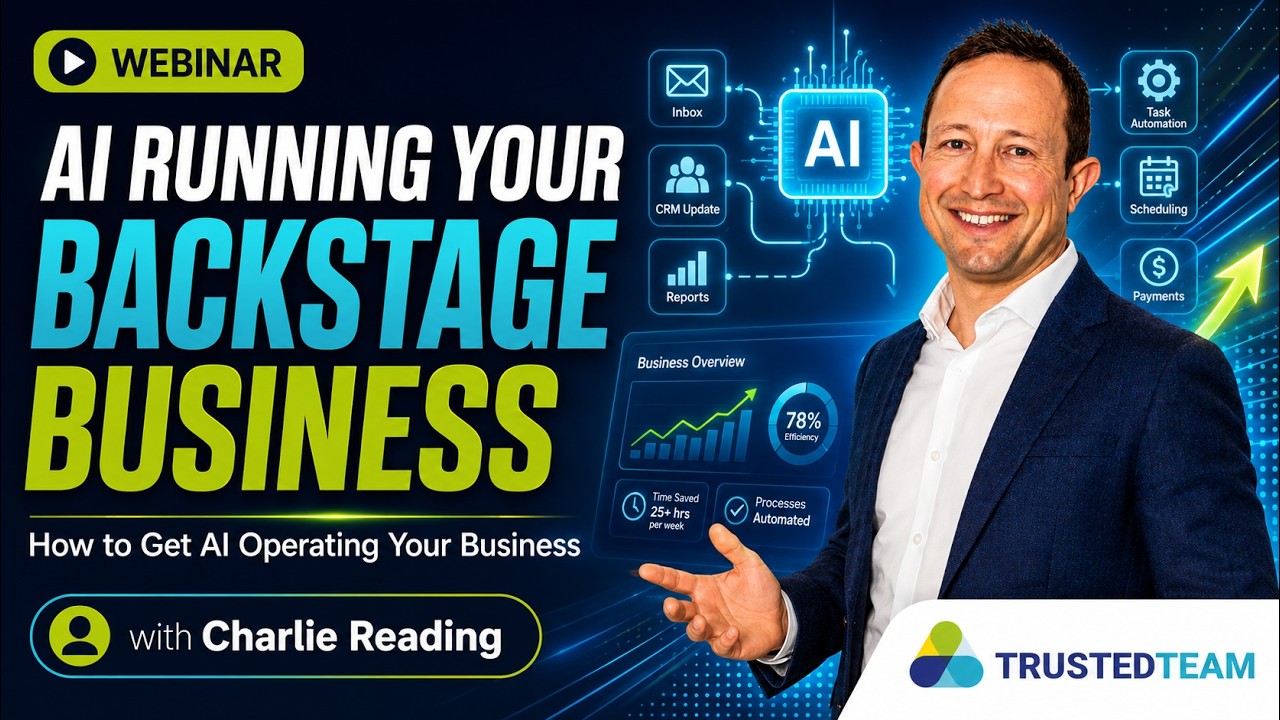
Charlie Reading shows service-based founders how to use AI to automate backstage work like email triage and SOP creation, freeing time for client relationships. He walks through the AICO framework and tools like Zapier, custom GPTs, and Synthesia, using examples like Selma's 14,000-client portfolio run by 25 people to show what's possible.
Chapters
So again, welcome to those that are dialing in as we speak. Uh, we'll kick off in, in a couple of minutes past the hour. Uh, inevitably a few people dial in late for these things. Um, and so you've still got 2 or 3 minutes to get yourself a drink, get yourself sorted with some notes. Again, lovely to see some familiar names dialing in at this moment in time and also some unfamiliar ones as well. So that's cool. So yeah, we'll be kicking off about 2 minutes past the hour when we— thanks for the message, Bhavik. Hey, nice to see you here. Yes, you do have a chatbot, chat box available. So if you want to send any messages, you are able to do that. So please do fire messages at us. I think only you guys, you can only message us as the panelists. I think, I think that's how it works. So yeah, welcome. Good to see you all here and we'll kick off in a couple of minutes. Excellent. Yeah, I can see more people dialing in now, so that's fantastic. Yeah, so we'll kick off. We'll kick off at 2 minutes past the hour. Invariably, as soon as I kick off, we'll have people joining us shortly afterwards, so we'll just give them 2 minutes to to get going. Um, and while I do, I'm going to kind of continue. I was rather hoping, uh, that it would be rather nice if when I'm live on a session like this that some dolphins decided to kind of make their way along the, along the, um, the Cornish Sea. Or even better, a whale. Where there was lots of whales in this part of Cornwall, uh, this time last year, but, um, we weren't living here permanently at that time. So we did catch a glimpse of one, but we didn't see— not from our house. Whereas this year they don't seem to have made an appearance. Anyway, more of you dialing in. Brilliant, thank you. Thanks for being on time. We'll kick off in just one more minute once we've given everybody a chance to get dialed in and settled and sorted with pens at the ready. So looking forward to diving into the topic which has been really close to my heart for quite a long time, something that I'll share with you in a bit. About why it's been close to my heart and kind of why I've been following it along my journey. Because I genuinely think this is a, like, not once in a lifetime opportunity. It actually could be a once in a lifetime opportunity. Certainly it's once in a decade opportunity. It really is an incredible opportunity that we have with AI. And the difference is the speed of change. That is really the difference. Okay, so it's 2 minutes past the hour. Thank you for being here on time. Let's kick things off because what I want to do, I've talked a lot about AI in the past. And what I wanted to do is I want to spend a bit of time talking about something that we don't talk, talk as much about. So I think when we first got access to AI, we were like, oh yeah, yeah, brilliant. We can get it to create this. We can get it to create this. We can get it to create that. But the concept of it running things backstage for us wasn't really on the agenda until just the last couple of months where we started to see true agentic AI starting to actually just do things on our behalf. And so my, my objective with anything like this is always to think about, well, how, how can we use this stuff to help us actually grow our business and grow our business faster than we were growing it previously? And how can we use it to get our time back? So whether that's to accelerate the growth of the business, whether that's to have more time off doing the things that you love or looking after your own fitness and health and well-being, whatever it is, if we can start to go through a process of getting AI to do more and more of those things backstage, we can actually start to focus on the thing that we do best, which is typically what we do front stage. So perhaps at the moment you're thinking, well, you know, how do I grow the business quicker than I have been previously? Perhaps you're wondering, you know, how do I kind of make this, make my business more profitable for the next stage? And perhaps you're also worried about, you know, well, what's the competition doing in this environment with, what's my competition doing with AI? And am I getting left behind, um, on this journey? So if we want to think about this, um, this concept, what we want to start with is why is AI so important? Why, why is it going to be such a game changer compared to like the dawn of the internet or the dawn of the smartphone. And really, the person that sums it up best for me is Yuval Noah Harari. So when he wrote his brilliant book Sapiens, he talked about how the Homo sapiens out-evolved the other species on the planet, like the Neanderthals. And really, the conclusion he draws in Sapiens is that it's our ability to converse. So it's the lang— it's our language that becomes the main reason why we become the dominant species of planet Earth. And so if we think about AI, this is now the first time in our history that we're aware of, of course, that we now have another species on planet Earth that can converse with us and with itself. There's actually some research to show that AIs are already having conversations in a language that we don't understand amongst themselves. Yeah, that's going to be where this goes. So, but this is why it's such a huge deal for businesses because ultimately we work in service-based industries, you work with service-based businesses and those Most service-based businesses are intelligence in, intelligence out. A client comes to us and says, I need this help with this particular pain, and you give them wisdom back to guide them through that pain. And of course, that's exactly what AI does. Intelligence in, intelligence out, which is why, particularly for service businesses, and especially for professional service-based businesses, this is both the best threat and the greatest opportunity we have seen in probably ever. And so when we think about this, we've got to be thinking about, well, OK, what happened— what's going to happen to the world of work? And how does it— how is it going to change? And so when we had the Industrial Revolution, we went from a point where people that were using their hands to work, that the work that they were doing with their hands got taken over by machines. And we, we transitioned to a workforce that was predominantly based around intellect, which is why we have, you know, such a huge service business sector. So machines took over what we did with our hands, and we went to working with our brains. The next phase of this, and why AI is going to change everything, or is changing everything, is that really AI takes over most things that we do with our brain. And therefore, where we need to take our business is to, um, what we is, is to the things that we do with our heart. It's the, the, um, empathy, the creativity, the leadership, those sorts of things that will be most valuable in our business because the intellect stuff, AI will take over the vast majority of that. So we want to be building this business that, um, is built on EQ, or we do the stuff that's built around EQ because the stuff that's built around IQ should be done by a Eye Backstage, and that's what we're going to be talking about today. And, and for those of you that know me, uh, you'll know I'm really keen on my endurance sport, particularly triathlon, particularly Ironman. In triathlon and, and in an Ironman, uh, you have to do a 2.4-mile swim, 112-mile bike, and a 26.2-mile run. Now actually, you don't have to do that. You could, if you wanted to, run the 112 miles. And you could swim where you couldn't swim the 112 miles because it's on land. But the reality is you don't have to bike, you don't have to use a bike for the 112 miles, you could choose to run it. The reason that you do use a bike is because it gets you there an awful lot quicker than were you to run the 112 miles. And that's what we want to think about AI is how can we use it to get us to being far quicker in everything we do, um, so that either we get more time back, uh, or we can help more people with our— through our business. Um, so what we're gonna be talking about today is really about how you can grow your business and your time off, which is the ultimate goal of everything that we do at the Trust— Trusted Team. And we're gonna do that without you working harder, without it costing you thousands to develop technology, without it compromising on the quality of the work you do. In fact, I'd argue it'll make the work even better and without employing more people unless you choose to, but there's no need to, and without any previous experience. Now I'm going to caveat that experience, previous experience thing, because there's going to be some arguments that you're going to need to gain some experience, but you don't need to have been playing around with this already. But this is really important now. We've got to be doing this now because if, if you know the story of Netflix versus Blockbuster, um, when Netflix was fairly early on in its journey, uh, it decided to approach Blockbuster and said, would you like to buy us for $50 million? And Blockbuster basically laughed in their face and said, why would we buy you? We own this space. We'd be wasting our money. Well, of course, spoiler alert, Blockbuster no longer exists. Netflix isn't worth $50 billion— sorry, $50 million. It's worth more than around about $300 billion. Blockbuster didn't evolve, Netflix did, and Netflix ate Blockbuster for breakfast. And of course, we saw the same with Kodak. Kodak actually invented the digital camera, but they didn't embrace the digital camera because they predominantly sold film. And so their competitors embraced the digital camera. And Kodak is no more, or at least the name I think is still there on another company. But certainly it's not the company that it was. And the reason this is different, so when we think about the internet adoption, we saw how quickly, how it changed the world of business. The world of business is unrecognizable today to as it was pre-internet, but it took a long time to transition. This is taking a tiny, tiny fraction of the time. It's the speed of change that is going to make such a difference. Because, you know, for example, ChatGPT got to 100 million users in 2 months. That is like a tiny fraction. It took 3 and a half years for Netflix to get to a million users. This is like a speed of change that we've never ever seen before. And so what we're really looking to do here is we're trying to get AI to do those repetitive routine tasks, tasks that it can help us optimize as well. And then we want to keep the complex and the creative roles for us, because that's really where we add our empathy and creativity and leadership, which are the things that are the human side of the business. And, and, and if you read a book called AI Superpowers, you can kind of find, and this actually was written I would guess 2019, I think. So it was long before ChatGPT came out, but it basically talks about how the repetitive, the routine jobs will be taken over by AI. And I think it was published in 2019. So 5 years prediction of the repetitive task, pretty accurate. 10 years for routine. I reckon they've underplayed that. AI optimizing Again, I think they've underplayed that. I'm also not sure that complex and creative are completely safe. I think there is some opportunity for AI to, certainly change some of that. So a word of warning before we continue and you dive into the content. You can't unsee this stuff. It's like that moment in The Matrix when Morpheus offers Neo, do you wanna take the blue pill and you wake up in the morning forgetting all this happened? Or do you want to take the red pill and you get to see how deep the rabbit hole goes? My children take the mickey out of me because every time they ask me something, I'm like, well, not every time, but a lot of the time I'm like, ah, well, AI can allow us to do that that much quicker. And so you can't unlearn it when you start thinking. The biggest challenge I think with AI is remembering to use it as much as we have the opportunity to use it. I've started wearing Meta glasses, particularly when I cycle. And like often I'll be cycling along thinking, I wonder what the answer to this is, or I wonder if that café is open, or I wonder what the wind direction is today, or those sorts of things. And of course now I can, when I remember, I can just ask my glasses, hey Meta, what's the wind speed and direction today? Is the café at, um, Godrevy Beach going to be open at 10 o'clock today? And also, are there any showers forecast? You know, those sorts of things. It's you can ask at the point of thought, um, which is like seriously empowering. So that's what we're going to be thinking about, but it's just a word of warning because the more you see in this, the more you will see in this. Um, so as I said, there's some familiar names on this call, but there's also some unfamiliar people, um, some people that don't know me very well. So just, um, by way of, um, a bit of background, you may be asking, you know, why would I listen to Charlie Reading on this subject? Um, uh, well, uh, historically I used to run a financial planning business, business called Efficient Portfolio. And probably like many of you, I was drowning in admin, working too many hours. You know, I was the bottleneck in my business. And so what I did was I decided to go out and find the best coaches in the world to help guide me through, uh, to build the business better. And I found the best business coaches, the best life coaches, the best technology coaches, the best the best marketing coaches. And as a result of the, the success that leaving clues that they, they shared, um, I built one of the top financial planning practices in the UK. As I said, a company called Efficient Portfolio. We won top financial planning practice in the Midlands. We were consistently featured in the press. And, and in 2015, I had a book published called The Dream Retirement, which led on to a real roller coaster of success in that journey. So I was featured on the radio, TV, cover of industry magazines, all of that sort of stuff. And I also spoke on stages all around the world. And actually, this is where kind of my, my interest in AI was born from, because it was around about— so this talk I delivered here where I was talking about artificial intelligence and the threat it was for financial advisors, I was delivering this to 9— sorry, 11,000 financial advisors from around the globe in Miami, and it was in 2019. So I was warning financial advisors that AI was coming for us back in 2019, having read a number of books, including that AI Superpowers book that I mentioned earlier on. Um, I've since sold my financial planning business. I decided that I had enough of, uh, uh, FCA regulation for one lifetime, and I set up a few different businesses now, but my main one, and the one I share with you kind of here today is the Trusted Team, and it's a business that helps people in the professional services world grow their business into a saleable and scalable business whilst working less and enjoying more. So that's kind of why I'm, why I'm here. And one of the best ways that we can build a saleable and scalable business, one that gives us our time back but helps way more people, is by embracing AI. And if we get AI operating backstage, then we, it frees us up to do the one or two things that we should be focusing most of our attention, or ideally all of our attention on in the business. And they're typically the things that we love and that we're really good at. I delivered a workshop to the members of the Trusted Team last week and we were looking at what do we need to delegate and what do we need to focus on as the founder that adds the most value to the business and that we enjoy the most and that we're best at. And AI is such a brilliant opportunity to do that. And also I'm the host of the Business of Endurance podcast. Like I mentioned, I was big into my endurance sport, so I've interviewed over 150 of the top professionals, coaches, and adventurers in the world of endurance sport. And so some of those stories come into my coaching on that journey. So when I started thinking about how we grow our business using AI, I built a framework. My brain tends to think in frameworks. So I built a framework so that I could guide the members of the trusted team through how to grow the business using AI. Because when ChatGPT first came out, we were like, oh yeah, we can get it to create these emails, we can get it to create these blog posts, we can get it to create these documents, we can get it to create— they jump, everyone jumped to create. And actually there was two stages that I thought that they should do before that, which was to analyze things like data, documents, that sort of stuff, help them ideate and come up with better ideas within their business. Then also do the creation piece, but help AI can engage with your prospects, with your team, and with your clients to move you up to another level. But the last stage and the stage, so I built this model 2 years ago. And the last stage in the AICO was operate. And it was really how to break through the client's ceiling by operating the business through AI. You know, every business typically has a client ceiling. Financial advisors, it's typically around 100 to 120 clients per advisor, but every different professional services practice has a client ceiling. And actually, if we start to embrace AI, we can massively change that. So for example, the firm I know that has embraced AI best in the world of financial services where the typical client ceiling was 100 clients per advisor is a company based in Switzerland called Selma. They have 14,000 clients and they have a total of 25 employees, of which about 5 are regulated. They've totally smashed through the client ceiling because they've embraced AI. So why is this so important to our business? Well, I'll give you an example and a story. So when Tesla first introduced their full self-driving mode, or Autopilot as it was called at the time, one of the early adopters was living in Silicon Valley, and he was trying to get Autopilot to drive him from his office back to his home. There was quite a steep, quite a sharp corner that this Tesla was failing to take each time. And the first 6 times it tried to take this corner, it failed. On the 7th attempt, it took that corner, and every time thereafter it made that corner. Now what's interesting about this and why I'm sharing it with you is that it wasn't just his Tesla that learned to take that corner on that day. Every Tesla on the planet then and made ever since has known how to take that corner. So if we could take the time to get Tesla or AI operating things within our business. Yes, it might take a bit of time to get it going to start with, but it will then do it forevermore. And that is a huge, huge opportunity. And if we think about this from a futuristic point of view, we've gone from Tesla's doing like self-driving, but not really full self-driving. Through to Waymo, which is now actually operating. So Waymo, this is in San Francisco. This was me getting a taxi. My family are in the back. My eldest daughter was petrified at the time, but we were just getting in a Waymo. By the way, I've just seen these, they're test driving these around London now, but in the US there are about 5 cities. Happy Friday. So we've now got a Waymo car operating essentially a taxi firm with no human being in involved. I say no human being, there's a few sitting in central office monitoring the whole network. But this to me was an amazing experience because we'd got an Uber earlier on, uh, from San Francisco Airport into the city center, and the Uber driver was crap. He was really erratic. Then you get this beautiful smooth Waymo. You can pick the music, you can pick the climber. At one point, a, um, we could hear a siren and it pulled over to the side of the road before we could even see where the sign was coming from. Unbelievable. So what we wanted to do is look at, um, 6 different ways that we can have AI start to operate our business. And the first step towards that, I think, is software. Um, software has been an expense for most of us for a long time because it's been guarded by this horribly complex thing called coding. I have never done coding. I don't know anything about how to code. I've never played around with it. I've never done any coding courses. So the idea of me creating software was, it was forbidden. I just couldn't do it. It was like, you know, me trying to speak German when I have no ability to speak German. But the gloves are off. We have access to software now. In fact, I've heard a saying that software is the new content. Instead of giving content to your ideal clients, you can start to give them software, and that becomes a much, much, much more powerful attraction marketing device. But that's kind of a slightly different, uh, tact for this. I wanted to think about, well, how can we use software within our businesses? To have it operating backstage. And I'll give you an example. So I write a newsletter every week, uh, well, not every week, every week I'm working, I write a newsletter. Uh, I wrote it this morning. It'll go out on Friday, uh, this Friday. It's called Friday Footnotes. Um, most of you hopefully get it. If you're, by the way, if you're a member of the Trusted Team and you don't get Friday Footnotes, let Charlotte know and we'll make sure that you do. Now we get a ludicrously high open rate on this, about 60, 70%. Um, which is really high for a newsletter. And the reason is it's just stuff that, uh, people are running businesses are looking for and finding value. So it's always a book recommendation, a TED Talk recommendation, a podcast recommendation, an inspiring quote, a piece of tech or AI, um, that I'm finding useful, one piece about the Trusted Team, and that's it. Really quick read. Really just very— oh, and something I'm watching, like a film or docuseries or something like that. So it's just a way of me sharing the things that I'm consuming that I'm finding valuable within our business. So when we first started doing this, it would typically take me about 2 hours to write it, and then it would take my backstage team probably another 2 hours to format it, get it all out into the different worlds that we wanted it out. You know, we put it on email, we put it on LinkedIn, et cetera. Then we got better with AI and we create, started creating it with a custom GPT. So it probably went from 2 hours to maybe 20 minutes for me to write. And it was presented in a much better format for the team. So probably 2 hours to an hour for them to actually roll it out. But I was sitting there going, like, literally most weeks, We do this same job and it seems like it should be quicker than this, but it still needs to be books that I've read and what I took from reading that book. And it still needs to be podcasts I've listened to and why I'm recommending other, other people. So I don't want to take away my impact that I create with it. I just want to make it, I want to make AI speed the whole process up. Now, bear in mind, I've never coded a thing in my entire life, but AI now gives us the ability to do so without knowing how to code. So I went to a piece of software called Replit, and Replit is your ability to— it's text-to-coding. I can describe what I want and it will build exactly what I've described in text. And so I basically gave it a video that I'd done on what I do to create Friday Footnotes. I gave it a video that Charlotte has done to tell us what she does. And literally, this is what we built. We built a— well, I say we, I built a piece of software that essentially speeds this whole process up. So what goes on is this is a website. It's actually a Friday Footnotes website page that it created for me. I give it my intro topic of, like, I did this a few days ago, so I was in, uh, uh, LA watching Abundance 3 at a conference called Abundance 360, which is where I'm gonna share some of this, you know, where some of this AI stuff is coming from. Uh, I, I can preload things that you've already watched, which is what I'm doing here. I'm preloading the book that I've recently read. I've pre— I've already preloaded it to speed up this video. Um, but you know, like, uh, watching, uh, film, watch the, remember the Titans, lovely Disney film. About sport and nice motivational film. And each time I'm just giving it why I thought this was a, you know, why I want to share this with people. With these, the trusted team bit, I just picked one that the system had created as a default. I added podcast and then I just hit save and it creates the inspiring quotes for me, because I always want quotes that relate to the topics that are in the newsletter. So I then get to pick, for some reason that time it gave me some empty cells, but it's stopped doing that now. So I picked the quote that I like, hit Generate Newsletter, and hey presto, it writes the newsletter. Now, still work in progress. The newsletter it created was a bit too flowing texty for me. I like sort of short paragraphs. For each of the different things. So I actually went back to this software today because I was using it on today's episode and I was like, why, why am I getting two Flowing Pros? This is the example of what I want. And sure enough, Replit just went back in, changed all its, some of its settings, and it's now delivering me the newsletter exactly as I want it. But the bigger deal is, I mean, so let's be honest, it's probably now taken me from 20 minutes to 10 minutes. It's not saved me massive amounts of time. But where I think the big game changer is for, for us is the fact that it now is producing a set pack. So it's got the newsletter content, but it's got Charlotte's pack to give her all of the stuff that she needs to, to upload. It's pulling through images. It's starting to pull through different things. It's giving it, giving her it in, in the format she needs for Basecamp. It's giving her in the format she needs for GoHighLevel. We've added preset libraries, which is kind of the different things that we're adding in, like the books and the, and the videos that we're creating. I can give it style preferences, add in content ideas. It's got a whole load of analytics in there. And it's got a how-to guide for me and for whoever's performing Charlotte's role in, in that. That whole piece of software was created by me. With zero coding ability. And that is where this thing is going. So what I, what we, and the reason that we decided to target that one first is we went through an exercise as a business where we basically identified what tasks we were each doing in the business. And, uh, when we were like, so Charlotte and I were like, well, okay, this is a, this is a thing that we're doing. It's taking me about now 20 minutes a week. It's taking you about an hour a week. If we could get AI to get that down to sort of 10 minutes each, that would be, that would be amazing. It's not worth us going off and spending thousands on an IT system to save us like, you know, an hour a week. But is it worth us spending 2 or 3 hours to, you know, this week to save us an hour every week thereafter? Absolutely it is. And so these tools are, are incredible. There's actually loads of them. So, One of the people that are on, is on this call, Ben, has kind of shown me what he was doing in a different platform called Lovable, similar sort of thing. Make is another sort of version of this. Google AI Studio is starting to step into this space as well, and Rorc is another app builder. I'm only playing around with Replit at the moment, and if I'm honest, with all of these different AI agents, in many situations, they're so similar and they're sort of in such a race against each other. Just pick the one that does the, you know, that you're going to start with and stick with it for now, because you'll make far more inroads into that. The alternative is if it's something that's really like more complex, what you might decide to do is actually pick 3 and get all of them to build the same thing and see which builds the better prototype to start with so that you can then launch, carry on the build within that. Um, so that is incredible. Uh, Zapier is a, is another format that you would, um, that you kind of, you can use to stitch together processes. You know, we normally do this and then we do this and then we do this. And Zapier is just a way of connecting those things up so that they all, when, when we do this, all these three, three things then happen. Um, one of the things I would be saying though is, and I think probably most of the people that are listening to this. Run the business. And my suggestion is that, that you guys probably shouldn't be building this stuff. For those of you, I think on here, there's probably a few people that are actually, um, kind of ops managers, people that run the backstage of, um, of the business. You guys are the people that should be either learning this piece or, um, or at least getting your team to learn this stuff. With Zapier, there's a whole Zapier University for free in YouTube. So you can just give Zapier as a project. And once you've identified those tasks that you can automate, you can get people in your team to be sort of building those out. Um, it's such an incredible, um, tool, but we're going even faster than this. Uh, and so when I was in LA, I was chatting to a friend of mine who's far further ahead of this, uh, me on this stuff. And he was saying that he has 3 different— no, he has his normal laptop at home and he has 3 extra laptops, which are all running Perplexity. Perplexity Computer. So Perplexity Computer is like Replit but on steroids. It's, it's building whole businesses for him. He said, I've had 5 businesses in the back of my mind lately, um, that I just haven't had time to do. And now these agents are just building them for me, um, like literally 24/7. He's got 3 laptops running this, this thing. Now I haven't got to playing with Perplexity Computer yet. But if you want to take that to the next level, this is where I would go. It's more expensive than the other things that I've talked about. But it is an incredible opportunity to get Agentic AI building pieces of software or even some, in some instances, whole businesses for you in the world of AI. The next piece I think that we can kind of think about is how we get AI helping us with the training that is needed within our business.. If you read The E-Myth Revisited by Michael Gerber, Why Most Small Businesses Fail, he talks a lot about how important it is to document the processes that go on in your business. Because what you do, you do it first and then you delegate it. Or so you do it first, then you document it, and then you delegate it. Because that way it happens as you want it to. And in fact, funnily enough, I was sharing a story last week at our, I don't think I didn't share it in the workshop. I shared it in the mastermind day that we do after the workshop about Van Halen and the blue M&Ms. So basically Van Halen in the '80s had the biggest live show, live rock show touring around the US and they had this huge user manual to say that they would send ahead to each city to say, this is how we want the whole thing set up so that it was safe and so that it delivered the same exceptional experience for everyone that attended. And, um, they got a bit of a reputation for being really fussy because one of the instructions within that is we want to eat M&Ms as our snack, but we want you to take all the blue M&Ms out. And so they've got like this reputation for being these prima donnas, but actually the reason it was in there was because when they, when they got to the next show, if they could see that they'd got a bowl of M&Ms and the blue ones had been taken out, they knew that the, the organizer had read the manual and had, had accurately and safely implemented the, uh, the guidelines. If they could see they'd got blue M&Ms in the bowl, then they knew that they hadn't read the guidelines. So it was a very visual trigger. So we talk a lot about at the Trusted Team building out these outstanding operations to make sure that your backstage is running really smoothly. And there's loads of ways you can do that, but we can now get AI enhancing this process so much more. So I'm sure you, some of you will have been already using Loom. And if you haven't, if you're not using it, you've probably heard of it. So Loom is basically a really great platform for,, uh, for, for recording and talking at, you know, recording your screen and talking people through it. So it's a brilliant tool to use for creating outstanding operations, those standard operating procedures that you need to build up in the business. Um, and, and, and that principle is incredibly powerful because if something happens to you or somebody in your team and somebody new needs to come in and take over that role at the last, you know, uh, all of a sudden, those will be your get out of jail free card. Those, those, uh, policies and procedures will be what allows somebody to step in and do what's needed at the drop of a hat. What I really like about Loom, I mean, Loom's a great way of building those, those videos, but Loom AI is an extra add-on that you can add into Loom and it will actually just go up. You record the video, you just go through the process, record it, and it will then, the AI will turn that into a standard operating procedure. For you. So, I mean, that's, that's, um, like a really quick way of doing it. I know, um, Matt, who runs one of my businesses, uh, loves Scribe for doing this. That's kind of another platform that you could do this on. But building out these operating procedures is, is incredibly powerful. But then how do you keep making sure that people are trained with them? And of course they could sit there and watch those, um, those standard operating procedures. In fact, again, we were talking about this in the mastermind session last week. You say, well, actually, some people want an exec summary, some people are very detailed set of instructions, and some people just want to watch the video. Um, and so the beautiful thing about AI is you could very easily create a standard operating procedure that delivers all of those so that people have got it in whatever format they want it in, and probably also with a checklist. But one thing that's really powerful, particularly when you've got a new joiner in your business, is to have training videos that instead of watching a screen and somebody operating a screen, actually is like a person presenting, this is what you would do, you know, particularly like your company culture or all of those sorts of things that can build out a brilliant experience when somebody new joins your company. And Synthesia is a great way of doing that because it's text to video. So you can have this text that explains whatever it is, company culture, let's take that as an example. Um, but 6 months down the line, you might go, actually, we want to tweak this. We want to change this. Or if it's a training video on something that involves regulatory changes, you know, 6 months later, that video that you'd have recorded yourself is now out of date and it needs doing again. Great thing about Synthesia is because it's text to video, you can just go in, tweak the text to whatever's now needed, and hey presto, you've now got a brand new video, um, that is now exactly what you need it to be, reflecting the current culture, reflecting the new regulations. And so really what we want to be doing is we want to be using this AI to train our team as much as we possibly can. And when we think about compound growth, we think about how the— how our money, you get a little bit of growth on your money this year and you think, oh, it doesn't seem that much. And you get a bit more next year. Again, it doesn't seem that much. But when that compound growth what is allowed to happen, you know, build over time, we get huge amounts of growth. I talked about it in my book Smart Money. I was telling my, uh, I was trying to explain this concept to my, um, uh, daughter last, uh, actually one evening this week actually, um, while I was doing her ISA allowance for the year. And, um, I used the example which I haven't used for ages, but with compound growth, you know, if you take a piece of paper and you fold it in half, obviously, it's twice the height of a piece of paper. You fold it in half again, it's now 4 times the height of a piece of paper. And I asked her, in terms of height of things, if we folded that piece of paper in, it doubled it 50 times, how high do you think it would get to? It was like, well, maybe the height of this chair. Well, the answer was to the moon. That's the impact of compound growth. And why am I saying that? Well, because if we can train our team to use AI and embrace these opportunities, our compounding is exponential. Like, if you as the founder learn how to use AI, then you have the opportunity to triple what you do as the founder. And as the business bottleneck, probably, that's a great thing. But if you can train your team to treble their productivity through AI, two things happen. Firstly, they see AI as an opportunity instead of a threat to them losing their job. And the second thing is you can 10x your business by doing this, because if one person is doing 3 times more and the next person is doing 3 times more, that has a huge impact. And it's actually the main reason why I built the AI Masterclass, which is 12 90-minute sessions on how to think about using AI in your business and how to grow your business. And it's a great tool for training your team members. So Trusted Team Members, you already have access to, to this. So you can give this to your team and get them learning how to, to upskill in AI. Anyone that's not currently a member of the Trusted Team, I can talk to you about that afterwards if that is something of interest. So training is a key opportunity. And then what we want to be thinking about is we want to be thinking about those repetitive, boring tasks like, um, the author of, um, AI Superpowers talked about. How do we identify those and get those out of the business, um, or get those automated? And here's where life has got really exciting in terms of AI, uh, in the last, um, 2 months really. And that is we've now seen the dawn of the agentic AI. Yes, we sort of saw it last year. We had OpenAI release their Operator model. We've seen some movements in this space last year, but it's really gone exponential in the last 2 months. And I asked AI when I built the AI Masterclass for, you know, what jobs should we be getting based on each department of a business? What jobs should we be getting AI to do for us? And it gave me that example. I'm obviously, the text is small, so I'm not going to be going through that. But you could do exactly this exercise. You could ask it, give me the tasks within this business that I should be identifying, or you can take a screenshot of this or watch the record. We'll probably send you the recording afterwards so you can just use this as your guide. But this part has, I think, gone crazy, like I said, in the last 3 months. So over the last few weeks, I've been playing with Manus, which was recently bought, bought by Meta. Manus is agentic AI, and I cannot tell you how many tasks this has done for me. And, and the difference between this and say ChatGPT is ChatGPT, you go off, you give it a task, it'll do the task, and it'll come, it'll, well, it'll do the thing, and then it will come back. And then you might need to give it the next step, and then it will come back. And then you do the next step, and then it will come back. And also, it's not very good at going off and, and taking information from other websites. So for example, I was trying to get ChatGPT to build a— I've just moved to Cornwall permanently. We've had a house down here for years but moved down here in January, and I'm going to launch a Trusted Team Mastermind in Cornwall down here. So I need to build a database of the right firms to invite to a taster event that we're going to do. And I went to ChatGPT and said, can you kind of go off and build this database for me? And it could identify there was there's probably about 300 firms that fitted, fit the right profile, um, within a sort of 20-mile or probably 15-mile radius of Truro. Um, but, and it kept telling me it would build it, but it wouldn't actually build the database. Every time it gave it to me, it kind of gave me like this tiny, um, uh, like list of 5. Uh, Manus just went off and like literally took about half an hour And in half an hour it'd done about 150. I then said, right, now I want to kind of dial down and add these and build it up to about 300. Second attempt, I had the full directory at 300. Probably took an hour to do that. Like, that is just incredible. I did a presentation yesterday to the members of the Trusted Team. We do a learning lunch once a month. So people literally sit there eating their lunch and I talk about a topic. Sometimes it's health and wellbeing, sometimes it's business, sometimes it's kind of Other stuff. Yesterday it was other stuff and it was about the 10,000 hours rule. And Manus built my entire slide deck. So I had a conversation with Manus about what I wanted in the presentation. And I just, I gave it that, I gave it some notes I'd already made. Literally, it was a list of names that I knew, I knew what it meant to me. But it went off, it did the research, built all the slide notes, it put all the slide images in. I changed a couple of images. Uh, but other than that, it saved me— what would it have taken me to build that normally? Probably 2 hours. I probably did it in 20 minutes, I should think, because it just, it just goes off and builds. Um, I've had it analyzing in my investment portfolio and telling me where I should be, um, investing some, some of the money that I've got, uh, in cash at the moment. And it's blown my mind in some of the research it's done there.. And even when I started to push it to go, look, should I be, look, putting some money into NFTs, something I don't actually know much about? And the answer is no, I'm not going to. But it built out a, a dive, a section of the portfolio, only a small section of the portfolio that could be, um, that diversified, um, uh, into NFTs. Um, it built me the flyer for that Niche to Network event that we're going to, um, uh, launch in Cornwall. It even put Truro Cathedral in the background. I didn't ask it do that. Um, with the, with the, with the database it built me, it put together LinkedIn profiles so we can, um, message them on there. It gave me email addresses, founders' names, all of this stuff. Like, it is a game changer for doing the work that others haven't been doing. And then that kind of segues me into OpenClaw. And OpenClaw is now the even more advanced version of this. Now, I have a old laptop here sitting next to me that I am going to be playing around with OpenClaw on. The advice I've had from my, uh, tech experts is that you don't really want OpenClaw on your main machine at the moment because there are consistently some security flaws in it, and people are targeting these agents and asking them to get them to send all your passwords to them. So that's why actually the, the Mac Minis are pretty much sold out globally at the moment, because everyone's buying Mac Minis so they can install OpenClaw on them. But I had a demo from a guy called Alex Ferrari, I think, when I was in LA. He has a YouTube channel showing you how to use OpenClaw. And he's basically running an entire business where all the employees, and of which he has about 7 or 8, uh, are Open Claw agents. So he has Henry, who is his, um, uh, chief of staff. So Henry operates, uh, all of the, um, employees. I think actually, I think, um, Henry is run on— is an agent from Clawed as opposed to Open Claw. And then all of the employees are Open Claw employees., and so, um, Henry is kind of checking in with them every sort of 10 minutes to make sure they're doing things that are moving the company forward. But it's unbelievable. This, and by the way, when I was at this same conference in LA a year ago, somebody said, at some point, we will have a billion-dollar company that only has one employee in it. But they were pretty vague as to when they thought that might happen. This business that's already happened. OpenClaw is it. So OpenClaw was founded by a single person and the 60 days after founding that company, he sold it for a billion dollars. That is how exciting every excited everyone is about OpenClaw. But you need to be super careful with it. Treat it with caution. That's why you, you're best to put it on either a Mac mini or a, an old laptop that's not connected to any of your cloud or your passwords or anything like that. And have it running there to— somebody said it's a bit like a 5-year-old running around with an AK-47. At some point, it's going to shoot you in the foot. So don't give it the ammo. Okay. So next step is email, I think. How can we get email being operated by AI? Because I think Email is our biggest drain, is probably the biggest drain in business at the moment. Literally, I speak to people getting thousands of emails or certainly hundreds of emails a day and it's become this massive bottleneck. And when we decided we were going to sell Efficient Portfolio, I had this concept of will it make the boat go faster? Once we decided that that was a particular goal, like every decision got shone through that lens. Will it make the boat go faster? And so what we want to be thinking about is how can we make everything go faster in the business? And so with the productivity focus, so it's something that I sort of touched on within the workshop that I did last week. Week. We're looking at ways we can optimize everything that we do, and the inbox is a great way of doing that because, like, there's so many people are so bogged down with so many emails. And so how do we get AI helping us with this? Well, well, there are lots of ways we can do it. Obviously, you've got Copilot, which will do an average job or not a very quick job of helping you draft emails. You've probably got better versions within, within Google for that. You've got, but Where I do like using Copilot is getting it to sum up folders for me. And I'll, I'll, so one of the things that I do as part of my email process is set up subfolders for focus, which are the important emails that I need to see. That's typically 3 a day. Emails from my team, and they know if they're spamming me, they'll soon hear about it. So those I need to reply to. And then everything else is either newslettery type things or Buffer or marketing type stuff. And so my emails, I want to be filtered by it like that. Things like my Buffer folder, I only want to look at maybe once a week, maybe once a month. So Copilot is a great tool for just going in and going, right, there's 150 emails in this Buffer folder. None of them are urgent because my AI has already, already sifted those out. Now summarize all 150 emails into groups, identify any that you think I might need to reply to, and then literally I can deal with 150 emails in 5 minutes, which is absolutely like game-changing. And I know that on a daily basis, I've probably got about 3 emails I need to reply to. Gmail has its own. If you're using the paid-for version of Gmail, you have Gemini built into that so that can help you. But the way I personally filter all of those emails out, and it's not perfect. I found an email yesterday that I should have replied to that it'd been putting into marketing. So it's probably, but even then, like I missed it at the time, but I still replied within the week., so, it wasn't a particularly big deal. But yeah, I use Fixer.ai to do all of that filtering, putting emails into the right categories. And I reckon it's reduced my email time by about half. It's also, by the way, I've had a PA running my emails for the last, well, over 10 years. And now I don't need a PA to run my emails. Fixer.ai is basically doing the job that a PA was doing, or at least probably 90% of that job. Combination of that and rules built into Outlook, and pretty much everything I need done on email is now automated. And like I said, I think Copilot is pretty rubbish at most things, but it is— where I like it is summarizing big groups of emails that I kind of think are mostly marketing and buffer, but like, I just want to scan through once a week. Obviously, Apple Intelligence is miles behind on the game, but it can't be too long. I was listening to a podcast this morning about how Apple has got— I mean, ironically, Apple, from a physical point of view, from a hardware point of view with these Mac Minis, is probably the winner in terms of of the, of the, uh, the race to agentic AI. Um, but, uh, I think I remember reading that Apple has signed a deal with, with Google to bring Gemini into their smartphones, uh, because they fit— it feels like Apple are actually pretty like miles behind their competitors on this one. And then they, um, but no doubt they'll come to market late, but with something even more usable as kind of Apple's traditional model, isn't it? Okay, so email is definitely something that we can be using AI to optimize us and operate on a decent level. The next thing we want to be thinking about is what other people's AI and software can we just adopt? How can we just borrow other people's and get on with it. And so I thought I'd show you this video. This was San Francisco Airport actually, and it was a robot making us a coffee. And you can see the reflection of my eldest daughter in the kind of on the right-hand side here is like watching it do like the, and then in a minute it waves at us, I think, while it's waiting for the espresso to pour. So these pieces of— there we go, there's this little wave. This space is accelerating at a lightning pace as well. And so really that's a robot, not AI, isn't it? Although, you know, you'd argue there's some AI in that. Where this is merging is— so when I was in LA 2 weeks ago, I got to meet Neo, which is one of the humanoid robots built by X1. Oh my God, I love Neo. I've, I've put an order in for Neo. Just brilliant. Absolutely brilliant. Like great to have a conversation with, but, um, really agile. Basically it's a house robot. It'll do all of your jobs for you, like your, your washing up, your hoovering, your loading the, the, the washing machine, all of that kind of stuff in-house. And you can sit and have a conversation with it. I asked it whether, who was the best football manager, Brian Clough or Pep Guardiola. I like Neo even more based on the fact that he said that Brian Clough was definitely the better manager, which I loved. And these things are allowing us to just get better and better at stuff. So for example, I got a coffee that was made by a robot, not the one in San Francisco Airport, but one at the conference. And well, I didn't get this. This wasn't my coffee, obviously. But this lady got her own image made in her latte art, which was quite amazing. And we're seeing so much advancement in this robotic space. So we're seeing— I think the prediction was 10 million humanoid robots. On the planet within 10 years. This is going to change society as we know it. And when you think about those robots having agentic AI within them, it's just, it's just another world. So how can we use this in our business now? I mean, you could put an order in for, for a Neo, and they're shipping to the US this year and the UK next year. Um, so if you've got a physical office, I think having a Neo in there is an absolutely brilliant idea. But for now, there's lots of other things. One of the best ways you can do this, I think, is, um, for now, and, and I think there's, there's an argument to say this is maybe a short-term policy, but companies like Salesforce, HubSpot, GoHighLevel, are going to have to, and they are obviously back office systems, they are going to have to embrace and are embracing AI for you. And they're going to have to keep up, keep pace and keep making their software better and better through this. Because I think otherwise, and we talked a little bit about this, this last week in the mastermind session, otherwise we're going to start to see companies just create their own CRM system and decide that they don't want to pay paying, you know, a fortune to Salesforce for this all-singing, all-dancing system when really they only want 25% of it and they want it to be bespoke for their business. But the benefit of piggybacking on these guys' shoulders is the fact that they can then go off and build all of the fun AI functionality that would be needed, and you can just kind of use that. And I think that Another example of this is, and I'm going to go back to the world of financial services, but I'm sure the same applies with CRM systems throughout every sector. You can embrace a back office system that embraces AI. So for example, you've got in the financial services world, you've got prehistoric back office systems like Intelleflow and the like, which are like just so out of date based on, on, um, the rest of the options out there. And then you've got new players coming into the market, particularly Ningyi. I really like what Ningyi are doing with AI, and they're weaving AI into that whole step of the journey. So for example, the AI note taker that attends the first meeting is also the same thing that's pulling it through to the follow-up emails, through to the fact find, through to the suitability letters, through to the financial plan, through to the cash flow forecasting. That's where this should be going. And you could say, I'm going to go out and build some of these tools myself, and I'm going to implement some of these ideas myself. Or you could just go to a Ningi and get them to kind of create that journey for you. If you want an introduction to Ningi, just message me afterwards, and I'll happily introduce you to the founders. I think it's— if I still ran a financial planning business, it's this piece of software that I would be using as the back office system. And another way that we can do this is through the creation, through using some of the video tools that are out there. And this section, we could have, I could have arguably put this, this could fit into create, but I think that this part of AI has got so much better so recently that I wanted to share this. So this is a video. So we have an app that we that we use in our business, or like a tool we use in our business, uh, called the Limitless Life Planner. And it is probably— it's not probably, it is without doubt the most beneficial tool from productivity, from a goal achievement and planning point of view that I've seen and I've, I've created. It's basically taken from the best ideas from all the coaches that I've worked with in the past. And we're about to turn this into an app app. In fact, Ben and Om from Studio 64 are on this call as we speak, and we're going to turn this into a physical app that people can have on their phone. It kind of builds them into it, builds a morning routine around these tools as well as all that goal planning and task management stuff. But that's a bit of background. I went to a tool I've been playing around with for a while, but it wasn't great when I first started playing around with it and used this invideo.io. I gave it, I gave it a prompt that took me 5 minutes to create. I gave it 5 minutes worth of background, and this is the video it produced. Are you an overworked service business founder trapped inside your own company? You've built a business but became the bottleneck. The trusted team created the Limitless Life Planner app Proven coaching frameworks in your pocket. Our mission: inspire 1 million founders to double their business and double their time off. You shouldn't sacrifice sanity for success. Download the Limitless Life Planner today and transform into the strategic CEO you were meant to be. So it's not perfect, uh, but it picked up a whole load of branding from our website. It picked up one bit that was, you know, it put one logo in that was wrong, but it put a load in that was right. And I think for 5 minutes work, I mean, imagine how much that would've cost you to create as an ad just 2 years ago. I mean, it's absolutely incredible how quickly that has evolved. Another piece of software that we've used in a similar way, but well, a slightly different way is Opus Clip. So Opus Clip is a great tool for taking snippet or taking snippets of longer content. So for example, the podcast, you might have a 40-minute interview with Opus Clip. It will create you 3 short ads based on kind of the optimum pieces within, um, within that, uh, interview. It'll add the captions over it and you've got 3, 4 ads for, for that thing just created immediately. Um, so again, that is just getting better and better. And then the final, uh, final opportunity I think that we want to think about in the business is how we monitor what goes on in our business. So a friend of mine that I hang out with when I go to this conference in LA runs a vertical farm in Sweden, and historically they were actually growing mostly lettuce. When I was chatting to him this time, they've stopped growing lettuce and they're now growing these micro herbs. And for supplements. And the main reason that they're seeing such great returns is because AI is constantly monitoring all of the growth of all of these microherbs, which are then— which, you know, so the AI is monitoring whether they're kind of growing at optimum rate or not, and then giving them the exact amount of fertilizer that they would need to get them. So it saves the, the producer— saves them a huge amount because they're not having to fertilize plants that don't need it. And they're just like, it's massively expanding their growth on their business. And we see this in lots of other businesses as well. We see it in Waze kind of predicting AI. We see it in Starbucks coming in with their kind of AI predicting inventories and staffing schedules. And we see it in Amazon Logistics logistics and kind of, um, demand forecasting that they do. But of course, this is stuff for bigger business and we don't think about this in our business. Um, but one of the ways I think we can start to use this well in our business is when we combine it with the Net Promoter Score. So Net Promoter Score is, is a great metric which is used to measure how likely customers are to recommend your company or product or service or whatever it is. And it's essentially calculating, uh, it's calculated by asking people to rate the likelihood of recommending you to somebody else. And it's kind of trying to cut through the noise of all of the different things you could ask them and just say, well, really, what you really want is people to be promoters. And promoters are those people that give it a 9 or a 10. And you also want to identify the detractors, which are people that are going to moan about you, and they're the 0s to 6s. So it's a really brilliant way of of seeing how good a job you're doing for your customers. Oh, sorry. But how would AI help you with this? Well, AI can give you real-time insights into this. AI can kind of give feedback in terms of what's going on with your customers, how you're engaging with them. Could we, you know, it's not like historically where you'd probably just do a net promoter score review once every kind of 6 months maybe. Now there can be live data coming through about a much deeper analysis, much more accurate assessment on, on what's going on with this. So that's one way that you might use this. Another way you might use this is a company that I've invested in, um, is a company called Aiphoria. Um, actually they've just rebranded. I should have updated this slide. They've just literally rebranded to Subphonic, I think it is. Another equally very difficult name to remember. But what they're doing is they're doing their AI solution, which they're selling it into some huge, huge companies, is compliance of human conversations. So if you think about, you know, like, let's take it Scottish Widows or the Pru or the bank, their agents are having literally thousands and thousands of conversations a day with their customers. And they need a way of compliance checking all of those calls. So AI4U will just monitor the compliance of all of them, and it will, like, create triggers to go, oh, hang on, this particular call wasn't compliant because of this. So we can start to monitor those conversations. One of the most powerful ways of using AI, and I genuinely hope you're all doing this already, is through the opportunities that are linked to having a note-taker. If you've got a note-taker, it doesn't really matter whether it's Otter, Firefly, Zoom, or one of these physical devices like a Plaud that sits on the back of your phone. Then once you've captured that information, you can use it in so many different ways. So what you can start to do is you can start to think about, well, okay, how can I create, like, if it's a Prospect meeting, how can I create a much more personalized version of this, um, of the follow-up that comes out of this? Or like Ningi, can it be linked into the whole client journey so this information is filtering through in at the different stages? Um, can it be, um, you know, like in terms of sales calls, you might have a, a, a, you know, once you've captured them, you might have a book of these are all the successful sales calls these are all the failed sales calls. What can we learn from that? And, and you might use like NotebookLM to build those notebooks so you can then start to go back and analyze them later and go, well, look, what are the common traits with these failed ones and what are the common traits with the successful ones? Um, you might use it for— so when, when we were talking about building the, the Limitless Life Planner app, um, uh, I, I obviously recorded the conversations I had with the different developers that we were looking at potentially using. And then at the end, I could take all of those notes and create one best ideas document so that the company that we are working with can get the best ideas that came out of all of the conversations that I had on that journey. So there's so many brilliant ways of getting AI note-taking to upscale what you do. Just make sure that you're using them. And what I like about the Plaud, um, and we were having this debate last week, is like, generally speaking, I'll have Otter dialed into most things. Um, but like, I went to meet somebody for a coffee yesterday, and it felt less intrusive to just go, oh, do you mind if I hit record and get this? I could have gone into my phone and turned Otter on and started recording it. Um, but Plaud was a nice way of, uh, of, of doing that, uh, separately. Um, So I'm going to get Charlotte to give you this tool called the AI operator, which you could do after this session. I'm not going to get you to do it in the session, but I want you to think about what, what tasks take up the greatest resource in your operation. And I'd actually encourage you to do this with your team. Sit down, you maybe as a group, maybe if you run the backstage of the business, you want to sit down with your with the backstage team. Maybe if you're the founder, you want to sit down with your ops manager and say, how do we, how do we do this? But what are the tasks that are taking up the greatest resources in our business at the moment? And then start to brainstorm, how could AI help us boost this efficiently, efficiently, or efficiency? And if you don't know the answer to that question, the best thing you can do is ask AI. We have this job in the business. We want to automate as much as possible with AI. In fact, we want the minimum viable input. In Silicon Valley, they talked about the, the minimum viable product. We're now talking how, what is the minimum viable input for us to deliver this process consistently? So if you don't know the answer, ask AI to help you on that journey. And then what do we need to learn to be able to achieve this? Do you need to go off and play around with with, with Replit? Do you need to go and get your, one of your team to do the Zapier, um, University? Do you wanna, you know, one of your team to go through the AI Masterclass so that they can actually understand where the, where the, the, the game-changing opportunities are? And then who is gonna take charge of doing this and by when? And then once you've got to the end of that, you might wanna think, who is gonna be head of AI in this business? Who's the person that's following this journey? Typically, that wouldn't be the founder. In, in the Trust Team, it is because I'm the one that tends to go to the conferences and follow it, follow that journey. And then what are the most— the 3 most important actions that you need to take immediately, um, with that exercise? I hope this has got you thinking about how you could live a better life, because I would genuinely love you to enjoy the same freedom that I have and a business that's thriving and growing at 50% year on year like my business Efficient Portfolio was, whilst you're taking 3 months of every year off should you want to. But I love taking 3 months of every year off. Like I said, it's happened for over a decade and there is no way I am going back. So I'd love you to benefit the same way. But you know what I've been teaching you over the course of this session hasn't just worked for me. It's worked for many, many other people that run particularly professional services firms. So, for example, it worked for Bhavesh, and he was able to go from a standing start in the world of finance to massively growing his business really, really quickly because one of the things that we helped him do is we helped him ideate, create, and publish a book which positions him as the expert in front of his ideal clients. In just 3 months. Like I said, it took me 3 years to write my first book, but it took— we showed him how to do this in 3 months. So we've helped lots and lots of financial planners because obviously that's my background and that's the business, the sector that I know the best. But actually, I've helped many, many other businesses as well in many different sectors. So for example, Nitesh, he runs actually a few different companies, but his main business is the Rutland Web Designer. So he builds websites and helps people build out AI solutions. And he's seen exponential growth in his business. But not only that, he actually takes even more time off than I do. I think he has, he has completely transformed his work-life balance. And then I've helped lots of people in the property space as well. I've helped people like Annie, who works more on the interior design stuff, and she's both grown her business and sorted out her work-life balance through the help we've done. But we've helped many other people in the property space as well and really helped to then build a much more saleable and scalable business. Because what I want you to really think about is what is not acting costing you? You know, by doing the same thing as you did yesterday, what's that going to cost you in the future? You know, if you, if you do the same today as you did yesterday, you get the same results tomorrow as you got today. So what's the opportunity cost of not taking action? What's the opportunity cost of not fixing the marketing of your business so that it works whether you're working or not? And it, you know, having— what's the cost of having this feast or famine? What's the cost of you being the bottleneck in the business? Or what's the cost of you not having a business that you can step away from and in the future even sell? What is that cost to you? So, what I'd like to do is I'd like to share with you an opportunity that can help you solve the biggest problems in your business at the moment and help you stride towards those big goals that you know that you would love to achieve, but you're not quite sure how. Maybe you've hit a bit of a ceiling at the moment. You're not quite sure how to break through that. Well, I'd love to share with you how we can potentially help you. And the first thing I would say is, you know, I've given you hopefully quite a few different ideas over the course of this session. But it's not what we think, that people that have huge success do so because they have one brilliant, massive light bulb moment. They come up with one idea that generates 100% growth for their business. It's actually not true. It almost never happens. Actually, what really drives success is a constant flow of 1% gains. Not only is it what tends to happen, it's also much easier. It's much easier to find a constant flow of 1% improvements or 100 1% improvements than it is to find one 100% improvement. And that's what we're all about at the Trustee Team. It's about delivering this constant flow of 1% improvements and the compound effect of your business growing 1% on top of 1% on top of 1% means that over the course of a period of time, like maybe a year or 3 years, you're gonna see exponential growth, not just in the, in the revenue in your business, but in the quality of your life, in the quality of the value that you create for your clients. And that's how we help people. We help you see the way into the future. We help you achieve your goals quicker, more consistently, and with working less rather than working more. But the question you're hopefully asking now is, how do you do that? We have a number of different solutions that allow us to do that. We help people through online coaching, both live and on-demand. We help people through group coaching, and that's in-person, in-workshop group coaching. We help people with some one-to-one coaching where we can give them a bespoke path so that they achieve and help them achieve their goals. And we help people that run bigger businesses that already have a leadership team, and we help that whole leadership leadership team really make smarter decisions on a quarterly basis, and so that they're driving the business forward. So, how might we help you? Well, obviously, I don't know exactly what you're going through at this moment in time, but if you're currently in the feast or famine marketing stage where you're thinking, I don't really, I wish I had, I don't really have enough clients, or I don't have enough of the best clients or the right clients, and you're finding yourself, you know, like you market for a bit, you get some clients, you therefore stop marketing, and then you finish serving those clients, and suddenly there's a gap in the system, and suddenly there's no clients again. And so it's like feast or famine. You're either super busy or super quiet. And, you know, if you're relying exclusively on referrals and you're not quite sure when the next one's coming in or where the next client's coming from, then we can help you, because really what you want to do at that stage is build out this automated marketing machine. And the automated marketing machine is making sure that you have a constant flow of your ideal clients, not any clients, but your ideal clients, whether you're working or not. And we can help you with that. And we do that through an online coaching program called the Professional Marketing Magnet. And this is how professional services firms can really up their marketing game and build out this automated marketing machine that delivers this constant flow of ideal clients. And we do this by guiding them through the, the Professional Marketing Magnet. It's everything from, like, proper designed with intention referral process, something we call the Referral Revolution. It's about building partnerships with other firms that serve your clients that aren't in competition with you, which is something we do called the Partnership Playbook. We'll show you how to position yourself yourself as the expert in front of your ideal clients, as well as knowing who your ideal clients are and what keeps those ideal clients awake at night. So therefore, what makes them take action. We'll show you how you can integrate AI into your marketing, and we'll show you how you can communicate and articulate what you do so much better than anyone else. So, you'll have a queue of ideal clients knocking down your door. So, if that's the problem you're trying to experience, you're experiencing at the moment, the Professional Marketing Magnet can help you build this constant flow your ideal clients coming to you whether you're working or not. But that might not be you at the moment. You might have fixed that problem. You might already have a constant flow of your ideal clients. And maybe at the moment, you're kind of running the business and you're feeling, suffering from what I term entrepreneurial loneliness, which is, you know, you're at the top of the business, but you've got different problems in the business. You don't really want to go home and spend the evening talking to your other half or your children about the problems you've got in your business. You can't really talk to your team about the problems, and your mates down the pub don't really relate to the problems you're experiencing either, either, because it can be a really lonely place being a business owner. So maybe that's part of the problem. Also, possibly at the moment, you are the biggest bottleneck in this business, and you have a business that you couldn't sell because it's reliant on you, and every decision goes through you, or at least most go through you, and maybe every new client goes through you, and therefore you are the biggest bottleneck in the business. So if that's you and you're suffering from entrepreneurial loneliness and you are the founder bottleneck, then probably the way we can help you is slightly different because we can help you build a saleable and scalable business, a business that grows whether you're there or not, and a business that in the future, if you want to sell it, you have the choice to sell it. You'll have people wanting to buy it because it's a business that grows whether you're there or not. And we do that through our group coaching workshops. And because, because what, what we find is that when group coaching is delivered well, you should learn as much from the other people in the room as you learn from the person at the front of the room. So we do these group mastermind sessions typically groups of about 20 people. And so that what you're doing is you're all running businesses of different shapes and sizes, but going through the same type of problems. And so what you can do is you can work on a strategy, let's call it, maybe it's the Referral Revolution, or maybe it's something to do with AI, or whether it's something to do with building a scalable business or a team, but you'll be working on at the same time on that concept with other people that are also working on that same problem. And then you can share the best ideas. As well as what I can teach you, you can share what you're gonna do with other people in the room, which creates brilliant learning, accelerates the learning, but also it helps you build accountability of what you're going to do. But most importantly, it also means that you leave with the actions already kind of decided and built and a plan formulated. It's not just a teaching exercise, it's a proper workshop. When you bring people together and get them working on the same concepts at the same time, magic tends to happen. Because as Steve Jobs would have said, ideas have sex. And the way that we do this is we guide people through, in what we call the Founder Accelerator or the Planner Accelerator, if it's just for financial advisors, we guide people through what we call the Better Future Framework. And this is really about Yes, we help you build out the automated marketing machine, as I've already shared, but we'll help you create founder magnification. So, when you do something once, it helps many people as opposed to doing something once and it helping one person. We'll help you build outstanding operations. So, backstage, the bits that the clients don't see is operating super smoothly and accelerating in terms of quality and growth. We'll help you get back your time. So that you can either focus more inside the business on the bits that you love and ex-drive the growth forward that way, or you can take more time out of the business to spend time with the people that you care most about or doing hobbies that you love the most. We'll breed this constant innovation, so you'll be constantly coming up with new ideas to improve the business and grow the business and your work-life balance. And we'll do so by setting out this incredible foundation of goals. Because goals for your business, goals for you, not just personal, not just business goals, but personal goals, that is the key to celebrating creating success. So we build, we drive you through this group workshops that will really help you move the business forward. So the workshops happen every quarter, plus an extra one at the end of the year to set those goals and start the new year on an amazing platform. And really, the difference between kind of what we do and what you'll see in a lot of courses is that we're focusing on the implementation gap, not the knowledge gap. Now, we're obviously going to teach you stuff, some of which you'll know, some of which you don't know, but we don't live in a knowledge gap society, particularly in a world driven by AI. We are not short of knowledge. You know, you've got ChatGPT, you've got Claude, you've got whatever it is, you've got an abundance of knowledge. In fact, you've almost got too much knowledge. The benefit of having a workshop is it's actually filling the implementation gap. So yes, you're going to learn some concepts around how you can make your business better, but then most importantly, you're going to spend time actually working on that idea so that when you leave the workshop, you've already got an action plan. Plus, you're going to share it with some other founders so that you can see what their good looked like. You get ideas and feedback on what you've come up with and accountability going forward. Forward. So, that's the group workshops. And now, if you really want, if you want to build a business that will grow and build and solve that entrepreneurial loneliness piece and remove yourself as the bottleneck in the business, that is the best way that we can help you. And then, for certain people within that, where we're coaching you in the group environment, we also offer some one-to-one coaching. And this is where If you need some one-to-one time with me regularly to really kind of focus your attention on what you want to achieve, you might have a specific goal that, you know, I can help you with. For example, it might be selling your business in 3 years' time, or you might be a financial planner that knows that my expertise in and experience in that sector is really going to push you forward even quicker. We also do some, some one-to-one coaching that can help you there. And then for bigger businesses, companies that already have a leadership team in place, we can essentially do that one-to-one coaching, but on a quarterly basis with the leadership team. So, it's a whole day a quarter. So, if you think one of those solutions is going to drive your business forward and help you maximize your opportunities, minimize the things that are concerning you, help you achieve those goals that are really important, the best thing you can do is just to book a conversation with me. It's a strategy call to understand where you're at at the moment, what's working, what's, what's not working, where you want to get to in the future, and then we can understand whether one of the solutions that we have available at The Trusted Team is going to be able to help you. And you can book that strategy call. By the way, it's completely free of charge. Book that strategy call with me on this by scanning this QR code here. If you book that that session, then we'll be able to jump on and I'll be able to sort of spend some time with you understanding where you're at at the moment, what's— where you want to be in the future, what's stopping you getting there, and we'll be able to work out which, you know, if we can help you, I'll be able to tell you which part of which journey within the Trustee Team can help you the most. So if you want to make tomorrow better than today, if you want to achieve those goals that are important to you, if you want to build a saleable and scalable business, if you want to build an automated marketing machine, if you want to remove yourself as the founder bottleneck, and if you want to solve the problem of entrepreneurial loneliness, then book a time slot with me. Book a strategy call. We'll understand a bit more about where you're at. I'll give you the experience and wisdom I can give you in, in the time that we have together. And then if we think we can help you, I'd be delighted to share with you what that would look like. So scan the QR code Book that strategy call because remember, if you do the same today as you did yesterday, you'll get the same results tomorrow as you got today. It's only when we take action that we see change and we see the results coming. You know, there's lots of people that came— do you know what? 9 people came up with the idea of a cyclone vacuum cleaner and applied for a patent for cyclone vacuum cleaner. Before James Dyson, but 9 people didn't become a billionaire from that idea. Only one person took action. Only one person actually became a billionaire on that idea. So you've got to take action if you want to see change. So scan the QR code, book some time in. I'd love to chat to you. And yeah, good luck on your journey. I'll see you on the strategy call.