The Ideal Client Deep Dive Discovery Free Webinar

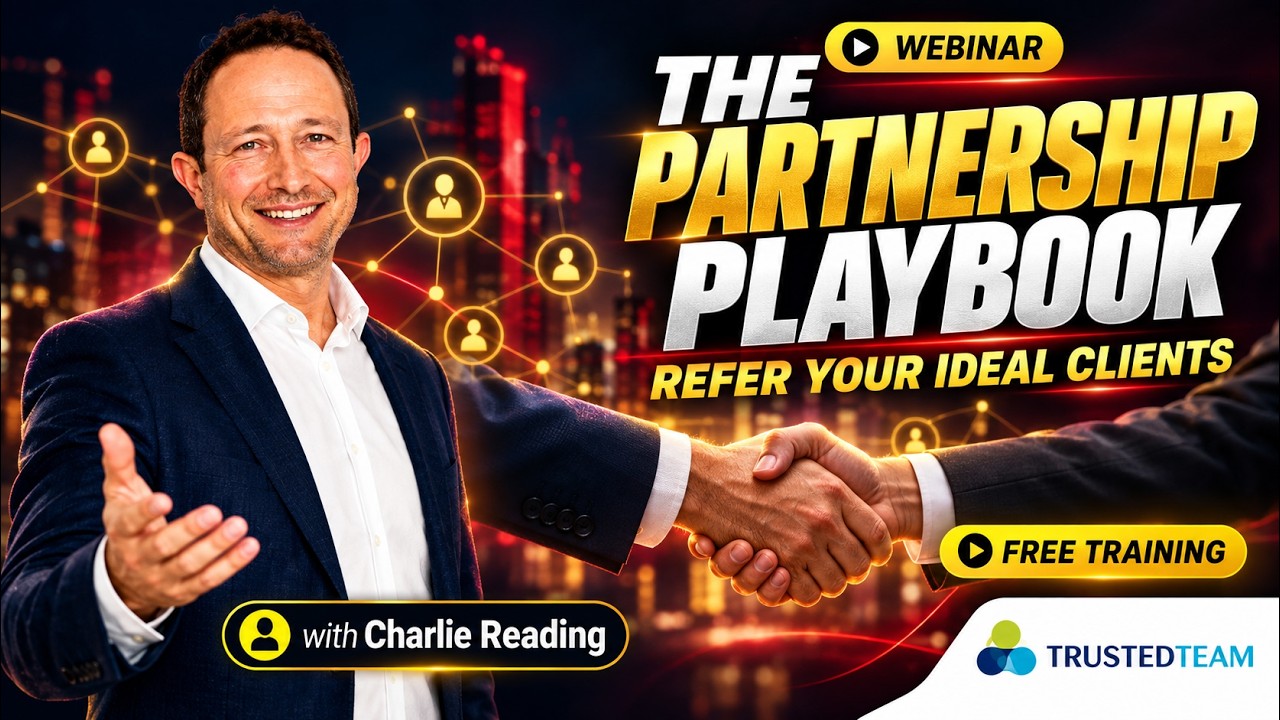
Charlie Reading shows how to identify and attract ideal clients using a step-by-step framework built on current client data, psychometric tools, and the six human needs model. He covers attraction marketing devices like books and quiz funnels, the PASS framework for messaging, and strategic partnerships to amplify reach.
Chapters
OK, so we'll give it one more minute and then we'll be kicking off. And Charlotte has shared the tool that you will need later on in the chat. So if you haven't already got that, you can access that and you can— and do that towards the end of this session. Don't start yet because it'll spoil the surprise. But also the idea is that I'm going to hopefully coach you through some of the areas that will prompt you to come up with some new ideas in these particular, in this particular concept. So we'll be kicking off. Make sure you're comfortable, screens laid out as you best work, some ability to take notes somewhere, because not only obviously notes important when you hear something you haven't heard before, but by writing that note down, you do of course help to lock it into your subconscious and conscious memory, and therefore you're much more likely to A, remember it, and B, take action on it. And of course, it's only when we take action with the things that we hear at conferences and seminars and webinars and those sorts of things that actually it does anything. You know, ideas are, are two a penny, but it's only when we take action with those ideas that, um, uh, the, the magic happens. And that's why today is really more of a, like, a small workshop as opposed to a just like a normal webinar where you listen to people consuming content, uh, or you listen, delivering content, um, because this topic, uh, it is so important. If you get this piece right, it is the foundation of the rest of your marketing strategy. But if you don't get this piece right, you are going to end up a busy fool. You're going to end up dealing with lots and lots of people that aren't actually very profitable. You're going to become super busy but not super profitable. And actually, we want the opposite of that. What we want is to be making lots and lots of money in our business whilst we only work as often as we want to work. And so if we get this bit right, this is kind of the starting point, that one of the key foundations to building an amazing marketing strategy. And, you know, maybe at the moment you're thinking, well, okay, maybe you're making good money in your business, maybe you're— you've got a bigger business and it's kind of generating good revenue, but ultimately if you're not bringing in enough of your ideal clients, you're leaving money on the table. The business isn't growing as fast as it could be, the revenue is not as high as it could be, your drawings as, as the founder, if you're the founder, are not as high as they could be if you're not attracting enough of your ideal clients. And perhaps at the moment you and/or your team are overworked because there is work flying in all over the place. But is it super profitable work? Because if you're working for people that aren't your ideal clients, then like I said, you become a busy fool. You end up taking longer to deal with clients that are actually making you less money. And we all know that when we see that ideal client, it's like, ah, this is brilliant. It didn't take us that long to look after them, and it was really profitable. And yet what we often find is where, when you, when you see founders and people in business that are really struggling with, you know, work-life balance and working every hour God sends, is often because they're not dealing with the right people in the first place. And perhaps, you know, often what happens then for founders and people in businesses, and particularly in professional practices, they find that the love falls out of the business because they got into this business to, to do the thing. Whether they're an accountant, a solicitor, financial advisor, they got into this business to do the thing that they love. And yet, as the business grows, often they find themselves doing less and less of that. And that is often because they're not even seeing the right people. Um, but actually, if they could generate more of their ideal clients then they could delegate more and more of the admin compliance crap, whatever you want to call it, but, and focus on the thing that they love and the thing that they're really good at. And so inevitably, if that doesn't happen and we don't have enough ideal clients coming in, the love of the business sort of drains away. And I find that this is a really common situation, particularly with founders where they're just running out of steam, they're running out of passion because it feels like they're getting beaten up by their business. Um, so if this is where you are at the moment, where would you like to be? Well, imagine a time where there's this constant flow of your ideal clients knocking down your door. You know, you come into work and there is people sitting in your inbox or in your calendar that are waiting to speak to you, that are your ideal clients. They don't want to speak to your competitors, they only want to speak to you. That's what we can create if we know who our ideal client is and where they hang out and how we best target them. And imagine a time where you only work as many hours as you want to. So whether that means that you can spend the rest of your time doing the things that you love, hanging out with the people that you love, looking after your own health and wellbeing, then, you know, that's an amazing thing. And really as a, as a professional in practice or as an entrepreneur or a founder, we have this amazing opportunity to do this. And so we only have to really work the number of hours that we want to if we can get the results in the rest of the time. And then finally, imagine a time where, when you're at work, you only do the few things that you love and you're really good at. So work becomes more fun than fun. Well, that's what we're trying to do with identifying these ideal clients and then making a beeline for them and actually attracting them into this business. And it's why it's such an important topic. And really what I found, so I founded 3 businesses and sold those 3 businesses and founded 3 more since, invested in others. And what I've seen time and time again is I, there's these kind of 3 stages to the business. And the first stage of the business is what I would call founder-restricted growth. And that is where all of the new clients come into the business through the founder. And that's because they're the person that goes out networking, they're the person that goes out and creates partnerships, they're the person that gets referrals out of the clients, and it's all driven through the founder. So the founder is the biggest bottleneck in the business. And it's often at this stage that we need to really nail down our ideal client. So instead of dealing with 100 clients that are all kind of bad fit, you can deal with 10 that you're ideal fit and you get way more profitable, but you also get your time back and you give more value to those ideal fit clients. And some, not all, but some founders beat their way through this element and they build an exponential growth business, a business that is starting to grow much, much, much more quickly. The problem is that what then tends to happen is they become really time-poor and they run out of time. And, and because they've now got this flow of clients, often because they're not— they're a flow of clients, but they're not often, not always their ideal clients. So they become really time-poor, and the small, a small minority of those businesses crack that and work out how they can deliver a bit better balanced business life, um, and still have a business that grows. However, it's still typically the founder that restricts the growth of that business, uh, and the business would survive if the founder wasn't there, but it wouldn't grow without the founder. And it's only— and it's at that point you, you, if you move through that, and only a tiny percentage of businesses get to this stage where that business would continue growing without the founder, that's where you have a self-driving business. And that's where we're trying to get to because it's at that point the business is most scalable and most saleable. So it's really important that we go through these phases. And a key part of that is identifying the ideal client, but then attracting the ideal client. Because like I said, otherwise what ends up happening is you're dealing with lots of people that aren't a good fit. You become really, really busy, but you're actually not super profitable because you're dealing with lots of people that aren't actually, you know, I, when I, what I always found is that when it was a smaller client, they ended up taking more time than the bigger clients, and we made far less revenue out of them than, uh, than the bigger clients. Um, and so yeah, you end up becoming this busy, busy fool, whereas if you can nail down this attraction, uh, marketing of genuinely ideal clients then actually we've become a focused achiever. It's really, really easy to build out amazing systems and amazing marketing and amazing solutions for your ideal client. And really, you know, ultimately what we're trying to do is, is build an automated marketing machine. So I help people build an automated marketing machine that delivers your client, client, constant flow of your, of clients to you. And but it's got to be your ideal clients, otherwise you will, you will, you will, you just find yourself dealing with a whole variety of different situations and, you know, you're not profitable. The other reason why this is so important is that if you really smash the ideal client concept you will stand out from all of your competitors. You will eliminate the competition because when you truly resonate with an ideal client, they, they can see that, they can feel that, which is even more important than seeing it. And suddenly they won't want to deal with anyone other than you because they can see that you are the person, you are the person or the business that stands out from everyone else. And is the person that's gonna best serve them. So if we get this right, we're gonna eliminate our competition literally almost immediately. And there's also never been a more important time to do this because in a world of AI, and I was talking to Charlotte about this just this morning, it's becoming really, really easy to see what marketing content is being generated by AI. And, you know, we've done plenty of it ourselves and we are now starting to go back from it or at least making it look less like it was created by AI, because it's— it's— we're becoming immune to it. And it's also so easy. Uh, I remember when ChatGPT first came out, it was a really funny, um, South Park quote, and it was, um, this, you know, the South Park school teacher going, I just cannot understand it. These kids have never, never been doing any homework for years, and now suddenly they're putting out 15,000-word essays. And this guy stands behind them and says, "Have you heard of ChatGPT?" And the teacher then says, "You mean there's an AI that can mark all this homework?" And it's brilliant. But of course, we're now seeing it in the marketing world, on our social media feeds. We're suddenly seeing people that have hardly ever posted before posting long, long posts that are all like full of emojis and like lots of bullet points and all of this really clever stuff, but we're gonna become immune to it. We're gonna get lots of generic marketing noise that doesn't resonate with people. And so really, if we're targeting our ideal clients well, we can resonate and we can get people to see that we understand their emotions. And actually, that's really kind of the key to this is in this world, I think today, we need to be authentic and connecting with people and being kind of much more true to ourselves. And if you've seen Brené Brown speak or read any of her books like Daring Greatly, if you haven't consumed any of Brené Brown's stuff, like either reading Daring Greatly or watching the— there's a Netflix like hour-long talk of hers, just absolutely brilliant about, and it's so valuable in today's world of marketing. And we can only do this and we can only connect with people emotionally when we truly understand them emotionally. And that's what getting to the heart of your ideal client is all about. And that's why this is really called the deep dive discovery, because actually this isn't just about saying, well, you know, we deal with people that are over the age of 55 that have got half a million pounds in their pension or whatever it is. It's about really, truly understanding them and their strengths, their opportunities, their worries, their concerns, because when you can speak to them in that language, it becomes way more powerful than any generic AI-driven marketing. So that's why this is such an important topic. But you might be asking, who is Charlie Reading? Why on earth would I listen to him? And it would be a fair question. You should definitely ask that question. So just before I sort of dive in, I'm gonna give you a little bit of background as to where I've come from. So as I mentioned already, I've built and sold 3 businesses, built 3 more, invested in a whole load of others, and coached a whole load of others. But my main business, my most successful business, was a business called Efficient Portfolio. It delivered the best financial planning possible. That's what our goal was right from the outset. So I joined the financial services sector in 1999, founded this business in 2006. But like the founders that I described, I was the one-man band that was drowning in work, doing all of the prospecting, all all of the admin, all of the client work, and I was struggling. And for a good couple of years at the start of me running my own business, even though I'd been self-employed in the industry before that, for a good couple of years, I was really struggling with this stage. And then what I realized was I needed to go out and find other people that had broken through these barriers. And, you know, 'cause they say that success leaves clues. Uh, and so I basically went out and found the best coaches on the planet to coach me in the different areas that I thought I needed, that whether that's business, life, technology, speaking, marketing, all of these different things. I literally spent hundreds of thousands of pounds on coaching over the years, read hundreds of, of business books. Um, and, and, and basically as a result of that, I realized that we need to help our clients at a much deeper level. So in 2015, I had my first book published, a book called The Dream Retirement: How to Secure Your Money and Retire Happy. And that book led on to a real, a bit of a roller coaster of success for us. Um, over, over my time at Efficient Portfolio, that book generated over £1 million of fee revenue for us. Um, and Efficient Portfolio went on to become one of the top financial planning practices in the UK. It was, it was an award-winning practice. We were We were, uh, this particular award was the best financial planning practice in the Midlands by the top industry magazine. Um, and on this journey, I started getting featured on national radio, on TV, covering industry magazines, national newspapers. I got asked to speak on stages from as far wide ranging as Singapore to Nashville, London to Miami. Um, but in 2002, I decided that it was time. I had enough of FCA regulation for one lifetime, and I decided it was time to sell that business. So I exited that business. But because coaching had been such a massive influence on me over my journey, what I wanted to do— A, I'd had a lot of coaching, and B, I could see how much that coaching had helped me build this business and two others during that time. And so what I wanted to do, and the business I was passionate about starting and I've now been doing for for over 3 years is a business called The Trusted Team, which is where we help people, particularly professional service, um, business owners build a saleable and scalable business while working less and enjoying more. Because it was always what I aimed to do. I, while I was running Efficient Portfolio, I was delivering 50% growth year on year, but I've taken 3 months of every year off for over 10 years now. So you do not have to work long hours and cancel holidays to achieve great growth. It is absolutely possible to do it. And one of the ways I did that was by being really specific about who our ideal clients were. So I mentioned The Dream Retirement, my first book. I actually ended up writing 4 books while I ran Efficient Portfolio, and I've had 1 published since. And the reason that we did that is because we knew that we actually had 3 ideal clients at Efficient Portfolio, um, plus a future ideal client. Now, we knew that the most important one to us, uh, because of my expertise in pensions and retirement planning, was the retirement clients. So that's why obviously I wrote the book The Dream Retirement at the start. And of course, I didn't like try and write 4 books, um, at the same time. We built an entire business around the, the ideal client that would read a book called The Dream Retirement, uh, and then and only then did we start to think about, right, okay, now how do we target us— number— our ideal client number 2, which was entrepreneurs, hence having Entrepreneurial Happiness published. And then we built a whole system and business essentially around those ideal clients. And then we did it again for inheritance tax planning clients with the life legacy gift. Smart money was kind of a thing to fuel future clients in our gym. And so it's really important that we identify these ideal clients. But really what we want to do is identify one, get that whole thing working really well, and then identify the next. Now it might be that if you're running a bigger business, like a bigger financial planning business, a bigger you know, legal practice, a bigger accountancy practice, it might be that each department has an ideal client and you build a framework around that. But so it's not that, you know, this, this was the right thing for the business that was our size. It depends on, you know, the size of the business that you're running. But this ideal client niche principle became so important because as soon as we decided who was our ideal client and what were the common traits of that ideal client and where could we find those ideal clients and how could we kind of connect to people that could introduce us to those ideal clients. As soon as we really knew that and could articulate it, which is a really important point, then we started to attract them and it never ceased to amaze me. We worked with a firm of solicitors that introduced their clients to us and I remember I, and this was kind of quite early on in Efficient Portfolios' journey. And I said to the lead solicitor, we only deal with, we, you know, we really come into our own over £500,000 investments. And £500,000 investments at the time, at that time was a reasonable size investment for us. So it felt scary saying that, but guess what? The solicitor only sent us clients where they're investing over £500,000. I thought, well, that worked. Why didn't I, why didn't I say £1 million? So the next time I was chatting to a similar sort of person, I said a million pounds. And guess what? The people that they sent us all had over a million pounds to invest. So it's an amazing principle. So let's dive into it. There's an Australian dentist called Paddy Lund. Now, Paddy Lund found himself stood on the edge of Sydney Harbour Bridge, ready to jump off and take his own life. Because at the time, uh, the, the highest suicide rate for any profession in Australia was dentists. It was a hugely stressful job, and Paddy Lund had got to the end of, of the line and was like, I can't run this business anymore. Anyway, he didn't jump off. What he did was he took himself back to his practice and he wrote a letter, and he wrote a letter that said I was about to jump off Sydney Harbour Bridge to take my own life because I've become so stressed by, by this business. And then that letter, for 95% of his clients, that letter finished with, here is a list of all the other dentistry practices in Sydney. Please take your business to one of them in the future. To just 5% of his clients or to his entire client base, that letter didn't finish like that. It finished with, 'You are a really valued client of this business. It's people like you that we want to build this business around. Please, we would love to continue to serve as your dentist, but also please connect us with other people like you.' And Paddy, the reason I know this story and the reason that Paddy Lund is a published author and speaks on stages around the world is because as a result of that exercise of sacking 95% of his clients, he became a world-renowned dentist. They produced— they bought a beautiful Italian coffee machine and made the best coffees for their clients. They had a client relationship manager. They baked dental buns, which are sugar-free buns that patients left with. And of course, as they're walking across the marketplace eating a dental bun, they bump into their friend and it's like, oh, 'My dentist just gave me these amazing things that are sugar-free.' Uh, my dentist doesn't bake me products. Um, so he built this amazing practice based on this concept. And I'm not suggesting you need to sack 95% of your clients— that is an extreme measure— but he was in extreme times and needed to, to make extreme changes. Um, but actually what it really shows is he became world-renowned because he knew, he identified who his ideal client is. And so within the Trusted Team, I tend to think in frameworks. It helps me process my thoughts, it helps me coach on them. If my slides fail, it helps me remember them, but it also hopefully helps you guys remember the concept as well. And we're going to work our way through the ideal client niche over the course of this session. So the first thing we need to do is to name our ideal clients. Now, You might be thinking of that as, oh, we've got to give a name like Bob. And I've heard people talk about that before, and we've done that before. To be honest, that doesn't work for me. That's not what I mean by naming them. But we do need to identify who are, you know, give like the, put a name to them so that we know who we're talking about. And so how do we find our ideal clients? Well, the best place to look to start with is our current clients. Who within our current clients are our ideal clients? You know, what is the gender of our current clients? What's the age bracket of our ideal clients? What industry are they in? What location are they in? What's their income level? What's their net worth? What's their role? What do they enjoy? All of those things. You can look at your existing clients and go, well, actually— and the best thing to do is look at your best clients and go, what are the things that are all common about those clients? And so that's a great place to start. To narrow this down. The next thing to think about is what are their habits? You know, let's consider the current habits of those clients. Where do they hang out digitally? Where do they hang out socially? Where do they hang out professionally? Where do they hang out to enjoy things? Where do they network? All of those— what are their habits? What are the common habits amongst those ideal clients. And then the next principle is, what are their goals? You know, what are the common goals of those ideal clients? And if we, if we start to do this well— and I'm going to come into, come on to this later— you can start to communicate at a much, much, much deeper level. And because when they see what you're doing, they go, wow, 'That's me, that's exactly what I'm looking for. I know that I'm worried about that, I know that that's what I need to do next, that's my greatest opportunity, and therefore I want to listen to you more.' So you want to think about who are your ideal clients at the moment, and like I said, at the moment when you're kind of trying to build this out, for most businesses, even if you've got 3 ideal clients, you build the system and the marketing for one of them. If you build a marketing system that's designed for all of those ideal clients, it will serve none of those ideal clients. You've got to call out your ideal client for it to really resonate with them. And so the best thing to do is to— and by the way, during the— so when I had the Just the Dream Retirement and we had a whole marketing system designed for retirement-based clients, and by that I meant people that were sort of in the 10 years leading up to retirement that had more than half a million pounds of investable assets, etc. I'll come on to this in a minute. But did I turn away clients that wanted help with inheritance tax planning? Did I turn away entrepreneurial clients? No, of course I didn't. Absolutely, we served those. They just weren't who we were building the marketing system for at that time. Later on, we built an entirely separate kind of— not a separate business, but a separate marketing machine for those other ideal clients. So it doesn't mean that you're excluding these others, but for your marketing to work, you've got to target the ideal client. And so that's why I say you've got to pick one to start with, build it all out. And then we want to start to think about, well, what does— what's the identity of those clients? And the best story I can, I can remember reading about on this point is the story in Sir Alex Ferguson's book Leading, um, and he tells the story of where he's trying to sign Gazza. So he's manager of Manchester United, the biggest, wealthiest, most successful club in England at the time, and he wants to sign the young Geordie prodigy Paul Gascoigne, best footballer in the country at the time. And, and Sir Alex Ferguson is determined to sign Gazza. So he takes along Bobby Robson, who is, you know, hugely successful England player, but also a Geordie and somebody that thrived at Manchester United, as part of his recruitment team. And he's basically willing to do anything to get Gazza to sign for Manchester United. So we all remember Manchester United having a, you know, thriving under their time with Paul Gascoigne, don't we? Well, no, we don't, because it never happened. They didn't sign. Gazza didn't sign for Man United. Gazza signed for Tottenham Hotspur. And you know why Gazza signed for Tottenham Hotspur? Because they offered to buy his mum a house in Sunderland. Now, this is— must be the mid-'80s. A house in Sunderland's probably, let's say, £10,000-£20,000. Um, do you think if, if Sir Alex Ferguson had known that's what would get Gazza to sign for Manchester United, he would have offered to buy Gazza's mum a house in Sunderland. Of course he would. The reason that Gazza never signed for Manchester United and Sir Alex Ferguson never offered to buy Gazza's mum a house in Sunderland is because he didn't know. He didn't ask the question. So what we've got to be doing, and you might be doing this already at a deeper level, but all we want to really do is get to the heart of those existing ideal clients. And the best way we can do that is to really help understand or kind of get to the heart of what are their really deep common concerns. So if we identify the concerns of those people, so for example, I take that, take my retirement type client, they're 55, they've now suddenly, the kids have just flown the nest, they've suddenly got funds, but retirement is now looming large, bounding over the horizon to them, and they're really worried. Are they going to have enough money to retire? Are they going to run out of, you know, money in retirement? Are they— have they got the right types of pensions? They've probably got pensions dotted all over the place from different career moves. They don't really know what's going on with them. Those are their common concerns, but they're also concerned that even if they've got enough money, are they going to be bored in retirement? Are they going to be like so many people and get sick and become a shadow of their former self and only have a very short retirement. Those are the common concerns. When I looked at the retirement clients that we'd got, those were the common concerns that I was seeing. And then the common opportunities, you know, the opportunities to really make the most of the assets that they saved, even if they are scattered across multiple pensions, and, and the opportunity of kind of saving tax, getting money growing faster, getting clarity on your financial future using clever tools like Lifetime Cash Flow Forecasts. All of those sorts of things were the common opportunities of that ideal client. So if we, if we can understand that, again, we can communicate with them and speak to them at a much deeper level. And really what happens is, particularly on those two points, if we truly understand their concern and truly understand their opportunity, then what ends up happening is that we can, when we communicate with them, they just kind of self-select. Yep, I am that person. I need your help. And so your marketing content will work much better. There's also other ways that we can do this. So we use an amazing tool called the Kolbe Index. I used it to build out the team in Efficient Portfolio. But what you can— and it's a psychometric profile. To be honest, I've used lots of different psychometric profiles, DiSC, Myers-Briggs, all sorts. This is the best one I have found for building a team. I think it's a fantastic tool for building a team. But you can also profile your clients. You know, I teach a concept in the Trusted Team called the Kolbe Concept, which is how we use this tool both to build a team, but also how to really look at our ideal clients. What fascinated me is the predicted Kolbe profile of the ideal client of the Trusted Team. I thought I knew it because I knew Kolbe, but it isn't. The best— the ideal clients of the Trusted Team actually have a slightly different Kolbe to what I expected. They're not the brazen entrepreneur that takes massive risks and goes off and does, you know, makes super quick decisions. They're actually tending to be the entrepreneur that's slightly less slightly more risk-averse ones. That seems to be the people that we help the most. So again, psychometric profiling of your ideal client helps you understand them at a deeper level. But there's some other things that we should be looking at in terms of what are our ideal clients. Selfishly, we should look at who do we like working with, who do we get on well with. If there's a particular type of person that you can't stand working with, it doesn't matter if they're profitable, they'll drive you crazy dealing with them. So you've got to factor in who do you actually enjoy working with, and if you enjoy working with people that also love playing golf, or you enjoy working with people that are under the age of 30 or over the age of 50, then that's also your ideal client. You should be factoring that into, um, what it is that you do and who you look for. And of course, it sounds crass, but we need to be thinking about what's the lifetime value of this client as well. Because if you, you know, it's all very well taking on lots of clients that you're helping massively, but if you're not making any money doing it, then you don't have a sustainable business. And that you're not doing much help to those clients if that business doesn't exist in, in 5, 10 years from now. So they have got to be profitable clients, and you need to factor that into, uh, how you, you know, who you're going to serve and who your ideal client is. Now, of course, you can still make exceptions to this rule if you choose to, but you need to know who you're actually going out and targeting so that you attract them. Even if somebody comes in and you go, okay, well, it's a bit less than we would normally manage, or a smaller business than we would normally deliver accounting services for, but I can see where you're going, so we'll make an exception. Um, So how does this all play out? Well, if we use Efficient Portfolio as the example, what did we do to identify our ideal client? Well, firstly, we knew that there was a level of wealth that they needed to have to be our ideal client. Again, we had the choice of, you know, making exceptions for different people, but we knew there was a level of wealth. We knew that they were typically based around Rutland. We knew that they were typically male. It didn't— it wasn't that we didn't want female clients, we actually really wanted female clients, But typically, the age group, the age profile of the clients we were dealing with in that part of the world meant that we were mostly dealing with males. You know, we were mostly having to attract the male into because they were the person that managed the finances. We also identified that our ideal client typically holidayed in places like South Africa. We identified that they typically drove a Range Rover. They liked golf and followed brands like Titleist. They were actually often a member at Luffenham Heath Golf Club because that was the best golf club in the area, and they typically read The Daily Telegraph. So why is— you might be thinking, why is any of this relevant? Well, it's relevant in many different aspects because, of course, when you're designing any marketing program, you can say, well, okay, we want to target people in the Rutland area. We might, uh, we only want to deal with clients above a certain level of wealth, like I told that solicitor, um, all those years ago. Uh, we wrote a blog article on holidaying in South Africa. We wrote blog articles on the best golf courses in the world. But of course, with Meta, and I don't know if this is quite as easy as it is, it was then, but we could also market to people in Rutland that followed Titleist as a brand. I think nowadays you have to be slightly more generic than that, but it's still possible to do the same sort of concept. Yeah, we could target people, you know, the reason I was, you know, published in the Daily Telegraph was because we knew that's where our ideal clients were hanging out, and even if they didn't read it, us telling our ideal clients I'd been featured in the Daily Telegraph positioned me as the expert in their eyes. We can obviously host events sponsor other events at a particular golf club, and we could work in partnership with dealerships that sold Range Rovers to do collaborative events to, to serve their clients. So, um, there's so many things when you kind of start to drill down as to how you can, um, really target these ideal clients. And I just want to take this to a deeper level because Tony Robbins talks about the fact that we have 6 human needs. And those 6 human needs are really what drives us to be happy. But when we really start to look at a deeper level and do a deep dive on these ideal clients, we can start to see that we can communicate with them in different ways to serve different aspects of their human needs. And each person, whilst we have 6 human needs, each, each person will have a human need that at that time, and it does vary, but at that time is their most important human need. So what are the 6 human needs and how would we target this? Well, the first is certainty. People need to know what's going on, otherwise they just feel constantly anxious. So if I'm talking to business owners or founders or entrepreneurs, I might talk about how they need to know their numbers. You know, you need to know your, um, the numbers that's going on in your business, and that's like the weekly pulse of your business because That's one of the things that gives you the certainty to be able to step away from the business more, because you know what's going on in every aspect of the business when you've got a line of numbers that gives you the pulse of what's going on in the different parts of the business. And that's what we would call the successful business scorecard. So that's how we might talk about certainty being, um, for a business owner. Variety, variety, the opposite, it's actually uncertainty, it's the opposite of certainty. Uncertainty. If you lived a life where everything was certain, it'd be really boring. So we also need variety. So how would a business owner get this? Well, we can bring fun into business. I talked about making business more fun than fun. So how can we bring tax-deductible fun? Like, whatever it is that motivates you, whether it's golf, whether it's scuba diving, whether it's, um, traveling, whether it's cycling— I've, I've introduced all of those different things into my work day And you might be saying, scuba diving for a financial planning business? Absolutely. I've managed it several times, including with some shark, amazing shark diving in Florida that was all under the guise of business. So yeah, we can merge business with fun and therefore introduce variety into that. And we coach people on how to do that with their business as well. The next concept is, or next human need is significance. Now, business leaders, founders obviously tend to be the sort of people that want significance because it's one of the reasons why they've put themselves forward. But we need to be feeling special and unique. And, you know, and obviously this is a bigger thing for some people rather than others, and it tends to be one that gradually reduces with age. But one of the things that we would, we would help people do is market themselves as the expert, put themselves as the absolute expert in their field so that when their ideal client sees them, they go, well, there's only one person I'm going to see in this space because I know that this person is the expert. So significance is our next human need. And then finally, love and connection is the fourth human need. And this, and this is you know, for example, as part of the Trusted Team, we bring— it's— I describe running your own business as having entrepreneurial loneliness because it can be a really lonely place. Uh, and, um, and that's because, you know, if your friends aren't entrepreneurs, I don't think and speak in the same way as you, you know, perhaps your spouse doesn't run their own business, so, um, you know, they don't really kind of relate. So actually building a community around, um, of other entrepreneurs that are going on the same journey as you, as we do with mastermind groups and the Trusted Team, is, is, is incredibly powerful. So connection, uh, that's your example of connection being human need. Growth. So, um, growth is the fifth human need. So we need to be— if you're not moving forward, uh, you're moving backwards. If you're not growing, you're dying. Um, so constant growth, whether that's through reading books, whether that's through coaching, whether that's through kind of online sessions, all of that sort of stuff. You've got to be moving forward to be truly happy. And then contribution, giving back, giving to others, um, and like supporting other people on your journey, uh, and also helping more of your ideal clients. So again, one of the things that we do in the Trusted Team is a thing called Magnification Mastery, where we help you take what you would have done on a one-to-one basis and deliver it to one-to-many. So therefore you're helping many more of your ideal clients in the same time it would have taken you to help one person. So that's the 6 human needs and that's the explanation of them. Why is this important to your ideal client? Well, you've got these core human needs, but to be truly happy— and they're the 4— but then to be truly happy, you need to have growth and contribution involved. Now, when we start to know what the huge— the primary human needs, primary driving human needs for your ideal clients are, we can start to speak to them. So for example, if I'm trying to attract clients that are worried about the retirement looming, I might talk to them about the certainty of knowing that they've got enough money for retirement, the ticking off of the bucket list to create an exciting, varied retirement, the— how they can like when people give up their job, they lose purpose. And they say, how can we replace that purpose so they've got enough purpose to get up in the morning? Because I always used to say the dream retirement is having enough money to sleep at night, enough purpose to get up in the morning, and enough money to be able to do both. Sorry, no, and sorry, not enough health and well-being to be able to do both. So how can we, how can we do that? Retirement can be a lonely existence as well. So how do we build connection? Around that? How do we make sure that their money is continuing to grow and improve and their finances are continuing to grow? And how can they leave a legacy to the next generation that's really worth leaving? So that's contribution. So though when we talk in this language that relates to our ideal client, because we truly know our ideal client, it resonates much better. Now, like I said, everyone has a primary driver at any one time as to what they need to do most of within one of these 6 human needs. So if we know that, we can actually build marketing material around each of those human needs. So for example, you could write one piece of copy that relates to every one of those 6 human needs, which means regardless of which primary driver your ideal client has at that time, we've addressed that one. And in fact, of course, you could use— like, there's a famous marketing copywriting system called PASS, which stands for Problem, Agitation, Solution. You could use that to, to do this really well, because once you understand their concerns, their opportunities, their key human needs, and their passions and where they hang out, you can connect and resonate with. You can write copy, you can speak, you can do all of the things that you do to attract people, but in a much deeper level where people resonate and go, yep, you're right, I, I, that's what's, that's what's struggling with, you know, that's what I'm struggling with at the moment. Um, you might have picked up that this lovely piece of art was created by AI. It's because it's part of this concept and diving deeper on this is part of a separate course we have that we built called the AI Masterclass. But of course, the reason that you can use AI to help you with this is the wonderful thing about AI is AI knows the past, you know, ChatGPT knows the past system. So you can just ask ChatGPT to write you a piece of code and it knows what the 6 human needs are. So you can say, this is my ideal client, I want a piece of copy about this topic, I want you to address each of the 6 human needs, I want you to do it based on the PASS system, and hey presto, you've got an amazing piece of marketing copy. So we can take this at a deeper level, we don't have time to do this today, we actually help people go through the ideal client needs assessment, which is going really deep into those human needs of each of those clients and building— because the more you understand that, the more you can help, you can relate to it in everything that you do. And we also help people do this with, um, uh, through a SWOT analysis of that, of your ideal clients. Because again, if we really focus on that, thinking back to what Sir Alex Ferguson didn't achieve with Gaza, we can, we can do this at a much deeper level. And we can also help. We also then work out how do we flip the risk for that person, because each of your ideal clients will have things that they, you know, that are— they're resisting, that they don't want to come to you because of. You know, that could be a lack of trust, it could be a worry about fees. So how can we actually have an 8-tier process to, to reverse the risk so that when your ideal client sees whatever it is that you're offering them, they say, well, I'd be stupid not to try on that based on that offer. So that's how you reverse the risk. But obviously I'm not going up and got time to go into that this morning. The next stage of the ideal client niche is to connect with, with those people. And I'm going to start by explaining— I kind of sort of explained this, I could have explained this earlier really, but It's so important that you— one of the reasons why the ideal client niche is so important is because if you can't communicate who your ideal client is when you're delivering content online, speaking to partners, referrals, etc., etc., if you can't clearly communicate this stuff, you can't expect the right people to arrive at your door. The reason you've got a picture of Flash Boys by Michael Lewis here is, um, uh, so one of my best mates from school, uh, works in the city. He's worked for Japanese banks, he's worked for American banks, he's, he's, he's worked in Hong Kong, he's worked in New York, he's currently working in London. And about 5 years ago, I read Michael Lewis's Flash Boys. And I— this is somebody that I see at least 2, 3 times a year, but, you know, I had spell— I was at school with him, so I've had spells of seeing huge amounts with him. We've been on holiday together numerous times, and so I know him pretty well. Anyway, 5 years ago, uh, just so you know, it's a long time since I was at school, over 30 years, so I've known him for a long time. Uh, anyway, 5 years ago I read Flash Boys, and I'm talking about it to him, and he says, um, oh, you know, in the first chapter he talks about that algorithm that does this particular thing in this black box. I wrote that algorithm. I was like, oh really? Do you know what, Dave? This is— of knowing you for like 25, 30 years, whatever it is, this is now the first time I actually know what you do. Because he's so bright, he's so techie within the bank that he's writing these algorithms that have been talked about in Michael Lewis's books. That he's never ever been able to communicate to me what he does. I just see him as somebody that works in a bank and it's technology-based, but I have no idea what. But in that one line, he could communicate to me what he did in a way that he'd never found in 30 years. So being able to— and when I've talked about this, I did a workshop on this topic a while ago, and a financial advisor that was in attendance at the time said, "Ah, this is easy for me. I deal with little old ladies with lots of money." I was like, "That's brilliant." Like, that's so easy to communicate. If you're chatting to somebody down the pub and they say, "Who do you serve?" You know, "Who do you help?" "I deal with little old ladies with lots of money." Because immediately you're starting to think, "What little old ladies do I know with lots of money?" And if I know them, there's a good chance I might well introduce them to him. So Being able to articulate this is really important because in today's world of marketing, we have the opportunity that we've never had before. You know, historically, if you wanted to advertise on TV, it cost you an absolute fortune and you reached only a tiny number of people that were actually your ideal client and lots of people that weren't. If you wanted to advertise on radio, it cost you a fortune and you reached lots, literally lots and lots of people that weren't your ideal client. And if you wanted to advertise in the newspaper, exactly the same problem. Lots of people that aren't your ideal client for a lot of money. Whereas of course now you can have your own TV station and you can specifically target the people that are your ideal client. You can have your own radio station, otherwise known as a podcast these days, and again specifically target your ideal client. You can have your own newspaper, whether that's LinkedIn, whether that's Meta, whether that's X, whatever it is, you can speak to your ideal client directly through those channels at, for completely nothing. Um, and so that's really the key to this, is the way that I build out an automated marketing machine is that we build out these attraction marketing devices. And the Dream Retirement is an example of the attraction marketing devices. And really what then happens is those collect connections with people, and it's really important that those attraction marketing devices resonate with your ideal client. And that's why if we've gone through this earlier stage of knowing that ideal client, then we can start— they'll want those things that you've got to offer. And then that's what drives referrals, partnerships. That's what gets people to turn up to your events or seminars, and then that's what drives them into the process that you lead people through, um, as whatever it is that you do. So that next stage is what I would call the real results roadmap, and that's a whole different part of the trusted team. Uh, so those attraction marketing devices, if we take that ideal client of the retirement client, uh, we had, uh, the book, which I've already mentioned, but we had a quiz funnel, which was the 2-minute retirement plan. So in 2 minutes, they could build their own basic lifetime cash flow forecast. And we had a dinner. So invite them to a lovely dinner, and in between each course I'm talking to them about, about their dream retirement. We had the same for the inheritance tax people. Like I said, we built out this system for each of the ideal client, but one at a time. So we had the Life Legacy Gift, we had the Learning Lunch— sorry, the Leaving a Legacy Lunch, uh, because we, we know that people post-retirement love a free lunch, uh, and we had the quiz funnel, the One Minute Wealth Protector, because they're more focused on protecting what they've already accumulated. And then of course for the entrepreneurs, we had— they prefer a free breakfast, so that we had the Business Planning Breakfast, we had Entrepreneurial Happiness, and we had the quiz funnel of the One Minute Wealth Builder because they're about building their wealth. So you use these, these attraction marketing devices, and then each of those needs to really resonate with the ideal client that you're trying to pull in. And an example of how we might then take this to another level is we sponsored the Pro-Am at Luffenham Heath. We, I already mentioned our ideal clients hang out at Luffenham Heath, so we sponsored that event. At the end of, obviously we've got banners all over the place and I get a mention in the program and all that sort of stuff, but what we also did was we gave them a goodie bag at the end of the round of golf. And within that, there's some like free golf balls and, you know, nice ball marker and divot repairer type thing, pitch mark repairer. But there was also a copy of The Dream Retirement in there. And from that event, we generated more fee income from the clients that came immediately out of that than the whole sponsorship had cost us. But over the long run, that was 150 people, of which about half were members of Loughnam, half were guests or visitors, because Pro-Am brings in a wide range of people that would have come to us or that had the dream retirement. So that was much more difficult to measure, but immediately it had the impact that it needed to have because we knew so much about our ideal clients. And we could speak to their pains, their concerns, and their opportunities. And this also is really important when we come to connecting with other people in business. So I'm not sure if you, um, if you're a Coldplay fan, but if you, if you like Coldplay, uh, they're on their latest album, they released a single called We Pray, and We Pray was originally on the album It's got a guy whose name I forget singing with Coldplay, and then it's also got a female rapper, Little Simz, that raps in English. That's what's on the album. They released that as a single. So Coldplay have now reached two extra audiences: Little Simz and the other person whose name I now forget. And of course, Little Simz is reaching the Coldplay audience. Those two extra people make that song even better than it would have been if it had just been Coldplay. But, um, so the consumer is getting a better product, the client is getting a better product, but both Coldplay and Little Simz are getting exposure to new audiences as a result of the collaboration. What they then did, which I thought was brilliant, they released the single again but with Eliana doing the rap in Arabic. Then they release it again with Tini doing the rap in Spanish, and then release it again with TWICE doing the, the, uh, a piece in Korean. So they've now gained 5— exposure to 5 different people's audiences. They haven't re-recorded their bit once, you know, it's exactly the same content, isn't it? And this is what we want to think about with, with partnerships. And it's only really once we've identified our ideal client and can communicate that ideal client and know how we're best to connect to that ideal client, that we can then start to work in partnership with other firms. Uh, that's a concept called the Partnership Playbook. Again, I'm not going to go through it today, um, but we can really start to partner with those firms. Because if we— like, for example, when I ran Efficient Portfolio, we would partner with firms of accountants, firms of solicitors, and we would be adding value to their client offering, and therefore they would be introducing us to their network. Essentially, we are two firms that have exactly the same ideal clients, or very similar ideal clients, but aren't in competition with each other. In fact, we add value to each other's offer. So that's what the Partnership Playbook is all about, and this ideal client niche concept is a really, really important first step to make those— because if you can't articulate who your ideal client is, how do you expect another business owner to be able to articulate that or spot that? They've got no chance. Okay, so the next thing we need to do is then really hone this concept and improve it along the journey. And when Unilever were trying— as part of Unilever's process, they were trying to— one of the things they manufacture is washing powder. And within the engineering process of the washing powder, there was a particular nozzle that was not working, or it was really inefficient, and it was costing them millions. And they'd spent a fortune and ages with engineers trying to improve this nozzle. And it really wasn't happening, and it was still costing Unilever millions. So in an act of desperation, what they did was they asked the biologists within Unilever to try and fix the problem. Now, the biologists had no clue about why the nozzle wasn't working, and they had no clue as to how to fix that nozzle to make it better. But what the biologists did know was evolution and how that had worked. So all they did was they took the nozzle, they made 100 variations of it, and they tried all of them. They picked the one that worked best, made 100 variations of it, and, and, uh, tested it. Picked the one that worked best, tested them all, and by the time they got to the end of that, they had, um created a nozzle that had fixed the problem, and they'd done so without any clue as to how they'd actually done it. Evolution had fixed the problem, not their intellect. And really, that's what we're trying to do with, with our marketing. We've got to continually hone the, the marketing and continually split test and try different things. So for example, you might write a piece of copy that you copy that you think, wow, this is brilliant, this ticks off all 6 human needs, I've got their concerns in there, I've got their opportunities in there, I've smashed it. And then you might write— and if you send that out and it gets a 5% response rate, you're going, is that good or bad? I don't know. You might get a different piece of copy that is differently worded, maybe focusing much more intently on a couple of human needs, maybe focusing more on the positive of the opportunity as opposed to the negative of the concern. And you might split test, and you split test, and you go, well, this is never going to be as good as the first one., and yet that might get a 10% success rate. So by split testing it, you've— and then what you would do is say, well, okay, let's, let's take the 10% one. Now let's create a variation on that. Does that get it from 10 to 12? Because if it does, we now use that. But we can only do this when we measure and we hone it. And that's what we've got to do with our approach to marketing. And really, it's, it's a classic example of where it's much easier to find 100 1% gains than one 100% gain. We're all going out there looking for the absolute bombshell idea that's going to change everything about my marketing. It's suddenly going to click and everything is suddenly— it's all going to work amazingly. Actually, in reality, it almost never happens. It's almost always a series of 1% changes, lots of one percenters as opposed to a significant 100%. And so that's really what we're trying to do with the marketing, is to constantly hone it. And in Silicon Valley, there's a widely popular or widely used term called the minimum viable product, made famous by a book called The Lean Startup. And it's really simple in the sense that a minimum viable product is when you're launching a product, you just create the absolute minimum launch it, and then get the initial users, the beta users, to tell you, well, this bit's really valuable, I want you to make this better. This bit, don't worry about that, that's a pain in the ass, I don't even— I'm not even interested in that. Because what it does is it allows you to kind of go out and start to see where your ideal clients are going to gain the greatest value. And this concept is a brilliant concept, But the reason I'm sharing with you is kind of more because then Seth Godin, who writes some brilliant marketing books like This Is Marketing and Tribes and a handful of others like Purple Cow, uh, in, in This Is Marketing, he talks about the minimum viable audience. And really, that's what we're doing with the ideal client niche is going, how can we start with the minimum viable audience? You know, that's what Paddy Lund did, isn't it? He basically said this 5% is the minimum viable existing audience that I've got that I can build from. And so really that's what we're trying to do, is we're trying to hone it and then like really get it narrow, and then it's only then later on expand that when we've got that bit working really, really well. Because if I'd just written a a general finance book, would it have resonated with those 55 to 65-year-olds like The Dream Retirement did? No, it— of course it wouldn't. There's one other way, uh, that you can do this, and that's learning the sort of principles of influence. Again, I'm not going to dive deep into this because we haven't got time, but there's 6 key principles of influence, and we take people through a system called the Influence Innovation, which is— if you understand that, you can then start to get that that marketing working even better and having people actually take action on it. It's kind of like the next step beyond the human needs is kind of how do you, how do you work with the Six Principles of Influence. So final step is to evaluate, and evaluation is ultimately an ongoing process, but it's the starting point and it's a tool. So I wanted to give you a tool Normally, often at these events, I don't give out the tools that we get people to work through at The Trusted Team, but for this particular event, I think it's a really powerful exercise to go through. So what I'm going to do is I'm going to talk you through the tool. We've given you the tool, but what I'm going to do— by the way, I didn't say this at the start, there is a Q&A. The last time we did this webinar, the Q&A didn't work for some reason. So if you would like to post a question in the Q&A and the Q&A is working, please do that and I will answer it in due course. But if not, then I think you can send the question to Charlotte in the chat and she'll send it on to me so that I can answer it as well. So any questions, drop those in. But what I wanted to do is I wanted to give you this tool because it's a great example of how we can work through this process. Because really what we're trying to do is we're trying to say, OK, where, you know, like, by the way, when we look at this tool, and the reason that we use tools like this in the Trusted Team is because when you go to a conference, you typically hear a load of ideas, you write a load of notes, you leave, and you often do nothing with those notes. So the difference between a conference and a workshop is where you actually start to do the work and you come away with an action plan that means that you are going to do this, this, and this, and you've already maybe scheduled it, and you've kind of, you know, exactly what you're going to do with the ideas. In today's society, you know, we actually, we have more of a a shortage of— we don't have a knowledge gap, do we? You know, with ChatGPT, we do not have a knowledge gap. We have an implementation gap. It's actually implementing the ideas that we can get from knowledge because there's knowledge everywhere. You could, you know, you could listen to an audiobook a week or even a day and have abundant knowledge. You might not have the time to do that, but abundant— there's abundant knowledge. It's about actually doing stuff with it. So I'm going to give you this to do I think because this is in webinar format and I'll have no idea how long it's taking you to do this, I'm going to give you this to do straight after the session, but I'll explain the tool and how it works. There is actually two versions of this tool. There is a B2C version and a B2B version. So if you— for most people, I would do the B2C even if your client is the owner of a business. So for example, if I was doing this exercise for entrepreneurial financial planning clients, I would still do the B2C version of this tool because I am going out trying to find the owner of a business, but it is a, it's a person it's still a person. I am not that bothered by whether they're running a business in, in this sector or that sector or that sector. It's the founder that's playing golf at this golf club. It's the founder that reads The Telegraph. It's the founder that goes on holiday to South Africa. So that's who I'm going after. If I ran a business where my only clients were like large accountancy practices, then I would do a slightly different version of this, which is the B2B one. We're going to give you both anyway so that, so that you can do both, but I'm going to explain the B2C version because essentially it's— some of these categories aren't going to be relevant. Some of these questions you can look at and go, 'Ah, that doesn't apply to me,' but what I've tried to do is I've tried to help you brainstorm what categories are relevant to you. So if we just look at it, we're going to be basically going through, well, where are they based? That's geographically, you know, that could be UK, it could be Rutland, it depends on the size of your business and what you're doing. What do they do for a living? Are they employed, self-employed, business owners? How much do they earn? How old are they? Marital status, gender, do they own their home? Where do they hang out online? Where do they hang out in reality? What do they read? And they're sort of designed to be open-ended questions. So, what do they read? I mean, that could be, you know, they like fiction, or it could be they read this particular trade journal, or, you know, those sorts of— The Daily Telegraph, whatever it is. How do you like— who do you like working with? Really important concept, as I shared. What's their total net worth? You know, maybe totally irrelevant for your business, might be really relevant, you know. You know, if you want people that can afford to do what you do, that might be a really important one. What other assets do they own? Where— and you know, that might be sports cars as opposed to financial planning products. Where do they like to holiday? What do they like to watch or do, or who do they support? Because if they supported a particular team, you might say, well, let's take a box at Nottingham Forest, which would have been a bad season to pick if that's what you did. But hey ho, hopefully next season will be better. Who do they, you know, what clubs are they a member of? Where do they eat, drink? You know, all of these sorts of things become really powerful because like, even if they like to eat or drink in a particular place, if you then want to kind of meet them for lunch and you suggest that place, then they're much more likely to accept, aren't they? So knowing these things in advance helps you in so many different ways. What are their current goals? What are their current fears? What are their similar profile traits? And what do they like and need? And of course, you might want to add some of your own categories to this. What if, you know, I don't know all of the businesses that are dialed in here. So you can add other questions within this, or other— you might think, well, okay, watch or do, I'm going to interpret this as that because that's more relevant to— but we want to be doing, filling this out thinking of those current top 5 clients or the clients that you're trying to attract. And so you've got, if you've got those in mind, then it will help you answer these questions. And then what we really need to do so that we can articulate who they are is we need— oh, sorry, one thing to finish that last section off. With all those questions, what you're then going to do is ask yourself, how could I use this information to find more of my ideal clients? You know, if they happen to play golf at Luffenham Heath, how should I be joining Luffenham Heath? Should I be sponsoring an event at Luffenham Heath? Should I be going to the Tuesday night staple food at Loughnam Heath. You know, whatever it is, you can ask yourself that question. And then simply, you want a sentence that sums up your ideal client. We did this example version a little while ago, so probably that needs a bit of updating from us. You can give them a name, you know, like Efficient Portfolio. We did have a particular name for— I think it was Peter— for our ideal client. But then the fact that I can't even remember whether the ideal client's name was Peter proves that that concept of giving them a name doesn't really apply. I think little old ladies with lots of money is a far better way of naming them than a random name. But you might think differently. It's whatever works for you and your business ultimately. And then finally, and most importantly, What 3 actions could I implement immediately to help us find more ideal clients? And that's really why I say immediately and think in the next 7 days is because this might not be— it might like one of your ideas you might have got from this is to write a book that is on this subject. Well, you don't want to write a book in the next 7 days. But what you could do is, what the 7-day action might be is to write on my 3-year goals to have a published book. That would be a good thing that you could— we want to identify what action can we take in the next 7 days that's going to move us a step further forward towards whatever it is that we've identified as being important. And the B2B is very similar to that, just slightly bit more business versions of those questions. So I hope this has got you thinking about how you could live a better life, because I would genuinely love you to enjoy the same freedom that I have and a business that's thriving and growing at 50% year on year, like my business Efficient Portfolio was, whilst you're taking 3 months of every year off should you want to. But I love taking 3 months of every year off. Like I said, it's happened for over a decade and there is no way I am going back. So, I'd love you to benefit the same way. But you know, what I've been teaching you over the course of this session hasn't just worked for me, it's worked for many, many other people that run particularly professional services firms. So, for example, it worked for Bhavesh and he was able to go from a standing start in the world of finance to massively growing his business really, really quickly because One of the things that we helped him do is we helped him ideate, create, and publish a book which positions him as the expert in front of his ideal clients in just 3 months. Like I said, it took me 3 years to write my first book, but it took— we showed him how to do this in 3 months. So, we've helped lots and lots of financial planners because obviously that's my background and that's the business, the sector that I know the best. But actually, I've helped many, many other businesses as well in many different sectors. So, for example, Nitesh, He runs actually a few different companies, but his main business is The Rutland Web Designer. So he builds websites and helps people build out AI solutions. And he's seen exponential growth in his business. But not only that, he actually takes even more time off than I do. I think he has, he has completely transformed his work-life balance. And then I've helped lots of people in the property space as well. I've helped people like Annie, who works more on the interior design stuff, and she's both grown her business and sorted out her work-life balance through the help we've done. But we've helped many other people in the property space as well and really helped them build a much more saleable and scalable business. Because what I want you to really think about is what is not acting costing you? You know, by doing the same thing as you did yesterday, what's that going to cost you in the future? You know, if you, if you do the same today as you did yesterday, you get the same results tomorrow as you got today. So what's the opportunity cost of not taking action? What's the opportunity cost of not fixing the marketing of your business so that it works whether you're working or not? And it, you know, having— what's the cost of having this feast or famine? What's the cost of you being the bottleneck in the business, or what's the cost of you not having a business that you can step away from and in the future even sell? What is that cost to you? So, what I'd like to do is I'd like to share with you an opportunity that can help you solve the biggest problems in your business at the moment and help you stride towards those big goals that you know that you would love to achieve. But you're not quite sure how. Maybe you've hit a bit of a ceiling at the moment. You're not quite sure how to break through that. Well, I'd love to share with you how we can potentially help you. And the first thing I would say is, you know, I've given you hopefully quite a few different ideas over the course of this session, but it's not what we think that people that have huge success do so because they have one brilliant, massive light bulb moment. They come up with one idea that generates 100% growth for their business. It's actually not true. It almost never happens. Actually, what really drives success is a constant flow of 1% gains. Not only is it what tends to happen, it's also much easier. It's much easier to find a constant flow of 1% improvements or 100 1% improvements than it is to find one 100% 1% improvement. And that's what we're all about at the Trusted Teams, about delivering this constant flow of 1% improvements. And the compound effect of your business growing 1% on top of 1% on top of 1% means that over the course of a period of time, like maybe a year or 3 years, you're gonna see exponential growth, not just in the, in the revenue in your business, but in the quality of your life, in the quality of the value that you create for your clients. And that's how we help people. We help you see the way into the future. We help you achieve your goals quicker, more consistently, and, and with, with working less rather than working more. But the question you're hopefully asking now is, how do you do that? We have a number of different solutions that allow us to do that. We help people through online coaching, both live and on-demand, We help people through group coaching, and that's in-person, in-workshop group coaching. We help people with some one-to-one coaching where we can give them a bespoke path so that they achieve and help them achieve their goals. And we help people that run bigger businesses that already have a leadership team, and we help that whole leadership team really make smarter decisions on a quarterly basis and so that they're driving the business forward. So, how might we help you? Well, obviously, I don't know exactly what you're going through at this moment in time, but if you're currently in the feast or famine marketing stage where you're thinking, I don't really, I wish I had, I don't really have enough clients, or I don't have enough of the best clients or of the right clients, and you're finding yourself, you know, like you market for a bit, you get some clients, you therefore stop marketing, and then you finish serving those clients, and suddenly there's a gap in the system, and suddenly there's no clients again. And so it's like feast or famine—you're either super busy or super quiet. And, you know, if you're relying exclusively on referrals and you're not quite sure when the next one's coming in or where the next client's coming from, then we can help you. Because really what you want to do at that stage is build out this automated marketing machine. And the automated marketing machine is making sure that you have a constant flow of your ideal clients, not any clients, but your ideal clients, whether you're working or not. And we can help you with that. And we do that through an online coaching program called the Professional Marketing Magnet. And this is how professional services firms can really up their marketing game and build out this automated marketing machine that delivers this constant flow of ideal clients. And we do this by guiding come through the, the Professional Marketing Magnet. It's everything from, like, proper designed with intention referral process, something we call the Referral Revolution. It's about building partnerships with other firms that serve your clients that aren't in competition with you, which is something we do called the Partnership Playbook. We'll show you how to position yourself as the expert in front of your ideal clients, as well as knowing who your ideal clients are and what keeps those ideal clients us awake at night. So therefore, what makes them take action? We'll show you how you can integrate AI into your marketing, and we'll show you how you can communicate and articulate what you do so much better than anyone else. So you'll have a queue of ideal clients knocking down your door. So if that's the problem you're trying to experience, you're experiencing at the moment, the Professional Marketing Magnet can help you build this constant flow of your ideal clients. Clients coming to you whether you're working or not. But that might not be you at the moment. You might have fixed that problem. You might already have a constant flow of your ideal clients, and maybe at the moment you're kind of running the business and you're feeling, suffering from what I term entrepreneurial loneliness, which is, you know, you're at the top of the business, but you've got different problems in the business. You don't really want to go home and spend the evenings talking to your other half or your children about the problems you've got in your business. You can't really talk to your team about the problems, and your mates down the pub don't really relate to the problems you're experiencing either, either, because it can be a really lonely place being a business owner. So maybe that's part of the problem. Also, possibly at the moment, you are the biggest bottleneck in this business, and you have a business that you couldn't sell because it's reliant on you, and every decision goes through you, or at least most go through you, and maybe every new client goes through you, and therefore you are the biggest bottleneck in the business. So, if that's you and you're suffering from entrepreneurial loneliness and you are the founder bottleneck, then probably the way we can help you is slightly different because we can help you build a saleable and scalable business, a business that grows whether you're there or not, and a business that in the future, if you want to sell it, you have the choice to sell it. You'll have people wanting to buy it because it's a business that grows whether you're there or not. And we do that through our group coaching workshops. And because, because what we find is that when group coaching is delivered well, you should learn as much from the other people in the room as you learn from the person at the front of the room. So we do these group mastermind sessions, typically groups of about 20 people. And so that what you're doing is you're all work, you're all running businesses of different shapes and sizes. But going through the same type of problems. And so what you can do is you can work on a strategy, let's call it, maybe it's the Referral Revolution, or maybe it's something to do with AI, or whether it's something to do with building a scalable business or a team, but you'll be working on, at the same time, on that concept with other people that are also working on that same problem. And then you can share the best ideas as well as what I can teach you, you can share what you're going to do with other people in the room, which creates brilliant learning, accelerates the learning, but also it helps you build accountability of what you're going to do. But most importantly, it also means that you leave with the actions already kind of decided and built and a plan formulated. It's not just a teaching exercise, it's a proper workshop. When you bring people together and get them working on the same concepts at the same time, magic tends to happen because, as Steve Jobs would have said, ideas have sex. And the way that we do this is we guide people through, in what we call the Founder Accelerator or the Planner Accelerator if it's just for financial advisors, we guide people through what we call the Better Future Framework. And this is really about, yes, we help you build out the automated marketing machine as I've already shared, but we'll help you create founder magnification. So When you do something once, it helps many people, as opposed to doing something once and it helping one person. We'll help you build outstanding operations. So backstage, the bits that the clients don't see is operating super smoothly and accelerating in terms of quality and growth. We'll help you get back your time so that you can either focus more inside the business on the bits that you love and ex— drive the growth forward that way, or you can take more time out of the business to spend time with the people you care most about or doing hobbies that you love the most. We'll breed this constant innovation, so you'll be constantly coming up with new ideas to improve the business and grow the business and your work-life balance. And we'll do so by setting out this incredible foundation of goals, because goals for your business, goals for you, not just personal, not just business goals, but personal goals. That is the key to celebrating creating success. So we build, we drive you through this group workshops that will really help you move the business forward. So the workshops happen every quarter, plus an extra one at the end of the year to set those goals and start the new year on an amazing platform. And really, the difference between kind of what we do and what you'll see in a lot of courses is that we're focusing on the implementation gap, not the knowledge gap. Now, we're obviously going to teach you stuff, some of which you'll know, some of which you don't know, but we don't live in a knowledge gap society, particularly in a world driven by AI. We are not short of knowledge. You know, you've got ChatGPT, you've got Claude, you've got whatever it is, you've got an abundance of knowledge. In fact, you've almost got too much knowledge. The benefit of having a workshop is it's actually filling the implementation gap. So yes, you're going to learn some concepts around how you can make your business better, but then most importantly, you're going to spend time actually working on that idea so that when you leave the workshop, you've already got an action plan. Plus, you're going to share it with some other founders so that you can see what their good look like. You get ideas and feedback on what you've come up with and accountability going forward. Forward. So that's the, the group workshops. And now, if you really want— if you want to build a business that will grow and build and solve that entrepreneurial loneliness piece and remove yourself as the bottleneck in the business, that is the best way that we can help you. And then for certain people within that, where we're coaching you in the group environment, we also offer some one-to-one coaching. And this is where If you need some one-to-one time with me regularly to really kind of focus your attention on what you want to achieve, you might have a specific goal that, you know, I can help you with. For example, it might be selling your business in 3 years' time, or you might be a financial planner that knows that my expertise in and experience in that sector is really going to push you forward even quicker. We also do some, some one-to-one coaching that can help you there. And then for bigger businesses, that already have a leadership team in place, we can essentially do that one-to-one coaching, but on a quarterly basis with the leadership team. So, it's a whole day a quarter. So, if you think one of those solutions is going to drive your business forward and help you maximize your opportunities, minimize the things that are concerning you, help you achieve those goals that are really important, the best thing you can do is is just to book a conversation with me. It's a strategy call to understand where you're at at the moment, what's working, what's, what's not working, where you want to get to in the future. And then we can understand whether one of the solutions that we have available at The Trusted Team is going to be able to help you. And you can book that strategy call. By the way, it's completely free of charge. Book that strategy call with me on this by scanning this QR code here. If you book that session, then we'll be able to jump on and I'll be able to sort of spend some time with you understanding where you're at at the moment, where you want to be in the future, what's stopping you getting there, and we'll be able to work out which, you know, if we can help you, I'll be able to tell you which part of which journey within the Trustee Team can help you the most. So, if you want to make tomorrow better than today, if you want to achieve those goals that are important to you, if you want to build a saleable and scalable business, if you want to build an automated marketing machine, if you want to remove yourself as the founder bottleneck, and if you want to solve the problem of entrepreneurial loneliness, then book a time slot with me. Book a strategy call. We'll understand a bit more about where you're at. I'll give you the experience and wisdom I can give you in, in the time that we have together. And then if we think we can help you, I'd be delighted to share with you what that would look like. So, scan the QR code, book that strategy call, because remember, if you do the same today as you did yesterday, you'll get the same results tomorrow as you got today. It's only when we take action that we see change and we see the results coming. You know, there's lots of people that came up with the idea of a cyclone vacuum cleaner and a and applied for a patent for a cyclone vacuum cleaner before James Dyson. But 9 people didn't become a billionaire from that idea. Only one person took action. Only one person actually became a billionaire on that idea. So, you've got to take action if you want to see change. So, scan the QR code, book some time in. I'd love to chat to you. And yeah, good luck on your journey. I'll see you on the strategy call.