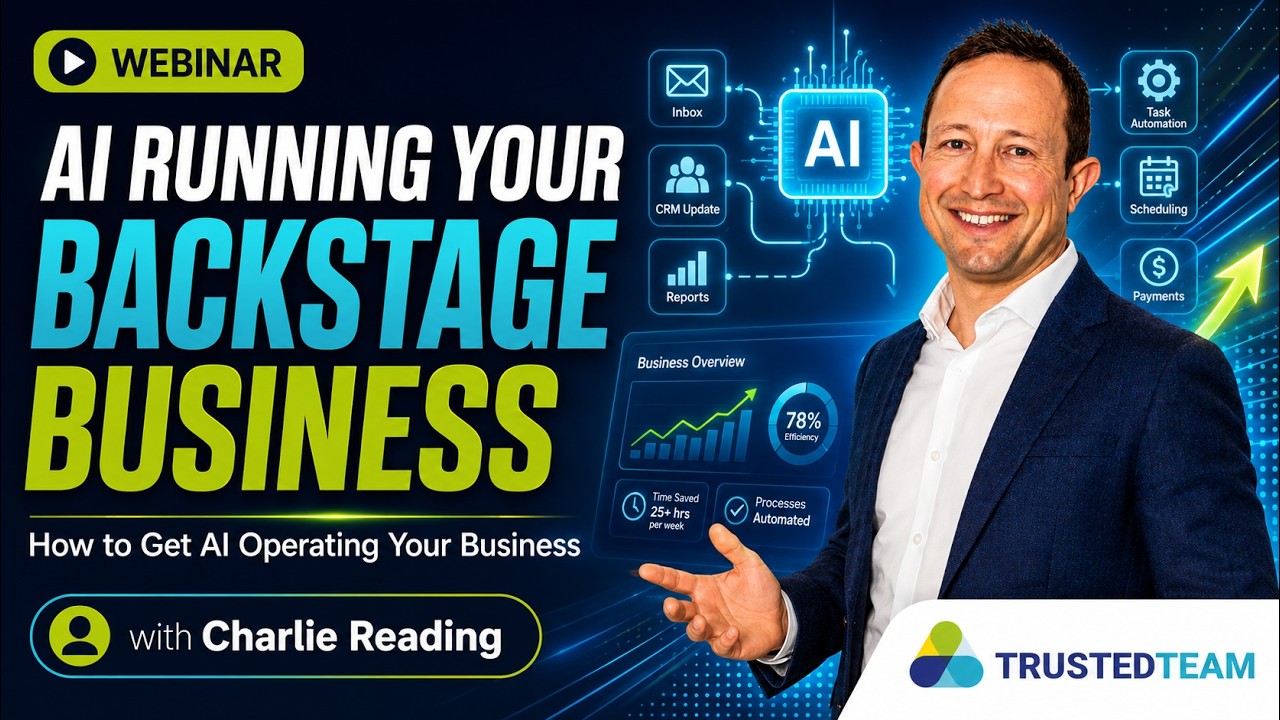
The Partnership Playbook Free Webinar
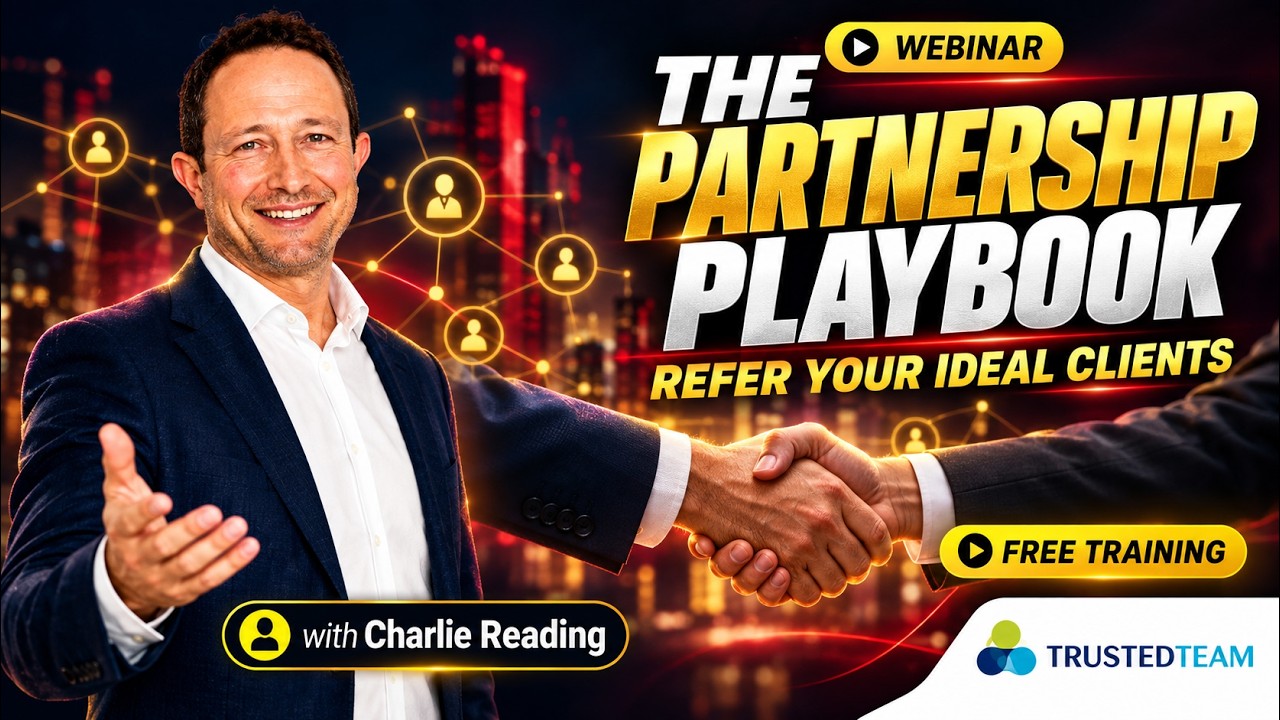
Charlie Reading walks through the Partnership Playbook, a framework for professional-service firms to grow through referral partnerships instead of relying on one founder. He covers identifying partners, designing value exchanges, and tracking results, using examples like an accounting firm that generated £288k in revenue for him.
Chapters
Thank you very much for dialing in on time. Really looking forward to spending some time with you this morning talking about this concept that I think had such a key impact, such a huge impact on all of my businesses. And so, really, what we want to talk about this morning is how you can grow your business whilst actually enjoying the business more, and also whilst you're actually working less. That's really what this is all about. And so, you know, maybe at the moment you're thinking, well, okay, you know, I do need to drive more clients into the business. Maybe you're thinking, you know, we're getting some clients, but we need to drive that, we need to increase the flow. Or possibly the clients that you're attracting aren't really your ideal clients. So they're okay, but they're not really as profitable as they should be, either because they take more work because they're not the ideal fit, Or they generate less revenue because they're not the ideal fit. So, maybe that's what you're struggling with at the moment, and maybe also you're struggling with the sort of work-life balance. You know, the sheer amount of workload is kind of holding you back because you're responsible for going out and finding the new clients or designing the, you know, writing the blog article or designing the Metro ads or whatever it is. going to networking events, all of that sort of stuff, then maybe that's part of the problem with your work-life balance, is that all of the new clients are coming in through active work that you're having to put in, as opposed to them passively just arriving on your doorstep. And perhaps also, and this is quite a common thing that I see in business owners, is that they gradually start to fall out of love with their business because they find themselves doing all of those other things that they don't really want to do, And basically, you know, as opposed to doing the one or two things that they both love and they're really good at. And so often, that can be where business owners head, is this situation where kind of the business isn't growing as fast as they want, they're working more hours than they want, and when they're at their work, they just don't really enjoy it as much as they thought they would or they once did. But there is a different way. You know, you can have a business that is growing exponentially. You know, we had, when I was running Efficient Portfolio, we had 7 consecutive years where we drove new business growth up by 50%. 50% year on year for 7 years is pretty phenomenal growth. So that is absolutely possible. And you're probably thinking, well, yeah, that's because you were working all the hours God sends. But actually, no. During that time, I was taking 3 months of every year off. So you can have a business that's thriving and growing, Whilst you're actually taking all the time off you want, whether that's to spend with the people you care most about, whether it's to spend doing the hobbies that you care most about, and whether it's to look after your own fitness and health and wellbeing. All of those things actually, let's be honest, are more important than the business and making more money. So actually, it's possible to do both. It's possible to have this growing business and also to have as much time off as you want. But, The secret also isn't just to get those first 2 bits right. It's to have this business where, when you're at work, you love doing what you're doing. You know, it's more fun than fun. And whether that's because you love playing golf, or whether that's because you love fine dining, or cycling, or going to races, or even going skiing, all of those things should be possible and are possible as part of your business day. Now, it never ceases to make me— to amuse me That when, when like I'm going off, like for example, three weeks ago I was flown to Sydney to speak on a stage. So I'm paid to fly. I'm paid to stay there. They're paying my expenses. They're paying me a speaker fee, and my daughters will be like, "Oh yeah, you're off to Sydney to go to work." You know, I know what it's going to be like. You're going to be hanging out with your mates, drinking, blah blah blah. And I'm like, "Yeah, but I designed it this way. I get." to do that. That's how I've worked to design my business life so that I'm doing things I love and I'm also being paid to do them. But you're doing— the secret really is you're paying, you're being paid to do things you would actually have paid to do. And partnerships is the most amazing way. Building partnerships with strategic people that can help you on your journey is going to be one of the best ways for you to spend more time doing the things that you love under the guise of work, and we'll come back to how that happens. So it's absolutely possible, but the problem is that most business owners have is that they are the bottleneck of the business. You know, there's no two ways about it. It's probably the most common problem I hear when I'm speaking to business owners is they are the bottleneck in the business. And so, partnerships are one of the ways to remove you as the bottleneck, because if you're the bottleneck in the sense that you're the one that's going out and finding new clients, if you can recruit a suite of people that are going to recruit those, find those clients for you, you're gonna get loads more of your time back, and we can remove you as the bottleneck in that part of the business. So, partnerships are one of the ways that we can fix this bottleneck. Founder bottleneck problem. They're also one of the ways that we can fix the feast or famine problem, because what typically happens in businesses in professional services is that you're going out and you're going, right, okay, I haven't got many clients at the moment, so I've got time to go off to networking events and find clients and do this and do that. And then you find a load of clients, you organize a seminar or whatever it is, you find a load of clients and you get really busy. So, you get really busy doing the work, and you stop looking for the new clients. And then, at some point, you finish doing the work, and then you look around and you go, oh, wait, I haven't got any more clients now. Now, I've got the famine. I've got to go out and find the new clients, and only once I've found more new clients do I now get to do the work again. And so, if we can recruit a team of partners that are out there looking for clients while we're doing the work, Essentially, what that means is we can continue to do the things that we love and we're really good at, which is serving our clients in whatever it is that you do, but other people are going out and finding those clients for us. So, partnerships is a brilliant, brilliant way of fixing this feast or famine problem because you're not having to go out and find the clients. You can just carry on doing the work. But one of the key things I think is probably the biggest barrier that professional service firms, whether it's a financial advisor or accountant or solicitor, The biggest concern and biggest challenge they have to overcome with their marketing and finding new clients is trust. And this is going— this is obviously even more so today in an AI-driven world than it was before, but it's always been trust. And so really, what we need to do with our marketing is try and attract people that already trust us. And partnerships is one of the most amazing ways to do that. Because let's say you've got a trusted advisor and that trusted advisor says, you need to go and see my mate John. Immediately, you now trust John. Because you trust John because your trusted advisor trusts John. So this is one of the best ways to build a marketing system that is built around trust. And so partnerships are the key to— key to this. And I just want to share with you why I think this whole thing is so important, because when I've built— I've built and sold— I've built 6 businesses, I've sold 4 of them. I'd say 3 were a successful exit, we'll describe one as a learning experience. Most expensive coffee I'll ever drink, that one. But the 3 that were successful all went through, and the 6 that we've built, have all gone through this same 3-stage pattern. And really, at the start of a new business, it's all about finding enough new clients, isn't it? It's finding whatever the business is, you're just struggling. It's like firefighting, trying to find those clients. And eventually, you try and break through that system. And then, what you'll find is you get really busy and your work-life balance goes to pot, and you have— you're the time-poor founder. And most business owners don't actually get through that, but let's say 5% get through that. Well, that's when you end up with this balanced business life as well as the exponential growth business. But probably now, they've still got a business where they're managing the business, they're still running the business, even if they're not driving all of the growth. And so really, the secret and the place to get to so that you have a saleable and scalable business is what I would describe as the self-driving business. And the reason I'm sharing this with you is because partnerships can help you on every stage of this journey. Partnerships can help you find those clients. Partnerships can help you expand the client attraction whilst you work less, and partnerships can actually start to help you build out that self-driving business to allow you to extract yourself because of the relationships that they are. So, they're actually really powerful. But predominantly, it's the first 2 stages that they can help you with. And the other thing is, it can help you help make sure that you attract the right clients, because the problem is that a lot of people get super busy dealing with the wrong clients, and they end up becoming the busy fool, spending loads of time serving people that undervalue the work they do and underpay them for the work that they do, and perhaps actually take longer to serve than your ideal client, even though you're getting paid less than you would have done for your ideal client. And that's because when you're going out and doing LinkedIn marketing and things like that, it's difficult to really hone in on who you're going to attract. Whereas when you're working with partners, you can be really specific on who you're going to attract, and therefore you can target them. You're much, much more likely to attract the ideal clients. So, become the focused achiever rather than the busy fool. And of course, in an AI-driven world, you know, now is the best time to do this. We'll come back to the trust thing in a minute, and we've sort of touched on it already, but in a trust-driven world, or like a world where we don't trust what we see online, then what somebody that we trust says is absolutely the best way to go from a marketing point of view. That's why referrals and partnership playbooks are such a key part of professional service businesses, more now than ever before. But the other thing is people more, like since COVID you know, we've seen Coldplay gigs and Oasis gigs selling out in seconds, much more so than ever before COVID And that's because people value people and interactions with people more than they've ever done before. And so that's why really this is the kind of secret sauce to helping people, have people introducing you to clients. your ideal clients, as opposed to you trying to find them through some technology platform and trying to game their algorithm. It really is, this is the way that people want to be served now more than ever before, whether that's in their pastimes or whether that's who they seek advice from. So, now is the most important time to focus on these, on the people relationships. You know, AI has an amazing role to play, and that is to automate the boring, repetitive tasks that we don't want to spend our time doing. But what it does is then free us up to humanize the things in our business that are exceptional and to have more time to do more amazing things, like spend time with partnerships. So that's what we're gonna be talking about today. And you might be asking, well, who is Charlie Reading? I think, you know, obviously the people on here that are existing Trusted Team members that know who I am, but I just wanted to give those of you that aren't members of the Trusted Team a little small sort of bit of background on where I've come from because my main business was, or my main business over the last 25 years has been, or 20, wow, 27 years actually, has been in the world of finance. And it was a business called Efficient Portfolio, but it's not the only business, as I mentioned. And if you'd found me in 2010, so 11 years after I started working after university and traveling, you'd have probably found me In the middle of a bit of a crisis. So I was running Efficient Portfolio, which was a pretty average financial planning firm at the time. I was trying to set up my second business, the Rural Business Community, which was like a rural version of WeWork. I was married to Carol. I still am married to Carol, but I was married to Carol. Got 2 girls, Fiona and Bronwyn, and I was in the thick of it. I was literally working 24/7, no time for holidays, not making any money. I was making all of those mistakes and struggling to break through, but I knew other people had broken through these challenges. So, I basically went out and found the best coaches I could find out there to really kind of try and help me fix the problem and break through that ceiling. And I started with the work-life balance. So, I went from literally working 24/7, like literally packing up Efficient Portfolio at 5:00 PM, putting the girls to bed after after tea, go back to work on Rural Business Community, and working till gone midnight. But I decided that was the first thing I needed to change, and very quickly I went from working, like, literally full-time to pretty, I mean, like, probably only a matter of 2 or 3 years, I went to taking 3 months of every year off, and have done for now over a decade. And that 3 months of every year has kind of completely transformed, you know, we've had the most amazing experiences as a family, we've traveled the world, we've done some super cool experiences as a family. And so that was vital. But I also realized that, you know, like, at that moment in 2010, I was probably 3 stone heavier than I am today. I was the unhealthiest I'd ever been. So I knew that that wasn't sustainable. So I then went on to go, and I went from that 3 stone overweight person to completing multiple Ironmans, including the Ironman World Championships in Hawaii, and later went on to form the Business of Endurance podcast, where I interviewed a lot of the top pros in that endurance sports space. And then in business, we kind of, we just made significant progress. So I built and then sold the Rural Business Community, which was the rural version of WeWork. We turned that redundant hay barn in the bottom left-hand corner into this beautiful serviced office. And then my financial planning business grew to be known as one of the top financial planning firms in the country. And in 2015, I had my first book published, The Dream Retirement: How to Secure Your Money and Retire Happy. And that book led on to a bit of a rollercoaster of success for us. I started getting featured on national radio, on TV, on cover of industry magazines, on stages, literally all around the world. And Efficient Portfolio became known as the top financial planning practice in the Midlands. But in 2000, well, it's sort of around 2000, I decided it was time. Over 20 years of FCA regulation was enough for one lifetime. So I decided it was time to try and engineer an exit from that and to do something else that I was passionate about, which was the coaching, because this is where, you know, what helped me so much on my journey. So I decided to exit that business, and I successfully exited that business in 2023. But it's not the only business. I mentioned the Rural Business Community. I've also built and sold a business called Efficient Power Planning, which still trades today but under a different name. The learning experience one was The Hub and Spoke, which we built and sold, sold it this year. But my main business, and the reason that I'm here is I run a business called The Trusted Team, which helps people grow their business while working less and enjoying more. And the Partnership Playbook is one of the best strategies for doing that. It's one of the ways that we've grown. So, like, literally every one of those businesses has benefited from the principles of the Partnership Playbook because I've run every business through this model I'm about to share with you. So let me explain why is this so important. Essentially, what we are trying to do is we're trying to have other people that already serve your ideal clients incentivized to go out and introduce them to you. That's really what we're trying to do. We want them to go out and they already have these connections, so we want them to make— we want to incentivize them to go, actually, I want to introduce them to you. That's what we're trying to do, because if we do that, basically what we've got is a whole marketing team that we don't need to pay for. I'll give you an example in the music world because we've already talked about Coldplay once. When Coldplay released their latest album, they released a single called We Pray, and when they first released that, that song was sung by Chris Martin, obviously the Coldplay singer, plus featured on it was Burna Boy, And Little Simz. Now, Little Simz did a rap in English, whereas Chris Martin is obviously singing, and so that's brought a different type of audience. The people that would follow Little Simz and her rap are now starting to listen to this song, and people who follow Coldplay are now listening to Little Simz. And Burna Boy. Burna Boy brings kind of this Nigerian undertone to it, but he does sing in English. So again, different audience brought in for both Burna Boy and Coldplay. But importantly, so they're benefiting from collaborating with each other, but in addition to that, the listener is benefiting because actually that song is a far, far better song because it's got Chris Martin, Burna Boy, and Little Simz in it as opposed to just Chris Martin singing it. So the consumer is better off. and the businesses, the artists are also better off. And then what Coldplay then did was brilliant because they kept releasing this single multiple times but with different collaborators just slotted in instead of Little Simz and Burna Boy. So they did one with Jasleen Royale singing in Punjabi and Hindi. They did another version with Tini singing in Spanish. They did another one with Eliana singing in Arabic, and they did another one with Twice, the K-pop sensation, singing in Korean. Now, did Coldplay go back and re-record their section every time they did this? Of course they didn't. But now they've managed to get their music out to another 6 different audiences that may not have been listening to them, but their fans that want to listen to a song sung in Punjabi and Hindi, or a song sung in Arabic or Sung Sung in Korean, then they've got more value out of this. So the consumer's been better and the business and the artists are better, and that's what partnerships is all about. And if we think about this in business, there's a famous story around when Steve Jobs was looking for a new home for Pixar after the IPO following Toy Story's huge success. And they were looking for this amazing new office and they built— they found this big building somewhere around Silicon Valley, I think it was. And so the logic would have been to have post boxes, toilets, and kind of coffee stations dotted around the whole building. But Steve Jobs was like, nope, I believe that ideas have sex. What do you mean by that? He said, well, basically, when people that have the same objective, but coming at it from a very different angle, have conversations, different ideas, ideas have sex, ideas bump into ideas, and different people with different perspectives bring new strategies into the business. So what he was saying is, essentially, what I want is to create this central atrium where all the post, water, coffee, and toilets are based. So everyone, regardless of what they do for Pixar, have to come to this central atrium to get the things that they need to get. And because he knew that when the, like, the animator and the finance director or the marketing guy are all stood in the queue for the coffee machine together, then they were chatting away. They all wanted to make Pixar the greatest success that it could be, but they all had very different roles in that. And so that is why he was absolutely adamant that that was going to happen. And this is what we can do in business. We can bring together Experts that all are trying to serve their client in the best way possible, and we can allow ideas to have sex. So when I ran Efficient Portfolio, historically what used to happen was you would have the client in the middle, and the client would have a financial planner, us, the accountant, and also the solicitor. And the problem was that the client typically was sat in the middle of that whole relationship. So, for example, they might— if they were getting inheritance tax planning, they're getting some advice from their financial planner, they're getting some advice from their accountant, they're getting some advice from their solicitor, and they're stuck in the middle. So when those advice solutions come together, they're kind of stuck trying to work out, well, which way do I do it? You know, like, which way do I go? And they're evaluating each piece, which makes their life much, much harder. So we realised at Efficient Portfolio we needed to adopt this trusted team approach. It's actually where the name The Trusted Team came from. So we called it The Trusted Team approach because what we wanted to do was we wanted to hang out and speak to the accountant and the solicitor of the client, because we knew that if we put all of our expertise together and came up with one cohesive plan and then shared it with the client, The client would be just like, well, if you 3 all think that's the right idea, as the 3 people I trust as my advisors the most, if you guys think this is all the right plan, my life is better. It's simple. I just go ahead and do that. So the client is getting a much better service if those 3 trusted advisors are all putting their heads together and strategizing together. Ideas have sex. Better, better, better, better ideas. Better strategy, easier outcome for the client. But the advantage, and what we would do is, when we met a new client, if we didn't know their accountant or didn't know their solicitor, we'd be saying, look, you know, we want to really speak to these guys because, as a whole, we can do a better job on this, for this. So that's exactly what we'd do. We'd seek out the accountant and solicitor of a new client, make a point of having a meeting with them, and it was all for the benefit of delivering a better service for them. for the client. However, there was of course another benefit, and that is that we knew that these people served our ideal clients as well as us, but they weren't in competition with us. You know, the reason that if we're dealing with this ideal client, then we know that that person, that accountant, also serves other people the same as that ideal client of ours. So, we would then look to build those partnerships together. So, it's one strategy. One of the strategies that people often ask me is, how do you find more partnerships? Well, who is serving your current ideal clients would be a very great starting point because legitimately you can phone them up and go, look, I serve this person that's also served by you. We can do a better job if we get our heads together and at least meet and start some sort of relationship so that we can share ideas around this particular client. So that's a great way to do it because what trusted, what good advisor is gonna say, no, I don't want to do that meeting, because they're basically saying, I don't want to serve my client as well as possible. So it's a brilliant, brilliant way to meet new partners. But why is this such an empowering approach for us? Well, I'll give you an example. So this firm that the partner that we met was a 6. Partner firm of accountants. Now, so that's an okay size firm of accountants, not a particularly big one, but it's not bad. So over the course of the first 18 months of working with them, they sent us 30 referrals which became clients. No, actually, they sent us 30 referrals, probably not all of them became clients. But that generated us an additional £288,000 worth of revenue that was for us, and we did less marketing during that time because these guys are just sending all of these clients directly to us. By the way, this was when it was— I think this was just me, still when Efficient Portfolio only had me as an advisor before we had employed advisors within the team. The firm of accountants got 8 referrals back from us. They got an extra £72,000 worth of revenue that we paid them, not out of the £288,000, but it was on top of that through a revenue share. I'll come back to whether that's a good idea or not in due course. They increased their accountancy fees because we referred the clients back into the accountants to say, look, you need to do this work now with them. So they got more accountancy fees. By the way, that £72,000 worth of revenue, they did no work for that. Obviously, we were doing all the financial planning work to generate the £288,000, but for the £72,000, they were just passing a name and a number and going, now crack on. And that was £72,000 straight to the bottom line. And their clients have been better served. They've got happier clients. So, like, the partner's winning, we're winning, everyone's happy. And so that's why this is such a powerful concept. And if you've got a multitude of these partnerships working, then this could be generating you a significant amount of revenue. And obviously, this was a relatively small firm of accountants in a relatively sleepy part of the world. If that was a bigger firm of accountants or solicitors in central London, you could put zero on the end of these numbers quite easily. So what I realized was that we'd meet these partners, we'd meet these potential people, and we'd all talk a good game to start with. Then sometimes Sometimes it would all go to radio silence. And I started to look back on the relationships that worked really well and the ones that didn't. And I thought, well, okay, what did we do in those situations that we didn't do in these situations that's clearly driven success? Now, sometimes you'll meet a firm and they're just, they totally get it. And maybe it's because they've worked with another firm previously and it's like shooting fish in a barrel. But other times, you've really got to work to get these partnerships up and running and really kind of put the effort in. So, I'm going to share with you the strategy that we went through that allowed, when we met a partner that we thought was a good fit, you know, obviously, if you're meeting somebody that doesn't share your values and you don't think it's a good fit and you don't like the person or they don't like you, you might as well just bin it off straight away. There's no point in trying to push water uphill. There's plenty of other potential partners that can introduce you to your ideal clients. When you find a good one that's got similar values, similar mindset, if you follow this next process, you stack the chances of you succeeding in generating business as a result of it much, much, much higher in your favor. So, I like to break things down into frameworks, and that's what I've called the Partnership Playbook, is the partner framework. And the first step of the Partner Framework is to really understand what's the purpose of this partnership for the potential partner. So, what do I mean by that? You've got to get to the heart of what motivates them to drive this partnership forward, because if you don't, you'll be trying to sell based on the wrong thing. So, I'll share with you a story to explain. So you may have heard, if you've read Leading by Sir Alex Ferguson, you may have read this story. But back in the day where Paul Gascoigne was the young Geordie protégé, you know, the up-and-coming England player, probably the brightest talent in English football, it was at a time where Sir Alex Ferguson was managing Manchester United, the wealthiest club in England, and he was determined to sign Gazza. He was like, I am going to sign Gazza. And so what I'm going to do is I'm going to take Sir Bobby Robson along to help me sign Gazza. And because Sir Bobby Robson was— oh no, no, sorry, Sir Brian Moore. Brian Moore was a famous Geordie that had played for Manchester United and played for England, obviously to the very highest level. And so he's like, yeah, we'll get him over the line with Sir Bobby Moore helping us here. And so basically he tried to pitch what he thought was, what he thought was important to Gazza. But Sir Alex Ferguson didn't manage to sign Gazza. In fact, Gazza signed for Tottenham Hotspur, a far lesser club than Manchester United at the time. And do you know why Gazza signed for Tottenham Hotspur? Because they offered to buy his mum a house in Sunderland. So, if you think, I mean, what would be a house in Sunderland back in the 1980s? Probably £10,000, maybe £20,000. Do we think if Sir Alex Ferguson had known that was the thing that was going to get Gazza to sign, he would have offered to pay for a house in Sunderland for Gazza? No. Of course he would. The reason he didn't do that was because he didn't ask the question. So, the very first question you should ask when you meet a potential partner is the same question that we would ask when we first met a new client, and that is, you know, if we were sitting here a year from now, and you might want to change it to 3 years, but if you were sitting here a year from now, what's going to have happened in your business for you to be happy with the progress you've made? Because I'll give you 2 examples that I heard accountants say. One was, I want to retire in 3 years' time, so I want to get this business into a more profitable practice per client. That's what's gonna drive the value of this business. So, that accountant needed to drive the profitability per client already in the business up higher. Right, okay, that's great. Now that I know that, I can show you how delivering financial planning for your existing clients is going to increase the profitability of your practice per client and help you sell the business. I'm going to show you how the partnership is going to drive towards the goal that's important to you. Second example, a younger accountant, I need to attract more clients into my business, so now I'm going to show him how doing the financial planning for his existing clients is going to allow us to get in contact with things like their trustees, get referrals, and refer people back into his business, so we're going to drive business back into his business as a result of this. So I can explain to him all of, like, why, again, what motivates him. But if I try and sell the driving up profitability per client to the young guy who just wants more clients, it doesn't work. He's not that motivated. So that's why the first question we ask a potential partner is, if we were sitting here a year from now looking back, what's going to have happened with the business? for you to be happy with the progress that you've made, because only when you get to the heart of what is important to him, i.e., his business goals, can you help explain how your partnership together is going to drive him towards that goal. Now, I mentioned that we did a revenue share with that firm of accountants, and this is probably the most contentious part of this whole piece, and I delivered this piece to a session of professional service business owners in person a couple of weeks ago, and of course, this was the bit that got all the conversation. So, let's deal with it right head-on, and the way to deal with it for any partnership is to deal with it right head-on, and that is at the start of the relationship, try and determine what's in it for both of us financially. Now, what that means is, so for example, which way is the likelihood most of the highest client flow? If you're both looking at a situation where you think, probably I can send you as many clients as you're going to send me, then that's fine. There's probably no need— money needs to change hands, and if I'm honest, that's the better way of doing it. However, sometimes business is only likely to really flow one way. I'll give you an example with an architect and firm of builders. By the time the builder is meeting the client, The architect's already done their work. So there's very little opportunity for a builder to ever refer business to an architect, but the architect will be able to refer business to the builders. Now, that doesn't mean that there should be money necessarily changing hands for that, and in many situations that would be unethical, but it does mean that you need to be aware that all the leads are going to flow one way, and if that's the case, then you need to be making sure you're thanking them in a different way, not just necessarily money, But it might be a day at the races, take them out for dinner, have lunch with them, take them out for— take them and their wife to the theater or go to the cricket or whatever it is. Those sorts of things we're going to need to work out because otherwise what is going to happen is all the leads are going to flow from one person to the next, and after a while that person is going to go, I'm not getting anything back for this, I'll just send the leads somewhere else. So That is really important. Now, like for professional services, if you're going to take a fee split, it's got to be done on a professional basis. Either you've got to ask the client for permission, which involves just a signature to say, yep, I'm happy for you to take a share of that. It's up to you whether you deduct that off your fees, or you say, this is my fee to cover the work that I do with the partner, because they're obviously going to come and consult with me on this topic, or you create a joint venture company, which is what we did with the firm of accountants that I mentioned earlier on, create a joint venture company and you both profit from that. Essentially, it becomes a separate financial planning arm for that business, which is perfectly acceptable and fine with both the legal regulator and the accountancy regulator. I'll come back to that piece in a minute, but the important point at this stage is what's in it for them and what's in it for you. Because what you'll find is their motivation is different. What we always found was solicitors never wanted a fee cut. They always wanted to be able to say to the client, we're whiter than white. We're not doing this for our benefit. We just think it's best for you. Accountants, on the other hand, always wanted a fee cut. They always wanted that, that, wanted that, and that was what drove them. But if you know that, you build a system that allows that to happen. Whether that's, you know, and if the solicitor doesn't want the fee and you know that you're not going to be referring as many clients to them, maybe it's a bigger firm and they're going to refer 5 clients to you for every 1 you send to them. Well, if that's the case, then you've got to try and reward them in a different way. They don't want a fee, take them to cricket, dinner, etc. We'll come back to that. But it's really important in that first meeting you understand, you set out these, establish this because Otherwise, what will happen is it will gradually— the relationship will fizzle out later on. The next thing you've got to be able to do is you've got to be able to articulate exactly who you serve, how you serve them, and what makes you different. A friend of mine works in the City. He's worked on Wall Street, he's worked in the City, he's worked in Hong Kong, he's worked in London for big banks. And he's one of my best mates from school. And so he works in technology inside the investment banks. And literally, I have never, in 20 years of him working in that environment, I have never understood what he does. And then I was reading Flash Boys, a book by Michael Lewis, the same author as The Big Short and Moneyball. It's not one of his best books, actually. It's about flash trading on Wall Street. But in there, I happened to mention to Dave, my schoolmate, that I'm reading this book, and he says, oh, you know that algorithm at the start of— that he talks about at the start of Flash Boys? I said, yes. He said, I wrote that. I was like, wow, Dave, for the first time in over 20 years, I now actually know what you do. You've never ever been able to articulate what you do. Until you found that sentence that did it for me. So, we've got to be able to articulate what it is that we do, and one of the best ways to do that is to come into that first meeting really, really super prepared. So, what's gonna happen in that first meeting is you're gonna start by asking, if we were sitting here a year from now looking back, what's gonna happen in your business for you to be happy with the progress that you've made? And what they're gonna start to do is they're gonna start to talk about their business or talk about their goals. You can dive a little bit deeper by going, you know, sort of, What concerns have you got that you need to overcome? Or, you know, what obstacles are going to block you to get to that? Or, you know, what opportunities have you got that you'd like to maximize? Those sorts of digging questions. And then, after talking about themselves for probably the first half to 3 quarters of the meeting, they're gonna suddenly go, oh my God, I need to talk. I need to find out more about you because this has all been about me. So, they're gonna be like, right, okay. Now, tell me about you. Tell me about what you do. At this point, I would open a professional presentation. We called it the Center of Influence presentation at the time, and what immediately happens is this person's come into this meeting, they've just talked freely for half an hour, they haven't got any presentation prepared, they haven't come into it like really well organized, and now they've gone, right, now your turn to tell me about you. You can go, look, I have come prepared. I've done this. Now, I'm not suggesting you go through the presentation page by page, slide by slide. If it's booklet, you know, it might be a professional brochure, whatever it is. I tended to keep it digital actually, but I think we did at one stage have this printed into a brochure. You don't go through it piece by piece, but by coming into it prepared, immediately they're going, Hang on, this guy's come into this meeting way more prepared than I came into it. So you're immediately looking professional. But what then is brilliant is once you spent half an hour talking to them about what's important to them, you can now use a visual aid to show them how what you do as a firm is going to help them move towards that. So for example, you might say, well, look, really, you know, lifetime cash flow forecasting is a key part of proper financial planning. It's the cornerstone of proper financial planning, and we need to help you to really get your clients more profitable, get you more clients. We need to do this lifetime cash flow forecasting for them. So if you've now got a visual picture of a lifetime cash flow forecast that you can show them, it's going to be way more powerful than explaining it. So in that pack, I just flick through and go, look, you know, I mentioned one of the things that we do differently is it would really help your clients Based on what you've told me, is this lifetime cash flow forecast? It's difficult to explain that, so let me use this image to show you what it looks like. That presentation, so we would give that to all the employed advisors that worked for us, so again, every time that they're meeting a potential partner, they're following this process and they're coming in really well prepared. And by the way, in those first couple of pages, you'll notice Oh, top 100 firm, the Sunday Telegraph, the Sunday Times, the, you know, like top UK practices award, me holding that award. I wouldn't mention those in the meeting, but what I would do is just flick past them. So they're just seeing that that is there. Oh, you know, I don't need to talk about that, but they're seeing it's there. That's really powerful as well. I don't need to brag, but I'm just reminding you that there's evidence that we're an award-winning firm here. One of the most important things to have in that Centre of Influence Pack, or whatever you want to call it, is— we now call it the Partnership Presentation, I suppose, based on Trusted Team terminology— is the Real Results Roadmap, and this is something that I'm not going to go into much detail now. It's an entirely separate piece of coaching that we do in the Trusted team, but it's an incredibly important part to have in the partner presentation. So, the Real Results Roadmap is essentially the journey you're going to take your ideal client on that's going to move them away from their pain and what's keeping them awake at night and move them towards maximizing their opportunities and eliminating those pains and concerns. So, I'll give you an example of the Efficient Portfolio one. It's not the best one because I created it years and years ago, long before I understood some of the principles behind the Real Results Roadmap, but it's not bad. So you have the initial financial planning, which is the Financial Breakthrough Call, then we'd have the Exploration Meeting, which is kind of exploring the client situation. We design them the Efficient Financial Plan, a plan that was efficient, Planning Meeting, and then the Progressive Review Programme, which was there to make sure that their clients' financial planning evolved with them. Yeah. But the key point really is that what we're doing is when we meet an ideal client, we can explain, look, this is the process that you go through, and this is what it's going to look like, and this is the benefit of going through each stage. And the idea is now what you do is name the thing based on the benefit that the person gets. So, the reason that this is so important, it's in the Partnership presentation is, not only do you, if you can't explain this to the partner, what hope do you think the partner has got of explaining it to one of their clients? So you need to make it super clear what this journey looks like so that when they're sitting in front of their client and you're not there, they can explain this process to your client. So I'll give you an example of a different type of one. There's a couple of different types of ones. This is the one that we use for the Trusted Team coaching and the in-person group workshops that we do, which we call the Founder Accelerators. So basically, we lead them through, and it's cyclical because it's continuous as opposed to the financial planning one, which was linear. So we help them set amazing goals, but then build the systems to achieve those goals. We help them build out the automated marketing machine. So that the marketing works whether they're working or not. We help them magnify everything that they do as the founder so that they can remove themselves as a bottleneck. We help them build outstanding operations, which is what goes on behind the scenes so that the business delivers predictable and scalable results. We help them create time freedom for themselves, which is like the delegating all anything but the 2 things that they love and they're really good at. And then finally, we build this culture of constant innovation so that they're constantly coming up with new ideas, their team are constantly coming up with new ideas, and that business is constantly improving month on month. So there's an example of a real results roadmap. Another example is what we do for the Professional Marketing Magnet, and this session actually today, the Partnership Playbook, is, you'll see, one component of that, but this is a journey that we take people on to help them build out the automated marketing machine. So this is this road— and like you can see, it's actually designed like a roadmap, Because this is the journey that we help take people on to build out their automated marketing machine. It's how we communicate it, but it's what you need to do to the partners to communicate how you're going to take your ideal client from their current pain down to their current opportunities. And in terms of articulation, one of the other things that was on that Real Results Roadmap for the Professional Marketing Magnet is the ideal client niche. It's not something that we're gonna go into today, but it's really important that you absolutely nail who your ideal client niche is and be able to articulate that, because if you can't articulate that, it won't be memorable in the partner's mind. I'll give you a great example of somebody that I was coaching on this and what he came up with. He came up with I help little old ladies with lots of money. I'm like, that's beautifully simple. I absolutely love that because immediately when I say that, you are thinking, oh, I know a little old lady with lots of money, you know, and therefore I would introduce that person if I was in a situation to do so. So we want to get really brilliant at articulating exactly who we serve, and the ideal client niche is one way you can do that. So, on to recognition. Now, recognition is about making the partner look good in front of their clients, and this will have lots of benefits. I'll give you an example of how we've used this in the Hub and Spoke, which was the business hub and café by week, cycling café at the weekend, that we ran in Rutland, sold it earlier on this year. This was the business that was the learning experience. Beautiful, delicious, very, very expensive coffee for me, but it was great fun while we did it, and I learned loads from doing it. But one of the things that we did when we were going through the Partnership Playbook for the Hub and Spoke is we realized that, you know, at the end of the day, there's bits of— there's a few bits of cake left, isn't there? And typically, you know, maybe one of the team would take it home, or, you know, maybe it would just go in the bin or whatever. And we thought, actually, what would be better is— what we really wanted to make the staff of the Hub and Spoke look great in front of other employees— sorry, in front of customers, because if they did that, the customers built strong relationships with them, much more likely to come back in the future, and also much more likely to tip them, which meant that the staff were happier. So we would say to the members of the Hub and Spoke team, At the end of the day, go around and just give these bits of cake out to people that are sitting in the cafe or people that are in the hot desking room or people that have rented one of the offices. Just give them free cake. It doesn't really cost us anything, but it's building great recognition that the staff look lovely in front of the other people, which is much more likely to mean they come back and buy more stuff or tip the staff. It's just a really simple thing, but it's a lovely thing to do. So, how would you do this in professional services? Well, a few things that you can do here. First thing is, we would give them, we would offer to give, well, firstly, we would give the partner a copy of my book, or, you know, one of them. But more importantly, we would say to that partner, we'll give you more copies of this book to send as a gift to your client. And in some instances, we actually said, Right, you just give us the names and addresses. We're not going to communicate with these people any other way. We'll destroy it afterwards for GDPR purposes, but you just give us the list of clients. We'll have pre-agreed the letter that you want to send with this letter, so it's from the accountant or solicitor, and it basically goes out to the client, and it's essentially something like, look, Mr. Client, I've just been reading this book, The Dream Retirement, and I know you're in the lead-up to your retirement. I know it's something that's part of, you know, on the horizon, so I thought you would benefit from a copy of this book. By the way, I know Charlie, so if you want an introduction for help on your retirement planning, more than happy to make that introduction. How does the accountant look to the client in that situation? He just looks really thoughtful. He's just gone out, he's just made a gift of a book out of the blue to somebody because he knows it's going to add value to their situation. And he's also said he'll happily introduce that person to the author if that's useful. That's a lovely thing. So, what other way— and it's cost him nothing. It's cost us the cost of a book to print, which is, let's call it, a tenner. But when a client, a new client to us, was worth about £10,000, this makes the accountant, solicitor, or whatever the partnership is, look really, really good. And so therefore, why wouldn't they do this? The other couple of things that we would do is we would say that first meeting on the Real Results Roadmap for Efficient Portfolio was the exploration meeting, which is a 90-minute meeting with one of the Chartered Financial Planners in the business. And we would say that that meeting was worth £297, but the clients or introductions from one of our partners would get that meeting for free. So, for example, so what that means is the solicitor is sitting in front of the client going, look, I think it'd be a really good idea for you to go and have a meeting with Charlie or one of his team. Normally, they'd charge £297 for that meeting, but because you're a client of ours, you'll get that meeting for free. Again, it just makes them look good, and the reason we want them to look good in front of the clients is it's much more likely that they're going to then introduce the client to you, which is what you're trying to get them to do. The final thing that we would do is we would create a bespoke video for each partner so that when they introduced a client to us, that partner could send a video that just said, oh, look, you know, we work really closely with this particular firm. Between us, we're, you know, we're serving clients much, much better. And so it was just another way that we could make them look good. In front of their client. Look really professional in the way that they've done that. And obviously, if it's just a video and it's online, it's super easy for them to just hit send and go. So, I suppose at this point, I just have you thinking, you know, what low-cost gift could you gift to a partner that they could gift away, give away as many times as possible to their clients? You know, is that a free meeting? Is that a book? Is it something else? But what low-cost gift can you give them that they can give away as many times as they want to? It might be a dinner, an invite to a dinner or something like that. I'll come back to that in due course. The next thing that is going to drive success with this partnership is to track and measure. And so once upon a time, I took an American friend of mine to the cricket. And after about 5 overs, he said— he spotted the scoreboard. He's like, oh my God, what does that tell me? The stats for the entire season? And I'm like, no, it's just today's game. And if you understand how to read the scoreboard, you understand everything about what's going on in the game of cricket. But of course, he didn't understand the scoreboard. He couldn't read the scoreboard, so he didn't know who was winning or losing. losing in the cricket match. And the problem is that most people are like that in business. So one of the tools that we give— get people to work through and build is called the Successful Business Scorecard. And one of the measures that you should have within the Successful Business Scorecard is measure where are the different leads coming from and the channels. And so when we boil that down to a greater degree, what we would have is what we would call the referral register. The referral register is tracking where every client came from. Did they come from this particular partner so that we could, at the end of the year, say, well, look, this particular firm generated us 10 clients this year, so therefore we need to find a way to make sure that we're thanking them for that. Or what it would start to do is build trends as well. Say, well, look, yeah, okay, when we add these 4 partners together, We can see that accountants are delivering us way more leads than solicitors are, or in this situation, events and referrals are driving more. But each year that'll change, but only when you track it and measure it does it become really easy. What gets measured gets done, doesn't it? But the other thing that you should do here is measure what— make this accessible to both you and the partner. So, we would create a Google Sheet for each partnership, and on that Google Sheet would show you every different introduction that we've sent to them and they've sent to us, and where that client is on that journey. Because if you both sit down and say, yep, we're gonna send clients to each other, and then 6 months later you're looking at the score, you're catching up with them, and you're looking at this scorecard that you've set up together, and there's one client from you to them and nothing from them to you, That creates great accountability to the fact that actually, we need to do something to make this work. So just track where the clients are flowing from and to, and how you're going to get on with them, so that they can see where a client has— and I think one of the key reasons for this, and the way to sell this concept to them, is, we want you to know exactly where any client that you introduce to us, We want you to know exactly where they are in our journey. How do we get on with them? Are we serving them? Have they decided that they're gonna go off elsewhere? All of that stuff, that's what they want to know, and that's really reassuring. There is an alternative way of doing this, and if you've got multiple firms and you wanna build out multiple partnerships, there's a piece of software called RQ. There's a couple of benefits for doing this. Excuse me. Oh, let me just have a drink. So RQ is a brilliant system that allows financial planners, accountants, solicitors, and other professional service practices to refer clients to each other, keep track of them, but also tick off all the compliance stepping stones. So for example, if the if you're going down the route of needing to disclose a fee share to the client, it will draft all the emails and letters and etc. to make that a compliant introduction automatically. And interestingly, I've spoken to a few solicitors about this, and solicitors that have always said, no, we wouldn't take a fee cut, and as soon as we said, if we gave you a piece of software that would do all of that compliancy bit for you, Would that change anything? And a few of them have gone, yeah, it would actually. We'd quite like the fee split, but we've just never been able to kind of square the regulatory circle. So interesting angle to take, but this is really good for them as well because they can see what clients they've referred to who and what service they've got back. You know, the client can do Net Promoter Score and give ratings to different firms if you want to add that in. So actually, it's a really powerful referral platform for professional service firms, so you might want to check that out. And that would do all of that measurement piece in one, but you don't have to have this. A Google Sheet is just absolutely sufficient, but this is going to do it better. The next secret to the Partnership Playbook is to nurture the relationship. If you just kind of expect it to now all work perfectly. It's not gonna happen. You know, I remember when I interviewed Louise Minchin, the BBC Breakfast person that went from doing no exercise to becoming a Team GB triathlete, when I interviewed her on the Business of Endurance podcast, she— it's amazing, you know, she came into cycling for the first time in pretty much in her life and because of a Comic Relief challenge on the velodrome. And she decided she liked the cycling, so then she did a bit more cycling, then she did a bit more, a bit of running. Then somebody said you should try a triathlon, and she did, like, basically a female-only super sprint triathlon. She quite liked that, so she did another, then another, another, and basically just kept nurturing the learning journey of triathlon and ended up as a Team GB triathlete, which is utterly amazing. Brilliant, brilliant lady. You should definitely listen to that episode if you can listen to one of my episodes of Business of Endurance. But the same applies to partnership relationships. You've got to nurture them little and often, and there's really 4 ways that I think you can do that. You can send them content, and that content might be your blog, it might be your newsletter. In fact, I'd say a newsletter is a great Great idea. I'll come back to that in a second. But content of all sorts is good because you're going to stay front of mind when you send them content they value. So one of the pieces of content that we would do specifically for partners is we created a sequence of 12 videos, one like a video of me explaining what is a Lifetime Cashflow Forecast and why do clients value it so much, or why do we use trusts in their financial planning so much, or What, you know, what, why, you know, different videos like that. Can't remember some of the others. And then what we would do is when we built, found a new partner, after that first meeting, I'd say, right, well, I'm gonna send you a series of videos, just one a month. They're only 10 to 15 minutes long, but it'll just show you how we can help your clients. So now they may or may not watch these videos. But what is happening is once a month, I'm dropping into— a picture of me is dropping into their inbox, a very young-looking picture of me actually, dropping into their inbox, and I'm explaining a particular principle of how we can help their clients. And sometimes they're just going to delete that and they're never going to watch it, and sometimes that topic is going to resonate. Oh, why do Efficient Portfolio use trusts with their clients so much? Maybe I should watch that. But either way, that content is creating value, and all I've done is drop their email address into an automated sequence, and they're now going to get one a month for the next 12 months to continue to be front of mind. Then we can collaborate. We can collaborate with them on joint events. Now, that might be joint seminars, joint webinars, joint golf days. It doesn't really matter what, but the great thing about anything that you collaborate on is you bring some of the audience, they bring some of the audience, so they're meeting potential clients, you're meeting potential clients, you're both adding value to each other's clients. Joint webinars and seminars are a brilliant, brilliant way to do that. We've done collaborative events where we did one, for example, with a commercial finance guy and a corporate lawyer, and me speaking on selling your business. And yeah, and like, we're all bringing a third of the audience to the table and we're all adding value to everyone. The next way to nurture the relationships is to connect with them, and that is through things like going and playing golf with them, going and having lunch with them, going and having dinner with them, going to the races with them, going— anything that you can do to spend time with them. The cricket is a great one because you're literally sitting there for like 10 hours chatting whilst sort of watching cricket and sort of having a few drinks and something to eat. But anything that allows you to build stronger connections with them is really powerful. And then the final thing is consult. So go in regularly and say, look, how can we help? And one of the ways that we did that would be to the quarterly video— sorry, quarterly hot topics meetings. So I'd go into each firm once a quarter, sit down with the partners, And just use it as a chance to probably explain a principle that I put in one of those videos, like, this is what we're doing for a load of clients at the moment, or, you know, because of the budget, this is what we're doing at the moment, making it kind of really super relevant. But then by doing that, they're like, oh, hang on, I hadn't thought about it, but that prompt, you know, that would apply to John Smith. You need to speak to him. So that's really brilliant at prompting those names. But then But then also, of course, because you're there in the flesh, you can answer any questions. Oh, I saw this client yesterday, they've got this pension issue, is that something you could help with? Yeah, of course it is, just send us a connection. So that's really the 4 ways that you can nurture those relationships. I mentioned the newsletter, so my newsletter is called the Friday Footnotes, and the reason it gets— I mean, we get about 75% open rate on this newsletter, which is phenomenal for a newsletter in in this day and age. But the reason it is, is because it's built on what they want, not what we want to give them. So, it's always a book recommendation. It's always a podcast recommendation. There's usually a TED Talk in there. There's some sort of film, documentary, series, something like that. There's an inspiring quote. There's a piece of AI or tech. And then finally, there's one piece from the trusted team, and that might be talking about a new event that we've got coming up or whatever. But we get a high open rate because people really value the book recommendations or the TED Talk recommendations or the podcast or all that sort of stuff. So give them content that they really want as opposed to what you think they should have and hide the thing that they should have within the thing that they really want. That's the key to a great newsletter. The next principle of the Partnership Playbook is pretty easy and that's because it's ease. It's just make it super easy. The reason that Spotify— sorry, that Amazon and Shopify have gone to become ridiculously valuable is because it's made shopping online easy. One-click purchase from Amazon is just super easy, and Shopify, obviously, that same approach to everyone that doesn't want to be on Amazon. Just how can we make this super easy? And one of the ways we can do that is have what we would call attraction marketing devices. So one of the other sessions in, or a couple of the other sessions actually, in the Professional Marketing Magnet are focusing on building attraction marketing devices. And these are things that you can give out to other people, or other people can give out on your behalf, and you draw them into your network. So I mentioned obviously the book, The Dream Retirement, but if an accountant or solicitor was sitting in front of a retirement client, they may want to give them the book, or they might want to say, look, actually Charlie regularly does a really lovely, like, Michelin-starred dinner called the Dream Retirement Dinner. You get really lovely food, meet some interesting people, and Charlie will speak in between each course about things that are very soft topics around retirement. So we would let them invite people to that dinner. We had an online tool called the 2 Minute Retirement Plan, so again, the accountant solicitor could send that to the client and go, look here, if you want to find out, you know, see if you're on track for retirement, go through the 2 Minute Retirement Plan. Super easy things for them just to point people to engage in our service, you know, in our business. We had one series for retirement clients, we had a series for post-retirement legacy planning clients, and we had a series for business owners, including things like my book Entrepreneurial Happiness. So just make it really easy to make that introduction, and the best way is just to send an email introduction, asking them just to send an email introduction going, look, connect us up. I'll be able to then put them on the tracker, and then I'll make sure we pick up with them, whether that's by initially setting up a call or meeting or whatever it is. But just make it super easy. And then the final piece, which actually is kind of the magic sauce to to this whole process is the principle of building reciprocity. And if you've read Influence by Dr. Cialdini, which is one of the best business books you could ever read, if you haven't read it, you really should, but Influence by Dr. Cialdini tells you that reciprocity is one of the 6 principles of influence. And in that book, he tells this amazing story, and it's an amazing story of money flowing between Ethiopia and Mexico during a time in the cultures, in the countries' devastating history. So this was at a time where Ethiopia was in the midst of the most awful famine and everything else. It was just like in the worst of it, most difficult of its time, probably almost in history. So it would make sense that Mexico was sending them aid. But unfortunately, in this story, the aid was actually going from Ethiopia and they were sending it to Mexico. And you're like, what is going on there? And they were sending it to Mexico because there had been an earthquake that had devastated part of the city. But still, Ethiopia didn't have enough money for its own people. Why would it be sending money to Mexico, and they basically had to go and look into the history to work out what was going on here. And what they found is that 50 years earlier, so in 1935, Mexico City had been instrumental in helping Ethiopia gain its independence. And so Ethiopia had spent 50 years looking for an opportunity to pay Mexico City back for that. So when they have this earthquake, That is deemed to be the time that Ethiopia can thank Mexico City and pay back, pay off their reciprocity burden that's been sitting on their shoulders for 50 years. So this power of reciprocity is incredibly powerful, and obviously you see it being used widely across lots of different places to get people to do what they want them to do, including Hare Krishnas giving away books and flowers and all sorts to help engage people in them spreading the word of Hari Krishnas. So how can we do this in business? Well, first thing you can do is invite people to stuff. So I remember doing a day at the— we got a box at the races and literally, I know we've got like maybe 10 or 12 accountants and solicitors all in in this box. And it was so funny, literally over the course of the day, I think every one of them sidled up to me at a quiet moment and just said, this is a great day, absolutely loving it. What can I do to thank you? Who are you looking for? Who can I introduce you to to thank you? The power of reciprocity is just building over the course of the day, and by the end of the day, they're like, I need to pay Charlie back. We've had a great day here. So invite them to something cool. Box at the races is quite good because you don't have to be a massive racing fan for it to be a nice day, but a day at the cricket is a lovely thing. Golf obviously is a good thing. Like, things that you can talk to people at whilst enjoying whatever it is, is a great thing, I would suggest. The next one is to introduce them to somebody that they will get value from. Like, try going out and finding a client that you can introduce to them, just so that you can show that you're making this partnership work. Because if you introduce them to somebody, then they're going to build— that reciprocity is going to build, and they're going to almost certainly feel like they need to find somebody to introduce back to you. And then some sort of inspirational gift, some sort of thought-provoking gift. You know, that might be that you found out that they were a fan of golf, a golf fan, Or they're keen on playing golf, and so sending a book out of the blue with a handwritten note, just to go, the best book I ever read on golf was The Golfer's Mind by Dr. Bob Rotella. I know you said that you're enjoying your golf, so I thought I'd just send you a copy. Just something really thoughtful like that will have you standing out from the crowd by a million miles. And of course, one of the ways that you can do that is gifting them a copy of your book. Don't have a book, it's one of the best ways of positioning yourself as the expert, something I talk a lot about in the Professional Marketing Magnet. It took me 3 years to write this book, but now we can do it in literally 3 weeks as opposed to 3 years if you know how to do it, something again that we talk about in the Professional Marketing Magnet quite a lot. So like, that is a brilliant, brilliant way of you positioning yourself as the expert in front of the of the partner, and so that is one of the things that you should definitely— in fact, it's quite funny the number of times I'd sit in a first meeting with a potential partner and my book's just sitting there on the table. I haven't mentioned it, but eventually the partner's like, okay, tell me about that book, because they just can't help but they want to know, but it positions you as the expert the whole way through, so that's a great thing to gift to them. As well as to their clients, of course. One of the other things I would say you should do is gift something of high value that you do within your business to the partner themselves. So, in our financial planning, the Efficient Wealth Management Process, the Real Results Roadmap for Efficient Portfolio, the middle step was called the Efficient Financial Plan, and we typically charge between £3,000 and £5,000 design a financial plan. It had a lifetime cash flow forecast in it, it had all of the portfolio analysis, all of the tax planning strategies, all that sort of stuff. So what we would offer to do is do a free financial plan for the partners of the firm that we were going to partner with. So if it was a, like, let's say that 6-partner firm of accountants, we did a free financial plan to every one of the partners. Why are we doing that? Firstly, If we've said that this is worth, let's say, £5,000, we're creating massive reciprocity with the partner. We've just given them something worth £5,000. That is going to create reciprocity, but it didn't cost us £5,000. Probably cost us £500 to produce, obviously, in terms of time, but it's creating massive reciprocity and they'll want to thank you for that. And I've seen this happen time and time again. The second reason why this is important It's a great way of demonstrating why you're so good at what you do and showing them why you're different to the other people. And, like, typically our financial plan came in a beautiful box that was like the iPad and all of these sorts of things, so it really stands out. So you're demonstrating your worth as well. But finally, so we've given them the free financial plan, but within that there would be a whole load of pieces of advice for them to improve their own finances. If they wanted to take that advice, we would say, look, we still have to charge you the normal— we've given you that plan for free, we still need to charge you the normal fees because obviously we're incurring regulatory fees and all of that kind of risk and all that sort of stuff. So that means it actually can be still fairly profitable, not as profitable as an ideal client, but fairly profitable. But the most important thing is, and why you want them to become a client of yours in one form or another, Is because then you get to really show them how good you are. They're in your review process, so they're seeing you regularly, hearing from you regularly. But even more importantly, when they come to introduce a client of theirs, what they'll then typically say is, by the way, these are the people that look after my finances. So what high value can you give to the partner, not for their clients, Just to the partner to create massive reciprocity, demonstrate your worth, and have them become a client of yours, because it will have a massive impact. And then finally, in terms of reciprocity, just— and this kind of comes back to how you can nurture the relationship as well— invite them to lovely things. You know, invite— we do a golf day every year, so we would invite them, the partners, to the golf day and we'd get them to bring a client of theirs to the golf day. We'd invite them to our referral dinner, which was a dinner we did at the end of the year for people that referred us into other clients. We'd do joint events with them. We'd like, just like every opportunity you can, try and build this reciprocity piece because it will have them sending clients back in your direction without doubt. So in summary, what we've looked at here is we've looked at Okay. How do we get to the purpose for the partner of this partnership? What's really in it for them? And really understand and communicate around how this partnership is going to take them towards their goals. Then you've got to be able to articulate really clearly who you serve, how you help them, and what makes you different. So you've got to be able to really deliver that succinctly. Then you've got to find a way of making them look good in front of their clients. That's stuff that they can give away for free. And stuff that they can do to make them look good when they're in front of their client. If mentioning you makes them look and feel good, they'll do it more often. The next thing is to track everything. Track the numbers. What gets measured gets done. It'll bring accountability to you and them. They'll feel more comfortable knowing where their clients are in the process, and you'll actually get more referrals as a result of that accountability. Then you find ways to nurture those relationships, and that's with the 4 C's of connection, collaboration, content, and one other that I can't remember at the moment, but kind of helping them nurture that relationship through kind of constant contact and adding value along the journey. Then make it super easy for them to introduce the people that you actually want, and that kind That can be just like send a quick email, but it can be giving them a suite of tools to go, here's a whole load of attraction marketing devices for this type of client that you can just give away to those clients and make it super easy. And then finally, find ways of building massive reciprocity so that they just feel compelled to help you because they've seen that you've given them value in one form or another. Either that's through a client, a gift, or through hanging out socially and and spending time connecting through an invite. So what did this look like? Well, the trusted team approach when I ran Efficient Portfolio meant that clients of the partner got a free exploration meeting and book. The partner themselves got the free financial plan worth up to, well, at that point it was worth £3,000. We do quarterly hot topics meetings in their office and a quarterly and a monthly hot topic video sent to their inbox, and then we also do joint client events and invite them to our existing own client events. One final thing that I would suggest is make sure you do what you say you're going to do and follow up. You know, what you really want to do Is be the first person, once you've had that first meeting, be the first person to follow up. Follow up detailing everything that you've said that you'll do. You know, look, I've CC'd in Charlotte, she'll add you to the newsletter that we talked about. She'll also send you an invite to the golf day that's coming up on this date. I've already been in contact with this particular person I think might benefit from speaking to you, so I'll send a separate email that introduces you to them. Here's the session that I recorded on The Partnership Playbook, which I said I'd share with you. Here's the link to that. Just do, like, being that first person to follow up. And actually, one final thing on the reciprocity piece, which I've just remembered, is if you're meeting them for the first time and you're having lunch or coffee or whatever it is, make sure you pick up the bill. That first time is a first opportunity to create a bit of reciprocity. So, I'm going to give you a couple of tools— sorry, a tool to work through on this. I'm not going to get you to do it now. We'll send it to you afterwards. I think you probably already have been sent it. It's called the Partnership Playbook, as you'd expect. It's just going to get you to go through a series of questions to help you identify who are the firms that serve our ideal clients that aren't in competition with us, and think outside the box of this. This might not be just accountancy firms. It might be the car dealership because our clients typically drive Range Rovers, so it might be the Range Rover dealership. It might be the local golf club. It might be— think about different partners in different ways and expand your thinking on that. Then, who do I know in these different areas and how can I— what little thing can I give them to make them— that they can give away many times and look good in front of their client? What big thing can I give them? That's gonna help bring them into our own process and demonstrate our worth, and kind of what are the 3 key things that you can do with the information that I've been sharing with you today. And I really encourage you to, after this session, just spend half an hour going through this and really thinking it through, and even better, if you've got a team, going through it with your team, because this is gonna help you build out this process to mean that A, you'll find more partners, and B, you'll then start to build a system so that the partners that you find, or have already found but not really maximized, can actually really deliver you what's important and deliver you this constant flow of ideal clients. So think through everything you can do at each one of these stages, and I promise you, if you do this, you know, you can build a business that is growing by 50% year on year. And whilst you're having 3 months of every year off, and literally, and when you're at work, you might be playing golf with this accountant or going to the races with that firm of solicitors or whatever. That's what you have the opportunity to turn your business life into. You know, as business owners, we get to live life by our design, but we have to actually take the time to design what we want in the first place. And you know, this stuff, this is an example of one piece of content that we've done within the Trusted Team. We do, like, I shared with you the Automated Marketing Machine. I've shared with you a little bit about the workshops. I'll come back to more of that in a second. But this hasn't just worked, these principles haven't just worked for me. They've worked for loads of other business owners of a variety of different professional service firms. So Kenny's an example of that. He's— you can watch the video testimonial on our website if you like, but he says that joining the Trusted Team was one of the best investments that he's made in his business. Bhavesh was retiring from the City but going into becoming a financial advisor. We helped him produce his book in just 3 months, from concept to actually having the physical book in, which has been a huge step forward in him growing his business. One of the guys in the trusted team runs a firm of accountants. This guy's called Steve, runs Inspire, and this is just a small snippet. Again, this video you can watch online. This is just a small snippet of what Steve says about being part of the trusted team.
Group, a community, a mastermind group is its people, right? The value is in the Conversations we have with each other. However, I have to say it's not the most valuable part because Charlie, Charlie is a leader of the group. Charlie is so influential. I've picked up so much and sometimes it's the big things, but very often it's the little things. It's the things that I didn't know I was looking for. It's the answers to questions that I wasn't necessarily asking at the time. Charlie has a brilliant way of being able switch our minds onto subjects and then take us into places where at the start of it we didn't see where we were going at all. And for that, I'm really grateful because as a business leader, I think we all need an element of that. We need to— okay, it's a cliché, but we go outside of our comfort zone in order to learn things, not necessarily just because we have problems, but because we're able to seize opportunities that we weren't necessarily thinking about before we had that conversation. But another point I'd like to mention is that Charlie is really good at structuring the meetings as well.
So I want to share with you briefly an opportunity to move forward with what we're doing here, if that is of interest. Obviously, for trusted team members, you already know what this looks like. But, you know, before I do, I'd just like to ask you, you know, what Is not acting costing you? I've given you ideas within this session today, but it's only when we take action with those ideas that anything happens. So, what is not acting and not moving your business forward, not taking these strides, really costing you? Because really, what people think is, when they come to things like this, they think, oh, I might get this one idea, and that one idea is going to grow my business by 100%. It's not really typically how it works, It's much easier to find 100 1% gains than it is to find one 100% gain, and that's what we try and create within the Trusted Team is this environment where you're getting this constant flow of 1% improvements because the compound effect of that is much, much, much more impactful than trying to find, going out and looking for this one 100% gain. So will the Partnership Playbook be the 100% idea? I mean, in time it might be, but realistically what it is, is giving you a process to go through and find lots of 1% gains that are all actually going to make a massive difference in the long run. So how can we help you on this journey? Well, the Trusted Team kind of delivers some online stuff like you're witnessing today, but our greatest impact is typically in person. We do group workshops, we do some online marketing sessions, and then we do some group workshops and a little bit of one-to-one stuff. So if at the moment your biggest problem is the feast or famine marketing and just trying to build out the automated marketing machine, and that's kind of your primary focus, the best way we can help you is through the Professional Marketing Magnet, which is a series, and this is one module of 17 modules in the Professional Marketing Magnet, and essentially what we do is we guide you through through this roadmap to help you build out your automated marketing machine. All online, you can do it as quickly or slowly as you want, and each session will have a tool for you to work through so that you clarify your thinking on this particular concept. So if that's your biggest problem at the moment in marketing, then the Professional Marketing Magnet is the best way that we can help you. But if you're sort of thinking, well, actually it can be a pretty lonely place running my own business, I'm really looking to find a tribe of other like-minded business owners, that also could potentially also be your future partners for your business. And if you're looking to remove yourself as the founder bottleneck and build a saleable and scalable business, then the best way we can help you is through what we do with our group coaching workshops. And that's where we guide you through the framework that I shared with you earlier, through the Better Future Framework, which we take people through during the Founder Accelerator workshop. So this is all about building and then systematizing, executing the goals. It's about building the automated marketing machine that delivers leads while you sleep, and this is one example of one concept within that. It's about building founder magnification, so you do something once and it helps many people many times, building amazing backstage processes which we call outstanding operations, giving you time freedom, So that you can actually achieve more, but whilst working less, and then building this constant flow of innovation within the business. Because in today's day and age, we don't live in a knowledge gap. You know, in an AI-driven society, we definitely don't live in a knowledge gap. We live in an implementation gap. You know, we've all been to conferences and come away with pages and pages of notes and then done nothing with them. So the reason that we employ a particular type of transformation in the Trusted Team is because we see that it gets results. So basically, once a quarter, we're meeting in person for a full day of workshop coaching, sort of like this, but with more time to work on the concept and then more time to discuss it with other people that run different businesses. So we do that once a quarter, and then in between that and the next workshop, we'll give you meetings that you can have with your team to help you drive innovation in the business. We'll give you learning lunches that will help you kind of build out everything from sales processes to improving sleep quality and fitness and health. We'll give you the Professional Marketing Magnet, which will help you and your team build out the automated marketing machine, and we'll give you the Accountability Amplifier, which is how we kind of build you that accountability environment amongst the other members of the Trusted Team. And then, of course, That brings us to the end of the quarter where we then meet again and we come together again in person, which creates the most value to drive that forward. And so, if that's something that is of interest, people often just join straight into those workshops, but if you want to dip your toe into that water, we have a 1-day, one-off workshop called the Trusted Growth Accelerator. Which is about helping you build a saleable and scalable business. It's in London, we do it regularly, and so if you want to join us for the next one of those, it's just a one-off fee to join that, but because you've been through this particular workshop, you'll actually get a 50% reduction on that, and so if you want to join us to the Trusted Growth Accelerator, or you want to have a conversation with joining the Trusted Team membership and being a part of those Founder Accelerator workshops every quarter, or you want to find out more about the Professional Marketing Magnet and how you can use that to grow your automated marketing machine, the best thing to do is scan the QR code, book a conversation with me. I'll explain, you know, firstly I'll get to the heart of what's really important to you and what you need, what's driving you forward and how we think we can help, and then I'll share with you where within the Trusted Team solution Do we think that, you know, what within that solution will best help you achieve those goals, eliminate those concerns, maximize those opportunities? So, it just leaves me to say that thank you very much for dialing in and listening to this session. I hope it's proven really valuable. I hope you take some action with it. If you want to book some time with me, just scan the QR code and we'll have a conversation about how We can help you grow your business while working less and enjoying more. But I'll just leave you with one final thought, and that is, if you do the same today as you did yesterday, you'll get the same results tomorrow as you got today. So what action can you take today that is going to drive your business forward and maybe transform your business and your life 5, 3, or even just 1 year from now? So, make sure you take that action, go through the Partnership Playbook, identify what those 3 most important things are that you do with this information, and make sure that those happen over the course of the next 14 days. And if you'd like to continue the conversation with me and book a time, I'd love to, I'd love to have that chat with you, and I can share with you how the Trusted Team can help you achieve those goals or help you eliminate those concerns that you've got. And whether that's things like the Professional Marketing Magnet, whether that's the Trusted Team membership, or some of the sort of other things that we do, I can share that with you in that conversation. So please do go out and build those partnerships and stack the odds in your favor and follow the partner model, the partner framework, to make sure that That you achieve those. And if you want to contact me with any questions on this particular subject or what worked or what didn't work, then by all means reach out. I'm charlie@thetrusted.team, so that's my email address. So you can always fire a question at me if you want a specific question answering on this. We do have time for a Q&A, so if anyone has Any particular questions that you would like to ask, you are welcome to drop them into the Q&A, and I will happily do my best to answer them. But what I would say is, in this day and age, I mean, this has been an incredible tool for me to grow my businesses, but I genuinely think that in a day, in the AI age, this becomes an even more powerful principle for marketing. I think, you know, when we used to run people's investments, we always used to say, look, we employ investment strategies that have always worked. We're not following the latest trend, we're not diving into cryptocurrency, and we're not doing this, that, and the other, this fad, because that's currently working. What we want to do is build strategies around systems and theories that have always worked, and so, and that because that's how we should do it. And honestly, the same should be the approach to marketing. If you're chasing down the latest Meta or LinkedIn algorithm, even if you get it absolutely nailed and you build out this marketing system that's designed because you've nailed the algorithm, they'll change the algorithm in 3 months' time and suddenly you've got to reinvent it all over again. Whereas if you build your marketing system around principles like the Partnership Playbook, like the Referral Revolution, like positioning yourself as the expert. These are systems that have always worked and always will work. So that would be my suggestion. So there's no questions in the Q&A, which means I've obviously done an exceptional job answering them all already. But please do fill out the Partnership Playbook, and I wish you every success in the future. It's such a brilliant principle. And if Trusted Team can help you on your journey to grow your business whilst working less and enjoying more, we would love to do that. So scan the QR code, book a time, and for today, that's us done. I hope this has delivered you huge amounts of value. I hope you've got loads out of it, and I hope you have an amazing rest of your day. And apparently the sunshine is coming, so it's not very evident in Cornwall at the moment, but apparently it is according to the BBC. News. So, uh, let's keep our fingers crossed for that. Have a great day, everyone. Thank you very much.