Game of Gains 2026 Short

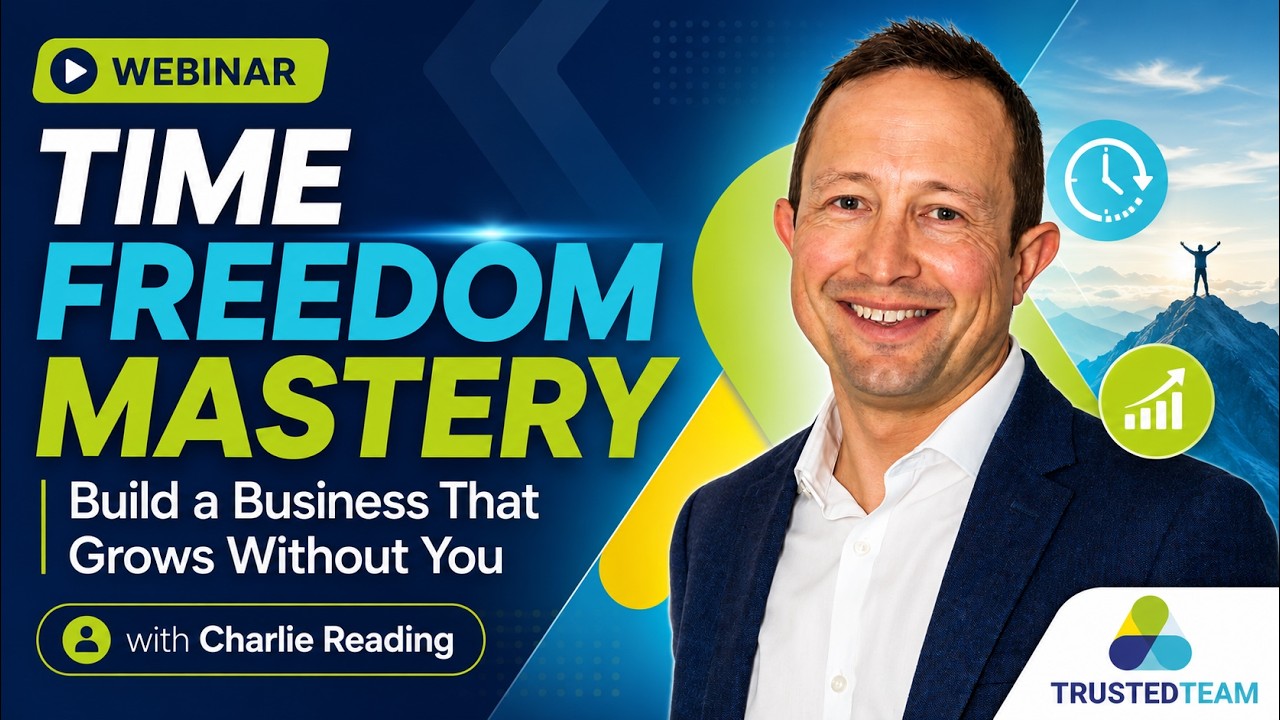
In this workshop-style session, Charlie Reading explains how to drive sustainable growth by applying the marginal gains (kaizen) philosophy to businesses. He introduces the concept of seeking many 1% improvements rather than a single breakthrough, drawing on Sir Dave Brailsford’s British Cycling success and Toyota’s Kaizen transformation of a GM plant. Charlie maps a business’s evolution onto human life stages—infancy, toddler, teenager, young adult, mature adult, mid‑life crisis, aging, institutionalization, and death—highlighting the challenges and opportunities at each phase. He stresses that building robust processes, a strong leadership team, and continuous innovation are key to moving from founder‑dependent to self‑driving organizations. Practical tools include the Learning Library (pay‑to‑read books with one‑page takeaways), “Google Time” style work‑on‑the‑business sessions, and the Real Results Roadmap that documents the client journey. The session culminates in the “Game of Gains” exercise, where teams identify 1% improvements across the business’s seven steps, illustrating how compound gains can yield exponential growth. Real‑world examples from Apple’s turnaround, sport (Clive Woodward’s shirt change), and office ergonomics reinforce the approach.
Chapters
So if we— we— one of the things I've said quite a lot within the Trusted Team is that it's really difficult to find that 100% idea boost, isn't that? One, one 100% idea that suddenly changes everything. But it's much easier to find 101% improvements, and that's ultimately what we're trying to do here, isn't it? We're trying to come out with like 1, 2, 5, 10, 1%— 1% improvements every 3 months. And then that, we know that that delivers constant compound growth within the business. And really, that's what we're, what we're going to try and do over the course of this first session, which is called the Game of Games, because we're looking for lots of 1% improvements. And really, this is inspired by Sir Dave Brailsford and his work with British Cycling, because obviously he was the, the guy that coined the term marginal gains. And it was something that— I don't know if you ever saw it, but I mean, obviously he became famous for this comment of this phrase marginal gains, and it was, it was really around looking for all of the little 1% improvements. And that was like, if we give them— if we keep their legs warm in between races, they'll, they'll, they'll gain 1%. And if we give them better pillows, they'll sleep better, and that will give them 1%. And if we give them slightly more aerodynamic helmets or sweat-resistant clothing, all of these little 1% compound up. And there's quite a funny moment actually after London 2012 where they basically completely cleaned up and and won— I can't remember how many of the cycling medals that were available, but most of them. He was being interviewed by the media, and somebody from France asked him, you know, what was the secret behind all the success that they'd had at London 2012. And so Dave Brailsford's answer was, we found a way of making the wheels rounder, which obviously was complete and utter bollocks. Although maybe, maybe one of the 1%ers was to make the wheel slightly rounder. But it wasn't. It was actually like finding 101% improvements as opposed to looking for that one big idea, which is what, like, clearly the media thought, it's one big idea that's generated this success. But actually it wasn't. And so that's what we're trying to do. And it's trying to create this constant innovation within the business. And innovation is a really, really important part of our business, isn't it? And yesterday I was talking about the, the business life cycle, and so I wanted to revisit this because I don't know that I'll have shared this with you, um, for some— with some of you before. Um, but ultimately the, the life of a business is very similar to the life of a human being. So the human is born, that goes into infancy, toddler Toddler stage that some of you can relate to at the moment. Teenager stage, I can definitely relate to that stage at the moment. Young adult, maturity, my children would tell you I can relate to this stage quite well as well. Then we go into the aging, institutionalization, death, and the business can go through this same cycle. I'll explain what I mean by this because when you create a business, it's like the birth of a child. It basically, you know, it needs a lot of attention. And even really when you get to toddler status, it really doesn't give you a huge amount back. It kind of causes you a load of grief and some pride of ownership, but that aside, it's not really giving you a whole lot back. And it's really a race for survival, isn't it, at this stage? And it kind of needs 100% of your attention. Money's tight. It's kind of— it's really like a hand-to-mouth business. Business. Um, and cash flow is usually the biggest constraining factor in the, in the, in the toddler status, um, business. Um, and, and then it kind of moves on to the grumpy teenager stage. Um, and in this stage, cash flow becomes less of a problem. You're starting to make some, some money, um, you're starting to kind of feel like you're a bit of a genius. Um, and potentially it's the sort of stage where most things he touched turned to gold. You're making good sales, good income, but probably not great profits. Yeah.
Charlie, just on that slide again where you've got the graph, is there any sort of like for us, right, where we're sort of probably quite early on? I mean, looking at that graph, it makes me feel that I'm earlier than I thought I was.
Yeah.
And then, you know, is that managing sort of expectations there, because although I'm in the business, like, maybe I'm meant to be in the business. I mean, I'm quite happy to be in there, but it's like having a realistic expectation of when you can progress to the next kind of tollgate.
Well, I think this is— this— so the reason I'm sharing this with you is I think to move up— when I felt exactly the same thing the first time I saw this, and it gave me an idea as to what I needed to do next to move up to the next level, and it gave me an idea as to where I was aiming for longer term. And I think when I first saw this, I probably was in teenage stage of the business. And so things were working and we were generating good revenue, but we weren't generating great profit at the point at which I first sort of heard about this. And so then what we're really trying to do is trying to sort of build out— so I was just looking back to my notes to answer your question specifically. So teenagers, in terms of— yes, so they take lots of risks. Some of those risks pay off. Actually, probably I wasn't— probably I was at young adult stage. I'm just reading this and thinking back to when I saw this. But essentially what we're now starting to do is we're starting to see a business that's making money, but it's very much reliant on the founder. And it's, it's all a little bit ad hoc. And this is where we start to then see the processes coming in. And like the business starts to create processes, which is obviously what we were talking about yesterday in terms of, you know, something you do, then you document it and then you delegate it. You're in that stage of trying to evolve up to the next stage so that you know that yes, it's something that you used to do and you used to kind of just do it as you did it. But now you know that other people can do it to the same standard as you. And then, and then you kind of, um, get to this, uh, young adult stage, and that's where, um, cash flow becomes much healthier. You've got a constant, like, healthy stream of sales. Um, and, and, and again, this is all about finding the processes and structure, but now starting to build the team, and particularly the sort of the leadership team starts to, starts to take shape. And this is where potentially you start to find that the profits kick in. And building up to the mature adult, the mature adult is then when we have the most saleable, most scalable business. And this is where we have a business that's run by the leadership team. So the young adult stage is still very much run by the founder but the leadership team were in place. In this business, in the mature adult stage, the business is now run by a leadership team, and whether the, whether the founder is there or not, it will continue to grow. And this is the point at which, where we're the business that is most saleable, most scalable, because you've now created this founder independence, the sort of things that we were talking about yesterday. Um, so that's where we're trying to get to. Um, We then— but businesses can— those processes that you build to create that, um, I should have put a guy in Lycra on this one, shouldn't I? Um, when you get to the midlife crisis stage, it's often because those processes now start to become out of date, or because, like, it takes a lot, um, a lot of time to turn a, a ship, doesn't it? A tanker. And so gradually the bigger the business becomes, the less dynamic, the less efficient it got, it becomes, and it ends up going into midlife crisis. And then an aging business is where things continue to break down, your best people leave, it kind of, uh, and then that moves into institutionalization, which is essentially where it's supported by, you know, a company putting in money, um, and, you know, it's essentially losing money and it's, it's going out of business towards the final stage. So if we think about what drives that and what those stages are in, um, uh, in, in the business, then really what we've got is this lifestyle business here that is, that is essentially, um, creating a lot of work for the founder, um, and is generating some revenue but not much profit. Then we're starting to get into this one where we're starting to build a team around us Uh, but it's, um, uh, it's still very much dependent on the founder. We've got this massive founder bottleneck here. We're now at this stage starting to get, um, the, the management, the management team in place, or the leadership team in place, and the self-driving business is truly driven by the leadership team. But the key to this, and the reason I'm sharing this with you, is really What one of the things that drives the business up towards this self-driving, uh, business, um, stage is the, the process— putting the processes in place. Having the right processes backstage is, is part of the key, and also innovation. Um, and certainly when it comes to a business that goes beyond this, beyond maturity and into midlife, uh, status, The way that we get it back to a mature business again is through innovation. And in fact, that's exactly what we saw with Apple. So when Steve Jobs returned to Apple, having been booted out of his own company originally, I would argue that Apple was probably in an institutionalization stage at that point. It was basically on life support. It was hemorrhaging cash. And Steve Jobs came in and like stripped away a lot of the products and then created the iPod, the iPhone, the iPad, the Apple Watch. And it was that drive for innovation that took them from really a company that was in institutionalization status back to a mature company status. And that's why innovation is so important, because it's driving both sides of this process. You've got You've got processes backstage is a key thing, and building out the leadership team is a key thing. But also innovation is going to drive you towards a maturity business. But innovation is also going to drive you when you go back, when you go beyond it, back towards and keep you at that mature business stage. So that's what we're trying to achieve. And if you think about it, this is what we talk about in when we use the terminology kaizen, because kaizen is this concept of how Toyota came in to the— when they partnered with Ford or General Motors, they, um, General Motors had a, a, their worst performing factory in the US and they were going to close it. And Toyota said, well, we're going to partner with you Why don't we take over that plant, that factory, and we'll work, we'll run that one as we run the Toyota factories in Asia? And through this concept of kaizen, they turned it from the worst-performing General Motors factory to the best-performing General Motors factory. And the reason they do— what this kaizen means is it translates directly to Constant improvement. And so basically what it was, was them going to everyone in the business, everyone in the factory, and saying, how can we improve what you— your little part of that business, how can we improve that by 1%? And it's this constant flow of ideas from everyone in the business. And it's why I said right at the start, The exercise I'm going to take you through today, you should do as the business owner, but you should definitely do it with your team if you've got a team, because the ideas that they'll come up with will be very different to the ideas that you come up with. And so essentially, this is what this, this kaizen concept is about. And they, like I said, Toyota took the worst-performing General Motors factory to becoming one of, I think it was, it actually became the best-performing factory for General Motors because of this kaizen approach of asking everyone on the factory floor what they could do to improve it. So how can we do this in our businesses? Well, one of the ways that we can do this in our business is the learning library. Have I— how many of you have heard me talk about the learning library before? Most, but, but not everyone. Okay, so the learning library— obviously I reference a lot of books on— in what I'm talking about, and I was reading Delivering Happiness, which is up here, when I was on a holiday in—
where was I?
I was in Crete at the time. And something I read in "Delivering Happiness" made me think, this is— you know, reading all these books really helps me on my journey. Wouldn't it be amazing if I could persuade my team to read books like this? I'm paying them to do exams, financial services, but, like, what could I do to get them to read books that made them more valuable employees. And so I came back and introduced the learning library. And so basically what I said is, I'm gonna pay you to read the books that are in the learning library. I'm gonna pay you more, like if you were taking exam, I'll pay you more. And we created this ladder of— and Charlotte at the time said, hang on, let's just stop a sec. Did you just say you're gonna pay me more to read books? Because she reads like about 2 books a week. She's like, "Are you sure?" So like 5 weeks later, she's read 5 books. And I'm like, "Whoa, Charlotte, ease off here." So we capped it at 5 books a year. But what started happening— and we also put in a criteria that once you've read a book, you had to send me no more than 1-page explanation on what you'd learned from that book and what we could do in our business to improve our business based on what you'd taken from this book. So what would start happening is I'd start getting like an email from a paraplanner to say— and paraplanners work backstage, so they're not like working with the clients— but I'd have like one of the paraplanners had read the referral engine, and then they'd send me a, like, a couple of paragraphs on even within the paraplanning part of the business, if we did this, this, and this, I think we would get more referrals in the business. Like, This is brilliant, absolutely brilliant, game changer. So introducing the learning library was a fantastic way of getting everyone to, to grow it like themselves, which means that they're happier. It's one of their human needs, which means they're much less likely to leave your business because you're satisfying one of their human needs. So they feel like they're developing, but you're getting more valuable team members and you're— they're coming up with a constant flow of ideas. So the learning library is a brilliant concept. We've actually got an attraction marketing device, which is like a white paper on the learning library. So I'll get Charlotte to send that in the follow-up. The next thing, the next concept kind of plays nicely alongside the learning library, and that is working on the business. And Google became famous for Google Time. So Google will say— and if you work for Google, I think it's one day a month or one hour a week or something like that, kind of exact proportion— is Google time. So basically, in Google time, if you're a Google employee, you don't do your normal job. You can work on anything else that takes your fancy, and the only condition is that Google own what you create. And so Gmail came out of somebody working on it as Google time. Google Maps came out of somebody working on it in Google time. These were people that weren't tasked with those projects. They just decided that that was a thing that they should try and build. And so we introduced working on the business as once a month, we wanted them to down tools for 90 minutes and they could work on anything that they liked. Like, that could be, how can I improve my department? But it could be, I've just, you know, read a book on this, and therefore I'm going to, you know, think about how we could improve that element for the business. Sometimes I'd give them a theme as well. So for example, when we were moving offices, it's like, right, this, this month's theme, I want it to be on what would make a really cool new office for Efficient Portfolio. And that's where standing desks came out of, because People told me that they wanted standing desks. They never used the bloody things. But anyway, that's a different story. But like we would say, we would create themes. And this is also what we linked into the learning library. So when they'd read a book that they wanted for it to qualify for their Learning Library 5, they had— they're working on the business had to be that one-pager on, on the book that they'd read. But it means that everyone now feels like they're shaping the direction of the company. And they feel like they're growing. So it's, it's a really powerful combination. Um, and also I would suggest that getting them to work on the business with you on a regular basis is really important. So if you don't already have once a month— and this is a, a, a, an extra pulse that I'm going to add into what we talked about a minute ago— on once a month, have a working on the business meeting with, with your team. If you're not sure how to do it, just follow the Kaizen Constant Meetings. They're all in the portal. There's, I think there's 11 of them, so you do 11 over the course of the year. So basically one a month except for August, um, and one will be on marketing, one will be on referrals, one will be on Backstage, one will be on Frontstage, one is the Game of Games that we're about to do. So You just have— because the ideas that they generate for improving the business will be different to what you see because they're hands-on in a different area of the business. But it also then gives them much more accountability and ownership to, to drive the business forward. So I definitely say doing a Kaizen meeting once a month is a really powerful concept. And really what you're looking for is, is lots and lots of 1% gains.. And an example of how simple they can be is the example that Sir Clive Woodward talks about in his book. So this is Leon Lloyd, a friend of mine, used to play for England and Leicester Tigers. The only reason it's a photo of him is because he's got a baggy England shirt. And then this is Jason Robertson, nicknamed Billy Whizz, came from, you know, grew up in rugby league, switched codes to rugby union. Was one of the stars of the team that won the World Cup. But this guy was super quick, super nippy, like dodging around. And when he first started playing for England at rugby union, they kept tackling him, but the only way they could tackle him because he was so quick and so nimble was by grabbing hold of his shirt. And so Clive Woodward's like, this is really doing my head in that these baggy shirts are actually helping them tackle one of our most dangerous players. And it's why they all switched to tight shirts, because it was to make them less easy to tackle and to make Billy Wizz a more, even more impactful player than he was. So you think, like, what's, what's really the gain of having going from a baggy shirt to a tight shirt? But if it's one less tackle on Jason Robinson, which leads to one more try from Jason Robinson, actually it can make a huge difference. So that's what we're looking for. And like I said, it can be all areas of business. So this slide is there just to remind me that it was, you know, that Shane Benzie, who's the amazing running coach, talks a lot about the importance of a stand-up desk. So part, you know, when I had somebody mention a stand-up desk in the working on the business, and then I'd been reading about stand-up desks and the importance of, you know, like sitting is the new smoking, It's like, okay, this is a cool thing to do for our office, not just for me, but for the team. So it's all areas of innovation that make a big difference. And then it's one of the reasons why having a Real Results Roadmap is a really powerful concept. By the way, has anyone not— anyone here not done the Real Results Roadmap? There would be a few of you, I expect. So yes, I would assume that. Okay. And you guys won't have done it either. No? Okay, fine. So the real results roadmap, I've alluded to it occasionally, and obviously I mentioned it yesterday. It's this clear documented path. I will do it again in the near future. I can't— I don't think it's in Professional Marketing Magnets, so I'll make sure it's in a workshop soon. But it's creating this clear journey. And it's important for so many different reasons. It's obviously really important in terms of how you articulate, how you solve the concerns of your ideal client, and how you help them maximize their opportunities. And when you've got this clearly documented, what happens is when you're having the conversation with your ideal client, they're like, "Wow, this is exactly what I'm looking for. I can see you know exactly the concerns I've got, and you can see how I can maximize the opportunities I've got." So it's a really powerful concept in terms of a marketing concept. And obviously, so there's— we had— this is a slightly extended version of the Efficient Portfolio one. Sometimes I'll show you the shorter version, which was often the one that we'd use to talk through for clients. But really, this was the extended version of the journey we took each client on. And the— what part of the reason why this is so important is because clearly documenting this journey then allows you you to go through what I'm about to get you to do, which is processes like the Game of Games. Because what we do is we've now broken that journey up into— what's that— 7 different steps. And so when we think about improving the business as a whole, it's quite daunting. But if we then— and if we particularly— if we sit down as a team and say, right, today we're going to improve what we do at Efficient Portfolio 'Go.' And I was like, 'Well, I don't know, I don't know.' I like— but if I would say to them, like, the advisors were doing the exploration meeting, 'Right, advisors, what could we do to make the exploration meeting better than it currently is?' Then they're like, 'All right, okay, now we're being specific about something. Well, we could do this, we could do this. I'm getting this kickback at this point, so what could we do to eliminate that?' Or How could we do it? It makes it, it makes it much easier to find those gains. It's like thinking about— I'm sure when Sir Dave Brailsford was thinking about the marginal gains, he didn't just sort of go at this scattergun approach of everything. It was like, right, let's think about the journey that the athlete goes on. They're sleeping in the hotel the night before. What can we do to improve that, right? Are they sleeping on the right mattresses? Are they using the right pillows? Are they eating the right food? Are they, you know, getting the right number of hours sleep? Then on the way to the— on the way to the velodrome, what are they doing there? How can we improve that? Right, when they're racing, what can we do to improve that? When they're in between the races, what can we do to improve? It's kind of like this timeline journey, and it makes it much easier to find those gains. And this is why, um, we break it all down. It's one of the reasons why we break it down, because it allows you to think through these these steps much more, you know, you're chunking down the problem. And when you think— when I first was introduced to this concept, I thought, basically, I assumed if you said, right, if we improve each of these steps by 10%, then we would create an overall growth in the business of 10%. That's what seemed logical to me, but that's not true. If you've got a 10-step process and you improve every step by 10%, that'll actually deliver 100% growth, not 10% growth, because of the compound effect of you put more— 10% more people in the start, i.e., on the marketing bit, and every bit is either 10% more profitable more efficient, or 10% more profitable, quicker, or— there's one more, I'll come back to it, it's in the tool— then you drive actually 100% growth. And it's why when I did this with my team year on year, I attributed this one meeting to the fact that we were growing by 50% year on year. Because all of the ideas that came out of this, this single meeting and this simple, this single exercise drove all of the growth for the next 12 months. So by breaking it down and going, right, how do we improve each step by just 10%? You can actually drive far, far greater growth. And so that's what the Game of Gains is all about. That's all we're trying to do. So