Productivity Focuser Free Webinar
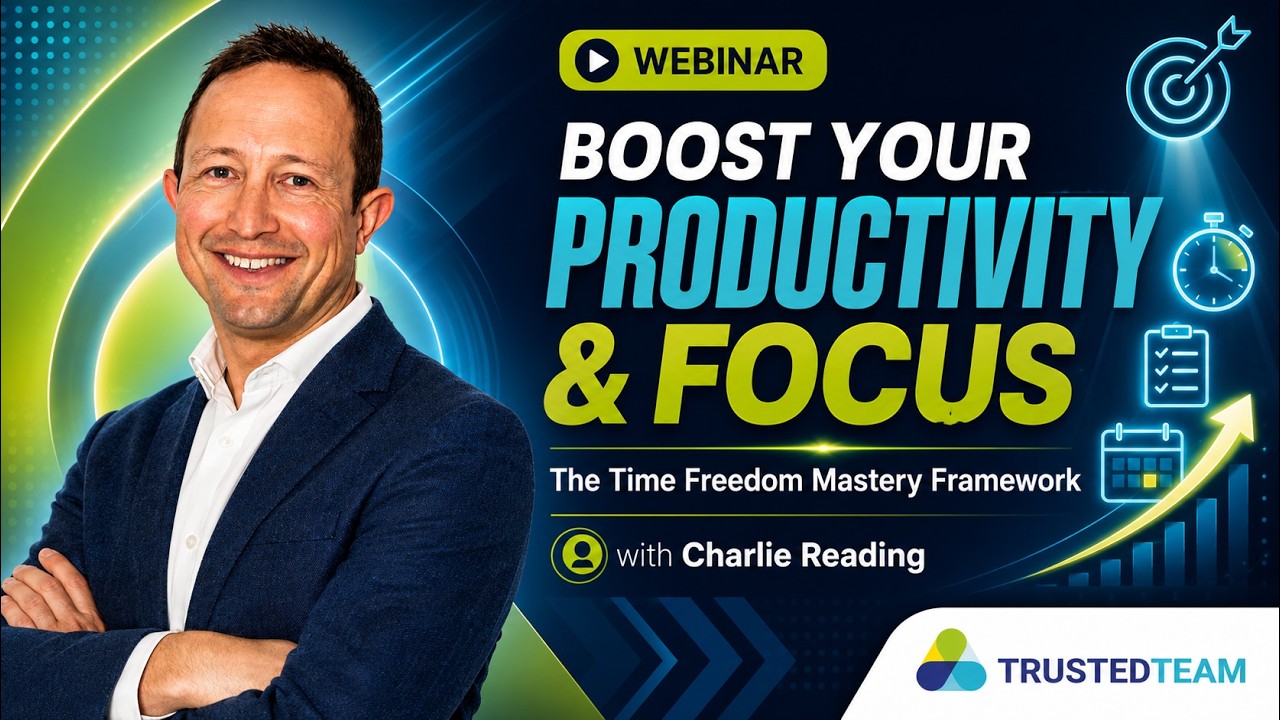
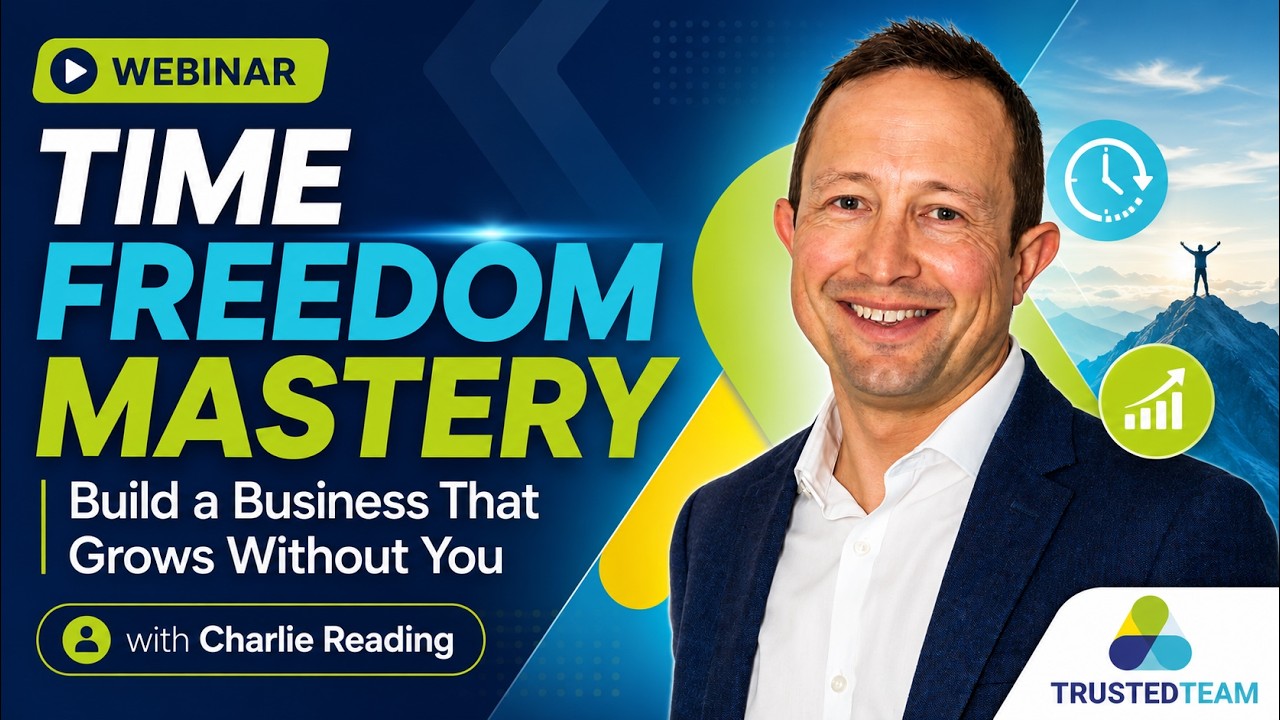
Charlie Reading shares a system for founders to escape burnout and reclaim time. He walks through the Time Freedom Mastery framework: delegation, AI tools like Otter and Fixer.ai to repurpose your speaking and writing, and ruthless focus on 1-3 high-impact activities. The worksheet helps you spot your biggest distractions and cut them.
Chapters
Welcome, welcome, welcome for those of you that are dialing in now. Thank you. You can see the names jumping up now, which is brilliant. Looking forward to sharing the next 90 minutes with you. It is a workshop, so you will be doing some work within this. It's not just me speaking, you'll be pleased to hear, but I'm here to inspire some ideas. And inspire your thinking. So thank you for dialling in promptly. We'll kick off at 9:05, just so that we give people a chance to get logged in. So you've still got a couple of minutes left if you need to recharge your water glass, grab a coffee, grab something to take notes with. I've already said it once, so apologies for repeating it, but I can see there's more people dialling in now, so I'm going to have to. There is a Q&A box through for this webinar, so if you've got any questions about what I talk about or really anything else that relates to today's topic, stick them in the Q&A. I probably will deal with them at the end because I don't look at the Q&A while I'm presenting, but equally Charlotte is here on hand to be able to interrupt me if she thinks it's something that I'd be better off covering immediately rather than at the end. But please do stick any questions you've got relating to this topic into the Q&A, and I promise to address them at the end. Lovely to see some familiar names dialing in that are already members of the Trustee Team, and some new people that I don't know the names of, and some people whose names I recognize, and I think I've met you once or twice, so thank you for all dialing in promptly. And I will be aiming to give you some ideas and inspiration on how you can improve your productivity and give you more focus on the work that you do, whatever it is that you do. So I can see a few more people dialing in now. Thank you for that. We'll kick off at 5 past 9, just so that everyone has had a chance to get dialed in, grab themselves a coffee, grab themselves a notetaker, go get some— and I can see actually we've got a couple of notetakers here as well, so well done for bringing your AI notetaker to the meeting. I'm surprised there's not more of them actually. By the end of this session, I'll be telling you that there should be. But we'll cover that in due course. So again, welcome, thank you for dialling in. We'll kick off in 3 minutes. And the sun is shining in Cornwall. It was— so we've had actually a cracking couple of days. It was Carol's 50th yesterday, and so on Monday we did a, I don't know, 14, 15 mile walk along the Cornish coastline. Beautiful sunshine, stunning section of the coast or path, so from sort of Portreath through to Godrevy, if any of you know that on the north coast. So that was beautiful. And then yesterday we had a rather lovely brunch and then an afternoon in the Carbis Bay Hotel Spa and then a really lovely dinner down on Porthminster Beach in St Ives. So very happy that the sun is shining. In Cornwall at the moment. If everything went really according to plan today and I got everything done and get packed for what will be about a week or so on the road, then I may even get out on the paddleboard tonight, which would be lovely, or maybe even a surf. I've not looked at what the conditions are like. So anyway, that's the joys of living in Cornwall, and it's also the joys of being very focused when it comes to your productivity. Because if you get this part of your life and business nailed, then you can do so much more in so much less time, and you can focus on those things. Oh, by the way, yes, thank you, Bhavik, for the birthday wish for Carol. Yeah, that's very kind. I see the fact that as you have dialed in, I see that there is no new arrival quite yet. So good luck with with that, but thank you for the message, that's kind. So yeah, we will just kick off in just one more minute. So yeah, so that's the benefit of kind of getting this productivity piece mastered is that you can actually achieve so much more in so much less time, which buys you the freedom to do other cool things. Yes, Bhavik, very good idea. Don't rush these things. Stay— tell us to stay away from pineapple and what was it, raspberry leaf tea, that was it, and a curry. That's— those are the 3 things that I think speed up that process. So there's no need to be rushing. I agree. Okay, so it's 5 past the hour. Thank you very much for dialling in on time. And for those of you that are members of the Trusted Team, this is kind of an overlap to content that we did during the workshops. So, there's gonna be some familiar stuff within this. And for those of you that aren't members, you'll kind of get a taster of what sort of we go into in the workshops I do within the Trusted Team, because today is really about thinking about, well, how can we make more of the time that we dedicate to our work so that if we get more done in that time, then we can focus much more on having a better work-life balance, achieving more but in less time. You know, that's what ultimately what we talk about at The Trustee Team is how to grow your business while working less and enjoying more, and some of the secrets behind that are within this session. But because there's a few of you that aren't members of The Trustee Team here, in fact quite a few of you, I'm going to focus a little bit on giving you a bit of background first, and then we'll dive into this. Dive into the topic because, you know, maybe at the moment you're struggling in business by not sort of finding enough clients, not, you know, maybe the business is making good money, but you know, it could be better. You know, it's not delivering the potential that it has, and it's not kind of, if it's not delivering the potential that it has, you can't afford to employ the people that you want to employ. You can't afford to live the life that you want to live. You can't afford to employ the strategies that you want to employ. Perhaps also what's going on in business is that maybe your work-life balance is out of sync at the moment. Maybe, like so many other business owners, you're on the brink of burnout and you're working far too many hours, you're burning the candle at both ends trying to get the business to the place that it wants to be. And really, this is— long-term, this is unsustainable. You can have sort of periods of sprinting, but really, if this is what it's like long-term, then you are going to end up burning out. And you'll also be doing things at a far lower level than you are capable of when you're in this sort of zone. You know, you're kind of just making ends meet every day, getting everything done, but you're not being your best. And what often happens then is when that's, when that's what business life looks like, you start falling out of love with the business. Now, I'm sure you got into this business to create something amazing and because you had a passion for it, for whatever it is that you do. But perhaps if you're getting dragged down by, you know, working too many hours or getting, like, not getting the work, or not focusing on the work that is most important, then perhaps what's happening is you're falling out of love with your business. And also perhaps you're becoming the bottleneck in that business, and you know that you need to get yourself out of the way. So before we dive in, I just want you to imagine a different time. So like, forget about all of those problems at the moment. Imagine a time where you've got this brilliant business. This business is growing exponentially. It's doing unbelievably well, and you're getting 50% growth year on year, but you're only working as much as you want to. So for example, more like me, you might be taking 3 months of every year off. So you've got this great business that's growing 50% year on year, but you're taking 3 months of every year off to do what's important, whether that's looking after your health, whether that's spending time with your family, whether it's following your passions and hobbies, all of those things that are actually way more important than what you do in your business, probably. But, so imagine this time where you've got this growth, business is growing by 50% year on year, you've got, let's say, 3 months of every year off, but when you're at work, It's more fun than fun. You've merged business with fun. And in fact, you know, you find yourself justifying. I find myself explaining to my daughters that, you know, work and fun aren't mutually exclusive. What you do for your business and what makes money in your business can actually be the things that you genuinely love to do and you'd actually pay to do them. So when you get paid to do things that you would pay to do, then that's a beautiful thing. So, if this is where we want to get to, we wanna get to this time where the business is growing by 50% year on year, we're taking 3 months of every year off, but when we love, when we're at work, it's more fun than fun, then we've kind of got to put some intention and purpose into how we construct that, because that doesn't happen by accident, which is why 99% of entrepreneurs and business owners and founders never get to that point. But it is absolutely possible. We can live life by our design, but only if we design it. I've built and sold 3 businesses. I'm in the process of, touch wood, of selling a 4th. And what I've seen is that really there's this kind of pattern that goes on with these businesses in these 3 stages. And really what I see is that at the first stage of business, and this has happened in every one of my businesses, and I think it's happened in almost every business that I've coached is the starting point is that all of the growth is restricted by the founder because it's the founder that goes out and does the networking, finds the clients, speaks to the clients, does all of that kind of stuff. And probably only 20% of people that found a business break through into an exponential growth business where that business starts to grow beyond their capability. The problem is that most business owners, what happens to most businesses is they get the marketing piece done, they start getting a flow of their ideal clients, or at least clients, hopefully they've built a flow of their ideal clients, but then they become really time-poor. And this is where the business owner becomes the biggest bottleneck in the business. And because everything goes through them, yes, the clients might now be coming through from referrals or through partnerships and things like that, But everything goes through the founder, and that's why the founder becomes the bottleneck. And I would say if only 20% of businesses get through that first stage, only maybe 5% of businesses get through the second stage, which is where we get the founder out of the way and we have this balanced business-life founder. And that's brilliant. But what tends to happen is that still most businesses then still have to be run by that founder, and the founder manages the business. So the business would probably survive for a few weeks without the founder, but it certainly wouldn't grow without the founder. And so really, if we want to have the most valuable, most saleable, the most scalable business that we can create, we've got to get to the point where we have a self-driving business, and that's where the business is being, is actually growing whether the founder is there or not. And that's kind of where we're trying to get to. And so really what we've got to do is we've got to free up the founder to focus on what's really important. And the way that we do that is we get rid of a lot of the other aspects that drain them, but also we need to free them up to make sure that when they're at work, they achieve absolutely as much as they can achieve in the shortest time because they're not distracted, they're not disturbed. And that's what we're going to be talking about over the course of this morning. Because what we find is that we end up with these people become like the busy fool. They're frantically going all over the place, you know, and they're serving lots of different people, they're doing lots of different tasks, they're getting interrupted, so things are taking them far longer than they were supposed to. And so really what we want to become is this focused achiever where when we get, when we're at work, we get way more done than ever before. It's the most important things done. And that's what we're aiming to do today. And today's really like an opportunity for me to try and inspire your thinking. So for those of you that we touched, we sort of went into some of this subject on a few weeks ago at our last workshop. This is an opportunity to come think about some of the stuff that we talked about in a slightly different way to make— what we were looking at before was how do we delegate more, whereas this is more how can we then make sure that when we're working, we're focused on the most important thing and getting the most important thing done. And so that's kind of where we're going in this session because there's this concept called flow, which is, which was termed by a guy called Mihaly Csikszentmihalyi in a book of the same name. And flow activities are things, are activities that are those things that actually give you energy rather than drain your energy. And you're so focused that time just flies by and you're just kind of in the zone would be how you describe it with sport. And that's what we're trying to to do in business is we're trying to get rid of all those tasks that are actually draining and, you know, like kind of sap our energy and kind of like demotivate us and focus on those few, probably 1 to 3 activities that are the things that you love, the things that you're really good at, the things that put you into flow state. And actually, typically they are the 3 things that make the business the most amount of money because they're where you create the most impact. And then by doing that, we can embrace this concept of the 10,000 hours. So if we can get you up to, we did a separate session on this in the learning lunch called the 10,000 hours. For those of you that don't know anything about the 10,000 hours rule, basically it takes 10,000 hours to excel at anything, whether that's playing the violin, whether that's sport, And so really, the more we can get stuff out the way and then focus intently on the 1 to 3 things that are really important in our business, the quicker that we can become world-class at whatever we do in our business. So we're trying to get to that 10,000 hours as quickly as possible. I'm not gonna go into a huge amount of detail on that, but I will touch on it. And of course, in a world of AI, we have the, you know, there's never been a better opportunity to do this. We have the ability to get AI to help us on this journey. Journey, and whether that's to make our business stand out more, as I did with this ad, and or whether— so this ad was created by AI. So whether it's you becoming more prominent in your business as a result of it, or whether it's like just using AI as an example, I think there's so much opportunity to now to free us up to focus on what's, what, what, where we add the most value, to, to kind of humanize the exceptional within the business and automate the repetitive. And so there's never been a better time to do this. But also, if there's never been a better time for you to do this, there's never been a better time for your competitors to do this as well. So therefore, you've either got to embrace this and focus on creating the best business that you can and creating the most impact when you're at work as you can, or your competitors will do it and they'll out-sprint you. So for those of you that aren't members of the Trusted Team, you may be asking, who is Charlie Reading? I think looking down the list here, most of you know who I am because you've either been to another one of our events or you're already a member of the Trusted Team. So I'm going to skip through this really quickly, but basically, as you probably know, I run a business called Efficient Portfolio, and I was which was a financial planning business. But for many years I was a, you know, a one-man band, and I was the bottleneck in the business. And even when I was up to kind of probably a support team of 10 people, I was still probably the biggest bottleneck in that business. And so I made all of the same mistakes that I'm talking about here. But what I did do was I realized that success leaves clues. And so I'd read over 300 business books. I went and found the best business coaches and life coaches around the world. And that was to allow me to focus so much more intently on what was really important. And in 2015, I had my first book, The Dream Retirement, published, and that led on to a bit of a roller coaster of success for us as a business. So we became an award-winning practice. I've started getting featured on national radio, on TV, cover of industry magazines, on stages all around the world. But in, in 2022, I decided I was going to sell my financial planning business. I'd been regulated by the FCA for over 20 years, and that was enough for one lifetime. Um, and so, uh, I, I sold that business. I've sold some other businesses along the way. Um, but now my main focus is a business called The Trusted Team, which is where we help, um, founders of particularly professional service firms build a saleable and scalable business. Whilst working less and enjoying more. And that's what today's session is really all about. It's about really boosting your productivity and your focus, because if you can do that, yes, there's some other things that we need to do to free up your time, and obviously we're not going to cover all of those today, some of which we kind of dove into around the sort of delegation principles in that, in that last workshop. But what we can do is try and think of ways that when we're at work, we really get way more done, way more achieved. And so one of the businesses that I founded and sold back in— so when did I find— found this? I think I founded this in 2010 and sold it around 2017. So bottom left-hand corner was a redundant hay barn that was next to the farmhouse we were living in at the time in rural Rutland. We needed a new home for Efficient Portfolio. We were probably a team of 4 or 5 at about this point, so this barn was way bigger than we needed. So what I managed to do was secure EU funding to build, to convert this into essentially a rural version of WeWork. It's called the Rural Business Community. So Efficient Portfolio were housed in the bottom right-hand corner office, as you will see on the beautifully lovely refurbished barn, but there was offices dotted around around the place. In fact, I can see at least one name on the attendance today that was one I met by him being a tenant within this building. But the point, the reason I'm telling you about this is I was absolutely working every hour God sent. I was basically working 9 till 5, or probably 8 till 5 on Efficient Portfolio. Go home, have tea with the girls. My daughters were, well, like 1 and 3 at this point. Have tea with them, put them to bed, then I'd go back to bed— sorry, I'd go back to work, but this time on the Rural Business Community. And I was working till about midnight, 1 o'clock, whatever it was. And so I was working every hour God sends, and I realized I was pretty close to burnout. And it was around this time that I went to an event that made me realize that actually, I needed to change the way I was working. I needed, like, I had to go, I had to sort this out. I wasn't seeing my children grow up. I wasn't spending, we weren't taking any holidays or anything. And I went very quickly from that to taking 3 months of every year off. And I've taken over 3 months of every year off for now over a decade. And it really didn't take me that long to get from literally taking no time off to taking 3 months of every year off and not working weekends and not working evenings. And so it's absolutely possible. It's just about thinking about it and designing it around it. And it's because that most things that we do are inessential. Most of the stuff that we do are inessential. And so we've got to think about how do we— and what I say by that is, what I mean by that is, It's not that everything that we do is not essential, but it's not essential that we do those tasks because what we're trying to do is make sure that when we're at work, when we're focusing on our work, we're focusing on the most important things and we are absolutely smashing through them. So in the Trusted Team workshop, I got you to do an exercise. So I'm not gonna get you to do this again now. I'll explain it for those that haven't done this. This before, but what I did was I got people to do an exercise where they wrote down— we timed it— and they wrote down the numbers 1 to 26, and then they wrote down the letters A to Z, and we timed it. And the typical— the average time was about 30 seconds, I would guess, from memory. We then gone to exactly the same task, but instead of going 1 to 26, and then A to Z, they had to go 1, A, 2, B, 3, C, and the average time went up from about 30 seconds to about 45 seconds. Now, they've performed exactly the same task, got exactly the same outcome, but one they could deliver in 30 seconds and one they could deliver in 45 seconds. And this is because of this concept called switch tasking. There is actually no such thing as multitasking. I mean, I joke that you know, I'm a bloke, therefore I can't multitask. But actually, no one can multitask. We can just switch tasks very quickly. The problem is what we, what we don't realize is, and it's really apparent to other people, but what we don't realize is that we're working far less effectively, kind of 50% less effectively, because we're switchtasking. So you've probably experienced this recently, but obviously now we're all kind of glued to our phones. Have you noticed that when you're trying to type a message, or even just trying to read a message, or trying to look at the map, you end up walking slower? So you might be walking along with a group, so you're all keeping the same pace. Suddenly you're looking at your phone, and the next thing is they're sort of 5 meters ahead of you. You haven't really, haven't consciously slowed down, but that's exactly what's going on in your business life. You're getting less done if you're not working with the focus that you need to have. Now, I'm gonna build this talk around a session that I sort of did in the workshop. We're gonna focus on it in a slightly different way. So I'm gonna use the same framework, the Time Freedom Mastery framework, to think about this process and think about, well, okay, how can we really make sure that we are way more productive so that when we're at work, we're smashing out the work that we want to do. And the first part of that Time Freedom Mastery piece is the team that we build around us. And it's so important in business that we build a great team around us because, you know, like Richard Branson, Richard Branson, you've probably heard this story before, but Sir Richard Branson tells the story of at the stage where he was already running several multi-million pound businesses, he's in a boardroom and he calls his CFO, says, Richard, would you mind just stepping outside the boardroom for a second? And he says to Richard Dunn, Richard, would I be right in saying that you don't know the difference between net and gross profit? And Sir Richard says, "Yes, you would be absolutely right." And so the CFO says, "Well, look, put it this way, you know, all the profits in the business are like all the fish in the ocean, but the net profit is— they're the only ones that we get to keep. They're the fish that are in the net. So the net profit is what we get to keep, but all the gross profit is all of the fish in the ocean." He's like, "Ah, I get it, thank you." And they go back into the The point is that Richard could build these businesses without even knowing the difference between net and gross profit because he built teams around him. He knew where his expertise was, and he's famous for getting rid of everything else. And there's, of course, there's lots of strengths within a team. So there's lots of roles within a team, and the rugby team is probably the best example of that. You know, the difference between like a prop forward and a scrum half and a winger. It's like there's 3 completely different creatures. You know, you've got the prop who's the big guy at the front, all muscles and really strong. You've got the little short scrum half who's nippy and kind of a bit chippy and likely to start the fights. And you've got the wingers that are just really quick and can put on the burners. Completely different roles. And that's what we've got to think about as a team when we're building business. And it's a term that I've used before, but it's worth just reiterating here. And that is, when we're kind of building a team around us, we've got to remember this principle that one person's rubbish is another person's treasure. So what do I mean by that? Well, when I ran Efficient Portfolio, the financial planning business, I had a lady that worked for me called Debs. Now, Debs, so I, if you gave me a massive spreadsheet that had lots of data in it and asked me to sort of analyze that data and check for errors and find mistakes and all that sort of stuff, honestly, honestly, it'd be like me pulling my toenails out. It would just, it's just the sort of work that would Just, it's soul-destroying to me. By the way, if you can hear the dog kicking off in the background, please apologize for that. So that's the sort of work that saps my energy. It would just like, I'd be putting it off for days. It would just be horrible. Whereas Debs would come in early to do that sort of work. She was like, it was, she was like absolutely in her happy place. When she was sitting and diving into spreadsheets. So when we align our business with those flow activities, we can kind of get into flow and we can just absolutely just deliver so much more. But to do that, we've got to free ourselves up by getting those, getting rid of those things that drain us. And really, that's what we're— one of the reasons why building a team is so important, because the team is there to protect your productivity and your focus. The team is there to be able to kind of give you the freedom to do whatever it is that you do best. I'll give you an example here. So a friend of mine who runs a really successful financial planning business, by his own admission, hates small talk. He just hates the whole— like, he's, you know, probably on the spectrum like me. And that is just not something he enjoys. So he had somebody in the team that he basically said, look, if I do the small talk at the start of a client meeting, I'm amazing at the client meetings, but the small talk bit at the start, just kind of, I find it soul destroying. And I'm never as good in the client meeting if I've had to do all of that small talk. So he built a team around him. So the part of that was the client relationship manager going and having the small talk conversation in reception before the meeting. And so that when he got there, he could just focus straight on the actual client meeting, which is where he excelled at. And he was better at doing that because he'd got rid of the small talk at the start of it. And he'd given that, and yet to the client relationship manager, the idea of going and having a a conversation with the client in reception before they had their meeting was like their happy place. It was, you know, so that's what we want to be thinking about. And, you know, when you're thinking about delegating, one of the best books that you can think about or read on this is a book called The E-Myth by Michael Gerber, or The E-Myth Revisited. And what he talks about is really within this, you know, when you're— if you want to think about getting rid of a task or a part of a task like David, my financial planner friend, had done, then what he will say is, do the task first, understand it, then document it, and then delegate it. And that's a great way of thinking about any of this stuff, is do it first, document it, and then delegate it. In, in the Trusted Team, we call these outstanding operations once you've delegated— sorry, once you've documented them, and then that's much, much easier to get to delegate them. One of the things I would really encourage you, and I mentioned this before we started, because a few of you have got your note-takers dialled in, which is brilliant. I can see that there's definitely a few note-takers in attendance today. But this is brilliant because you're freeing up your focus to focus on what's really important, which is hopefully what I'm talking about, as opposed to worrying about making all of the key notes. And so why I love embracing note-taking, AI note-takers, and for that, you know, you might use— I use Otter typically. I've got one of these Plaud devices you can see on this that sits on the back of your phone. I actually tend not to use it so much now because I tend to just use Otter on everything, actually as a result of a conversation I had with Bhavik at the Trusted Teams. So thank you, Bhavik. But The note-takers, I'm finding, are just freeing me up to be much more focused on what's important, i.e., the conversation, and less focused on, have I made all the notes that I needed to? Have I kind of jotted down all of the important points and the actions? And in fact, you find yourself sort of dealing with the note-taker. What I find myself doing is at the end of any meeting, I'll just recap on all the things that we said. Just to doubly make sure that me and the person I'm meeting have got it clear in our minds, but also so that the note-taker has, because then the notes are even better and more robust. So this is a great way of allowing you to focus on what's really important. And of course, AI is this huge opportunity to recycle what you've done elsewhere and turn it into something else. So, for example, you may say, "I hate writing. I really, the idea of writing a blog just is soul destroying." So, the beauty of AI, but you may say, "Well, I love speaking. I love delivering webinars or speaking on a stage or whatever." So, the beauty of AI is you can do something in the format that you love. That might, like I said, that might be speaking on a stage,, and then the AI can turn that content into the other bits that you don't love. So you've got this great opportunity to do something in one format and have AI deliver it. And if you can do it in that way, you'll create so much better content. I've had a few times where I, well, loads of times, like where I'm delivering something on stage and I'm talking about something I had not planned to talk about. I've never said it before, but it's what's coming out of me at the time. I'm like, that's, you know, that might have been some of the best content I delivered today, but I had never planned to do it. Because when you're in flow state, that's where you deliver your best outcome. And that's what we're trying to do, is we're trying to give ourselves permission and find ways that we can be in flow state more, doing those few things that we love. And then we can use AI to convert that into other formats. You might wanna think about, when it comes to this, think about your minimum viable input. So in Silicon Valley, the term for releasing new products is minimum viable product, MVP. And so, you know, if that's an app, they talk about, well, okay, how can you release the most basic version of that app, test it, see what people think, and then rebuild it. But I think we need to now think about this approach in our work. Think, as the founder, what's the minimum viable input I can do on this task and then have AI or somebody else do the rest. So that's a great principle. A couple more principles just to think about around this task before we kind of dive, kind of finish off the team element is when it comes to recruiting a team or kind of freeing yourself up to, to focus on what's really important by building a team. One piece of advice I was given which stood me in amazing stead and I kept coming back to it year after year was, if you think you can fill 50% of a person's time, an additional person's time. That is the time to recruit the person. So the time to recruit the next team member is at the point at which you can fill 50% of their time. Why does that work? Well, firstly, it free— it gives them, gives you the capacity to train them. They're not going to be as efficient as somebody that's been doing that task for years when they first start, but also What it then does is it gives you the opportunity to delegate more to that person later on once they've got embedded into the business. So that's just a piece of advice I would share with you on this to free you up to focus on what's important. And of course, in this day and age, you don't have to employ somebody. You can outsource that solution, and that might be like a Fiverr or an Upwork or onlinejobs.ph. Or it might be an industry specialist firm, like for example, so one of my businesses now is a business called Accelerate Advisor Solutions. So they do paraplanning, administration, and consultancy outsourcing specifically for financial advisors. Obviously, there's firms that are similar to this for accountancy practices, etc., etc. So if you might need some specific industry outsourcing, so there's those sorts of firms like Accelerate that you can do that with. But that's the starting point. You've got to free yourself up to be able to focus on what's important. And then we want to dive into the intensity of, of what you do, because the more intensely you can focus on an area and the most important areas in your business, the more you will, the the better you will be and the quicker you will become world-class at what you do. And the best example I can give you on this is, is the story of a guy called Desmond Douglas. Now Desmond Douglas in his day was one of the best table tennis players in the world, and he was known for his lightning reaction, lightning-fast reactions. He was known as the table tennis player with the quickest reactions. And so the scientists that were studying Desmond decided to study how quick those reactions were compared to the average person— not the average table tennis player, the average person. And so what he, what he did, what they did was they studied, like, did all these tests, and what they realized was that Desmond Douglas didn't have quicker reactions than the average person. He actually had slower reactions than the average person. So how could this be the case? You know, why, why was— why, why is this— how is this possible? And so they went back and looked at his childhood, and when Desmond Douglas was playing table tennis as a youngster, he had his table tennis table was in too small a room, and so what, what he had to do was stand closer to the back of the table than he would have, you know, would have been optimum. So that meant that one of the, like, basically he was being forced to start, you know, to react quickly. And what, it wasn't reacting quickly, actually he was being forced to read the opponent. And so he was being forced to read what the opponent's shot was going to be before the bat ever made contact with the ball. And so the more we can put ourselves in this situation, basically he was getting 10,000 hours a really kind of much more difficult table tennis practice than everyone else because he was standing close to the back of the table. And so we want to put ourselves in positions like this. And like Bill Gates, his story is exactly the same. You know, he ended up really— he got his 10,000 hours, but by a series of incredibly lucky breaks. I'm not going to go through the story in any detail, but Essentially, by the time Bill Gates was 18, he probably had, well, certainly he was in the top 5 people on the planet of coding time and experience. But just because of the school he went to, because of his mum's friend who had a company that did, and all of that fell out of touch. So he was coming out of school with this incredible experience. But at a time where the personal computer was just becoming a thing. So he got his 10,000 hours worth of practice because he create— he create— he had this unbelievable opportunity where he could intensify everything that he was doing around that computer. And then when the opportunity presented itself, he was the person that could take it. So it's about taking this deliberate practice and putting yourself in a difficult position. And this goes really back to that 10,000 hours rule that was— all comes out of research by Anders Ericsson, and where— and it was popularized by Malcolm Gladwell in his book Outliers. But where Malcolm Gladwell kind of missed the mark was he just said it was all about the 10,000 hours, which— whereas actually, if we think back to Desmond Douglas, it was really about how he put himself in this kind of deliberate practice place, this place that was putting him in a slightly awkward, more difficult practice. And that's what they found with violinists, which is where this research came from. So essentially what it was saying is if you are— the very best violinists in the world have 10,000 hours worth of practice, whereas the good ones typically had about 6,000. But it was deliberate deliberate, difficult practice. And this is what we want to be doing, you know, and so therefore, the more we can get rid of everything else and focus on that really difficult form, whatever it is. So for example, when I was running Efficient Portfolio, I got rid of pretty much everything so I could spend almost all of my time in front of clients. And what that did was it meant, and I went on life coaching courses to, as in to teach me how to life coach those clients. I went on courses that taught me how to really kind of get to the heart of their pains and their opportunities, because what that meant was I got massive— I got 10,000 hours worth of practice of being in front of clients, which meant that I became really, really good at that. And so how could we do that? What ideas can we do for that? Well, the first thing you might want to do is have Really, like the first 90 minutes of whatever it is, you know, your working day, focusing on the most important things. Focus in, like block it out and go, right, okay. So for example, if I have, you know, let's say it's writing a book, you might say, well, the first 90 minutes of every day I'm doing nothing but writing the book. Actually, It's kind of how I wrote The Dream Retirement, if I think back to it. So when I was, I was behind at my writing schedule and I was going to miss the 3-year goal of having a published book. And so what I decided I was going to do was Wednesdays at the time were my London day, and I'd go down to London, see clients, come back. And I decided that Wednesday was going to be book writing and client London day. So the only 2 things I did on a Wednesday was see clients in the London office or write the book. So literally I would write it on the train, I'd write it in between the meetings, I'd write it on the train on the way home. That's all I did except those client meetings. And so blocking it, having daily focus blocks is really powerful. There's a concept called time blocking, and it's a really powerful concept. And so what it allows you to do is go, right, okay, well, in this block, I am going to focus on this particular thing. But what we can also do is build in the opposite of that. We can build in buffers and white space. So for example, you may say, well, look, you know, over lunchtime, I need X amount of time, so I'm gonna block that out, or on a Friday afternoon, I need, I need X amount of time to block that out. What gets scheduled gets done. And so, we can become really much, much, much more focused when we start to block sections of time out for dedicated activities. And we took this to a greater degree when we, in the workshop a couple of months ago, when we did the tool, the Happy Week. And we kind of actually strategize around what that whole, the whole week looks like from an ideal time block point of view. But it's a really powerful concept for going, okay, I want to do this thing. And also what we also talked about in Happy Week is where we have the different energy cycles over the course of the day. And when am I best at doing this task? And when am I best at doing that task? So we want to be thinking about really blocking out those most important things and making sure that that is in the diary to get done. Not just the meeting, because if it was an important meeting, it would go in your diary, wouldn't it? So why wouldn't we block out other times for other things, whether that's fitness, whether that's, you know, going for a walk at lunchtime, whether that's mental recovery, or whether that is, you know, writing a book, or like 9 till 1 every day is client time. That's where we put client meetings. Those sorts of strategies can have a huge impact on your focus and your productivity. And then what we can do is we can have like kind of seasons, sprints, and Sabbaths. So seasons, sprints, and Sabbaths is all about, well, okay, how can we say, well, look, you know, like for example, in the summer, I will work in July and August, I will work probably 3 hours a day, 3 days a week. That is kind of like— and I'll probably take, of the 8 weeks over July and August, I'll probably— I can't remember exactly what I've done this year. I think it would have normally been 4 weeks of the 8 would have been off. No, it would have been 5, and now it's 4 because I'm speaking at a conference in Sydney in the last week in in August. So you can have seasons of like, this is what this season looks like and work looks like here. And then this season, like when I'm in my office mode, then maybe I'm working, you know, my ideal week is 4 hours a day, 4 days a week, or 5 hours a day, 5 days a week, depends on where I'm at. So I like this concept of having seasons. I also like this concept of having like intense sprints. So sometimes it's good to like have a 12-week sprint of I'm going to focus on this. Actually, I think 12 weeks is probably too long. But having like, but we have to accept, like for example, when you start a new business, you're going to have to kind of do some, like, you know, these things just don't get off the ground. So sometimes you've got to accept you're going to have a sprint, which is why then, you know, when you've got the rest the other side and Sabbaths. So for example, I don't work Saturdays, I don't work Sundays. I don't typically work any evenings, and I take the 3 months off in addition to that. So I know where my Sabbaths are, but yours might need to be different for that. Note-taking I've covered. One thing is, one thought process as well on this is to really be clear on what's important to you. Really be clear on where you're going and what are the most important goals. Because when you are, it's really easy to say no to other things and decide on what's important. And the problem that a lot of people have is that they don't know what's important because they haven't really kind of clarified that at the start. And if then, then what's difficult is knowing what should I be focusing on. And so when I was selling Efficient Portfolio, we had a term that we used to use a lot, which is Will it make the boat go faster? And that term was essentially when we were discussing anything, it all then got shone through the lens of will it help us? You know, at the time we set the goal for a 5-year goal to sell the business. So every time we had a question to answer, it was like, is that going to help us sell the business quicker, better, 5 years from now? If the answer was no, forget it, it's not important. If the answer is yes, absolutely go all in. So if it was like taking on more clients, then it's like, yes, that's a really important thing. If it's trying to optimise our back office for something that's going to take 3 years to do, probably it's not. So obviously within the Trusted Team, we talk a lot about goal setting, and really goals are the foundation of everything. And we do this through the workshops that we do with the members and through an event that we have called the Limitless Living a Limitless Life workshop. But this is where the Limitless Life Planner is so important because what it can do— like, the problem, the problem that a lot of business owners have is they have too many ideas bouncing around in their brain. And that kind of gets— if you think about it in computer terms, if you had like 25 different programs open on your laptop up, how quickly would the laptop work? It wouldn't. It would go really slowly, wouldn't it, because there's lots of stuff in the working memory. So we have to close down some of the programs and it frees up the, the important programs to work better. Our brain is exactly the same thing. If we've got hundreds of ideas bouncing around, then the brain works far less efficiently. So therefore, the tool that the Limitless Life Planner is, which is a tool that we're Currently, it currently sits in Google Sheets, but Ben and Om are currently building it out into a brand new app which we're going to be launching soon. And in fact, some of you guys in this room will be in the beta test group, so looking forward to sharing that with you. One of the benefits of this tool is that it allows you to park everything that isn't important now. But not ever forget about it. So, for example, you may come up with an idea and it's like, well, do I do that this week? Do I do that this month? Do I do that this quarter? Do I do that later on this year? And it gives you the ability to drop it in there so that you can come back to it at the timeframe that's right. It won't get forgotten, but it frees you up to focus on what's important today. Because the brain has this weird concept of when you write something down, the brain treats it the same way as when it's done. So if you write something down, the brain goes, oh, it's okay, I can now stop worrying about that thing because it's written down or like I said, done. So it's a really powerful concept. And another way that we can free ourselves up, obviously, kind of using AI. I just wanted to, I created this video relating to the Limitless Life Planner and I created it in AI. It took me about 5 minutes to write the prompt for this. Um, so it's kind of— A, I'm going to show it to you to explain the Limitless Life Planner, and B, I'm going to show it to you to say, look, I mean, how, how incredible has AI got to and freed us up to, to do what we're— what we should be focusing on. So, so check this video out. Are you an overworked service business founder trapped inside your own company? You've built a business but became the bottleneck. The trusted team created the Limitless Life Planner app. Proven coaching frameworks in your pocket. Our mission: inspire 1 million founders to double their business and double their time off. You shouldn't sacrifice sanity for success. Download the Limitless Life Planner today and transform into the strategic CEO you were meant to be. Pretty cool, isn't it? I mean, it's not, it's not perfect, but like 5 minutes to write that prompt. Okay, so there's some ideas around intensify, around the intensity at which you work and how we can increase that. And now we want to really then want to focus on how we maximize what it is that you do and how we maximize that productivity and focus. And the problem is that nature abhors a vacuum. What I mean by that is if you don't have, like, if you don't make a plan for yourself and you don't block out time, then other things will kind of naturally come in and fill that time. So you've got to set out a clear plan and then you control what you do when you do it. And this section is really about ultimately about. It's about control. It's about controlling what you do, when you do it, how you do it. Because, you know, when you get on an aeroplane, they say you've got to put the face mask— you know, if the face masks drop down, put the face mask on yourself first. You've got to do that. You know, they don't tell you to put it on your children first. They don't tell you to put it on your beloved wife first. They tell you to put it on yourself first. And this is what you've got to do when it comes to protecting your productivity, protecting your focus. Because if you wanna be the best you, and that's the best you in terms of fitness and health, best you with your family, and the best you at work, you've gotta focus on what's really important and look after yourself first and put the face mask on yourself first. And in the 1940s, Italian economist, Wilfredo Pareto noted that 80% of land in Italy was owned by 20% of the population. But then he started sort of like considering this, and he realized that actually this same proportion happened in lots of different areas. So for example, 20% of pea pods in his garden were producing 80% of the peas. And he saw this time and time and again. And really, when we apply this to business, we start to think about this And by the way, Richard Koch wrote about this in his book. He started to realize, well, actually, or to talk about the fact that really 20%, 80% of our income growth productivity comes from what we do in 20% of our time. So what we need to do is find those opportunities to find those flow activities. We talked about flow earlier on. But embrace those flow activities and really find out or identify what 3 flow activities are that we should be doing. Because as a business owner, a founder, we need to be trying to get rid of everything else and focusing on just 3 things. And one of the things that we can do within that— this slide is probably in the wrong place, but I'll explain it. Now anyway. Apologies, I think I've dropped this in the wrong place. But one of the things that we want to do when we're, when we're focusing on those flow activities is focus on inputs, not output. And I use sleep as an example here. When you're trying to get to sleep, what you can be doing is focus on resting to get sleep, not focusing on how much sleep you are getting. The body gets what the body needs is a saying around this. But I think the point is that we want to focus on the input, focus on the process, not the outcome, because the outcome we can't— we struggle to determine. But what we can do is focus on what we put into something. And so that's an important principle. But apologies, I think I've I think that slide is in the wrong place. One of the things that we can definitely do to free ourselves up and focus on the things that are most important to us, but still help people out on a much wider level in other areas, is we can use products to help us on this journey. So, for example, I knew that, you know, when we went around Efficient Portfolio, I knew that we would do a lot of, um, uh, have a lot of conversations around trusts and estate planning and protecting, um, protecting their legacy. Um, and, uh, and there's a much wider conversation there, isn't there? You know, so for example, you know, we might be looking at— we might be— might have been speaking to a client about making sure that, you know, if their son or daughter got married to the daughter or son-in-law from hell and then got divorced and they walked off with part of their inheritance. You know, that was something that they want to protect. So we'd have conversations with that and build out trust frameworks for that. But there's much greater degrees to which we can help people leave a legacy. And one of the ways that, you know, you might do that is kind of getting them to document their values, to gift with a warm hand, build out the family tree, write letters as to what's important, find the most important photos, maybe create some videos. All of these sorts of things have holidays with them during, you know, like take the grandkids on holiday so that you get to sort of spend the inheritance with them. All of those sorts of things, helping your community. But those were things that I didn't have time to have the conversations with clients on, but I knew were part of really building that bigger legacy. So that's why I wrote the Life Legacy Gift book, because I could do it once and help every client that we already had and every client thereafter. We could also use it as a marketing tool as well. It's actually not the reason why we wrote that book. It was a way of saying, how do we create a single product that solves this problem? And you may be thinking, well, yeah, but writing a book is— that takes forever. Well, we helped Bhavesh do this and he wrote a book in just 3 months. So he retired from the city. Went into financial advice, knew that a book was going to help him on this journey. We helped him do that in 3 months. I actually wrote a book using AI in— well, you'd argue that, like, well, I got the first draft written in 1 day. That's from concept while I was on the bike through to first draft, all written in a day. So, like, it's really not— it took me 3 years to write The Dream Retirement, Bhavesh 3 months, my latest one, Dividends of the Soul, is the current working title. Yeah, like I said, a day. It's not the big task that we used to think. So how can we then build up and maximize our capability when we're focusing on, you know, we want to focus on what's really important and boosting our productivity? Activity? Well, one of the things that we can do is, there's a term called the Ulysses Pact. And we can make pacts with ourselves, because we're good at making decisions for ourself in the future. We're better at that than we are making decisions at the time. So the Ulysses story is the fact that, so Ulysses was going to have to say— I can't remember the exact story, but essentially he was gonna have to sail around an island that was gonna have all of these beautiful things and beautiful women attracting him off the boat. And so basically what he did was he tied himself to the mast, knowing that this was going to be the case, tied himself to the mast, poured beeswax in his ears. So he basically made a pact with himself in advance to go, I know I'm going to be sailing around this island. I'm gonna be tempted to buy all of these beautiful things and women on the island, so I am gonna make a pact with myself at the start before I do that to ensure that I have self-control when that thing comes along. So how might we do this? Well, there's lots of ways that we can do this in our business. You know, we might say, I'm not gonna check my emails in between these things. I might, you know, we'll come on to emails in a minute, but there's lots of packs that we can do in advance, and there's actually apps that we can use to help us on this. So for example, this app here is called Freedom, and it's just an app that will now allow you to, you know, allow you to kind of create time block sessions so that you can focus on what it is that you do. But there's some amazing research done with nurses, and what they found was where in nurses, when they were given a red jacket that said basically, "Do not disturb, I am focusing on my medication round," they saw an 88% improvement of dispensary accuracy when people were wearing those. So because they were— people were seeing that they were in the middle of something that involved concentration, people didn't disturb them, which meant that they could continue their focus on what was important, and they improved their accuracy by 88%. Because they say that when we get disturbed, when we get interrupted, it takes us 20 minutes to get back to the level of focus that we had previously. And in this day and age, there's so many disruptions for that can drag us down. So if we want to, if we want to get rid of those distractions and maximize our focus in that time, we have to be intentional about it. We can't— it doesn't just happen naturally. But one of the other things that's really— I found fascinating is this, not just for you as the founder, but your whole team. These constant distractions, this inability to focus, has been shown to massively increase the stress levels of people during their working day. So this whole kind of like, I'm being drawn to here, then I'm being drawn to there, then I'm being drawn to here, this like switch-tasking stuff that we talked about right at the start is a very good way to ruin your mental health when you're working. So anything we can do to focus better is really important. And one of the things that we've done in the past is, you know, when we were all sitting in an office together, i.e., pre-COVID, we would have little red flags that we would have people, people would put on their desk to show, I'm in focus mode, I am in, therefore please don't disturb me. Now, of course, you might do this now with Teams on do not disturb. You might do it with your phone. You might put your phone on aeroplane mode, but, and you might just tell your team, I am focusing on this this thing. You will be happier, you'll be way more productive, you won't be distracted, you'll get, you'll get the work done better, much quicker. And so what can you do to really kind of protect those times so that when you are working in them on the most important tasks, you're not disrupted and you're not slowed down? Well, one of the things that you can do is to start eliminating other things. Other things that get in the way. And so that's where I want to sort of round this up with before I get you guys doing some work. So when Steve Jobs was brought back into Apple following his kind of redundancy, sacking, whatever you call it, in the '90s, one of the things he did was he just got rid of so many different products and focused on just 4 products, the key Apple products at the time. And by doing that, it freed him up to be able to create the iPhone, the iPod, and the iPad. And so, really, what do we need to eliminate to, to be able to focus on what's important? And one of the things that we can eliminate is decisions. So there's some recent, there's a recent study on the brain, on a part of the brain called the anterior midcingulate cortex. Which is located in the frontal part of the brain, and it's basically considered the muscle of willpower. And long story short, it gets tired. So the more decisions that that part of the brain has to make, the more tired it gets and the less likely it is to make important decisions later on in the day. So what we can do is eliminate simple decisions that are just unnecessary so that we have more ability to make important decisions later on. So what you'll notice about these pictures with Steve Jobs is that whilst they're taken across a variety of different decades and eras and times at Apple, one thing that is exactly the same in every shot is his attire. He's wearing a black polo neck in every shot. And one of the reasons that's the case is because he eliminated the decision of what he's going to wear during his workday. Every day, he— that was— and it's just one extra thing that freed up that willpower and that decision-making ability so that when he had an important decision to make, he could get on and make it. Jeff Bezos talks about doing exactly the same thing, but in different ways. The other thing we need to do is we need to stop saying yes to everything. You know, you want to think about the fact that when you say yes to one thing, you're saying no to 20 other things. And so I think we need to think about how we say no more often. And what do we need to say no to that we're currently saying yes to, that's creating a distraction and taking us away from our most important focus. And sometimes it's difficult to give away the things that you're already doing. I'll kind of briefly explain that there's a concept called the endowment effect, which is where we value what we already have much more than the things that we don't have yet. And Daniel Kahneman, in his studies around this, found that when he gave— he got exactly the same set of mugs and people he gave a mug to were only willing to sell the mug for $7, but the people that he asked if they would like to buy a mug were only willing to pay $2 for it. And that's because we value the things that we already have more than the things that we don't have yet. And so one of the ways we can overcome that is what I would call the reset test. And the reset test is really about going, well, look, would I make this design, you know, is this how I would design it if I went back to a completely blank canvas? And you might be thinking about this with regards to your day. If I went back to a blank canvas, what would my day look like? How would I design my day? You know, Stephen Bartlett talks about the fact that he doesn't start work until 10:00. Deborah Medan doesn't start work until 12:00. So they've designed their day. So if you're gonna reset, if everything went back to zero, you had no, you know, no formal diary, what would you design it to to look like. And that'll hopefully give you freedom to create that focus, those focus times, and block it out and ignore everything else. And also think about, you know, we have— think about— we have this ability to say yes to things that are farther in the future because we think, oh, I've got loads of time in the future. And then when it comes around, you're like, oh God, wish I had said yes to that. Funny enough, I actually said yes to attending a workshop in London next Tuesday, and this morning I was like, I said yes to it months ago and now it's come around, I'm like, I just don't, it's just not important enough, I'm not going to do it and I'm going to ditch it. But I should have thought about this process at the time and I should have gone, if that was tomorrow, would I still want to do it? No? Okay, fine, it's not, it's not going in the diary in 6 months if I wouldn't want to do it tomorrow. It's just another way of reframing it. But one of the things that I really want to focus on is to eliminate disturbances. If you want to increase your productivity, you've got to eliminate disturbances. This is not me taking up an extra job as a dentist. Obviously, it's the work of AI. But imagine if you were at the dentist's and he's got his drill in your mouth and you're kind of feeling stressed as it is, and then he took a phone call. How would you feel? So if you're giving your mobile phone number and giving free rein to your clients and prospects and people that are trying to sell stuff to your business, if you're putting it out in the public, you're giving them the ability to interrupt you whenever they want. And it's no real different. You wouldn't be happy with it if that happened in the dentist, and so you shouldn't be happy with it when it happens to any other business. So I always use my solicitor as an example on this. Now, I think it's lovely that I can phone up and interrupt her work because I can then just deal with what I want to deal with at that time, and I think that's a kind of privilege. Except if I can do that, and it's listed on her website, so can the cleaning sales company, and so can like 3 other prospects or people that aren't her ideal client, or people that want a different area of advice. And if she's focusing on a contract that she's writing up for me at this moment in time and somebody phones her up in the middle of that, it takes her 20 minutes to get back to her her focus. Or if she's having a day off and she, you know, if that's her mobile, if she's having a day off, she's on holiday, whatever, then people can be interrupting her without knowing that they're interrupting her. So don't give your mobile phone out. If you can possibly avoid it, have somebody else answering a main phone for the business that is controlled by the business, and then that person knows whether they can pass the phone call to you, whether you're working, whether you're in your focus time, whatever it is. So, just, you're much, much better off having a— and of course, in this day and age, that could be, you know, you could have an AI agent answering the phone 24/7 and putting it through to you when you're wanting to speak to people, or actually even better, making an appointment in your calendar so that you make you that meeting you're prepared for, you're not just being caught on the hoof, whatever it is. Much, much better way of managing your diary. When I ran Efficient Portfolio for the last few years, nobody got to speak to me by just picking up the phone. If they phoned the office, it'd be like, "Ah yeah, Charlie's not available at the moment, but let me put a call in the diary or a meeting in the diary for him to contact you." just like, it means I go into that call prepared rather than being caught on the hoof. The next key thing is to focus on how we eliminate distractions with, over the course of our day. One of the things that I would massively encourage you to do is, particularly on your laptop, is turn off any pop-up notifications that appear in this bottom right-hand corner. It's the quickest way to smash your productivity. You're focusing on a particular task, an email pops up or a Teams message pops up or some other, like, Microsoft occasionally kind of finds a way in of having pop-ups or something else. And you're like, oh, now I'm distracted. I'm thinking about this thing. I've lost my flow. It's going to take me 20 minutes to get back into flow. State on that task as it did before, or as I was before. So eliminate those and eliminate these kind of, these bubbles. I mean, God, that's this, this 13,000. Like, if I look at Carol's phone, she would have that sort of level of inbox, and that just would stress me out. It's just basically telling me there's lots and lots of work there, and it's gonna, it's gonna cause me stress. So I would eliminate these bubbles, eliminate pop-ups and notifications. Just, I turn off, I've got a smartwatch, but I turn off pretty much all notifications that come through onto this because all it's gonna do is distract my focus on, you know, what's important at that moment in time. And the worst one of all of them is the BBC News, isn't it? You know, I'm sure you've had it, but You'll be in a meeting and suddenly the client goes, you hear this doo doo doo doo doo doo doo, and it's like bad news alert, bad news alert. And it's like immediately they're like, oh, what's the bad news? I'm going to look at it because it might be really bad news. And I'm looking at it and I'm going to see it is bad news. It's completely irrelevant to me and my life. But you've interrupted what I, my focus, because I'm now, I've now been drawn to this. All of those notifications should go off if you want to be much, much, much more productive. And of course, where you place your apps, you can do that, you can achieve that with, with that as well. So I went through a phase of deleting all social media apps off my phone. I also deleted my work email off my phone so that I wasn't tempted to be distracted by those. I actually ended up putting the social media apps back on because everything now is so photo-oriented, and of course that's where you're taking your photos and it became such, like, hard work. But yeah, you've got to think about what's important to you. I do have all of my social media apps on the third swipe in a separate folder so that it's actually an effort to go see them. I don't see the bubbles that are there drawing me in. So, and I have deleted some apps that were a distraction. So absolutely, you know, remove apps or at least hide them so that they're not being called to you and get rid of the notifications. So you're not being drawn in on those. And of course, the same goes for your desktop. And I don't just mean your computer desktop, I also mean the desk that you work on. You know, a cluttered desk is a cluttered mind, isn't it? So think about your whole working environment. How can you have a more conducive physical environment to work around so that you can be way more productive? Clearing out kind of distractions, but also the ability to every 20 minutes look for 20 seconds at something that's 20 meters away, because that's also a great way of just kind of defragging the brain a little bit and then coming back without complete, you know, without the distraction of looking at your phone. One of the best ways you can do this is with your inbox. I've delegated my inbox for over 10 years. Until recently, that was a PA managing my inbox. Now it's Fixer.ai. I know a few of you are using this. It just speeds up everything. You know, I'm a strong believer that the inbox is the greatest drain on business productivity at the moment because you've got people with literally hundreds of emails going through and deleting them all in different orders. So one of the benefits of Fixer is you can— it can when combined with something like Outlook, you can have everything going into 4 simple categories. So I probably get 2 to 3 emails a day from my team, which I know I need to, to read. I get 2 to 3 important emails a day, which go into my focus folder, and then everything else is basically buffer, news, marketing, those sorts of things. And so it automatically filters those out. I'll still look at those like once a week or once a month, to make sure that nothing got kind of missed. But it means that I've now got 2 or 3 emails a day to deal with, as opposed to 50 to 60. And so set some anti-goals. Set some things that, you know, I am not going to do this. I'm not going to check emails. I'm gonna check emails at this time and this time, but not in between. I'm not going to do, I'm not gonna look at my phone between these hours. I'm not gonna look at social media between these hours. Think about some, what are the, you know, the anti-goals that you can set? Because think about what all of these distractions are costing you. You know, could you be working, could you be taking 3 months of every year off if you really got smart and worked in a much more focused, much more intent way when you were at work? And could you eliminate, automate, sell or delegate/elevate some of the other things within your business through the EASE escape. So, I've probably gone a little bit longer than I was expecting, if I'm honest, but then those of you that know me won't be surprised because I kind of tend to bring stuff in that I wasn't necessarily anticipating. So, in summary, what we've covered here is if we want to really create amazing focus, amazing productivity, then The starting point is to build a team around us that can allow us to focus on the 1 to 3 things that are really important. And by then doing that, we can build up the intensity. We can get to our 10,000 hours that much quicker. We can become world-class at that by getting rid of all of the other stuff. We can maximize what we, what we, what we then do in that area by really creating intense focus and blocking out time to focus exclusively on that. And the way that we really achieve great success then is eliminating the other stuff, eliminating the distractions, eliminating the clutter to free ourselves up. I'm gonna skip over that slide. So what you've been sent now is a tool called the Productivity Focuser, and I just want to explain how this works. And it's really like, you're gonna— I've covered a whole load of different things today, And some of this stuff, you know, like I haven't kind of talked about meetings, but you may have meetings in your business that are a distraction, that aren't really that productive. So this is just a really straightforward tool of thinking, what are the problems that distract me in each of these areas? You know, is it the number of emails? Is it how much I spend the time doing it? And then ideas that could avoid distraction. Or improve the efficiency that I make? And then what packs, like Ulysses, what packs can I make to improve this? And what would be the first step in implementing this? So what I'm gonna do is I'm going to, I'm actually gonna come back to this tool at the end because what I'm gonna do is I'm gonna give you the opportunity to go through this after I've finished the I don't have an issue with this thing. It doesn't matter. Don't get stressed about filling in every box. This is about finding the one or two things that can make the biggest difference for you. If you've got any questions on this, by the way, please drop them in the chat and I will go through this. Sorry, Charlotte's just told me my sound just went for a minute. Apologies if that went wrong. That's probably the Cornish internet playing games with me. Hopefully, by the sounds of things, it's okay again now. So please drop any questions in the chat that you've got on this topic. So I hope this has got you thinking about how you could live a better life because I would genuinely love you to enjoy the same freedom that I have and a business that's thriving and growing at 50% year on year like my business Efficient Portfolio was whilst you're taking 3 months of every year off should you want to. But I love taking 3 months of every year off. Like I said, it's happened for over a decade and there is no way I am going back. So, I'd love you to benefit the same way, but you know what I've been teaching you over the course of this session hasn't just worked for me, it's worked for many, many other people that run particularly professional services firms. So, for example, it worked for Bhavesh, and he was able to go from a standing start in the world of finance to massively growing his business really, really quickly because one of the things that we helped him do is we helped him ideate create and publish a book which positions him as the expert in front of his ideal clients in just 3 months. Like I said, it took me 3 years to write my first book, but it took— we showed him how to do this in 3 months. So we've helped lots and lots of financial planners because obviously that's my background and that's the business, the sector that I know the best. But actually I've helped many, many other businesses as well in many different sectors. So for example, Nitesh, He runs actually a few different companies, but his main business is The Rutland Web Designer. So he builds websites and helps people build out AI solutions. And he's seen exponential growth in his business. But not only that, he actually takes even more time off than I do. I think he has, he has completely transformed his work-life balance. And then I've helped lots of people in the property space as well. I've helped people like Annie, who works more on the interior design stuff, and she's both grown her business and sorted out her work-life balance through the help we've done. But we've helped many other people in the property space as well and really helped them build a much more saleable and scalable business. Because what I want you to really think about is what is not acting costing you? You know, by doing the same thing as you did yesterday, what's that going to cost you in the future? You know, if you If you do the same today as you did yesterday, you get the same results tomorrow as you got today. So, what's the opportunity cost of not taking action? What's the opportunity cost of not fixing the marketing of your business so that it works whether you're working or not? And it, you know, having— what's the cost of having this feast or famine? What's the cost of you being the bottleneck in the business? Or what's the cost Have you not have a business that you can step away from and in the future even sell? What is that cost to you? So, what I'd like to do is I'd like to share with you an opportunity that can help you solve the biggest problems in your business at the moment and help you stride towards those big goals that you know that you would love to achieve, but you're not quite sure how. Maybe you've hit a bit of a ceiling at the moment. Quite sure how to break through that. Well, I'd love to share with you how we can potentially help you. And the first thing I would say is, you know, I've given you hopefully quite a few different ideas over the course of this session, but it's not what we think that people that have huge success do so because they have one brilliant, massive lightbulb moment. They come up with one idea that generates 100% growth for their business. It's actually not true. It almost never happens. Actually, what really drives success is a constant flow of 1% gains. Not only is it what tends to happen, it's also much easier. It's much easier to find a constant flow of 1% improvements or 100 1% improvements than it is to find one 100% improvement. And that's what we're all about at the Trustee Team. It's about delivering this constant flow of 1% improvements and the compound effect of your business growing 1% on top of 1% on top of 1% means that over the course of a period of time, like maybe a year or 3 years, you're going to see exponential growth, not just in the, in the revenue in your business, but in the quality of your life, in the quality of the value that you create for your clients. And that's how we help people. We help you see the way into the future. We help you achieve your goals. Quicker, more consistently, and, and with, with working less rather than working more. But the question you're hopefully asking now is, how do you do that? We have a number of different solutions that allow us to do that. We help people through online coaching, both live and on-demand. We help people through group coaching, and that's in-person, in-workshop group coaching. We help people with some one-to-one coaching where we can give them a bespoke path so that they achieve and help them achieve their goals. And we help people that run bigger businesses that already have a leadership team, and we help that whole leadership team really make smarter decisions on a quarterly basis and so that they're driving the business forward. So, how might we help you? Well, obviously, I don't know exactly what you're going through at this moment in time. But if you're currently in the feast or famine marketing stage where you're thinking, I don't really, I wish I had, I don't really have enough clients, or I don't have enough of the best clients or the right clients, and you're finding yourself, you know, like you market for a bit, you get some clients, you therefore stop marketing, and then you finish serving those clients, and suddenly there's a gap in the system. And suddenly there's no clients again, and so it's like feast or famine. You're either super busy or super quiet, and you know, if you're relying exclusively on referrals and you're not quite sure when the next one's coming in or where the next client's coming from, then we can help you, because really what you want to do at that stage is build out this automated marketing machine, and the automated marketing machine is making sure that you have a constant flow of your ideal clients, not any clients, but your ideal clients, whether you're working or not. And we can help you with that. And we do that through an online coaching program called the Professional Marketing Magnet. And this is how professional services firms can really up their marketing game and build out this automated marketing machine that delivers this constant flow of ideal clients. And we do this by guiding them through the, the Professional Marketing Magnet. It's everything from like proper designed with intention referral process something we call the Referral Revolution. It's about building partnerships with other firms that serve your clients that aren't in competition with you, which is something we do called the Partnership Playbook. We'll show you how to position yourself as the expert in front of your ideal clients, as well as knowing who your ideal clients are and what keeps those ideal clients awake at night. So therefore, what makes them take action. We'll show you how you can integrate AI into your marketing. And we'll show you how you can communicate and articulate what you do so much better than anyone else, so you'll have a queue of ideal clients knocking down your door. So, if that's the problem you're trying to experience, you're experiencing at the moment, the Professional Marketing Magnet can help you build this constant flow of your ideal clients coming to you whether you're working or not. But that might not be you at the moment. You might have fixed that problem, you might already have a constant flow of your ideal your clients. And maybe at the moment you're kind of running the business and you're feeling, suffering from what I term entrepreneurial loneliness, which is, you know, you're at the top of the business, but you've got different problems in the business. You don't really want to go home and spend the evenings talking to your other half or your children about the problems you've got in your business. You can't really talk to your team about the problems, and your mates down the pub don't really relate to the problems you're experiencing either, either, because it can be a really lonely place being a business owner. So maybe that's part of the problem. Also, possibly at the moment, you are the biggest bottleneck in this business, and you have a business that you couldn't sell because it's reliant on you, and every decision goes through you, or at least most go through you, and maybe every new client goes through you, and, and therefore you are the biggest bottleneck in the business. So, if that's you and you're suffering from entrepreneur loneliness and you are the founder bottleneck, then probably the way we can help you is slightly different because we can help you build a saleable and scalable business, a business that grows whether you're there or not, and a business that in the future, if you want to sell it, you have the choice to sell it. You'll have people wanting to buy it because it's a business that grows whether you're there or not. And we do that through our group coaching workshops. And because, because what, what we find is that when group coaching is delivered well, you should learn as much from the other people in the room as you learn from the person at the front of the room. So we do these group mastermind sessions, typically groups of about 20 people. And so that what you're doing is you're all running businesses of different shapes of shapes and sizes, but going through the same type of problems. And so what you can do is you can work on a strategy, let's call it, maybe it's the Referral Revolution, or maybe it's something to do with AI, or whether it's something to do with building a scalable business or a team, but you'll be working on, at the same time, on that concept with other people that are also working on that same problem. And then you can share the best ideas as well as what I can teach you. You can share what you're going to do with other people in the room, which creates brilliant learning, accelerates the learning, but also it helps you build accountability of what you're going to do. But most importantly, it also means that you leave with the actions already kind of decided and built and a plan formulated. It's not just a teaching exercise, it's a proper workshop. When you bring people together and get them working on the same concepts at the same time, magic tends to happen. Because as Steve Jobs would have said, ideas have sex. And the way that we do this is we guide people through, in what we call the Founder Accelerator or the Planner Accelerator, if it's just for financial advisors, we guide people through what we call the Better Future Framework. And this is really about, yes, we help you build out the automated marketing machine, as I've already shared, but we'll help you create founder magnification. So when you do something once, it helps many people, as opposed to doing something once and it helping one person. We'll help you build outstanding operations, so backstage, the bits that the clients don't see is operating super smoothly and accelerating in terms of quality and growth. We'll help you get back your time so that you can either focus more inside the business on the bits that you love and ex— drive the growth forward that way, or you can take more time out of the business to spend time with the people that you care most about or doing hobbies that you love the most. We'll breed this constant innovation, so you'll be constantly coming up with new ideas to improve the business and grow the business and your work-life balance. And we'll do so by setting out this incredible foundation of goals, because goals for your business, goals for you, not just personal, not just business goals, but personal goals, that is the key to celebrating creating success. So, we build, we drive you through this group workshops that will really help you move the business forward. So, the workshops happen every quarter, plus an extra one at the end of the year to set those goals and start the new year on an amazing platform. And really, the difference between kind of what we do and what you'll see in a lot of courses is that we're focusing on the implementation gap, not the knowledge gap. Now, we're obviously going to teach you stuff, some of which you'll know, some of which you don't know, but we don't live in a knowledge gap society, particularly in a world driven by AI. We are not short of knowledge. You know, you've got ChatGPT, you've got Claude, you've got whatever it is, you've got an abundance of knowledge. In fact, you've almost got too much knowledge. The benefit of having a workshop is it's actually filling the implementation gap. So yes, you're going to learn some concepts around how you can make your business better, but then most importantly, you're going to spend time actually working on that idea so that when you leave the workshop, you've already got an action plan. Plus, you're going to share it with some other founders so that you can see what their good looked like. You get ideas and feedback on what you've come up with and accountability going forward. So that's the group workshops. And now, if you really want— if you want to build a business that will grow and build and solve that entrepreneurial loneliness piece and remove yourself as the bottleneck in the business, that is the best way that we can help you. And then for certain people within that, where we're coaching you in the group environment, we also offer some one-to-one coaching. And this is where If you need some one-to-one time with me regularly to really kind of focus your attention on what you want to achieve, you might have a specific goal that, you know, I can help you with. For example, it might be selling your business in 3 years' time, or you might be a financial planner that knows that my expertise in and experience in that sector is really going to push you forward even quicker. We also do some, some one-to-one coaching that can help you there. And then for bigger businesses, companies that already have a leadership team in place, we can essentially do that one-to-one coaching, but on a quarterly basis with the leadership team. So, it's a whole day a quarter. So, if you think one of those solutions is going to drive your business forward and help you maximize your opportunities, minimize the things that are concerning you, help you achieve those goals that are really important, the best thing you can do is just to book a conversation with me. It's a strategy call to understand where you're at at the moment, what's working, what's, what's not working, where you want to get to in the future. And then we can understand whether one of the solutions that we have available at The Trusted Team is going to be able to help you. And you can book that strategy call. By the way, it's completely free of charge. Book that strategy call with me on this by scanning this QR code here. If you book that session, then we'll be able to jump on and I'll be able to sort of spend some time with you understanding where you're at at the moment, where you want to be in the future, what's stopping you getting there, and we'll be able to work out which, you know, if we can help you, I'll be able to tell you which part of which journey within the Trustee Team can help you the most. So, if you want to make tomorrow better than today, if you want to achieve those goals that are important to you, if you want to build saleable and scalable business, if you want to build an automated marketing machine, if you want to remove yourself as the founder bottleneck, and if you want to solve the problem of entrepreneurial loneliness, then book a time slot with me. Book a strategy call. We'll understand a bit more about where you're at. I'll give you the experience and wisdom I can give you in, in the time that we have together. And then if we think we can help you, I'd be delighted to share with you what that would look like. So scan the QR code Book that strategy call because remember, if you do the same today as you did yesterday, you'll get the same results tomorrow as you got today. It's only when we take action that we see change and we see the results coming. You know, there's lots of people that came— do you know what? 9 people came up with the idea of a cyclone vacuum cleaner and applied for a patent for cyclone vacuum cleaner. Before James Dyson, but 9 people didn't become a billionaire from that idea. Only one person took action. Only one person actually became a billionaire on that idea. So you've got to take action if you want to see change. So scan the QR code, book some time in. I'd love to chat to you. And yeah, good luck on your journey. I'll see you on the strategy call.