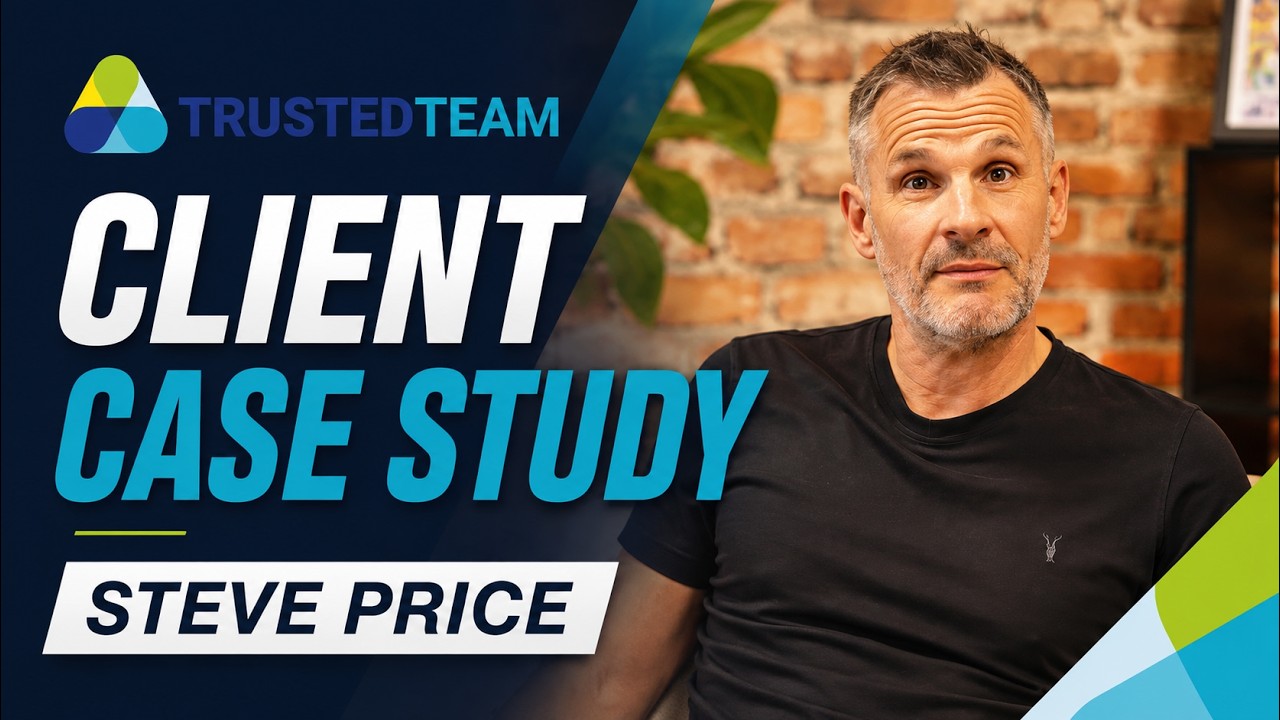
The Progress in Practice Podcast: Episode 4 Steve Price
Steve Price, founder of accountancy firm Inspire, explains how his firm helps owner-managed businesses use their numbers to improve their lives, not just stay compliant. He credits self-belief as the critical trait for entrepreneurs and emphasizes the "who, not how" approach to solving problems.
Chapters
Welcome to Progress in Practice, where we explore what it really takes to build and sustain a professional service business. The hard lessons, the smart moves, the uncomfortable truths, because success leaves clues if you're willing to look for them. I'm Charlie Reading. Let's dive in. So Steve, welcome to the Progress in Practice podcast. I'm really looking forward to chatting to you. I know quite a bit about Inspire and what you do. So I'm looking forward to diving in. So thank you for joining me.
Well, thank you, Charlie. Thank you for the invitation and happy New Year to you, seeing as though we're doing this early January.
Absolutely. Happy New Year to you. And so let's kick off by sort of helping people understand what it is you do. So who do you serve? How do you help them? And what makes Inspire different to your competitors?
Okay.
Yeah.
Thank you. That's a great, great place to start. So, okay, here comes the 2-second elevator pitch. I'm an accountant. There you go. You all know what an accountant is. You know that it's probably not going to be the best podcast you've ever had because you know what accountants are like. Let me try and extend that slightly. We do believe we're different. So we serve, um, owner-managed businesses. We don't try to niche on any particular sector, but we do most definitely serve a type, a mindset of business owner. So what do I mean by that? Well, most of my industry, sadly, despite lots of talk decades after decades, most of my industry is still well entrenched into the compliance element of what we have to do. And what Inspire does is not just talk about, but take steps to actually help business owners use their business numbers. That's the critical phrase, use their business business numbers, work with them to interpret them and improve them so that they can create a business that serves them. Because we all know of the scenario which too often befalls, which is the opposite, and they become a slave to their own business. So we think using those numbers enables us to make an impact. I don't think we are unique in any way, but we are rare, and I'm happy with rare. We are rare and we are making a difference to most of the accountants out there, we have programmes and we have services helping that type of business owner who wants more out of their business, whatever that might mean to them.
Brilliant. And I think just touching on the name Inspire, it doesn't— there's not many accountancy firms that are called a name like Inspire. So I suppose what was the thinking behind that? And yeah, I mean, maybe that answer, you've already answered it in the previous question, but I'm intrigued by that.
Let me tell you what our core purpose is, or our mission statement, as some people might define it. So we are, we are all about crunching numbers, inspiring business, and improving lives. The improving lives is what I've already touched upon. That's what Simon Sinek might describe as our why. That's what we're really trying to do. The crunching numbers is a little bit of a tongue-in-cheek nod towards what most people see accountants, but it's essentially what we do. So that inspire comes from the middle bit. It's about how we go about it. I think my role. Is to inspire my team. And my team's role is to try and inspire business owners to try and, because there's so much, there's so much against business owners, isn't there? Whether it's, whether it's taxation, whether it's red tape in their, in their own sector, whether it's COVID, if you like, there's so much working against you. Every business owner goes through that moment when they say, do you know what, jack this, I'm going for, I'm going back to my job. And our job is to say, yeah, but look, look at the potential, look at what you can do. And at that point, as accountants, and it's not a simple task at all, particularly as accountants, but at that point there, our job is to start by inspiring that business owner. Once we can do that to some extent, then we can start to work with them to say, look, these numbers that you're scared of, these numbers that you don't look at, they're actually the key towards the improvement that you're searching for.
Brilliant. Brilliant. I love that. And it definitely makes you different from the vast majority of your competitors. So what's the story that best explains why you do what you do?
Okay, so 21-year-old Steve Price leaves university. Fortunately, I've always been good academically, and I don't say that to boast, but that's what I'm quite good at. What I'm not very good at, or at least wasn't as a 21-year-old, was having any idea of what I wanted to do. So I liked numbers, why not become an accountant? So off I went and became an accountant and I went through my exams and I ticked all the boxes, but I wasn't inspired. I wasn't inspired individually. I've been various different types of accountant throughout my career. I started in industry, I've worked in implementing and even developing accounting systems. And then I made a decision to go into practice and I'll tell you why I made that decision. I made it entirely for selfish reasons, and I don't, and I take no guilt from that. I implore business owners to do the same. The business is there to suit me. And when we started a family, we being myself and my wife started a family, I needed more flexibility in my time. I needed more control over what I was doing. So I set up myself into a practice. It was only when I first sat down with a business owner. For the first time, an owner-managed business. And I went through the numbers with them and realised, almost kind of in the moment, realised that we weren't talking about their business at all. We were talking about their life. We were— the success or the failure of this business was going to depend upon their life, their family's life, what car they drove, what holiday they had, what sort of food they were gonna eat. And it's so intrinsically linked. And that was And maybe getting on for 20 years ago. And I realised that this, this career choice, which I think has always been a good career choice, but was never born out of inspiration. Suddenly I got my payback on inspiration. Suddenly I was, this is what I'm here to do. And it goes back to this idea of why we're different. I'm not here to be a government form filler. I'm not interested in filling out forms for people so that they can, you know, tick the box for VAT or any other tax. I know that has to be done. Don't get me wrong. I'm not, I'm not trying to be complacent about that, but as an accountant, I believe we can, should be making an impact. And that's my story. And that's why I probably get more of a kick out of being an accountant now than I ever did as that young lad coming out of university.
Brilliant. And I know that from a mastering the work-life balance piece, well, before we started recording, you were talking about 3 ski trips over the course of, so that's a pretty good demonstration of the fact that you've achieved what you set out to do, which is awesome. So if you could go, I want to sort of dive into the wisdom that you've picked up along that journey. And if you could go back to the young Steve Price, back at the start of you, you know, setting up your, you know, setting up Inspire, or maybe even starting your career in accounting, what advice, what wisdom would you share with the young Steve Price and why?
Yeah, yeah, that's a good question. And I'll take it, if you don't mind, I'll interpret that and take that as from when I started the practice, as in myself as a business owner, as opposed to maybe earlier on in my career. Because I think it comes down to, and I'll steal a phrase which sums it up nicely, who, not how, about understanding how to be resourceful rather than just understanding how hard you can work, which, let's be honest, when you're starting off in business, how hard you can work means how many hours you can put into it. If I, if I could go back, as the question suggests, if I could go back, I would approach it from a different mindset using the who, not how. So to be honest, to try and explain that a little bit more, what resources can I tap into to create short shortcuts. So we all know for a founder company, etc., with funding can create so many shortcuts. And if they can attract venture capital, etc., it can create shortcuts. But this mindset can also create massive shortcuts. So where do I look to? Where do I go? I was probably in business for about 5 years. I'm being slightly vague there, before I took on a mentor. And as soon as I worked with a mentor, I knew, I could feel, I could see that Everything started to accelerate. And you know what my overriding thought was? Why didn't I do this 5 years ago? It's that kind of who, not how thinking.
Well, it's interesting, isn't it? Because you're talking about the benefit of mentoring and coaching and something we'll perhaps touch on further on. But you're absolutely right. You know, it's, you know, you can learn from somebody's sort of years and years of wisdom. You can learn something in a much shorter space of time and save yourself a huge amount of time by doing that. So I think that's really astute.
Yeah. And everybody, you know, with business owners and the right to, but everybody looks at everything on the cost benefit analysis. And of course, the problem is you never have the foresight of the benefit, or perhaps you don't believe or trust in the foresight of the benefit. And so sometimes, you know, your question is a hindsight one. Sometimes you come out of this to be able to say, yeah, now, now I understand the benefit. But if I was speaking to myself as a junior, as a new business owner rather, and what was the advice I'd give? That is it. Cast iron, no doubt about it, because the benefit is ridiculous. And it's not just that you learn from a mentor, or let's not get too tied up, mentor, coach, consultant. It's not just that you learn from their experience, it's what they are able to get out of you and help you be on the right track for yourself. I think that's the real gain.
I agree. And to think about the wider wisdom for, from you as a person, if you could pass on no money to your children, but instead just one piece of advice, What would that be and why?
Yeah, that's not easy. Although there's just about anything I could say. So let's go interesting on it. Let's say self-belief, because I could say, you know, I could say courage, I could say motivation, I could say commitment, I think there's all these, these, but most of them stem from self-belief. I think we only get one run at this life. So every one of us is a beginner. And certainly as a business owner, I know that's the context of the podcast. Let's talk about it in terms of a business owner. Sometimes we might own more more than one business, but we'll all have that time when we're opening business. It's scary as hell. And there are mentors out there, there are textbooks. Most people wing it. Most people do it for themselves. And I would say the single biggest factor to success is probably their level of self-belief, because that allows them to be motivated. And being motivated, as we all know, means they'll be more resourceful, more committed, et cetera. Self-belief, I would say. I know it's vague, Charlie Reading, but it's, but yeah, actual genuine self-belief. I can do this. Certainly that's what I would've, you know, if I could've had some sort of superpower instilled in me 20 years ago, that's probably what I'd have a dose of.
And probably in today's world where, you know, we've got so many, you know, the highest level of people suffering, young people suffering from mental health issues and confidence issues. Maybe there's never been a more important time for that advice actually. So, yeah. So I think that's, I think I think it's really astute. And when you think about the goals of your business and what you're setting, well, not just for your business, but I know you, you know, I know you're, you're a keen Ironman athlete like, like myself. What are the biggest obstacles blocking you at the moment? What if you could, if you could eliminate, or what a couple of obstacles if you could eliminate, you could hit your goals more quickly?
Okay, so let me be dead honest with you, dead frank. If you'd have asked me this question 10 years ago, and you didn't know me then, but if you'd have asked me that question, I would have probably Taking up 5 or 10 minutes of your, of your time now in, in creating some big list of all the different things that were obstacles. I, I, I'm so proud to tell you that I've been able to take most of the obstacles out. Let's, let's, let's put it, let's put it down right. Most obstacles that appear to people, the perception of the obstacle really come down to two things: lack of money and lack of time. I know there are others and I know it comes through in different ways, but most of them tangibly tangibly come back to lack of money or lack of time. I'm not going to blame any of those. I've created a place in my life where I don't think either of those are obstacles. If I had to therefore name what is left, I'll come back to the issue we've just been talking about. I create goals. We've done exercises together, Charlie Reading, where you've helped me in short-term, long-term, the hierarchy of goals, planning, etc. And sometimes I sway from them, and I think focus and maintaining accountability towards them, which is all within me— there is nothing else that's an ob— you know, a tangible obstacle out there, all within me— I think that presents itself as the biggest obstacle. So if you like, put very simply, I'm my own biggest obstacle.
If I— oh, you're out to Yeah, yeah, yeah. But also interesting. So potentially a lack of focus, a lack of focusing or coming back to what you set out as to be most important is, is the obstacle, isn't it? So, so providing, so I suppose, how are you giving yourself structure to make sure that you don't?
Yeah. So I, I think this all comes down to accountability. So I think it's all about maintaining those goals and keeping a vision of them and keeping accountable to what you've said you're going to do. I think we solve, or we, sorry, we reach goals. Goals. We solve problems, we reach goals by taking action, whatever that might be. So how do we keep accountable? How do we take the action when we said we'll do it and to the extent we said we'll do it? And that's all about accountability. So if you were to walk into my practice now, I'm, I'm being serious with you now, and you were, you were, um, you were to stop any, any of my member of the team at their desks or whatever in the middle of, let's say, somebody's tax return and say, look, you're, you're You're Steve, who runs your company, bangs on about this accountability. What, what's he doing about it in truth? What does it mean? What does he get done? Accountability runs through everybody. We run Traction as a system, which is EOS from the book Traction. I know you know about this Gino Wickman system. We have it many years, years now, but we do run it. We run it religiously. Um, we run it, we run every segment of it and everybody in the, in the company, whether they've been with us 2 weeks or however many years, including myself, has to be accountable to what we say we're gonna do. Which, again, to speak Traction for a second, that's our rocks. That's our— this is gonna take us from one place now to some place in the future, one step at a time. What is our rock? So that is what I do at a business level. From a personal level, I've talked about having a mentor before. I currently work one-to-one with a mentor, but what I've done is I've put myself into two mastermind groups. So now we're talking about peer-to-peer accountability. Charlie, you know this, one of them is your mastermind group.
I think you are proud to say that you are.
Yeah. And you know, I'm not a member there by mistake. I'm a member there because it's given me what we're talking about now. It's given me structure, to use your word. The other mastermind group is one I run myself, which is one I've created for accountants. And though the theme is different, The principles are the same. So is it perfect? Am I absolutely aye on track? No, of course I'm not because I'm not perfect and never will be. But do I keep myself at least in vision of that track and where I need to be? Well, hopefully, and I can only hope that, you know, I can carry on using this structure that I've tried to create. Brilliant.
Well, and you're absolutely right. There's no such thing as perfect. You know, life is not a game of perfect, is it? But it's all about progress, not perfection, which is ultimately what this podcast is all about. So fantastic.
Love that.
And you sort of have answered this next question. You've sort of beaten me to it. I'm gonna ask it anyway because it might tease out something else. What book or other framework, or, you know, you've obviously talked about mentors already, but what book, mentor, or framework do you keep returning to and how does it show up in your business?
Yeah, well, I kind of have, haven't I? So how does it show up in my business? I think the easy way to answer that is this, is this running this, this EOS. And I suspect people listening to your podcast will know exactly what that is, but if they don't, it's, you know, I don't think it's the only book out there, but Create a structure, create some structure that you then stick to. Traction is the one we found was ideal for ourselves, but create that structure in the first place. Don't say, or don't at least have the mindset that says, well, yeah, I've read that book, or I've seen, I've seen how that can work, but it doesn't work for us because we're different in such and such a way. We're all different. Of course we are, but you need to create a structure of some form. That's the one for us. The mastermind groups, I believe in them hugely. Accountability, whether it comes from the people who work for you, whether it comes from peers or a mentor. I suppose the other thing I'd say, and again, this will go back to a conversation we've had before, Charlie Reading, although maybe some time ago, this concept of lifelong learning. So if you were to ask me what resources I then use or favourite author or favourite book or framework, I'm not sure I could do that in really in a short period of time in a podcast. I think anything and everything isn't quite the right answer. But I take it from a multitude of sources. But the point is that I learn for learning's sake, not I've got a problem, let's go and research it. Let's go and use, you know, an LLM or Google or whatever I might do and find the answer to it so that tomorrow I don't have the problem. Learn for learning's sake and learn and embrace learning because it's that concept of you don't know what you don't know. And whenever I'm reading a book, and again, this will come back to a conversation you You might recall, I'm sure you've had various conversations on the subject, but you've read the book for a particular reason, that the title or the author has grabbed your, uh, grabbed your attention. But when you start to then absorb it, it's all the other stuff that you weren't even conscious was a problem or an issue or a curiosity in your life. And that's it there, it's that mindset to just say, just keep learning. And hopefully just keep learning because you enjoy it, because that's again going to help you to embrace it.
Brilliant.
Kind of scared the issue of giving you any more sources of, of inspiration there, but I, I hope that's quite a reasonable answer.
Yeah, it is. And I think it, it's sort of kind of like, I love the book Traction. I think it's a fantastic book, and it also kind of highlights exactly what you're talking about, because when I read it, I didn't think I needed what I actually got out of it. What I got out of it was like so many things I changed in the business, but I didn't go into it for that reason. I picked it up thinking I was gonna get something different from it. So I think it's a great book by Gino Wickman and yeah, I can't recommend it highly enough. And I love the EOS system like you. All my businesses run on the EOS, which is a great thing to learn more about.
That's the gift of learning, isn't it? If you just open yourself to it, then who knows what you're gonna get back the other way. The biggest problem them, and this is whether it's a business owner or anybody else, is that, that I know thinking that way. I'm not going to listen to that because you know what, I've, I know that I'm okay for that. So I'll, I'll, I'll pass on that one, please. As soon as we start to think like that or talk like that, I worry. And I sometimes see that in business owners. I've been around for 20 years now. There's nothing I can learn new here. And yet they're struggling on so many, on so many different levels. We have to embrace learning. For the sake of it. I think that's the mindset that I've got.
Which is why reading the same book more than once is still worthwhile because you get different ideas when you consume it at different stages in your life. Steve, this has been absolutely brilliant. There's loads of great wisdom for people here. What's— if people want to find out more about you or about Inspire, where's the best place for people to track you down?
Yeah, so you probably don't need me to reel off. I think we appear on just about every social media. BWP money-inspire, well, that's our website and across all of the, or at least the vast majority of the social media channels. That's how to get in touch with us. The best way to engage with us, if you, if you don't mind me asking that, would definitely be to have a look at some of the courses we run. We run two courses at the moment. One is my Money Freedom course, which empowers business owners not to understand, not just to understand their numbers better, but to use them. As I was saying right at the start of this conversation, we've got a course centred all around that, and we've helped so many business owners. And then the other one takes it a stage further towards exit planning. They are really easy ways to get to know us at Inspire and see what we can do and put us to the test. Are we really that different from other accountants?
Fantastic. And yeah, from what I've seen, you definitely are. And if it's okay with you, what we'll do is we'll share the link to those courses in the show notes as well. So that would be fantastic. Steve, as always, been an absolute pleasure chatting to you.
You.
Thank you so much for joining us on the Progress in Practice podcast. As a reminder, the Progress in Practice podcast is brought to you by the trusted team that helps professional service-based entrepreneurs grow their business whilst working less and enjoying more. So Steve, good luck with all of your goals for 2026. Thank you very much again for coming on.
Thanks, Charlie, and good luck with your goals too.
If this conversation resonated, you'll find more support structure and community inside The Trusted Team, where ambitious service-based founders come to build businesses that are scalable, saleable, and sustainable. You can find out more at thetrusted.team. And if you're enjoying Progress in Practice, please make sure you follow the show and leave a rating and review. It really helps more founders find these conversations and to bring you better and better guests. So until the next time, keep progressing.