The Progress in Practice Podcast: Episode 2 Bhavik Shah
Bhavik Shah, founder of Providence Capital, provides flexible financing for complex real-estate deals like distressed assets and cost overruns. He built the firm on the belief that finance should enable progress, not trap owners. Integrity and reputation compound over time, and staying focused on your niche matters more than chasing every opportunity.
Chapters
Welcome to Progress in Practice, where we explore what it really takes to build and sustain a professional service business. The hard lessons, the smart moves, the uncomfortable truths, because success leaves clues if you're willing to look for them. I'm Charlie Reading. Let's dive in. So welcome to the Progress in Practice podcast. Where we dive into the wisdom and experience of founders and entrepreneurs in the professional services world. And today I'm absolutely delighted to be joined by Bhavik Shah from Providence Capital. And I know this is gonna be a brilliant conversation 'cause obviously I know you, Bhavik, and I know we're gonna have a really interesting chat over the course of the next sort of 20, 25 minutes or so. But I always like to start these with giving you the opportunity to explain who you serve, how you help them, and what makes you different. So tell us about what you do at Providus Capital.
Nice to have you, Charlie Reading. Thank you so much for this podcast opportunity. So give you a bit of background of Providus Capital. So at Providus Capital, we work with property developers, operators, and owners who find themselves in complex or time-sensitive situations. So these are special situations where, you know, no conventional form of funding or lending would actually fit the box. So that might be distressed property, insolvency, broken capital stacks, cost overruns on development projects, planning risk on, you know, planning opportunities, for example, when somebody's taking a site through planning, or even just simply situations where speed and certainty really matter.
Brilliant. And what makes you different to the other people in your space?
So we provide flexible capital. It's really typically bridge, mezzanine equity or structured finance. And more importantly, what we provide is clarity. So what makes us really different is the fact that we think like principals, not like lenders. And that allows us to actually be a lot more aligned with what the actual client requires in their specific situation or scenario.
Fantastic. I love that. And it must be a really difficult space to work in. So I love the fact that you're providing a solution for people that are struggling to find other solutions. I always like to go back to the stories, you know, you know, I talk a lot about stories. What's the story that best explains why you do what you do?
So early on in my own entrepreneurial journey, I saw firsthand how good businesses in the real estate space doing good projects can end up in really difficult situations. And it's not because of, you know, business owners or developers being reckless, It's because the capital and the partners around them aren't aligned or don't understand their reality. I became fascinated by the idea that capital and experience, when structured properly, can actually remove stress rather than create it. And this is really how Providence Capital was born. It was really born from that belief that finance and partnerships should be tools that enable progress, not things that trap people. I am highly motivated by solving problems others avoid and by being the person who stays calm when things are really messy.
Brilliant. You've obviously got a wealth of experience in this. I love the fact that we were having dinner one night with some of the other people in the Trusted team and you happened to just drop in that while you started a sentence with something along the lines of, oh, when I was doing business at Harvard over a summer, like, Nobody else starts a sentence like that. That's quite a big thing. So I'm intrigued. I can't— it was a few glasses of wine in. Just very briefly, what were you doing? Was it Harvard? Is that right?
It is. It was Harvard. That's why it was actually not business. It was actually summer courses that I did at Harvard, in particular two, one called strategic management and the one that was a lot more fun, which was space exploration and astronomy. And in that particular course, you know, it was really quite incredible as an experience because I went into the course thinking that there is, you know, no possibility whatsoever for there to be life anywhere else in the universe. And by the time I finished the course, I was convinced that it's inevitable that there is life elsewhere in this universe, and it's just a matter of time before we find it.
Amazing. And what a cool place to go and study something as fascinating as that. So I want to now think about the sort of dive into the wisdom that you've got as a result of being in business. If you could go back to your younger self that was at the starting point of your business journey, what advice would you give your younger self based on the wisdom that you've now accumulated?
I'd tell myself to slow down just enough to build the right foundations. Early on, I thought progress meant doing more deals, doing it faster. I had this immense drive and energy in me as a 20-something-year-old. I grew very quickly with shining success, had everything that one could, you know, ask for. But importantly, the foundations were very weak. What I now know is that the real leverage comes from core values, strong relationships, and clarity of thinking. So I would really, that would be the sort of, you know, the key message. I'd also say that, you know, don't be afraid to ask for help. Growth doesn't necessarily come from being the smartest person in the room. But it comes from building the right room, I would say.
Brilliant advice. I love that. You could sum it up as it's a who, not how solution, isn't it? You're looking for the who, not who to fix it, not how to fix it. So I think that's brilliant advice. And, you know, You have two children, I think I'm right in saying, is that correct?
Well, one.
Oh no, one there. One on the way. One on the way, that's right.
Yes, yes, yes.
Sorry. So if you could leave them no money, but just one piece of advice as your sort of legacy to them, what would that advice be?
I'd probably pass on the importance of integrity, especially under pressure. You know, it's easy to do the right thing when everything's going well. The real test is going to be really when things don't go well. It's really when you're in difficult situation and how you are actually able to interact with other people and find solutions collectively in those situations. You know, I've had personally insolvency, bankruptcy. I've had my businesses going to insolvency. And so I have had firsthand experience of what losing money feels like. And not just for myself, but also for others around me. I mean, investors and funders who've actually backed me on my own projects and my own vision. So what I've, what I would really say is that integrity is key. Reputations compound just like money. And, you know, once trust is lost, it's impossible to rebuild, almost impossible, I would say. And so Long-term success, both in business and life, comes from choosing the right partners, but also choosing the right way forward as opposed to, you know, the convenient way, which may be wrong.
Yeah, no, you're absolutely right. And I think that's really, really good advice. You mentioned the business going into, or experiencing, you know, going through an insolvency. Are there any other lessons around that? That you've now sort of taken on board and sort of been able to apply to business and kind of, because that's a big learning opportunity, isn't it?
Indeed. It's a lot. Look, I mean, being into insolvency is actually, yeah, it's something that you can't learn in a textbook. And the lessons from that have been, of course, very much around the core values, i.e., what are your core values? What are the things that really matter to you? And my entire outlook on life changed on the back of the experience that I've been through within entrepreneurship, business, and, you know, the, the ride up and down, i.e., the importance I now place to personal relationships, the importance I place to my core values being the authenticity, the integrity, the resilience that, you know, I want to be instilling in my next generation.
Brilliant. And building a business around core values is such a powerful principle. And particularly when you come to difficult decisions. I remember interviewing John Dutton, the CEO of British Cycling, and he at the time was running the Rugby League World Cup. And it was through COVID and they were like, do we actually go ahead with this or do we cancel the World Cup? And they basically sat around as a board and they went through their values that they'd previously documented and said, Based on these values, do we go ahead or do we cancel? And they ended up creating the most successful Rugby League World Cup in history, and it was based on that decisions around value. So it's a brilliant, brilliant piece of advice. So thinking about Providence Capital again now, what's the biggest challenge that's sort of stopping you reaching your goals as quickly as you'd like?
I would say that the biggest challenge right now for Providence is how we can maintain our focus as we continue scaling up. You know, as the business keeps growing, as our access to various opportunities keep growing, what happens is that we not only get more opportunities, but also the breadth of the opportunities that we receive, you know, is widening. And as a result, it's very easy to get distracted and spend time and resource on opportunities that aren't quite fitting what we're made for. So for example, we're not in the market of providing conventional vanilla, simple funding for a buy-to-let property. That's not really where we fit in. If somebody's seeking leverage, which is a typical 50 to 60% loan to value on a property that is perfectly sound, there's no reason for them to actually need our funding, which is of course going to be inappropriate and overly expensive for the requirements. We would really be suitable for transactions where we know that the underlying opportunity is sound, but due to some quirky complexity that the borrower or the sponsor is facing, they're not able to access conventional funding. And that's really where we come in. Keeping that focus from our perspective on exactly what we're good at and ensuring that we're spending our time and resources in, you know, and on those opportunities is really where our— where I guess our biggest challenge will come from.
Brilliant. We've spoken a lot in the past about really knowing who your ideal client is and focusing it like having laser-like vision for your ideal client and not getting distracted by people that aren't your ideal client. And I know that you've, you've, you've been good enough not just to attend my event, the Niche to Network, from Niche to Network, but also you've actually, or, you know, put a room together for me to deliver it to some of your contacts.
So I have personally attended that session of yours, probably 3 or 4 times now. And every time I do it, there is— there are new revelations, new ideas that spring to my mind. And I find that really effective because it just allows us to then have a clearer focus on who are ideal clients.
Yeah, no, brilliant. I love the fact that you have done it 4 times and still getting new ideas. For anyone that's listening, what I'll do is we have a you can go through that process for free. So I'll put the link in the show notes and you can follow that through. And as you know, Bhavik, I love books and podcasts and documentaries. And so what resources, what books, podcasts, documentaries, or anything else have you found helping you on your journey? Where do they show up in Providence Capital?
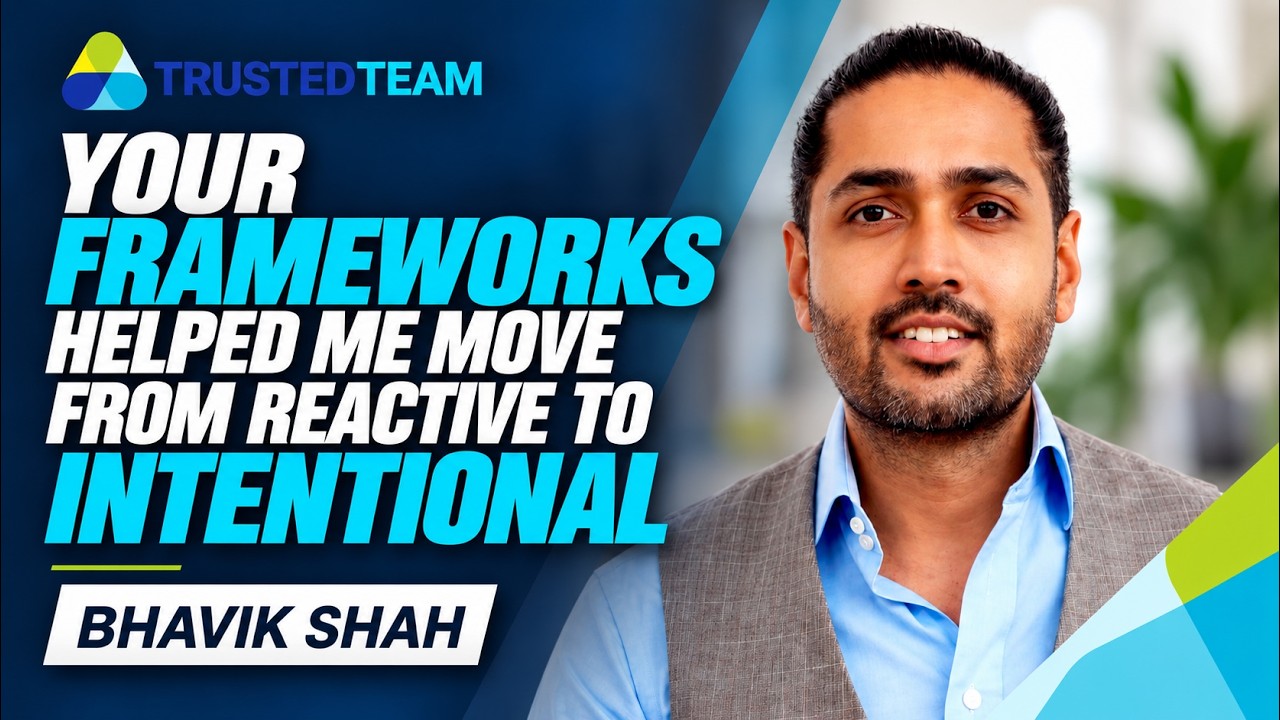
I must confess here, Charlie, it's actually you. It's entirely you when it comes to you know, my key resource for anything that I need inspiration for. So I guess, yeah, again, for many people who may be watching this podcast wouldn't be knowing that you are my business coach. And, you know, one of the most impactful influences on me recently has been the coaching and the structured thinking that I have gained from you. It's all your frameworks that force me to step back and work on the business rather than just in the business. And that's really been quite powerful when, you know, practically implemented. When I look at Providence Capital today, it shows in our definition of edge, what our edge is to how we assessing risk, to how we're making decisions under pressure. Your frameworks have actually helped me move from being reactive to being more intentional, and that has made a real difference across the business.
Well, but for anyone listening, this was not prompted. I was not expecting you to say me or my work, but that's amazing. Thank you. And I'm delighted it has such an impact on you and Providence Capital, but also like you've gotta be coachable to actually take on board the ideas and you are very coachable and that is, you know, a huge testament to you and the success you're building with Providence Capital. So for those people that are listening or watching this, if they wanna find out more about Providence Capital, where's the best place to track you down?
Well, it'll certainly be our website. Our website's got some information about Providence Capital, also ways to reach us and the team. At the same time, LinkedIn would be a great place. You know, do follow me and follow Providence Capital's LinkedIn page. That's where we share a lot of our thinking and updates on, you know, recent transactions and deals that we've been involved in. And of course, people are most welcome to actually reach us directly. Come visit our offices in Hanover Square in in the West End and would love to meet you.
Fantastic. And of course, we're recording this at the end of 2025, but in 2026, we have some collaborative events that we're doing together, aren't we? So, which would be really cool. So we're delivering some workshops for some of Bhavik's contacts. So we'll put the links in the show notes for that as well. And then if anyone's listening to this that would like to come along, they can find out more information. Bhavik, you've been an absolute pleasure to get on the podcast, to coach as part of the Trusted Team. Just I want to say a huge thank you for, for coming on and wish you every success with Providence Capital in the future.
Thank you so much, Charlie. Thank you for having me here. And yeah, look forward to collaborating more with you in 2026.
Brilliant. Thank you. If this conversation resonated, you'll find more support, structure, and community inside the Trusted Team, where ambitious service-based founders come to build businesses that are scalable, profitable, saleable, and sustainable. You can find out more at thetrusted.team. And if you're enjoying Progress in Practice, please make sure you follow the show and leave a rating and review. It really helps more founders find these conversations and to bring you better and better guests. So until the next time, keep progressing.