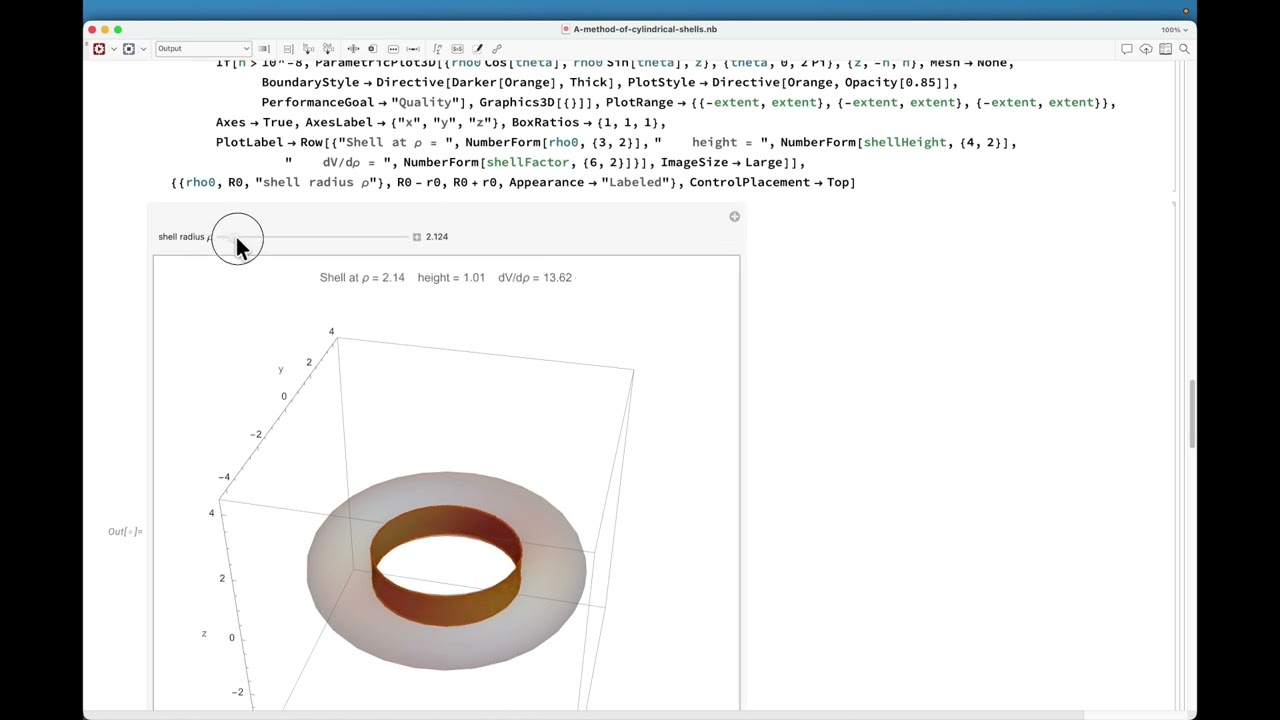
Conor Cosnett explains how to find a torus's volume using the washer method in Cartesian coordinates. Slice the torus into infinitesimal washers at each height z, calculate each washer's area as the difference between outer and inner circles, then integrate over the full height. The Cartesian approach is simpler than using polar geometry.
Chapters
So the question is, how do we get the volume of a torus? And this is the formula that we need to derive. Yves, you mentioned a method where you subtract, you subtract two terms from each other. There's a subtraction involved in your method. And I actually, I believe what you might have been describing is the washer method, which apparently is the simplest method in Cartesian space to do it. Now you can do it, you can also do it in polar geometry, but in Cartesian space, what you do is you basically scan the torus with this washer. And so if I move it like this, it's basically like an MRI scan. And you basically, you make a function which represents the area of this washer, and then you set that area as the dz, the infinitesimal width. Let me draw this here. So this little slice is our dz, and you integrate this washer area. So you integrate the washer area, which we'll call w, which is a function of z. Z is this axis here, the z-axis, and you basically integrate that up and down. So you integrate the washer area and you integrate it from, I don't know, -2 to 2 or whatever is required, and then you get the volume of this, um, of the torus. So here we go. I'm just going to move this infinitesimal washer up and down the torus. So our task essentially is to compute this washer, and the way we compute it is we get the, the outer, the area of an outer circle And then we subtract the area of the inner circle, which I think is what you mentioned in our meeting. And thus we get W. So W as a function of height z is equal to the area of the outer circle, which we'll do in blue, minus the area of the inner circle. Which we represent also as a function of z. So you can think of w, you can think of this washer area, as a computer program which outputs the area of this washer or annulus at a specific height z. Yeah, so I thought that was really cool, and you were actually right, Yves, and I was actually wrong. I think I was thinking of polar geometry, and this is the simplest way to do it in Cartesian geometry.