How Stay Productive at Work without Burning Out | Daisy Auger-Dominguez on Burnt Out to Lit Up
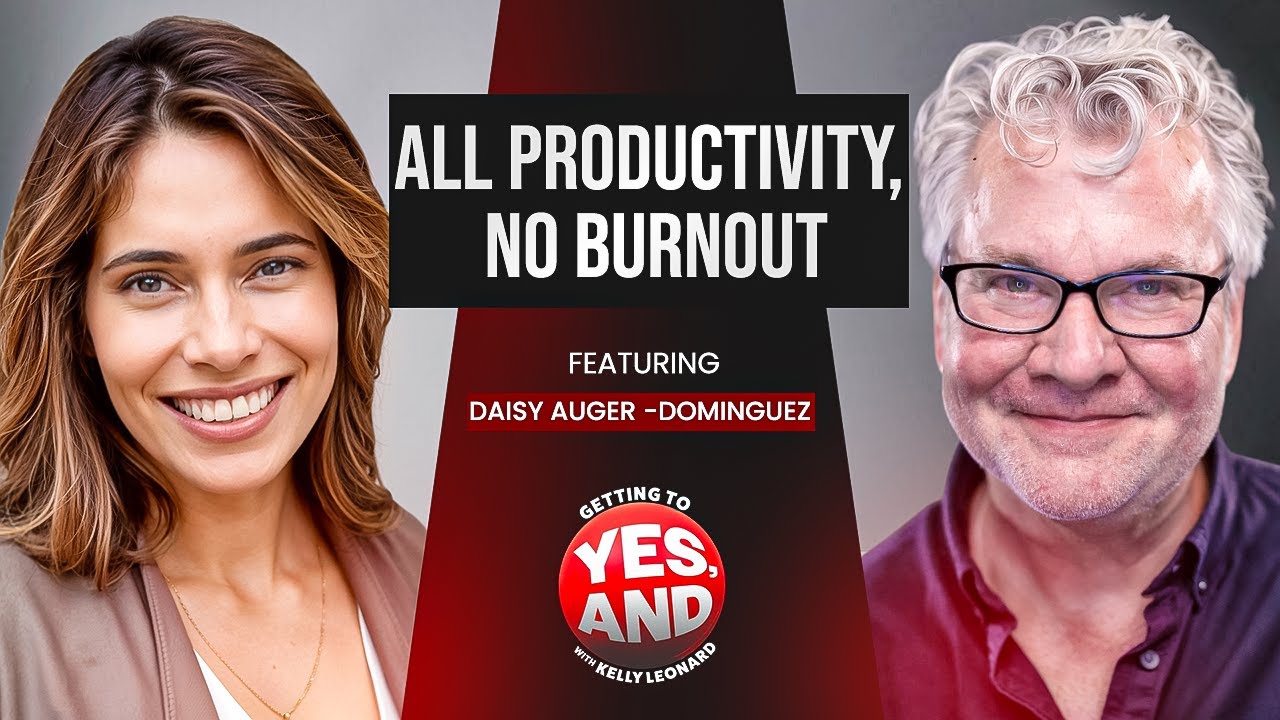
Daisy Auger-Dominguez, former chief people officer at Vice, discusses burnout after the company's 2023 bankruptcy and how leaders can prevent it. She introduces "strategic mediocrity" as a humane performance standard and the "hungry ghosts" metaphor for endless workplace desire. Modern leadership requires acting as cultural architects and change-management experts, not just enforcing return-to-office mandates.
Chapters
Daisy can't be counted by the money spent. Today was just another better left unsaid. Daisy can't be counted by the time till rent. Tomorrow's just another like the one that comes next. The car on the highway that leads to the job at the desk by the boss with the elegant watch. The tick of the clock and the tick of the clock mark the moments till the ticking stops.
Today's podcast is with Daisy Auger-Domínguez, who once served as the global chief people officer at Vice Media Group. Yeah, that's right. She also held leadership positions at such companies as the Walt Disney Company, Google, and Viacom. She's the author of Inclusion Revolution, as well as her latest book, which is called Burnt Out to Lit Up: How to Reignite the Joy of Leading People. Enjoy the pod. Daisy Auger-Domínguez, welcome to the show.
Oh, thank you for having me, Kelly. I'm thrilled to be here.
So let's start this conversation where you basically start the book. It's Monday, July 10th, 2023, and you're still in your role at Vice Media at this point, I believe, right?
Yes.
And you get an email that said, quote, people are talking, end quote. That's ominous. What happened? What's going on?
Oh, goodness. Well, this was the summer of 2023. You're bringing me back to that moment right now.
We're all back there right now.
Yes. And Vice had been going through a really contentious bankruptcy process that had followed our most recent restructuring in the organization where we had done massive layoffs. So we had a workforce that was unhappy at best, right? Just, and, but really pained and in a lot of deep anguish. And as a company of content creators and journalists, the bankruptcy process was made even more complicated because every week as information was released about the bankruptcy, our teams, our journalists would just push it out there and, you know, tell the world everything that they were discovering as part of the bankruptcy and, as part of the terrible corporate overlords in the organization. And that weekend, the reports would go out. This was publicly facing information. It would go out on Sunday night, and Monday was usually when all the posting would happen. And that week, that was a Monday, a late Monday afternoon, they had released the salaries of the top executives in the organization. And this is all part of the transparency efforts of a bankruptcy.
Mm-hmm.
We all accepted it. We all knew it. It is what it is. And immediately, one of our journalists sent out a— back then it was Twitter— a tweet essentially saying, you know, I knew this company was awful and these executives were awful, but I didn't realize that they were this morally corrupt. And they made all this money right after we filed for bankruptcy and gave out bonuses. And he named 4 executives out of the 11 executives that were listed. He named 4 of them, 3 of whom were women and one of whom was me. And immediately after— and he— what he did was— gosh, I'm going back to these days, Kelly. I was like, he—
I'm so sorry.
It's okay. It's okay. He sent out little images with the exact data, right? Like, this is how much money they made, bonuses, everything. And immediately, I'm telling you, within hours, Twitter just went bananas. And folks just started talking to each other, which is why that note went out from one of our comms leaders to let us know people are talking, we need to be prepared. But I did not realize the extent of it till the day after. when I started receiving hate email and tweets and all sorts of things. Most of it, this real deep anger at the HR lady making so much money, which was really interesting to me. I'm like, of all the things for you to be angry is that I run HR. Now, to be fair, as the HR leader, I was seen for, you know, first, it always happens as the person that was doing all the firing, right? As if I was the one that made all these decisions and I wanted to do all of this. So it was, the affront was like, this woman that's firing everybody makes all this money, whatnot. And there was never this sense of like, she's a human, she's a mother. Like the things that you're saying are really disgusting, right? It was really, really painful and awful to read and to experience, to feel bombarded by it.
I'm going to suggest that the HR person at Vice Media should be the highest paid person at Vice Media. I spent time—
I wasn't, I wasn't, to be clear.
Yeah, no, I bet you weren't. So a few years before you got there, the music that bookends our show is by a band called Jukebox the Ghost, and their management company was in the same building as Vice Media. And I remember I was like, let's, let's take a trip over there. And I'm like, oh, wow, there's a little bar set up in here. And there's like, I mean, it was like, It was wild. I, like, I know people think that Second City might be like that. And yes, we have a bar, but that bar is open in the evening, not the day. At Vice Media, it was open during the day and they are not a bar. So it's, you know, there's so much stuff. Yeah. And so, I mean, I, I like that you start with the fire, with the storm, right? Because it's like those are— those situations are inevitable and they're terrible. Yeah. And you stay long enough in your, in your industry and you You go, you, you know, exceed in your industry and those things are going to happen to you. And you've got a killer line early in the book where you say, everybody wants to manage people until they have to manage people.
Yes. Yes.
Yeah, it's hard. It's, it's, and it's, it's most, mostly not fun in, in, in many regards, I think, unless or until you get kind of good at it and then you become a gift to so many different people.
I like to think so. I think it is the hardest work any of us will ever do, but I think it can also be the most rewarding.
Yeah. You also say it's like a high-wire act of care.
Yeah.
And what I love about that is some of my closest friends are people who are so, they're involved in the caregiving movement and the way we need to elevate caregivers and how we do the opposite in this country in so many regards because we don't pay them. And I know this in terms of my relationship with like HR here. And I speak with a lot of groups around that. It's like, I'm convinced that in the coming decade, HR is going to be the engine in most companies because with AI and all of that robotics, What we'll need to do is tap into the most human elements of performance and what makes people go. And we're terrible at it.
Yes, yes, we really are. And we, we keep on promoting people and, you know, and we keep on sending people to these trainings that kind of take the humanity out of this work. And we keep on thrusting folks into situations that are untenable. And also, Kelly, I think part of the challenge of all of this, this was already hard work to do in the first place, but this is also the most messy, challenging time that any of us have ever experienced. And so a manager now doesn't just have to deliver on outcomes, right? They have to be cultural architects. They have to be change management experts. They have to be DEI specialists. They have to be influencers across meta-communities, not just their own community. They have to do all of that while also managing a workforce that is increasingly exhausted, disengaged, and untrusting of leadership. It is really hard.
Yeah. And, and there's this— it's so interesting, right? Because there's been so many articles written about burnout, books written about burnout, and that hasn't seemed to convince corporate America that they should be paying attention to burnout.
Right. It's, you know, it's really fascinating that you say that because I just read a report by care.com that essentially says burnout is quietly corroding our workplaces. And there's over 2/3 of employees say that they're at high risk of burnout, and fewer than half of the employers don't even recognize it. It is wild to me. I did not know that burnout was going to have the moment that it's having right now when I wrote the book, to be fair. And in many ways, I wrote it because I had been so deeply burnt out and I needed to find answers to all of these questions that I had about this work. And I really do fundamentally believe that leadership in today's workplace needs to really focus on wellness and on how do we do this work better. But I didn't, at that point, I didn't realize when I started doing the book that there was, as you say, so much research and so much information already about this work, right? I discovered it like many of us, like, ooh, I just discovered this. And then I realized, oh no, there is a deep body of work around this. The World Health Organization diagnosed burnout as a workplace phenomenon in 2019. This was before the pandemic. So we were already heading in this direction. And academics, researchers have been raising their hands and talking about this. And practitioners like me have been writing about it. And authors, I mean, now almost every week, I read a piece around burnout, and it is still wild to me that organizations are not putting into place practices to help reduce burnout. Forget about just reducing burnout, to help identify it.
Yeah. Yeah. I was actually just on a call with my co-authors. We're working on a follow-up to Yes, And. And we were talking about one of the first chapters is going to become about being comfortable with discomfort, which is the whole improv thing, right? You have to learn to do that because everything is a first draft in public, right? Like, so like, if you're not comfortable with that level of failure, like, you need to be. I think, I think there is a false, uh, um, uh, that, that they don't want to acknowledge burnout and they claim it's this generational thing with people being soft or not wanting. Yes. I'm like, those are 2 different things and they can both exist. There can be people who are uncomfortable with discomfort. Sure. That's, that's, that's wildly true. There are people who don't want to do the work. Sure, that's wildly true. There is also trauma, grief, and burnout, which are also true.
Yes.
And we just have a difficult— we have a difficulty, I think, as humans to reconcile that all these things can be true at one given time. But we have to if we are going to effectively navigate through what is increasingly A very, like, it's the turmoil that exists right now culturally, politically, financially. It's like, acknowledge it. Like, acknowledge it. Help your people. You can actually— and here's the other thing I think, which is true, and I think you'd agree, which is going through the fire together with your team makes you a really strong team.
Yes.
And that also means you got each other's back.
That's right. That's right. You make it through, right? You are you're going through it and you are experiencing your vulnerability, your pain points, your humanity together. And there is no way— I will tell you this, having gone through this at Vice, some of the— and having gone through this at Google, having gone through this at Disney, right? Like, I've been through this over and over again at all these large and, you know, smaller organizations. And my teams, they are— they've become my family, right? And we know each other. Yeah. In ways that, that, you know, many of our best friends don't know us, quite frankly. And it keeps us tied together. There isn't a moment that I don't get, and I still do, and I'm so grateful of my team members calling me and I've got this job. Can you, can you, you know, help answer these questions? You know these people, right? Just, and we have a shorthand with each other and we have an affection and a care towards each other that came from going through that fire together and getting to the other side together.
All right, let's talk about return to work.
Oh, my— everyone's favorite topic.
This is everyone's favorite topic. So I work, of course, at a live theater. So there is an element of our folks that absolutely are returning because you can't— we did comedy on Zoom. Guess what? Not as interesting as comedy live at the Second City. We hold live classes. So, there's all that element. But there's been a lot of people who figured out that they could do their work at home and be just as effective. And we had a real hard time here, not as hard as other folks, but kind of navigating like how much should people come back to work? Should they come back to work? And what I like about a smaller business like ours or a mid-sized business like ours is that we could have those conversations. not always agree, but at least, you know, there was some humanity behind it. Then you've got these companies that are being like, nope, you're coming back to work right now. Yeah. I don't think they have any data to support that move. Right? Isn't that just their sense that people should be there? Because somehow if their people are there, they're working harder than where they were?
Yeah. I call it holding onto old relics of performance and work, right? It's just, it's these assumptions that If people are in the office, they're gonna work harder. And it really fundamentally, Kelly, comes down to control, right? It is about controlling the workforce in a way that has become outdated, right? Mm-hmm. Because if employees feel that their supervisors don't understand their motivations or don't care about the impact of return-to-office mandates on their lives, right, their sense of autonomy, their sense of agency, and frankly, their ability to get work done, you will lose them, right? You will lose them either through attrition or you will lose them because they will no longer trust and believe and be engaged in the workplace. But it is holding onto these old forms of what management looked like. It is also, frankly, it's— there are companies that have invested a lot in real estate. And now they're stuck with, these investments. And they're like, well, make it worth it, right? It is, it is these old notions of, you know, just, you know, if people see me and you, and you see this right now, and you see it in all the Instagram memes or whatnot, of, you know, especially young people like acting like they're busy, but they're not busy, right? And they're just, you know, they're in that performative state, which it's funny when you read it in a meme, but that is anger-inducing, right? That is exhaustion-inducing. That is disengagement-inducing. And so it is, it's having the, the, the alternate effect of what they're aiming for, because we have to redefine what performance and operational excellence looks like in today's day and age with the advent of technology changes. And also the fact that the train has left the station. People have learned how to be productive outside of the workplace. And I will say this, I am the HR leader that asked teams to come back. And it was the unenviable role of having to tell people to come back. And I believe that it was important for us to come back for culture and for engagement, and also for the shortcuts that you build in when you're in a physical space together. And I can go, you know what? This needs to be solved. And Kelly's right next to me. I was just like, Kelly, can you just do this? Versus having to schedule a call on a chat for a Zoom 3 hours later, right? There's a shortcut there. I believe that is important, but I don't believe we need to be in the office 5 days a week to do that. Right. And I think it is about finding the right cadence and space. I'll never forget, this is one of my favorite stories. When we went back to Vice, I asked and did a little pleading with my team to all come back to the office because I wanted us to be an example for other teams as their HR teams. We needed to be there. And one day, my office, the way that it was structured, my office was really far from my team, which I hated. And so, I would have to go all the way to the back of this big warehouse to sit next to my team. And I went cubicle by cubicle and just started chatting with everybody and going like, what's going on? Is there anything I can help you with? And in every cubicle, there was just one little thing like, Daisy, I'm having a hard time with this, or Daisy, I can't push this. Initiative forward because such and such is not responding, whatever. And in everyone, I'd be like, "Oh, they're not talking to you. Hold on a second. Let me pick up a phone. Call them." Was like, "Answer this person's email. Okay? Do this job. Do this." And by the time I got to the last person, it was one of our most junior team members. He looked up at me, and he was just so cute. He's like, "Oh my God! That was so cool!" I was like, "What? What?" He's like, "You just solved all these problems like in ten minutes." That is so amazing. And it dawned on me that he had entered the workforce during COVID He had not had the experience of watching us and learning the way that perhaps, you know, you— I know for sure how I learned, which was watching people do the work, right? Watching—
Same.
What worked and what didn't, right? How people negotiated access and you know, and alignment and influence. And I gave him that little tutorial in those 10 minutes without even trying. And that, that is one of the reasons why I always share this story is why I believe it is important for us to be in workplaces. It is important for young people to experience what working is like, but it doesn't have to be the way it was for us. And so we need to reinvent and reimagine together. And that's where a lot of organizations are struggling right now.
So I know you talk in the book quite a bit about your sort of love of humor. That's sort of one of your superpowers. You talk about my friends Jennifer Acker and Amy Bagdanas and their book, Humor, Seriously. And my wife, Anne, and I are the origin story of that book at the very preface of that book.
That's amazing.
And so I thought about this. You have a great line from the book, which I'm going to read in a moment, but I was, I was at the show last night here because we're writing a new show at the Second City Mainstage. Of course, it is a very unique time to be creating comedy in America. Mm-hmm. And one of the things I was talking to Jen Ellison, who directed it, I said, the second act is just spectacular. And I said, you're balancing 3 things that I think are amazing. You've got this social, cultural, political satire, which we need to do. We're Second City. You have deeply funny and silly material that allow people just to laugh, right? And the third thing that she has, a sense of individual and collective rage. And it is palpable. And you talk about a senior manager on your team who confessed, I rage-wrote that plan.
Oh, totally.
That's what I— and I really liked that. And I didn't know what context I was going to talk to you about. And I'm like, I think it's that. I think it's like there, there can be positive rage, there can be negative rage, maybe there's neutral rage. I don't, I don't know if there is, but for me, this was appropriate rage in the show.
It is. And I'll, and I'll never forget that. And I, and I use it to, to introduce one of the chapters. And I talk about the, the heaviness that I felt when she said that to me. And by the way, she's read the book, and she was so proud to be in that chapter. And I tease her. I was like, oh, you're in many others, but you may not see yourself because I didn't say your name. But she was so proud of it. And she said, I remember that day. She was 8 months pregnant. Oh, wow. And this was during the restructuring. She was one of my— I mean, my strongest players. The person that, you know, our technical expert, right? Like, there was none of what I was asking her to do I could take from her because she was the only person that could do that. And I remember, you know, when I just went to her with, you know, with deep empathy and said, oh, goodness, like, thank you so much. It's fantastic, whatnot. And she just looked at me on video. This is on video. And she's like, I rage-wrote that plan. I just went through it. And I was like, well, rage worked in this moment. I was like, you delivered some of your best work. But but then it was the the the the second piece to that was gosh, but but the weight of having to to you know expend all of that energy and you know and somewhat negative right positive and negative energy. I just felt so guilty that I was making this human that was making another human go through rage writing, rage writing and rage answering and rage all the things because that's. That was the only emotion she could, you know, she— that was the— not the only, that was the closest emotion that she could hold on to. And it's what she drove it. She sure did.
But this is what I love about the book and the tenor of it, really. And it's also, you know, the things you write about, which is like, we put up this fake door that's called work. And somehow we're a different human when we come in. Somehow we have to act like Not pay attention to certain aspects of who we are. And I'm not saying you show up to work in your pajamas. That's not what I'm saying. But I am saying that it is all our, our, all the things that make us who we are, all the things that, that we devise and learn through the human experience are usable in all aspects of the human experience, work, home, otherwise.
Mm-hmm.
And like, if, if we can figure out how to sort of sway through all that. Like that, I think we have an opportunity to succeed. I think when you have to cover, and I mean, you know, you know this way better than I do. I'm a straight white man in corporate culture. I, you know, I did not have to cover in the same ways that that becomes this insidious thing that got us to this point.
Mm-hmm.
And continues to get us to this point, right? This ain't solved. We do not live in a post-racial America. Thank you, Obama years. Like, it's— that was never true. So I'm just sort of curious in terms of like, because you don't back down on anything, but you also don't back down on your hope.
Oh, gosh, no. Absolutely. I mean, I come from from a people that survived based on hope, right? My father's Dominican, my mother's Puerto Rican. My parents were teenagers when I was born, and I had the tremendous gift that my grandparents offered to raise me, and they raised me in the Dominican Republic. And these were two wonderful humans who had survived a brutal dictatorship, who have survived extreme poverty, and, and still lived on hope, right? And they lived on hope through us, through their children, through the family that they were building. And, and so who am I to give up on hope? Right? I have, I have had it extremely good compared to them. Yes, I have suffered the indignities of being a woman of color in corporate workplaces, and have been sidelined and marginalized. I have all of that. But to me, as painful and as anguish-filled as all of these moral injuries that I've collected over the years working in corporate America, I always go back to the people that I come from and the tremendous hope and joy and happiness and humor, as you say. Actually, I am the least funny person in my family. I was like, I come from really funny people. My father can deliver Any joke and just crack everybody up. My humor comes from my earnestness and my honesty and my vulnerability, right? I'm the one that delivers the bad jokes, and I know they're bad. I'm just like, and I'm like, hee hee hee! Everybody laugh, laugh, laugh with me, not at me. And you know, and that that is really that's my fuel. That's my energy. And and it took me a very long time, Kelly, to. Find my voice. And not just because we talk often about finding your voice, but to me, it was finding the courage to use it, right? It's the courage to use my voice, to show up as my full self. That's what changed everything for me. And once you, once you go to the other side of that, you don't go back. Like, this is, this is, this has been my, my freedom in many ways. And my hallway pass to show up as me. Because I know that when I show up as me and my full self, I am giving other people the freedom to do so. And I am lightening their load. And I think I can't think of a better gift than that.
One of the best metaphors you have for the thing that maybe stands in the way is hungry ghosts.
Yes. Oh, Goodness.
Tell us about those.
Oh, goodness. The hungry ghost. And I frame it from when I learned about the hungry ghost was advice. And it was my colleague. I was— we were complaining, we would, as we often would complain about what was happening in workplaces and leaders that, you know, we were carrying. And she just boss, and she said, you know, she's like, Daisy, these are the hungry ghosts at work. Um, and I was like, what are these? Who do you speak of? What, what are you talking about? Um, and, you know, little did I know that, um, the hungry ghost, it's a Buddhist, um, uh, it's a Buddhist, uh, um, story. It comes from a Buddhist story. And, um, there, it's a concept from Asian cultures, um, that describes these beings that are these they have these unending desires, right? And if you ever see an image, I don't know if you've ever seen an image of it. But it's like, it's like these, these ugly little animals with like big bellies. Because they are— Yeah. Yeah, they're these, they're ghosts, right? They're, they have, they tend to have like these long, thin necks and like really swollen bellies. Because that's the, what's described as like this perpetual dissatisfaction, right? They're just greedy, greedy, greedy, and they want more and more. And she was using that as a metaphor for everybody being greedy around us, wanting more and more and more at work and never being able to satisfy that. And it was this aha moment for me because it reminded me of like the tricks that people play on you when they're constantly trying to beg and demand your attention and your energy and your sense of self. And that is what many of us experience in the workplace. And it was really what reminded me to pause and think about, okay, what are the hungry ghosts in my life? And they're not just my team members who are demanding and asking for more from me. It is also me, right? It is how I have grown up thinking about success and ambition and what it takes. And I've let the hungry ghost take over me. And so how do I release these hungry ghosts? What does it look like to stop feeding the bad ghosts and start feeding the goodness and the energy that I need to show up as my best self? And so I devote a chapter to the hungry ghosts. And it's— and by the way, also, my colleague read the book and was really pleased to see herself in the book as well. Many of my— I think many of my colleagues that see themselves in a not so positive way have not let me know that yet. But those who see themselves as positive contributors have been, have been very excited to see it and to, and to recognize the positive impact that they had in my life.
I'm going to, I'm going to suggest to you that the people who you're talking about who haven't contacted you is because they don't see themselves in the book. And that's the problem.
That, that, that could also be true. Yes, you're right.
Yeah. All right. So I get hit up by publicists, you know, probably between 15 to 25 pitches a week for people to come on the podcast with their books. And there's a phenomenon that I have not figured out a name for, but it's the book that was written about DEI that now they're trying to thread the needle to somehow talk about it, given the fact that we have a government that says you can't talk about it.
Yeah.
Which they can't really say via the Constitution to private business. Thank you, small government. But they're saying it. So where do you— I know where you sit. I sit where you sit in terms of our belief about this. And at my company, we have a big meeting next week where our commitment to DEI is going to be reaffirmed over and over and over again. But where do you sit inside this conversation right now with all of this going on?
Oh, goodness. First of all, I'll say this, this has been the, you know, my, my body of work for so long. And I, and I know, and I'm, and I'm, and I'm doing a lot of coaching and consulting in this space right now, holding space for leaders who are seeing decades of their body of work being just diminished within, you know, within weeks. And, and it is really painful. In the conversations I'm having, You know, I'm focusing on what does it look like to build a future-ready workplace, right? A company that, or an organization where people want to work for, where people feel seen, when people who are different from each other are brought together and are able to collaborate and communicate and get their work done really well. Because when you say you're no longer doing DEI, what does that actually mean? What does it mean about who you were just a few weeks before? and why this work was important then, what has changed? And for most organizations, nothing has changed other than the fear of retribution, right? Yeah. And for some, that really does, you know, and I feel deep, deep empathy for these organizations because, you know, when I go into spaces where people are angry and like, why did this company change? And I was like, well, we don't, you know, there are organizations, I, you know, I consult for one where about 40% of their revenue comes from the federal government, right? And so, if they do not adjust the way that they're adjusting, they will no longer exist. That is a real significant fear. Yeah. So, in the face of that, what do you change? What does it look like, right? You know, it's— and my experience is that there are fewer things that are changing that we might be led to believe, and that companies are probably evolving a similar set of things. Which makes sense from a legal and regulatory standpoint, even though, as you just said, and I remind everybody, diversity, equity, and inclusion are not illegal, right? Like, these words are not illegal, right? We can still say these things, but I understand where that anxiety comes from. And so how do we focus on the core practices that continue to work in service of fairness, right, of experience, of inclusion for everyone? Right? How do we help build cultures that truly work for everyone? Because your workplace will consist of, continually consist of people who come from all walks of life. And that is, you know, to be clear, a culture for everyone isn't an identity agnostic culture, right? It's a culture that recognizes that if we want to create a great place for everyone to work, We need to ask ourselves, for whom are we not doing that today? And then we need to solve and address those gaps. That's the work that continues, Kelly. That's the work that remains necessary for organizations to endure.
You talk about another Latina executive who said to you, integrity is expensive.
Oh, yes. Yes.
That's it.
Yeah.
It's the golden handcuffs. Yes. And, and, and I will add to that, nothing worthwhile comes easy. And doing the right thing is probably, if not probably always doing the hard thing.
Oh, you're absolutely right. And, and it is possible. And I think that for, for some of us, we have lost the art of possibility in these moments, because that That is what this moment and this push is. That's what it wants, right? It wants us to believe that we are powerless, that we cannot continue this good work in, you know, as we have perhaps not just been talking about, but really believing in. I cut my teeth doing this work and it wasn't even called DEI back then, right? But that was my bridge to leadership and to understanding How do we inform and strengthen each other in the best ways? And I think this, this work continues, and it's not going to be comfortable. It is not. And by saying that, I also want to recognize, Kelly, that it's not going to be comfortable. It takes courage. It is pushing against the grain. And it is all of us holding hands doing it and protecting each other along the way, right? There's a difference between Me being able to say this now that I am not holding that title in a corporation, I can say a lot of things that I can say in support and in protection of those that can't say it because they're desperately trying to keep their seats right now so they can continue the work. And I recognize that because I've been there. And so I am using my space and what privilege and power I have to be able to support that. And I think all of us— All of us, you as a white man, you know, the, your colleagues, friends, every one of us has a role to play. And now is the time to play it.
Yeah. We don't do it alone. We never have. So
never, never.
All right. In a moment, I'm going to ask you for a yes and story. But before we do that, we have a concept, you know, we create our shows in front of an audience. And so we're often in a position because it's like, it's in process. It's not done. It's not polished at that. that we want a good enough show. We need a good enough show. You have this wonderful guide to mediocrity, which is this. It's the same thing. Mm-hmm. So can you talk to us a little bit about— because like you still— you— I don't know how you got there. You know, we— I got there a long while ago because I saw there's a 12-week period we're putting up a show and there's going to be a period where that's like, you got to— you got to protect some stuff that may completely go off the rails and fail. And you don't know until it gets up there. So how do you do that? We figured out some— we figured out a way to do a good enough show. And I think that's, I think that's the same thing you're saying.
Yeah. And it took me a really long time to get there. Because like many other, you know, rising executives, and I would say, and I speak about this often in the book, and also as a woman and a woman of color, right, the narrative, the pressure is to be perfect, right? To, you know, work harder than everybody else, because I know that I have to work twice as hard to get half as far, right? Like all of these stories and narratives and painful experiences really release us from being able to give breath and space to things. And for me, it was during the pandemic out of necessity. It was recognizing I cannot be all things to everyone. So I'm just going to show up as best I can today. And then over time, I started realizing, and I'm sure you've heard the— my good friend Reshma Saujani uses the expression of like, I wish I could just walk this earth like a mediocre white man, right? And just walk around without the burdens of having to be excellent and to be perfect. And so, I married the two and I said, I was like, what would it look like to be strategically mediocre? Right. At my most mediocre self, I'm still performing at a higher level than a lot of people around me, but I'm putting less pressure on myself. I am being kinder to myself. I am being lighter. And it was— and the story that I share in the book was when, in a moment of truth-telling to one of my team members who was struggling and trying to figure out how to manage it all, I just said, you know, here's what I tell myself some days. I am going to be mediocre today. And it's not about underperforming, right? It's not about keeping your eye off the ball. It's about learning how to dance with the balls that we're balancing all the time differently. Right. And it's about easing the pressure on ourselves to be these things that we can never be. And, and, and doing that and giving permission to my team to do that was like a breath of fresh air.
We always end the podcast asking our guests for a yes and story, a time in their life where they normally would have said no. But instead they said, yes, and. Do you have a story for us?
Yeah. You know, the first story I can think of was I was at Disney. I had moved my 4-year-old daughter and my husband across country from New York to run their— the DEI function for what was then the Disney ABC Television Group. And about 3 or 4 months into my role there, our head of talent acquisition announced that he was leaving. And this was around the time that everybody was going to tech. This was before I went to tech. And I remember walking into my boss's office. He was the head of HR. And I said, hey, I need a really strong head of talent acquisition to do this job because, you know, most people don't even want to hear me when I come into the room. But if I come in with our head of TA, everybody has to recruit. Everybody wants to do this work. And so, please let me know how I can help you. And he looked at me and said, well, why don't you do it? And I was like, what? He's like, you've done recruitment before. He's like, why don't you run both functions? And I said, let me think about it. But my first thought, Kelly, was, hell no, I am not taking 2 jobs. I am still catching up on— like, I'm still learning how to drive around LA, right? I'm just like, I'm still learning how to figure out how to see my daughter before she goes to bed, right? My daughter was 4, going to bed really early. I'm still figuring out all these things. And I called on my— I'll never forget, on my ride back home from Burbank to South Pasadena, I called my best friend here in New York. That was when we used to— be able to catch up. And I told her what happened. And she paused. And she said, give me a break, Daisy. You just moved your family across the country to a role that was destined for you. And now you're going to start saying no? Right. And that was the reminder where I was like, who am I to say no to this? And then I walked in the next morning. And the first thing I did was go into my boss's office. And I just said, yes. And he looked at me with a big smile. And he's like, what took you so long? And that was the best thing I said.
I love it. The book is called Burnt Out to Lit Up: How to Reignite the Joy of Leading People. Daisy, thank you so much for coming on the pod.
Oh, thank you so much for having me, Kelly. I appreciate you.
More from Daisy

What Happens When the Workplace Culture Fixer Needs Fixing Too? Daisy Auger-Dominguez Explains


DEI expert Daisy Auger-Domínguez on overcoming burnout and navigating a corporate crisis
38. Feeling Overwhelmed? The Micro Resets That Can Change Everything with Daisy Auger-Dominguez