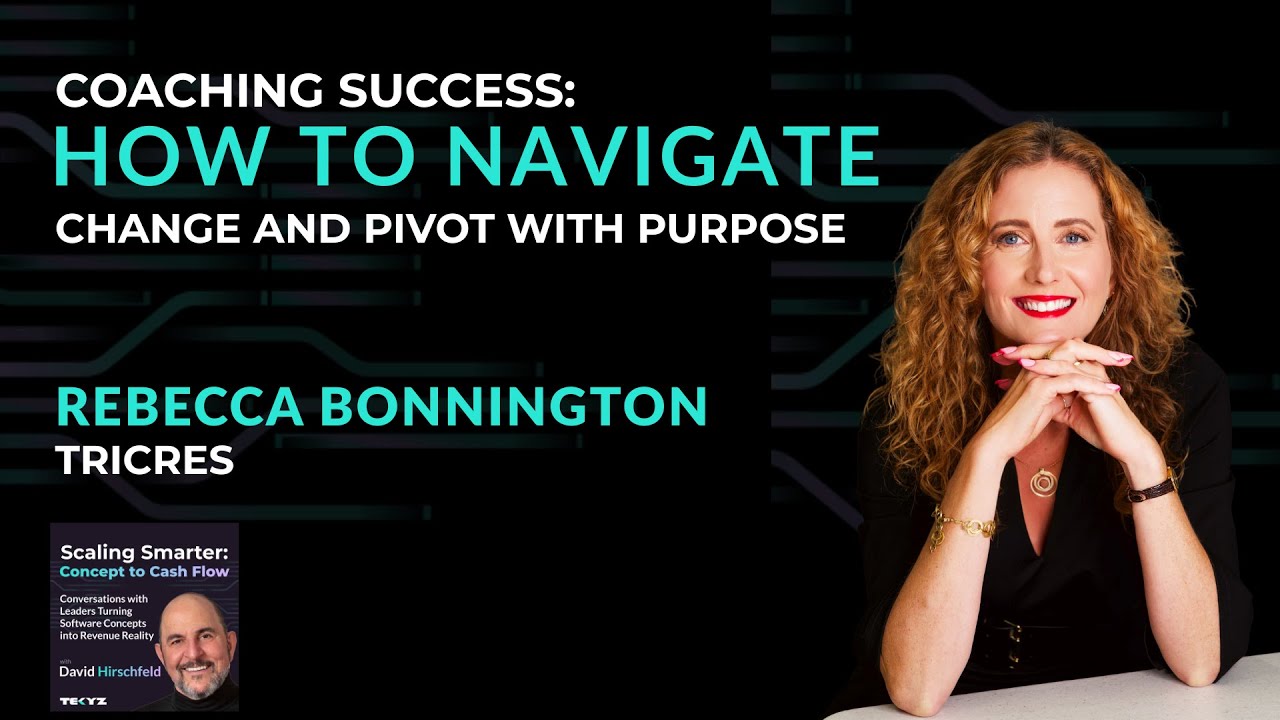
In this episode of Scaling Smarter, host David Hirschfeld interviews Rebecca Bonnington, a business‑coach‑for‑coaches and author of four books. Rebecca shares her 16‑year journey from running a recruitment firm to creating a low‑cost, high‑value coach‑training model called the Kick‑Ass Culture methodology. She recounts early attempts to reach SME owners with a custom app that failed due to a rogue development partner, leading her to pivot to Kajabi for course delivery and ultimately to train other coaches instead of business owners. Rebecca describes building an AI tool, BB Coach, a digital replica of herself that answers coaching questions for her community. She highlights varied client success stories—from a California tech founder using the program for female leadership, to a US engineer moving into internal corporate coaching, to a UK parent balancing family and practice. The conversation explores her personal pivot away from a 15‑person recruitment business to achieve better work‑life balance, and her vision of using technology to create gamified frameworks that help lonely SME owners. Rebecca recommends Matthew Syed’s Black Box Thinking as a must‑read on learning from failure, and provides contact details (tricres.com and LinkedIn). The interview weaves themes of purposeful pivots, affordable scaling, AI integration, and redefining success.
Chapters
Today I've got Rebecca Bonnington. She is the business coach for business coaches. She's— she has trained coaches all around the world. She's a published author of 4 books and a podcast host, and she was nice enough to have interviewed me about 6 months ago, and that was a particularly interesting conversation anyway. And I should say she's an expert on pivoting. So welcome, Rebecca, to Scaling Smarter.
Thank you, David. Thank you so much for asking me.
So Rebecca, tell us a little bit about how you became a coach's business coach's coach.
So I've been coaching, training, consulting, whatever you want to call it, for 16 years. And I was quite lonely after 9 years being out on my own. Great working with clients, really enjoyable, but I wanted to be part of something bigger and share the highs and lows. And I couldn't find a business model that suited me. So I didn't want to pay tens of thousands of pounds for a franchise. And I didn't want to go and work for anybody else because I really enjoy the freedom of working for myself. And like most entrepreneurs went, I know I'll create something. So I created a model that means that you can train with us to be a business coach and you use our materials and our brand, and we don't charge you ridiculous fees. There's no marketing fees, there's no territory fees, and to set up is really high value, low cost entry point. My mission is to spread the Kick-Ass Culture methodology, which is what I created, across the world so people have happier places to work, David.
Okay. This is a goal of everybody. So tell us a little bit about, you started this, your business about 6 years ago and you have struggled at different times and pivoted many times to finally find the right kind of pattern and business and sales. Tell us a little bit about that.
Yeah. When I started out, what I thought was that I would share this methodology with business owners. So, my original target market was SME business owners. I originally paid for an app to be built and designed, thinking that business owners would download the app, ask it some questions about how to run or build the next phase of their business, and the app would magically give them the answers and show the models and things like that. None of that worked, David.
Yeah.
The app was a disaster. The company in South Africa I employed to do it turned out to be run by a bunch of crooks. They didn't pay for AWS for 6 weeks, so it launched and then died because it wasn't supported by AWS. What I hadn't realized is that they—
That's like the worst. Yeah.
Yeah. They hadn't been paying the bills.
That is not good.
No, it wasn't good. And then I found out afterwards that they hadn't even been paying their staff, which was just awful. So I cut my losses. I thought, okay, that didn't work. Somebody said, why don't you use Kajabi? I think most people know what that is, but for people who don't, it's where course creators put all their content and create their courses. It's a great platform. I had, oh, why didn't I know about this soon? So put everything on Kajabi. I was still positioning it at business owners at this point. And it just wasn't working, David. I couldn't even give it away for free because business owners are too busy. They're just too busy to be able to sit down and work this. They actually do want somebody to hold their hand and hold them accountable and talk them through it and make it easy. So I thought I'll train coaches and I ran some pilots. In the first year, and then I did some online Zoom sessions. It worked really well. The people loved it. They got a qualification out of it. And the rest, as they say, is history, David.
And now you've got a huge group of business consultants who are actively using and being trained by the platform and by you. So what, so tell us about how you've leveraged AI and workflow automation to help scale and grow your business?
Yeah, so the first way is Kajabi as a platform. They're constantly updating and reevaluating, so that, that helps me keep up to date. But what I've added is my own coach AI tool. So I created a version of myself in AI. I called it BB Coach, and She, I like to think she's a, she answers all my coaches' coaching questions and it's free at the moment because again, I want to get this out there to everybody. I think I'll start charging a small fee for it, but nothing major. I've got heads of learning and development now using it and it's a really nifty tool.
Tell us about some of the successes that you've had with your coaching program.
So I have had people from all backgrounds, all walks of life, different parts of the world, and they each come to the program wanting something slightly different. So I'll give you some examples. I've got Colleen Hancock. She's based in California. She grew and sold a tech business, obviously, because she's based in California. I don't know what else you do in California apart from do that.
I'm in California, so that's pretty much what I do.
Yeah, exactly. It's like compulsory. And so she, she's taken our materials and she focuses on female leadership. And what she's done is taken what she already knew from her work and combined it with our 21st Century Leadership Program. And she now delivers that to her clients, whether that's pro bono or whether that's paid. So that's really, it's a really good example of probably a more traditional way. Then I've got people, Esther, who's also based in the US. She still works in her 9 to 5. She works for a bunch of engineers who are dotted across the world. And what she's done is taken our learning and uses it in-house. It's enabled her to get, it's not a promotion, but a sideways move into coaching internally in the business. And that's a way I did not imagine our content being used, but I'm delighted it is being used in that way. And then I've got people in the UK who are doing that traditional, self-employed, tapping into the network they've already got. Harry down in London is using it to— yeah, to— he's married with young kids, to have a really nice life. So he can see his kids grow up, he sees his clients, and he's doing great. So lots of really nice success stories.
That's interesting too, because some people think that building the kind of life you want has to do with being big, and growing a big company. I just ate at a restaurant. It's a restaurant where the chef had 3 huge restaurants and he had 130 or 140 employees and he hated it. And so he comes from a European family where, and when he goes to Europe, he sees people that have had the same shop for 50 years and they take a month off every year and they have a work-life balance and So he closed all his restaurants and started a little boutique restaurant near the ocean in Oceanside, California, 5 years ago, and has done incredibly well. And he only has a few employees and he's there every day and he has just a great life and he's really happy. He's the guy that greets you when you go to the restaurant and he loves to talk about his journey. Pivots don't always look like what you expect them to look like.
No, no. And I was that restaurateur. So I had a recruitment business for 9 years. I grew it, a few offices, quite a few staff, not 140, more like 14, 15 staff. And it made me miserable, David. I felt trapped by my own business. I hated turning up to the, my own office every day because I was really bored. And yeah, I wanted to simplify. And I've had a much better quality of life without that business, and I've been able to see my kids grow up and take time off when I want. Yeah, success comes in many different forms and different packages, and it is definitely not always getting bigger.
So I always ask everybody this question. If you had no limitation on budget and you could do anything with technology and AI you wanted, what What problem would you solve?
Oh, that's a really great question. Problem I would solve. I think, I think I would, I'd go back to my original thinking about people running SME businesses in that it can be really lonely doing it and you can feel like there's no one to turn to. My original idea was to create some games out of my models and frameworks. If money was no object, And I could use technology freely, that's what I would do. I would create games of my— out of my models and frameworks so that when business owners are in those dark places at 2 in the morning, they'd have something fun to turn to that would put a smile on their faces and give them the answers that they needed there and then. That's what I would do.
Oh, I like that. I would think that's a great— so give us a book suggestion. What books have you, what book have you read that you think everybody should know about?
Oh, that's a great, um, it's quite an old book actually. It's called Black Box Thinking by Matthew Syed. It was published in 2015 and it was sitting on my bookshelf for years and years. Somebody gave it to me years ago and I heard him interviewed on a podcast and the interviewer said, out of all your books, which one should people read? And he said, Black Box Thinking. It's my best one. I thought, I have to read it. I really, Matthew Syed is a great thinker and a great writer.
Yeah.
And it's about how you fail your way to success. And it's about all the things all these people who are now successful have failed at doing, which eventually leads to being successful. And that's the principle of black boxes in aeroplanes is that they, it records everything that went wrong so that everybody can learn from it. And that's why my proposition for business coaches isn't Expensive, it's not restrictive. It's because I want everybody to learn from where I went wrong and to not do that for themselves. And I mean that in terms of growing my SME business and also setting out as a coach. I just think if you've got knowledge, then you're duty-bound to share it with the world whilst earning a living, but share it in a way that people can access it.
That's okay. I'm— I've not heard of that book, so that's now on my reading list.
Yeah.
Well, Rebecca, we really appreciate you coming on to Scaling Smarter. The links to— oh, how would we get in touch with you if somebody wants to reach out to you? How do they find you?
So that's really easy. If you go to tricres.com, T-R-I-C-R-E-S.com, there's a contact page there and that goes to me. You can find me on LinkedIn, Rebecca Bonnington. You will definitely find me there because I'm all over LinkedIn. And it's really that straightforward. That's it.
All right. Thank you for being on Scaling Smarter.