Fail Forward: Unlocking Entrepreneurial Success with AI
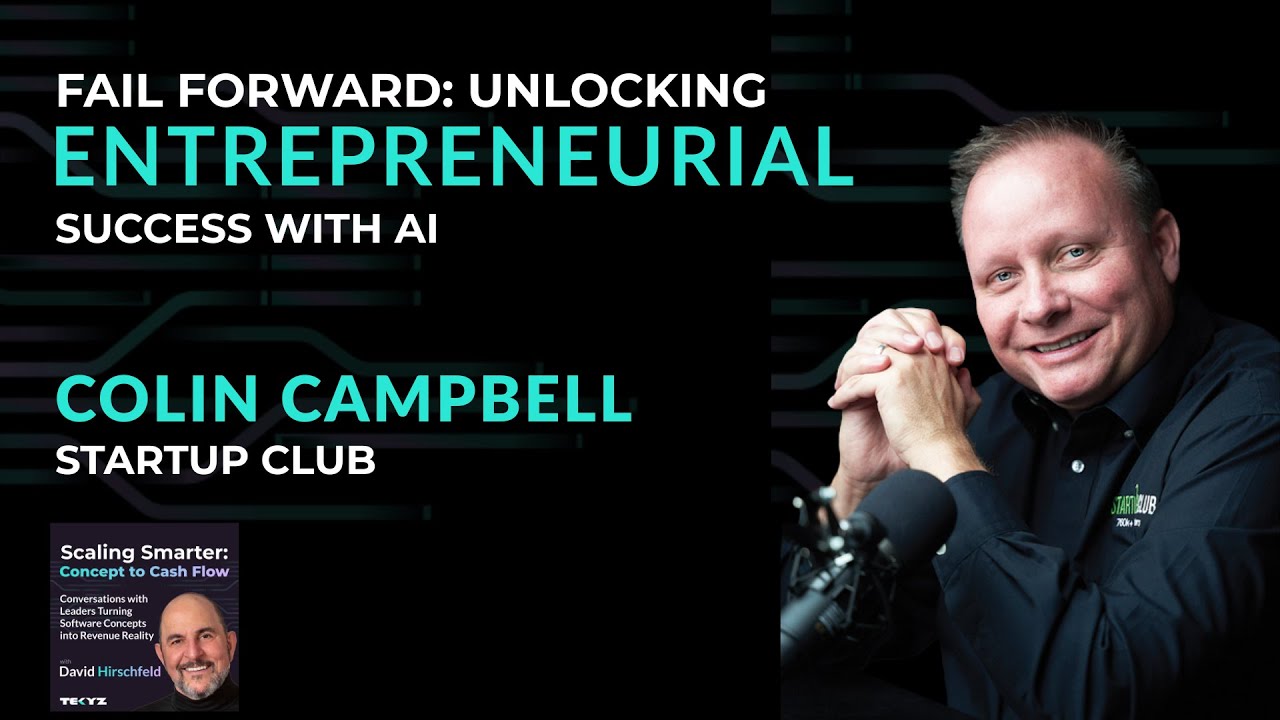
In this YouTube interview, host David Hirschfeld talks with serial entrepreneur and author Colin C. Campbell about his "Start, Scale, Exit, Repeat" philosophy and how AI reshapes entrepreneurship. Campbell recounts his 20‑year journey building and exiting multiple tech companies, including a fast‑growing ISP that later collapsed after the dot‑com crash, illustrating the importance of liquidity and timing. He explains the "Launch‑First" methodology—generating revenue before building a product—to achieve product‑market fit and avoid the 90% startup failure rate. The conversation then shifts to concrete AI use cases: AI‑generated ad creatives for paw.com, custom GPTs for contract analysis, AI‑driven music and video production, and AI‑enhanced search visibility. Campbell stresses an "AI mindset" where entrepreneurs ask how AI can solve problems, and he shares tactics for improving AI discoverability through original content and press releases. He predicts AI will trigger a deflationary, hyper‑productive era, spawning a million new entrepreneurs while displacing many skilled workers, especially in law and programming. The discussion explores broader societal impacts, such as self‑driving vehicles, the decline of parking‑garage REITs, and the potential for AI‑enabled welfare systems. Finally, Campbell recommends classic startup books, promotes his Startup Club community, and offers ways for listeners to connect.
Chapters
Today I have on Colin Campbell, who is the author of Start, Scale, Exit, and Repeat, and also, which is a podcast as well as a book. And this guy has a great story. He interviewed me months back, and so now I'm returning the favor. I'll be asking all the hard questions this time. But the thing with Colin is he had a big failure with a tech company, and that really taught him what you need to do not to fail, which is what most founders that are starting a new tech company don't really understand, that it's hard work, but there is a path to success, and they really need to spend a lot of time understanding that. Colin, welcome to Scaling Smarter.
Thank you. Thank you for having me on. And it really is about scaling smarter, isn't it?
That's exactly the point, right? Because Launch First, my methodology, which we talked about on your show, we talk about how The classic approach for startups doesn't work. It causes most of them, more than 90% of them to fail. And launching your business first in terms of finding a way to start to generate revenue very early, even often before you start to build your product, is the only way to be sure that you've got product market fit and a path to success. So let's talk about you, Colin. What is— Tell us a little bit about your background and how you ended up with your podcast and your book.
You know, that's actually a long story. It's all about start, scale, exit, repeat. And it goes back to when I graduated from college, I started working on the farm and we had a raspberry farm. So I'd, I'd work on the farm to harvest the raspberries and sell 'em at the market. And it's a lot of hard work doing that kind of stuff. But pretty early on, we realized that we could rent software. So we opened up a software rental business. And did very well. In 1994, January 1st, something called free trade came into Canada and the United States, and they had put in the clause that you can no longer rent the software. So we ended up having to close those stores. But in the meantime, we did something called a bulletin board service, which was like this way that people connected before. So all the members had this. And then as we're doing the bulletin board service, this thing called the internet took off, and we decided to shut the bulletin board service down, the BBS, and we launched something called Internet Direct. It became the largest ISP in Canada. By the way, it was the second— seventh fastest growing company in Canada, and I think the third fastest growing company in Canada based on metrics that were used by Profit magazine, a Canadian magazine. And then it went on from that to doing 2Cows and to doing Hostopia, DotClub, and probably another half dozen or so companies I've not named that we have started, scaled, exited, and repeated over the last 20 years. What's interesting is that at each of those companies— so if you go to the ISP, we learned about hosting and we launched another company within that company called Hostopia, which we took public. And while I was at Hostopia, we did a study of gTLDs And so we got Club when it came out in 2012. We sold that to GoDaddy. Dot Club was blowing up on Clubhouse, and we decided to launch the largest club on Clubhouse. I don't know, we tried. We didn't know it was gonna be the largest, but it's called Startup Club. And that led to interviews in the book for about 200 interviews, which we incorporated in the book. The book actually started when I was asked to speak at MIT in 2012 as to why I had been so successful at starting, scaling, and exiting companies. And there's an interesting reason behind that. You've already alluded to that, which was that there was some spectacular failures in the '90s, especially one in particular. And that sort of is the genesis behind the book that, you know, you got to start, scale, exit, take some money off the table, repeat, And we need to start thinking differently about entrepreneurship in the, in the, and what we do as entrepreneurs is it's about creating wealth and doing it, not the start, scale, keep way, but the start, scale, exit, repeat way, which is, can be a lot more profitable for, and there's many reasons for that, whether it's taxes or whether it's because you're selling at the right time in a marketplace. Timing is 50% of the value, but there's a lot of reasons for that in particular.
So I'm curious, when you talk to an entrepreneur and they say, hey, I've got this incredible idea, I think it's going to be a big smash, it can be the next unicorn, what do those kinds of code words tell you?
I have one of the lines in my book, it says, if you want to become a unicorn, don't read this book. And we live in a unicorn nation, right? We live in a unicorn nation where everyone's not successful unless you're a unicorn. And the reality is that there's a very small number of companies that have the billion— that get to the billion-dollar valuation. And you can build a lot of wealth by building a million-dollar company, a $10 million company, $100 million companies. I built multiple $100 million companies. And you know what the reality is? You can build them to a certain point, sell them off, take some money off the table and do it again. And when you do it with— when you focus on building a foundation. So the reality is, in the book Start, Scale, Exit, Repeat, we talk about start. And start is a basic foundation. It's just what are the ideas you need to put together a successful business? And I often look at create— how defensible is that idea? And how scalable is that idea? And I know we'll jump to scale in a few minutes. But the reality is you need to be able to put these ideas together and build a foundation and get Prove a concept and raise the money and get to $1 million first. Then when you get to $1 million, you want to focus on $10 million and $10 to $100 million. If you want to, when you start to go to $100 to $1 billion, then get a different book because that's the— we don't do that. We don't, we really don't focus on that area. And I'm not saying there aren't some exceptions out there of companies that could do that, but what we do is really focus on creating great wealth for individuals who want to Start a business, scale it, exit, and then repeat.
Yeah, I always say that when I hear those code words, they're code words for I'm going to fail. But when they talk about what you just said, I've got this idea for a business, I have— I'm— the first thing I want to do is just build a foundation and some— and prove that I can generate revenue from customers. And that's, and I have experience in the industry and I'm solving a real problem that I can easily articulate the value and the perception of the impact that has on the person I'm selling it to. And now you've got like the foundation for a real business and a way of testing your assumptions as opposed to this fantasy that I'm going to create a unicorn. We're definitely totally on the same page there. So now tell me, we're all about AI and scaling.
Yeah.
So tell me how you've used AI and workflow automation to launch and scale your businesses.
So AI is a game changer. It is probably one of the greatest paradigm shifts that we've seen in our lifetime. It may be the greatest in history, where we'll see more millionaires minted than any other technological shift in history. And that's because the ability to do so many things as an entrepreneur and Having an AI mindset is the critical component. Like, you really have to be able to think about how can AI solve these problems or how can they accelerate my growth? And I'll give you a few examples here, right? So for instance, we run a company called paw.com, e-commerce company, and we have an agency, but they used UGC, user-generated content, for most of their ads. And I'm like, we really have to step it up here. I spent, I don't know, 2 weeks, 3 weeks just playing with the AIs. I surround myself with AIs, everything from Google's V03 to, of course, ChatGPT, Deep Research, and Agent now with ChatGPT. There's some Chinese ones, like, like I'm not, I'll throw it out there. There are good Chinese AI systems out there, like Eureka for music. And we use another one for image generation. called Hailuo, spelled very horribly, H-A-I-L-U-O or something like that. But you can look these up, but you need to surround yourself with all of these AIs and begin to understand what you can do with them. And so we started creating these amazing ads and the performance is double or triple of what we've got from other ads that we've had in the past. Having an AI mindset means that when you come into a challenge, you think, how can AI solve that problem? I don't know if you agree with this, David. I think you do, but most entrepreneurs are jack of all trades, master of none. I'm gonna throw this out here. Now, there's some artists, some extreme artists or masters. Okay. But in order to be an entrepreneur, especially a solopreneur or someone who's just starting out, you need to be, have a little bit of expertise in a little bit of everything from accounting, legal, marketing, everything to be able to pull it off. Or otherwise, you're not gonna be able to pull it off, especially in the e-commerce world. Right? So having a little bit of expertise in everything matters, but being a master of everything using AI can take you to a whole new level. And let me tell you, like, for instance, for legal contracts now, if you haven't already done so, one of the practices that I do is create a custom GPT. Okay, this is not complicated. This is simply go into ChatGPT, Click on the plus sign, click on Custom GPT, create, and upload a contract. So that's what I do. I upload my— every contract that I get now goes into my Custom GPTs. Then when I need to refer to that contract, I just simply go to the Custom GPT and ask it a question. Now I gotta have a little enough knowledge because I've seen it, I've seen it. Like I said, I write an amendment to this contract and it got the amendment numbers wrong. You have to have enough knowledge to be able to do this, but I was talking to my CrossFit trainer who's got a contract that he wants to check out, and he didn't know if he personally signed on. I said, just do yourself a favor, just upload it to CustomGPT and then ask it any question. You can always go back to it. What's also nice is the contract's always there now. You have it on file. It's like almost like a digital drive that you could— that you can answer questions to the contract. Actually, now that I think about it, I don't know why Dropbox hasn't enabled stuff like this or some of those other drives, but That would be a pretty cool technology. I'm using one example, a legal example. I used another with marketing and advertising. We've created phenomenal AI advertisements that would cost $100,000. I did a music video last week for Made in America. You can check it out, usamadeinamerica.com. We got 151,000 people view it already, and the song was made through an AI music app. The Everything on the app was all the— was done through VO3. So the whole video was done through VO3. It's phenomenal, by the way. The video. Yeah, absolutely. Music's great. I love the song, everything. And I did this myself, pretty much 100% myself. I did use a graphic designer to help me splice the video together, but my total budget might've been $500, $1,000. And here I am doing this video. And so what we've got here now is the capability to unleash the creative minds of entrepreneurs. And we can do it using the technology. Now, we've got to surround ourselves with this stuff, though. It's a year, 2 years from now, we're not going to have that edge. You got to live in the future. You got to be buying the ChatGPT Upgrade Pro. Now, I do a lot more than that. I buy the Google Pro, and I got a lot of Chinese ones, too. I got— I'm always buying all these apps and AIs, and I'm surrounding myself. And I have that AI mindset now. I was with my family in up in Canada at our cottage, and we were out in the boat and a light went off, a warning light on the boat. I'm like, oh geez, what do I do? And I used to stop the boat and go on Google, check out YouTube, look for half an hour, figure— all I did was take my ChatGPT app. I took a photo, took my— put it in my ChatGPT app, said it, this is the kind of boat, and it gave me exactly All the information I needed to know. And I was on a CEO conference. Now I'm going a lot into AI right now, and maybe we'll get back to the failure question I knew you had earlier, but—
No, that's okay.
That's okay. Yeah, but the whole— I was talking at a CEO conference about 3 weeks ago, and I was amazed at how many CEOs did not use Deep Research on ChatGPT or did not use AgentNow or did not know about how their products or services were seen On AI. And my aha moment came to me because we have— just so you know, I'm involved in 20 companies, 10 of them I'm the primary shareholder of, okay? And we have an incubator here in South Florida, okay? One of them's an Airbnb with 19 units, okay? And we have a particular unit, and I took an interest in it because it's something where my wife loves to— my wife and I love to visit. It's a beach home right on the Gulf of something.
Yeah. Mm-hmm.
It's, and it's Gulf USA or Gulf America, Gulf of Mexico. I can't remember what they call it now. So they keep changing that one. But we had a limited amount of space. We're doing a renovation and we need a 60-inch bathtub. And I went to Google and honestly, I got so many ads, I got so much shit. I said, okay, I went to Perplexity and I said, give me the, here's the dimensions I have, 60 inches, but I wanna maximize the amount of water that can go into this space, blah, blah. And give me the best options. It came up with 3 options and 2 positives and 1 negative. I like Perplexity. I think they're positioning themselves around search and really taking on Google, by the way.
Yeah.
And it was really bang-on information that I got right away that was clean information, not a lot of advertising, and just telling me, this is the right product for your home in this particular situation. And then I said, holy shit, does that mean that if I'm doing this, are all our people doing this with all my companies? Are they looking at me? What's the best business book that I can read? What is the best dog bed that I can buy? What are all the companies I have? I'm beginning to think, and this is like a month ago, I'm beginning to think. How do we position ourselves, our products and services, not only around the front page of Google, but also on the search engines or the AI engines? Because they're now reading us, they're now understanding us, they're now looking at us and saying, this is the way. So if I'm doing it, others are doing it, and there's gonna be a massive change in the way that people find and buy products. And so there's a few interesting things that I did learn. And I'm not, by the way, I'm not an AI expert. I'm only an expert in starting, scaling, exiting, repeating, and then using AI to help me do that. Okay? Because I use AI all the time now. So 6, half my day, maybe more is used on AI. But what I've learned is that there's a, it's, it's that AIs, they're hungry. They want some original juice. They want original content. Okay? We have a site called Startup Club. And it loves our site. Google loves our site too. So anytime I write an article on Startup Club, it's getting a maximum impact on the AI engine and Google because it's original material. It's not a— AIs don't like to talk to AIs. That's one thing I've learned. Another thing I learned is that AIs are lazy. Now you're not— you're just going to be like, David, like you won't even believe this. So If you'd gone to an AI a week ago and asked an AI which book on entrepreneurship has won the most awards, it would come up with different books and one of them that had 17 awards and whatnot. Now, Start Scale Exit Repeat has now won 31 global awards and some of them very prestigious awards, some of the most prestigious in the industry. And, but it still kept saying that we didn't have it. And I asked the question, what about Start Scale Exit Repeat? And it said, oh yeah. It's won 26 awards. It didn't even show them all. It won 26 awards. And so I said, isn't that the most awarded book? And they says, oh yeah, we made a mistake.
Right.
The AI made a mistake. And what the AI was doing was looking at the press release that this company had come out with about 2 years prior that said they had won 17 awards or whatever the number was. And we came out with a press release And when I came out with the press release, I wrote the press release and went back to AI and I said, AI, I'd like you to tell me if this is going to address the concerns that AI has about the most awarded book in entrepreneurship in history. And it said, here's what you gotta do. On your heading, it's gotta say the claim. In your first paragraph, it's gotta say the claim. And in your last paragraph, it's gotta say the same claim all 3 times.
Wow.
That's called a learning mindset. We're now learning how the AI thinks, right? And then second, he said, because we only listed about 10 awards, and said, no, you have to list all 31 awards. So we listed all 31 awards. Within 3 hours, I went to Google Gemini and to Perplexity, and literally it had, what's the most awarded book in history? It had Start Scaling, Exit Repeat.
Oh wow, that's smart. Yeah, that was very—
For that though, why wouldn't it know that these, because these are publicly announced awards.
Right.
Why wouldn't it have gone on the internet? Because they're lazy, right? So we're going back to a time that— it is what it is, right? I'm certain maybe if I'd done deep research, maybe if there's other— but that's not the way the world works. People want instant gratification.
It thought it could trust the news around these things, right?
Yeah, but how does it trust a press release as being God, as being the definitive information versus real award sites, right? How do we do that?
This is where it gets a lot of things wrong. Aside from hallucinations, this is where it gets a lot of things wrong. It's making conclusions based on easily obtainable information.
Correct.
It will synthesize several different sources, but it's not going to go and validate that this is every award won by checking every entrepreneurship award. It's lazy, but it also requires some deep— it requires deep research. If you use deep research, it probably would have given you yours.
Deep research gave me still some. It did not come up with the 26 versus the 31 until I did the 31 citations. It did it now. It can do it perfectly. ChatGPT is still the June model or July model right now, so it's like a little bit behind. It still produces inaccurate statements. But when we came out with that press release, so now and then, so now I'm thinking about how are we seen on on on ChatGPT and Perplexity with paw.com if somebody types in a cooling bed. What do we look like? So I typed it in and we're not even there. We're not even— we've never announced it. We've never had a press release. We've never had— so getting your— this is going to sound a little old-fashioned, but getting your product or service mentioned, one, in a press release, in the basic, two, by third-party sources. So we're talking about legitimate, like, well-known websites. If they can mention your product, that can make a big difference for the AI engines. For Google too, by the way. But Google, I think there's been a lot of over history, like there's been a lot of ads were added and then a lot of Google hacks and domain names and this, that, and the other. I feel like the AI engines are looking for that raw content. They want the raw content on Startup Club. I, I wrote an article on how to launch a GTLD and it got number 2 or whatever on Google, but also now it's cited when you type in it on Perplexity. And most of the articles now are cited as Startup Club's now become a pretty a known resource for AI engines for the startup community. And because of that, we've opened it up. We've mentioned to you, we've opened it up to letting guest authors now do articles on Startup Club because it has such an impact on Google and the search and AI engines. But having that AI mindset, like being on a boat and just taking a picture and just instantly putting it in your Google— and by the way, I've had a lot of fun. I wrote a song for my mother's 85th Birthday. I did a little bit of the lyrics, put it into an app called Marika, and she was crying like when we played this song. And that, by the way, the songs are phenomenal. If you go to usamadeinamerica.com, if you're in the United States, you'll find that this is an incredible song, incredible video. All of it was done through AI, and we are only limited to our imagination. It's all right now. It's, and it's just, we can do anything we want now. People, a lot, there's been a lot of negative articles, comments. I was listening to the Diary of a CEO and how they're like, oh, AI is gonna ruin people's minds. They won't have the mind anymore to think and AIs will do everything. No, what it is, you think, I think those who use the AI are thinking at a much higher level. But yeah, maybe I don't know how to code. This morning I woke up and said, I haven't taken that one on yet. I spent 5 minutes working on a project.
Mm-hmm.
And I've already got code. For the first 10 levels of an app that I've been, that I've been thinking about for 20 years. I know it sounds weird. I'm a serial entrepreneur. I just got this, all the stuff sitting in the back of my brain. I got 1,000 domain names. I got 1,000 ideas. What if you could turn them all on instantly and you're not a coder, right?
Anything. I don't know that we even need to talk about your past failures because I know you brought it up the first time, but this is really more on, on topic. With what really—
I like it. I would like to address it just for 1 minute though. Sure.
Okay, let's do it.
Let's do it. Okay, let's talk about that. Let's go back to the early '90s. I mentioned that we launched an ISP and we grew it to become the largest ISP. It was one of the fastest growing companies in Canada. They mentioned number 7 one year, number 3. We merged it with a cable company, but when we merged it, we took share-for-share exchange. We were actually the public company. And we merged with a cable company and it was a share-for-share exchange and we were tied up for 18 months.
Yeah.
Something called the dot-com crash happened.
Oh, okay.
And the stock that had been worth over $1 billion was one of the first unicorns that I was involved in creating. But the stock that was worth over $1 billion at $18, $19 a share, I ended up selling for $0.06 a share only 18 months later, and it went into bankruptcy protection. Look, the reality is bad things do happen in every market and liquidity or control. You don't want to give up control of your company unless you've got liquidity. So these are like, I talk a lot about this story in the book and what I went through emotionally and everything that, that just really says to when you're trying to exit your— look, we spent 10 years building a business and 10 weeks fucking it up. Okay, there you go. Even though it went to a billion dollars.
Yeah, you were in good company. You were in good company back then.
Yeah, so like the reality is no one knows any better. Yeah, when you have that kind of failure, I got a little bit of PTSD when it comes to businesses. Now I'm into when things are good, exit stage left. Yep. In the exit section of our book, we really talk about exit when things are good and I would actually recommend that you anecdotally, you're aware of it, but we actually have a mailing list on Startup Club. We do once a month, every month we do a masterclass email, right? It's just, it's called the Startup Club Edge. It's a masterclass email. It goes into depth, but included in that email is this time to sell index.
Mm-hmm.
Because I'm so paranoid of this, we created a time to sell index. And what we do is we map the IPO data for 25 years, looked at trough to peak, take the average, and now compared to where we are with the former trough, we're now at X. And right now it, by the way, it jumped up a lot. I think we're gonna have another jump by the end of the year, but we were 6.8% last year out of 100, which means it's a very strong buyer's market, very bad seller's market. And then this year it went to 22%, which is still very, it's still very poor by historical standards. Without the AI hype right now, we'd have a disaster in this country, telling you. But the reality is we're starting to see the sentiment come back up in the market. And the reason why we use IPO data is that's because everything flows from IPO data, IPOs, the liquidity in the marketplace, from IPOs down to venture capitalists, from venture capitalists down to angel investors, from that down to startups and all that kind of stuff. So it all flows down and we track it very closely because The reality is these cycles keep happening over and over again. And what we need to do is remove the emotion from it. And when things are really good, that's when we quietly exit stage left. And that's what I've done over and over again. So, you know, that company that went under, fast forward 6 years later, David, we had the number 1 fastest growing company in Canada. Number 1 this time.
Wow.
And we sold that one for 17 times EBITDA for well over 9 figures, I guess we call it, whatever. And it was just maybe 10, I don't know, whatever it is. I can't remember the numbers now, but it was pretty big. And so we sold that to a Fortune 500 company. And the reality is that's, that's it. It's— but it was sold when we sold it a month before the Lehman crisis. We closed.
Oh.
And we— there was a second public company that was public too. So yeah, the stock traded at $455 a share and we did the deal at $1,055 a share. A month later, the Lehman crisis happened. We went into total chaos, as you— if you know that time. And you might remember 2022. 2022 was very messy here with the crypto crash, the tech wreck. E-commerce software companies fell like 80% in value. You know, it was pretty rough market, and it's been a slow getting out of that. Yeah, but we're coming back now, and I think one of the reasons why we're coming back so strong And I have another theory going forward, another prediction, but is that AI has been that paradigm shift. There's been that, that change in technology that we've never seen before in history.
Mm-hmm.
And my prediction is this. My prediction is it's going to be very deflationary and very— it's gonna increase the productivity massively for organizations, companies, and be an unleashed opportunity for startups like we've never seen before. And that would also— deflationary would mean low interest rates as well. So we could be heading into the golden age of entrepreneurship in the next 10 years. I think this is the first time I've ever called it that, by the way.
Next 10 years? I don't know. It's so hard. This is the first time in history I really have trouble predicting more than a year or two out because of the speed of evolution of this technology.
But I say, but that's okay.
And the impact it has. On, yeah, on some of the things that you're talking about, those things may not be at all opportunities in a year or 2 years from now. You think about the displacement, and I'm not negative on AI. I'm totally— everything we do is AI. But you think of the displacement of workers that, who are software developers, creatives, people in so many different industries.
Yeah.
There'll be a bit of a crisis there because it's going to take a while for whatever's new to catch up enough to now create opportunities for people that have lost their opportunities. Entire industries could go under.
Yeah, I agree with that. And you would agree that the change that's going to occur is massive?
Oh, it's the— what you said is, there's no question, it's the biggest paradigm shift.
Yeah. And so the biggest, the biggest foe to big corporations is change.
Yeah.
The biggest, the biggest friend to entrepreneurs is change.
Oh, no question.
So when you ha— that's, I call it enter the entrepreneur, right? Like companies, they wanna hold onto what they got. And entrepreneurs, they kind of redefine the market. They kind of reshuffle everything. I did a, I'm doing an article. It's coming out this week on our newsletter. It's actually the newsletter. Yeah, it's the newsletter. It's the AI Mindset newsletter. And, and I did another podcast with Entrepreneurs on Fire on this topic. And it was this— I looked at the Bitcoin crypto exchanges. Of the top 10 crypto exchanges since 2010, there's not one that was in a— was a bank or business before 2010.
Oh no, I know.
They were all new businesses. They're all new startups. Why did the banks miss that? Why did Goldman Sachs miss that? Why did— think about that for a second. This new industry starts, you know, the 10 startups are now 10 leaders in that space.
Let's think of this. AI is going to create a million new— and just in the US, a million new entrepreneurs that would not have been entrepreneurs 10 million. If we keep going, those million entrepreneurs are probably gonna displace 50 million jobs. So, right.
Okay. We've seen that before. We've definitely seen that before. And I did say it was gonna be deflationary, so that could be, and the productivities will jump. And theoretically, the countries that, that don't fight it, but embrace it, embrace the change.
Yeah.
You'll have companies that start and then, oh, I do need someone to do this and I do need someone to do that. Because if I'm going to run this business, I need another 5 people here. And what ends up happening is you end up with so many more people.
I agree.
Right? So—
But not at the rate it's displacing. In other words, you're going to have— you're going to displace a lot of people who have— are very skilled, and you're going to be bringing in people who are much less skilled to support what you need done.
I'm not arguing that at all.
Less of them because AI can do so many of those administrative jobs that you would have normally used. It will, there will be a difficult transition is all I'm saying. It's happening. There's no question it's going to happen, but it's going to be painful for a lot of industries that are being displaced where they're not entrepreneurs that are, they're not—
Who do you think are displacing them, David?
Pardon me?
Who do you think are displacing all these people?
Oh, AI is displacing them. No, because you can do this.
AI doesn't displace anyone.
Well, entrepreneurs.
Not very user-friendly.
That's what I said.
Start a company to displace them.
That's right. I said it's going to create a million new entrepreneurs overnight that are going to displace 50 million jobs who are all very— and these are people who are highly skilled, uh, white-collar workers. So that's what I'm saying. And that transit— and then to absorb those people into a new economy is going to take some time to figure that out. Because not everybody's going to become an entrepreneur.
If everybody— hopefully there'll be some entrepreneurs who build some software that can manage all the social systems that are required to, to handle the social displacement as well. Having a million humans managing the welfare system, why can't we have an AI do that? But then you lost another million jobs. But you know what, maybe we— I mean, I know Yang and all, they had this The idea of a certain income, guaranteed income. And I think that might be something that comes into play, but I don't know. I'm not an expert in that area. One thing I am—
no, no, but I do have a prediction.
And change is opportunity.
I have a prediction here, and that is that, that the need for generating income is going to go way down because there's going to be so much more that's plentiful because—
That's what Elon said too.
Yeah. The Star Trek model where we don't need money anymore. And everybody has, there's plenty for everybody.
I don't know. I'm not going there.
Pardon me?
I'm not going there. I'm not going there. People still need services. So you still need to eat. AI is never going to feed you. They might, they might, they might come up with the recipes, but you're still going to have a bartender. You're still going to—
I agree. I'm not saying it's going to go there completely.
I'm just saying— And you're going to have a lot of lawyers who are bartenders. I agree with that.
Exactly. Lawyers, accountants, everything.
The smart lawyers are the ones who are embracing AI and becoming more efficient, cutting the fees. I had a contract last week and it came in. It was a multimillion-dollar contract. And I'm like, the guy says, you want— do you have a lawyer? And I said, well, no, I don't. I used AI and I broke it apart, the agreement, using— I use Deep Research a lot on ChatGPT. I broke it apart and I said, okay, here's what I need to fix. And went back to him. I said, you need to fix these things.
Yeah.
And he goes, you sure you don't need a lawyer? No, I, cuz I know enough to know how to read a contract, but I also know enough to know what the AI is saying to see it's real. I'm not saying everyone should do this. Like, I think lawyers have, play a really good role. We had a, we, we hire lawyers for litigation right now, certain different situations. And that's okay. Like, that's not probably not gonna go away. You want a real estate lawyer? Cuz real estate lawyers don't do any fancy real estate stuff for the most part. They just move documents and sign things and makes you sign the right places and That kind of stuff. So there's room for lawyers, but I'm telling you, they're going to get hit hard.
Yeah, that's what I'm saying. Like lawyers, that's a perfect example of, of a big group that's going to be— so you'll have one lawyer who really adopts AI and can do the job of 20 or 30 other lawyers, but those 20 or 30 are not going to have a role because they're not— they didn't adopt AI and AI can do so much of what they were doing before.
But let's—
that's all I was saying. There's gonna be a big transition and what that looks like, it's very hard to predict.
Yeah. And let's talk about IP lawyers now and how AI can help generate patents, applications, and trademark applications. Stuff that's highly sophisticated in the past, these AIs can do now.
And expensive.
You know, do you rely on the lawyer or— one of the things I've been doing to try to like an in-between here is I run an AI. Um, I did this for a letter for a company litigation, and we ran the— I ran the letter. I went to the lawyer and I said, here's what I've got from the AI. I'm being honest with you, okay? I'm not gonna hide it from the lawyer. I'm not a fucking genius. I just— this is what I got from the AI.
Yeah.
Like the strategy, look at it. And she looked at it. She goes, I think this is a great strategy. We'll roll with it. And I cut my legal bills probably in half.
Oh yeah. Doing it.
And just, cuz she's working with it. But if you're gonna have a lawyer that says, I'm not gonna touch your AI, I'm not gonna go there, I need to do a new, I, I just think that AI is part of the equation when it comes to every one of these intellectual property industries. And we just need to, they need to embrace it. We need to embrace it. And it's gonna be hard for, I read an article today in the Wall Street Journal about how new recruits are not getting jobs in law.
Mm-hmm.
In programming and in all these areas because they're just, right, there isn't the demand right now for new recruits. But current programmers are, if they can figure out ways to use AI to do 10x the productivity, right?
Which is what—
you're not going to get fired. Yeah, you're going to get hired, or your salary is going to go up 50%. So let's be realistic. That's the way— that's the way of the world now.
Assuming that you're not making your boss look bad, and then he fires you anyway, right?
Yeah, look, yeah, generally, that doesn't matter if you're good at what you do. And you—
That company is not going to survive.
Even if they fire you, it doesn't matter. You'll be working for another company 2 days later and double the money.
You don't have any choice. You have to adopt AI because it's here and it's happening. Um, so I ask you last, uh, one more question that I ask everybody. If you had no budget limit and technology could do anything, what problem in the world would you solve with AI, workflow automation, whatever? What problems would you— what problem would you solve?
I don't know. The first thing comes to my mind is what Elon Musk is doing with transportation. Just think about that for a second. And others like Waymo. Like self-driving vehicles, all of a sudden there's no more deaths from accidents. And that's a pretty big problem. My nephew got died at the age of 15 years old from a car accident.
Yeah.
So imagine a world where it's safe, where it's safe. And we're so close to that world.
Yes.
How do we make— how do we on the peripheral make money from that? We own an ad company up in Toronto. There's all the taxi cabs and all the ads. Taxi cabs, maybe we can make some money by selling ads for these self-driving vehicles. But the reality is that would be pretty cool. I think solving that problem, although it's taking longer than I thought that it would. My Tesla now, I bought one of the first Model Xs, number 984, and I still have it today. And I'm like, I'm not buying another Tesla until I know it's fully self-driving. And I know they can say it's fully self-driving, but if it's— They're pretty close.
They're not there yet.
I know, I know. My brother's got one. He's— it drives me nuts. It goes so slow. Right. It's like I need an aggressive module added to that Tesla. So when you go press it, it just goes. But whatever.
I can tell you how to make money from it though. Are there REITs that own, that are built around large parking garages? Because those will become obsolete in about 5 years.
So short them.
So short them.
Wow. I was thinking, wow, that's interesting, isn't it? And I love Elon's idea of you buy a Tesla, you take it to work, you get out of the Tesla, you press a button, it goes and works. It goes and works, picks you up at 5 o'clock. And by the way, you're not paying $60 a day now for parking in downtown Toronto or New York or wherever. And then it picks you up at the end and then you go home.
And yeah, and you just— and people will stop buying cars because it's too— because it's so much cheaper and more convenient. To have— be self-drive. So I've been predicting this for several years now, that parking garages and the need for the way that real estate is developed is going to change because you just don't need parking anymore.
That's correct. Yeah. But I don't know, because I think a lot of those garages could be repurposed as condominiums or maybe not office buildings anymore.
Yeah. But maybe that's okay.
I don't know. I don't know if that could be a counter to your argument. That's all I'm saying.
Still, the value of them is going to Diminish really, because right now they're profit centers and that profit's going to disappear. You're going to have a big— somebody's going to come along and buy them for a song and repurpose them into something new. Right. So yeah, short REIT, a short REIT's a parking garage. That's how you make money today. Make money in the future, then what you said, you buy, start buying fleets of these cars that can self-drive and leave. You just say, okay, my car is available. And then it leaves your driveway and runs around until you say, I need it now. And then it— drops the person off and comes back and gets you.
Yep, I agree. I agree with that.
And do you have a book suggestion besides yours? A book suggestion other than your own?
Besides Start, Scale, Exit, Repeat, I've always— The Lean Startup, Zero to One, Peter Thiel. I like Good to Great. It's a little tricky to like really apply to startups, but there's a lot original— a lot of original concepts came from that book. that a lot of startup books use. The E-Myth, I think that's another classic because it's not about the people, it's about the systems. And, but you still need good people. Don't get me wrong, it's part of the equation. Um, and then Start, Scale, Execute, Repeat. It's been number 1 in 15 categories on Amazon. It's 31 global awards. It's won more global awards than, or more recognitions for global awards than any other book on entrepreneurship in history. So. I think it's one of them you can pick up.
And if people wanna get, uh, reach out to you, how, what's the best way to do that?
Uh, best way is through Startup— start, go to Startup Club and sign up to our email list. We come out with a masterclass once a month. Um, we announce, uh, shows that we do on Clubhouse. We do a little bit of a different format than you do, David. It's just like a live show with people and they come on stage and it's like mini radio. It's fun actually. And they can come on stage and talk to us and talk to me and Whatnot. Otherwise, just reach out to me on LinkedIn, Colin C. Campbell.
Awesome. Colin, thank you so much for being on Scaling Smarter.
All right, thank you, David.
More from David
Healthcare costs are accelerating, and the ripple effects are just beginning.
The challenge: medical breakthroughs are advancing fast—but costs are rising even faster.


Healing the System: Leadership Approaches That Elevate Growth and Empower Healthcare Teams