How AI and Personal Values Are Revolutionizing the Way We Choose Stocks
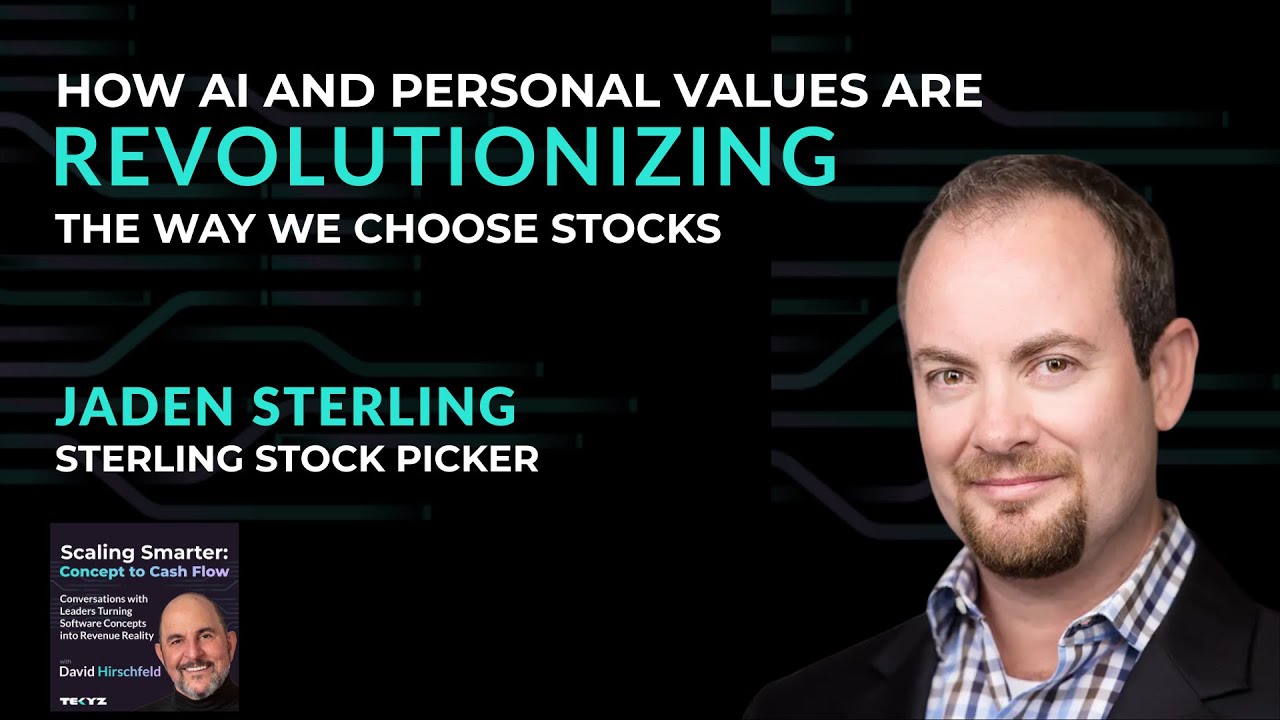
In this episode of Scaling Smarter, host David Hirschfeld interviews Jaden Sterling, the founder of Sterling Stock Picker, a SaaS platform that helps investors select stocks using a blend of AI, personal‑values alignment, and risk profiling. Sterling recounts his transition from a 1990s Wall Street career at Merrill Lynch and Citigroup—where he observed that concentrated, focused portfolios outperformed diversified packaged products—to teaching investors through workshops and courses. A request from a student sparked the creation of a software platform eight years ago, which has grown from a handful of early users to 2,500 subscribers across 12 countries. The company raised $750,000 from its own user base when only 100 users existed, turning 32 investors into shareholders. Sterling explains how the platform leverages a Retrieval‑Augmented Generation (RAG) vector database, a large language model, and a proprietary AI financial coach named Finley to deliver personalized stock recommendations that respect 33 personal‑value dimensions (e.g., health‑oriented users never see fast‑food stocks). Growth has been driven by high‑level affiliate partnerships and community outreach, adding 2,000 users in the current year. Performance is highlighted with 5‑star stock picks delivering 56%‑plus returns over sector averages in rolling 30‑day windows and around 60% over 12 months. Future plans include a Frequent Trader Program that surfaces daily short‑term momentum opportunities based on 11 proprietary metrics, offered as a modest subscription. Sterling also shares his broader vision of a universal financial‑decision engine and recommends two books—Atomic Habits and The Surrender Experiment.
Chapters
Today, Scaling Smarter welcomes Jaden Sterling to the show. Jaden spent his formative years working on Wall Street for Merrill Lynch and Citigroup, and then later created a money coaching program for investors and then started his own company, SaaS company, where he helps traders pick stocks. So Jayden, welcome to Scaling Smarter.
Hey David, thanks for having me.
So Jayden, tell us a little bit about your genesis to becoming a SaaS company.
Yeah, so like you mentioned, I worked on Wall Street in the '90s and I saw the most successful investors back then were our clients who came into Merrill Lynch, multimillionaires, and they had like a handful of stocks anywhere from 4 to 8 different companies in their portfolio. And we were instructed as good corporate employees to sell their positions, diversify because of risk, and put them in packaged products like mutual funds, investment trusts, bond funds, all that stuff, manage money. And being an insider on Wall Street, I learned very quickly that the industry is set up to make money off of people, not for people.
Mm-hmm.
So it opened my eyes. And one day I sat down and ran the numbers and I looked at my clients' holdings when they first came to the firm. And I could see very quickly that if they had just held their stocks, their performance would've been far better than selling them and buying them into packaged products. So that was my— so then I followed suit. I bought one stock in the '90s and invested all my money in that. And it happened to be Travelers Insurance Company. It tripled during the '90s, and I created a lot of wealth from that back then. A million dollars back then was a lot of money. Today it's not so much, but—
Right.
I learned that it was the power of focus. It was that diversification is a myth. And I took that knowledge, David, and I started teaching people. I would just do it informally, talk to people, and I would do workshops and seminars and share this knowledge and information. And I noticed that they weren't doing anything with it. And I thought, oh, all right, that's because I'm not charging for this information. People value what they pay for.
Yeah.
So it taught me, all right, let's just formalize this and start teaching it on a level where people have to invest to, to learn. So I did. So I started creating courses and programs and taught basically from 2013 Until about 3 or 4 years ago. And the shift that took place was during our time where a student came to me and said, hey, I love what you're teaching me. You've got me going over to this website to find this information and that website to get information. And could you just create software around everything that you're teaching? And then I only have one place to go to. And I said, that's a great idea, but I'm not a, I'm not a software guy. I'm not a programmer. I didn't, I wouldn't even know where to start with that. So I said, let me let me think about that. Let me sit with it. And then one of my one of my students, actually a personal development student, came to me and he said, "Look, my partner and I are program programmers, and things have slowed down for us a little bit. Do you have any projects you're working on?" And I said, "I happen to have a project if you're interested." I said, "If I've been teaching courses on empowering people about money, teaching them how to invest money." helping them navigate money myths and teaching them to create a concentrated portfolio where they can actually do something meaningful with their investments, actually grow wealth. And I said, if we could create software where people could find— even novice investors, like, don't even know what they're doing or just starting to get involved in investing, all the way to expert investors— if we could teach them or show them in 2 clicks or less how to find winning stocks, I think we'd have something. And they said, all right, we'll jump in. They don't— they didn't know anything about investing or anything about the stock market, but they knew how to create— take my vision and put it on a screen. And so that's been 8 years now. Wow, time flies when you're having fun. 8 years. And they say it takes 8 years to become an overnight success. And that's exactly what's happened for us this year. We grew our subscriber base. We rolled into 2025 with 500 subscribers. We're now at 2,500 subscribers. So we've had this tremendous period of scaling our user base, and it's been awesome because we've gone from— we were just basically focused in North America, US, Canada stocks, and now we're global. We're in 12 different countries where we analyze stocks for investors around the world. So it's been really an incredible year so far for us.
It's amazing when you go international too, right? Because all of a sudden your horizon shifts. My very first company, software company, which was in the '90s, started out as a US software company for logistics, route distribution, inventory management. But when I sold it 8 years later, we had 800 customers in 22 countries.
Awesome.
And so it was, it was, and then we'd go to trade shows and people from all these different countries would be coming to see us. And all excited that they get to see this American company that's really helped them grow their businesses. So I get the excitement around becoming international.
And I really like that about your story. You were what I call an early adopter of that type of technology because how many companies back then were out there developing software like you did?
We were the, in the In our industry, in the snack food distribution industry, we were the first Windows product, which is, which was funny. Not that it's my interview, it's yours, but which was funny because we had no idea that we had tapped into a vein being a Windows product and less expensive than these big Unix screen complex products. And our first trade show we went to, it was just 2 of us and it was a little 10 by 10 booth that we got at the very last minute, decided to go. We're in the back corner of this huge trade show because you have all the big snack food companies and the soda companies there and manufacturers of equipment. And, and we're in the very back and we had people lined up outside our booth for 3 solid days. We never got to eat lunch the whole time we were at the show because we were demoing solidly. We even had fire marshals come and Tell us to, that we had to move people out. And we told them that, look, we're not going to tell them to move. You tell them to move because you're blocking the road.
Something like that has got to inspire a listener on this show. Even we often, we often have a vision of what we want to create, but we're not sure how to get there. And then once you just take a risk, which is basically what I heard you say, which is what we did as well. When you take a risk and keep following, showing up just one foot in front of the other, Magic happens, and you said in eight years you sold your company.
Yeah, in eight years we sold our company to a publicly traded firm out of Toronto.
Awesome. Yeah, that's great. So yeah, our goal is we did a capital raise to help fund the project. We had first funded it personally, and then we did a capital raise seven hundred fifty thousand just from our user base, and it was at a time when our user base was a hundred users, and. 32, a third of our user base said, yes, we will invest in you, which was really for us profound because, yeah, early, it was so early.
And right.
And they said, yeah, we believe in what you're doing. We like what you're doing. And that's our mission now. My goal is to turn all of those 32 investors into millionaires. Now that in this incredible society that we're in, this age of crypto, and we're looking at, there's so many other conventional or non-conventional exit strategies. That we're even thinking about it going on a tokenized exchange with our, with our platform and just drawing from our current user base in order to make that happen. And there's— and I've talked to, I've talked to venture capitalists. Like, the main— what I'm seeing in this industry now is the main artery of going public or raising capital has completely shifted. It's completely changed. And there's so many— from crowdsourcing, crowdfunding— there's so many new ways to raise capital and to get some liquidity for the business that I think I'm encouraging everyone, man, if you've got a vision, a goal, or a dream, just keep showing up for it because we're in a whole different society now or a different world to operate in that's no longer conventional corporate. It's, it's a lot more creative than that. Yeah.
You told me earlier that you had 100 customers when you went to raise money, and that's so important. that you prove that you've got a revenue model before you start to try to raise money.
Absolutely.
Because that way, you know, you've got a business you can grow. You're not— it's not a dream trying to leverage some investment that— and you don't know who your customer is yet, right? And so you've been able to grow it to $2,500. So your next round is going to be dramatically higher and your valuation is going to be dramatically higher, right? And so you're in that process of starting to build and capitalize on the growth. So how has AI affected your business?
Yeah, in a huge way, from every aspect of the business, from client onboarding to assessing a client's risk level and to recommending stocks based on certain— we actually integrate— we didn't touch on this earlier, but we've integrated a personal value system within our software. And I think we're the only stock picking software platform in the world that does this. So what we did, we correlated 33 personal values with each individually publicly traded stock. So if someone really values health and wellbeing, we will never show them McDonald's or Coca-Cola stock, things like that.
Right.
And AI is directly responsible for the data procurement and showing them these winning stocks that are in alignment with their personal values and their risk level. So, and then we took it a step further to where we integrated AI into what we call a financial coach, Finley. And Finley is on demand 24/7, obviously, where anyone around the world can ask Finley a question from all the way from refinancing a mortgage to finding a winning stock for their portfolio, because Finley knows what's in their portfolio, what's on their watch list for our stock, and has made incredible recommendations I'm always using Finley for my portfolio as well. And you used a term that's new to me, RAG, I think it was.
RAG, yeah. Okay. Yeah. It's how you basically create a, excuse me, a machine learning database, which is a vector database for technical people out there. And that is vertical in terms of, for you, it'd be about stocks and whatever the knowledge you want to train that you're training. your own AI database. And then that informs a large language model like Claude or ChatGPT or whatever you're using for the communication. And that way, the data that it's providing back to your users is very specific to your business domain and expert at your business domain and limited to your business domain, right? So it's not going out there answering medical questions and it's—
Right.
And just getting generalized knowledge on those things, but it's actually using, getting expert knowledge on your specific domain, but in a very conversational way because that's what the large language models are so brilliant at.
Exactly. That's exactly what you said is what we do. That's right.
Yeah. And so how have you used AI and workflow automation to grow your business?
I'm not certain if we use AI to grow the business. How we've grown the business though is through affiliate partnerships and high-level affiliates. We rolled into the year, as I mentioned, like just with about 500 users and coming into our 8th year, I said to my team, this is our year for massive growth. And I said, we're just gonna go about it differently because we had done some different marketing efforts in the past and they didn't really pan out for us. And so I recognized if we could go with some type of high-level affiliates who have a large following and user base, we could offer their people a discount for our software and an affiliate fee for them as well. So we believe in the model of sharing the wealth. That's, that's our, that's our thing. It's worked out incredibly well. And from podcasts that I do and different summits that I speak on. We find our affiliate partners that way and we make the connection and then they share our platform with their folks. And we've added, like I mentioned, 2,000 users this year so far. And I think we're gonna be able to get— I think we're gonna double user base in the next 2 years. That's our goal.
No, that's excellent.
Yeah.
Yeah. And you've added just 2,000 this year.
Yes.
So in the next 2 years, doubling it seems pretty easy to accomplish, right? Maybe a lot faster than that. That's a conservative number since you've done 2,000 and you're not even the end of third quarter yet.
That's right. We're in it for the long haul and to under-promise and over-deliver. It's how I live my life. It's how I have less stress in my life.
Yes, it's smart.
I just tell my team and our investors, give us 2 more years, we'll get there, and, and then we'll have some type of exit for them.
So that's amazing. What are some of the big plans you have for the software coming up?
We are in the trenches right now, my friend. Yeah, we are working diligently on a program called the Frequent Trader Program where— talk about AI and other assets that we're using— we're identifying winning stocks short-term so that people who are more I know you and I tend to buy and hold. There's many investors out there who like to trade more frequently, like to get into option strategies, which I love option strategies.
Mm-hmm.
So we're developing a system that's going to allow for folks to find stocks that are not only momentum plays, but based on the 11 metrics that we identified as solid metrics for a company. Once we can tick all those boxes, We're gonna show 3 to 5 of those every single day. Tuesday, Wednesday, Thursday, I'm gonna jump on live calls and work, walk people through trades that I'm making within those stocks. So we're super excited about that. And also the fact that we're able to offer this to a much larger audience than we've had before is exciting. We're very careful about different products and services and things that we offer. So far, everything that we've offered from a portfolio assistant helping them put a portfolio together of individual stocks to Finley, we've all done that as part of their original fee. And we haven't raised our prices in all these years either. If anything, we've lowered them over the last 8 years because we want to make sure that it's accessible to everyone. We don't want to have money as a barrier. This will be different though. This will be a small fee to pay to play every month.
Mm-hmm.
And in order to really do a little more handholding with our more active traders.
Oh, that'll be a great way to generate new revenue too, because people trust you. Yeah. And so they're gonna be interested in the kind of stocks that you pick on a monthly basis. Exactly. Yeah.
Yeah. Actually weekly base. We're gonna, we're gonna make it a weekly basis. Yeah. Very frequent program. Yeah. So it'll be a whole new, whole new way for us to introduce the software to people.
Very exciting. What kind of— and, and just tell me that you can't answer this question, but what kind of returns do you typically see from the users that are using your application software?
So we're starting to track that more closely than we have before, but what I can give you is definitive numbers on what our 5-star stocks have done in terms of performance, because we believe in transparency. We post that, it's on our website, sterlingstockpicker.com. It's right there. So on the Previous rolling 30 days, so we roll forward every 30 days, we're up 56% above the indexes, or excuse me, above the sector averages. So our performance has been really good, but that's with our like coveted 5-star, which is a strong buy in our system.
That means— When you say 56% above, do you mean that the return has been 56% or you're Oh, wow. Okay. That's pretty wild.
The total return is greater than 56% because we're above. So if an average was up 56—
Oh, so if the return was 10% on the others, you're at 66%. Wow. Okay.
Yeah. And that's on our homepage that we post. And then our trailing 12-month is right around there, maybe at 60%. So we don't have a ton of 5-star stocks, but the ones that are 5-star are really great performers.
Okay, I'm impressed. I'm signing up for your program as soon as we're done with this interview.
Awesome. Thank you. I look forward to having you in there.
Yeah. So I ask everybody this question. If there was no budget limitation and technology could do anything, what problem in the world would you solve?
For, you mean within our platform?
Or not, or beyond that, whatever.
My expertise is in the financial realm, and I think if I had an unlimited budget kind of approach, I would, I would create a product or software where people could make the best financial decisions for themselves. It would be like a weighing machine or a voting machine. Oh, do I spend $50 on this hoodie, or do I take that and invest in a fractional share of whatever, Amazon? And then it would alert you. So you'd ask this app that question, and then it would just be like, ding, ding, ding, X out the spending the money and big check mark for investing. Like, right, they could weigh these things. Or do I lease a car versus buy? Or do I go with 40-year— now in the States, can you believe this? They have 40-year amortization mortgages, which is the biggest scam on the planet.
Oh my God.
It's crazy. Do I go with a 20-year AM or 40? Like, all these big financial questions from small to big, like daily practices to the big things, where you could run it by this app and it helps you navigate these decisions. I think that's what I would do. Maybe that, maybe that sounds so mundane, but I think it could really help people make better decisions in life.
I think that's great. So do you have a favorite book that you would like to recommend?
I really liked Atomic Habits.
Oh, that's a great book. I love that one too.
Yeah, I— man, I read it every year. I really enjoyed it. But there's one more. Can I give 2?
Yeah, please do.
The Surrender Experiment by Michael Singer.
Okay, that one I'm not familiar with.
Highly recommended.
What is that?
It's based on his life story of how he's this spiritual guy and how he learned to trust in what shows up for him in life and just learn to say yes. And you would find it interesting, and so would your listeners and viewers, Because he's a software guy. He created— he ended up creating software in the medical field billing space. And it was like a multi-billion dollar company. It was incredible what he did. All— but it was neat because it led up to that point of creating the software, his life and his purpose and how he just got into like meditation and just went with it and how the people that showed up in his life made the biggest impact and difference. And now he forced himself just to keep saying yes to everything.
Okay.
Surrendering, right? To surrender to everything. And yeah, man, it's such a good book.
Oh, I love the idea of it. Jayden, I really appreciate you coming to Scaling Smarter and I'm looking forward to continuing the conversation with you.
I am too, David. Thanks very much for having me.
And just as a reminder to my listeners, if anybody's struggling with software issues, whether it's trying to figure out how to implement AI or workflow automation in your organization, or you're struggling with an existing development team, please reach out to tekyz.com. That's T-E-K-Y-Z.com. If you really need exceptional help with software development. Thank you, Jayden, and thank you to my listeners and look forward to the next Scaling Smarter episode.
More from David
Healthcare costs are accelerating, and the ripple effects are just beginning.

The challenge: medical breakthroughs are advancing fast—but costs are rising even faster.


Healing the System: Leadership Approaches That Elevate Growth and Empower Healthcare Teams