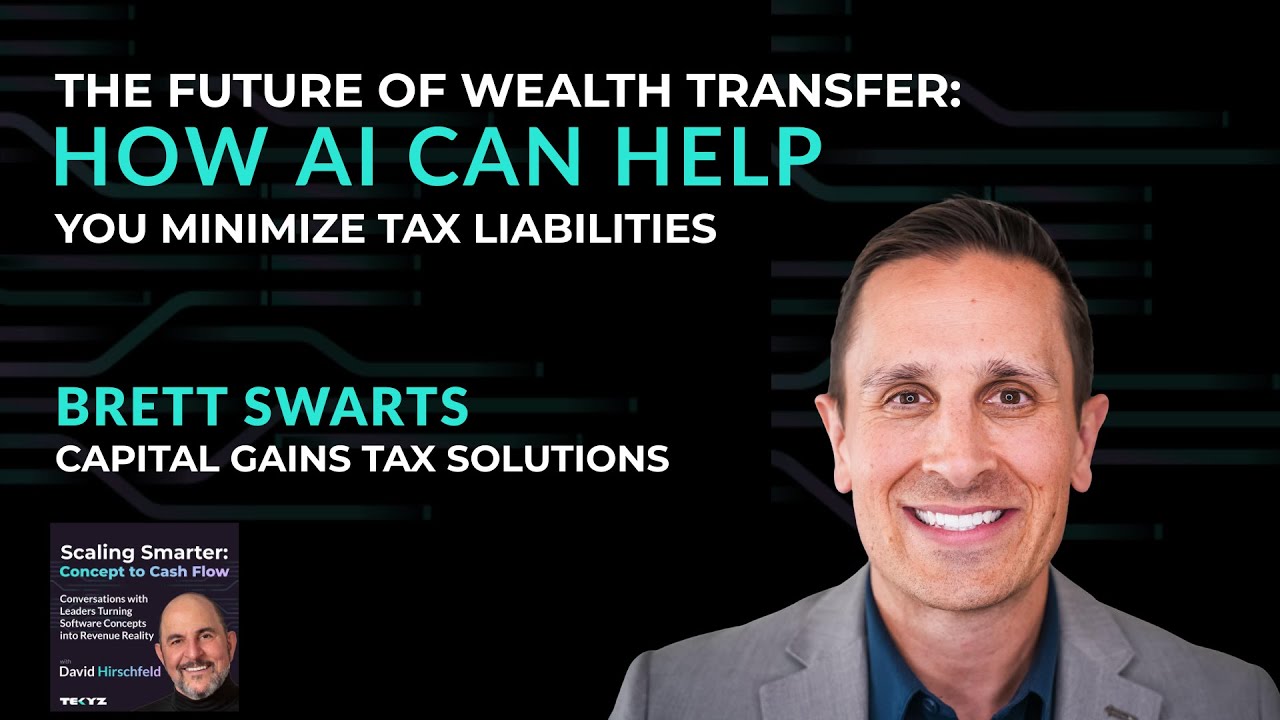
In this episode of Scaling Smarter, host David Hirschfeld interviews Brett Swartz, a specialist in capital gains tax deferral and exit planning for real‑estate and business owners. Brett recounts his journey from a commission‑only real‑estate broker in Sacramento to building a firm that creates capital‑gains tax exit plans, helping clients defer taxes and reinvest proceeds. He explains how he leverages AI to scale his practice, starting with dictation tools (ChatGPT/Gemini) for rapid note‑taking and email drafting, then moving to task‑specific bots and agents that generate newsletters, blog posts, and SEO‑optimized content using platforms like Gumloop and Lindy.ai. Brett discusses the challenges of AI adoption, emphasizing the need for dedicated time blocks, team training, and cultural change to shift from short‑term compliance to long‑term integration. He explores future revenue opportunities, such as AI‑powered expert chatbots that could field capital‑gains questions and be monetized. The conversation highlights the looming $100 trillion wealth transfer over the next 5‑15 years as baby boomers age, framing it as a massive stewardship challenge that AI could help address by educating advisors and targeting high‑net‑worth individuals. Brett also shares book recommendations—the Bible and Chris Voss’s Never Split the Difference—and invites listeners to reach out for AI and automation assistance.
Chapters
In this episode, Scaling Smarter welcomes Brett Swartz to the program. Brett is an expert on how to use, how to recapture capital gains and use that for new investment so that you're not just paying out tons of taxes. And we're gonna talk with Brett about how he's using AI and workflow automation to scale his business as well, and maybe give a few of you entrepreneurs who are looking to exit a way of recapturing that revenue as well. Welcome to the show, Brett.
David, I'm grateful to be here. Thank you for having me.
Yeah. So, tell us a little bit about your journey to get to where you are now.
Yeah. So, I started out, I think I call it like semi-entrepreneur because I worked for a commercial real estate brokerage company where it was 100% commission, 100% sales, and no benefits, no salary, nothing. And this was in 2006 in Sacramento, California. So, I helped people buy and sell multifamily properties. But I basically would serve a kind of what I call mini real estate entrepreneurs. They own these portfolios of real estate properties that basically become their businesses, and then they scale that by doing what's called 1031 exchanges and moving their properties up. And so, I basically was a consultant that helped them buy and sell these investment real estate properties and run them really well. And so, fast forward, I learned about some tax deferral strategies. And so, we basically— we're best positioned to serve the person you once were or the people you used to serve. But I found as I helped these entrepreneur real estate people build their businesses in real estate, their next problem was the capital gains tax. And so we expanded our services and really niched in on a deferral strategy to help them scale more and do it more efficiently. And so yeah, that's all we do now is we build capital gains tax exit plans, and then we help real estate mainly ex— people exit or business people exit, defer tax, and then reinvest the funds to grow their next business venture or their passive real estate or passive income plan.
So tell me how you've used, because you're in a growing business yourself, right? So how have you used AI and workflow automation to scale what you're doing?
Yeah, I think literally one, I think one, one small apple at a time, one small bite of the apple at a time. It's, it's the first most obvious one I use is dictation. I think that's AI automation 1.0, where you're just speaking into the, like a ChatGPT or a Gemini. And you're just saying, hey, here's what I want you to do quickly and efficiently so I don't have to type manually. So it's one input, one output. And so that is probably the— and also what's beautiful about that, David, is in between meetings, you're— I'm 8, sometimes 5, 6, 7, 8 meetings a day and they're back to back. I can quickly, 2 and 3 minutes, just basically download all of the notes in my brain into chat as an example, draft an email or for notes for follow-up. Mm-hmm. For the conversation, and I just speak to ChatGPT and just say, hey, help me do this, draft this email, take down these notes, and it quickly, efficiently kind of brain dumps all of that in there. And boom, I can move on to my next meeting, and then it's— and then it's pre-drafted for me to send in an hour. So I think that's the first way I've really used it, is to accelerate communication on the follow-up, because our conversations can go for an hour. And if I can quickly send Summarize that and get that email out, that helps me to take the part of my brain that doesn't have to think about it later.
Yeah. What are the challenges that you've run into implementing that? And that was one, that was your 1.0 version. So what about 1.1 and 1.2? Yeah.
And the next part of the version is using AI through bots, right? And so within ChatGPT in particular, we're creating individual bots for individual tasks that are repeatable that we can train the bot to do that one task. And we can put some general information into there. An example might be write a newsletter to our avatar, to our current avatar, and be make it make a call to action and weave in our service that we're using. But take this information or take this transcript or take this video interview that I just did and listen or read that and then create this thing. So email sequencing, a newsletter, a blog post. We've recently built one, I think with Gumloop, where you drop the YouTube link into the loop that it's my team create it. And then all you do that, and then it'll automatically create a Google blog post draft for you to review. So one, it goes through the entire process, boom, it has the SEO. So obviously the— takes a little image, creates a little image. And so that is our 2.0 version bot slash now moving into more of an agent. Still takes the— still takes some manual stuff and some review, but we're trying to continue on in that process.
And that's called Gumloop. That's not a program I'm familiar with.
Yeah, I think it's— yeah, it's Gumloop. Yeah, so Lindy.ai, Gumloop are the 2 that Gemini are the— we— Chat has been our main one for 80 to 90%. Yeah, we're branching out into some of these other ones that seem that they're a little more— I feel like a little more friendly. I will also mention in Chat, it's been very helpful to do the custom instructions for individual projects and also custom instructions for the whole— so really making sure that you're set up properly, but then the The projects have been very helpful. So each of my team members have their own name for their projects. That helps to organize the flow there. And then the custom projects, you can give custom instructions. And I think the answer to your question is we're trying to every single day flex the, flex the muscle of AI. And we feel that if we don't, we're gonna be left behind. We don't want to be left behind and we want to be more efficient, make a bigger impact, grow our business. And AI is, is our, is really our big next tool and strategy to master.
Yeah, I try to tell everybody that if you're not adopting AI, then you are already behind because AI changes the game in so many ways. And if you're not changing your game, other people are changing their game and making you obsolete. And there's a lot of companies, especially medium-sized companies that have, that are solidly in their channel that just are not doing this. And the risk that they are facing and the speed at which that risk will, with those chickens will come to roost is impossible to overstate.
Couldn't agree more.
Yeah. So what are some of the big challenges that you've had trying to adopt AI?
Yeah. I think really setting aside the time. I think Dan Martell says buy back your time, like really time blocking. In fact, this week, it's funny we're having this conversation because typically I'm doing podcasts on, on more of just the real estate and the Mm-hmm. And the tax stuff. I love that we're having this conversation, but I set a whole hour with my, with 3 of my team members and said, mm-hmm, all we're gonna do in inside of a, all we're gonna do is focus on training and talking and masterminding on AI every Wednesday at this time. Right. And, and then, so the ch— I'd say the challenge before was really just not taking the time to focus on it. And so it would be sporadic, like watching a YouTube video or a short or something online and, and like you're getting excited about it, but then you're like, oh man, then the next thing's coming out, the next thing coming out, and you're just getting hit by these waves and it's, whoa, whoa, I've gotta get really intentional about it. So I actually don't think it's difficult in the idea, but you've gotta plan it. You gotta put it on the calendar. And so I would just say the fact that it just takes me this long to put it on the calendar. Now I've told my team like, hey team, I want you guys to all adopt AI. I want you, but what I found as an entrepreneur is like, if you don't go first, you get a little, you get a little push in the beginning when you tell them to do something. But if you're not an entrepreneur in the front pulling the rope, like pulling the whole team—
Yeah.
To the adoption of the culture, Then you're gonna get short-term compliance.
Yes.
Versus long-term adoption. And so now what I'm doing, I would say, is I'm getting outta my own way. I've hired a couple more team members to take some stuff off my plate. And now what I'm doing is I'm getting in, I'm putting on the yoke, if you will, of AI. And I'm starting to charge forward and I'm telling my team members to come with me on this journey. And we're gonna be moving from an hour a week to a full day, an entire day of all we're gonna do is say, what are the repeated tasks? Okay. What are the things that we need to, we can do with AI and take a bite out of the apple? Okay. Today we're going to tackle this one for blogs or this one for YouTube scripts or this one for invoicing and just this one tool, this one agent. And so I would say get out of my own way is the answer to the question.
Yeah. So how about using AI to create recurring revenue or, or automated tools that help you deliver like a chatbot that's an expert on capital gain strategies or things like that?
It's a great question. So we haven't got to that level yet, per se. We have some bots that we've created, and we're exploring the idea of taking all of my thought leadership. I wrote a bestselling book called Building a Capital Gains Tax Exit Plan, and basically feeding the bot, like, all of it, boom, and saying basically in, in Brett's voice, how would you answer this question, and have our team do that. So We know of the idea. We haven't quite— we, again, we've done some low level of that, but, uh, but I love the idea. We want to move towards that. The agents, the bots, the ex— the expert part of it. That is definitely the next step for sure.
Yeah. And then maybe even monetizing that.
Yeah, monetize. That's a great question on that thing. So our model is one of someone exits a $10 million business, has $3 million of tax, we defer all of it, and then we help them manage the capital and then move And that's how we get paid on a recurring model. So that would be interesting to see what that looks like and always open to ideas for that.
Huh. That's interesting. So I always ask everybody this question. If you didn't have any technical limitations and there was no budget restriction, what problem would you solve?
So besides the one I'm already solving now, which is the $100 trillion transfer in the next 5 to 15 years, which is known as the largest wealth transfer in the history of the planet. And 10,000 baby boomers turning 65 every single day in the US alone. There's about 80 million in the US alone. And this tsunami of wealth is either going to get taxed, David, or it's going to be deferred or tax efficient. And we believe this will be one of the biggest impacts that the world has ever seen, or the biggest loss or the biggest gain for humanity because of the sheer size of the wealth that's transferring. And we call this the stewardship and the reverse Tea Party of American capital and really mostly the world's capital, because America's probably the richest in the world. And so this is what we're fighting. And so if I had a magic wand or a magic AI, we would be able to go and we would be able to educate the top business advisors, CPAs, financial advisors on not only the urgency of this, but also on the skills, the strategies to help their clients exit. And we'd be a big part of that. So maybe that's the answer to the AI bot, right? Where it, it serves that business community in a real tangible way.
Interesting. And it's, I was even thinking that it could identify people that are about to make that transfer and shortcut, short circuit them from paying those taxes.
Yeah, that's a great point too, to like target or figure out a way to be in front of those people that are founders or Bitcoin billionaires or millionaires or crypto folks. Yeah, we've done it with Bitcoin, done it with crypto, done it with business exits, real estate. So I think that's a good point.
Yeah.
Have it just go and search for and find and put stuff in front of them. I think that's a great idea.
Yeah. And then do you have a book recommendation, a book that you really love? You think—
Yeah, so the Bible always. So if you haven't read the Bible yet, read the Bible. It's actually the most sold book in the history of the world and it's number one bestseller every single year in the world. So the Bible. Outside of the Bible, I would say Never Split the Difference is really good, David. It's a book about communication, negotiation, and really human relationships. A gentleman named Chris Voss. And what I love about it, more than just the book, Actually, it's the masterclass that he gives. It's an app you can download and it's called The Art of Negotiation. And it breaks down the ways that you and I can communicate with our family, business partners, negotiating. It's a, it's an amazing masterclass is what I would say. The book is good too, but I think for a lot of entrepreneurs, like really visual hands-on is really helpful.
Okay, great. Brett, I really appreciate you coming on to Scaling Smarter. And just as a reminder to my audience, anybody struggling with software automation issues, an existing team, or just looking to accelerate and figure out how to adopt AI and workflow automation in your business, which can give you 10x gains and growth, reach out to me, David Hirschfeld, and at tekyz.com. And Brett, thank you for coming on to Scaling Smarter.