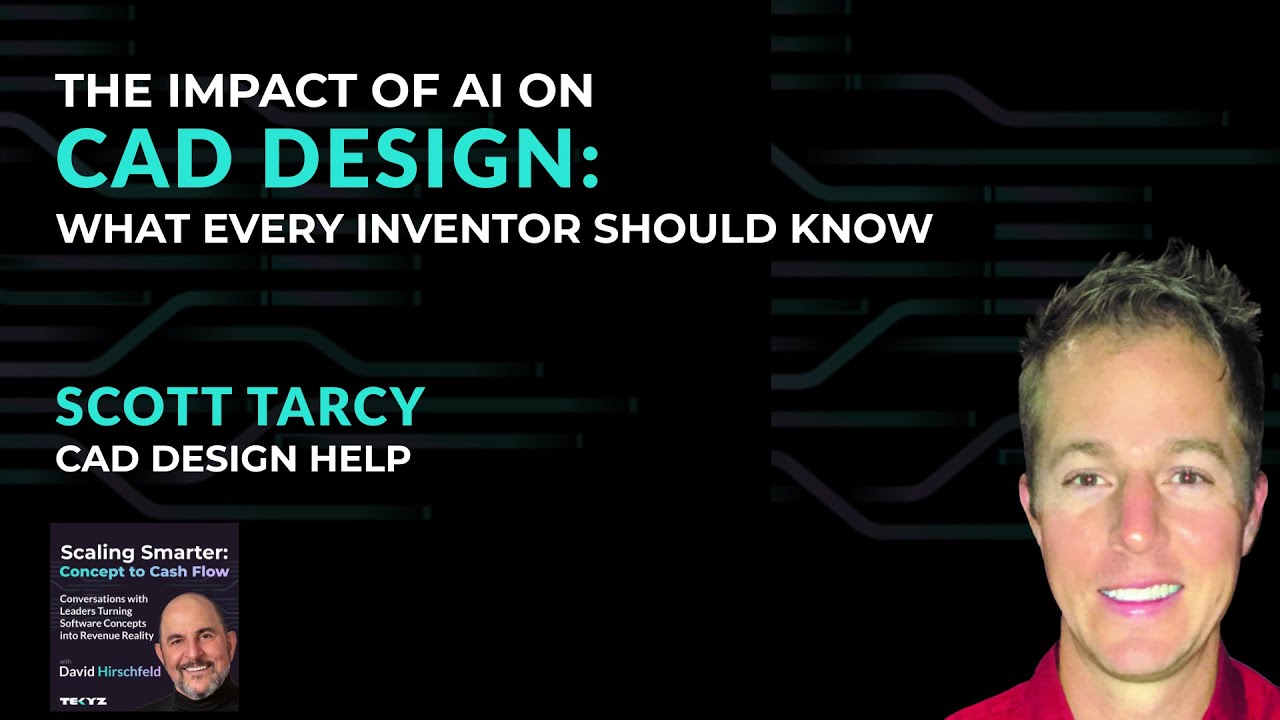
In this episode of Scaling Smarter, host David Hirschfeld interviews Scott Tarsi, president of CAD Design Help. Scott recounts his transition from a decade‑long corporate mechanical‑engineering career to founding his own CAD‑design consultancy in 2014, initially as a side hustle before going full‑time. He highlights several niche product successes, including a Shark‑Tank‑featured egg‑spinning device, a novel surfboard‑carry handle, and custom fire‑truck fixtures, emphasizing the value of solving specific industry problems. The conversation shifts to AI’s emerging role in CAD workflows: Scott notes automation of repetitive tasks like batch filleting, experiments with ChatGPT for image editing, and acknowledges current limitations of prompting. He envisions AI dramatically lowering healthcare costs by automating expensive procedures, though he clarifies he isn’t advocating for eliminating doctors. Scott also shares his favorite productivity book, "The 4‑Hour Workweek," linking its principles of automation and virtual assistance to modern AI tools. The interview concludes with clear contact information for CAD Design Help (cad‑design‑help.com, info@cad-design-help.com) and a reminder to reach David at davidhirschfeld@tekyz.com for AI or software‑development assistance.
Chapters
Scaling Smarter wants to welcome Scott Tarsi to the show. Scott is the president of CAD Design Help and he helps inventors bring their products to market. Hi Scott, welcome to the show.
Hey, thanks for having me.
Scott, tell us a little bit about your journey.
Yeah, so I went to school for mechanical engineering and so that's what I did corporately for 10 years and I wanted to be an entrepreneur. So I figured the best way to do that would be to take the skills that I learned there and Start my own business doing the same thing.
So how has the journey been with, since you started your business? When did you start it?
I started about 12 years ago in 2014, but on the side, it was just a side hustle until I grew it large enough to go full-time.
And then how has that process, how has that been since you've gone full-time?
It's had its ups and downs. COVID was a weird year. Things were actually probably better before COVID but now they're picking back up again. But I would say all in all, it was a great decision.
Yeah. And why do you think it was a great decision?
Just having— being— when you work for yourself, you're working hard for yourself, not hard for somebody else. So that's— and then 2, it's I have control now. Like, I'm the boss. I can control my schedule. I can control the jobs I take and so on. And that's just a way better place to be than to be having somebody else tell you everything.
Sure. So tell me about some of your, the, your customers. What are some success stories you can share?
Yeah, for sure. I've had a company go on Shark Tank and get a deal. It was the eggs, amazing spinning egg thing. I raised Easter eggs. I've had just so many crazy different projects. Sometimes the clients, they take it and they go, I don't really know, find out what ends up happening to them. But there's one I'm working with right now that's a pretty interesting one. I do a little surfing and this lady. From California has this handle that's gonna be able to, you can be able to carry your surfboard around instead of having to carry it under your arm. You just have a little, like a little carry case handle thing that's gonna carry it around. So that's looking, I think that's gonna be a big seller cuz there's nothing, I've never seen anybody out there surfing who's had carry, has something to carry the surfboard with.
Yeah, it's funny. I do woodworking and I've got a little handle for carrying plywood around, so I wonder if it's kind of similar to that. Yeah.
And where did you get that handle? Did you make it yourself?
Oh, from a wood— it's a woodworking store. No, it's a product that you buy for specifically for carrying plywood.
Somebody had the same problem and they figured—
Yeah, exactly.
It was probably somebody who was carrying around plywood by hand and said, there's gotta be a better way to do this.
Exactly.
And they came up, and that's typically the best product are these kind of, let's not say too niche, but something that's for a specific industry. Like making another iPhone case is probably not the best. thing to try to invent.
Right.
It's been done a million times. Like, how different is it gonna be? But specific things like that, or I did this project for this fire truck company and like, they have these very specific like tools they use for firefighting. And like, they, they have specific, like the way they put installed into the fire truck, they have special fixtures for that. And that is the kind of thing that like every, cuz every fire truck company has the same tools. They get the newest equipment every year. And when they, these guys create these like cases or like fixtures to hold it, every single company's gonna buy one because they're all gonna have to find a place to put it in their truck and it all has to be custom made. These kind of products really do well.
So now how has AI affected your industry?
I don't know entirely yet how that will affect. I don't know if it has affected. I, From this, from the standpoint of actually creating, I think that AI is involved. I don't have the latest software on my computer, so that kind of stuff probably has been coming out in the last few years. But maybe a lot of the, like, tedious tasks when you're designing something are probably automated now. Again, I'm not, like, super up to speed on that, but I'd imagine, like, at the end of every file I got to add fillets around the corners. There's probably a button now in the software that says add fillets to every corner and it just does it on versus having to physically click every little thing, which is what you had to do in the past. I, stuff like that, I imagine would be, if it's not out there, it will be out there soon.
There could be things even use AI to improve my design, create a design and then have AI either create it or improve it.
Possibly. But me messing around with ChatGPT, for example, I had a picture Of a store. And I said, I just said, okay, take this picture and change the— I just wanted to change the photos for the address to be a different number. And just doing that, so you could do it in Photoshop, right? I was like, I could have done it in Photoshop, but I was like, let's just see if AI, ChatGPT, it could not do it. Like it literally created an entire different store image and put those numbers on it. And I was like, that was super easy task it failed at. So—
What, when did you try that? Just out of curiosity, how long?
Last week.
Yeah. So it's, and a lot has to do with the prompting because I've been doing stuff like that really effectively recently. Okay. Where I couldn't do it.
ChatGPT or do you use something else?
ChatGPT, actually. I've been able to do stuff like that pretty effectively, but you have to prompt it, be smart about how you prompt it.
I put the photo in and I said, change the store, the house number, store number, whatever address. Whatever it was, the 2908, whatever. It's right there on the front of the photo. It's super clear. And instead of doing that, it created a whole new image. Yeah, but building—
you have to ask it to keep the image identical except for the number and things like that.
I feel like I did. I feel like I added that in later and it still didn't do it right.
Yeah, it does. It's not perfect in that respect, but it's way better than it used to be.
I've had AI take my order at drive-through, so it's Yeah, it's coming along. It's definitely the wave of the future, even if it's not perfect yet.
Yeah. And Google Docs just came out with, I think today, where they read your doc, they'll read your doc for you, which that should have been there a long time ago.
But I think that existed in Microsoft Word like 20 years ago.
Yeah, it did. But it was okay. It was on not Word so much as on the desktop. It was Windows built into Windows.
Okay. Yeah. You could highlight text and hit read for me and it would read it.
And now Google Docs finally has that.
Okay. But it just, but when I tried that in the past, it sounds like a robot reading it.
Oh no, this is a really good voice now.
Okay. So they've improved.
That just came out today.
They've improved how it reads as well.
It just came out today. Yeah. You can pick different voices and it's like what you would expect for AI to be. Okay.
Gotcha.
So I always ask all my guests this, what if you had No limit, budget limit, and technology was not a limitation. What would you— so what problem would you solve using AI and workflow automation? And you can pick any problem.
What problem would I solve? You'd want to solve a problem that would be— you could monetize and make a bunch of money on. That is a good question. I feel like the healthcare industry is the biggest problem. Like, it's just, yeah, Things shouldn't be as expensive as they are. Yeah. And from personal experience, I've had to get these voice surgeries that are just crazy expensive over and over. So if—
You said voice? Voice?
Yeah. Like I've literally had to shove a laser down my nose and burn these spots off my throat. It's crazy. It's crazy. So it's so expensive and I'm assuming it's because the doctor's time is expensive. If all this stuff can be automated, why can't the robot just do it? You know what I mean? And just could do it cheap. And that's a huge problem just from my specific standpoint for all these other medical things. Like if we I'm not advocating getting rid of doctors, but it's just the costs are so high.
Yeah.
That if we can have machines do it, can't we drive the cost down? This is getting into a whole other thing with insurance companies keeping prices high and stuff, but it just seems like that could be a huge issue that could be solved.
Yeah, I agree. I agree.
Like you get like, why is one trip in an ambulance like $12,000 or whatever? 'Cause I just heard stories. Oh yeah.
I've had stories myself like that.
Yeah. It shouldn't cost that much. Like it should be like $100 to ride to the hospital or something. Like, it shouldn't be— you shouldn't go bankrupt from these things. And I don't know, you know, again, I— the story of why is, I think, very complex, but it's just— I just don't think it should be— that should be the case.
So I, I agree. I don't think anybody will argue with you that listens to this show. Do you have any book recommendations?
I haven't read books a long time. What the books that— the book that I got started with that was huge for me was The 4-Hour Workweek, which I know it's an older book, but which one? The 4-Hour Workweek.
Yeah.
So it's really about, it's okay, what are your goals in life? What does your lifestyle wanna look like? And just focus on the important things and automate things. If he wrote the book now, Tim Ferriss, he'd probably include AI. He talked about virtual assistants and finding help. And that's, I do a lot of that stuff. Like I have a virtual assistant and I have people that help me because trying to do every little thing myself would take too much time and I can't focus on the most important things. That book was huge for Me when I got started with this whole journey.
And if somebody wanted to get ahold of you to design their product, how would they reach you?
Yeah, my website's cad-design-help.com. Really easy to remember. Oh, I need help with CAD design. Go to cad-design-help.com. And my email is info at— I should have made it scott at, but it's info@cad-design-help.com.
That works. That's pretty easy to remember. If they don't remember your name, everybody will remember info.
Yeah, exactly.
Anyway, just as a reminder, everybody, if you have issues with software development, you're unhappy with the team you're working with, or you're looking to figure out how to implement AI in your organization or workflow automation to improve efficiency, reach out to me, davidhirschfeld@tekyz.com, spelled T-E-K-Y-Z dot com. Scott, I wanna thank you for coming on to Scaling Smarter.