Unlocking the Future: How AI is Revolutionizing the Consulting Industry
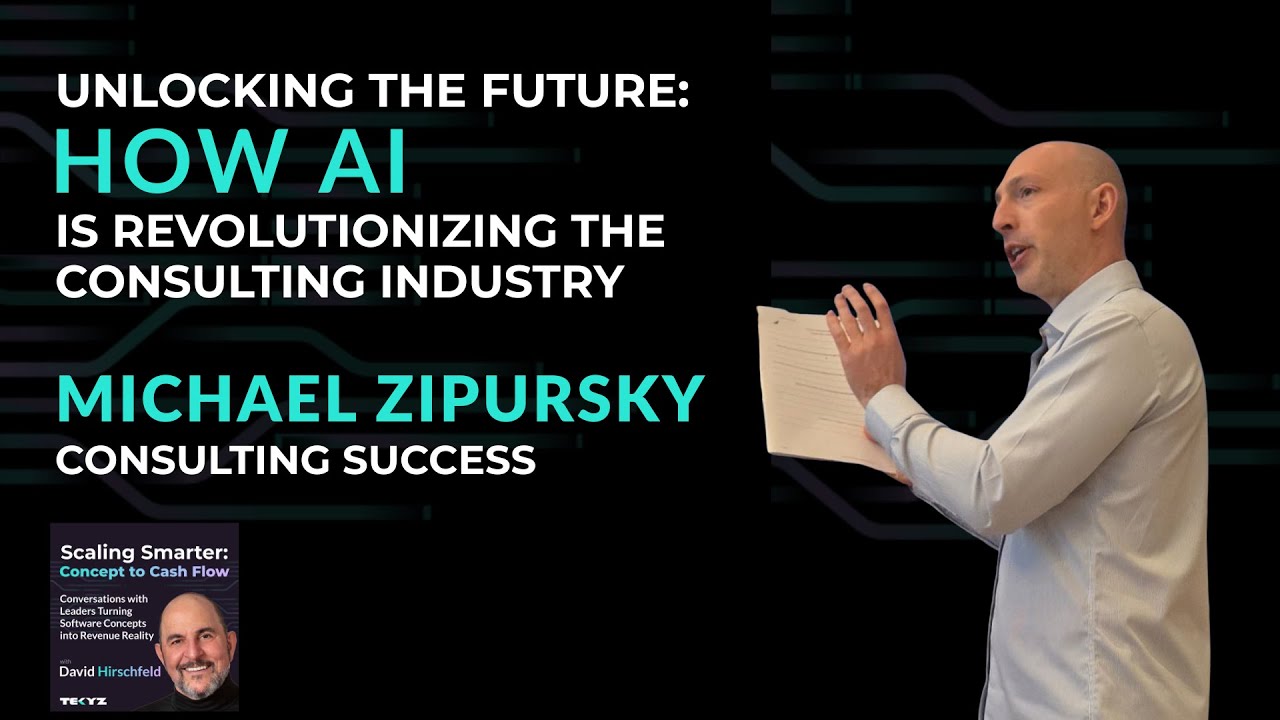
Michael Zipursky built Consulting Success into a program serving over 1,400 participants by teaching consultants systematic pricing and team-building. One client grew from a corporate salary to seven figures in six months; another scaled from $400k to $2 million in 18 months. Zipursky argues AI won't eliminate consulting but will become mandatory to stay competitive.
Chapters
Welcome back to another episode of Scaling Smarter, the podcast where we talk with successful business owners in the software or coaching world, or in a lot of different business domains about how they've used AI and software and workflow automation to help establish, grow, and scale their businesses. And just as a reminder to all of you, if you're looking for somebody to help you with workflow automation, with AI implementation, or you've got an idea for a startup and you're not sure how to go about it, if it's a software idea, talk to me. Techies, we've been doing software development and for apps and startups and existing businesses and can make a huge difference in your effectiveness and your success, the revenue you generate, the reduced cost. Just reach out to me at any time. I'd be happy to talk to you or at least point you in the right direction. Today we have Michael Zipursky, who runs a business called Consulting Success, and you can find him at consultingsuccess.com. And what he does is he helps, and he's an expert at growing other coaching businesses, consulting businesses, to go from wherever they're at and bring them to the next level of success. Welcome, Michael.
Thanks for having me, David.
So why don't you give the audience a little bit of background about you and what you do? Sure.
Yeah, Consulting Success, as you mentioned, we help consulting business owners to build the consulting business that they truly want, whether they are a solo consultant or they have a team in place already. We bring them the systems, the coaching, the support to really help them to reach the next level of success. And I've been doing this for 20+ years. We started off really running multiple different consulting businesses, both in North America as well as in Japan, where I went to open up a branch office for one of our consulting companies there. And my co-founder is my cousin Sam. Our dads are twins, a little fun fact there. But we've been on the journey of building multiple businesses together, selling some businesses together. And almost 20 years ago, we decided that we wanted to do something online. Together that would allow us to live and work anywhere. And this was before the whole idea of digital nomads and remote work was popularized or at least available. And so we started sharing our experiences of building consulting businesses. And the goal of that was to help people avoid many of the mistakes or lessons that we had learned, but also to accelerate their success as consultants. And so that led to people following the story and what we were sharing. And then people said, do you guys have a way that we can learn more about what you've done and can you help us to build more successful consulting businesses? And so we launched an online program and then people said, this is fantastic. Is there a way that we can get coaching from you? And we said, we don't have a coaching program, but we'll build one. And so today we've had about 1,400 people go through our online program and about 1,200 consulting business owners have gone through our Clarity Coaching Program. Our whole team is focused and really specializes in working with consulting consulting business owners. And that's the short version of the story, but I'm happy to go into as much of any part of that as you'd like.
All right. 1,200 consulting businesses have been through your program. That's, that says something because you don't get 1,200 unless you had some level of success with the first 100.
Yeah.
So hopefully. Yeah. Tell me a little bit about some of the, where you can point to 2 or 3 really successful results. As a result of going through your program.
Yeah, it's— I'm happy to share with you, but I know it's always best for people to hear it in other people's voices. And that's why we've put— so if you go to consultingsuccess.com, you click on the client results page, we have hundreds of testimonials and case studies, videos from clients. And so we've, from an early kind of stage, focused on documenting those successes. We believe that People don't reach out to Consulting Success or come to us for help just to learn new things. They come for an outcome. They come because they truly want transformation in their business. And we've done our best to document that on an ongoing basis. I can share the example of an early stage consultant who came in when they had just left the corporate world. They thought it would take them a year or 2 to get back in terms of replacing their corporate level senior role income. And within about 6 months they had replaced that. Fast forward to today, they have a very solid 7-figure business, living an amazing lifestyle, traveling the world, doing things they didn't think they would be able to do. And they did an amazing job. We had another client that came in, they were already doing about $400,000 per year and learning the systems and applying what we helped them with. But all the, the kind of credit goes to them for actually implementing and really taking action. But they got to $2 million within about 18 months, and today they have grown significantly beyond that. So there's many of these examples. What our clients are in all different industries all around the world, what they all share is that they have deep expertise. They truly are very effective in delivering results to their clients, and they understand their domain. But what they don't necessarily have a lot of training or background on is how to grow a consulting business and what are the systems that they can benefit from to help them to grow more efficiently and effectively. And so whether that is around their pricing strategies or their messaging or their marketing or how to build out their team, all of these types of things is what we help our clients with at Consulting Success.
So let's now talk to what really matters on this show, and that's growing and scaling using workflow automation and AI. Tell me about your journey in that respect, especially in the last couple years. Yeah. Oh, by the way, when did you start Consulting Success?
So Consulting Success started about almost 20 years ago. We started the first part of the business. So we've been doing this for quite some time. But when we first launched, we actually had 2 other businesses that we were running at the same time. We ended up selling. One was acquired, the other one we actively sold. And, and then we just went full in or to focus on Consulting Success. A few years after that. So we've been doing this for over a decade. And to answer your question, so we've always valued technology. And in fact, one of our businesses that was acquired was a technology platform. That being said, I don't consider myself to be an expert in, in, in technology itself or in workflow automation or anything like that. But what we have done is we've become much more intentional In how we are approaching our CRM and using that to manage our whole sales process more effectively. And that's still definitely a work in progress. We've leveraged a lot of automations and built systems for client onboarding and really managing the whole experience of our clients with AI. We have really focused on helping our clients to understand that our belief and our stance on AI is that AI is not going to kill the consulting industry as a lot of news headlines might make you think. But the consultant or the firm that does not leverage AI in their business and with their clients certainly has a much higher likelihood of being displaced by those that don't. And so our position is not that all consultants need to be AI consultants. But rather that you need to, as a consultant or as a business owner, you need to understand how to use AI in your business to streamline it, to make it more efficient, more effective, how to use AI with your client engagements. So in the actual delivery of your work. And then the third one, which people don't, I don't think, talk enough about is what is the impact of AI on your actual clients? So in our case, Our clients are consultants working with organizations, and so our clients need to understand what is the impact of AI on their clients, meaning the organizations, whether for-profit or nonprofit, whether multi-billion-dollar organization or smaller. And so that's really what we're spending a lot of time is educating our clients on that. And we also have been developing a lot of master prompts and other ways that consultants can use AI. To, to get outputs or to make progress, to essentially accelerate what may have taken them weeks to do before, or something they may have hesitated or just held off doing because of overthinking or inaction or just some limiting beliefs. Now with AI, they're able to get past a lot of those things and make progress much faster. So those are some of the initial things. And then I also, I know I mentioned to you, David, before that we're right now in the process of rolling out a brand new LMS, so kind of a learning management system for our clients, which will be at the central portal for everything that we do with our clients.
That's really exciting because becoming good at what— at building and growing your business, learn— you have systems in place that you're training people to use. And so having a prescribed protocol process for learning and being able to evaluate your progress as you're achieving success and what success means. So that learning management system, I'm assuming, is going to encompass those aspects of the journey for them, right?
Yeah, the reason that we decided to update and essentially shift to a brand new LMS and really build this out— one was just the times. Our current system is definitely feeling a little bit outdated, and so while the content and many aspects of it are still very powerful and people see great results with it, It was just time for a bit of a refresh and an update. So that was number one. Number 2 is we wanted to bring in more community engagement aspects. We have a community of hundreds of consultants that are, you know, at different stages. And so with this new LMS, we're able to help them to engage more, to interact, to build relationships, to find referral and partnership opportunities, and a whole bunch of other things that we know that they want, but our current platform did not really allow that in the best or most effective way. And then there's other aspects of AI as well, and gamification and accountability and a lot of things that we want to bring in, but our current platform just had some limitations. And so this is why we decided to make the shift. And our team is now working on this and getting lots of feedback from clients, which is, I think, very important in a process like this. And we're really excited about being able to launch this shortly and give everyone this kind of additional value benefits that will come with it.
So where do you see— this is always very difficult for people to answer, but where do you see the future in terms of how technology is going to impact it for your business? We used to literally 5 and 10 years out, right? And then it was 4 and 3 years. Now it's 6 months to a year because things are evolving— excuse me— friggin fast.
Yeah.
And of course, in my industry, it's like almost impossible to keep up. So I'm curious from your perspective, how do you see AI, how do you see the future with technology and AI, and how do you— and where are the biggest opportunities for you to leverage that?
Yeah, it's a really great question, and it's something that I spend definitely time thinking about. What does the future look like? And so I, I do believe that the technology will continue to develop at a rapid pace. I think there's If you look at the history on this, as time goes on, things advance at an ever faster rate. So I don't see this slowing down by any means. I think there's a lot of things that people don't yet, myself included, can't yet even picture that will be a reality. And in a year from now, we'll look back and some of the things that we, yeah, didn't even think were possible will be the norm. All of that said, so I think technology will continue to to be adopted by more and more people. But the other part of this is I believe that because technology will, will become so established and really accepted in many areas of business, people will crave more human interaction. And so I'll give you an example of this, or maybe a couple examples.
And I really hope that's true. Yeah. Yeah.
Think about it this way, right? From the marketing perspective, there's more and more tools now for automation. And of course, if you leverage AI, you can send messages to hundreds or thousands of people within a few clicks of a button. Those messages these days are able to be much more tailored, personalized, and you might say better than previous years where you would just take somebody's name and shoot out an email and hope that they respond. But the challenge with this is that from the buyer's perspective, when you're getting inundated with emails or any kind of messages, and you know that these messages are not personalized, that the person sending them has not taken the time to really do their homework on you. At a certain point, you just put your— you close your eyes and are not really paying attention to any of those messages anymore because there's just so much noise. And so I believe that as technology continues to proliferate and people adopt it more and use more automations and use more AI, that what that will create is the opposite desired impact or effect, where it will— the effectiveness will decrease because people will just be overwhelmed. There'll be too much noise, which means that the opportunity, I think, for many people will actually be to look at how do I— of course, how do I use technology to increase efficiency and effectiveness in my business or with my clients? There's still going to always be a lot of applications for technology. But when everybody is doing the same thing or everybody is using it, using certain things too much, and especially in the marketing sense, I think that the opportunity will be for those to think, to look at How do we do the opposite? How do we connect with people in a more personal way? And so I think very similar events, getting people together. I know certainly we do this a couple times a year with our clients where we host mastermind events. And for example, we have one coming up in Montreal, and prior to that we did Mexico City, but our Montreal event just sold out. And that hasn't happened at that level before. And I think it's because people more and more really are craving interaction with other people. That's where I see it. But I'm not a futurist, David, and the reality is I don't know what's going to happen. So for me, what I'm doing is just spending more time recognizing there's a lot of uncertainty and there likely will be a lot of uncertainty going forward. And so first of all, I need to get comfortable with that uncertainty, and I feel that I definitely am much more comfortable with it. But it also means that as a business owner, I have a responsibility to really look at and consider different impacts and different scenarios and how that will impact our clients, will impact our, our team, our company. Just, there's a lot of things that, that could happen because of uncertainty. But I see this as a positive, not as a negative, and I choose to—
It's an opportunity.
Exactly. It can be an opportunity if you choose to look at it in that light. And so to me, while all of this uncertainty, you could be almost paralyzed by the fear of it because there's so much, so many unknowns, I think I choose to look at it more as exactly you just said, which is an opportunity that can be exciting.
Every change creates new opportunity. Yeah, it obsoletes certain things, which is the reason why the change happened, because there was an opportunity to improve on something. And it, in the process of obsoleting one thing, it creates opportunities often in multiples of what the obsoleting was done. Not always, but often. Historically, it's always been like that. Right. Even some of the really big shifts, like the— anyway, I don't need to go into history lesson, but yes.
Oh no, it's good. My observation on this, and I've felt this way for many years, is that anything that we can see— and when I say see, this often shows up, for example, in movies or television programs, or somebody writes about it in a book— my belief is that when that happens, so you can visually see it or read about it, Then it will happen in the future. And so you think about—
Yeah, no question. No question.
Back to the Future, like the hoverboard, and like you essentially have things that are very similar. I was just at the ocean, at the beach here recently, like the other day, and I saw this guy hop on this— looks like a little surfboard— and he powers it with his remote control and he's flying on top of the ocean.
Yeah, right, with the hydrofoils underneath. Yeah, yeah, it's just a big deal now.
Yeah, it's absolutely— I mean, and 5 years ago, 10 years ago, no one really would've Imagine that could actually happen. And now it's becoming commonplace and it's just amazing the development or the pace of development and what the future holds.
Yeah. And then they're blending now the windsailing and that hydrofoil.
Yeah.
And it's crazy the how quickly these sports are developing and evolving and they look like fun. And I keep thinking, I wish I was 30, 40 years younger cuz I would be out buying all these toys.
You can do it.
Yeah. Yeah. Last thing, Michael, how do people get ahold of you if they want to learn more about consultingsuccess.com or if they want to, or anything else, or your podcast or anything else?
Yeah. consultingsuccess.com is kind of the home base for everything. We have hundreds and hundreds of articles and free resources. As you mentioned, the Consulting Success Podcast, we have a channel on YouTube for Consulting Success. If you want to connect with me on LinkedIn, you're welcome to do so. But yeah, lots of resources that are available there for complimentary. And I suggest if people want to learn more about how to grow their consulting business to the next level, to really build the consulting business they truly want, they can head over there and enjoy.
Okay. Thank you, Michael Bursky. He's, by the way, I was a guest on his show several months back, which is how we got connected. So thank you so much. And anybody who's a consultant and isn't really exploring success— consultingsuccess.com— is just putting their head in the sand and closing their eyes and just hoping that they can find a path to success. Thank you again, Michael, and look forward to future conversations with you.
Thanks for having me, David.
More from David
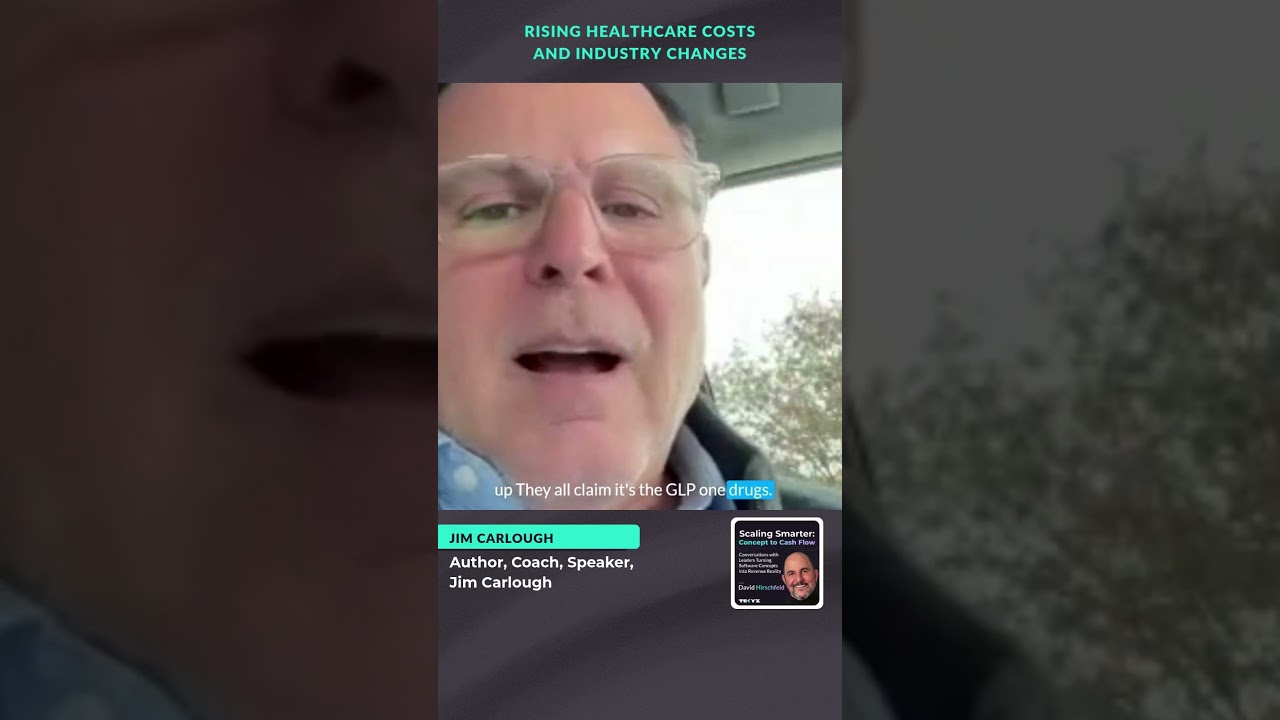
Healthcare costs are accelerating, and the ripple effects are just beginning.
The challenge: medical breakthroughs are advancing fast—but costs are rising even faster.


Healing the System: Leadership Approaches That Elevate Growth and Empower Healthcare Teams