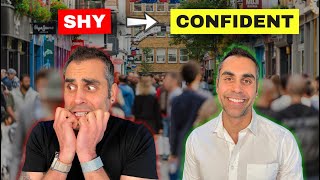
Dr. Aziz breaks shyness into two parts: how you see yourself and what you do about it. Stop the negative self-talk, then force yourself into small social situations repeatedly. The faster you practice, the faster your brain catches up.
Chapters
Do you want to quickly break out of shyness and become much more confident in a variety of areas of your life, social, dating, career? I'm going to share in this video exactly how you can do this and do it quickly. And this is not based upon just my own experience. It's based upon working with thousands of people, writing seven best selling books on confidence and teaching large workshops, online events, and working with clients in a group program for over nine years, getting a lot of data to see what works. One of the biggest things I see is people that are coming to me, they want to shift this, they want to break free and they want do it fast, right? You know, they've been stuck for years in their life, decades. And it's like, oh God, I don't want to work on this for like 20 years. Like, can we just make this go as quickly as possible? And my answer to them is yes. They say, great, what can I do? So maybe you're in that situation, like I want to make this shift, I want to make it fast. Great. I have some good news for you. You can really accelerate this process. You have control over the throttle. First you have to understand what is the process and then how do I speed it up. The process, if you could put in a nutshell, is you have a negative self concept. If you're struggling with social anxiety, shyness, lack of confidence, you have a negative self concept, a negative identity, which means you see yourself as meh. Maybe you're not smart enough, or you're not attractive enough, or there's something wrong with you, you're going to bother people or whatever it might be that causes you to hesitate. Instead of connecting with people, instead of speaking up, instead of sharing your ideas, whatever the setting is in your life, does that make sense with me so far? I'm sure you can see that in your own experience. So then as a result of that negative identity, we avoid approaching people, we avoid speaking up, we avoid being authentic, we avoid sharing ideas, we hide, we please. We kind of skate through life under the radar. How do I shift that? Well, most people on I want to feel better about myself, I want to feel more confident. And that's very important. And that's one of the key things I teach called being on your own side. On my own side almost. And you need to change your relationship with yourself, start to see yourself as more valuable, more desirable, right? Because if you go up to somebody and whether you say this out loud or it's just transmitted non verbally, energetically, if you're like hey, I'm kind of this, you know, sucky guy. Do you want to hang out with me? I mean, it's probably going to be be sucky, but huh, Right? Who wants to do that if you know you own your value? Like, hey, I am an interesting human. Of course people want to spend time with me. If you hang out with me, it's going to be interesting, right? That's going to have a very different response from people. So a lot of people say, okay, I got to feel good about myself. I got to feel interesting. I'll get myself pumped up and then I'll go out there and I'll be confident. And it doesn't work. Why? Because you're trying to resolve the problem with only one half of the puzzle. The other half of the puzzle is that we don't truly upgrade our identity. You don't get rid of that bad self concept, how you see yourself until you have enough evidence to show you otherwise. Otherwise we just kind of know. It's maybe hot air, it's a hope, it's a wish, it's a dream. Is it real? We got to find out. So the way that you accelerate this process is by being the other half of the puzzle in and you got to test things out and see what actually happens again and again. And you'll discover, you'll realize a couple of things. So let's make this very practical. It's a social confidence situation. You want to go approach people, dating, friendships, whatever. Want to go approach this group of people and hang out with them and see if they're into me. You got to have a negative self concept. No, it's not going to work. It's not going to. Okay, now we need to challenge that. You might give yourself some positive self talk, like, hey, I got a lot to offer. Of course people can like me. I don't know if I believe it, but now I need to strengthen that evidence and actually finding what happens when I go interact with that person, that is your key to walk over to them and start the conversation and interact. And sometimes people hear this and say, that's the problem. I'm afraid I can't do it. I'm afraid I can't. I got to get more confident first. It doesn't work that way. It'll never work that way. You're not going to get the confidence until you take the action. Confidence is a byproduct of the action. But if it goes badly, that's what I'm so afraid of. Well, if it goes badly, two things are going to happen. One, you're going to die a terrible death from shame and embarrassment, and then everyone's going to look down upon you for the rest of your life. No, that's not going to happen. What's going to happen is two things. One, either it's going to go well and you're going to surprise yourself. Well, it's. I guess all those stories in my head weren't true. And it doesn't just happen once. You have to do this again and again and again and again. It's like reconditioning yourself. And all of a sudden you're like, oh, I guess I do have a lot to offer. So that could happen. Or they don't like you, you get rejected, which is the boogeyman that everyone's, oh, God, I got rejected. Terrible, terrifying. And you're going to realize it's okay, you can handle it. You can get through it. It's okay to fail. It's okay to make a mistake. It's okay to get rejected. And that's where getting on your own side is important. Because if you get rejected and you leave and you're like, beat myself up for six weeks. I know because I used to do that. It's really hard to get out there and try again. It's like you want to take another risk. No, no, no. I'm not done beating myself for the next six weeks. Then I'll. Then I'll try again. Right? That's awful. You don't have to. You could try again tomorrow. You could try again in one hour. You could try again in one minute. And that brings me to the second point of this video, which how to do a fast. Right? So if you want to go fast, then we're kindred spirits. I'm the same way. So how do you do it? You turn up the dial of your risk rate. You go for it more often. So if you're going to go, approach a group of people to see if they want to talk to you, and you do that once a month, that's going to be a long couple of years to try to build confidence. Maybe even not at all. It's not going to work because there's too much time in between tests. So I'll do it every week. Great. Now we're going faster. And look, the first couple times I've seen this with clients, there's like this building period where like, no, I can't, I cannot. And then they just start doing stuff, and all of a sudden they start to shift the whole pattern but that I call it pacing at the edge of the pool. Oh, just get in the water and you'll realize it's cold, but you're to die. And what I do with clients is also we titrate it up or down. So if it's too intense, you don't have to go jump in the deep end of the pool. Let's get on the edge and get your feet in. If it's too terrifying to walk over to that beautiful stranger and smoothly start a conversation, I could have never done that. I had to build up to that. So you build up to that is maybe you walk down the street and just say hi to people. I call this friendly greeting. Maybe you go up to someone and say, hey, do you have a restaurant recommendation around here? My real basic stuff. And then eventually you realize that doesn't kill you. You can handle a rejection there if it happens, and it often doesn't happen. And now we get some moment. So we want to take those risks as fast as possible. Remember I was saying, what if you did it once a week? What if you did it once a day? What if you on purpose approached someone you didn't know to have a brief conversation with them once a day on your way to work or on your way home or when you're during your lunch or whatever? Once a day. Maybe you do it five days a week. That's five repetitions in one week. Now you're going fast. Now you're going to see in the span of two to three weeks, like these big shifts in your confidence. And what does that do? It inspires you. You get excited, you get energized. Now you want to go do more. So this is the key. This is secret. And so if you're waiting, if I just feel better about myself and I talk better to myself, then maybe it'll be easy and comfortable. There's always going to be that discomfort of diving into the risk. And so we want, yes, build your being on your own side. Super important skill. But also, let's build a muscle of courage, of boldness. And one more thing I'll leave you with in this video. What if you started to tell yourself every single day in your mind, maybe even out loud if you're alone, don't want to look crazy. I am bold. I am bold. Just start saying that more and more and more in your head. I am bold. It's kind of fun to say out loud, too. It's got a nice ring to it. I like the word bold. Maybe you want to say it out loud right now as you're watching me. I am bold. Or just in your head. That's cool, whatever. But if you start to do this, what are you doing? You're adding something to that self concept, that identity. You're building a better, newer version of you. And then you're going to stay consistent with that identity by going and acting in the world how, as a bold person would. So share down below in the comments what you're finding most valuable until we speak again. May have the courage to be who you are and to know on a deep level that you're awesome.










