How To Stand Up For Yourself Without Being Rude | | CONFIDENCE COACH, DR. AZIZ
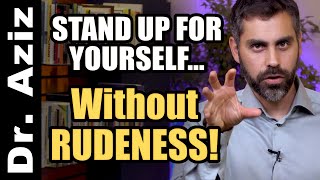
A short coaching video by Dr. Aziz explaining how to stand up for yourself without being rude. He distinguishes passive, aggressive, and assertive communication, emphasizes that assertiveness is direct but still leaves space for the other person, and gives concrete wording/examples to criticize behavior (not character). He previews a follow-up video addressing guilt about asserting oneself.
Chapters
So how do you stand up for yourself and say what you need or what you don't need without being rude? This is extremely important. This is a question I often get. We're going to talk about that in this video because if you are having some anxiety about standing up for yourself, which was the subject of the last video, maybe it makes you feel uncomfortable. Maybe you're afraid of conflict, Maybe you're worried about if they're going to be upset with you. Maybe you're worried about feeling guilty. What's going to happen is you're going to try to not speak up. Make sure you do it in just the right way. And this fear is like, well, if I speak up for myself and I'm rude, that's gonna upset people more. It's gonna make me feel more guilty. So let's focus on that in this video, and I'm gonna give you some very practical tips. Does that sound good? Okay, great. And by the way, if you're benefiting from this, make sure you hit the like button down below that little thumbs up and click subscribe on this channel with the notification bell on the little bell. And that way you can find these videos as soon as they come out to watch this stuff and apply it in your life. And the next video that's coming out next week is gonna be all about how. How to deal with that feeling of guilt. So you don't feel guilt for standing up for yourself, but today is about how to do it without being rude. So first things first, you might have to update your dial. Let me explain what I mean. So there's kind of a general three categories of how we can communicate. You've probably heard these before. One is passive, one is aggressive, and one is assertive. This is gonna be the 32nd version. Passive is you don't speak up for yourself. You, you're nice, you're pleasing. I don't want to make you upset with me, so I'm not gonna say anything. I'm gonna smile. I'm gonna be pleasing and not rock the boat. That's passive aggressive, is like, screw you. I say what I want, I take what I want. You know, like, it doesn't matter what you think and feel. It's about me. That's aggressive. I'm gonna browbeat you. I'm gonna intimidate you, I'm gonna criticize you. Do whatever it takes to get what I want. That's aggressive. In the middle is assertive. Assertive is, I know what I want and that matters. And I'm Gonna advocate for it. What also matters is what you want, and I'm curious about that. I want to see if we can create a win win situation here. Right? So there's a level of strength and power that comes with assertiveness, but it doesn't have that edge and that kind of destructive force of aggressiveness. Okay. Having said that, your dial. Remember I talked about your dial a minute ago, Might be a little uncalibrated. So what I see again and again with clients is they communicate in a way that I would describe as assertive. It's clear, it's direct. They're asking for what they want. They're being respectful. They're caring about the other person, but at the same time, making sure that they're clear about what's gonna work or not gonna work. And afterwards they're like, oh, man, that was real rude. I came in too harsh or too strong, and I know exactly what that feels like. You know what I'm talking about. I still have this to this day. Just had a meeting this morning where I was really direct with someone. I had to be clear. I was like, wait a minute, we're talking about something. I think that this is the kind of thing that you would need to do before the meeting to prepare for the meeting and not be doing on the meeting with us. Because I thought this would be a deliverable that you come to the meeting with, and the person's like, yeah, you're right. I wasn't communicating clearly. I'll make sure I have it done. They were totally on board with that smooth, assertive, respectful conversation. And afterwards I was like, I'm so guilty. Right? So we'll talk about that in the next video. Trust me, deprogramming yourself from nice conditioning and becoming more boldly, authentically, assertively you. That's an ongoing process. And the more it's like a muscle, the more you build it, the stronger you get. Doesn't mean you're totally free of this stuff, but when it comes up, boom, you can address it quickly. So I noticed that. Did a little technique that I'll share in the next video, and then I feel fine. Right? So we're not trapped in that stuff. But you might think you're being rude when you're not. That's the key point here. You're being assertive, and it feels like you're being aggressive. It feels like you're being mean, but you're not. You're so conditioned to being so damn pleasing and nice that anything other than that feels mean, bad. And wrong. So what you need to do is you need to give more space to be direct. So what's that difference? What's rude and what's not rude? Speaking clearly and directly, this is what I want. This is what I don't want. This is what works. I think we should do it this way. None of that's rude. How do you know what's rude? What's rude is when you provide no space for the other person to share or ask or counter you in any way. If they try to talk and you're like, shut up. I'm not done yet. Now, you might need to. If they're interrupting you, you might need to be able to assert yourself and keep going. But then at some point in that meeting, there's a space for them to ask or challenge or say something. Right? That's part of being assertive versus aggressive. The other thing is, are you criticizing them? Their character, their intelligence, their competence, or their abilities? Right. That's where it tends to get more aggressive. So let's say someone did a poor job on something. Instead of saying like, you know, you seem like you don't know what you're doing, you seem incompetent, you're an idiot. This is stupid. You say, okay, it looks like, you know, we wanted to get these things done to this standard, and what you turned in did not meet that standard. And here's how this was supposed to be there. This thing wasn't done on time. And this thing you described, specifically what was happening, you're talking about the thing, not the person and their intelligence and their capability. So that is respectful. If you want to comment on something not being done right, you can do that. And. But you leave the character attacks out of it and the blame and the disparagement out of it. Does that make sense? So if you're doing those things, if you're giving space for someone else to communicate and you're not attacking them, then you're not being rude, you're being assertive, you're being clear, you're being direct. And it just feels uncomfortable. So my recommendation for you is to practice that again and again and again, because it's just going to become a matter of familiarity and there might be a little bit of guilt. We'll deal with that in the next video. But. But for now, practice it again and again and again. Just remember, running through that criteria, did I cut them off and give them no space to talk ever in the whole conversation, and did I just completely go at them or criticize them? Or blame them or call them names. Okay. No, no. Great. All right. I was being assertive, not being rude. Great. And now you have permission. You have freedom. Just know, over time, your sensors will calibrate a little bit and you'll have a lot more permission to be boldly accepted. Expressively, you so fantastic. Share down below in the comments what you're learning and until we speak again, may have the courage to be who you are and to know on a deep level that you're awesome.










