How To Stop Overthinking In Social Interactions
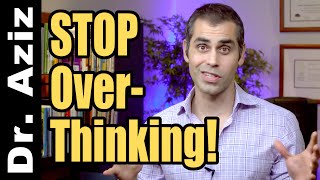
Dr. Aziz explains why your brain treats social situations like threats, triggering constant analysis that kills connection. He suggests naming what you actually fear (rejection, upsetting someone, losing yourself), then practicing authenticity and using a calming phrase like "I'm not for everybody" to break the overthinking loop.
Chapters
Do you ever wonder how to stop overthinking about social interactions? This is one of the things that most of us can obsess about and find it actually really hard to turn that little voice off inside of your head, that after social interaction, you start to question, you start to doubt, you start to wonder. And either the whole time the conversation just sucks because you're all tight and tense and focused on yourself and your own negative thoughts, or maybe you've experienced this. The conversation actually goes pretty well. Whether it's a date or a social interaction or a networking thing, any area of life, it goes pretty well. You're connected, things are flowing, it's a good experience, you're in the moment. And then what happens? Then you leave, you get into your car, and it might be one minute later, it might be 10 minutes later, or it might be like three hours later. You're sitting there, you just finished dinner, you're just at home, and then a thought comes in your mind. It's like, oh, what did I say there? And we start to analyze the conversation. Here's the thing. When we go into that pattern, we're already screwed. Because we're not actually really looking for any real information about the conversation. We're combing through it to look for things that went bad, things that went wrong. And even before we look for the data, we already jumped to the conclusion that we messed it up, that something bad is happening. And we start to feel unsettled and uncomfortable. And that connection that you're experiencing with that person now starts to erode. And instead of feeling good and warm and hopeful and just fulfilled, what do we feel? We feel anxious, we feel tense, we feel uncomfortable, we feel unsettled. So how do we stop this pattern? Can you relate to this? Where does this show up most in your life? Is it in dating? Is it in work conversations? Because that's important to note, because that is the area that you need to work on. Your own confidence. Because that's a sign. It's nothing about the other person. It's a symptom. It's a sign that there's an insecurity inside of us that we need to address, we need to change. And this topic is absolutely essential. This is what I would call conversation confidence and social mastery, which is something I'm so passionate about. I have a course for it inside of Confidence University. And we have my next live event, which is called Supremely Confident Conversation Master, dedicated to this subject entirely. In fact, we have the Early Bird, Super Early Bird promo window going for that coming up in just about five days from now, depending on when you're watching this. So down below we'll have a link. You can check that out. You should get on my email list definitely to be able to find out about the special offers. But. But that's going to be a powerful, life changing experience. We're going to get deep into conversation mastery. But this is a topic that comes up all the time there. How do I stop overthinking conversations? Well, here's the biggest thing to know to be free of that. Why do you overthink conversations in the first place? Why is your mind on hyperdrive? Have you ever wondered about that? It's because you're under threat. Part of you is perceiving that there's a threat in that situation. And once we perceive that there's a threat, we start to look for danger. In fact, we do this fallacy which is if I feel like there's a threat or I perceive that there's a threat, I must be in danger and I must find the danger. This is 2 million year old programming running in your mind that is trying to keep you safe. However, it's not necessarily the best for social interactions, for being freely yourself in conversation. And the over analysis comes up because you're threatened by what? Let's examine the threat. Can you think of a time where you overanalyze conversations? I mean, it could be happening every conversation for you, in which case just think back to your last conversation. Or it could happen more periodically. So think back to the time where you recently had an experience of overanalyzing conversations. You got one. Okay, so what are you afraid of? What's the threat? The more clear you can get, the more free you can become. Common threats are this person's gonna get upset. And we tend to view the upset as like permanent and relationship ending. They're not gonna wanna date me anymore, they're not gonna work with me anymore, they're gonna fire me, they're gonna quit, they're gonna get mad at me, they're gonna yell at me, something bad's gonna happen, they're gonna retaliate against me. Our mind starts to get paranoid and go crazy with all these ideas because we're uncomfortable about another person being upset with us. Some sort of perceived loss. Another kind of threat, which is really interesting is you might have been more you in that conversation. You might have been more outspoken, you might have been more bold, more assertive, more unapologetically yourself, more playful, more direct, more expressive, just more you which is a good thing, right? That's what this show, that's what my mission is all about. That's what you're probably all about, is becoming more and more you. It seems like it's going to be all clear sailing, right? No, you're more you in the conversation. That's maybe why you felt more alive, more connected. But then you leave and what kicks into gear, your safety police. And it's like, whoa, whoa, whoa, whoa. Why aren't you being that restrained person, that inhibited person, that people pleasing, nice person who's just looking to others to find the conversation topic? Why are you inserting your own conversation topics? Why are you being more bold and assertive? Bad things are gonna happen and tries to scare you into going back into your small self. So you got to identify the threat and then you got to let go and see that there actually is no danger. How do you do that? Well, that's a bigger topic. That's why I invited you to my live event, to really get this deeply inside your body. I also recommend you read my book Not Nice, which a lot of that people pleasing stuff and that fear of someone being upset with you is coming back to an anxious attachment with others. Like, oh my God, if someone's upset with me, I'm not safe in the world. So those are ways to go much deeper with this. For now, just remember, and this is from not nice. Take a full deep breath in and say this phrase with me. I'm not for everybody. I'm not for everybody. Not everyone's gonna like me. So the question is, are you gonna focus on trying to get everyone to like you, which is a fool's errands, an impossible task, or are you gonna focus on controlling how much you express yourself? That's what you have control over. Are you gonna turn the dial up on how much you are gonna be you? And if you do that, not only will you start to feel more confident in conversations and reduce the analysis, you actually start to enjoy yourself a lot more. And afterwards, when the analysis comes back in, just say, you know what? Yep, you're scared. That part of you is scared of me being more me. And that's okay, because I'm going to keep doing this. And the more you do it, the more you practice it, the more bold you are, the easier it becomes. So share down below in the comments what you're finding most valuable and we'll have a few more videos coming up in the next weeks here about conversation mastery and social confidence, such a key aspect of life. The better your conversations, the better your life. So, until we speak again, may have the courage to be who you are and to know on a deep level that you're awesome.










