How To Talk About Politics Without Fighting
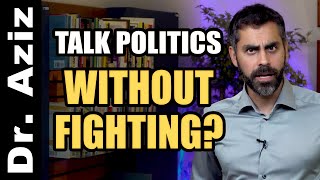
Dr. Aziz explains how to talk about politics confidently and constructively without fighting by (1) knowing your purpose for the conversation, (2) assessing the other person’s purpose and level of openness, (3) noticing and managing your emotional triggers, and (4) leading with genuine curiosity (asking questions, exploring perspectives) while sharing your views selectively. He illustrates these points with brief anecdotes (an Uber driver, a relative) and closes with a promise to address how to decline political conversations in a follow-up video.
Chapters
How can you talk about politics without fighting or without crumpling or going silent or just smiling and nodding and sort of agreeing with stuff that you don't agree with? How can you talk about politics with confidence? That's the subject of this video and obviously extremely relevant right now. I mean, if you're in the United States, we're having an election coming up, and it is a boiling stew of strong opinions and feelings and perspectives and emotional charges. So here are some tips on how to talk about confidence, politics with confidence. Okay, here we go. Number one is, know your purpose. Why are you doing it? Because if you're going to talk about it with somebody, a lot of people unconsciously, their purpose when it comes to talking about politics is to feel a greater sense of certainty, to feel right and to discharge frustration, upset, or anger by blaming somebody. Saying so and so is bad, so and so is wrong. And then they get to feel a sense of superiority and certainty that those people are bad and therefore I'm good. So that is often the purpose behind talking about politics. And if that is your purpose behind talking about politics, then you're not going to have a very good conversation. You are going to get into a fight, and that's part of what you might want. Because, you know, when you get into a fight with somebody, I got some energy now, I'm a little more powerful now, and they're stupid and. And forget about that. I feel anxious going to work. Forget about that. I feel anxious because no one's going to love me, and I don't think I'm good enough all of a sudden. Now that doesn't matter. I know that I'm right and that person's an idiot meets our needs. So if that is your purpose, then you're not going to have a good conversation. So if that is your purpose, say, you know what? How else can I get certainty? How else can I get a sense of power? That's probably a better source of fuel, because the power and certainty you get from fighting with somebody and blaming somebody, I would call that dirty fuel. It doesn't really work so well in your engine. Okay, so now you know your purpose. Number two is, what is their purpose? You got to be able to assess their level of consciousness that you're talking to. Some people are. They're in a level of consciousness where they just want. They're polarized, right, Wrong, good or bad. Look, the world is not gray with the whole spectrum. There's not a lot of nuance here, okay? To be able to hold nuance to be able to know that things are complex, that there's many moving parts. There's not usually just one right answer that requires a certain level of awareness or consciousness. Right? Little kids, when they're starting to learn about the world, they want to know, who's the good guy, who's the bad guy? I have two little kids, they're almost 5 and 7 now, and they're asked like, so is that guy bad or is that guy good? And I kind of mess with them a little bit. Sometimes I'll just tell them that's the bad guy or whatever in the movie. But other times I'll say, well, how do we know what's bad? Who determines what's bad? You know, it's all about the perspective, the eye of the beholder, right? We gotta find our own values and our own way to navigate this mysterious life. And so that's. I'm trying to expand their awareness now. They're young. Over time, though, as we get older and more mature, we can hopefully hold more perspectives than just one. That's not true for everybody, especially if they're emotionally charged. So if you're trying to talk to a family member or a colleague or a friend who you know is, as soon as it comes up, they're like, can you believe what kind of idiots would think this? And that's how they're coming at you. Maybe that's not going to be a fruitful conversation. So you could say, hey, I'd be open to talking about this with you, but only if we're going to have a dialogue, because I don't necessarily just want to have a conversation where you just want to assert your perspective again and again and have me either agree or be silent. Right? So you could talk about whether they want to have a real conversation with you or just say, you know what, I'm not going to talk about politics with Uncle Jim because Uncle Jim just wants to get on his high horse and rant. That's important because I'm imagining if you want to be able to talk about politics more in a way that's going to bring about more, I don't know, engagement, connection, thought provoking. You got to assess where you're coming from and where they're coming from. Okay, great. Now that you know that, you got to understand your triggers because you are going to have emotional hooks and emotional triggers as well. We all are going to want to fall back into that, right? Wrong. Good, bad. That's just part of it. So it doesn't mean it never happens. But when it does, you want to become aware and you want to not take your emotional hot buttons as absolute fact or truth. So when you're talking to somebody and they share a viewpoint that's different than yours, or maybe a whole way of seeing the world that feels like wrong or off to you, they're like, how come they don't think about it this way? And you notice that inside. And you feel that sense of like, I don't even, I don't like them anymore. They're bad. I can't be friends with them, I can't work with them. This whatever. You, you know, you notice that inside. Say, ah, there's a trigger there. I'm having an emotional trigger. And you become aware of it, you own that. And then you're able to keep dialoguing with them as opposed to having that just sweep you away where you now have to fight or run. Okay. The next thing is now that you are able to know where you're coming from, where they're coming from, you're able to notice your emotional triggers. Now you can actually start to have a dialogue. And the key thing here is curiosity. You know, ideally, what feels best for people is when someone else is curious about them. It's not just like, well, I don't care about what you think. Let me tell you what I think. Not a very satisfying conversation, right? So ideally, there's a back and forth. And the way that we create that or set that up is we gotta lead with curiosity. What do you think? What do you think about this? What do you think about that? And don't just stop there. Curiosity is about following your fascination. So they say something, you say, oh, wow, that's really interesting. Where did you learn that? Or have you thought about this thing? Or have you heard about this information? And how does that information influence how you think? Right. So you're not doing it to try to prove them wrong, you're doing it to try to find out what does their world do. And I actually am really fascinated in this. And if you really come in with this angle, you can have a conversation with anyone about anything, literally. And I've talked to people about all sorts of things and I just am curious. Sometimes you push buttons, sometimes they get upset with. You had a conversation not that long ago with an Uber driver, and this was a little while back when there was some protests that turned violent in Portland. And there was this short period of time where they were like tearing down statues. And it just happened that it just, I think people, some people had Torn down a George Washington statue, and there was an Uber driver. And she was like, can you believe what's happening? Right? She was upset. And I was like, yeah, tell me more. Which thing is. There's a lot happening. Which thing is happening? She's like, wow, these people were tearing down this George Washington statue. That is nothing to do with the movement. I don't know what they were thinking. And I was like, yeah, actually, I just heard about that earlier today myself. And instead of spouting my opinion or perspective, I just said, it sounds like you don't like that they did that. She's like, well, yeah, I mean, you know, they don't. The people that tore it down probably had no idea. I mean, I think George Washington has done a lot for this country, more than just being a slave owner. And I said, okay, is that why you think people tore it down? Is it because they thought it was late? And I asked her just a few questions. Then after the third question, she said, I don't even want to talk about this anymore. And I said, okay. I had had my headphones in. She brought it up. I took my headphones out to talk to her. And then all I did is I did not say anything about my perspective or opinion. I just asked her a few questions. And they weren't like, well, why do you think that, idiot? It was very curious. I truly just wanted to know her perspective. And then she didn't want to talk about it because what happens is sometimes people get emotionally triggered, and people are not necessarily familiar with having real conversations. They just want to say their viewpoint and get out and discharge a little bit of energy, but they don't really know what they think or why they think it or where they learned it or anything. And I'm all about helping us become more aware and learn about ourselves. So I was asking her about that. Now, in the spirit of being not nice and being authentic and being you, you don't always have to just ask them questions. You could also share your perspectives and your ideas and share. Well, I read about this, and I wonder. I mean, that made me feel this way, and I'm curious about you. I mean, does that influence you? Does that feel bad to you that that's happening in the world, or does that not matter to you? I remember I had an interesting conversation with a relative who. And one thing that I am very aware of is the access to clean environmental places and the ability to be able to not just obviously unpolluted air and water is good for all humans, but especially Access to amazing places. So making sure that the land, the national forest land, other things that are preserved and set aside for people continue to be accessible for hiking and backpacking. I love that stuff. And so if someone's like, hey, we want to remove that access so we can log or something, I have a personal agenda of like, but I don't want you to take out that forest. I like being in that forest. And so I was exploring this with a relative and she didn't share that perspective. And so instead of being like, what's wrong with you? Don't you care about the trees, you stupid. You know, I was just like, tell me more. What is your perspective? And as we started to explore it more, she was like, basically, I live in a city, I live in la. I don't go out to the forest. It doesn't matter as much to me. It's not as real to me. And the more I explored it, the more I was like, I get it. That makes sense. It's like, you know, it's hard for us to care about something that doesn't even feel like it relates to us. So you can uncover and you can explore and you can share your ideas and you can have fruitful conversations with people that you love, colleagues, and just treat them as opportunities to learn about people as opposed to jam your perspective in. And you'll have so much more fruitful conversations and they won't lead to fights, especially if you're able to assess where someone's coming from. Fantastic. Now share down below what you're learning from this. And in the next video, we're going to talk about, let's say you don't want to talk about politics and you got that colleague or that family member, that co worker who keeps coming at you with, you know how to, let's talk about this. And you don't want to. It doesn't feel good. They're talking about an unpleasant way. Then how do you stop that conversation from happening? That'll be the subject of this next video. In the meantime, click subscribe down below, give it a thumbs up and share in the comments. What you're learning until we speak again. May have the courage to be who you are and to know on a deep level that you're awesome.










