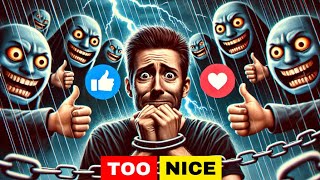
This content was created by Dr. Aziz. This content was uploaded by Dr. Aziz. This is a YouTube video titled "The Dangers Of Being Too Nice" created on July 11, 2024, featuring Dr. Aziz discussing the negative impacts of being overly nice, including emotional suppression and health issues, and promoting his books and coaching program for building confidence and assertiveness.
Chapters
Is it possible that being too nice can actually harm you and be a negative impact not only in your life, but the lives of people around you? I know that might sound totally counterintuitive because it seems like, hey, I'm being nice for everybody else. I'm being nice so I can be a better husband or wife or employer, employee or friend or son or daughter. And yet it turns out that actually being too nice can cause major problems in your life. I want to share a couple of them with you here. This could be like the wake up call. And if you want to take it further and learn how to shift this, watch more my videos on this channel. I also have a few books I'm gonna recommend that I've written that will help you break this pattern. So this isn't about that. You're stuck in this. This is the wake up call to say, hey, this isn't a selfish thing to do. This is a life saving thing to do. And it's actually gonna ultimately benefit you and others to be a little less nice. I'm Dr. Aziz. I'm the founder of the center for Social Confidence and the author of six bestselling books on confidence, including my most popular book, which is called Not Nice. And it's about how to take charge of your life and to realize that the opposite of nice is not to be some raging egomaniac jerk. It's authentically you. And to say what needs to be said and to be honest and real, that's the opposite of being nice. So what's the problem with being nice, though? Most people hear the term nice and like, wait a minute, nice is good. In fact, the world's so messed up because there's not enough nice people. There's too much cruelty, too much selfishness, too much attacking and not listening and not being collaborative and tolerant and compassionate and loving. And they think that nice is all those things, but nice is most the time. And you can see in your own life what's true for you. What I've seen is mostly rooted in fear. And niceness is I have to say or do the right thing to make sure that everybody feels okay. And that might sound like love, but actually, no. Sometimes to say the loving thing is to be what's. What's true. So you tell the person if they're doing something that's upsetting you because the nice person says, well, I don't want to say that you're upsetting me because that might make you feel bad, but then I'm just going to avoid you well, is that really kind? Or, you know, instead of saying, hey, that bothers me that you do that and I want you to do something different. You don't say anything. You don't say anything. You don't say anything and then you explode or you shut down, or you're distant and withdrawn and I don't know about you, but I, I would not want any of those things from somebody. I'd rather they told me if I was bothering them so we could fix it. As opposed to this dance where you pretend. That's the key thing about niceness is it's pretending. I'm going to pretend to be kind so that I look like and tell myself I'm a good person, but really I'm avoidant. I'm burnt out, I'm stressed out. And that's where some of the biggest costs of nice come in. One of the huge ones is you have a hard time saying no because you're accommodating everybody. And if you have a hard time saying no, that means you're saying a lot of yeses, right? You're saying yes to that request, yes to the what they need at work, yes to the family, and you end up putting everybody else first. And then you are over committed, stressed out, burnt out, resentful underneath because you don't have enough of your own needs being met. Not only do you not have your own needs being met, you have this. Part of the resentment is like, people don't care about me. People are only focused on themselves. Everyone else is so selfish. And part of it is that you're not advocating for yourself, you're not claiming that. And so no one's giving it to you and you're expecting, well, if I just give and give and give and give, then other people will be generous back with me. And it seems like it doesn't work that way. And the world's so messed up. Well, I don't know, maybe the world's messed up, maybe it's not. But we could spend all day judging what's right or wrong. But at the end of the day, that's just how most connections and relationships and humans work, that if you don't say what you want. Not everyone's a mind reader. And people will just ask you for things. And if you keep saying yes, yes, yes, and don't look like you're upset and you just put a big smile on your face, they'll keep asking you for things. Hey, this is what a great employee. Let's keep having her do more stuff. This is great. And you can say it's awful and it's bad, or you could just say, hey, this is how it is. Maybe I could change something. Another huge cost of being nice. One of the dates dangers is that suppression quality, that holding in when you're upset. And either you don't share it at all or you only let 2% out like I am a little, little. It was a little hard that you didn't get that thing in. But it's okay, we're working with it. You know, you just let the little tiniest bit of frustration out. The rest goes where, I don't know, in your intestines, just shove it down in your body. And they found that that particular quality, emotional suppression they call it, is related to a radical increase, in fact a 4x increase. And all cause mortality over a 12 year period. That means you're four times more likely to die from anything over that 12 years when everything else is held constant. And they just looked at emotional suppression. So it's not just a preference or. Oh, that. I guess that'll be good for me to do. It's a matter of your health. And look, you don't need a study to tell you that, you'll know it. There's so much chronic pain, we can have backaches, neck aches, stomach problems, migraines, all of these things are coming from a system that is supposed to suppressed. And on top of that, not only are you suppressed, but if you're nice, you're living in chronic fear. Because a nice person's biggest fear is what are they going to think of me? What if someone gets upset with me? And that means every time you leave your house, every phone call, every email, every time you check your messages, someone could be upset with you. And even if you're not in panic mode, it's a background startle response that gets triggered off many times a day. And you have cortisol and adrenaline and there's this fear because you're operating in life without this solid sense of if, you know, if someone's upset with me, I can handle that. In your mind it's like if someone's upset with me, I cannot handle that. That better not happen today. And that's a very fearful way to live. And when you live that way, it takes another toll on your health. And the last impact that I want to share with you, and I see this all the time, it's the tipping point when people end up working with me. I ask what's happening in your life now? And as you want to make that step and join. I have a 12 month mastermind program. People join in and absolutely changes their confidence, their assertiveness, their authenticity for their entire lives. I say what leading to this moment and the thing will tell me is, you know, I got kids and they're watching me and I see them doing the same things that I'm doing. And basically what's happening is you're becoming a model others and you're showing others this is how to be and they really get that mirror reflected back to them. They say, oh my God, I don't want other people to live this way. So look at how you're living right now. Would you want your maybe you don't have kids. If you do, would you want your kids to live that way? If you don't have kids, would you want your loved ones to live that way? Would you want a niece or a nephew or brother or sister or someone, a friend that you cared about? Would you really want them to be constantly afraid of what other people thought and always say yes and never be able to disagree with somebody? You know, when I talked about this with people, almost everyone will say no, that's not a good way to be, but I should be that way. And if that pressure is on you, the invitation, the call of this video is to choose something different. And if you want to know what that is, want to take those actions, Definitely. Check out my book not nice if you haven't read it. I also have another book called Less Nice, more you that recently just came out lightning bolt of an action packed book of like, hey, I'm not here to convince you. You know what you want to do, let's talk about how to do it. And again, if you really want to make life changing shifts, go to Dr.aziz.com Dr.az I z.com and click on the coaching tab and learn about my 12 month mastermind called the Unstoppable Confidence Mastermind. And it is a fast track to radically changing confidence. And be more assertive and be more authentic in every area of your life until we speak again. You have the courage to be who you are and to know on a deep level that you're awesome.










