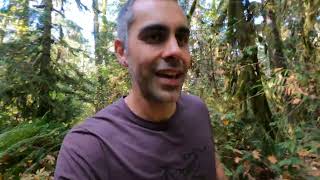
Dr. Aziz narrates a running vlog while doing hill-repeat training with his dogs (Shadow and Sierra). He describes the physical format of hill repeats (repeated uphill efforts producing high heart rate and chest burn, interleaved with downhill recovery), the anticipatory dread he feels before hard workouts, and anecdotes about his dogs (Shadow sometimes refuses long runs; Sierra is fearless). He reflects on why he wants to run 50 miles, offering multiple answers: as a celebration/prayer of what his body can do after years of pain, and as training for inevitable suffering—using painful workouts to cultivate humility, faith, and resilience. The tone mixes humor, candid self-reflection, and spiritual-philosophical meditation.
Chapters
It doesn't look like it on the video, but it's very steep. On our way to the river for some hill repeats, my crew here, we got the big brute in the back, this one who generally sits in the back. But I went in to get something from this store and when I came back, oh, look who just found his way right up there, right? Shadow. Shadow. Hi. He gets. He gets away with it too, because he's so adorable. All right, off we go. All right. The hill repeats. Does everyone feel this much dread before doing, like, harder workouts? I don't know. Maybe other people are just more macho than I am, but I noticed that if my pace is not that fast, I don't feel the dread. I feel the dread before I'm going to do something hard. So these hill repeats are you go down the hill and then you go up the hill and then you go down the hill and then you go up the hill and so on and so forth. And going up the hill, you're going hard, so you're getting your heart rate really high and your chest is burning. And I mean, Isn't that amazing how I could feel dread about this run? Like starting the day before and all that night, all the next morning, all today leading up to this run, I'm not doing the discomfort. And then even at the run, most of the run, I mean, there's like half of it's this downhill. It's lovely how much we can dread that one moment of discomfort. Ooh, that's new. I have to go under this sucker. Do you feel dread, Shadow? Sierra? Good girl, good girl. I think Sierra feels no dread. She's a savage. But Shadow does. I. I scientifically know this as a fact. I'm no veterinarian or pet psychic, but I do have proof. So one time I took Shadow and sierra on an 18 mile run. And then for the rest, probably about a week or more. Every time I'd head out towards the wild country, Shadow be like, oh, no, I ain't doing that. And he'd either not come with me or he'd start and then he'd within a mile, we're still on the road, getting there. I turn around and Shadow's nowhere to be found. Just turned and bolted. So I'm going to use my powers of deduction to say that he felt some dread and decided to turn the other way. I used to get really angry at Shadow when he didn't want to run. And then I'd get back from my run and he'd be waiting at the door like, hi, hi, good to see you. And I'd ignore him. Real, real mature 40 year old man move right there. And I was angry at him and then I started to get curious because what I learned with dogs and kids and spouse and people you're close with is like when you're leaning hard on them or you're leaning on yourself and you're doing it with harshness and it seems like that's how it's gotta be. I get really curious about that. What I realized is, oh, that's how I treat myself. Shocking, right? It's like this harsh, like I don't care if you want to do it or not, you're going to do it. So part of my growth to even be able to do these distances and runs is to find a new way of being with myself. And so I extended that to the old, the old shady daddy here. Look at him. He loves to run. Just depends upon when, in what circumstance. He loves to chase a ball, especially if he can win. He thrives on pets and touch and snuggle. He's the snuggliest dog ever. So here I am trying to like brute force this sweet little dog into something that's not his nature. And maybe you're doing the same with yourself. I certainly have. So I changed my approach, said, alright, shaddy, shaddy daddy, you can run if you wanna. You want to turn and bolt after a mile. I trust you. You can find your way home. And he does. And you know, yesterday he went eight miles with me. Some days he does nothing. And it's beautiful, it's perfect. Speaking of beautiful and perfect, look at this. Frolicking around as we get towards the forest. Little do they know of the terror that awaits his flat here. And then pretty soon we're gonna hit the incline. And thus begins the torture. I mean the training. The TR. 28. Okay, and we get to go back down for four minutes. Here we begin again. Here we go. That's number three completed. I had a friend who asked me not that long ago, why do you want to run 50 miles, you freak? No, he didn't say that last part, but he did ask me that question. I've thought about it a lot. I don't think there's one final answer. There are many different wise and you know one, one really inspiring one, is to see what this gift of a body can do after so many years in a cage of chronic pain and the cage of the mind, of perceiving myself as weak and broken. To see what this body, this gift from God can do when activated and cultivated, is like a prayer. It's a celebration prayer of this gift. And that just feels so energized. So there's a lot of fuel there. But there's a second one which relates to these dreaded hill repeats. That's important. So I'm going to share that with you now. Actually, I gotta turn around less than about 30 seconds, so I'll save that for after my triumphant fourth one. Victory. I choose to believe that victory or glory is on the other side of dread, but only always depends on how you look at it. Because if you define victory or glory as your own personal achievement, you know, you might or you might not. You might train a ton, prepare a ton, work hard, and someone else gets the promotion. You don't get to sale, or you train really hard and you go run. And on that race day, you're just not feeling great or you're sick or. And so, you know, maybe you don't finish or you do, but it's not what you wanted, you know, where's the glory in that? Depends on how you define glory. So there's one definition of glory which is like me. I look what I have created, behold me. And that's beautiful. That's pride, will, defiance, autonomy, king, queen. It's great. And there's also another kind of glory, which is the biblical glory, or divine, if you will. That's like glory be to all this glory in this beating heart that keeps going with no will of my own. So the glory is like a grace. And sometimes the grace comes when you get what you want and you feel that personal pride. And then the other side of the glory is when you don't. And it's like this bitter brew of failure and disappointment, discouragement. And that's where I'd say the deeper, more profound divine glory is, right? Because it's like you're being humbled, you're being shaped, and you get to cultivate your faith because you gotta have faith to do anything extraordinary or to just feel extraordinary. So that's where your spiritual beliefs come in. Your faith is. Is something guiding me, be it God or the universe. And if so, and this failure, this setback, is part of the road. It's part of the cultivation of who I am and who I'm meant to be. And it's guiding me further on my purpose. Because nothing that befalls me is off that divine purpose, even if it seems that way. Which brings me to the other question of why run 50 miles? You freak. I have some friends who are Buddhists and they'll tell you pain is inevitable and suffering is inevitable. Dukkha, bitch. I believe that's true. I'm no Buddhist, but I do like me some Buddhist ideas. There is going to be inevitable pains in life that are going to befall us. Sickness. I just swallowed a bug. That was an inevitable pain. Okay? In other inevitable pains, sickness of someone that you love, and ultimately the failing of your body, maybe even the loss of things, wealth or material possessions. I think that this type of running is a training for that because you put yourself in some situations, like those hill repeats, where during those four minutes each round, you know, usually about a minute and a half to two minutes in, it's like, when's this gonna be over? I don't like this. I want it to stop. And then you go on the long distance stuff and you got bigger chunks of time, you know, 20 minutes, 30 minutes, an hour, maybe longer during the run. Or you're like, I hate this. I want it to be over. And you're fighting the suffering. But it's a potent, visceral form of training for the situations that you can't get out of in life. And there's something about that that I find absolutely fascinating. And there's a lot of energy in that side of it as. There you go. Another brick in the foundation of awesomeness, of victory. Seems like a fitting place to sit and talk, my macho Chuck. All right. I don't really know what else to say. I think I said it all during the run. Well, we did it. Me and this one and even that one. Look at that beast. Love your essential nature and celebrate who you are. Night Shadow. Sweet nugget, Sam.