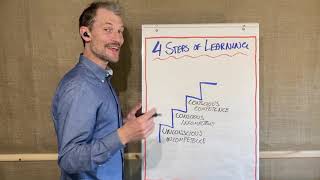
Edward Nelson walks through four stages of learning using driving as an example: not knowing you don't know, realizing you don't know, practicing consciously, and finally doing it without thinking. The uncomfortable middle phase where you're aware but struggling is where real progress happens.
Chapters
Hi, my name is Edward Nelson, and I am going to present to you one of my favorite models. A simple one, an old one, but one I think you'll find really useful whenever you're trying something new. And we're all trying something new these days, whether it's a new skill, a new habit, a new behavior, or even a new mental habit, like the stories you tell yourself about presenting on video or going into meetings. All of these things we can look at, take our old habits and build up new ones. In order to do so, we often go through these four steps to learning. So I'll introduce you to the four steps. I'll start by drawing the four steps as they come on our learning journey to building new and more helpful habits. So often we'll start at the bottom. And the bottom step is called unconscious incompetence, which means I'm not aware and I can't do it right. Or otherwise known as ignorance is bliss. This is like when a child is sitting in the driver's seat of a car, hanging onto the steering wheel, honking the horn, flicking the windscreen wipers on and off, thinking he's driving. In the case of my son, can't even touch the pedals on the floor. Blissfully ignorant. Fast forward 10 years and when they're 15, they're first starting to sit down in a car to actually learn to drive. They can't even get it into gear and take off smoothly and the clutch gives in and they are conscious, but they're still incompetent. So all that's changed here is awareness. But we've gone from bliss to. To pain. And that doesn't necessarily mean physical pain, although if it's a new physical habit, it could do, but also mental pain and emotional pain, like stress, anxiety, discomfort, annoyance, frustration. So those are things that happen around conscious incompetence. We're aware, but we can't do it. It doesn't take very long to move from this step to this step. And that's the first barrier that we face whenever we're learning something new. We go from things feeling good to. To things feeling less good. If we persevere and we see the reason to continue, we'll often get to a stage called conscious competence. That is, we can do it, but we have to think about it. On the driving analogy, that's like when you're taking your test and you're very aware of the speed limit, making sure you adhere very strictly to it, making sure your head moves around, making sure that you look in the Mirrors. All of these things you're hyper aware of, you're very conscious, and if your driving instructor passes you and gives you a tick, they deem you competent, for better or worse, to go out and drive. Nowadays, when you're driving, you might be at stage four, what we call a habit, or in this model, unconscious. But competence, okay, which means we can do it and we can do it without even thinking about it. Habits are great. It means we can do other things like sing along to our favorite song or listen to an audiobook or argue with our partner or kids. All of these things we can do because we can drive without thinking about it. It's also when accidents happen. But nevertheless, that's the great thing about being up there at step four is that we have a habit. And the great things about habits is they don't take mental effort. So at the top and the bottom, we actually go from bliss through pain to effort before we can get to a new habit. And this is the biggest barrier anybody faces to learning anything new. As I said, whether it's a skill, a behavior, or a mental habit, is that to go from where we were to somewhere new, counterintuitively, it often feels painful, uncomfortable, stressful, takes a lot of mental effort. These two things are things that we often don't like and can create a bit of a barrier to us attaining a new habit. It's not that we can't do it, it's that our journey there feels uncomfortable. So I'd like you to bear that in mind and remember that just because you've moved from bliss to pain isn't a bad thing. It's actually progress. On the four Steps to Learning. With that in mind, I'd encourage you to persevere on anything that you've set out to try and know that actually this discomfort is progress. That's the four Steps to Learning. My name is Edward Nelson. I hope you've enjoyed it. Please leave any feedback below on the video. Thanks very much. Have fun.