Edward Nelson maps five stages of listening, from pretending to pay attention all the way to empathic listening that picks up unspoken emotions. Most people shift between these stages in a single conversation. The framework helps you notice where you actually are and move toward deeper listening.
Chapters
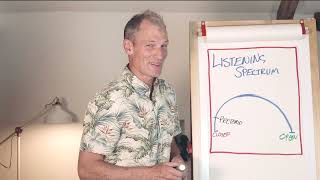
Hi, I'm Edward Nelson and this is the Listening Spectrum. The Listening Spectrum. So I'm going to write it up here, the Listening Spectrum. Because it always helps when we're taking in new information to access it in multiple ways. Hence the reason for me doing a video and not just writing a blog post. The Listening Spectrum I'm sharing with you as a self awareness tool to help you better engage with and even influence or connect to the people that are important to you. So of course like every other spectrum, there are two ends. We go from being closed at one end. This is when we've decided that we're not that interested in what the other person has to say or that it doesn't have that much value to us. Right now. We're kind of close minded. And the other end is when we're more open minded and we are interested and we're available and we're with the other person and most of our attention is with them. And of course we'll travel along this spectrum within the course of even one conversation. And it's very normal for us to do that because being over here takes an awful lot of energy and attention and focus. To raise your awareness around this, I'm going to introduce you to five stages. The first stage close to closed is called pretending. Okay. We pretend to listen quite often if we're honest. Often happens with our family relationships at work. People tell us about their day, we're kind of nodding along, sort of giving them some lip service, saying yes, uh huh, I get it, but we're not actually listening to what they're saying, you know. Ever been caught with that? Yes. So we've all pretended to listen and we've done that. We do do it sometimes. It's when we actually think that there's other things that we'd rather be doing when we're a little bit more invested in the conversation, but we're still closed. What I mean is we have our judgment about what the other person is saying, but we're listening to their words with the purpose of confirming our own point of view. Not to confirm I've made the other person feel, feel understood that I've understood you, but to confirm why I'm right in the first place and you have no idea what you're talking about. That's when we're in the confirm stage. That's what happens in debates, it's what happens in question time. How's the parliament when you're in there arguing? They're listening to confirm they're not actually listening to the other person, okay, Somewhere in the middle. We're not too judgmental, but we're not too invested. We're not too open. I would call this selective. We're sort of there with our antennae on listening to what might be valuable. Often this is prompted by our name, right? So someone says, edward, I'll stop what I'm doing and I'm back in the call, or I'm back in the meeting. That's selective listening. Moving a bit further over. And this is when we start coming over to where listening is what the other person really wants from us. I'd call it attentive. Now, attentive is when we are listening to the words, we're paying attention to what's said. We're even following the story or the narrative of the other person. They've got our attention. We're being attentive to them, and we're giving them our attention. But there is actually one more level that you can go to with listening that's closer to open, even when you're even more receptive to them. And I would call that empathic. And what I mean by empathic is that you listen to what's not said. And what I mean by that is you notice the feelings where the person's coming from. Their values, their needs, things that they might not be saying explicitly, but you get a sense that they're excited or they're frustrated, they're disappointed. They'd like things to be different. They're not saying that, but you pick that up from how they say it. And so that's at the other end of the spectrum. And we can, as I say, travel this spectrum in one conversation. So that's the listening spectrum. My invitation for you is next time you're in a conversation, just notice where you travel. And that at some point, as you pick up awareness about this, just see if you can. If you want to move a little bit further over here when you catch yourself here or here. Thanks for your attention. If you like my videos, please, like, subscribe. I'm Edward Nelson, and that was the listening spectrum.