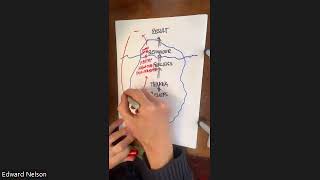
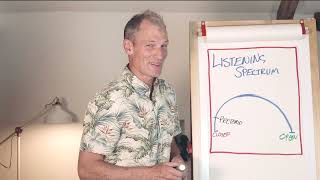
In this solo teaching video, Edward Nelson introduces a visual "iceberg" model that maps observable behavior to underlying feelings, thoughts (stories), and both conscious and unconscious beliefs. He explains how leaders often focus on changing surface behaviors—such as asking more questions or making more calls—to achieve business outcomes like higher sales or successful change initiatives. Nelson argues that these behaviors are driven by deeper emotional states, which in turn stem from the stories people tell themselves, rooted in underlying beliefs about the world. Using a feedback‑giving scenario, he illustrates how a negative belief (e.g., "this conversation won’t work") generates fear, apathy, and a brief, ineffective feedback exchange, thereby confirming the belief—a self‑fulfilling prophecy. Conversely, a positive belief (e.g., "I can make a difference") fosters curiosity, excitement, and a more thorough, constructive conversation, increasing the chance of a positive outcome and reinforcing the empowering belief. Nelson highlights that during periods of uncertainty, people cling to familiar beliefs, making change harder. He presents the iceberg sketch as a teaching tool and invites feedback on both the concept and the cartoon‑style format.
Chapters
Hi everybody, it's Edward Nelson. And I'm going to try a new way of putting a video together while my other one's still in the lab. So this one is a version of a teaching tool that I use often. And last week I was using it in two different contexts. I was using it about how to build trust with a team. And the other one was in terms of how, as a leader do you give feedback? But it comes down to a lot of the stories that we tell ourselves. So I'm going to share a model with you and I'd love your feedback, particularly on the way it works. The model itself might be familiar to you, but I'm just wondering what you think of the format. Okay, so here's the model. Now you might already guess what it is. And if I specify put the water in, you'll know that it's an iceberg. And why do we like drawing pictures of icebergs? Because they're easy, hard to get wrong, but also because there is a great deal of it, 80% of it exists below the waterline. And so when we're talking about human behavior, we see certain behaviors and we make assumptions, but we don't necessarily know what's going on below the surface that's driving that behavior. And that applies to us as well as to other people. So I'm going to put behavior here at the top. Right. What we see is the behavior. Now I will be asked to come into an organization and say, you know, we would like to increase our sales revenue or we would like to increase our retention of our staff or our customer retention, or we would like to navigate a change process and we're having challenge with it. So can you come and help us achieve that result? Okay, so obviously they'll go, well, we need our team to behave in a certain way to achieve that result. If it's sales, it might be to ask more follow up questions. It might be to for to pick up the phone more often for a change management process they're going through. It might be to communicate more often or ask more questions. So there's a number of ways that we might want to look for certain kinds of behavior with our team to get a certain result. Now some training just focuses on that behavior and there's definitely merit. As an actor, you can behave yourself into a certain result. I know that, but often what happens is that the way we behave is driven by something below the surface that we might be able to guess, but it's the feelings. And what I mean here is, I'LL do something on my to do list if I feel like doing it. And it's harder for me to do the things that I don't feel like doing. All right, so we know that there's an element of feelings, driving behavior. If you or your partner or the people you work with are in a bad mood, you can often tell by their behavior. So we have certain feelings that will drive that behavior. So we might want a result called getting the change program finished by the end of the year. We need a certain behavior, but there'll be a bunch of feelings like, oh, no, I don't feel like it, I don't want to do this, or yes, that's exciting. And that gives us a clue that below these feelings are a certain amount of stories. All right, Is the thinking. And below that we can have both unconscious and conscious beliefs. This is how the world, the world works, right? So we'll be carrying around a whole lot of assumptions about things that will be driving our feelings, that will drive our behavior, that will impact our results. What do I mean by this? So let's take the example of giving some feedback to somebody. All right, so if I believe that this conversation will go nowhere, right? Already I'm thinking they can't take feedback or they won't listen to me, right? So this, a version of this won't work. All right, so if I'm carrying a belief that this won't work. I've tried giving them feedback before. I've got to give them some feedback again. I'll have a series of feelings around giving that fear, that feedback, which might be apathy. What else my house might I be feeling as negative, disinterested. And often if there's things that we feel negative about, disinterested about, or apathetic about, we don't even do them. Right. Simple behaviour that results from that is that we don't even do the behavior. But let's say you do follow through on the behavior called giving the feedback to this person that you don't think is going to work. You'll probably have a short session, you probably won't ask many questions. You'll say a few things. You might even do the sandwich, the fill in the blank sandwich that you might have heard of. And we'll do it not expecting a result. And guess what? That person walks out of that conversation going, oh yeah, okay, whatever. And they've had a result. And the result is that wasn't particularly useful. I don't know what they're going on about. I don't think I need to change. And lo and behold, we have some proof. I told you it wasn't going to work. Now the biggest reason why this trap works so often is that when people are under pressure and the outside world is scary or uncertain, much as it is today, when we go and try and do something, it feels frightening, we feel uncomfortable and we find comfort in being right. We find comfort in reasserting what we already know about the world. And so we unintentionally create a self fulfilling prophecy. Okay, now might be great for feeling comfortable, but it isn't great for change. It isn't great for getting people from A to B, whether it's yourself or somebody else. Now the very problem is at the moment that we need to try something different, when the world outside is new or we have to try a different tact and there's something coming in that's unexpected, is the very moment we tend to get more scared and more attached to our way of working. When it is in fact that very moment that we need to let go of our way of working, of our old thinking habits and try something new. So in the case of giving feedback, this feedback matters. Let's say that's, that's this matters to them and to me. Right. And yeah, or try this for a challenging belief I can make a difference. You know, often we like to have humble leaders, right? And it's very un British to sort of believe I can make a difference. But over here in the negative story, if I'm a leader and I'm carrying around a kind of belief that I can't make a difference, that feedback conversation is going to go in this territory and I'm not going to spend very long doing long doing this and I'm going to get a negative result. So there's a lot of value in actually believing in yourself for loads of reasons. But when it comes to supporting your team, here's another way. If I believe I can make a difference, I might be interested in having that feedback conversation. I might be curious as to how it's going to work. I might be, I might be even excited, maybe that might be pushing it. You might be excited about giving feedback, but you might be, you know, it's a chance to contribute to your team. You know, so if I'm interested and curious and excited, I'm going to ask questions, I'm going to create space for the other person and I'm also going to be clear in my feedback. I want the message to get across as well as being open and the chances of that. Now, we put this above the iceberg because we're never 100% in control of the outcome, but you increase the chances of it being positive, and then you reaffirm the belief that I can make a difference. So that's the power of belief. That's the iceberg model. I just wanted to share that with you in this format to see what you think of me doing it over a sort of cartoon style. And there's going to be a little border around it. You know, we like to make our things pop out when we train. So I'm going to do that, even though it's just on a piece of paper, on zoom, just for you to have a. Have a look at this particular way of working. Not sure the board has helped in that particular case, but this is my practice, just putting it out there. Love to hear your thoughts either about the concept itself, but also about the format. Right. Look forward to hearing from you. If you have any other videos, if you'd like them in this format, do let me know. Take care. Bye.