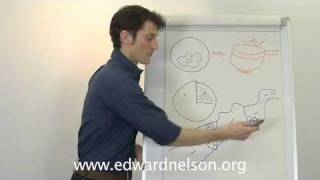
In this presentation, Edward Nelson outlines a visual, step‑by‑step model of how a mediator guides parties through a dispute. He begins with establishing the mediation framework – depicted as a petri dish containing an amoeba – to set boundaries and outline process principles. Next, he creates a safe space for parties to vent, using a pressure‑cooker metaphor to illustrate the release of built‑up tension. While parties vent, the mediator listens for recurring issues, likened to a 1950s radar that beeps whenever a concern surfaces. The mediator then helps the group prioritize those issues, comparing a large boulder (a major obstacle) and several smaller stones (minor issues) to decide whether to tackle the big problem first or build momentum by resolving smaller ones. Finally, the mediator guides parties through decision‑making, illustrated by a mouse navigating a maze toward cheese, helping them avoid traps and choose the most effective path. Nelson emphasizes that these stages are not strictly linear; the process can cycle back to earlier steps as new issues emerge, making mediation an iterative, flexible journey.
Chapters
Alright, My name is Edward Nelson and this is the pictorial representation of what a mediator does in a mediation. The first thing that a mediator does is set the boundaries. So this is like a petri dish and in the middle we have, guess what, an amoeba. Okay. The way this works is that we set out the guidelines, a process, we, we outline the process and the principles of mediation within that context. This takes any shape, the content is up to the parties, it takes any shape that they want. Okay? Now after that happens, the next thing that goes on is we give them some space to vent. Okay, so this is something that's becoming out of date now. And I was doing some work with kids the other day and they didn't know what it was. And it wasn't just my drawing, it's a pressure cooker. Okay. And so the next stage that happens is after we've sent it is they need to vent and they need to let off steam. You know, there's been a fire cooking under here, been a lot of pressure being built up and we need to facilitate a space for them to let off some steam. Okay? Now while that's happening, we. This is like a 1950s radar sweeping around. Now if you know these things, they, they do beeps, beep, beep, beep, beep, beep, beep, beep. Tracking, mining, tracking, different tracking things that you can't necessarily see or aren't obvious in its sweep around. So every time we hear a beep, we notice that's an issue. We're listening for the issues. What are the things that are really important? And as they talk, you'll hear it come up again. Beep, beep, beep. So this is the, this is the radar, this is like, this is what we do as they're talking, as they're venting, as things are going on, okay? The next thing that happens, we start to choose to focus on these issues. We've got to make a decision about which, which issue we want to look at. Okay, so here we have a. If you were able to respond to me, you'd be guessing what this was right now. This is, this is where we want to get them to. And this is a big boulder blocking them on their road to wherever it is they're going. We don't know where they're going yet, but right now some of these issues are getting in the way. Okay, so we've got one big issue possibly, and we've got two, three, four smaller issues on the side. Now what can happen is that we can get Caught up in this one big issue, and it might be so big that we can't do anything about it, and it's disheartening. So one approach is to decide to focus on some of the little issues and build up some momentum and show that they can actually work through something. When that happens, they can start tackling the bigger issue. However, it might work the other way around, and usually it does. There's one big issue in the middle, and we tackle that. The rest aren't important. They can sort themselves out. If they work that on out, 1, 2, 3 and 4, they're a piece of cake. They're not even important anymore. So how do we do that once we've gone through? Well, every choice that they make about how they're going to solve that. It's a bit like a little mouse here. Excuse my drawing, but this is a makeshift maze and we want to get this mouse out of the maze and we want to get the mouse for the cheese. Okay. I know it's pretty stock standard thing. I could have said peanut butter, apparently, that as well. But we want to get the mouse through there to what they want. Okay. They might be making some choices that are taking them towards, say, the rat trap, okay. The mousetrap. Okay, they're going to get caught. Or famously, the mog, the cat, something like that. You want to take them down the route and explore with them which one of them is going to be the best option for them to do to solve those issues. And for each one of those issues, you want to take them out through this process. So here's the mouse here. We're going to guide them. So that's in a nutshell, the visual pictorial representation of what happens in mediation. Now, they don't necessarily all happen in that order. You can go cycle around, you might find that you move back up and they've got to do a bit more venting and you hear a bit more about another issue as they've been working on this. But predominantly, that's the kind of overall theme of the way you want it to go. Okay. That is the stages of mediation.