Symantec CEO talks Kansas City Google Fiber, Startups, Leadership & Innovation
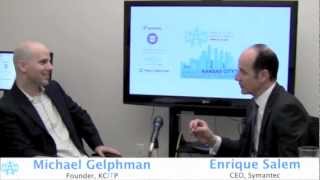
In this interview, Symantec CEO Enrique Salem discusses how gigabit‑speed connectivity like Google Fiber can spark new business models and personalized services, especially at the local level. He highlights the explosion of data (growing over 60% annually) and the resulting security and privacy challenges, emphasizing the need for new security offerings. Salem shares his entrepreneurial background, describing the rise of location‑aware services and the importance of “fail fast,” multi‑hat roles, and avoiding silos to foster a startup‑like culture within a large organization. He outlines his leadership philosophy: inspire teams, set high expectations, keep ego at the door, listen actively, and recruit only those who want to make a meaningful impact. Personal sources of inspiration—cycling, reading, stories from strangers—are presented as ways to maintain clarity and focus on controllable factors. Finally, he expresses excitement about the rapid pace of technological change, citing mobility, cloud computing, privacy, and emerging threats as areas ripe for breakthrough innovation, and predicts that high‑speed broadband will enable a wave of startups in Kansas City.
Chapters
I've got a couple questions for you today, so thanks so much for your time. I really appreciate it.
I love to do this. I mean, this is actually more fun than most of the things I do.
Good, good. So with Google Fiber, how do you see the gigabit speed infrastructure driving innovation within a city, and what verticals do you think will be impacted most?
What you want to think about is when you get— you ubiquitous connectivity at high speeds, it enables so many new great things. I think, you know, I used to always hear when I was a little kid, well, all the great things have already been invented. That's absolutely wrong. I mean, ever—
I've heard that before.
Right? Well, you know, we didn't have Google, we didn't have Facebook, we didn't have iPads or iPods or Android devices. And so, you know, as I look at it, anytime you get high-speed connectivity, it enables a whole new set of applications. Sure. Things that people haven't, you you even dreamed of. You know, I look at it, you know, I travel with a mobile device everywhere I go. When I walk into my hotel every day or every time I'm traveling, I go to the front desk, I give them my credit card, they give me a room key, you know, and why does that have to work that way? Right? When you've got ubiquitous connectivity, high-speed ubiquitous connectivity, they should know as soon as I walk in that front door, you know, what my room is. They've already got credit card details. And so when I think about high-speed broadband, It's going to enable, in my opinion, a whole new class of businesses and applications that we haven't even dreamed of.
What sort of ideas or services do you think will be built out? And, you know, if you weren't leading this company, what would you be doing?
Well, you know, I'm an entrepreneur at heart. I've been involved with 5 startups throughout my career. I mean, what you want to think about though, back to this broadband capability, is Connectivity is going to allow us to do some really interesting things. One of the things I see really surging right now is the idea of local services where I walk by a store and I may want to know more about that store. What are the things that are interesting to me in that store? And so this notion of local I think has a lot of value. And so the more information that can be communicated between me and everybody around me, the better customization or personalization of those services. Now the big question is going to be, so how do you deal with security? How do you deal with privacy? Because that'll create a whole new set of issues. Sure. Because quite frankly, I may not want everybody to know I'm walking down the street. I may want to be able to say, well, you know, I do like to go to the Apple Store. I like to go to, you know, check out specific sports stores. And so At the end of the day, there's going to have to be some control of what people know about me. And so I think there'll be a whole new set of security offerings. I think there'll be a whole new set of local applications. I think there'll be a whole new set of ways of organizing information. I think about data. Data is growing at over 60% per year. Crazy.
[Speaker:ENRIQUE SALEM] Yeah, it's amazing. [Speaker:SETH GREEN] Crazy.
So you've got to have new ways of organizing that. So I think there's going to be lots of opportunities for people who want to drive innovation. Take advantage of the broadband, focus on users and how do you create a better personal experience. I'll give you a classic example. I'm a big user of Amazon Prime.
Yeah.
Love it. Right? I log on to buy something and I can have it at my house in 2 days, no problem. They know who I am. They know things I like.
Yep.
They tell me things that maybe I'm interested in. Do I buy them all the time? I don't. but still they know who I am. It feels good. It's kind of like, I don't know, maybe you're too young, probably don't remember Cheers.
Oh yeah, love that show. Yeah, love that.
But think about that concept, right? People want to go to a place where they know who you are.
Yep.
People know your name.
Oh yeah.
Right? So that's what you love about that experience that you create with an Amazon. And so with broadband and this high-speed connectivity, I think the ability to create personalized services will be very, very different than what we've seen in the past.
So, and I guess that leads to my next question, and you've kind of already answered that, but how will Google Fiber change the way that companies approach information security and the threat landscape within Kansas City itself? So all the companies here with that big pipeline, I mean—
Well, there's a couple things you want to think about. First and foremost is I always look at how things are changing. If you look at what I call digital natives, so that's teenagers today and how they interact, they don't use email. They're always on their mobile device. When they want to solve a problem, they reach out to their network, to their social network and they interact. If they're trying to find information about where to go to dinner or to lunch or to a movie, they don't go look at a printed or website. They say to their friends, "Hey, what did you think? Is this interesting?" Yeah. One of the things you think about with that group is they absolutely think about privacy completely different. Sure. They want to share everything. Yep. Now the question is, they do care about their reputation, right? They don't want to be in a situation where people are saying, "Oh, well, that's not a good person," or, you know, trashes their reputation. Yeah. So there's a balance between privacy, reputation, and security. And so I think there's a lot of opportunities for companies to think about how do they help protect people's privacy? How do they clean up or help somebody with their reputation? Because you know that old saying, you put it out there, it should be out there forever.
[Speaker:ENRIQUE SALEM] Absolutely.
[Speaker:BOB BOYD] So you want to think about how do you deal with that, especially now that everybody's going to be constantly connected. What are some of the new challenges that come out of that? And I will tell you, I would be willing to bet, especially with this Google Fiber project here, you'll see a lot of startups here in Kansas City. And having been in the Valley where there's lots of startups created every day, one of the pieces of advice I would give to the startups or people who are going to be here is you want to do something I call fail fast, which is you want to try something. If it doesn't work, go try something else. Don't give up. Tweak your idea, be agile, and go try the next thing. But I'm willing to bet you there'll be some great startups here in Kansas City that are because of this new connectivity. I also tell people There's been the missing link in connectivity, which has been when you fly, but that's quickly also going away. So imagine now you really do have high-speed connectivity everywhere in the world continuously. I think it changes everything.
I want to talk about leadership though. Yeah, sure. I was a big fan of some of the articles I read about your leadership experiences, and so you talked about encouraging a startup culture in Symantec. How do you encourage that culture and encourage innovation?
I tell people I want to be a $7 billion startup. What does that mean? That means you don't have to run the company on consensus. You've got to have people who are willing to take chances. You've got a good idea? Go for it. Challenge the conventional thinking. I hate it when somebody says, well, we've always done things that way. That's got to be the most annoying—
I've heard, that's, yeah, absolutely.
Painful. Startups don't think that way. I ran a startup. They can't. They'll die, right?
Yeah.
They have to continue to innovate. And so what I think about with this notion is last startup I ran, I said the hierarchy can't get in the way. People got to be willing to challenge management, their own thinking, and say here's what we think is a better way of doing things. And be aggressive. Take some risks. The other thing I think about with startups is you don't get specialization. See, what happens as companies get bigger is you got people who do very specific things.
Yeah.
And as you get to a company like ours, you know, if you're going to go work on a specific engineering project, there may be somebody who works on the user interface, there may be somebody who works on the core engine, somebody else who works on the installation program. When you add it all up, you get all these little silos. When you work in a startup, people wear multiple hats. And so I like people to think outside of their function or out of what exactly is their responsibility and be willing to say, hey, you know what, I can take that on. Sure. You know, and what I kind of feel what really hurts big companies is they lose that passion for saying, you know what, it's not about somebody else, it's about everything I can do. It's just making it happen. Sure. Don't wait for somebody else to do it. You get it done. Absolutely. You get it done. Love that.
So with leaders, I mean, what advice would you give to people who want to be leaders like yourself one day? I mean, what are some of the, maybe the top 2 or 3 things that you think would really help them?
When you think about leadership, leadership is about getting people to be able to do extraordinary things. Often things that they don't think are possible. You know, somebody walks into your office and says, well, you know, I'm worried about getting this completed, or I don't know how my team and I are going to finish this project. Your job as a leader is to help them solve the problem and give them a view or a vision of how they solve that problem, to inspire them, right? My goal is when somebody leaves my office in a meeting like this, like we're having just this chat, I want them to be fired up when they walk out the door. I want them to feel like they are unstoppable. And so part of leadership is really being able to inspire people to do great things. And that's actually a way I end a lot of my emails to the company. I say, "Expect great things." I expect people to do great things.
Absolutely.
People who don't want to do great things, quite frankly, I don't want them at the company. I don't want mediocrity.
Yeah.
I want exceptional performance. I want the best. And you know, when I recruit people to the company, I tell them, "There's a lot of bad people out there. Your job is to protect the world." I was once at my daughter's back-to-school night. I was running a little email security company. And we were doing anti-spam, that's one of the things we did. And so somebody came up to me and said, "Enrique, what do you do?" I said, "Well, I work for an anti-spam company. We're trying to eliminate all the spam in the world." And the lady says to me, "God bless you." Right? Because we're trying to—
and that's what you're solving that problem.
And that's how you inspire people. You want to give them a vision of something really meaningful that they're trying to do and that they may not believe is possible. Like if I told people, we're gonna get rid of, in your inbox, you'll never get spam again. Some people might say, well, he's crazy. You know, people still send spam and he might not be able to catch all of it. Well, we're gonna go for it. We're gonna go try and figure it out.
Absolutely.
The other thing I think about with leadership is, I start with this phrase, you gotta check your ego and your title at the door. Right? It's not about your title. If it becomes about that, you've lost. It's gotta be about the people. Best ideas. It's got to be about listening. You know, one of the— you know, my mom used to always say, you know, God gave me two ears and one mouth, use them proportionately. Yep. So you got to listen.
Absolutely.
Yeah. And, and good leaders learn how to listen. You know, they don't— they quickly learn they don't have all the answers. They have to allow other people to win, to have good ideas, and to encourage that. And the The more you encourage people to shine, the more you give them a chance, the more you ask of people, you'll be surprised what people are capable of.
Absolutely.
And so that's how you want to think about it.
Where do you get your inspiration? I mean, you know, you're inspiring others, but how— where do you get— where does that come from for you? Because you're leading this company and you're leading—
I would tell you a lot of things I do are to kind of keep my head clear, you know, try not to get caught up in too many things. So I'm an avid cyclist, you know, I love to ride my bike and I race, you know, in the cycling season between pretty much May and end of September. You know, I'm on a group of riders and we get out there and, you know, quite frankly, it lets my— clears my head and it makes it possible for me not to get caught up in any small issue. You know, you're going to have big issues that come up. One of the things that's important is to not get overly concerned about any one thing. You gotta roll with the things that come. Now, if it's a real critical issue, a potential fatal issue to the business, then you better have urgency. But make sure you take things in stride. You know, I love to read. I read all the time. I've been inspired over the years by various poets, various artists, various— pieces of literature. You know, quite frankly, sometimes I get inspiration sitting on an airplane with hearing the story of somebody who sits next to me and tells me about, you know, what they do. And I've been inspired by people who are everything from— just the other day I was sitting on an airplane, gentleman next to me was raising money for a cancer foundation. And this person is doing something I think is tremendous. And listening to the story, the effort he puts in, you know, crisscrossing the country, you know, it makes me feel like, you know, I should be able to work a little harder, feel more committed to what I do. And so I can get inspiration from pretty much anywhere at this point. Yeah. And you know, the more experience you get with things, you realize not to sweat the little things.
Yeah.
Right. You know, there's a— well, when I was growing up, there was a little plaque my mom used used to always have and said, you know, focus on the things you can control.
Sure.
Not the things you can't. Absolutely. I'm sure you've heard that before. Yeah. And, you know, as you do your own thing, run your own business, you got to make sure you understand that difference because if you can't control it, why even stress about it?
This is my last question. What gets you excited about the future in regards to technology and what's the thing that just you could stay up all night just sort of thinking about ideas I mean, what is it that—
I think the world— we're seeing more change in technology than we've probably seen in the last about 35 years. And so what that means is there's a lot of disruption. There's a lot of opportunity to create breakthrough innovation. And so what I'm focused with my team is how are we changing the world, quite frankly. There's all these internet web services. There's all this data. There's all these mobile devices. There's all these privacy issues. There's new threats. And so as I look at it, What I focus on is what's the breakthrough innovation? What can we do that changes the world in a way that people want to work with my company every day with high levels of engagement? So I'm excited about mobility. I'm excited about how do we deal with all the new issues around cloud computing. I think there's some huge opportunities there. Awesome.
Thank you so much for coming.
I appreciate it. My pleasure.