A New Direction -- Thinking Outside the Box to Solve Todays Challenges – Squircle – Francis Cholle
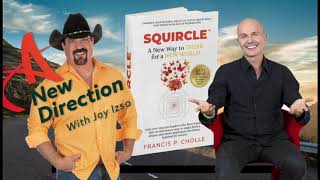
Francis Cholle explains his Squircle concept: square thinking is structured and metric-driven, circle thinking is creative and adaptive. The best approach blends both, using square thinking for planning and KPIs, circle thinking for play and improvisation. Over-structuring kills creativity, like a parrot trapped in a cage.
Chapters
You say the game is getting old Monday morning and your coffee's cold. Life is not what you want it to be.
Hello, everyone, and welcome to a new direction. My name is Jay Izzo, and. Wow, we did it again. Yes, sir. Yes, ma', am. We sure did. You know what we did? We got a great show with Francis Scholl. His book Squircle. What? Squircle. What do you mean, Jay? What? Squircle?
Trust me. Let me tell you, when I say this to you, Squircle is something that we do, but we don't do. Oh, the mystery continues, right? Yeah. Hold it here. Here's the deal. There are squares and circles, and I promise you, you fit into one of those two groups, you're either a square. See, I guess that's kind of this way. Yeah. Or you're a circle. All right? And you know what? Here's the deal. Depending on which one of those things you are determines how you think about solving problems and going about life and running your business and running your life and running your marriage and dealing with your kids and dealing. Right? I mean, it's everything. And you go, jay, I don't know what it is. That's why we got Francis shoes today, so he could tell you how to do Squircle. It's awesome, right? But before we get to Francis, who is absolutely awesome, that's what we do every week, right? Here's what we do every week. Here's the deal. You know, we live in a kind of an odd world right now, right? And in this odd world, one of the things that I've talked to you about is that we're only as good as our training. And what I meant by that when I say that is because, as you know, I've interviewed a lot of, you know, Navy seals and Delta Force special operations forces, people on this show who have written some great books. And one of the things that they have all said is that when you are under pressure, when you are under stress, when you are dealing with things that are. That sometimes are outside your control and you're having to fight it.
The fact of the matter is when you're tired, exhausted, all those things, you're only as good as your training.
And the thing is that we typically think of training only in the physical. But the truth is we're four part people. We're physically, mental, emotional and spiritual people. That's really the truth.
And.
If we don't understand that we have to be in a constant state of training, right? That we have to constantly be working on Ourselves in those four areas, what happens is as we deal with pressure, we just don't deal with it as well, which is why maybe you falter in one area or another. So what we do in this little segment here, in this first little segment, is I walk you through the four areas of your life to ask you how your training is going in those four areas. And you put yourself on a scale of one to ten. One is miserable, ten is outstanding. Alright? And I will tell you what we're looking for.
In these areas. So the first area is the physical. Now what do I mean by your physical training? Well, I do mean getting physical exercise. I do mean how is it going when it comes to eating, right? How about getting enough sleep? How about drinking enough water, right? If you were to think about those four areas, how would you evaluate everybody out there? How would you evaluate how your training is going on that scale of 1 to 10?
And then every one of these areas, we have to ask ourselves a question. The question becomes, why am I that way? Right? Awareness. And then the second question, what am I going to do about that right now? Action.
Okay, now I'm not telling you how to do it, right? Because as Francis is going to talk about here, you know what, creative solutions are awesome. Because I even talk about my physical training. You've seen some videos of me. I went to Home Depot and bought a galvanized piece of pipe. I use buckets of water, cinder blocks that cost me $1.65 a piece. And that's how I bench press and lift and squat and deadlift. I did, I did my mile plus walk with a 70 pound backpack on my back and did some boxing in my garage, right? Because we could be creative. Matter of fact, the beautiful thing about this, this time that we're living is this is an opportunity for you to be creative, right? If you're willing to let yourself be creative. So on a scale of 10, how do you think you're doing that? First number. Okay, physically, mentally, what do I mean by that? Well, you know, what are you a mental loafer? Here's what I mean by a mental loafer, right? Because if you're a mental loafer, you're down at the bottom end of the scale because you know, you need to take responsibility for what you put into your mind. Meaning, like, are you reading good books? Are you active participant?
Right.
Reading is an active participant sport, okay? Letting people tell you what to think, letting people try to express to you what you think is mental loafing.
We need to be an active participant in our learning. And what should we be learning? Well, we should be learning things that grow both halves of our brain. Things that are working with our wisdom and knowledge and understanding. Things that are maybe growing in what you do in your job. Maybe things growing in how you work with relationships, like this book can do and more. You know, maybe it's. It's working on a skill or developing a new skill. Maybe it's learning a foreign language, maybe it's taking up an instrument. Maybe it's doing all the above.
Right? So on a scale of 1 to 10, how would you say that mental training is going? And then, same two questions, why? And then what are you going to do about it? The third area is the emotional area. And I promise you that Francis is going to talk about the emotional area a lot. He does quite a bit. The fact of the matter is we're in emotional training every day, okay? Your emotions are your emotions. Nobody should be telling you, by the way, that you should feel this way or feel that way. No, your emotions are emotions. They are what they are, okay? But you do have control how you feel.
That's a fact.
You know, I was thinking about this. I was thinking about this as I was getting prepared for the show. And I was thinking about, you know, I have a lot of choices how I feel every day. My attitude is my choice. I read a beautiful quote by Viktor Frankl and, you know, they. They were in.
You know, when. During World War II, right. As a Jew, right. They were in concentration camps. And he said, you know, the last freedom that we have is the freedom to choose our attitude regardless of our circumstances.
I thought, that's really powerful.
You know, we do have a choice, right? You know, when somebody cut me off the other day in traffic, right.
Initially, I probably wanted to get angry, but you know what I thought? Well, maybe he's in a really big hurry. Maybe he's got an emergency that I don't know about.
And, you know, we were doing something the other day and we were doing this group activity and it was during Halloween, and we were giving candy to kids at the office. And. And they were driving through and. And because, you know, you know, we're in this thing where we can't really get together, but they were driving through, we were handing out candy and little toys, and we were out at the street and people, we were waving at people. And somebody flipped me off.
Right? And I had a choice. I could have been angry because this guy flipped me off from his car or, you know, you know, the truth is, I Felt sorry for him because that was the best response he had, I guess. See, I had choices. We have choices in our emotions. Not only do we have choices in our emotions, but the other part of your training is to increase your emotional vocabulary.
Right? There are so many subtle words. We're going to probably talk about those, too. So on a scale of 1 to 10, how would you say you're doing emotionally?
Then again, why? And what are you going to do to change it? And, you know, part of the change is just being better, intentional about your emotions. And then finally, the fourth area, the spiritual area, right? And a lot of people will say, well, I'm not really spiritual. We're all spiritual. Whether you want to believe that, you're the. Listen, Francis and I have an S as part of our graduate work, right? Francis family was in science, and I was a science guy and in grad school and was in experimental psychology and, you know, studied and did experiments and all sorts of things. And can I tell you something about that? Science can't explain everything. Matter of fact, what it does is it kind of locks us into believing that there's only one way of doing things. Can I tell you something? That's a big world out there. It's much bigger than you and I. And the fact of the matter is, you know what? Every one of us has plans for our future.
And whether that's going on a trip somewhere or whether, you know, what we plan to do later on in life, that's plans. And you know what? When we have plans, that's faith. And faith is a spiritual concept. It's not a scientific concept. It's not. Even if you believe that something's going to happen and hasn't happened, that's faith. It's as simple as that. And the fact of the matter is, even among circumstances, there's something inside of us that brings us back to a center. A sense of peace, a sense of joy, regardless of what's going on. The only way to explain that is the spiritual sense, because it's not emotional, it's not mental. It's. There's some connection that we make outside of ourselves that allows us to come to a place of wholeness.
Spiritual.
For some people, it is God. For some people, it's nature. For some people, it's meditation. For some people, it's something else, whatever that might be. You know, the question becomes, how's that going? And, you know, what do you need to change? Get yourself there.
And as I say to you every week, you know what? Here, listen. Spiritual is not about going to church and thinking about fishing. Spiritual is going fishing and thinking about God. That's being spiritual if you really want the truth. So those are the four areas of your life. And those four areas, you know what? We think about those four areas as the legs of a chair and we want the chair to be even because if we sit in an uneven chair it affects our posture and does a whole bunch of bad things. And we also want the chair to be up at the right height because when it's at the right height we can eat at the table and be as nourished as we possibly can. Speaking of somebody, who is that? I would like to introduce you to Francis Scholl. He's an international business consultant, best selling author by the way. This book is best selling author, USA Today and the Wall Street Journal by the way, just to let you know. And he's also sought after, highly sought after, engaging speaker trainer. He helps companies rethink businesses in ways that conventional strategic management cannot. His clients are everywhere from the major to the mid side to emerging firms. He's including global powerhouses across a wide variety of indust such as beauty, luxury, pharmaceuticals, communication, media and information technology.
He's got this unique approach we're going to talk about, it's called Squircles and it's helps companies and people understand the leverage and power of intuition and instinct thereby impacting people and their culture. And so we're going to talk to him and he's got this model, it's called the Intuitive compass which enables clients to foster innovations that are critical to long term success. And Francis is a graduate of Europe's leading business school, the HEC School of Management in Paris. And you'll hear his beautiful accent. He's also accredited by the Creative Problem Solving Institute in offer leadership assessments and credentialing administered the Myers Briggs type indicator which we have in common. Francis is absolutely outstanding. He is unbelievable. His clients include Alcatel Lucent, Bristol Myers Squibb, Chantelle Cordes, Johnson and Johnson, Estee Lauder, Ferman Ekachet. It just goes on. Siemens, it just goes on. And you know, here's the deal.
This book right here, Squircle is absolutely outstanding. It's not a long read but man it's par packed and full. So please welcome to the show everybody and please welcome to a new direction. Francis Scholl. Francis, welcome.
Hey, thank you Jay. Welcome to all your listeners to be with us and thank you for being there and thank you for having me here Jay.
So do me A favor because France is the number two country that listens to and downloads this show. Show. Will you do a nice little welcome for those people who speak French, whether that be in France or Would you do that for me, please?
That's awesome. Thank you so much for doing that. That means so much, I know, to personalize it for a listener. Right. And it's a creative thing to do. And because we're kind of both circles, I guess it's something that we would do anyway. So let's talk about this book here real quick. And.
We'Ve kind of given a little bit of a way I kind of did in the introduction. We talk about that we live ultimately in a world where there is two different ways about going about solving problems in our experience. And you talk about this in chapter one, entitled A New Way to Perform Better with Less Effort. And you start to define for us that we kind of live in a world that is really made up of two different things, squares and circles. So between chapters one and two, you kind of discuss that. Let's kind of pull it apart and help you help us understand the world that we kind of live in and the world that and how we analyze that in two different ways.
Okay, thank you, Jay. Lovely question. So maybe I can start with a story that I think people can relate in sports.
So I was giving a seminar in New York and as I'm talking and get people through a game, we debriefed the game and then there's one of the participants who said, hey, really reminds me of something. And he was very animated. So I said, okay, well, please share with the group. So he's a marathon runner and his name is Philip. So he's an executive at Unilever, but he's also a very seasoned marathon runner. He's in New York and he decided this year again to run New York's marathon. So as most of you must know, you know, it's like three month preparation. So you run it in November, that's October, September, August. So you start in the summer and you run by a regimen. So first month, August was okay. After Labor Day got more busy, and then October was very busy for him and especially towards the very end of the month. And he felt soon before right before the race that he was not prepared enough.
And he was worried that would not be a great race. So he calls his coach, Jennifer, and he tells her exactly what I told you. I'm not prepared enough. What do you think? So Jennifer tells him a few things very professionally. She says, hey, Listen, Philippe, you've prepared quite a bit and you're a very seasoned marathon runner. So there's no risk, if ever you are worried about this, there's no risk that you're going to injure yourself. Safety first. So know that my professional assessment is you can go from that perspective. Now you tell me that you're not sure, well, why don't we try something new? I would advise that if you go, run, do two things. One, never look at your watch.
Two, stay connected to your breathing all throughout the race.
So he listens, he has to go to his next meeting. He hangs up. She's very surprised because normally she's very performance oriented. Metrics. What did you eat? How much did you sleep? How much did you run? And on and on. And this time it's like very touchy feely. It's like, what is he about anyway? Goes to his work and he thinks like, you know what? I think about it overnight and tomorrow morning I'll make a decision. He goes to sleep. Next day he's actually thinking as he's taking his coffee that, you know what, maybe I'm going to try, I'm going to try those two things. You know, why not? And I love running and I love Manhattan. And so I'll do it and I'll tell her what she says. So without fail, he goes running and he finds it a bit hard to not look at his watch. But you know what? He has put it in a pocket so he cannot really look at it really from his wrist. And he finds it hard also to always remember to breathe because he's distracted, because it goes into his mind and everything. But finally he really finds a way of not looking at his watch and breathing. And what happens, what happens to him at the end? Well.
He gets to his best race ever. Best time ever. So here's the story. You have two ways to look at life. Two ways that Philippe engaged. One was, do I have the right strategy? Have I followed the right strategy? Have I delivered enough on strategy? Am I going to meet my metrics? Am I going to beat myself on my latest score? So very metric measured strategy, point A, point B, goals, etc. The other one, free flowing, let go of strategy, don't think about winning, don't think about performance, experience and joy and see what you get. So the interesting part here, that you have two forces, two approaches, two attitudes and in the world of performance. And I can explain more and expand on the story, but I will stop here. It's interesting to look at it in the world of performance. Because usually in business, and that's what I do with my own business and everybody does, you have somewhat of a strategy with somewhat of metrics. And every day you use your tactics to fulfill your strategy and meet your matrix. In the case of Philip, he got better performance results without a strategy and hardly any tactics, just like breathing.
You've said this in the book, but you and I both know that people will go.
Francis, you can't do business without a strategy. You just can't just do business without strategy. And.
The truth is though.
We get kind of locked into believing that we create all these things. This is what you talk about. We get kind of locked into this square mindset, right, which you talk about, chapter two, where we get kind of locked in thinking that, you know, everything has to be one way in order to. For us to succeed, but that it. That's not, we're not going to be the most successful that way, are we?
I mean, you know, listen, it all depends. The circumstances, I think few things to say. So the strategy goal metrics is square. You optimize. Everything is defined and clearly defined and squarely defined. Okay, good. It's dependable. If I need 45 minutes to get to the airport and I want to be there 30 minutes ahead, I need to leave an hour and 15 minutes and maybe give myself another 10 minutes just in case of 15 minutes. So I'm going to leave an hour and a half before. So I'm there on time and I'm sure that if stuff happens, I have a little bit of leeway and I will be also right early and no stress. So very valid approach, Very valid approach. Who wants to arrive late and miss their flight and pay another ticket or be late at arrival? So square. And then there is this other approach which is in the unknown. Like Philip, he didn't know what to do. It was actually an opportunity for him to try something new. And actually when you think of it, so he gave up the square. No strategy, free flowing. See what you get. Give up measuring yourself and even give up excelling. And he excelled in his world of competence and performance. So interesting enough, he opened the door, he got out of the square of his strategy and metrics and he went much more free flowing. He still had the square. You know, he was disciplined. He didn't look at his watch and he kept breathing very precisely in a very present manner. So there was a discipline there, There was a square. He was not dominant. He was willing to be in that discipline for the sake of the experience. And not for the sake of being held accountable for results. So listen, two approaches are valid. But in a world that's becoming more complex, more uncertain, more volatile, ambiguous, Vuca world military term, volatile, uncertain, complex and ambiguous.
Strategy doesn't work when you move on the golf course. When you need to move from hole number one to hole number two and you enter the jungle, you don't have the same set of attitudes and tools that they won't work. Everything can happen at any given moment in jungle. So you need to develop another way of being that, that allows you to improvise, not be phased out by the unexpected and not be afraid of the unknown and develop that capacity, which is a natural capacity. We're all natural born adapters. But because we've developed, as you were saying, this science and this habit to secure outcome, which is not necessarily science, by the way, the idea that you want to secure outcome no matter what, that's when you put yourself in a box, which works on the golf course, it doesn't work in the jungle. And we've moved clearly from being. Well, I know what next year is going to be. Who knows whether we're going to be able to travel for the holiday at the end of the year or not.
You know what, I'm going to say this, though. If you ever seen me play golf, Francis, I quickly go from the golf course into the jungle and have to find a creative way to get back on the golf course. We're talking with Francis Scholl. His book is called Squircle. And you're listening to him here, right? On a new direction. Hey, everybody, listen, you know what? I have two great sponsors here on a new direction. First is Epic Physical Therapy. And I want to give a shout out because you know what? They just won the News and Observer Newspapers Award for the best physical therapist. And it's just such a tremendous award. So congratulations to my sponsor, one of my sponsors, Epic Physical Therapy, for being the best in the triangle. Look, they're awesome. And whether you're recovering from an injury or surgery, maybe you're suffering from everyday aches and pains, maybe you're having difficulty in movement, maybe you're a professional athlete and you just want to get better at what you do and you're just trying to get back into the game. Look, here's the deal. Epic Physical Therapy will provide you with a customized treatment plan tailored to your needs. And look, they understand the need to treat the entire body as a functional whole, not just your symptoms or your injury. So get on over there, start with them. Start with if you want epic relief, epic recovery and epic results, start with epic physical therapy. You can learn more by going to epicptiga.com that's epicpt.com and Linda Craft and Team Realtors. You know What? For over 35 years, they have stayed at the top of the real estate game. How do you stay at the top of your game for 35 years? I'll tell you how. When you're Linda Kraft, you understand that what really makes your business is understanding that the house that people purchase, that they buy and they sell.
It'S really about the people. It's about the memories that were made. It's about the relationships that were had in those homes. And she understood that the relationship was the most important part of real estate. Yeah, she's going to get you the best price on your home and she's going to reduce the amount of stress and she's going to help you find the right home that fits your needs and wants and desires. She's going to do all that. But at the end of day, the very first thing is how well is the relationship? And not only the relationship from the very beginning, but how do we maintain that relationship over the course of time? Because her customers come back. Why? Because they call her the legend of customer service. That's how you stay at the top your game for 35 years. So when you're ready, and I don't care where you live in this world, she knows she's made relationships with the best experts all over the world. Start with Linda Craft and team and you can learn more by going to Lindacraft.com that's L I N D A C r a f t.com and we're back here on a new direction with Francis Scholl, best selling author, USA Today, Wall Street Journal. The book is entitled Squirkle. He is absolutely outstanding. And we're having a little bit of fun at my expense at how bad my golf game was because I actually could tie both getting on the golf course and into a jungle all in the same shot and had to come up with creative approach to get out of it.
I get what you're saying, that we need both the square and the circle because they do have complementary qualities. I think the thing that happens though, for those of us who are circles and I'm a circle, right? I mean, yes, I do have a logical piece that I do rely on in my work and I have to be very disciplined about it and I have to be very orderly about it. But I don't like playing by other people's rules. I'm just going to be really, really honest here. I do not always play well with people in the sandbox. And because I've always had different ideas and creative ideas when I've worked in situations where I've tried to bring up some different idea or different approach, I've been shot down, dismissed, and I have been angrily told in my office when I worked at these places, and these are places of higher educational learning, which you would think would be open to new ideas.
Literally was told that I was a loose cannon because of my ideas.
This can be problematic for people who are circles because our world really is follow the rules, we have it outlined. We need you to stay within the lines here. Isn't that true?
Sure.
I mean, isn't that our bias? Isn't our. Pretty much. Even in the 21st century that we live in, isn't our bias still.
Sure, totally. Because it's imprinted from very, very young age. You know, when you go to school at 4, 5, 6 of age, they will teach you the Alphabet, they will teach you numbers. And then you're being evaluated on your ability to use those letters and language and math and, or memorize things and deliver them in an orderly manner that can be noted and evaluated. So everything is put into an evaluation that's actually not really taking into consideration any form of creativity. And more importantly, they don't even tell you that those are tools for you to succeed in a society that generally in large majority will use those tools. But there is a unique person behind those tools. And never forget the unique person. And then really the most important part is not the tool. It's the artist with the tool or the artisan with the tool, the craftswoman, the craftsman. But that's not really what's developed, unfortunately. What's developed is the perfection of our use of the tool. So now you've identified with those tools. Those tools are.
Made to produce some results. So can. You can read. You can actually read and measure those results. And you lose bit by bit. Your. You lose bit by bit your ability to naturally adapt, naturally create, naturally invent. Because that's what we are. We are born natural adapters and natural creators. There's no way, you know, when you drive, you're in an environment that's forever changing. Ask Elon Musk and all people want to do, you know, driverless cars. It's very difficult to mirror or reproduce our ability as humans to take in all this information any given moment and make sense of it. And Adapt to it in real time. Okay, so that's who we are. That's who we are. But we don't trust this. We don't come from experience. We come from theory.
Yeah. You know.
I think this is why also in chapter three, you talk about square versus circle, a controversial relationship. You talk about that.
The square organizes everything in terms of opposites is what you discuss.
And I think it's because we want things to be binary. We want it to be ones and zeros. We want it to be black or white. We're just not very comfortable in the gray. I think that's just kind of what you're kind of. That you kind of get at. And I think also you talk about. What you talk about is that we like to think of everything as either rational or irrational. But there's another choice, isn't there?
Absolutely. So again, you know, we've developed an amazing language called science, and that enabled us to do so many things. I mean, like, you know, who's not happy to be able to have a hip replacement or to have their child with an X ray or so? I mean, like, you know, it's like. It's amazing.
It'S incredible, and we owe it so much. But every scientist knows that science is not there to produce certainty. It's there to produce knowledge. Knowledge that then you have the responsibility to do something with. It's immoral. And it's not responsible for what you do with atomic energy. Whether you want to create a bomb or you want to create a nuclear plant that's going to create energy cheaper and cleaner. That's supposedly. That's your choice. That's not the choice of the scientist. The scientist is there to produce knowledge. And then what we've done, we moved from science to scientism. We made it a. We give it faith because it's so practical not to have it, to make a choice, you know, well, science tells you this is the way to do it. All right, so I'll do it. I'll follow. It takes away my autonomy of choice. It takes away my responsibility of choice in the choice I make. So we drifted away. And our education is really based on this. And there's nothing wrong with the fact that we have tools and science, obviously nothing. But we should never forget that ultimately this is my choice and my responsibility. Not alone in relationship with others, obviously in relationship with society. So here are the boundaries and the constraints. But we have autonomy at an even moment. That's what you were saying with emotions. So let me give you a simple Example, so two images that really capture the whole thing. So life is filled with colors that combine endlessly and create endless nuances.
So nothing in life, in nature, for instance, can be said to be either black or white. Everything is in the gray zone. And when you think of it, even black and white.
White is the sum of all colors. And black is the absence of light, which denies any color. Okay? So apart from black and white, you have a world of things, endless world of things. So when you apply logic. True. Not true. This is red. No, this is not red. No. The red you like, the red you see, the red you don't like, the red you don't see. But this is it. It's completely subjective. So once you put this into a binary, it's as if you are looking at life, black and white. You take away the colors, and now you organize everything from black to white. There's no gray zone, as you were saying? And then there's no nuances. Fabulous. Those are computers, 1 and 0. And we know what computers have done for us. We're right now interfacing together through computers in two different parts of the country, on the east coast and West Coast. So it's fabulous. It's incredible. Incredibly multiplying our capacities and everything. Nothing wrong there. But we know more than 1 and 0. We're capable of taking in all these nuances. And that's where we need to be aware that that lens by which we evaluate ourselves, we judge everything we do, we judge ourselves, is actually meeting us tremendously. And when you're able to suspend judgments, suspend evaluation, be in the moment, then life, which moves and provides all the time, provides you with new options through a process of emergence. Emerging opportunities are constantly coming your way. And if you are in that black and white, you're not in the moment. You're evaluating, and you're not able to seize those opportunities. Very simple mechanism, very difficult to achieve.
I think one of the problems that we sometimes exist when we try to put everything and try to clean everything up is that we miss the point that our world is just not all that. That clean and neat and pretty. Human beings are not linear.
You know, we are not, you know, I am. I'm anything but linear. Solving a human problem you cannot put. You cannot. There's gray in human beings. And we struggle, I think we struggle so hard, so many of us do anyway, struggle so hard in our businesses, in our relationships, because we want. We want to put everybody into this narrow. Well, they have to be. They're either rational or they're irrational. They don't ever use the word non rational that you use, which I love and so beautiful. But we want them to fit there. But the truth of the matter is that's just not who we are as.
Human beings at all, at all. And that's why organizations od organizational design, the way we think work, the KPI and everything, all of this is limiting our potential. And that's why you have such a low level of engagement of the workforce globally. It's like 13% of people say they're engaged at work, you know, so there's a real problem. And that's the reason why you have burnout. You know, there's a pandemic, it's now registered disease at the World Health Organization. Because the way we think work, productivity and contribution at work is through the square.
Circle is the answer. Just very simple model. And I can add one thing very simply now, if you want to know what those black and white lenses do to your life, imagine a parrot in the jungle. The parrot flies, the parrot adapts, the parrot feeds itself. The parrot creates constantly changing behaviors, adapts, you know, natural adapter, natural creator. And then at the end of the day, the parrot comes back to its nest. That's why it reposes, finds solace, calm, you know, reproduces. So the parrot represents the circle, forever evolving and adapting. And the nest is the square, the structure, okay? It's always there, it's reliable, it's protective, it's bring structure to the life of the parrot that's otherwise constantly improvising. Now you replace the nest because you want to protect the parrot, you want the parrot to be safer in this jungle, no predators catching it and keep the parrot closer to you. So you feed the parrot, you bring in water, and you don't do that from the nest, you replace it with a cage. So now the structure, the square, becomes dominant because from the nest the parrot can pick up and fly, but in the cage it cannot. It's a prison. But it gets fed and protected and stable, always in the same place. So the price of that dominant square, the prison, is that bit by bit that parrot will unlearn how to adapt, how to create, how to sustain itself. That's what we've done. Our relationship with nature, unpredictability, chaos, non linearity is limited because we've put ourselves in the box, in our toolbox by which we swear and evaluate everything we do. And this is just not the way to be in this new world that's completely unpredictable. And to finish Jay, there is not one Single straight line in nature. Even the straightest bamboo, if you were to really look at it with a microscope, you would find irregularities that somewhere at some point, there is no straight line in nature. This is a geometric invention of the human mind. Very useful. Architecture is based on it. But not every architect, by the way, but mostly construction, science, technology, mathematics, geometry. Good. But that's an invention. And as you said, we're not linear. We're humans. There is not one single straight line in my human body.
No. Can I. I gotta tell you something. Something. You. You know, I've read this thing twice, right? And then you spoke something in the parrot analogy, which you do in the book Squircle, and something hit me that I just. That is not part of the book. This is. This is completely. So everybody. This is completely not something that I have. But it hit me. But it opened my eyes to something. The parrot is being fed and taken care of.
But it's in a cage and it's not free.
And I got. That is such a great human example. So often what we want is, I want to be fed, I want to be clothed, I want to be watered. I want to have all those things.
And safe. And at what cost?
Creativity, autonomy.
Yeah, man. At what cost Am I willing to have my wings basically clipped?
Yep.
Wow. Wow. I mean, I read it, and then when you said it, it just kind of hit me that. And we do this to people, by the way, we end up doing this to employees.
Yeah, right.
Because what we do is, listen, you've got a job, you're getting a salary. I just need you to stay in line. Right? And then we don't. And what we're missing out is the beauty of. The freedom of when they spread their wings like the parrot does. Oh, my.
And I always say, leaders need leaders around them. You know, we need to be challenged. We need to be constantly, you know, fed with new things and. And taken to new places by people around us as opposed to just being followed. Because then it becomes really stale.
It just hit me. Like, literally, you just hit me. As you were saying it. It struck me and I was like, wow. So chapter four, Meet Squircle. You'll say, what you say is meet Squirkle. And here's the you'll never forget it exclamation point.
So help us meet Squircle, because we're talking about squares and circles. Somewhere there's a combination.
So then maybe you'll share the image at some point on the COVID so people get it. But imagine. So what we're trying to say here is that the circle lives in the square. So imagine a circle in a square. So obviously the circle is now limited. That's like the bird in the cage. So it's no longer a circle because the circle is all about adapting and moving and evolving constantly and endlessly. So a circle in a square, just like a bird in a cage, it's no longer a bird, it's an object of decoration. A circle in a square is no longer a circle. It's a bird with clipped wings. As you said, Jay, a bird with clipped wing is no longer a bird. So that's what we've done to our own creativity. That's what we've done to our own ability to adapt. So now let's look at what it means to let the circle out of the square. So that's the image that you showed. The circle continuously expands. And as nature expands, as the circle expands, well, the circle has room to grow. I mean, do you know any people who have a house with seven rooms and only live in five and never open the door to go into room six and room seven? That doesn't exist. We're curious. We want to know, we want to understand. That's science. We want to produce knowledge. We just want to expand to know more of our surroundings. You want to read books, that's what you're saying. Like, you know, your intellectual, physical, emotional, spiritual self. So you want to grow, you want to expand, you want to know more. So to expand circle will not limit square. It will actually give a place for square to expand, to put circle within the square, on the contrary, will denature circle to the point that it's dried out and is no longer a bird. It's an object of decoration. It's a dependent animal, as opposed to being a free flying, creative, adaptive bird. So that's squirrel. Squirrel is a simple image by which you can see and remind yourself that you can approach things in two ways. Thank you, Jay. You can see how the circle keeps expanding and the square expands as well. So the simple image is there for you to remember. Am I approaching this situation from the square or am I approaching it from a circle? And sometimes square is the answer. I need to arrive on time for the bus, for the plane. This is it done. But in many situations in life, relationships, work, communication, innovation, entrepreneurial, all those activities require actually fundamentally a change of approach and really approaching things with an open mindset, an open attitude, a squirrel call attitude, a squirrel call mindset. Knowing that you will use your tools when you need them, but you will not let them dominate your capacity to be creative.
That's beautiful. His name is Francis Scholl, best selling author and the book is entitled Squircle. And you're listening to him here on a new direction, folks. Epic Physical Therapy. Congratulations again. You have won the News and Observers newspaper best physical therapist and absolutely well deserved. They're my therapists. They should be your therapists. I don't care. Start there. Just start with epic physical therapy right here. Listen, they have the most top of the line equipment such as the alter G anti gravity treadmill, the Normatec compression sleeves, the Gameready, which I swear up and down by because it's ice cold water and compression all at the same time taking the swelling out of your, whatever your joints are, wherever your joints are in your body, they're trained as certified most comprehensive cutting edge treatments such as blood flow restriction therapy, dry needling, cupping. That's just a few. All right, but listen, here's the deal. It doesn't matter if you're just an everyday person like me or you're a professional athlete that comes in and gets the treatment. Here's the thing. If you want epic relief, epic recovery and epic results, just start with epic physical therapy. And you can do that by going to epicpt.com that's epicpt.com and Linda Crafton, team Realtors, our longtime sponsor and we are so grateful for her and her team. You know what? 35 years they've been helping people all over the world. And how do they help people all over the world? Well, they do that because they're connected with other great real estate professionals all over the world. And how do they do that? Well, they did that by creating relationships. And not only just creating the relationship, they maintain those relationships and they continue to maintain those relationships. And because they understand that relationships are the key, the absolute key to a successful transaction and successful business. That's why Linda is known as the legend of customer service and the customer experience because she has the knowledge and she honestly and earnestly wants to develop a whole relationship with every client. So look, when you're ready to sell your home or buy your home, no matter where you're at, why not start with the legends of customer service, the legends of relationships, the legends of those who are interested in your memories too, because that's what's created in every home, why not go to lindacraft.com you can learn more by going to lindacraft.com that's L I N D A C r a f t.com and we're back here on a new direction with Francis Scholl, best selling author Francis Scholl. I need to keep saying that to myself because I'm looking at this book and I'm like going, oh, yeah, right. This is a, you know, he's a USA best selling author, Wall Street Journal best selling author, and he's here on a new direction talking his latest book, Squircle and the Square and the Circle and putting that together. And you know, I know that for some people and you've been doing a great job tempering my.
My, my frustration with squares.
All right.
I know that you've done a great. Because we, the truth of the matter is we need them both, right? I mean, we couldn't all be just full circles. And I'm clearly not full circle because I would not organize my job and have 30 pages of notes and try to organize this show if I was strictly a circle. I get it. The frustration I think I feel and I think there's a lot of people out there all over the world who feel this frustration is, you know, I so have these ideas inside me that I want to get out and I, and I am being pushed down and because I'm afraid of losing my job or I'm afraid of the repercussions of how people are going to respond to me if I come up with this outlandish idea, I just say nothing. And saying that nothing is extraordinarily frustrating. So how do we, how do we help? How do we help those folks? Is it. Can we. I mean, because I got to be. When I was younger, Francis, nobody could help me.
And it was, and it was as I grew older, of course I got more confident and just said, look, here's this. But. And start doing my own thing. But how do we help these folks? Because I do feel for them.
Yeah, of course. I think, I think you, you know, and then we'll come back about square and circle, why both are important later. But for now, if you, by the way, go to squirrelacademy.com squirrelacademy.com and you go to the top, right? That's your thinking now. And you receive a 20 page report customized to your answers, 12 questions, 3 minutes. And you'll get great insights about how you approach life and you'll get to appreciate what works for you and probably what works best for you. And then you'll get exercises and tips to kind of widen your repertoire and really create that more of a quote mindset so it's more balanced in a way. So I think there's a question of vocabulary. You know, a square will say, this is great. Can you show me the strategy? Oh, I love the idea. What are the facts? How much more time do we have? Could we rush on this one?
But those ideas don't add up, you know, and then the circle will be fabulous. I love this idea.
Hey, what if we were thinking to go to Tibet?
Let's not rush. We have plenty of time to catch the plane.
What if we were calling my aunt?
Hey, look, I know we plan a barbecue tomorrow, but why don't we go to the beach? So that's changes. So you see, there's one that's very improvising, free flowing, open to anything and everything. And the other one needs structure, guidelines, limits, boundaries. So you know, to know the vocabulary. And we speak a lot about it in Squircle. We speak about those words to expect from a square person, those words to expect from a circle person. We even do dialogues with people and we have a whole chapter on communication between types, between squares and circle. And then of course, the first thing is the interaction of square and circle within you. So there is a chapter called square called you.
Right?
And the thing is we need balance. But really what needs to be understand is question of synergy. And synergy is a very important word. Synergy is when two forces come together and create more that the sum of those forces of factors. So give me, let me give you an example. You're talking about epic physical therapy. So I'm sure they use medical science and I'm sure they use alternative therapy. So today, even the best hospitals in the United States, like Mayo Clinic, you'll find acupuncturists, right? So your medical doctor, if you go with stomach pain, they will look at the mechanics of the stomach and they will give you a pill to heal the pain of the stomach. And there might be some side effects and they may not see what's connected to the stomach, but they will help you and they will remove the pain. Same with the aspirin or the Advil, when you have headaches. And then you have the Asian doctor, the acupuncturist, who will look at the stomach in connection with a whole energy system and will look at it as a holistic system. And the only one thing they will do is letting the energy of the meridians, of all these channels of energy throughout the body so that the energy moves. So they work on a completely different organ, different place in the body than the stomach, but they will move energy through meriages that are connected to the function of the stomach. So they look at it as a whole. They don't piece it out. So what's interesting is that today, the scientific world of medical science, okay, hospitals are able to bring in.
Acupuncturists before anesthesia, after anesthesia for pain management, for different things. And they don't have to reconcile the two logic. There is the logic of medical science and there is the logic of ancient traditional Chinese medicine. And there are two different logics. They can't be reconciled, but they can come in resonance with another. They can help each other and create more. Because medical science alone would not handle anesthesia or pain management the same way. And obviously medical, Ancient Chinese traditional medicine would not be able to operate. You know, I mean, they do operation, but it's much less sophisticated than what we do today, replacing a hip or whatever. So what I'm trying to say. Square and circle live in each one of us. They respond to different logic. The circle is from the heart and emotions and inspiration and falling in love. And. And the square is much more about managing resources, money in the bank, being on time. And those are two different logic. You know, I mean. I mean, for God's sake, when we fall in love, we forget about time.
And for God's sake, you want me to, like, you know, in the square box of your clock, when you have a date and have a great time, you want to spend the whole night, okay, and speak forever or do whatever forever. So those two logic cannot be reconciled. Live within us and the two coming together create something much bigger than the sum of the two. And that's the beauty of it, that synergy.
Yeah. And I love the synergy. I just. I know you and I both know that it is very. I think it's more difficult. Maybe I'm wrong. Maybe I'm wrong here. I'm willing to be wrong. But I think it's more difficult for a square.
Especially in a business sense. I think it's more difficult for a square to accept circle thinking than it is for a circle to accept square thinking. Or am I. Do I got that wrong?
No, I mean, you know, okay, I'm going to add one thing. So yes, I would agree. And I will add one thing, so yes, I would agree. For a square that relies on structure to take people who improvise all the time to the point that it will not return the report that the team needs to complete in time because they just have more ideas coming at the last minute. That's unnerving to a Square. And that's actually not functioning well in a team environment and in a business environment, when you have a kind presentation the next day. Okay. So, yes, there's an unearthing factor and there's a difficulty for Square to really embrace fully Circle because it's chaotic.
Right.
At the same time, in organizations, and I've done a lot of business transformation work.
The circle are the more invested from a gut, visceral value standpoint.
If you're a doctor, you give your life to medical science. If you're a journalist, you give your life to pen and paper writing. If you're an artist, a violinist, you give your life to violin. Regardless of the money you're going to make or the great career or another great career, you'll just be disheartened. So they're very invested, and therefore, funnily enough, they're the one who has the most difficulty to change when we change organizations. I'm going to give you an example. I worked in a global magazine company, and that was the time of redigitalization of everything. So you have lots of online magazines, pure players at the time, digital magazines, and those were responding to different ways. Much more crowdsourcing, inviting dialogue with the people. Because everything was very in real time and very flexible. You can really have a dialogue with your readers. Much more interaction. So we thought at a time to offer potentially to do some crowdsourcing as well in the more traditional publishing world that they were, as they were transitioning to becoming more digitalized. And the journalists felt like, oh, my God.
You'Re taking away the sacredness of my life. I'm a journalist. I'm there to create the article. What are you doing? You give this to people who don't even know how to conceive ideas, put two ideas together, or write without spell checks. So you see, they were very resisting. And you have to really take in their values, taking their emotional investment into consideration for them to move. Otherwise, they feel like they're being violated.
Right? Well, because when those of us who.
Feel emotionally invested, right. The more we're emotionally invested in anything, the harder change is for us.
Yes, yes. You would think the opposite. You would think that if you're creative, you're used to flow and everything, but that's actually true and not true.
Right. Because it's the square. The more logical person who goes, well, change just makes sense.
Exactly, yeah. Show me the map and I'll change.
There's no map. Sometimes, you know, in the world that we live today, there's no map. There's no map forward, you know, I mean, again, who knows what we're going to be for the holiday? You know, are we going to be able to fly or not fly? So there's no map. Okay, so for square, that's very disconcerting. But once you tell them it makes sense, they get the map and then they'll follow it.
So you chapter eight and we've kind of hovered around chapter eight because we talked about Squircle and you. But you talk about there are three measures of a well honed circle approach. And the reason why I feel like this is so important to me is that when we're trying to solve problems, especially when we're trying to solve human problems, I think it is really important that you know, or when we're dealing with, look, I coach executives. I coach executives and business owners and a variety of people and, and you know, the fact of the matter is I can't have a one size fits all for every person because people are unique and I think any business that is deals with people, which I think is pretty much every business. I can't imagine that. Right. We kind of have to, we kind of have to hone in on a little bit of a circle approach. And so the one thing you give the three measures of a well known circle approach. The first one is how in touch are you with your emotions. And we've kind of spent some time there. But I thought the second piece was really important and is how much play and more importantly how much you allow yourself to have a playful approach to serious situations. Can you address that? Because I think, I don't think in the business world we talk about play enough, but it is critically important.
Yeah, there are more and more people doing some things in that direction. You know, look at the Google campus with games on the floor and swings and you know, and.
Poles, you know, to go from one floor to the other rather than using okay, staircase. So listen, it's not important. It's essential.
Essential because once you've understood that we're not square because we have nature, there's no straight line, so we're circle like the parrot. Now, rather than pushing or roaring in your canoe against the flow, the stream of the river, okay. Which is what we do all the time because we're putting ourselves in a square and we guide everything we do and every decision through the square. The metrics, the timeline, the budgets, the objectives, the KPI. So we're constantly against the flow of life that lives in us. This constantly, forever providing, changing, flowing that is Life, okay, so we are, if we take the image of the canoe on the river, we're always rowing and moving against stream. That's why you have burnouts, because this is not going to work. And the more complex, the more unknown, the more uncertain the world, the harder it is. That's why burnout is now a pandemic. On the opposite. If you're able to essentially understand that we are at an essential level circle, and you open the gates for this and you organize work in this way, then you're no longer going against the stream, you're no longer in your canoe, rowing against it. You're actually swimming.
With nothing. You don't need anything. You're swimming and you're being carried and pushed by the stream of the river. So that's fundamentally the difference that has enabled us to reinvent business models in billion dollar companies, in dire straits economy, in failing industries, with a failing business model at our clients and turn them around in less than a year.
That's just this adjustment. And then play. And then play. So now imagine a child on the floor in the backyard and there are dead leaves on the floor. So what does the child do with a dead leave? Starts to see characters, starts to throw them in the air, fly it as a plane, you know, gliding in the air, whatever. So they play. They don't start to organize them, compare them, tidy them, package them and sell them. Sorry, okay, that's not what they do, okay? They play with them, they don't organize them. Their imagination is triggered. So that's a child that's a two year old. So we are playful by nature and we are productive by necessity. That comes from way back when, tens of thousands or 15,000 of years. Another story historians tell this, that will tell you this. So what I'm trying to say here, there is this guy, Dr. Stuart Brown, who's the founder of the National Institute for Play, who says we're never more human than when we play. So if you really want to have engaged employees, you need to allow for play. And play doesn't mean, you know, that you play all the time. It's a mindset, it's an openness, it's not taking oneself too seriously. Because most of us, unless you are in the operating room, you know, dealing with patients with serious diseases, you know, or you're an army soldier, you know what we do, is that, that serious? Honestly, yes, we need to be responsible, but we can still do it in a very light manner. And the lighter the manner, the more human, the more fully in your Potential, the more creative and adaptable. And I'm telling you, it doesn't take away in any way the discipline. As tennis players, they're having fun, they're playing and they're extremely focused. Any athlete will tell you this, any musician will tell you this. And there is research talking about surgeon that those surgeons who play during the week three times on a PlayStation, 20 minutes are better. Surgeon make less mistakes by 25% are more, present a better eye, hand coordination and so on, so forth.
Play is productive. You know what? We've been on an hour together, you and I, and it has gone so fast.
So the show is called A New Direction. And it's because we try to help people find a new direction in their life or in career, business and success and leadership. And you've done that, I think today. But if you could leave people with a quick new direction.
Sure.
Based on Squirkle, what would it be?
Yeah, I'm not going to give them a new direction. I'm going to give them a tool to find the right direction for themselves. Okay.
I love it.
So like I'm going to give them a rod rather than giving them fish and how to fish. So whatever you're trying to achieve.
Trying to evaluate whether you, you're doing it because you want to stay in a square or because you're really honoring something that's deeper in you resonated from a circle standpoint. Because if you do it from the circle, trust me, you can bring in the discipline, but the energy and the connection and the satisfaction, fulfillment you'll gain out of it will be incomparable if you do it from the square. Meaning, oh, because I want to compare with X because that's my next milestone and I need to do this as my strategy. Well, okay, those are very valid points, but they don't have the same depth, they don't have the same connection and they won't have the same energy to carry you through the complexity of the world we're facing. That's going to be increasing and increasing and you want to be fit for complexity, you want to be fit for disruption and to do this. Squircle is the answer. That's why I designed it. It's worked with global organizations and it will work in anybody's individual life. And that image of square and circle is there for even a five year old to understand it. So share it with your kids and it's something that you can remind yourself of. This little image of people inclined to stuck it next to their computer so they can see it. So they remember that discipline should not be overpowering. Discipline is a tool to get you to a dream.
His name is Francis Scholl. He's a best selling author and the book is entitled Squircle. Folks, that's the show. You know what I say to you every week, right? And that is, you know what? Be inspired. Because when you're inspired, that means you can inspire others. And when they're inspired, that means they can in turn inspire others as well. And that can make this world a beautiful place. I'm going to be back next week with another great guest, another great book, and we're going to have another great show. As I say to you every week, Ciao, everybody. Rest well. Bob.
New direction?
Yeah, yeah?
When you lost your confidence? And the answers don't make sense? Got to keep your hope alive? You got to know you can survive? This is your time to fly?
A new direction? A brand new day?
A new direction? Sun, things are going to change?
You can't find the strength to go a different way? Yeah? The time has come?
Your dreams will take you places you have never been before?
Find your passion, find your strength? Don't worry anymore?
Oh.
A new direction?
A new direction?
A new direction? A brand new day?
New direction? Things are gonna change?
You can't find the strength to go a different way? Yeah? The time has come for a new direction?
Yeah, yeah?
A new direction?
Whoa, whoa?
New direction.
New direction?
More from Francis'
Squircle: Where Science and Nature Come TogetherEpisode 095 with Francis Cholle of Squircle Academy

A New Way to Think for a New World: Francis Cholle | TEC Canada's The Leadership Standard Podcast
Dear Creativity...Let's Play Podcast, hosted by Amy Isaman featuring Francis Cholle
Dear Creativity...Let's Play Podcast, hosted by Amy Isaman featuring Francis Cholle
A New Direction -- Thinking Outside the Box to Solve Todays Challenges – Squircle – Francis Cholle