Unlocking the Potential of All Your Employees
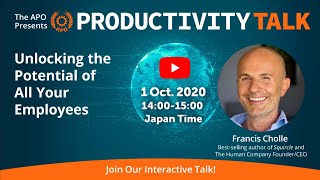
YouTube interview (David Sembe with Francis Scholl) about diagnosing and shifting toxic workplace culture to unlock employee potential. Scholl defines toxic culture as pockets of self-interest that erode trust and performance, and argues culture is best influenced (not forcibly changed) by aligning decision-making practices with measurable strategy and results. He presents his Squircle framework (square: control/strategy; circle: intuition/agility) and practical interventions: gap analysis (qualitative interviews + quantitative assessment across ~17 parameters), small experiments/serious games to awaken learning/unlearning, and executive coaching/certification to scale change. Themes: transparency vs. integrity, subjectivity with objective guardrails, psychological safety, talent development, and women’s leadership as a performance booster.
Chapters
Hello everyone. My name is David Sembe. I'm head of the division of Policy and Analysis at apo. And today I invited the author of the school, Francis Shaw from the United States. He's a thought leader and you have experienced like toxic culture or I'm sure that in your life you have worked for like horrible managers or toxic colleagues or the really some experience, bad experience about their workplaces since some of you might have been traumatized and some have like a nightmare even now. But if you can just escape from where you work, there's no ending. There's no such a thing as like a paradise in the world. So in a way I believe that we have to contribute improving the organization we work for. So today that's the reason why I invited Francis Shaw. He took some precious time for us and we would like to talk about the Taksi culture and how we can improve the organization. It's not only about the manager's leadership, it's also about the people. So how you're going to unlock the full potential of the people. At the end of the day, it all comes down to people. Without further ado, I'd like to introduce the Francis Shaw. And Francis, thank you so much for joining us today. Can you introduce yourself a little bit?
Hello David, very nice to be on your show. I would like to say hello to all your listeners and viewers today. So my name is Francis Scholl. I was born in Paris, France, where I was raised.
I started my career in Paris and then I moved to the United States about 25 years ago after a year and a half in Germany first and for the past 25 years I've been 10 years in New York and the past 15 years between the west coast and the east coast, between Los Angeles and New York City. I am an international consultant and what I do is I use deep human learning and cognitive science to help leaders and organizations solve complex problems and thrive in disruption. Let me just mention one thing which I know you know, but maybe not your viewers. I've worked extensively in Asia. I worked with Japan for many, many years, both with European companies and Japanese companies. I've worked in Korea, well, Hong Kong. I've worked in Southeast Asia, in Singapore, Malaysia, Thailand. I've collaborated with Taiwanese people as well over different projects. It's always been a great joy, a great pleasure. I like the depths of thinking. I like the thoroughness and I like the long term perspective. I like the civility relationship as well. And it's influenced a lot my thinking and some of the work. I'VE done the wisdom, the long term perspective. And I think that squirrel specifically by awakening our natural abilities, will speak, and I've seen it actually in the past, will speak to an Asian sensitivity which usually honors greatly nature. And I think for Asia, it's a way to innovate as you respect your great tradition for nature. So it's this combination of honoring tradition and at the same time being able to be forward thinking and innovating. So happy to be here and ready to answer any question you might have for your audience.
Okay, thank you. So let's start. The concept of toxic culture by the organization. So, so how would you define a toxic culture?
That's an interesting question. Culture in general is a very complex subject, but toxic culture is when you have islands of people who are more interested in their self interests than the general interest and when those groups start influencing the overall culture to the point that there's a lack of trust, a lack of communication, a lack of openness, and that becomes toxic to the point that it affects people's well being and performance.
To change the toxic culture is never easy since it is supported by certain people. How can you ever change the toxic culture? What if it cannot be fixed? So is it going to affect the survival of the organization, in your opinion?
Let me step back a little bit and talk about culture more broadly. Culture is a complex concept. Why? Because culture is in place to make the organization work better. This is what the group has shaped in order to function. So as an external stakeholder, as a consultant, when I come into an organization, I am first and foremost very respectful of what is. Because what is in terms of culture is what has brought the company to where it's at.
So what we do is we don't try to change culture because to change culture is first of all taking the risk of destabilizing something that to a certain degree works well and maybe could be improved, but well enough for the company to be in place functioning. And second, because I think rather than pushing against something, it's more interesting to look at how can you enhance it. And when you push against something as a consultant, the chances are that you're going to be rejected by the group. Because the function of culture is to ensure the survival of any organization, whether it's a human species or. Or whether it's a corporate group. So touching a culture is like really going into the heart of the safe where all the secrets and the recipes are held. What I do though, rather than talking about culture, I look at how people make decisions and how it impacts their ability to deliver on results and strategy. Peter Drucker, the management guru, said one day that culture eats strategy at breakfast. In other words, culture is very important in any organization in its capacity to deliver on strategy. And if you have the best strategy but a very bad culture, it will be very hard for you to deliver on strategy and to win. Also on the opposite side, I've seen people with poor strategy but great culture manage to pivot and actually deliver results. So it's important to understand that culture is something to not try to address heads on and at the same time be very clear that culture is a very powerful force that can compromise results or on the contrary, enhance results almost regardless of strategy. It's very powerful. So there's another great thinker by the name of Edgar Schein who wrote a seminal book on culture and leadership. He says, you know, culture impacts strategy. Okay, we know that. And the best way to look at culture surgically and almost objectively is by understanding how people make decisions. And I found about Edgar Schein after I'd come to that same conclusion myself. And that's why the model I developed, Squircle, is in place to analyze culture through the lens of decision making. So what we look at is what are the strong aspect of how people make decisions that work well for them and where are the opportunities?
And we compare the strength and the opportunities to the strategy and the goals and we see whether there's a match or where there are places of disconnection.
In many organizations, the management uses fear, intimidation, psychological threats, verbal violence, etc. Because they think this actually is faster and they don't have to argue and they don't have to consume their energy and time. So although we talk about the flat structure, mostly people tend to believe in the vertical and hierarchical structure to control people.
I understand why people might want to do this and where it's coming from, a certain worldview. I think it's important to keep in mind as much as these companies are successful with this top down, common control type of organization and leadership and management style, there is a complete counter movement today that's been actually now in existence for, I would say almost 20 years. There's a very good book that I recommend to all my clients, billion dollar companies. And that book is called Reinventing Organizations. It's by a gentleman by the name of Frederic Laloux. And he's eloquently put together a book that shows how you can create an organization that actually doesn't need a formal hierarchy to function. And when you do this, you realize that there are natural hierarchies based on merit and individual talents that emerges and function very well. So it's a much more organic way of working. So what we do at the human company is we respect what I call the cultural elasticity of any organization that we work for. Like a rubber band, you know, you can pull it and stretch it, but if you stretch it too much, it breaks. So you don't want to do this. So again, when it comes to culture, I'm very, very cautious. But I do offer CEOs leaders alternative ways to the common control. But rather than teaching it, I give them experiences. We take them through serious gains that represent what it is to come together as a group of people to solve complex problems and achieve goals within timelines. And through this experience, people discover that there is a very different way of doing business that actually is the way to address today complexity, uncertainty, and demand for innovative ways and innovation in general. So once they've lived through this experience, I've not taught them anything. They've discovered something new. I then explain it from a scientific standpoint through the model that I invented to look at the way people make decisions, called the intuitive compass for CEOs and executive teams and called the Squircle model to scale throughout the organization and embark everybody in the organization. But what we do, we do it with great respect for existing culture, offering new perspective on how this culture can be stretching so that they can get to their results more safely, more securely, more efficiently with less effort.
We often talk about transparency and fairness. And 2017 study published in the Journal of Leadership and Organizational Studies found that transparent leadership boosts employee creativity. Would you agree to that?
Okay. Transparency is a tricky term like culture. Okay, David, I have a question for you. Are you fully transparent to yourself? Are you always transparent to your best friends?
Very good question. Okay, yeah, it's tricky.
It's a difficult concept. But truthfulness integrity I believe in, because that's external. Are you stating the true facts? Are you masking the facts? That's pretty much judgeable. And integrity, just like in any mechanical system, there is integrity in the way the different pieces work together to deliver the result expected from the mechanics. So integrity also could be measured and looked at in a way that's objective. So I prefer this. Now, if you want creativity, creativity involves a level of vulnerability because you're going to come up with new things that nobody has tried. And some people may say, oh, my God, no, doesn't make any sense. No, we've tried it before. So many Times, it won't work. No. This is completely out of line with who we are and what we do. You're going to have a lot of pushback. What's important, I think, is that people feel a sense of belonging, a certain sense of safety. There is research that was conducted by Aria de Gaius looking at 25 different companies that were more than 100 years old and had been able to survive the ups and downs of market changes and economic changes. And what he saw are three key factors for success. One is fiscal conservancy makes sense. The second one is a sense of shared values that brings a community together so that people feel they belong and therefore can take risks and won't be sacked for it, won't be heard for it. They will be accepted in their capacity to take risks because they belong to the community and the community will support them. And the third thing is the openness to new ideas, whether they come from within the organization or from outside of the organization. And as you can see, fiscal conservancy is clear. Not easy, but clear. The sense of belonging, creating a community will require to nurture people and to make hierarchy as less felt as possible so that people can feel they belong wherever they are in the hierarchy. And that allows young people with new ideas, third dimension, to come up with new things. They're the new blood and to be listened to. In spite of the fact that they don't, you know, have much experience and are not high up in their hierarchy, they'll be listened to. And thirdly, being open to ideas from outside. So I would say, to answer your question, a certain level of vulnerability and nurturing is important for organizations to innovate.
So when we talk about the transparent leadership, actually it's about whether the leadership or management are transparent or fair about evaluating people. And when they give a promotion to anybody or pay raise, whenever they make any decision, when it affects everybody in the organization, if they tend to be biased towards some people that they like only, even though some other people actually doing a lot better, or in terms of performance, when it comes to the transparency, it's more about like, for example, if I have like two staff employees, one is just close to me, the other is actually kind of distant. And then I just think that this person who is close to me is not doing well, but simply because I like him, it's because he and I just hit it off well. So no matter what the other step, who is not very close to me doing better or performing well, still I just go for step that I like of Course, people are not like robots. So we cannot exclude our emotions and our preferences and our own styles. So I wouldn't deny that. And I'm not saying that the leaders or management have to be 100% national or like detached from their own emotions. I'm not saying that. But still, if somebody's doing a lot better, it's not just should be your own personal preference. Then I don't see the transparency and I don't see the fairness in that sense. I don't know whether we can run the organization well or not.
So if you discuss transparency, the sense of fairness, yes, I think that's very important to have clear rules that define the game that everybody's playing. Of course that humans have biases. Of course all people have biases. And it's good to be aware of your own biases. Actually there's been research conducted by McKinsey that showed that the return on investment was superior by 7% in the companies that were really doing self examination on biases when it came to running businesses. So yes, biases are important. At the same time, as you said it, I don't think you can really erase subjectivity. Organizations are made of humans, people catering to other people, whether they're customers or consumers. And all of this is based on subjectivity. But subjectivity doesn't deny objectivity. So I would say it's important to have both coexisting and be aware their respective contributions. So subjectivity is linked to inspiration, human connection, emotions, as you said, inspirations, aspirations, intuitions. And you want to preserve this? It's very important because organizations will only be successful if people are fully human. And on the other hand, I agree with you. There needs to be a certain element of objectivity first of all to start with and hopefully to end up on. Okay, so there's a journey here, but within the journey you need to preserve the subjectivity. And I think it's for everyone in an organization to be empowered to get their subjectivity to be heard, understood and valued. Because within that subjectivity we lived creativity, again, that capacity of agility and so on and so forth. So as a leader, I think it's important to encourage a certain level of subjectivity within a framework of objectivity.
So can we fix this kind of culture where we don't have, let's say that the fairness or lack of the transparency or the no learning and just only competition or nonchalance and all these things, let's say that it has been caused by certain people or certain management. Then can you fix the toxic culture like this one, without firing business, is about performance.
Nobody can deny this because the marketplace is competitive. So I think this is the place to come from. This is where the objectivity can come from. This is where you can really evaluate actions against results. So we start from what are your objectives, measurable goals? And let's look at your strategy to get there. And let's compare your strategy with the way you make decisions. That's how we help leaders and employees together influence their own culture. What I've seen happen is that motivation is a natural human attribute. You don't have to create motivation. Everyone gets up in the morning wanting society to function. Everyone wake up in the morning agreeing that they will stop at the red light and move on at a green light. So there's a natural motivation for people to make sure that things function. And in business you function if you are competitive and if your company performs. So that's the fundamental rule that we don't need to re establish. You need to just make sure as a leader that you cater to that competitiveness through a good strategy and well defined goals. So this being said, then what we do is bring people into a room and we discuss with them what we found out through an assessment about the culture, meaning how they make decisions. So we don't really bring up the word culture, we just discuss how you make decisions, which again is rather tangible to people, rather understandable and interesting. Because one decision at a time, you create your own reality and you create your own success in this process, which is very objective and at the same time subjective. Because we take all the non objective aspects of making decisions, feeling, intuition, everything that makes you competitive today in your ability to deal with uncertainty and with disruption. Truth is in the room and you don't need to define it. It has its own strength. It's what people want to gravitate towards. What truthfully will help people succeed and the company sustain in this process of truth, magnetic truth. Unearthing this and casting a light by which people understand how they can get to their goal more easily. Toxicity is challenged because toxicity is not serving the greater good of the organization. It's a relative point of view. So that's how I deal with toxicity. I don't oppose toxicity. I create more good air to dissipate toxicity and the toxicity. People then have two options. Either they say, well, should I fight for toxicity, should I fight against the grain, the movement or should I leave? And if they decide to leave, they leave. And then if they decide to stay, they have then two options. Either they keep fighting or they just adopt to go with the boat, to go with the majority. And what I found is that it's much better to give people the option to either leave the boat or stay on the boat, give up toxicity and function with others, because it's everybody's choice. And you don't want to convince people to stay if they don't want to stay. Because then you have people who are constantly grudging and constantly opposing and not contributing their best and not role modeling the kind of culture that you want to have. So that's how we deal with it. So not hands on, indirectly focusing on the good. So then people, the good becomes so strong that other people decide that they're going to have to leave.
Themselves on the organization. And if they stay, they realize that they will have to just enter the flow and go with the flow of the majority.
It is really difficult to speak up against the toxic culture where people make a wrong decision after another, because usually those who don't want any change to happen to the status quo are the ones who have the power as well. So how can we solve this issue? Because at the end of the day, I believe that architect rises against not with the wind. So we have to continue to have, argue and also to have a very constructive discussion internally.
You work for an organization, you have a deal with the organization. The deal is first and foremost, you deliver, you get paid. But then, of course, from an individual standpoint, there is a paycheck, but there is also the satisfaction, the experience of working for the organization.
That satisfaction is up to each individual.
So if you find yourself in a highly toxic environment, but you like so much your job and you like so much your organization that you want to be willing to invest time and energy to correct the course of the organization, you need to be really, really clear that you're going to fight an uphill battle that's going to be very costly to you. And in terms of time, career advancement, and potentially health, soon enough you will have to really evaluate whether you can win a field battle or not. Make a choice whether the level of toxicity is something that you can tolerate in respect to your love for the organization, the love for your job, and the love for the paycheck or not, It's a very personal conversation and it's a very hard situation to keep yourself in. In my view, we're asking this question from two standpoints. Asking the question from the point of view of the employees, it sounds like.
But the big decisions are made by the leaders and the Owners and the shareholders. So from the standpoint of the shareholders and the owners, what matters really is the return on investment and more recently, all the stakeholders, including your employees, the environment, your vendors and so on and so forth and many other social dimensions. That's a question for a shareholder to ask themselves. Am I best served by the existing culture or should I focus on improving culture? And again, my job in that question is not to evaluate whether the culture is toxic or not. My job is to evaluate whether the culture is through the lens of decision making. Again, the way people make decisions is best positioning the organization to succeed at its strategy and its goals.
That's my conversation. Rarely do I hear leaders come to me and say we have a toxic culture.
Not the top, rarely. Because they would fix it by themselves, they would address it by themselves.
And the way to fix it if they want my help is again, we're here to perform, we're here to fulfill a strategy, we're here to reach goals. And that's really the truthful, the fair value proposition that can bring everybody together and that can be the parameter by which we evaluate actions and behaviors and attitudes. So, so that's one thing. And the values. Now, from the standpoint of the employee, I think the employee who enters a company like this, and I've been in that position and I was even a co shareholder of the organization you evaluate how far are you willing? And I can only speak for myself of my own example, at some point I decided to leave and take my investment and sell my shares and move on. And that's what I did. Because the culture was too difficult. And when I said too difficult, it was not so much as from an emotional standpoint and personal well being standpoint as much as it was from the standpoint that all the effort that we had put in improving the company would have to be redone again because of one leader and main majority shareholder leading.
The work, the teams in a way that was more destructive than constructive. And therefore I felt that what I had learned to make the company better, I didn't have to learn it. Again, why would I go again through that same round, waste my time when I could go somewhere else, grow in my professional skills in an environment that would be conducive of this growth as opposed to stagnating in a game that already done and actually achieved and we had excelled at it. So I think from the standpoint of the employee, it's really a personal matter because at the time I was the only one who left the company. It's A matter of courage. We're never victim of our circumstances. We decide to be victims, but we're never victims. You have always a choice in life.
Maybe I can ask two different situations. One is that leaders actually are not guilty for shaping that kind of culture. They said that the culture is already there. Like a toxic culture is already there. And then you just arrived in the organization as a leader and then you want to improve the organization. And you can see that people are not really interested in what they do and they are not interested in one another. They are not interested in collaboration, they are not interested in improving the organization. They just get paid and they just go home and that's it. Like a clockwork. So in that sense, so because that kind of culture has been ingrained so deeply that as a leader you just arrived in the organization and you want to do something about it. So if you were in that position and what would you do? Because it's not going to that easy. It's not going to be that easy.
Right. That's what I did when I was 25 and I was called into an old company that was like more than 50 year old, actually more than 50, 55 or 60 year old, very respectful art book publishing house in Paris. And I came into a culture that had a lot of prose and a lot of negative to it. At the time I did as a young man, instinctually. Now I can explain it more conceptually. So I'm going to say what I did at the time instinctually as a young man with very little experience. And that's not the kind of thing that you learn at school. You know, you have to learn it through practice. When you confront it to the reality of it. I came back to what's going to make this company because it was also heavy in debts, very little profitable in an industry that was highly demanding of capital and profitability. Therefore, to finance the inventory, the main thing was, okay, let's re establish profitability to make this organization sustainable. We go back to fiscal conservancy. So that's the first thing I did, focusing on the profitability and competitiveness of this organization. And we did very well. In less than four years, we made it the most profitable publishing house in France in all categories. And our category, art book publishing was the.
Was the most. Was the least profitable. So it was a big feat. I only found out later on through industry surveys. I had no idea, okay, when I was doing it, but when. What I'm trying to say here is that this is the best way to surgically Change an organization, make it successful. Because everybody wants to be successful. Because everybody knows the truth is the fairness is an organization that's successful will last. Then you can start discussing, okay, what are. I'm talking changing the culture, people not knowing where to start. I was not the main shareholder. I was the managing director called into reforming this organization, revamping it, and making it successful. So I said, you know what? The minimum and necessary value proposition that everybody can agree to and commit to is to make this organization successful. And in doing so, I think I created a better culture at the same time. But it was as a side effect that I was not trying to change a culture. I was influencing the culture through my behaviors, my enthusiasm, and my results so that I would be believable. When I left, some people cried. So they knew what they were leaving behind or what I was leaving behind. And they were not sure that they could go back to this enjoyable culture and successful company. Now what I tell our clients, the CEOs I work with, is let's look at how decisions are made. Let's take an assessment, let's create a gap analysis between the desired states and where you are today. And through the way people make decisions. And we analyze it through 17 different parameters so we really scrutinize it. We can show a path forward that will make the organization more successful. And because decisions, the way you make decisions involves behaviors and attitudes and values, this is the best way to change bit by bit, the solution through efficiency, through the lens of efficiency. This is the best, safest, quickest way to allow a culture to evolve without working against culture, but kind of influencing culture by the flow of success.
Let's say you just arrived as a leader and then you found out that mostly people are really dedicated and committed, but then you realize that the way they work, like management, let's say that leadership, let's say opera leadership, actually they are the one who have shaped that kind of culture for the past few years. And just people who working for them just adjust themselves to that flow. So let's say that you have a new leader, you just arrived, and you realize that opera management and actually are the ones who shape the kind of culture. So as a new leader, what would you do to address the issue?
Culture is not something that you fight, it's something that you influence. The best way to influence is to create results. When we. Let's step away from culture. When you want to help organization innovate, whether through products, through ways of working, through products or ways of working, you start small and Smart. That's what I always advocate to my clients. We take a low hanging fruit, we do it differently and we show results. Then once you have results you can showcase because you have something interesting to show. And once that's adopted and accepted as being a new way of doing things, or new products to try on the market, or new strategies to market, then you have gained interest from people and then you can say, okay, well you thought it was interesting, so let's do it in the other department there and let's see what we can get. And let's take what worked in that small experiment into this new bigger experiment. So with culture same, you look at different practices, maybe you give more autonomy to people, you define new rules of working, you know, but you don't make it in a way that threatening the entire organization. You do it in a way that's just a sidekick, a side project, something that's almost not under the radar of, let's say, the leaders of the organization who have entertained certain ways of doing things, certain attitudes, certain ways of language and communication, everything. So you don't threaten this and you have to prove it to yourself. Because you know what? You come to a culture, you come to an organization. If you decide to work for this company, it's because you have some level of inspiration, therefore some level of respect the organization. So you owe your own respect and inspiration for this organization to try it, to try something. And I always tell people, go all the way to the end of your attempt to change things. And if it really doesn't work, if it cannot be adopted, and you know that you've tried your best, and you know that you've shown results and those results have not been crowned with acceptance for more inside the organization, then you can leave with a firm conviction that you've tried everything to honor the initial inspiration and the respect you owe to your employer before you step out. And when you have done that, you step out as a free person, free of the past and completely free to embark on a new journey. If you quit cooking a cake that's half baked, you always have remorse that if you have tried harder, you could have done better. And that will hamper your ability to be successful in your next venture. Try and demonstrate that they can deliver results, because results is what organization are about. Organizations about performance. So everything needs to demonstrate greater performance. If you can demonstrate greater performance, then people will be interested in what you have to offer and they will be considering what you have to offer to the point that they may adopt it. If you come with New ideas without the proof that you can perform, it's going to be hard for you to convince people. Much harder. Yes, you can bring benchmark. You can do comparisons and everything. But is it going to work home? This is always a question you're going to encounter, and you're going to have to show that, yes, it can work home. And that's your duty to do this. You owe it to yourself, you owe it to others, you owe it to the organization.
So when it comes to training staff for employees, there's always this fear. That is, what if we train them and they leave for better organizations? In fact, it happens quite often. So when I invited Murimoy, the vice president of Solid Korea before, he said, what if we don't train them at all and they all stay here forever?
It's the same with launching a new product. You can never launch new products.
Or.
You launch new products and your new products may be copied. So you train people because you know that we have to evolve because the market is evolving. It's not an option, it's a must. Your people and the way we work has to evolve more than ever today. So you train people.
And then those who want to leave will leave. And those who feel that they've been treated fairly and they're happy to have grown with you, well, stay. It's not the end of it all. You know, you can adjust. You know, there are ways to keep people to stay with you. One of them is making sure that you've put in place what's called a reason for being the company that you are, which is even bigger than the purpose. You know, it's really like, you know, we are all contributing to shaping the world. What is our duty? And when you are able to approach a definition of this, people are magnetically attracted to your organization. Why? Because belonging to your organization is not only about proving results. It's before committing to an intention to create a better world. And that's the supreme motivation for people. And then within that motivation, lofty goal, you can look at how is it going to translate in terms of business? What kind of business practices do we need to put in place to serve this reason for being and make our mission statement possible as a business? And if you create that kind of ecosystem.
People will be extremely, extremely autonomous because it will be there out of personal choice, and they will dare and take more calculated risks and they will advance your organization more than they were able. If you keep just like a team of lame employees who have no real interest in your future in their future to the point that they don't even care whether they're trained or not. I don't think today you can really retain people without training them as a leader.
You have to manage people, you have to lead people. Sometimes you have to scold them, sometimes you have to admonish them so that they can make more improvements. Not because you don't like them, but unlocking the full potential of the employees will boost the productivity of the organization. Amy Edmondson once said that the psychologically safe workplace is very important and no passion so effectually robs the mind of all its parts. Powers of acting and reasoning as fear by Edmund park so what I'm trying to say is as a leader, you have to encourage people, you have to motivate people so that they can improve themselves and also they can contribute to the organization's advance. But at the same time there must be some way that you don't discourage them and by intimidating them. But there's a certain point that you also have to be very strict about your employees because sometimes the leaders rely on the fear because that way actually is easy to control people. It's not because the leader has any bad intention, but at the same time because of that employee just feel discouraged.
Human relationships are complex.
So they have different shades and colors.
And they will require continuity and commitment and stability. A certain level of stability.
That people want to take shortcuts is understandable. But the question is what is the shortcut really building in the long term?
I can see the immediate benefit, that's clear. But are you invoking an adult to adult relationship or are you invoking an adult to to child relationship? Like in transactional analysis? Not transactional. I forgot the name, but I have the word in French, but I don't have it in English. I apologize. So parent to parent, adult to adult, adult to child, child to adult. Okay, so obviously the best relationship is adult to adult. If you instigate fear, you make the other person inferior. I understand the shortcut short term, but I'm not sure what you're building long term. And if you want to have a creative agile workforce, you need to create a sense of belonging for people to have enough vulnerability to try new things, to follow creative ideas, enough so that they can be surfaced, considered, tried potentially and turned into successful innovations. There's no other way around this. I don't think that there is any top down organization today that has a rosy future.
Any organization. There are always people who really like controlling people. So they are so obsessed with controlling people. But in A way, actually, it's also because they want to maintain their power that way. Because once they have the control over people and over the system, then they are highly unlikely to lose their jobs. So when people are too much obsessed with controlling their employees, I'm not talking about the leader himself or herself. I'm talking about the management itself. If the people like that actually are in the management and they are one of the decision makers, is there any way that we can deal with such a person?
The first thing is you need to know your convictions. So let's sidetrack for a minute. You know that women's leadership today is considered as something to really look into for success. You know what happened to Covid? Six countries managed the COVID crisis better than others, and all six countries were led by women. There was an article recently on the science of women's leadership. The values that are underpinning women's leadership are typically collaboration, communication, inclusivity, diversity. So I think you need to do some homework as an employee facing that kind of management so that you know what you're talking about. And you can bring benchmarks so that you can be really grounded in facing that kind of negativity. And then again, you can't change people. You can inspire people. You can't change culture. You can influence culture. And the way to do it is through bringing results, because this is the nature of organizations to perform and remain competitive in a competitive environment. So it's an uphill battle. Again, you need to lay your cards soon enough in a way that's grounded, in a way that's articulated, informed. And then you need to offer a few options to do things differently. And then after a while, you need to really evaluate whether there is a possibility for evolution or none. And if there's no possibility for evolution, then you need to realize, okay, and evaluate, what are my expectations in terms of outcomes? Do I want to give more to my career? Or is it a time when I can put my career a little bit on hold and just stay in this job? Because I've got this job and I need to relearn something. It's just going and cruising and, you know, in six months, I will reconsider. All of these things are personal considerations, you know, and there's no, like, cookie cutter. It's a personal evaluation at that moment.
So even if employees are capable enough and some organizations simply cannot make good use of their talents. So do you see any way to make it happen? Like, for example, that some organizations, they see the people and their employees let's say the employees are really talented and they are very capable, but sometimes the leaders just don't know how to use them.
Well.
Is there any best way for leaders to tap into or unlock their potential like a talents so that the employees can maximize their talents or capabilities?
Of course, of course there are ways. Okay, again, you know, I think you need to look at the gap analysis. That's the best way. What is the expected outcome and where am I today and how positioned I am to deliver on my goals, to reach my expected outcomes. And then within this gap analysis, which is what we do, we do it in two ways. We run qualitative interviews, a qualitative survey through one on one interview with people. They can be done remotely obviously, but we ask in depth questions to really understand how the organization is perceived, how the use of talent is perceived, the distribution of talent, the different roles, different rules, the different protocols of interactions, the attitudes, the behaviors and everything. And then we do our quantitative assessment.
And we look at, as I said, at the way people make decisions, which is really the heart of the matter. In business, we shape our companies through decisions, one decision at a time. And we evaluate how this making decisions serves or not the way the company wants to achieve its strategy and bringing those two things. Then we start a conversation. The leader can look really visually and what you do also is you can segment for population, women, men, young people, older people, departments, countries, regions, functions. And then you look at differences and you analyze and see what's working here, what's less working there. And then you look at individuals. You have the outliers, the people who have the very competence that are needed in this organization to succeed. But obviously, because they're not the outlier, because they are the outliers, they're not part of the way of doing business, they probably feel less heard and somewhat disengaged. So you want to go and spend time with them and listen to them and see how they work. And we have a methodology for executive committees to work in a way that really erase hierarchical structures. So everybody can be a co leader and then every voice can be contributing, their way of looking at things and their way of doing things. And that's very enriching. And then you can really leverage diversity. So what I would say, to answer your question, I don't believe in revolution. I believe in evolution when it comes to organizations. And evolution comes from small steps. But these steps need to be informed and they need to be mapped. And that's what we provide. We provide a map, a visual map that's the representation of the gap analysis so that leaders can try out things and see what works and leave behind what doesn't.
Wow. I think that makes really a great sense because you just talk about the revolution and evolution. I think it gives just a very good insight on how we can actually tap into the talents in the organization. The. Because some employees are actually so desperate that they are actually looking for revolution all the time, which actually doesn't come easily. So without destabilizing the organization itself, as you said before, actually one of the best ways to make a bringing the positive changes to organization will be evolution, not the revolution.
Go ahead. So, you know, and an evolution that serves again the profitability and the top line of the organization. This is the rule. This is the fundamental. This is a keystone, you know, but you can get to results in a different way. So what you do is you get to results in different ways, you try new ways, you showcase new ways and hopefully you get more results. And that's how you validate the new ways.
Let's talk about your book a little bit, because when I heard your book titled Squawkle then I think to myself, what Squawkle? What is a squocco? It turns out that actually it says curve mind and also circle mind qualities and software qualities. Could you elaborate on that?
Sure. So what I've observed in organizations that I work for, they're all looking for new solutions, innovation, change and everything. And at the same time, again, the way they make decisions is very square, meaning very controlling. They want to make sure that they have in place the right strategy to reach their goals. Fine, I understand that. But that way of thinking and going about things is not so well fitted for very complex environment and uncertain environments, which is exactly what we're facing today. So the old way of doing things, which is command control, I got my strategy, I've set up my goals and I'm going to go hands on to it and push through to make it happen. Is less and less operational, less and less valid. So I thought, okay, we need to really offer a different way of doing things. So that's why I brought the notion of intuition, which allows you to go beneath or beyond where the logical mind can go. The logical mind understands what's right, what's wrong, what's shorter, what's taller, what's heavier, what's lighter. So it's binary. Gray doesn't understand, black, white understands. But as we know in life, every day everything is in the gray zone. Very rarely can you say, oh, I want this or I don't want this. The notion of toxicity is a gradient true of so many things today. We need to go deeper. We need to mobilize a deeper intelligence than simply the logical mind. The beauty of it is that this deeper intelligence doesn't negate the logical mind. You can be perfectly logical and at the same time be open to more. But if you stay logical in a dominant way, in a square way, then you lose your ability to be open to more. Let me give you an example, very simple story. So this story of the parrot, the parrot has an S, and the parrot is free to fly. The freedom to fly is symbolized by the circle. Agility, creativity, self sustainability. Okay, that's the parrot. In nature, the nest is the structure. The parrot comes back to its nest. It's a place that is used to safe enough to repose, and so on and so forth. Now, a human being would say, oh, my God, this parrot in the wilderness, only a simple nest, it's exposed to many things. Why don't I put the parrot.
In a house that's closed so that nobody can get to the parrot? And at the same time, the parrot will always be next to me. I won't have to wait for the parrot. So it will always be there. So now you move the nest, the structure, the square, into a dominant square. A house where the parrot is locked in becomes a prison. And what happens? You feed the parrot. The parrot is always there. The parrot is protected, but the parrot loses its creativity, its agility. The circle is no longer free. The circle is no longer a circle. The bird is no longer a wild bird. It's an object of decoration. So when you use strategy to control things, it becomes a cage, and it diminishes your natural ability to be creative and adaptive and to be sustainable. So squirrel is the interplay between square and circle that creates synergies and not imprisonment. Synergies between the square and the circle so that they can give their best and create more than they would individually versus the way we tend to do things, which is command, control, domineering, wanting to secure. Absolutely results when it's much better to be open because disruption will come your way. And being open will keep your creativity and agility so that you can deal with disruption. We're naturally born to deal with disruption, but the structures we put in place have limited the circle in us.
We talked about the task culture and we talked about the leadership and just talk about also circle. It actually all comes down to how we are going to unlock the full potential of the employees. That's why we have been talking about all these things. So why we talk about the importance of leadership is because it also directly can contribute to improving or unlocking the full potential of the employees. So I would like to talk a little bit about the Mountain Everest 1996, since it simply teaches us a lot about the importance of leadership. So overconfidence or sun cost effect and recency fallacy. So in 1996, around eight people died in Mountain Everest because they were following simply their leader. So what can we learn from this incident?
Metaphorically speaking, every human being has the ability to make autonomous choices. Leadership is a human expression. It's not set in stone. It's evolving and it can fail. Employees should express enough leadership so they can evaluate the leadership they're following. When I get on a boat, whether motorboat or sailboat for a cruise, I instinctively evaluate the captain because in a way or another, I'm giving my life to that person. And I have an immediate evaluation which may be wrong, may be right, but that evaluation, I will keep it in mind and I will keep it alive. And I will observe the captain and how he or she is steering the boat. And I would evaluate whether there's hubris or whether there is a contained sense of confidence. So metaphorically, I'm the employee on the boat. I've subcontracted to that leader my well being, but I don't forfeit my leadership. And my leadership is expressed in my continuous evaluation of that leader. I was once in the Sahara, and the guide took us on an expedition without water, without matches.
And a woman was overweight and didn't work fast enough. And on our way back from where we went to look at wall paintings from millennia ago. On our way back, we hit dusk and then nighttime. We had no light and we had no water and we had no warm clothing. And there was no way for us to find our fire camp. The leader was not even asking people to write, to walk one after the other in line with somebody at the top, somebody at the end, appointing one song crusade at the beginning, pointing somebody strong at the end so that everybody would move cohesively. And I was really upset. And I just happened to see lights far away, far out, because all my antennas were out at that moment. All my instincts were out, my survival instincts. And I saw lights. And the lights were the jeeps of the Tuareg looking for us in the Sahara. And I told Philip, the guy said, look, there are lights there. Look, look, look. And then they found us. They were so upset at the guy. From that moment on, I spent all my time, all the rest of my trip in the Sahara with the Tuareg and no longer with the Guide. He had lost my trust. And quickly enough, I analyzed that he had got us lost, which was really a very negative, and he was not handling our situation well. So at that point on, he was no longer my boss. I was my own boss. And that's how I spotted the jeeps in the darkness. So the morality here, which I think applies to what happened in the Himalayas, is that you give your trust to people. But that's not a blank check. You're still linked to one another, and you have autonomy in that relationship, and you have responsibility. And what I tell all my clients, leaders need leaders. You want to have leaders around you. You want to have people who are challenging you. You want to have people who think even deeper than you or differently than you and bring back information, benchmarks, ideas that you wouldn't have alone. That's how you have a thriving organization. And that's a culture of leadership that you need to instillate in your organization. It's like 360 leadership, leadership on every chair. I don't care what your position is in the organization. You come to my organization. You need to be a leader. And I love what you challenge me, even if we agreed on something else. But you come back with something better. Be my guest. And I tell all my employees, let's.
Talk about the importance of shaping the learning culture of the organization. Evan Toffolo once said, the illiterate of the 21st century will not be those who cannot read and write, but those who cannot learn, unlearn and relearn. So in organizations, they don't encourage their employees to learn. Somehow they just believe that you just stick to what you know, and they don't actually encourage the learning itself.
When I start with any organization, we start with this serious game. And the serious game is about resolving a complex problem with a metric. You can measure the result, the outcome. It's completely objective. You fail or you pass. And the game is described as at length in Squirrel, so I don't need to revisit it. But it's really a complex situation where you need to engage rationally with the situation, but you cannot let your rational mind control the experience. You have to be open to how you feel your way through it, how you receive information, how you intuit. You know, you need to be heuristic, really be fully human, fully engaged, fully present as much as you know from a sensorial Perspective from an extrasensorial perspective, from a physical perspective, instinctual, intuitive, and at the same time intellectual and rational. And the beauty of this exercise, that it shows people that your way, your capacity to solve complex problems doesn't depend on your competence or your level of skills. From an objective standpoint, it really rely only in your ability to not know, be vulnerable, let go of the outcome, be fully present and access a deeper intelligence. Because as humans, we can naturally solve complex problems. We're complex. Nature is complex. We are of nature. We are wired for complexity. We are wired for complex problem solving. We are wired for adaptation. We are wired for disruption. So in this world where more and more it's about unlearning rather than learning more, the beauty of it is the more you accept to unlearn what you've known, the more open you are to this innate ability to move you through the complex situation that you find yourself. Because that ability to solve complex problems is of our nature. It's not something that you need to acquire, it's something you need to awaken. It's already inside of you. But I established this through experience. It's not a theory. It's not a theory. I don't teach anything. I let people have this experience and then I let people debrief the experience together and I let them come with incredible insights.
And then I explain the science behind it. Because everything we do at the human company and the Squirrel Academy is based in science and modelized. So the unlearning thing becomes a second nature for the companies, the employees that we work with.
One question is about the people that. Let's say that if you compete, of course this competition is always there, which is understandable. But on the other hand, there are actually two ways to handle the competition. In my opinion, between my colleagues, that you compete also, for example, that if somebody is doing well, then you can also try your best to also get better. That's one way. The other way is actually you just track them down to the mud and you just start like talking badly about them and trying your best to discount the value. So if you a leader and you have to handle that kind of situation, for example, that there are two groups, one group all the time trying to improve themselves by learning and they also try to hone in on their new skills. On the other hand, the other group is like all the time they talk badly about the other group and they're not trying to learn anything, but they're just saying that what they do is actually means nothing. They just talk Talk, talk, talk, talk. So as a leader, how would you address that kind of situation? Because as you know, at the end of the day, it's so easy to just talk and walking. The talk is different matter. So how can I motivate the other group that who don't want to learn, but they just want to do all the politics and discounting the value of the other group?
You know, again, what politics serve and how does bring results?
You know, I always say the truth is in the room.
What has integrity lives in the room. And people can feel it. They may not be able to express it, they may not be able to articulate it, they may not be able to say what is the strategy supporting integrity, but it is there. So it's a complex issue to turn this feeling into a reality. Okay, so rather than seeking control of a complexity which will not work.
That'S.
What human race has done with nature. Nature is complex. We want it to control. It doesn't work. Covid has told us this. For those who are not convinced, okay, so control is not the way to succeed in a complex environment. It's not about controlling the group of talk, talk, talk. It's about feeding the truth, feeding the integrity that will get the organization to succeed. Then the people who talk, talk, talk, what kind of creativity are they going to have in the end? The one who working towards making the truth a reality and turning into results will have the credibility. And then those people will have two choices, as always. Either they leave or if they stay, they won't be able to raise this very long, and they will have to adopt the mainstream culture that supports results. You know, I mean, if an organization is asking me to help them with this, this is how I do it. And I can assure you it works. It works, it works. It's always worked, and it works over again. I even worked in a nonprofit company organization in the United States, in Los Angeles, California, where they had a disagreement that was ideological at the board level, and they couldn't talk to each other for six months. And I was brought in through somebody who used to work for a company I had been consulting for. So she knew our reputation and she brought me in and I came pro bono. So there was not even, you know, I was not doing this for anything just to help. And in a day and a half, in one day and a half, we turned this group of highly intellectual, sophisticated, competent board members who were all disagreeing to the point that they were not able to communicate or yelling at each other, into a highly functioning team that actually Agreed on a path forward.
We can talk about like trust, importance of trust and importance of empathy. Importance of consistency. Yes, and also importance, predictability.
Yes, because.
So all these things that can contribute to unlocking the full potential of the people.
Empathy is a natural thing. Proved by a neuroscientist, David Richardson or Richard Davidson. I think it's Richard Davidson at Wisdom 2.0. Three or four years ago was sharing on stage his research that if you bring a newborn six month old and present to the newborn two adults, one displaying empathy and the other one not displaying empathy, where do you think the newborn gravitates towards?
Yeah, definitely. Adulthood shows empathy. Definitely.
Okay, so that means that empathy is natural to us because a six month old has no understanding of this. It's not a cultural choice, it's a natural choice. So empathy is a natural thing. The second thing that you were talking about is consistency. Do you know, in your honest estimation, do you know people who never brush their teeth or never drink water? But what I'm trying to say, like, you know, people who would not drink water eventually would have to go to the hospital, they would be dehydrated. Consistency is a natural thing as well. It's a natural, it's part. Being part of an ecosystem like nature requires consistency. You take care of yourself. So now you have empathy, a natural thing. You have consistency, a natural thing. You have motivation. We are all motivated for the world to work together. I can tell you I'm in Los Angeles, there are huge fires.
The skies are really horrible. In San Francisco, there was no daylight at noon. All the rest of the day it felt like apocalyptic. We all have a desire for this to be fixed, regardless of your system of creed. So we are all motivated for things to work. So you have motivation, consistency and empathy that are natural to us. And then we cannot live alone. We all collaborate. At some level, you collaborate. And if it's just like driving, you collaborate, you stop at the red light, you go at the green light. We all collaborate with one another. That's a natural. We are interdependent. We know that we have collaboration, motivation, empathy, consistency. What else do you need? The one thing that you need is to allow people to be humans. You need to allow people to just be rather than do. And do comes out of a result of all these qualities that are inherent to us. So there's a fundamental trust that you need to have as a leader to come back to trust. But trust is not something that you can buy or that you can, that you can just, you know, give it's something that you need to build through experience of consistency, of empathy, of motivation, and of collaboration. So honestly, the end game, the old ingredients are there to create a great cake, but you'll need patience. You'll need to accept that things will never go the way you thought they would go and that you'll be at the end. You'll have a better surprise than you would have thought if you let things be. And those type of organizations are the organization of the future. Why? Because the world is becoming more and more uncertain, less and less predictable, more and more complex. Therefore, the command control, the hierarchical organization, the top down, controlling, intimidating culture will not be your best bet for the future. I understand what it served, but I don't think it's your best investment into the future. That's not the best way to get to where you want to be. Meaning having a flourishing, successful organization. And that's what Squircle helps people to understand in a very simple way, very accessible way, in a natural way. There's nothing that's being taught. It's only about unlearning certain old patterns to rediscover what we naturally have in us that can serve the organization of the future. There's a performance booster in every organization today. And as we said, performance is the grail. That's what we all want in organization in different ways. But that's the end of the game. The end game is performance. Those performance boosters are women. Absolutely. They have the skill set of the future. They understand collaboration, they understand empathy, they understand communication. They understand reliability in a different way than men. Can men learn it? For sure. Are women closer to it today than men are? Overall? Yes. So studies prove it. Are some men as close to that as women are? For sure. But collectively, as a majority, as a looking at the whole, women are closer. Women have lessons to taught. Women have lessons that men can learn from women. And that's part of what organizations need to acknowledge. They need to acknowledge that they have a whole population that could serve them so much better if only we were paying time, paying attention to them, listening to them, and trusting that they have something that we don't have as male. And unfortunately, organizations were created by men for men historically. But women, therefore, women are not heard. Women are not so welcome. Women are not so welcome to contribute what they have, don't always feel they fit. And that's a huge loss. And that's something that every organization can correct and every organization benefit from and thrive from, thrive better from in this disruptive world. And I think that's one key message I would like to pass on today to Asian leaders who understand very well intuition and collaboration and interdependence. And some of them do amazing work in promoting the leadership of women. And I think there's an opportunity there everywhere in the world.
By the way, Francis, I have just one last question to you. Are you working on any other book now because your income is so great?
Really, I just copied the books. I'm working on marketing the book. No, what I'm developing now is a coaching certification so that I can go to organization and impart a number of executives this way of doing things so that they can then teach it to others and use this methodology for collaboration, for communication, for adaptation and for innovation. So if people go to squirrelcoalacademy.com they will see all this information and we are shaping a beta test. I've been beta testing a coaching certification and for now the reception has been great. So the next book will be a handbook for the certification in square call coaching. And people can go at the top right of the screen of the homepage, test your thinking. If they click on test your thinking then they will have direct access to a short questionnaire will only take them three minutes and they will give them an insight on their way of thinking as well as insights about their team members. There are seven different profiles. All these profiles are detailed given their strength, their areas of opportunities, tips to cultivate their strengths and tips to cultivate their opportunities so they can all grow together and that will help them communicate better, collaborate better, adapt better and innovate better individually and with other profiles.
So.
So it's a powerful tool, very simple assessment, very short period of time, 3 minutes and access free just for your readers and your viewers and listeners.
So really appreciate that you share this great insight on the organization and how we can unlock the full potential of the people and your insight on the leadership and deeply impressed by when you talk about the evolution and revolution because many people just want the drastic changes overnight, which actually rarely happens. So your insight is much appreciated and I'm sure that the viewers have learned a lot from you today.
Thank you David. Bye to you. Stay safe. May all your viewers stay safe and thank you for all for listening to this session today. Very much appreciate it.
Viewers, thank you so much for joining us today and don't forget to subscribe to our channel because otherwise we are going to miss out on a lot. So we are going to invite also more experts so that we can hear their insights and today was fantastic. Francis, my special thanks to you. So I hope they stay well and stay safe in the middle of the COVID 19.
More from Francis'
Squircle: Where Science and Nature Come TogetherEpisode 095 with Francis Cholle of Squircle Academy

A New Way to Think for a New World: Francis Cholle | TEC Canada's The Leadership Standard Podcast
Dear Creativity...Let's Play Podcast, hosted by Amy Isaman featuring Francis Cholle
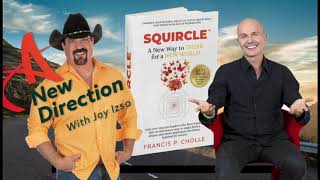
A New Direction -- Thinking Outside the Box to Solve Todays Challenges – Squircle – Francis Cholle
Dear Creativity...Let's Play Podcast, hosted by Amy Isaman featuring Francis Cholle
A New Direction -- Thinking Outside the Box to Solve Todays Challenges – Squircle – Francis Cholle