Episode 4 - Frédéric Mazzella - EU-Startups Podcast

In this EU Startups Podcast episode, host Speaker C interviews Frederic Mazzella, founder and chairman of BlaBlaCar, about the company’s evolution from a simple car‑pooling idea sparked during a Christmas trip to a global multimodal mobility marketplace. Mazzella recounts the early challenges of convincing others, building a prototype himself, and securing a financial runway. He explains how BlaBlaCar experimented with six different business models before settling on a transactional model that protects user data and avoids making members the product. The conversation moves to international expansion, highlighting how each market’s population density, transport costs, and mobile usage shaped entry decisions, and describing unexpected opportunities such as Russian bus operators that led to the creation of a digital bus‑operator marketplace (now BlaBlaBus). Mazzella outlines the multimodal strategy: integrating buses, e‑scooters (via a partnership with Voi), and future possibilities like train ticket booking, while emphasizing that BlaBlaCar remains a marketplace, not an operator. He discusses competitors across modes, asserting the company’s unique position. The interview then delves into leadership and culture, detailing the articulation of vision, transparent communication, and a set of evolving company principles (e.g., “member is the boss,” “share more, learn more,” “fail, learn, succeed”). Practices such as bi‑weekly BlablaTalks and the “Wall of Ambassadors” embed these values. Mazzella reflects on mistakes, notably the costly re‑branding from covoiturage.fr to BlaBlaCar and the pitfalls of running multiple business models simultaneously. The impact of COVID‑19 is examined: travel plummeted, BlaBlaBus was temporarily suspended, but the marketplace’s low fixed‑cost structure enabled a rapid rebound, especially in car‑pooling. Remote work was already common at BlaBlaCar, easing the transition, and the founder expects remote work to remain a larger component post‑pandemic. Finally, he notes that an IPO is not on the near‑term agenda; the focus stays on delivering the best shared‑mobility service. The interview closes with personal advice to younger entrepreneurs about using both rational and gut instincts, choosing co‑founders wisely, and embracing passion.
Chapters
TranscriptAuto-generated · 30 min
You are listening to episode 4 of the EU Startups Podcast. Today, I'm talking to Frederic Mazzella, the founder and chairman of BlaBlaCar, which is the world's leading long-distance carpooling platform. Welcome back to another episode of the EU Startups Podcast. I hope you enjoy the summer, even if you're probably spending it like most people this year at home due to the ongoing global pandemic. The impact of COVID-19 on travel and work is also something I'll be discussing with today's guest. But before we jump into the phone interview, please let me take a short moment to thank our sponsor. The EU Startups Podcast is powered by Shareworks by Morgan Stanley. Combining cutting-edge technology with outstanding client service, Shareworks by Morgan Stanley provides solutions designed for the unique needs of startups. Shareworks by Morgan Stanley simplifies the complexities of equity plan management, helps you engage with your employees, and provides your business with the tools it needs to comply with local and regulatory requirements. As an integrated platform, everything from HRIS integration to audit-ready financial reporting works together seamlessly for improved accuracy, collaboration, and decision-making. For more information, visit shareworks.com or check out the link in our show notes to schedule a free demo. But now, without further ado, let's jump right into the interview. Today, I'm excited to have Frederic Mazzella on the show. Frederic is the founder and chairman of BlaBlaCar, which is the world's largest long-distance carpooling community with about 90 million people globally. In total, BlaBlaCar raised about €390 million in funding and today is one of the few European scale-ups that reached unicorn status. But even more exciting than financial success, BlaBlaCar was able to achieve a massive social and environmental impact and continues to do so. Frederic, welcome to the podcast and thank you very much for taking the time.
Thank you very much. Hello.
Hello. So maybe let's start at the very beginning of BlaBlaCar. How did it all start? What made you start BlaBlaCar? And what were like the biggest challenges in the first 1 or 2 years?
Well, so it started with the idea of carpooling during Christmas time to bring me back home to Vendée, which is about 500 kilometers drive from Paris in France. And so I immediately felt a marketplace for carpooling was something that would exist in the future. But the main challenge right after was to convince people around me that this was not just a crazy idea. You know, when you've set yourself such a mission and you build the first bricks, you often feel lonely and you have to overcome that and make sure you've got a pretty stable financial situation actually for at least 2 or 3 years to start your mission and get peace of mind so that you don't stop just because you're running out of gas. And then I began to develop a product. I was lucky I could code myself a bit. And I could start the first version. And then you start to develop a product that— I started to develop a product that would work for me as a carpooler. And then I convinced people around me. I found new colleagues and co-founders who had complementary skills. But it takes a few years to actually start and then convince people around you.
Okay. And I assume that the initial business model was not the one that you eventually ended up with, right? So how did the business model of Blablacar change over time?
So yeah, we've got a strong principle at Blablacar today which says fail, learn, succeed. And the least we can say is that we applied it to find the right business model. We tried 6 different business models: SaaS, B2B, monthly fees, tentative of advertising, premium connection services, event-specific coupling platforms, and finally the transactional model that we've got today, where actually a driver publishes his seats and then passengers can book it, and then we just simply take a cut on this booking. So we chose the transactional model over, let's say, the advertising model, for example, because we need and want to preserve our members' data by all means. So, you know, what we say is that if you don't pay for the product, you are the product. So we chose the transactional model because in this case you simply pay for the product you're using and nothing more. And this is very healthy, I think, in terms of business model.
Okay. And BlaBlaCar, if I saw it correctly, is now already available in about 17 languages and in many different countries. Did you experience any unexpected or unusual differences in user and market behavior from country to country, or did the users behave pretty much the same everywhere?
Well, no, it's clearly not the same everywhere. Each country is different. Something unexpected we had to face, and that finally became a business opportunity for us, is that in Russia a few years ago when we launched, bus operators started to create BlaBlaCar accounts to distribute their seats. Okay. And back then we wanted to prevent it from happening because our product wasn't made for that. And we didn't comply with the professional driver law requirements. However, given the strong willingness of bus operators to do so, we decided to tackle it, to tackle the issue. And this gave birth to our digital marketplace for bus operators, originally in Russia and now in many other countries. And this is what we are building today
as well. Okay. And when you think about entering new markets in the past and in the future, Are you working with local teams on the ground in those countries, or is the whole team headquartered in France, in Paris?
So we've done a mix of all this. Until 2017, our objective was to become the world's leading community of carpooling. So we went from 1 to 22 countries in 5 years. And yeah, we can say today that each country has its own reasons for success, but it's difficult to know You never know how a totally new product will be adopted until you really try to enter the country. So we chose countries which had attributes we believed would make carpooling work, like the size and the spreading of the population in the country, the price of transport in general, and the cost of motoring in particular. That includes the price of gas, the price of tolls, the price of insurances, the price of parkings, etc. We also looked at mobile usage, and if we look at some large countries, what we can say is that in countries like Russia or Brazil, we experienced a quick adoption and a tremendous growth, like 3-digit growth for 4 years. In Brazil, there's no train network, and all long-distance travels happen on the road. Then in countries like India or Mexico, the adoption was slower than expected. The culture on the internet or mobile usage was probably not ready enough. So we decided to temporarily cut our marketing investments. But with time, we now see a double-digit growth in India and Mexico. And the future of Blablacar will probably greatly include these countries. Also, yeah, we're a tech company, you know, and so what we aim at is centralizing all the tech and product layers. But in our key markets, we also need local expertise. So we have teams on the ground to build partnerships partnerships to manage government relations and adapt our marketing strategy. We now have a quite significant geographic footprint and our goal is to clearly become the go-to place for shared mobility. This is the reason why we expand our offer beyond long-distance carpooling with also commuting carpooling buses and more recently maybe you've seen the electric scooters thanks to a partnership we have with, we have with Boya.
Okay, so you already mentioned it there at the end. So you're not only expanding into other countries, but also in other ways of transportation. And a while ago, you also extended your business by launching BlaBlaBus. How is that going so far? And do you consider expanding this kind of offering in the future to even something like BlaBlaPlane?
Yeah, well, the BlaBlaPlane maybe not for now. But no, yeah, we're building a multimodal travel app so that BlaBlaCar becomes, you know, Even more attractive for passengers. They don't need to visit multiple services to find multiple travel options. So yes, we are now offering buses alongside carpooling because the 2 modes complete one another, actually. Buses allow us to offer trips on high fill-up rates roads at low prices for people who usually plan their trips well in advance. And carpooling offers us a unique granular network at low price, and that connects all destinations, even those poorly served by other means of transport. And all this even works at the last minute, actually. So that's the beauty and the magic of carpooling. So a possible next step for us would be to offer the possibility to also book a train ticket on BlaBlaCar. However, yeah, not planes at this stage, but who knows. We would not operate trains, actually, of course, just like we don't operate buses. We simply work with bus operators. However, we would work with train operators to help them sell their available seats because, as you know, BlaBlaCar's DNA is to be a marketplace and not an operator.
So how is BlaBlaBus going so far for BlaBlaCar?
Well, in less than a year, we succeeded in offering buses for most of our community across the globe. So that was quite a launch. Most of our users now see buses in their search results. And we revamped our platform from a carpooling app to a multimodal app. So we can say it's on the way to becoming a success. And following the lift of the COVID-19 travel restriction measures, we see a fast recovery actually of our bus marketplace in emerging markets especially. And we relaunched our BlaBlaBus network in Europe a few weeks ago. What we see is that week over week, the activity is growing 50%. Per week lately. And so we are now back to more than 90% of the big cities in France, for example, which are covered with our BlaBlaBus network. So maybe a thing which is interesting is to see that the reboot, I would say, of carpooling is a bit stronger and faster than the reboot of the bus network, just because, you know, in carpooling, people offer their seats So we do not decide on the network of carpooling because it's really purely a C2C marketplace and drivers offer the seats they want. And so it gets back a bit faster than the bus network, which— for which we need to reboot line after line. So it's a different— actually, it's a different activity, it's a different travel means, and it's a totally different job. Okay. But we see that the carpooling is getting back faster than buses because of this reason.
And you also have this e-scooter offering. How does COVID-19 impact this part of the business so far?
Well, so, you know, it's a partnership with Voi, so it's really something we do jointly. So the activity is getting back good as well. It's actually very popular, I would say, because it's— well, especially because it's also summer. And so it's hard, you know, to compare data because there are so many parameters which have been changing the behaviors lately, including COVID-19, but also the arrival of summer, plus the fact that you have many, many actors playing in the e-scooters field. But clearly on the BlaBlaRide offer, we see a strong demand and we see a lot of people very happy actually to use this way to move around in the city.
Okay, so with additional mobility options like the buses, the e-scooters, BlaBlaCar is becoming much more than just a carpooling platform, right? You already mentioned that. Who would you say are BlaBlaCar's direct competitors these days? Is it like a Flixbus or an Omeo? Who do you see as a competitor?
Well, it depends on the activity itself. Well, if you look at the people, the platforms who do just buses, And we do offer buses on BlaBlaCar as well. So on this segment, we will be competitors. If you look at the e-scooters, then we'll be competitors. But then the thing is, we offer the possibility on BlaBlaCar to book just about anything. Mm-hmm. So it's a different approach to be a go-to marketplace where you can book your travels than to be, let's say, simply a bus network. Or to be a comparator, purely a comparator, and not a platform on which you can book. So yes, we're in the travel space, so there are many competitors you can name, but actually, well, if you ask me the question, I think we're unique.
Okay, that's a good spot to be. So Blablacar is one of France's biggest tech startup success stories, period. But I assume you also made a few mistakes along the way. So what were some of your biggest mistakes, you would say, in your entrepreneurial journey, and what did you learn from them?
Well, so yeah, I've done many mistakes, but hopefully they didn't result in total failures, well, I believe, because we were able to act on them when we identified them, and we did not insist or keep doing doing them. That's the thing. Actually, that's a lesson I would say. Failure is often the result of a repeated mistake. But if you act on it, you can avoid failure after a mistake. So among some mistakes, I'd say it's better if you choose the right name, the right brand for your company as soon as possible, and if possible, right at the beginning, because changing your name along the way is very costly and lots of people hesitate to do that. We had to change, you know, from covoiturage.fr to BlaBlaCar in France, and from other names to BlaBlaCar in other countries as well. So yeah, I would say if you can choose your definitive name right from the start, it's better. And then I would say, you know, I mentioned the principle we have, which is fail, learn, succeed, which we've applied a lot, including to business models. So I think it's great. to have this principle and to be able to be agile and change your business model along the way. However, I would not advise to try several business models at the same time, including in several countries, because this is actually very, very hard to handle, both with your community and internally. Because when you have several ways of offering your service and having people pay for it, it creates confusion.
Mm-hmm.
So it's good to try several business models, but you should try to isolate them as much as possible to not create too much confusion.
Okay, makes sense. You led Blablacar from a small startup team to becoming a scale-up with about 700 team members. How did your leadership approach change over time, and how do you make sure to keep a good company culture alive even during fast growth?
Well, I'd say in terms of leadership, I think of 2 things which are important. I think whether your team has 10, 100, or possibly 1,000 people. The first thing is you should try to convey your vision in the most articulated and rational way, because your dream needs to be fully described if you want the team to live the dream with you. You can't just expect that without arguments it will work. So there's a lot of work to transform your dream into something which is actually more rational, and your vision into something that is actionable. And the second thing I would say is you have to make sure you communicate genuinely all the time about what you know and what you don't know. It's important to admit mistakes and to create trust and to show you're simply trying to do your best to make things happen. And so, yeah, I also think this works all the time. It does not depend on the size of the team, I think, I hope.
Okay.
And then also one thing on the culture. To ensure the culture stays right when your startup enters in a hypergrowth phase, a good thing is to articulate what makes all of you happy to work together and to articulate all this together, meaning bottom-up and not top-down. Mm-hmm. In 2012, we crowdsourced a set of 10 principles that trained our mindset on interactions and guide us through every strategic decision we made. So among them you'd find at the time some principles like the member is the boss, in trust we trust. The member is the boss was something inherited as well from Sam Walton, the founder of Walmart, who had said there is only one boss, the customer. Okay. It's actually a good spirit to have in the company to put the entire company at the service of the clients, of the members. The other one was in trust we trust because we were building a trust network. Another one was fun and serious, to just show the balance between like very being very proud of producing something serious and also having some fun doing it. And then in 2017, the team considered that following the many developments of the previous 5 years, the principles should also evolve. So the old principles are still an integral part of who we are, but the 6 we now have 6 what we call blah blah principles. And they are the ones we have collectively chosen to put forward for the next phase of development. So among them you'll find— we used that before and then we re-emphasized it in 2017— but one of them is share more, learn more. So it's really a culture where you share to learn, and it's a strong pillar of how we behave. The other one I named several times was fail, learn, succeed.
Mm-hmm.
Like in between failure and success, you've got the learning phase. Another one is be lean, go far, which means that, yeah, if you're careful and you spend your resources right, you will go further than if you spend too much on things which don't work. Another one is dream, decide, deliver, for example. So which means that when you, when you have a meeting with your colleagues, it can be a dream meeting, a decide meeting, or deliver meeting. But the worst thing that can happen is that you think you're in a deliver meeting and someone comes back with a dream. Right. So this doesn't help delivery. So what we do is when we have meetings, we explicitly say what kind of meeting it is. If it's a dream meeting, then everything is allowed. If it's a decide meeting, then it gets more focused. And if it's a delivery meeting, then it's very operational and we just have to deliver.
Cool. And those BlaBlaCar principles, they sound super awesome, but how much incorporated is it really in the company, do you think? Do most BlaBlaCar employees really know those principles on top of their head? And is this maybe even something you kind of hire and fire for? Or is it just like, I don't know, something that everyone aligns a little bit on, but it doesn't play a big role in the day-to-day business? process?
It does. It is embedded in the culture, actually. Like, for example, if I take the share more, learn more principle, every 2 weeks we've got what we call a BlablaTalk, and one team shares what they've done in the past weeks or months and what they will do in the coming months with the entire company. So it can be about marketing, it can be about tech, it can be about finance, it can be about recruiting, it can be anything. And so this way we share And we get the involvement of everybody around the themes which are not their own job, but actually it's really a way of sharing knowledge inside the company. If I take, for example, the new principle, which is be the member, which is a bit inherited from the one I talked about, which is the member is the boss.
Mm-hmm.
So now it's be the member. Be the member means you use the product, you make your feedback to the product team so that we improve the product all the time. And actually we've got at the office, we've got what we call the Wall of Ambassadors. The Wall of Ambassadors is a place where you have all the employees who are ambassadors on BlaBlaCar. You know, ambassador is kind of the highest level you can reach in terms of trust on the platform. And so we've got, depending on the countries, 1 to 2% of the entire community in each country which is ambassadors, which are ambassadors. But at BlaBlaCar, it's more than 30% of the team which is ambassadors. So we use our own product, so we are the members. And this really It helps everybody to stick to the service we provide to our members. It's really embedded in the culture through concrete actions that the team does, and also they are displayed on the wall everywhere, so it's very, very present. It's something the team created, so we're proud of it and we use
it. Awesome. So what is the next big milestone for BlaBlaCar? Are you planning an IPO in the near future?
Near future? No, I don't know. Well, you know, some things change plans, like we've seen. It's very, very hard to forecast anything. Nobody saw the crisis coming. But so no, in the near future, surely not. In a later future, no one can say. I mean, it's really— it's not a topic today for us. We're really focused on delivering the best service for our community and also becoming the go-to marketplace for shared mobility. It's not a focus for us right now, but you should never say never, so maybe one day.
Okay. Let's imagine you could travel back in time, Frederic, and give your 20-year-old self some business and life advice. What kind of advice would you give your 25-year-old self?
Well, I would possibly emphasize things which, which maybe I did a bit intuitively, but which now I've rationalized a bit more. I would say use your 2 brains because you've got 2.
Mm-hmm.
So use your 2 brains when you make choices. Use the brain in your head and the brain in your guts. That's actually important because when you make a choice also with your guts, you get a lot more energy at executing right after. Mm-hmm. Then your privilege as a founder is to choose who you work with. So choose them right. Take the time to make sure the right people you want to work with. And so it's also something I did, like I took the time to make sure the people I work with were the people I wanted to work with for years. And then, yeah, then of course use your passion as an engine for achievement. Be prepared to not count your hours and you'll have a lot of fun.
Okay, so I have a very last question. So COVID-19 COVID-19 is changing a lot of things, right? At least right now, a bit the travel industry, hopefully just for the short term, but it also has a big impact on how we work. Many teams are going remote. Some companies even say they will change to remote work for a much longer time, maybe even forever. How do you see COVID-19 impacting the work and the team of BlaBlaCar, and what is your take on remote work?
So yeah, this was a very interesting period for us. So in March, the countries in which we operate gradually put in place travel restriction measures. The carpool activity on BlaBlaCar has dropped to almost zero in most of our markets. And then we also decided to suspend the whole BlaBlaBus network. But since the lift of travel restrictions, we've seen a faster recovery in activity, faster than we anticipated. In France, for example, we got in more bookings over the past few weeks than last summer, so it's a good sign of a reboot. And actually, our marketplace business model, as you know, especially on the bus side, has almost no fixed costs, and this allows us to be better and to better face this crisis than most transport players. Mm-hmm. Also, working remotely has always been something we were doing before before the virus. And so switching to a full remote mode was not as big an issue as in many other transport companies. So in the long term, we are totally convinced that BlaBlaCar meets the need for a more economical and greener way of traveling. So this is also the structure of the marketplace which makes us stronger.
Okay, but you're looking forward to have the whole team again in an office, reunited? Or will remote work be a bigger part of how you work in the future?
Well, for sure, and I think it's true for most companies, if not all, remote work will be now a component of how companies work, for sure, in the future, because COVID-19 has changed that. So, like, we can bet that it will take a bigger part in the future, remote work, But then it's really too early to say if we will be able to gather everybody in the same office in the coming months. You know, the situation is really, it's been serious and we don't know what's happening in the next months, so I can't really answer this question.
Okay, let's hope for the best. Thank you so much for your time, Frederic. It was a pleasure talking to you.
Thank you very much.
Perfect.
Bye-bye.
Have a nice day. Ciao.
You too. Thanks.
More from Frederic
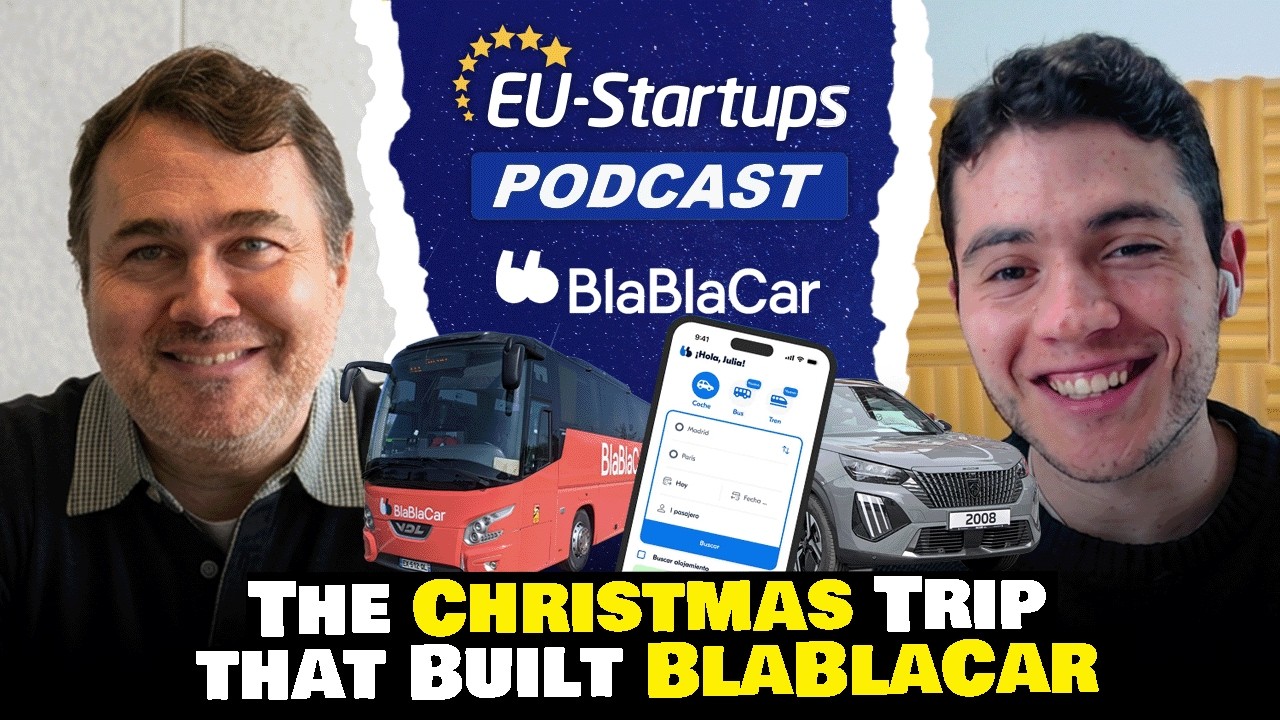
The Christmas Trip that Built BlaBlaCar - Interview with Frédéric Mazzella, founder of BlaBlaCar


#167 (English) Frédéric Mazzella: BlaBlaCar, piano players in the desert and Einstein

"Where to next with Blablacar ?" w/ Peter Zemsky, Nicolas Brusson & Frédéric Mazzella

Frédéric Mazzella: The importance of giving back | Founder & Chairman @Blablacar

South Summit 2016 - Frédéric Mazzella - Empowering communities to build a unicorn business


