An Interview with Noteworthy Publisher Jack Sternberg on Non Performing Notes
Jack Sternberg discusses buying non-performing notes as a real estate strategy. He covers acquiring seconds, spreading risk across multiple notes, and using them as options to take properties at a discount.
Chapters
Hello, everybody, and welcome to another edition of our Investing Animals strategy class. We're glad you're here with us and we really appreciate that you all are taking the time out of your day to join us. Today. We're joined by Gordon Moss, who is going to talk about the defaulted note business. Gordon, can you hear me?
I can. Jack, can you hear me?
Yes, sir. You sound good. So, folks, let me tell you a little bit about Gordon. Gordon began his career in real estate back in 1985 as a commercial real estate broker in Southern California. He's been a student of the masters of all facets of real estate and investing business for over 25 years. He owns and manages a portfolio of properties and notes full time. And he's very passionate and active in what he believes is the best real estate goat investment opportunity we're going to see in our lifetime. Those 25 years of experience and focus gives him a unique perspective. And Gordon takes great pride in the fact that he has a unique ability to make money in just about any real estate market. So with that, let me present my friend, Gordon Moss. Gordon, you can hear me. Good, I hear you. And Karen's recording. So let's jump into your presentation today and you guys are really going to get a lot out of it.
Okay, Should I go ahead and start then, Jack?
Sure, go ahead.
I've got the main screen up. Now you can see my company name, Peyote Ventures. And I've titled this A Unique Approach to the Perfect Financial Storm. That's the best way I could kind of encapsulate the way I see this happening right now and why I get so excited about this whole thing. So let me go to the next slide here. First slide.
Okay.
You touched on my background a little bit, Jack, and just a quick overview of who Gordon Moss is and why should you care? Once again, I've got been doing this forever. When I got out of college, I was looking for something to do. And the gentleman that owned the building that we lived in, he was a commercial real estate broker. So I kind of said, wow, I like the guy. I respected the guy. He seemed to be doing well. So I got into that business that was 1985 and did that for six years. But I soon realized that the brokerage business as opposed to building a fortune were two different things. It took me a while, but I figured that one out and I started going some investment clubs and different things like that. And I met a gentleman here in Orange County, California, ran an investment club, and he introduced me to what I consider are the masters, Jack Miller, Pete Fortunato, John Schaub, Jimmy Napier. And he started sending me these postcards that I should go to Florida for a real estate seminar. And I couldn't understand that. But when I met these guys, I said, boy, I opened my eyes up completely and completely changed my philosophy and my strategy about investing in real estate. I soon learned that all the slick commercial brokers that I was hanging around with that drove the fancy cars and had the Rolex watches and the silk suits, most of them didn't have any money. And it was the guys, the other guys that owned the buildings that were the owners and had focused on learning to invest that actually had the money. So I kind of shifted my direction and became a student, an avid student of, once again, the Jack Millers, John Shoves, Jimmy Napiers, and Pete Fortunatos. And I still am. And that's kind of directed my philosophy. So, you know, in a nutshell, what I look at, what I'm looking to do is acquire and keep passive income, truly passive income generated by quality assets. And these guys have always been single family house guys. And even though I was a commercial real estate broker selling industrial buildings, industrial land, the whole thing like that, I focused and kind of became a single family house guy. Because even in this market right now, I figured out, as John Shaw puts it, he says, people don't get tired of living inside. And I love the way he said that. And I said, you know, in a single family house, in my opinion, even in a bad economy is the best weather proofing against any kind of storm out there. So different approaches to it. Being a landlord, I am a landlord. Buying the notes. The last three years I focused on the notes and I'll touch on that later. So once again, just to kind of summarize background and philosophy, I'm looking at the note business. I'm a landlord, I own real estate for tax purposes, other things like that. But that's kind of been my focus and that's the direction that I'm going. So does that make sense? Oh, yeah.
I mean, you're preaching the philosophy and history of greats in the business. You know, all those guys that you've mentioned, you know, nobody with that. I mean, they certainly know their stuff. And I'm a student as well.
Yeah. You know, it's funny, you know, Jack Miller passed away a couple years ago and I. I didn't realize how much I missed him until he's gone now. I just, I miss that guy tremendously. So, yeah, so the 2020 vision. Can I touch on that? Jack, are you there?
I'm sorry, did you hear me?
I didn't hear you. I hear you now.
Okay, Yeah. I said why non performing notes and why in this market? In your own words, tell us.
Yeah, well, if I could, I'm going to touch on that 2020 vision for one second here. Okay, that was kind of a unique little catchphrase that I thought of because let me tell you a story if I could. Back in 1991 here in Southern California, the market crashed and it really crashed and I was a victim of that, frankly. I was in the commercial real estate business. I had tried for seven years and really developed a was the top commercial broker selling land. The economy and the market tanked and I kind of tanked with it and went right down the tubes. I lost everything I got from all my assets and everything else went down as well as I got a divorce and everything else. Just things were not good. I always said to myself, if that ever happens again, if that ever happens again, I'm going to be the guy who rises above it and basically takes advantage of it. Because there was a few guys even in those days that didn't get down, didn't lose the right mindset and basically went forward and made a ton of money. They bought properties for nothing because they were cheap back then. I always told myself, I said, if that ever happens again, I'm not going to be that guy. I'm going to be the guy on the right side of that equation. Guess where we are now? We're right there again, even worse, frankly, than it was then. What the 2020 vision means is that in my opinion, in about eight years from now, this cycle will have corrected itself. And the people that stepped up now took advantage of what's out there right now, didn't get bogged down in all the negativity out there and bought real estate, bought notes, did it the right way, did it carefully, studied the game. By 2020, they're going to be in a real good position. So that's my 2020 vision. And.
Man, I'm totally with you. You're so right. I was there too in the 80s and 90s. It's time again to make hay because the sun is shining on this business.
Yeah, it's a fascinating time and it shocks me when people don't see it. I'm so excited about this. I can't stand it. I really am. So why non performing notes and why now? The Banks right now, as we all know, are saddled with this big mortgage debt problem that they've had. There's never been a time where there's been such a huge inventory of non performing bank paper. The fact is that half of it is worthless, but in my opinion, the trick is to go find the other half, learn how to fix it as the banks can't do and make a fortune. Now, it's not that easy to go out there and find the right people that have the right bank paper that will sell it to you at the right price and how to evaluate a note, how to work it out, all the things the bank can't do. But I decided that if you could master that skill, first of all, finding the notes, finding the right ones, evaluating them, buying them, right, fixing them, there's just so much opportunity right now. It's just fascinating to me. So that's kind of where I focused at and that's kind of my thought on that. Okay, so let me go to the next slide here. I've got this slide, I call it Non performing notes through 2015. I think we've got two or three years of this existing issue to deal with right now. And this next point, I call it, what if your biggest fear wasn't? What if your biggest fear wasn't. So if you talk to note investors, what's their biggest fear? They want gold plated, super quality, no risk notes for a safe income, blah, blah, blah. That's what they want because they fear and the banks do too. Foreclosure, bankruptcy, all the bad things that can happen to you. So my point is this. If you could figure out the fact that bankruptcy is not that big of a deal and it's a strategy to work around it, I know guys that love bankrupt notes. Foreclosure. If you became an expert in foreclosure, you could become very, very dangerous. And once again, you could buy notes from people that are afraid of these things. So I just see this skill as the most powerful skill to conquer your fear of notes. Bad notes, bad real estate, all the things that people, investors, banks don't want. If you became the master of those things, I think the potential, the opportunity is unlimited.
That's right.
Should I continue?
Sure, please do. I mean, what you're saying is it's so right on point, Gordon. People don't realize, just having looking at things that other people think are bad deals and if you know how to do it, they turn into good deals. Yeah, I mean, I know what, I'm in total agreement with you. It's tough to get people to see that, but we're going to go through some of that right now with you. So I'm excited for you to share this with. Okay.
The next bullet point, I call it avoid the herd. I was always told, I always said to me, they said, find something that nobody else is doing that maybe isn't that simple or easy because the herd will go to where the easy things are. So for example, short sales, REOs, foreclosure auctions, I've done all that. I still do, but that's where the herd is. The mass of people is. I've got to elbow you in the mouth to try to get my deal and yell a little bit louder and pay more than you did. That's not that much fun. Same thing with short sales. I don't know anybody that does short sales that's real happy about it. Right now. It's not that much fun. And the reos, at least around here, they're scarce and I don't know when that's going to change. My point is that non performing notes, as I'll show you as we go through the presentation, are an angle to do all these things, but to be behind the scenes, be the man behind the curtain who's actually controlling the whole deal as opposed to being one of the sheep out there in the herd trying to wonder what happened when I didn't even see that coming. And competing against everybody. So there's a tiny amount of people, like for example, if you go to a bank and you say, I want to buy your non performing stuff, they go, oh, you mean the reo, I don't know, I want to go buy the non performing notes. They go really well. We only have one guy over there that does that. The herd goes over here to our O department, our short sale department. Those guys are inundated. But if you're that one guy who can go to the right place where nobody else is, where the herd is not, there's opportunity there. That's my point of this bullet point right here.
Go ahead, let me inject something. So I tell this story. Some of you all may have heard this before, but one day I was getting my hair cut and as I'm getting my hair cut, the girl who's cutting my hair says to me, what do you do for a living? And I told her, she says, oh, my husband and I just bought a 4 Plex and we're doing this, that and the other thing to it. And she started to tell me about how she was going to get rich in real estate. I thought to myself, now is the time to get out. This is several years ago. Now it's time to get out. Because by the time, I swear this is the truth, by the time my barber is telling me how she is going to do just make a fortune in real estate and anybody can do it, I realize it's time to get out. So the avoid the herd concept, you're right on point. I'm totally in agreement with you.
Yeah, it's being. Being the contrarian, you've got to be able to go up the stream like a salmon do. They're the ones. And to add to that, avoiding the risk, there's a classic real estate book out there by Zeckendorf, the Autobiography of Zeckendorf. And if you haven't read that, and it's hard to find, but you can Google it or something. But that guy, he was kind of the Donald Trump of the 50s. And that is the best book on real estate I've ever read. I highly recommend it. But the bottom line is he talks about options. And Jack Miller always told me about options being the most powerful, the safest strategy. And we all need to look for safety in this marketplace because it's a scary place right now. It's hard not to lose with the prices declining, and it's just a nightmare out there. So options, and let me kind of touch on that a little bit. What Zeckendorf did. I mean, he optioned a good part of. Of Manhattan when he had a deal right next to it. Now, he didn't buy the property next to it, he optioned it. So he had the right, but not the obligation to buy that property for a small amount of money. So that's the key. So, for example, let me say if I went down to the trustee sale and I paid $100,000 for a property and a lot of those trustee sales, or sheriff sales, as they're called around the country, you don't have much time for due diligence. And I've got to elbow somebody in the mouth and beat him out to make a higher price than him. And boom. Now I own the mystery house, which there could be an owner in there who knows. It could be wrecked. I don't know. It could have foundation problems. I don't know. But I have $100,000 into that deal. That's my cash. That could be somewhere else and it's at risk. Now, here's another thing. You could take an option through a note on that same Property, for example, $3,000. Now, your risk is so much less and you could do it a lot more times than putting your 100 grand into that one deal. So the whole avoid the risk using notes as virtual options is just a fantastic scheme in this marketplace to reduce your risk. So I'll touch on that more later with a couple deals. But I just wanted to. Does that clear? Did I make that clear?
Oh, absolutely. I mean, yeah, we're going to have a class on options, by the way, so that they'll totally understand because some folks on the call are not familiar with options or think they are, but don't realize just what a powerful vehicle and option is.
So yeah, and I classify these notes, Jack, as options and I'll go through that later. But exactly. Okay, so let me go to the next slide here. So non performing note strategies. I've got the first bullet point here. I call it why seconds might come first. And the bottom line, we've got different flavors of notes to buy. We've got non performing firsts or non performing seconds. So if I could tell a story, I bought my first note, my non performing note, three or four years ago and I thought I was doing pretty good. I paid about $30,000 for a $70,000 note and the property was worth about 80. So I said, you know, I paid less than half. So even as new as I was, I thought I'd probably do okay. But I went to a distressed debt conference in New York City a while after that and I met some gentlemen that were in the non performing second business and they said, you know, come with us, we're going to go out and show you Manhattan one night. And I said, okay. So after I'd been to every Irish bar in New York City, Manhattan, I didn't realize there was so many, but they had pretty much. They asked me that, they said, well, what do you do? And I said, well, I bought a non performing first for $30,000. And they said, oh, how do you feel about that? And I said, I feel pretty good. And they said, well, we would never do that. I said, okay, what would you do? Well, we'd buy a non performing second for about a tenth of that price for about $3,000. I was still coming to the realization that I was still kind of surprised you could even make money on non performing first. I'm now performing second. Sounded insane to me. But my point is that, and I'll go through this in a minute, like spreading your risk, making small bets, in my opinion, the non performing second niche. And I'll walk through three examples of it as we go through this is just a key way to create an option with low risk and a good quality property. Because you can buy these seconds on better quality properties, in my opinion. And it's just a way to illustrate how seconds are also a strategy as opposed to buying first in the non performing note business. So if I could, the next point talks about spreading your risk. And I always talk about the story about going to Las Vegas and say, okay, I could make one big bet. For example, I could make a $30,000 bet and say, okay, all on black, here we go. And see, I could win or lose, whatever, or I could go and say, let's make 10 small bets, let's make 10 $3,000 bets. And guess what? I plan to lose two of those bets. So now I've got eight, and maybe three or four of those are going to be home runs. So I look at it that way and say, you know what, if I went out and made 10 smaller bets with seconds, non performing notes, seconds, I spread my risk out wider and give myself an opportunity to make a few home runs with the thought in my mind that I'm going to lose some of those bets. So that's what I mean by the second bullet point. Spread your risk, make smaller bets. Does that make sense?
Oh, absolutely. I mean, at this point, people who are not familiar with what you're talking about might think you're out of your mind, you're far from it. So folks, pay attention. This strategy is, there's no other word but brilliant. So keep on keeping on.
Okay, now the last bullet point here, because I know some of the people on the call, including myself, frankly, are real estate people. I've been a real estate guy for 25 years. I own a portfolio of properties, rental properties, single family houses mainly. And I like to acquire property. Now what you're doing is you're going out and buying notes for different reasons. Some of these notes will re perform. People will start saying, you know what, okay, I'll start paying you monthly payments, other ones won't, and you'll be forced to foreclose. Now, it's a rare occurrence. Frankly, it happens less than 10% of the time in what we do. But once again, as opposed to paying $100,000 cash for an option property, I can go out and buy the non performing second for almost nothing. Let me give you a specific example. In Las Vegas, there's a house right now that I basically bought the non performing second and third for a total of about $13,000. This is a $300,000 house. There is about an $80,000 spread in there of equity which now I own the house now as of last week. And basically once again with $13,000 in I, I've acquired this property. And so if things did go bad, I've only risked 13,000 as opposed to 250 if I would have paid at the auction sale. So it's a unique way, if you know what you're doing with the foreclosure laws to acquire property. And I just think it's a fascinating piece of this non performing second business. Yep. Okay, let me go next slide. On this slide, I wanted to talk about kind of a big picture of note investing and kind of my philosophies on the whole thing. I worked in the corporate world for a while and I would talk to people and I would say, Jack, you make 100,000 and I make 100,000 every year. And that's okay. I said, but guess What? I own 10, 20 rental properties. So I only pay about 25,000 in taxes. You pay 50. And I used that 25,000 that I didn't pay to Uncle Sam for buying more houses or buy more notes or whatever it is. So they taught me earlier, the masters did, they said, live a tax life, a tax life, because your partner there, Uncle Sam is going to, he's not going to let you get rich unless you focus on it and find the strategies that are completely legal, completely legit, but find the rules that they've made in the tax code. And it's worth studying the tax code is my point with notes. Note income is great, but it's ordinary income and you need something to shelter it against. So I always tell people there's a perfect marriage between notes and real estate. And I've got a bunch of real estate for a big tax shelter and I've created a big note income to use that tax shelter. So I won't get too much into that now, but another piece of it, everybody should know about the self directed ira, and I'm sure your students do. But the Roth ira, that is a tax free way to really capitalize on this market. I mean, if you're making good money doing deals or doing note deals, whatever it might be, if you're doing it in your Roth, there's no taxes or your self directed ira, they're deferred. So I just, I have to, I always, whenever I talk to people, I always say, you know, this tax piece is something that people forget about because a lot of flipper types, they say, oh yeah, I made A million dollars last year flipping properties. Okay, well. But they paid half of it in taxes. That's a highly taxable event. A couple specific things. The Roth tail. This is just an amazing strategy with a note. If you take a note and for example, sell a partial, sell a piece of it to an investor, say a passive IRA type of guy, somebody who's got a job, he's making 1% in his regular Iraq, and you can give them a 10% return on a secure investment with a note. You can keep the tail of it with an option in your Roth IRA. So if you put out a $100 option, you could take the back end of that note. I won't get too much into that and I know that's kind of an advanced strategy, but I just want to throw it out there. That one keeps me up at night. That one, I think, wow. It's just an amazing strategy that if you. No notes. If you know IRAs, there's so much opportunity right now, it's unbelievable. The last piece too. Selling reperformers. Let me kind of explain what that means. Let's assume that you bought a note, let's call it non performing second for about 15 cents on the dollar. So for $100,000 note, you paid 15,000 and it cost you about 5,000 to fix it. Foreclosure costs this, that, the other thing, loan mod, whatever you did. So now you have a nice performing note and it's seasoned. Six months has gone by. Maybe a year has gone by. It's a nice seasoned note on a good quality property. Those things Jack, are reselling these re performers for 60 to 70 to 80 cents. So you bought something for effectively 20 cents and you can turn around and resell it once you've fixed it because you've mastered that skill for 60, 70, 80 cents. And people will line up for that because they're getting 1% right now in their IRA money. They'd be happy to get 10%. So it's just another strategy with the notes that I just think is fascinating.
You and I ought to do a class on both the ira, the Roth tail and about selling reperforming notes. So let's. In fact, we'll do that. Let's do that.
I would love to.
Yeah, that'd be great. Because that's such a fascinating topic. Exit strategy.
You're right. And I don't want to. It's a little bit deep strategy. I really can't do it justice here. But I just want to touch on it and I don't mean to confuse people or have them say, what's this guy talking about? But you're right, it's worth a whole seminar.
Yeah.
Okay, so let me move now to the real deals. This is. I've got three examples of notes, and I didn't pick my best ones or my huge ones, frankly. I picked smaller ones just to kind of give a real world example of. Some of the benefits of buying notes is you don't need that much money. So let's kind of walk through this. I call this the real deal one, an auction sale. Okay, so here it is. So it's a house, it's in Houston, Texas. And the fair market value, FMV $70,000. It's got a performing first loan. Performing first loan, meaning it's paid on time for $32,000. That sits on top. There's a non performing second loan underneath that for a little over $18,000. Does that make sense?
Oh, yeah.
Okay. It's a little regular house in an okay area of Houston. And frankly, the people have been there for 10 years. So I bought that note, I bought the non performing second for $2,700. $2,730. What we did was we tried to contact the people. We tried to do everything we could to work something out. We hired a detective, go out there. We had a door knocker go out. I sent him FedExes letters, tried to call them everything. They were just dark, as we call it. And you know, one of the most challenging pieces of this business, of the workout strategy, as I call the wake up part of it, a lot of these people have not been paying for two years and they're asleep, they're in denial. This doesn't even exist anymore. If you look at my credit report, it says charged off. So who's this? Who's Gordon Moss? I had a loan with Wells Fargo. Who is this? The hardest part, once again, is to wake them up. This one couldn't be woken up. So what we did was we sent it to auction. We just basically said, okay, if we can't talk, we'll just go ahead and start a foreclosure. We did it. Went all the way to foreclosure. At the foreclosure sale there in Texas, they have Super Tuesday in Texas, the first Tuesday of the month, they all sell. And somebody bought the note. Someone came in and bought the note at the sale for $19,810. We got a check that was.
So let's talk about this deal for a second. So you have $2,730 invested in this deal. That's how much you bought the 182 non performing. Second, the folks hadn't made a payment in several years. They're in denial. They don't respond to the wake up. So you foreclose. Yeah, Texas has a very, very fast foreclosure, unlike lots of other states. So that's good for us. And at the closing, they paid you off. Someone came and bought the note from you or paid you off.
They bought the note at the auction sale. Effectively at the auction sale, the note came up. It was basically this property. With this note, if you pay $19,000, you own the property, subject to the first. The first didn't go away. I don't wipe out the first. It's still there. So the person that bought this property for 19,000 still has a $32,000 note in front of it. Okay, so he's into it for about 50. If you take the 19,000 plus the 32, the property is worth 70. So some investor or someone decided that that was worth. That was worth it. I was a little bit surprised, frankly, but somebody did.
Yeah. Well, that's great. I mean, what a great profit.
It's not a ton of money, but for a little bit of money, for a little bit of money, $2,700 is not a bad return.
So, folks, do you see what he's done here is he effectively has bought himself a piece of the deal, or the right to acquire the deal, or the right to control the deal, or the right to push the deal, whatever you want to call it, for $2,730. By having his finger in the pot, he made something happen with this deal. Had he not come along, Wells Fargo or whoever the owner was, they look at this deal, we got $18,200 plus accrued interest, etc. Etc. And we'd have to pay off $32,000 first. And the thing's only worth $70,000. And they're looking at somebody coming along and only paying 60% at 70,000 on the REO market. So their calculation is we're going to net 40,000. We have to pay off 32 to get 40 or 45 and the risk of ownership. So Gordon enters the picture, buys the second from them. They don't have to worry about it anymore. And he makes something happen. He's the catalyst that forces this thing to an end. And the truth is, and I'm putting words in your mouth, Gordon, you would have taken less than 19 8, I bet. Yeah, because. But you don't have to tell them that, obviously. And folks, let me also tell you, very, very similar things have happened to me personally. I've been buying seconds for years, 25 years. Really, really, probably more. And I hate to say that I don't find second people living in caves and they come along, the cousin comes along and buys the note or pays it off or whatever. You have a choice. You can either accept the money or foreclose the property and take ownership of it. Again, I'm putting words in your mouth, Gordon, but sure, you weren't scared to own that property if you had to. Right? So, you know, you have several exit strategies and the second, you know, this second mortgage purchase strategy is absolutely killer in this market. So I don't want to step on your, on your presentation, but man, it's just, it's so cool. So keep going. They're going to love this.
Okay, I feel the same way. Here's the real deal too. And this happens sometimes. I call this one the payment plan. And let me kind of lay it out for you. So this is a property in Southern California and the fair market value of it is $425,000. There's a performing first loan on the property of $310,000. There was a non performing second on the property or there was for $102,000. Okay. Now these people had been in this house for a long time. I drove by the house, the lawn was mowed, the rows of bushes were planted. You could see there was pride of ownership, these people. And I looked for that when I scanned these things. So we bought that non performing second for $13,000, a little 13 cents or so. So when I contacted this borrower, they were very interested in keeping their home and wanted to work something out, which is great. It's what we always do. What happened was this, what we do is we normally say, okay, Mr. Borrower, what we'd like to do is kind of we need to do some underwriting here. So we need to get your tax information, your W2 or business information, any type of savings account. We basically act like a bank and we create a strong loan file on these because if I ever wanted to sell it again, that's a valuable thing. Basically, I could look at their finances and say, you know what, they had fallen down a couple years ago, but now they were in a pretty good position. They own a chain of businesses in Los Angeles and they actually just opened a new one. So in 08 or so things hadn't gone so well for them. The whole economy kind of dipped, but now it's 2011 and things are better. So they basically paid me $2,500 to start the whole thing to get the process going. And then the deal that we struck was they would pay me $700 a month for the next 30 years. I basically created about a 3% fixed 30 year note, which they were very happy about. And they actually came back two months later and said, we want to pay some more principal. So now they're paying us $1,000 a month, which is the last line where it says the note 30 year payment plan, $12,000 a year for the next 30 years. So once again, on a note investment of $13,000, we're getting $12,000 a year for 30 years. It's a good example of a payment plan.
Let me inject a couple of things in here for those listening and stop me if you want to talk about any of this, Gordon. Folks, there's total debt on this property at this point, $412,000 on a $425,000 property. And I would imagine that that non performing second, that was the principal amount. Is that right, Gordon?
Yes.
Okay, so those people hadn't made payments. And again, I'm just vocalizing my thoughts on this. Those people haven't made payments for X amount of time. It could be a year, it could be five years. Why? Because they owe as much on the house as it's worth. There was no incentive for them. There was no equity in the house. So the lender again looks at this deal and they say in order to protect our 102,000 plus interest, so it might have been $180,000 balance, we have to put out 310,000 on a house that's owned worth 425. So they didn't have any incentive to do that. They would rather sell it, take their loss, take the write down and have someone else do it. So stop me if I'm wrong, Gordon.
No, you're exactly right.
Right. So, Gordon, purchasing this at $13,000 and making contact with them and giving them. And also let me back up when you go buy the house and the lawn is cut and the first mortgage is current and there are a couple of cars, nice cars in the driveway. And these folks are giving every indication that they're staying there. They're making payments on the 1st, the pool is clean, you know, whatever. Those folks want to stay there. And that's a great deal. Part of, there's a bunch of different exit strategies on this deal, Gordon. Took $2,500. You very easily could have said to the folks, you all owe 180,000, which is $102,000 plus defaulted interest. I'll cut that in half. Now you only owe 90,000. Let's do a new note at 90,000 and I'll give you a 2% interest rate or a 3% interest rate. But I need you to make a down payment. Make a down payment of $13,000 or $15,000. It may take you a month or two to get that. Pay $7,500 this month, $7,500 next month, and we'll put you on a 30 year fixed rate. Second, pay it off any time you want. Stop me if I'm wrong, Gordon.
You're absolutely right.
Right. So there's a huge. On the calculator. I don't know if you have all this, but the return is absolutely skyrocket through the roof. So, you know, I hope folks can really see the value in this payment plan exit strategy.
You know, Jack, I call it almost three digits. As far as the rate of return. I call it almost three digits, which is a target sometimes. But, you know, and let me add a couple things to that if I could, because once again, they were a business and they had some money. I could see they had some money. I also offered them some other options in my modification plan. I said, you know, if you want to pay this thing off in full, we'll give you a year to come up with 75% of that number. So let's call it $75,000. If you can pay us $75,000 cash within 12 months, your loan is gone. So it gives them an incentive to say, wait a minute here, that's a great, a great rate that we'll never get again. Let's look at that. So I think right now, they're out there looking right now for some money to pay that off. That's one way. We also say this, Jack, here's what I did with the arrears, as you mentioned, about the accrued interest and everything else. My goal is to have them pay me on time for a long time. I don't want them. I always really research their. I underwrite them and I say, what can you really afford? And sometimes I'll go less than that. They'll say, we could afford $400. And I say, let's make it 300. And when they pick up the phone, because they're shocked because no bank has ever done that for them, they're saying, this is Great. And I say exactly. The people are happy. What I'll say about the arrears, I'll say, jack, if you will basically pay me on time for three years, I'll waive the arrears or half of them. I want to give them an incentive to make this a positive loan that works. I want this loan to be valuable to me and not have to. There's a high level of recidivism, reoccurring problems with people that have had problems in the past. So I want to make these loans as positive, that work out for me as best as possible by giving them an incentive. A positive incentive that a bank can't do.
Right? Yeah.
Okay, let's go to the next one. I call this one an estate sale. So here this property is in Las Vegas, Nevada. It's a nice home. The fair market value was $225,000. Performing first on it of $180,000. Non performing second. Right. About $19,000. Now, the problem with this one is the gentleman had passed away a few months earlier, and the bank, I guess, didn't realize that and couldn't figure out why they weren't getting their checks anymore, because he paid on time for years, a decade. So we bought this note for about $3,000. And probably within 30 days after buying it, I got a call from a realtor that said, yep, the estate is selling the house and it sold. It's kind of a short sale, but that's irrelevant. But basically we got paid off in full, $19,810. So once again, for a small amount of money, $3,000, we were able to participate in a sale and made a.
Good return, a huge return. Here's another example of really being seeing value in something that no one else sees value in. If you look at this deal, basically there's $200,000 owed on a house. The fair market value is two and a quarter. That's no money. I mean, by the time you pay real estate commission, et cetera, et cetera, there's not a lot of money in that on the surface. But looking beneath the surface, this is what it really looks like, especially in that market out there in Las Vegas, it's just such. It's ripe for this.
Exactly.
Oh, yeah, we're looking at a bunch of deals out there. In fact, if anybody's interested in that, send me an email. But keep going, keep going.
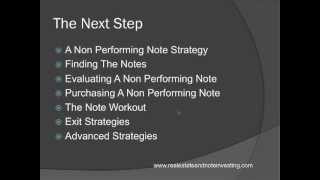
Yeah, and I'm with you about Las Vegas. I've got a lot of property in Las Vegas. The market's down 60% I love it out there. This is a great strategy to focus on. So let me kind of talk about the next slide, which I call the next step. And to myself three or four years ago when I was researching, saying, okay, how do you approach this market? How do you approach the non performing note market? The bank note market, we've all seen the seller finance been around forever, that piece of it. But the non performing banknotes, it's a unique niche which is relatively new. As far as this massive amount of debt out there, how do you get involved? How do you approach it? I broke it down into seven steps. A non performing note strategy. Let me just touch on that real quick. There's non performing first, which traditionally I found to be. Most of the banks have properties scattered all over the country. This is a national business. The first that I've seen are a lot of low end stuff, frankly, it's inner city stuff, it's stuff below $50,000, et cetera, et cetera. But there's money in that. When you can buy, the prices range, it depends from 20, 30, 40 cents in some areas in California or some different areas, Florida, they're 50, 60 cents for a first, a non performing first. And then as I've kind of talked about in my presentation here, another strategy would be the seconds, which is what I do. I'm not saying I don't buy firsts anymore, but I just see the seconds as such a unique option type strategy on the note business. So that's kind of where I focused. And you know, the banks, Jack, they really don't. People don't understand a lot about seconds. You know, first of all, I had a banker talk to me last week and he was saying that, you know, can you foreclose from second position? And I was just shocked to hear him say that. You know, they don't know that. And a lot of your borrowers will say that, you know, they'll say, I got a letter from you that's saying we need to pay, you know, we're not going to pay. And you say, well we need to do something or our partners here will force us to take action. What kind of action? Well, we can and will foreclose. You can't do that. Oh yes we can. Check it out. So they do and they come back and they go, you can, can't you? I said this loan is just like a first. It's a first trust deed or a mortgage, whatever state it is and we have all the rights that a first does. So it's just a Unique little niche that even the banks don't understand sometimes.
Let me inject something here. The second has all the rights to that the first has, except it's in second position. It doesn't mean it's not as powerful. It means it just gets satisfied after the first does. And it's the squeaky wheel. You know, if you're in a second position and you make that wheel squeak, they're going to pay attention to you. Let me also add one other thing that I don't. We hear to the folks listening, the reason it's an option is because for $2,300 or $2,500 or that nominal amount of money that Gordon used to buy that second, you have the option to walk away. You don't have to foreclose. You don't have to follow through on the deal. It's at your option. And that's really what we mean by this is really an option play.
Exactly.
So go ahead, Gordon.
That's exactly it. In my one point, I said, why seconds might come first. And I'm trying to be a little bit of a poet there, but I'm not real good at that stuff. But just because it's actually, in my opinion, more powerful than the first. Well, somebody could go back and say, wait a minute here. What is the worst thing that could happen? You say, well, you could get wiped out. What does that mean? Well, that means that the first forecloses and you lose your position. Oh, okay. Well, how about if you knew how to control that? In most states, you've got the right to foreclose from second position once again, and you can also protect your position. So if the first is going to foreclosure, you can cure it, you can reinstate it. So let's say the back payments on the 1st, that's going to foreclosure, getting ready to wipe you out are $5,000. You pay the first. Here's the $5,000. Stop your foreclosure. They have to. Now, you start your foreclosure and you take control of the deal. It's an amazing, powerful option strategy with a little bit of money, as you said, Jack.
Let me also inject this. You can buy it in second position. You can buy it subject to the first. Exactly. You can acquire the property subject to the first legally, morally, ethically, without violating a due on sale clause. You have the absolute right to cure and protect your position. So lots of people think it's. I think it's the most valuable position in the deal. Let me Also, say one other thing. If you got wiped out, if the worst thing happened and the first foreclosed and it wasn't enough money to even pay you back the $2,000 or nominal amount of money you have into the second, believe it or not, folks, they still owe the money. The security is gone, that is the house or the property, but they still owe the money. You no longer have a security interest in the property. It doesn't wipe the note out, it doesn't wipe the obligation out. It wipes out the security. So there are lots of folks who go around and they buy unsecured seconds. But let me tell you all a little secret. The loan's unsecured to begin with because the property's not worth what's owed on it. So that portion of the debt is unsecured? Basically, yes, it's secured by the house legally, but practically there's no security because the house isn't worth what's owed on it.
That's a great point.
I hope that helps.
Go ahead. Yeah. On some of these unsecured ones. Now what we do is we go back and say, okay, we'll file a judgment, which you can do for 10 years and then file another one for another 10 years. So effectively, you've got 20 years. So if this person, obviously they're probably having financial problems right now, but things will probably change in the future. They might want to get married or buy this or buy that. They've got to come back and talk to you 10, 20 years later. So as you said, being wiped out, it's still not really a bad position. You just have an unsecured debt, which start looking at the worst case scenario. What's the worst thing that could happen? And it's really not that bad. The more you understand about it, the less you worry about it. On the next bullet point, I put finding the notes. And let me kind of just briefly touch on that. I spent the last three years going around the country to every distressed debt conference, mortgage banker meeting, servicer meeting, to kind of get out there and find out who the real sellers were, what a real deal was. How does Gordon get out there and get the opportunity to buy notes? What kind of notes, who are the maniacs versus the real guys? Who can you trust? The whole thing like that. I won't say it's a challenge dealing with the banks. They don't make it easy. And so finding the notes, frankly, the first part of the strategy is to find the notes. Find your strategy. Are you going to buy seconds? Are you going to buy first? Are you going to buy them nationally? Are you going to buy them here? Are you going to buy them there? Are you going to buy single family houses? Are you going to buy notes on apartments or commercial or land? You need to kind of define what your vision is and then get out there and hunt. Once again you would think a lot of people think, well, go to the banks. Well what we found frankly is the fact that the servicers, a lot of these servicers, I mean once you get a loan, somebody will service it for you and they know who the sellers are. They know Jack has 1000 notes here and he's got about 100 of them that he doesn't like and he would sell those at this price. So you would think wow, okay, as opposed to going to the banks. And you would also think that banks in trouble, the banks with the big problems would be the ones to sell you the notes. We've not found that to be the case. Normally it's the healthy banks that can afford to sell you the notes. So it's kind of illogical. So just some comments on finding notes and that's been my story about how I did it. Any thoughts on that, Jack?
I mean you sound like me. That's exactly what I did years ago. Go to all those meetings, seminars and sessions, meet all the players and see who's real and who's not. Cut through the bull, you know, dismiss ones that are full of it and dismiss the daisy chainers and those that are just re brokering deals. Get to the, you know, get to the real meat of matter. So I'm total agreement with you Gordon. I mean it's, that's, you know, that's right.
Yeah, yeah. So the next point I've got here evaluating a non performing note. So let's say you've got some relationships now with some sellers of notes, banks, hedge funds, investors, whoever servicers. And what they would do is send you what they call a tape which is effectively a spreadsheet of notes. It could be 10 notes, it could be thousands of notes. And it's going to be on you at that point to be able to be, to know what you want and to know how to find it. For example, you would get the balance of the note, you would get the property, the collateral. So you need to kind of have an idea once again of how to quickly do research on collateral through the systems out there. There's a lot of them and then also what the size of the note is. If you're buying a second, how Big is the first in front of it is the first performing. Frankly, we're looking lately at non performing firsts in front of our second because this whole, once again, this whole acquisition strategy focuses on that. So once again, once you've kind of narrowed your strategy down, your philosophy, you need to be able to become a pro pretty quick at evaluating a non performing note and the process in my opinion, first you look at a tape, you look at your first tape, it'll take you two weeks to figure it out. But then now we get to the point where we can do it in about a minute. You can kind of pretty much go through something and, and scour it real quick and then narrow it down to maybe the number of assets you're looking for the one or the hundred and it doesn't take that long. So it's like anything else. It's like when you're new at it, it takes some time, but once you get the skill down, it's relatively easy.
But it seems, but yeah, yeah, it's very, you know, it's not all that different than looking at three or four exit strategies on if you were to acquire the property or some what if scenarios in your mind and on paper as to how you're going to get out or is this thing worth buying? If I had to keep it, what would I do? If I had to sell it, what would I do? If I had to fight them, what would I do? If it was a slam dunk, what would I do? But anyway, keep going. I don't like. Yeah.
So the next bullet point I've got purchasing a non performing note. This was a little bit exciting for me because I'd always been a real estate guy where we had thing called an escrow or an attorney close your deal. So I would put my money in and they would put their papers in and we kind of do that shift right there one day, 30 days later, where now I own the property and you have my money with the note. It's not like that. Here's how it works. You give them the money, the they cash your check and then you wait for your notes or your collateral file. I decided in this process, I said I better have a relationship with these sellers because that excitement is a little bit too much for me where I'm calling them 30 days later and saying, you got my check right? Oh yeah, you cashed my check, right? Oh yeah, we got your money. Where's my note? It's coming. The banks are slow. Bureaucracy. Wow. So sometimes it takes 30, 60 days to actually get the stuff. That was a new concept for me that I had to kind of get through. What it taught me was I needed to trust my seller and have a relationship with them. So if things did go bad, I had some recourse. I could say, wait a minute here, this is not the way it's done. You typically get a non disclosure agreement up front. You look at the tape they have, you sign a purchase and sale agreement and then once again you transfer your money and then you wait for the notes. And then weird things happen too. In my opinion, in this business, which is kind of unique, sometimes the bank will say, we want that one back. And you're like, what do you mean you want it back? You got my money, now you want the note back. And that happens on a regular basis. So it's kind of a mindset.
You have to.
You could turn around and say, no, you're talking to my attorney next, I gave you the money, it's my note. And they'd say, well, guess what, you'll never do business here again. And we're bank of America. So guess what, you're not in good shape right now. So it's one of those little nuances of the note business that I find unique in buying banknotes that you kind of have to get your mind wrapped around.
Until you have that note. Until you have that note in your hand, you don't know.
Yeah, that was. So the next bullet point, the note workout, in my opinion is the key part of this business. Because what you're actually saying is that, okay, I am better at the bank at solving their problem or they wouldn't sell it to me in the first place. And that's what you need to get your mind wrapped around. So as I kind of mentioned earlier, there's two pieces to the workout. There's the wake up and the workout and the non performing note. Waking the people up is an art and it needs. You know, here's one misconception that a lot of note people have. They say, well, this all sounds pretty good. I'll just go buy some notes and give it to a servicer and they'll make me all kinds of money. It doesn't happen that way. Everybody. I've talked to a servicer. There's two flavors of it. There's a workout and a servicer. A servicer collects the payments. So much principal, so much interest, does 98 does, all the regulations, respotilla, everything else. But it's gotta be you because you'll call up your servicer and Say, how's that note going? And they'll say, well, I called them, they didn't call me back. Well, how long ago was that? Well, that was a month ago. So what'd you do next? Well, nothing. They didn't call me back. And you're like, wait a minute here. Because if it was you on top of it, you would call them back again or you would show up at their house or you would send them another letter, you would do something. And this is that kind of business. The wake up part of it is a hands on business. And that's why we've been very successful, frankly, because we do it ourselves. That's part of the wake up part. The workout piece involves once again, once they're woken up now, now you're talking to them, figuring out a payment they can afford and being creative with them, developing a relationship, in my opinion with them, because this is a long term kind of deal, and then creating a solution for them that makes sense. So in my opinion, that note workout is the most important part of this whole game. And the better you get at that, the more successful you'll be.
I've heard some great strategies on the wake up part. I just have a smile on my face right now thinking about some of the things I've heard to get the people to respond and. But anyway, we'll save that for another day. Pretty funny.
The last couple exit strategy and advanced strategies. Exit strategies that we kind of touched on. You can sell at the auction, you can do a deed in lieu, you can foreclose, you can work out a payment plan, you can resell the note to somebody else. There's probably five key strategies for exiting these deals. And I'm not sure how much time we have left here, but we could talk for a long time about a lot of these different strategies. And that's really the key is the workout, the exit strategies. And as far as the advanced strategies, I kind of touched on that earlier in my one slide about the taxes and everything. Using your Roth IRA re, performing the note and selling them. There's 100 little things, the Roth tail, just exciting stuff that once you master this business, I just think to kind of sum it up, it is the best way to take advantage of what we see right now, which is the most exciting time in the market ever to buy distressed assets if you do it right. Because once again, people that I know that are doing short sales reos, the trustee sale, the auctions, that's a tough game right now. And everybody I see is burned out and just ready to quit. This part of it is in a unique way, a unique approach to that whole market and in my opinion, the best way to. So that's kind of my summary of where I think the market is and how you should do it here, Jack.
Okay, well, look, we're at the top of the hour. We got a bunch of questions. Let me just ask you before we close, Gordon, what is the biggest mistake that you see people making who try to get into this district business? The defaulted business? What's the one thing, the biggest single mistake you see?
Okay, what I see is people going. A lot of people don't have a strong real estate background or they don't really understand the business and they'll buy a note, they'll pay too much in the wrong area of town. And if you buy a note on a property in Detroit or something like that, you can make money there. Don't get me wrong. But when you're paying too much for it and there's really no exit strategy there, there's really no way to get out when you're in the hood and you've got the wrong property, you paid too much, nobody will buy it, you can't rent it and stay alive. I see a lot of people out there looking at the bottom third of these lists of properties and notes and they're buying this stuff that they should never touch. That's what I see as the biggest mistake.
Okay, good advice. I think you're right. I think you're right on point, right on target. You know, this is such an interesting topic and such an in demand topic. You want to do another session with me in the next couple of weeks and we'll record it and make it available to the folks.
Thanks for asking me, Jack. I would love to. I would really love to.
Okay, well, folks, that about wraps it up for today. Gordon and I are going to do another session in a few weeks. We've got to get it scheduled. So look, for that, we both want to thank each and every one of you for being here and taking the time out of your day to join us. We appreciate each and every one of you and hope you got some value from this class and some of the other ones we've done. Look forward to seeing you in two weeks for another Investing Animals strategy class. Thank you very much, Gordon. Thanks, folks and have a great day, everybody.