Module 10 Note Investment Mentoring [4/10]
Coach G covers borrower workout tactics in note investing, emphasizing relationship-building and active collection. Two deals show the payoff: a $27k junior note bought for $9,500 recovered $20,000; another $161k note bought for $24,198 was restructured to $369/month with principal cut to $100,000.
Chapters
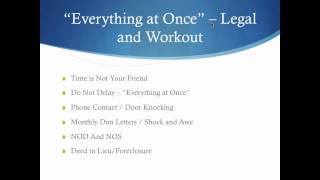
Talk about module four. We shifted into the psychology of the borrower workout. So we've got them woken up now. Now it's about the workout. And we had Steve Graglowski came on, who's an expert in analyzing and doing this for decades, workouts with borrowers who have had problems. So it's the attitude of the workout pro, fielding the questions, developing the respect of the borrower for a long term relationship. I talk about this a lot where if you delegate this to a servicer a lot of times and they haven't really developed a relationship with these people of mutual respect, I think the terms of your note might be a little shaky sometimes doing everything at once. We talked about legal and workout. The power of higher authority, kind of positioning yourself as the manager, not the boss, with all the decision making ability, but that you defer to legal, you defer to corporate. So when they come to you and say, hey, you know, can you make a decision today? And I say, well, you're a bank now, you have to send it to committee, you have to send it for review to legal. And once again, legal is moving forward without your authority. But you can work with them, you are their advocate and that you have all the solutions, you've got the solutions for them. You're actually there to help them. And you are. And it's a nice part of this business. And also not forcing anything on them, no forced solutions. It's about the borrower. So the point of this thing is that the workout pro versus a loan servicer, big difference. A workout pro is the real magic of this business. An asset manager, whatever you want to call it, versus a loan servicer. A loan servicer. When you go and hire a loan servicer, it's kind of the Achilles heel of this business because people think, well, I'll just delegate it to them, they'll take it over and make me a lot of money. It doesn't work that way. There's another piece of this. You've got to get this broken loan that you paid almost nothing for to a performing business. You got to wake them up, you got to work it out. And it's a high touch business. So I can't emphasize that enough and I did through the course. So the psychology of the borrower. I like the fact that you can buy better loans, leverage stronger borrowers and still pay a little bit. I can buy $100,000 note on a half a million dollar property a second for a fraction of what I would have had to pay for that first. And I'VE got a potential strong borrower there. And the profile, you know, as I mentioned, a lot of these guys, if they got a half million dollar home or an upgraded home, they want to keep that home. And a lot of them are business people, they're professional people. I like those people just as far as a potential to get them to pay me back. So building rapport and respect with them is key. So financial hardship, a lot of them, two or three years ago, maybe they lost a job or something like that, they've had income, they've had family challenges. These people are defensive and threatened. A confused mind says no. You've always got the potential with death, divorce, disease, that's what you're dealing with. It's part of this business. It's a reason they went down. But if you can be that confident, respectful, advocate of theirs, you can do very well in this business. So the attitude of the workout pro, professional, respectful, informative, offers guidance, options and direction, earns and demands their respect. Empathetic and excellent listener. I've got a whole slide here on that. These are some of the objectives that we went over and how to overcome them. Who are you? And prove it. A lot of them will say, no, no, no, I had my loan with Wells Fargo, who is, who is this company, Quixote Ventures, and prove it. And they'll say that this loan has been charged off by the lender. You know, it's been charged off, it's gone. You need to make it clear to them that, no, that's not the case. Basically, the loan is still a loan. You still own the property, it's still a lien on your property. They'll say, I'm paying my first mortgage. Okay, you need to pay your second mortgage because we can and will foreclose. They say, no, you can't do that. A lot of lenders who do seconds don't foreclose from second position. We don't have that same policy. Or they say, you know, there's no equity in my home. We talked about the emotional equity before, but these are the common objections that you're going to be getting in this business. This is a key part of this whole workout process. It's about listening. And if you just had these three questions, tell me what happened and then shut up and listen. Tell me what is happening now. Listen. Tell me what you would like to do. Listen. That is it right there. If you would just take those three questions in your first call, which you might be a little nervous about when you're calling your first Borrower, if you just wrote that down, that's what you want. You don't want to go right to the numbers. You don't want to start talking this and that. Solutions, you want to build a rapport. So open ended questions, listen, supportive responses, listen. You want to make them confident. The fact that you have all the solutions for them. A refinance which isn't happening that much these days. A payment plan which happens a lot. A discounted payoff where they can actually pay, you know, a lower amount and feel like they're getting a deal too. Friends and family plan where an uncle or another family member, they might have some money where they could fix this problem. A pension, a 401k, a loan advance, they can actually go to their pension plan or 401k with a letter from you saying that yes, the home is in jeopardy, they need to pull some money out of that, get the money that way, if none of those other solutions are in the cards, a sales and relocation assistance. You'll see a lot of times when people are being a little bit defensive or not really working with you and you offer that solution and they get real quiet for a minute but they realize what you're talking about. But also sometimes, you know, they really can't afford the house. So you are the solutions for them. On these notes, I put it this way. I say, time is not your friend. Do everything at once. Don't delay. Make the phone contact, do the door knocking, do the monthly dun letters, do the shock and awe, notice of default, notice of sale deed in lieu foreclosure. Do everything. Just don't be stalled, don't be. A lot of these borrowers were, some of them are pros frankly at stalling you. So they'll say, well, you know, if I can just get this, would you stall it in foreclosure? You say, well, you know, legal won't let me do that. But you know, get me information. I'll work with you, but do it all at once is my point. That's the biggest lesson I can tell everybody. I was talking to one of the students this last week and I just said, you know, be relentless, just keep going. Assume that no one's going to follow up. The people that you're working with, the legal people, the servicer people, do it, you know, get on it. If you get on it like that. And we're going to see an example from one of our students later tonight in his examples. He's on it. And that's what it takes. Reporting to higher Authority. I talked about this a bit earlier. You've got management to report to, you've got legal to report to, even if there isn't one. It's a good, you know, stance for yourself. You don't want to be the guy that has all the power. And they call you and say, well, can you take this number? You say, well, I need to run it by my other partners. Gives you a chance to think about it, you know, etc. So you got your financial, loan committees, financial partners. You are the bank now. Think that way, act like a bank. As my one friend says, arrearigists, this is the biggest rookie mistake. You forget that these loans that haven't paid for three years, it isn't like an empty house with a tenant that hasn't paid you. Good luck getting that money. These monies accrue the late fees, the interest, the charges, get the arrearages. You can go to them and say, here's the deal, we've got $100,000 workout for you. But oh, by the way, you've also got $6,000 in arrearages that we need to bring current, either in cash. Create another note, but always get the arrearages. A lot of people miss that when they get started. So understand what's owed, discuss it early and often. Developing borrower respect. I talked about this a bit earlier. It's a relationship development and that's going to make the quality of your reperformer that much better. So I always do it by making mutual commitments. I tell them it's if this was important to you, by Friday, can we get the information back? Yes. So I can assume that by Friday at noon, if you haven't got it back to me, you're no longer working with me. Is that correct? Yes. So make commitments and you keep yours, they keep theirs. Build the relationships. It's about the borrower. Don't force your solution on them. This is a key point because you're going to get good at this pretty quick and you're going to pretty much know with a lot of borrowers that one, they can't afford their house, or two, you think they should go here, but don't do that to them. Don't start throwing numbers at them. As my one partner put it, he says, take them by the hand, walk them down the path. They sit down, you sit down. Don't force it on them. They'll come to the conclusion, solution themselves. You're their advocate. Build a relationship with them. Let's talk about a Couple more deals for module four. Let me see here. The fair market value of the house. This was a discounted payoff. This happens sometimes was 675,000. There was a first for 555 and I bought a little second there for 27,000. Now I paid a lot of money for that. I paid $9,500 for that, which is 30%, which is more than I normally pay. Quality single family house owner occupied. We used a door knock. We to used. We file a notice of default. Customer contacted. The result and as we go through in our program we go through the whole banter back and forth between the borrower and us. How we did it, how we pushed them back and forth and back and forth because there was a lot of back and forth on this thing. But they paid us $20,000. So we doubled our money. Another one in Fontana, another payment plan houses worth 227. There's a first for 180. We bought the non performing junior lien, a large loan for 161,000. I think we paid. We paid 24,198 for that loan. Quality single family house owner occupied. We did the door knock. We file a notice of default. The result, $369 per month for 30 year. We did reduce our principal down to $100,000. I normally recommend not doing that, but in this case we did. But once again a solid reperformer.