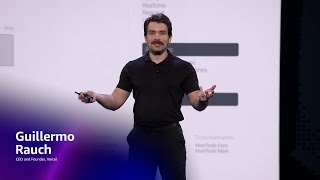
In this keynote at Amazon re:Invent, Guillermo Rauch, CEO and founder of Vercel, recounts his personal journey from hacking websites in Argentina to building the global platform Vercel, which now serves over 11 million customers and handles more than 1 trillion requests per month. He frames the rise of AI as a paradigm shift from static web pages to conversational agents, and introduces Vercel AI Cloud – a self‑driving, fully managed infrastructure built on AWS that automatically provisions, orchestrates, and optimizes resources for AI workloads. Rauch walks through the core components of this vision: v0, an instant‑deployment AI app platform powered by Amazon Bedrock; the AI SDK, a model‑agnostic toolkit that abstracts AI development much like Next.js did for web pages, with 5 million weekly downloads and notable customer use such as Thomson Reuters’ co‑counsel AI assistant built by a three‑person team in two months; the AI Gateway, described as a “CDN of tokens” that routes inference across Vercel’s global network using AWS Global Accelerator, Shield, S3, EC2, and other services; and Fluid Compute, an adaptive, pay‑for‑active‑CPU compute layer optimized for the long‑running, variable‑intensity nature of AI agents. He also highlights deeper AWS integrations (Agent Core, Kiro, RDS) and emphasizes that Vercel’s platform runs on AWS, enabling a single git push to trigger the entire self‑driving stack. The talk concludes with a call to developers to embrace this new AI‑first web, leveraging Vercel’s tools and AWS’s infrastructure to build, scale, and secure AI agents without managing underlying resources.
Now let's hear from Guillermo Rauch, CEO and founder of Vercel, who has put these principles into practice, leveraging AWS to build efficient and scalable tools that deliver real value to millions of developers today.
Hi everyone.
It's so great to be here. With you all in the cloud. When I was growing up in Argentina, I deconstruct sites on our family computer and bring my own ideas to life by FTPing a file to a server and sharing a link with my friends. It was the best feeling. I could just build. And I never stopped building. I built with every tool and every framework, which eventually led me to create my own framework, as one does. Next.js. With Next.js, we made building high-quality applications accessible to anyone, from the biggest enterprises on the planet to solo developers starting out with just an idea. The problem was that we, even with Next.js, I'd build an app in a couple hours and then spend weeks setting up infrastructure to get it out into the world., and I didn't just want easy. I wanted peak performance at scale, and I wanted it now. That idea led me to build Vercel. 10 years later, Vercel now empowers more than 11 million customers to build, scale, and secure global web applications without managing infrastructure, with more than 1 trillion requests served every month. Now, AI is changing what and how we build. Interfaces are becoming conversations, and workflows are becoming autonomous. We're witnessing the shift from web pages to AI agents. This is perhaps the most important transformation we'll see in our careers as developers and technologists. And this is how the Vercel AI Cloud was born, to redefine fully managed infrastructure for the AI era. We call this self-driving infrastructure. You write an app, you push your code, and automatically the best possible infrastructure is provisioned, orchestrated, and optimized for you. Vercel operates as an always-on system that observes every input from the code you write, the code you ship, to the traffic your users generate, and turns that data into real-time insights and optimizations. You get to focus on your business, your products, your customers. And we know this works 'cause we prove it at scale every day with our customers, but also because we build Vercel, guess what, with Vercel on Vercel. And Vercel is powered by AWS, which means with just one git push, you reap the benefits of fully self-driving AWS infrastructure. So, So, let's look at this in action. First, v0. v0 is the realization of that original dream, the thing I wished existed when I was hacking together my websites in Argentina. You speak your mind, and in seconds, you have a live working application. Since its launch, v0 has been serving millions of requests per day. And that was possible because under the hood, v0 runs on Vercel, which runs on AWS with model inference provided by Amazon Bedrock. When we were building v0, our engineers could just write code, deploy to Vercel, and scale without configuring AWS primitives. And so this freed up the team's time, the v0 team's time, to focus on the novel AI challenges with new models and new ideas and new techniques coming up every week. So, to keep up and move at the speed of AI, we built the AI SDK. So, think of it as Next.js— what Next.js did for building pages, AI SDK does for building agents. So, first, of course, we built it for ourselves, and then we made it available for everyone. It makes AI simple, model agnostic, and scalable. Today, AI SDK is downloaded about 5 million times per week. And with AI SDK, anyone can build with AI, whether it's your first AI app or you're at scale, like Thomson Reuters. Their co-counsel AI assistant, serves attorneys, accountants, audit teams. They used AI SDK and Vercel, and a team of just 3 developers built their tax advisory agent in just 2 months. And it's already in use by 1,300 accounting firms. Now they're migrating their entire codebase to AI SDK, deprecating thousands of lines of code, across 10 providers and consolidating everything into one composable and scalable system. 3 developers, 2 months, thousands of firms. Could be any of you. And so, as we move from pages to agents and pixels to tokens, it's helpful to reuse lessons from the past. The web scaled thanks to CDNs, which increased speed and reliability. And that's why we built the AI Gateway. Think of it as a CDN of tokens. It routes inference automatically. It adds failover and critical controls. AI Gateway is built on the same global network that serves all of our customers across 20 regions, close to your users, and your AWS data. This network runs on battle-tested AWS infrastructure, Global Accelerator, Shield, S3, EC2, and more. But here's the next challenge. AI is changing the profile of our workloads. While traditional apps need to load in milliseconds, agents can think over minutes, or even hours and soon days. So serverless has been great for scaling on demand, right? So which we also need for agents, but it hasn't been so great for what we call idle time. That's why we built Fluid Compute. It's compute optimized for AI. Powered by AWS, Fluid adapts to every workload. Whether it's pages or agents. Your functions scale on demand, but crucially, you pay only for what you actually use—active CPU time. This is fully self-driving compute infrastructure. Our AI Cloud goes beyond Vercel's own services, providing seamless access to even more AWS solutions. Like Agent Core, Kiro, and RDS. How we build the web is changing. You'll be working with agents like v0 and Kiro. These agents will be writing code using frameworks like Next.js and AI SDK, and they'll deploy to self-driving infrastructure. This is the future of the web, powered by Vercel, backed by AWS. Thank you.